

ASTM D7048-16
(Guide)Standard Guide for Applying Statistical Methods for Assessment and Corrective Action Environmental Monitoring Programs
General Information
- Abstract
SIGNIFICANCE AND USE
5.1 The principal use of this standard is in assessment, compliance and corrective action environmental monitoring programs (for example, for a facility that could potentially contaminate groundwater). The significance of the guidance is that it presents a statistical method that allows comparison of groundwater data to regulatory and/or health based limits.
5.2 Of course, there is considerable support for statistical methods applied to detection, assessment and corrective action monitoring programs that can be applied to environmental sites.
Note 1: For example, in the United States, the 90 % upper confidence limit (UCL) of the mean is used in USEPA’s SW846 (Chapter 9) for determining if a waste is hazardous. If the UCL is less than the criterion for a particular hazardous waste code, then the waste is not a hazardous waste even if certain individual measurements exceed the criterion. Similarly, in the USEPA Statistical Analysis of Groundwater Monitoring Data at RCRA Facilities Addendum to the Interim Final Guidance (1992) (2), confidence intervals for the mean and various upper percentiles of the distribution are advocated for assessment and corrective action. Interestingly, both the 1989 and 1992 USEPA guidance documents (2, 3) suggest use of the lower 95 % confidence limit (LCL) as a tool for determining whether a criterion has been exceeded in assessment monitoring.
The latest guidance in this area calls for use of the LCL in assessment monitoring and the UCL in corrective action. In this way, corrective action is only triggered if there is a high degree of confidence that the true concentration has exceeded the criterion or standard, whereas corrective action continues until there is a high degree of confidence that the true concentration is below the criterion or standard. This is the general approach adopted in this guide, as well.
5.3 There are several reasons why statistical methods are needed in assessment and corrective action monitoring pr...
SCOPE
1.1 The scope and purpose of this guidance is to present a variety of statistical approaches for assessment, compliance and corrective action environmental monitoring programs. Although the methods provided here are appropriate and often optimal for many environmental monitoring problems, they do not preclude use of other statistical approaches that may be equally or even more useful for certain site-specific applications.
1.2 In the following sections, the details of select statistical procedures used in assessment and corrective action programs for environmental monitoring (soil, groundwater, air, surface water, and waste streams) are presented.
1.3 The statistical methodology described in the following sections should be used as guidance. Other methods may also be appropriate based on site-specific conditions or for monitoring situations or media that are not presented in this document.
1.4 This practice offers an organized collection of information or a series of options and does not recommend a specific course of action. This document cannot replace education, experience and professional judgements. Not all aspects of this practice may be applicable in all circumstances. This ASTM standard is not intended to represent or replace the standard of care by which the adequacy of a given professional service must be judged without consideration of a project's many unique aspects. The word Standard in the title of this document only means that the document has been approved through the ASTM consensus process.
1.5 This standard does not purport to address all of the safety concerns, if any, associated with its use. It is the responsibility of the user of this standard to establish appropriate safety and health practices and determine the applicability of regulatory requirements prior to use.
- Status
- Published
- Publication Date
- 30-Sep-2016
- Technical Committee
- D18 - Soil and Rock
- Drafting Committee
- D18.21 - Groundwater and Vadose Zone Investigations
Buy Documents
ASTM D7048-16 - Standard Guide for Applying Statistical Methods for Assessment and Corrective Action Environmental Monitoring Programs
REDLINE ASTM D7048-16 - Standard Guide for Applying Statistical Methods for Assessment and Corrective Action Environmental Monitoring Programs
Overview
ASTM D7048-16: Standard Guide for Applying Statistical Methods for Assessment and Corrective Action Environmental Monitoring Programs is a crucial international guideline developed by ASTM International for the application of statistical techniques in environmental monitoring. The primary scope of this standard is to provide a variety of statistical methodologies to support assessment, compliance, and corrective action monitoring programs for environmental media such as soil, groundwater, air, surface water, and waste streams.
This guide is especially relevant for facilities with potential to contaminate groundwater or other environmental media and provides a framework for comparing environmental data against regulatory or health-based criteria. It is designed as a flexible resource; the described statistical approaches are recommended, but users can consider site-specific methods better suited to unique scenarios.
Key Topics
- Environmental Monitoring Applications: The standard addresses assessment, compliance, and corrective action programs with emphasis on prevention and remediation of environmental contamination.
- Statistical Methodologies: It offers options for selecting and applying statistical tests, such as upper and lower confidence limits (UCL/LCL), prediction limits, and trend analysis, to confidently determine whether contamination levels exceed regulatory or background levels.
- Comparison to Standards and Background: The guide details statistical strategies for comparing site data to both fixed criteria (like regulatory standards) and statistically characterized background conditions.
- Data Evaluation: Outlines methods for handling non-detects, data normality testing, handling heterogeneous sample data, and approaches for individual versus pooled site data.
- Flexibility and Professional Judgment: Users are encouraged to adapt methods as appropriate for their specific monitoring needs, site conditions, and regulatory requirements. The standard serves as guidance rather than a prescriptive protocol.
Applications
ASTM D7048-16 is applicable to a wide range of environmental monitoring and corrective action scenarios, including:
- Groundwater Contamination Monitoring: Establishes procedures for using statistical methods, such as UCL/LCL calculations, to assess whether observed groundwater concentrations exceed regulatory or health-based standards or are part of natural background variability.
- Soil and Waste Stream Monitoring: Provides guidance on determining whether soil or waste streams pose a risk, leveraging statistical comparisons to both criteria and background levels to make evidence-based decisions.
- Long-Term Site Monitoring: Supports trend analysis and effectiveness assessments of remediation or natural attenuation efforts using nonparametric trend tests.
- Site-Specific Program Design: Facilitates creating tailored monitoring strategies that account for the number of samples, variability in detection limits, and spatial/temporal aspects of site data.
- Regulatory Compliance Assurance: Aligns with regulatory frameworks (including USEPA methods) and provides defensible statistical processes for site reporting and compliance documentation.
Related Standards
Several other ASTM standards and regulatory guides complement and support the use of ASTM D7048-16, including:
- ASTM D653: Terminology Relating to Soil, Rock, and Contained Fluids
- ASTM D5092: Practice for Design and Installation of Groundwater Monitoring Wells
- ASTM D5792: Practice for Generation of Environmental Data Related to Waste Management Activities
- ASTM D6250: Practice for Derivation of Decision Point and Confidence Limits for Statistical Testing of Mean Concentration in Waste Management
- ASTM D6312: Guide for Developing Appropriate Statistical Approaches for Groundwater Detection Monitoring Programs
Practical Value
Implementing ASTM D7048-16 enables environmental professionals to:
- Use robust statistical tools to separate true contamination from natural or background variability.
- Efficiently identify when corrective action is necessary or when a site achieves cleanup targets.
- Reduce the risk of false positives or negatives, which can have significant regulatory and financial consequences.
- Adapt monitoring strategies to evolving regulatory requirements and site-specific characteristics.
- Provide scientifically defensible documentation in support of environmental decision-making and regulatory compliance.
In summary, ASTM D7048-16 serves as a foundational document for applying statistical methods to environmental monitoring, ensuring reliable, consistent, and defensible outcomes in environmental assessment and corrective action programs.
Relations
- Effective Date
- 01-Oct-2016
- Effective Date
- 01-Nov-2023
- Effective Date
- 01-Jan-2017
- Effective Date
- 01-Sep-2015
- Effective Date
- 01-Aug-2014
- Effective Date
- 15-Feb-2012
- Effective Date
- 01-Sep-2011
- Effective Date
- 01-Dec-2010
- Effective Date
- 01-Sep-2009
- Effective Date
- 01-Jan-2009
- Effective Date
- 01-Dec-2008
- Effective Date
- 01-Nov-2008
- Effective Date
- 15-Dec-2007
- Effective Date
- 01-Nov-2007
- Effective Date
- 01-Aug-2007
Buy Documents
ASTM D7048-16 - Standard Guide for Applying Statistical Methods for Assessment and Corrective Action Environmental Monitoring Programs
REDLINE ASTM D7048-16 - Standard Guide for Applying Statistical Methods for Assessment and Corrective Action Environmental Monitoring Programs
Get Certified
Connect with accredited certification bodies for this standard

BSI Group
BSI (British Standards Institution) is the business standards company that helps organizations make excellence a habit.

Bureau Veritas
Bureau Veritas is a world leader in laboratory testing, inspection and certification services.

DNV
DNV is an independent assurance and risk management provider.
Sponsored listings
Frequently Asked Questions
ASTM D7048-16 is a guide published by ASTM International. Its full title is "Standard Guide for Applying Statistical Methods for Assessment and Corrective Action Environmental Monitoring Programs". This standard covers: SIGNIFICANCE AND USE 5.1 The principal use of this standard is in assessment, compliance and corrective action environmental monitoring programs (for example, for a facility that could potentially contaminate groundwater). The significance of the guidance is that it presents a statistical method that allows comparison of groundwater data to regulatory and/or health based limits. 5.2 Of course, there is considerable support for statistical methods applied to detection, assessment and corrective action monitoring programs that can be applied to environmental sites. Note 1: For example, in the United States, the 90 % upper confidence limit (UCL) of the mean is used in USEPA’s SW846 (Chapter 9) for determining if a waste is hazardous. If the UCL is less than the criterion for a particular hazardous waste code, then the waste is not a hazardous waste even if certain individual measurements exceed the criterion. Similarly, in the USEPA Statistical Analysis of Groundwater Monitoring Data at RCRA Facilities Addendum to the Interim Final Guidance (1992) (2), confidence intervals for the mean and various upper percentiles of the distribution are advocated for assessment and corrective action. Interestingly, both the 1989 and 1992 USEPA guidance documents (2, 3) suggest use of the lower 95 % confidence limit (LCL) as a tool for determining whether a criterion has been exceeded in assessment monitoring. The latest guidance in this area calls for use of the LCL in assessment monitoring and the UCL in corrective action. In this way, corrective action is only triggered if there is a high degree of confidence that the true concentration has exceeded the criterion or standard, whereas corrective action continues until there is a high degree of confidence that the true concentration is below the criterion or standard. This is the general approach adopted in this guide, as well. 5.3 There are several reasons why statistical methods are needed in assessment and corrective action monitoring pr... SCOPE 1.1 The scope and purpose of this guidance is to present a variety of statistical approaches for assessment, compliance and corrective action environmental monitoring programs. Although the methods provided here are appropriate and often optimal for many environmental monitoring problems, they do not preclude use of other statistical approaches that may be equally or even more useful for certain site-specific applications. 1.2 In the following sections, the details of select statistical procedures used in assessment and corrective action programs for environmental monitoring (soil, groundwater, air, surface water, and waste streams) are presented. 1.3 The statistical methodology described in the following sections should be used as guidance. Other methods may also be appropriate based on site-specific conditions or for monitoring situations or media that are not presented in this document. 1.4 This practice offers an organized collection of information or a series of options and does not recommend a specific course of action. This document cannot replace education, experience and professional judgements. Not all aspects of this practice may be applicable in all circumstances. This ASTM standard is not intended to represent or replace the standard of care by which the adequacy of a given professional service must be judged without consideration of a project's many unique aspects. The word Standard in the title of this document only means that the document has been approved through the ASTM consensus process. 1.5 This standard does not purport to address all of the safety concerns, if any, associated with its use. It is the responsibility of the user of this standard to establish appropriate safety and health practices and determine the applicability of regulatory requirements prior to use.
SIGNIFICANCE AND USE 5.1 The principal use of this standard is in assessment, compliance and corrective action environmental monitoring programs (for example, for a facility that could potentially contaminate groundwater). The significance of the guidance is that it presents a statistical method that allows comparison of groundwater data to regulatory and/or health based limits. 5.2 Of course, there is considerable support for statistical methods applied to detection, assessment and corrective action monitoring programs that can be applied to environmental sites. Note 1: For example, in the United States, the 90 % upper confidence limit (UCL) of the mean is used in USEPA’s SW846 (Chapter 9) for determining if a waste is hazardous. If the UCL is less than the criterion for a particular hazardous waste code, then the waste is not a hazardous waste even if certain individual measurements exceed the criterion. Similarly, in the USEPA Statistical Analysis of Groundwater Monitoring Data at RCRA Facilities Addendum to the Interim Final Guidance (1992) (2), confidence intervals for the mean and various upper percentiles of the distribution are advocated for assessment and corrective action. Interestingly, both the 1989 and 1992 USEPA guidance documents (2, 3) suggest use of the lower 95 % confidence limit (LCL) as a tool for determining whether a criterion has been exceeded in assessment monitoring. The latest guidance in this area calls for use of the LCL in assessment monitoring and the UCL in corrective action. In this way, corrective action is only triggered if there is a high degree of confidence that the true concentration has exceeded the criterion or standard, whereas corrective action continues until there is a high degree of confidence that the true concentration is below the criterion or standard. This is the general approach adopted in this guide, as well. 5.3 There are several reasons why statistical methods are needed in assessment and corrective action monitoring pr... SCOPE 1.1 The scope and purpose of this guidance is to present a variety of statistical approaches for assessment, compliance and corrective action environmental monitoring programs. Although the methods provided here are appropriate and often optimal for many environmental monitoring problems, they do not preclude use of other statistical approaches that may be equally or even more useful for certain site-specific applications. 1.2 In the following sections, the details of select statistical procedures used in assessment and corrective action programs for environmental monitoring (soil, groundwater, air, surface water, and waste streams) are presented. 1.3 The statistical methodology described in the following sections should be used as guidance. Other methods may also be appropriate based on site-specific conditions or for monitoring situations or media that are not presented in this document. 1.4 This practice offers an organized collection of information or a series of options and does not recommend a specific course of action. This document cannot replace education, experience and professional judgements. Not all aspects of this practice may be applicable in all circumstances. This ASTM standard is not intended to represent or replace the standard of care by which the adequacy of a given professional service must be judged without consideration of a project's many unique aspects. The word Standard in the title of this document only means that the document has been approved through the ASTM consensus process. 1.5 This standard does not purport to address all of the safety concerns, if any, associated with its use. It is the responsibility of the user of this standard to establish appropriate safety and health practices and determine the applicability of regulatory requirements prior to use.
ASTM D7048-16 is classified under the following ICS (International Classification for Standards) categories: 13.020.10 - Environmental management. The ICS classification helps identify the subject area and facilitates finding related standards.
ASTM D7048-16 has the following relationships with other standards: It is inter standard links to ASTM D7048-04(2010), ASTM D5792-10(2023), ASTM D6312-17, ASTM D5792-10(2015), ASTM D653-14, ASTM D6312-98(2012)e1, ASTM D653-11, ASTM D5792-10, ASTM D6250-98(2009), ASTM D653-09, ASTM D653-08a, ASTM D653-08, ASTM D653-07f, ASTM D653-07e, ASTM D653-07d. Understanding these relationships helps ensure you are using the most current and applicable version of the standard.
ASTM D7048-16 is available in PDF format for immediate download after purchase. The document can be added to your cart and obtained through the secure checkout process. Digital delivery ensures instant access to the complete standard document.
Standards Content (Sample)
This international standard was developed in accordance with internationally recognized principles on standardization established in the Decision on Principles for the
Development of International Standards, Guides and Recommendations issued by the World Trade Organization Technical Barriers to Trade (TBT) Committee.
Designation: D7048 − 16
Standard Guide for
Applying Statistical Methods for Assessment and Corrective
Action Environmental Monitoring Programs
This standard is issued under the fixed designation D7048; the number immediately following the designation indicates the year of
original adoption or, in the case of revision, the year of last revision.Anumber in parentheses indicates the year of last reapproval.A
superscript epsilon (´) indicates an editorial change since the last revision or reapproval.
1. Scope 2. Referenced Documents
1.1 The scope and purpose of this guidance is to present a 2.1 ASTM Standards:
variety of statistical approaches for assessment, compliance D653Terminology Relating to Soil, Rock, and Contained
and corrective action environmental monitoring programs. Fluids
Although the methods provided here are appropriate and often D5092Practice for Design and Installation of Groundwater
optimal for many environmental monitoring problems, they do Monitoring Wells
not preclude use of other statistical approaches that may be D5792Practice for Generation of Environmental Data Re-
equally or even more useful for certain site-specific applica- lated to Waste Management Activities: Development of
tions. Data Quality Objectives
D6250Practice for Derivation of Decision Point and Confi-
1.2 In the following sections, the details of select statistical
dence Limit for StatisticalTesting of Mean Concentration
procedures used in assessment and corrective action programs
in Waste Management Decisions
for environmental monitoring (soil, groundwater, air, surface
D6312Guide for Developing Appropriate Statistical Ap-
water, and waste streams) are presented.
proaches for Groundwater Detection Monitoring Pro-
1.3 The statistical methodology described in the following
grams
sections should be used as guidance. Other methods may also
be appropriate based on site-specific conditions or for moni-
3. Terminology
toring situations or media that are not presented in this
3.1 Definitions—For definitions of common terms in this
document.
guid, see Terminology D653.
1.4 This practice offers an organized collection of informa-
3.2 Definitions of Terms Specific to This Standard:
tion or a series of options and does not recommend a specific
3.2.1 corrective action monitoring—under RCRA (in the
course of action. This document cannot replace education,
United States), corrective action monitoring is instituted when
experienceandprofessionaljudgements.Notallaspectsofthis
hazardous constituents from a RCRAregulated unit have been
practice may be applicable in all circumstances. This ASTM
detected at statistically significant concentrations between the
standard is not intended to represent or replace the standard of
compliance point and the downgradient facility property
care by which the adequacy of a given professional service
boundary as specified under 40 CFR 264.100. Corrective
must be judged without consideration of a project’s many
action monitoring is conducted throughout a corrective action
uniqueaspects.ThewordStandardinthetitleofthisdocument
program that is implemented to address groundwater contami-
only means that the document has been approved through the
nation. At non-RCRA sites, corrective action monitoring is
ASTM consensus process.
conducted throughout the active period of corrective action to
1.5 This standard does not purport to address all of the
determine the progress of remediation and to identify statisti-
safety concerns, if any, associated with its use. It is the
cally significant trends in groundwater contaminant concentra-
responsibility of the user of this standard to establish appro-
tions.
priate safety and health practices and determine the applica-
3.2.2 false positive rate—the rate at which the statistical
bility of regulatory requirements prior to use.
procedure indicates contamination when contamination is not
present.
ThisguideisunderthejurisdictionofASTMCommitteeD18onSoilandRock
and is the direct responsibility of Subcommittee D18.21 on Groundwater and
Vadose Zone Investigations. For referenced ASTM standards, visit the ASTM website, www.astm.org, or
Current edition approved Oct. 1, 2016. Published October 2016. Originally contact ASTM Customer Service at service@astm.org. For Annual Book of ASTM
approved in 2004. Last previous edition approved in 2010 as D7048–04(2010). Standards volume information, refer to the standard’s Document Summary page on
DOI: 10.1520/D7048-16. the ASTM website.
Copyright © ASTM International, 100 Barr Harbor Drive, PO Box C700, West Conshohocken, PA 19428-2959. United States
D7048 − 16
3.2.3 lognormal distribution—a frequency distribution s=the sample-based standard deviation of a constituent
whose logarithm follows a normal distribution. computed from n background measurements
y¯ =the mean of the natural log transformed data (also the
3.2.4 lower confidence limit, LCL—a lower limit that has a
natural log of the geometric mean)
specified probability (for example, 95%) of including the true
s =the standard deviation of the natural log transformed
y
concentration (or other parameter). Taken together with the
data
upper confidence limit, forms a confidence interval that will
n=the number of background (offsite or upgradient) mea-
include the true concentration with confidence level that
surements
accounts for both tail areas (for example, 90%).
k=the number of future comparisons for a single monitor-
3.2.5 lower prediction limit, LPL—a statistical estimate of
ing event (for example, the number of downgradient monitor-
theminimumconcentrationthatwillprovidealowerboundfor
ing wells multiplied by the number of constituents to be
the next series of k measurements from that distribution, or the
monitored) for which statistics are to be computed
meanofmnewmeasurementsforeachofksamplinglocations,
α=the false positive rate for an individual comparison (that
with specified level of confidence (for example, 95%).
is, one sampling location and constituent)
m=the number of onsite or downgradient measurements
3.2.6 nonparametric—a term referring to a statistical tech-
used in computing the onsite mean concentration
nique in which the distribution of the constituent in the
α*=the site-wide false positive rate covering the sampling
population is unknown and is not restricted to be of a specified
locations and constituents
form.
t = the 100(1 − α) percentage point of Student’s
3.2.7 nonparametricpredictionlimit—thelargest(orsecond
t-distribution on n − 1 degrees of freedom
largest) of n background samples. The confidence level asso-
H =the factor developed by Land (1971) (1) to obtain the
L
ciated with the nonparametric prediction limit is a function of
lower 100(α)% confidence limit for the mean of a lognormal
n, m and k.
distribution
3.2.8 normal distribution—a frequency distribution whose H =the factor developed by Land (1971) (1) to obtain the
U
plot is a continuous, infinite, bell-shaped curve that is sym-
upper 100(α)% confidence limit for the mean of a lognormal
metrical about its arithmetic mean, mode and median (which distribution
are numerically equivalent). The normal distribution has two
4. Summary of Guide
parameters, the mean and variance.
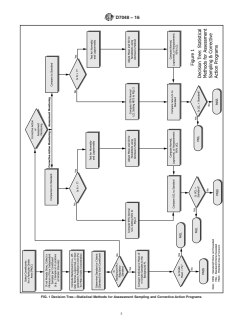
4.1 The guide is summarized as Figs. 1-7. These figures
3.2.9 outlier—a measurement that is statistically inconsis-
provides a flow-chart illustrating the steps used in computing
tent with the distribution of other measurements from which it
the comparisons to regulatory or health based groundwater
was drawn.
protection standard (GWPS) in assessment and corrective
3.2.10 parametric—a term referring to a statistical tech-
action environmental monitoring programs.
nique in which the distribution of the constituent in the
population is assumed to be known.
5. Significance and Use
3.2.11 potential area of concern—areas with a documented
5.1 The principal use of this standard is in assessment,
release or likely presence of a hazardous substance that could
compliance and corrective action environmental monitoring
pose an unacceptable risk to human health or the environment.
programs (for example, for a facility that could potentially
contaminate groundwater). The significance of the guidance is
3.2.12 upperconfidencelimit,UCL—anupperlimitthathas
that it presents a statistical method that allows comparison of
a specified probability (for example, 95%) of including the
groundwater data to regulatory and/or health based limits.
true concentration (or other parameter). Taken together with
the lower confidence limit, the UCL forms a confidence
5.2 Of course, there is considerable support for statistical
intervalthatwillincludethetrueconcentrationwithconfidence
methods applied to detection, assessment and corrective action
level that accounts for both tail areas.
monitoring programs that can be applied to environmental
sites.
3.2.13 upper prediction limit, UPL—a statistical estimate of
the maximum concentration that will not be exceeded by the
NOTE 1—For example, in the United States, the 90% upper confidence
next series of k measurements from that distribution, or the limit (UCL) of the mean is used in USEPA’s SW846 (Chapter 9) for
determining if a waste is hazardous. If the UCL is less than the criterion
meanofmnewmeasurementsforeachofksamplinglocations,
for a particular hazardous waste code, then the waste is not a hazardous
with specified level of confidence (for example, 95%) based
waste even if certain individual measurements exceed the criterion.
on a sample of n background measurements.
Similarly, in the USEPA Statistical Analysis of Groundwater Monitoring
Data at RCRAFacilitiesAddendum to the Interim Final Guidance (1992)
3.3 Symbols: µ=the true population mean of a constituent
(2),confidenceintervalsforthemeanandvariousupperpercentilesofthe
x¯ =the sample-based mean or average concentration of a
distribution are advocated for assessment and corrective action.
constituentcomputedfromnbackgroundmeasurementswhich Interestingly, both the 1989 and 1992 USEPAguidance documents (2, 3)
suggest use of the lower 95% confidence limit (LCL) as a tool for
differs from µ because of sampling variability, and other error
σ =the true population variance of a constituent
s =the sample-based variance of a constituent computed
The boldface numbers in parentheses refer to a list of references at the end of
from n background measurements this standard.
D7048 − 16
FIG. 1 Decision Tree—Statistical Methods for Assessment Sampling and Corrective Action Programs
D7048 − 16
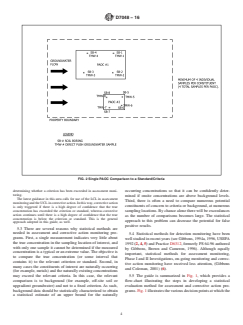
FIG. 2 Single PAOC Comparison to a Standard/Criteria
determining whether a criterion has been exceeded in assessment moni-
occurring concentrations so that it can be confidently deter-
toring.
mined if onsite concentrations are above background levels.
The latest guidance in this area calls for use of the LCL in assessment
Third, there is often a need to compare numerous potential
monitoringandtheUCLincorrectiveaction.Inthisway,correctiveaction
constituents of concern to criteria or background, at numerous
is only triggered if there is a high degree of confidence that the true
concentration has exceeded the criterion or standard, whereas corrective
samplinglocations.Bychancealonetherewillbeexceedances
action continues until there is a high degree of confidence that the true
as the number of comparisons becomes large. The statistical
concentration is below the criterion or standard. This is the general
approach to this problem can decrease the potential for false
approach adopted in this guide, as well.
positive results.
5.3 There are several reasons why statistical methods are
needed in assessment and corrective action monitoring pro-
5.4 Statistical methods for detection monitoring have been
grams. First, a single measurement indicates very little about
wellstudiedinrecentyears(seeGibbons,1994a,1996,USEPA
the true concentration in the sampling location of interest, and
1992 (2, 4, 5)andPracticeD6312,formerlyPS64-96authored
with only one sample it cannot be determined if the measured
by Gibbons, Brown and Cameron, 1996). Although equally
concentration is a typical or an extreme value.The objective is
important, statistical methods for assessment monitoring,
to compare the true concentration (or some interval that
Phase I and II Investigations, on-going monitoring and correc-
contains it) to the relevant criterion or standard. Second, in
tive action monitoring have received less attention, (Gibbons
many cases the constituents of interest are naturally occurring
and Coleman, 2001) (6).
(for example, metals) and the naturally existing concentrations
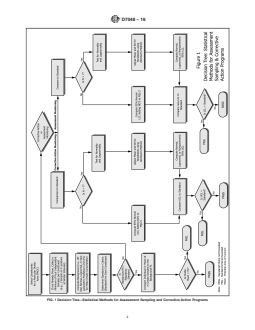
may exceed the relevant criteria. In this case, the relevant 5.5 The guide is summarized in Fig. 1, which provides a
comparison is to background (for example, off-site soil or flow-chart illustrating the steps in developing a statistical
upgradient groundwater) and not to a fixed criterion.As such,
evaluation method for assessment and corrective action pro-
background data should be statistically characterized to obtain
grams.Fig.1illustratesthevariousdecisionpointsatwhichthe
a statistical estimate of an upper bound for the naturally
D7048 − 16
FIG. 3 Multiple PAOC Comparison to a Standard/Criteria
generalcomparativestrategyisselected,andhowthestatistical standard should be selected based on relevant pathways (for
methods are to be selected based on site-specific consider- example, direct contact, ingestion, inhalation) and appropriate
ations. land use criteria (for example, commercial, industrial, residen-
tial).
6. Procedure
6.1.3 For each constituent which may have a background
concentration higher than the relevant health based criterion,
6.1 In the following, the general conceptual and statistical
set“background”totheupper95%confidencepredictionlimit
foundations of the sampling program are described. Following
(UPL) as described in the Technical Details section. The
this general discussion, media-specific details (that is, soil,
groundwater, and waste streams) are provided. prediction limits are computed from available data collected
from background, or outside source areas that are unlikely to
6.1.1 Identify relevant constituents for the specific type of
facility, media (for example, soil and/or groundwater) and area be contaminated, upstream, upwind or upgradient locations
only. Henceforth, background refers to these types of offsite
of interest. A facility is generally comprised of a series of
sources.Thebackgrounddataarefirstscreenedforoutliersand
subunits or “source areas” that may have a distinct set of
then tested for normality and lognormality (see Technical
sampling locations and relevant constituents of concern (re-
Details section).
ferred to as a PAOC). The subunit may consist of a single
6.1.3.1 If the test of normality cannot be rejected (for
samplingpointorcollectionofsamplingpoints.Insomecases,
the entire site may comprise the area of interest and all example,atthe95%confidencelevel),backgroundisequalto
the 95% confidence normal prediction limit.
sampling locations are considered jointly. The boundaries of
the “source area” or “decision unit” should be defined. In most 6.1.3.2 If the test of normality is rejected but the test of
lognormality cannot be rejected, background is equal to the
cases, the owner/operator should select the smallest practical
list of constituents that adequately characterize the source area 95% confidence lognormal prediction limit.
in terms of historical use. 6.1.3.3 If the data are neither normal nor lognormal, or the
6.1.2 For each constituent obtain the appropriate regulatory detection frequency is less than 50%, background is the
criterion or standard (for example, maximum contaminant nonparametric prediction limit. When we are interested in a
level, MCL) if one is available. The appropriate criterion or single potentially impacted measurement, normal, lognormal,
D7048 − 16
FIG. 4 Comparison of Mean Concentrations of Entire Site to a Standard/Criteria
and nonparametric prediction limits are identical with respect samples within a source area. If comparison is to background,
to the parameter being compared (that is, an individual collectoneormoresamplesfromeachsourceareaorsampling
measurement). However, when the comparison to background
location. If comparison is to a criterion (that is, the criterion is
is for an onsite/downgradient mean concentration, they differ
greater than background), and interest is in a single location,
in that the nonparametric prediction limit is for the median
fourormoreindependentsamplesfromeachsamplinglocation
whereastheparametricpredictionlimitsareforthemean.This
will be needed. If the comparison is to a criterion for an entire
limitation is unavoidable, so whenever practical, parametric
source area, one or more samples from each of four sampling
prediction limits should be used. Note that, if the detection
locations within the source area are needed. If there are fewer
frequency is zero, background is set equal to the appropriate
than four sampling locations within a given source area, then
Quantification Limit (QL) for that constituent which is the
thetotalnumberofmeasurementsfromthesourceareamustbe
lowest concentration that can be reliably determined within
four or more (for example, two sampling locations each with
specified limits of precision and accuracy by the indicated
two independent samples). Note that these sample sizes repre-
methods under routine laboratory operating conditions.
sent absolute minimum necessary for the statistical computa-
6.1.3.4 If the background is greater than the relevant crite-
tions. In general, a larger number of samples will be needed to
rion or standard or if there is no criterion or standard, then
obtain a representative sample of the population of interest.
comparisons are made to the background prediction limit. If
6.1.5 Ifcomparisonistoacriterionorstandardtherearetwo
the criterion is greater than background, then compare the
general approaches. In assessment, monitoring where interest
appropriate confidence limit to the criterion. Note that if
is in determining if a criterion has been exceeded, compare the
nothing is detected in background, then the background is the
95% lower confidence limit (LCL) for the mean of four or
QL. If the criterion is lower than the QL, then the criterion is
more samples from a single location, source area or the entire
the QL.
site to the relevant criterion. In corrective action sampling and
6.1.4 The number of samples taken depends on whether
monitoring, where interest is in demonstrating that the onsite
comparison is to background or a criterion and whether
comparisons are made at individual locations or by pooling concentration is lower than the criterion, compare the 95%
D7048 − 16
FIG. 5 Evaluation of Groundwater Concentrations for the Entire Site
upper confidence limit (UCL) for the mean of four or more 6.2.1 Collect soil samples from the surface to the ground-
samples from a single location, source area or the entire site to water table at appropriate intervals in the most likely contami-
the relevant criterion. nated location in the source area and screen soils to determine
6.1.6 If the background prediction limit is larger than the the interval with highest concentration(s).
relevantcriterion,thendooneofthefollowing:(1)forasingle
6.2.2 At three or more other nearby borings located in the
measurement obtained from an individual location, compare
same source area, collect one sample in the same vertical
thisindividualmeasurementtothebackgroundpredictionlimit
interval (geologic profile) as the previously identified highest
for the next single measurement from each of k locations, (2)
concentrationinterval(thatis,thefirst,boringintheintervalof
for multiple measurements obtained from a given source area
highest screening concentration).
ortheentiresite,comparethemeanofthemeasurementstothe
6.2.3 Send the samples from the vertical interval in the four
background prediction limit for the mean of m measurements
borings to the lab for analysis. As in 6.1.5 these intervals and
based on the best fitting statistical distribution or nonparamet-
sample sizes represent a minimum needed for the statistical
ric alternative.
computations and larger numbers will typically be needed in
6.1.7 Note that if the background UPL and the regulatory
practice to provide adequate characterization of the area of
criterion are quite similar, the downgradient mean may exceed
interest.
the background UPL but the LCL for the downgradient mean
6.2.4 Compute the 95% LCL(assessment) or UCL(correc-
may still be less than the regulatory criterion. In this case, an
tive action) for the mean of the m results to determine if the
exceedance is not determined. Fig. 1 presents a decision tree
particular PAOC exceeds the regulatory criterion.
that can be used to step through the statistical analysis
6.2.5 If an exceedance is found, assess whether it is natu-
approach.
rally occurring (for example, metals) by obtaining eight or
6.1.8 Inthefollowingsections,applicationtospecificmedia
more independent background samples (that is, offsite soil
and types of sampling and monitoring programs is described.
samples from the same interval) and compute the 95%
The areas covered include soil, groundwater and waste stream
confidence upper prediction limit (UPL) for the mean of the m
sampling;however,similarapproachescanbetakenforairand
onsite/downgradient samples, and compare the UPL to the
surface water monitoring.
observed mean at each PAOC. An exceedance is determined
6.2 Soils—Evaluation of Individual Source Areas (PAOCs): only if the PAOC mean concentration exceeds both the
D7048 − 16
FIG. 6 Evaluation of Groundwater Data to Determine Compliance with GSI Criteria
regulatory criterion and the background UPL. Figs. 2 and 3 6.3.6 An exceedance is determined only if the area or
illustrate the sampling location approaches for this scenario. site-wide mean concentration exceeds both the regulatory
Eight samples are needed because for fewer, uncertainty in the criterion and the background UPL.
background mean and variance will lead to unacceptably large
6.3.7 If an exceedance is found, it may be practical to
UPLs.
exclude PAOCs one at a time until the Site minus the selected
PAOCs does not exceed criterion. This method may be
6.3 Soils—Area-Wide or Site-Wide Evaluations:
appropriate only when sufficient sampling of the PAOC has
6.3.1 Collect soil samples to be representative of the entire
beenconductedaspartofthesiteorarea-wideevaluation.Fig.
spatial distribution of constituents of concern (four or more
4 illustrates the sampling location approach for this scenario.
samples).
6.3.2 Compute the 95% LCL(assessment) or UCL(correc-
6.4 Groundwater—Aquifer:
tive action) for the mean of the onsite samples and determine
6.4.1 As in the soil sampling above, if soil sampling and
if the area or site as a whole exceeds the regulatory criterion.
screening or prior groundwater monitoring indicates that
6.3.3 Ifanexceedanceisfound,checkthatitisnotnaturally
groundwater may be impacted, then one groundwater sample
occurring by obtaining eight or more independent background
will be obtained in each of four or more borings using a direct
samples (that is, offsite soil samples from the same strati-
push methodology or from existing groundwater monitoring
graphic unit) and compute the 95% confidence UPL.
wells and results will be evaluated statistically to determine if
6.3.4 If the level of hazardous substance concentrations at
the entire PAOC requires additional assessment. The general
the site is relatively homogeneous, co
...
This document is not an ASTM standard and is intended only to provide the user of an ASTM standard an indication of what changes have been made to the previous version. Because
it may not be technically possible to adequately depict all changes accurately, ASTM recommends that users consult prior editions as appropriate. In all cases only the current version
of the standard as published by ASTM is to be considered the official document.
Designation: D7048 − 04 (Reapproved 2010) D7048 − 16
Standard Guide for
Applying Statistical Methods for Assessment and Corrective
Action Environmental Monitoring Programs
This standard is issued under the fixed designation D7048; the number immediately following the designation indicates the year of
original adoption or, in the case of revision, the year of last revision. A number in parentheses indicates the year of last reapproval. A
superscript epsilon (´) indicates an editorial change since the last revision or reapproval.
1. Scope
1.1 The scope and purpose of this guidance is to present a variety of statistical approaches for assessment, compliance and
corrective action environmental monitoring programs. Although the methods provided here are appropriate and often optimal for
many environmental monitoring problems, they do not preclude use of other statistical approaches that may be equally or even
more useful for certain site-specific applications.
1.2 In the following sections, completethe details of select statistical procedures used in assessment and corrective action
programs for environmental monitoring (soil, groundwater, air, surface water, and waste streams) are presented.
1.3 The statistical methodology described in the following sections should be used as guidance. Other methods may also be
appropriate based on site-specific conditions or for monitoring situations or media that are not presented in this document.
1.4 This practice offers an organized collection of information or a series of options and does not recommend a specific course
of action. This document cannot replace education, experience and professional judgements. Not all aspects of this practice may
be applicable in all circumstances. This ASTM standard is not intended to represent or replace the standard of care by which the
adequacy of a given professional service must be judged without consideration of a project’s many unique aspects. The word
Standard in the title of this document only means that the document has been approved through the ASTM consensus process.
1.5 This standard does not purport to address all of the safety concerns, if any, associated with its use. It is the responsibility
of the user of this standard to establish appropriate safety and health practices and determine the applicability of regulatory
requirements prior to use.
2. Referenced Documents
2.1 ASTM Standards:
D653 Terminology Relating to Soil, Rock, and Contained Fluids
D5092 Practice for Design and Installation of Groundwater Monitoring Wells
D5792 Practice for Generation of Environmental Data Related to Waste Management Activities: Development of Data Quality
Objectives
D6250 Practice for Derivation of Decision Point and Confidence Limit for Statistical Testing of Mean Concentration in Waste
Management Decisions
D6312 Guide for Developing Appropriate Statistical Approaches for Groundwater Detection Monitoring Programs
3. Terminology
3.1 Definitions—For definitions of common terms in this guid, see Terminology D653.
3.2 Definitions:Definitions of Terms Specific to This Standard:
3.1.1 assessment monitoring—investigative monitoring that is initiated after the presence of a contaminant has been detected
in groundwater above a relevant criterion at one or more locations. The objective of the program is to determine if there is a
statistical exceedance of a standard or criteria at a Potential Area of Concern (PAOC) or at the groundwater discharging to surface
water interface, and/or to quantify the rate and extent of migration of constituents detected in groundwater above applicable
criteria.
This guide is under the jurisdiction of ASTM Committee D18 on Soil and Rock and is the direct responsibility of Subcommittee D18.21 on Groundwater and Vadose
Zone Investigations.
Current edition approved July 1, 2010Oct. 1, 2016. Published September 2010October 2016. Originally approved in 2004. Last previous edition approved in 20042010
as D7048D7048–04(2010).–04. DOI: 10.1520/D7048-04R10.10.1520/D7048-16.
For referenced ASTM standards, visit the ASTM website, www.astm.org, or contact ASTM Customer Service at service@astm.org. For Annual Book of ASTM Standards
volume information, refer to the standard’s Document Summary page on the ASTM website.
Copyright © ASTM International, 100 Barr Harbor Drive, PO Box C700, West Conshohocken, PA 19428-2959. United States
D7048 − 16
3.1.2 compliance monitoring—as specified under 40 CFR 264.99, compliance monitoring is instituted when hazardous
constituents have been detected above a relevant criterion at the compliance point during RCRA detection monitoring.
Groundwater samples are collected at the compliance point, facility property boundary, and upgradient monitoring wells for
analysis of hazardous constituents to determine if they are leaving the regulated unit at statistically significant concentrations above
background.
3.2.1 corrective action monitoring—under RCRA, RCRA (in the United States), corrective action monitoring is instituted when
hazardous constituents from a RCRA regulated unit have been detected at statistically significant concentrations between the
compliance point and the downgradient facility property boundary as specified under 40 CFR 264.100. Corrective action
monitoring is conducted throughout a corrective action program that is implemented to address groundwater contamination. At
non-RCRA sites, corrective action monitoring is conducted throughout the active period of corrective action to determine the
progress of remediation and to identify statistically significant trends in groundwater contaminant concentrations.
3.1.4 detection limit, DL—the true concentration at which there is a specified level of confidence (for example, 99 % confidence)
that the true concentration is greater than zero.
3.1.5 detection monitoring—a program of monitoring for the express purpose of determining whether or not there has been a
release of a contaminant to groundwater. Under RCRA, Detection Monitoring involves collection of groundwater samples from
compliance point and upgradient monitoring wells on a semi-annual basis for analysis of hazardous constituents of concern, as
specified under 40 CFR 264.98. Results are evaluated to determine if there is a statistically significant exceedance of the
groundwater protection criterion and/or background. At non-RCRA sites, monitoring is conducted in a similar manner and results
are compared to criteria to determine if there is a statistically significant exceedance.
3.1.6 direct push sampling—groundwater sampling conducted with a device that is temporarily pushed into the ground with a
hydraulic system or with a hammer. After groundwater sample collection, the device is removed from the ground. Examples
include Geoprobe®, Hydropunch® direct push, and environmental soil probe.
3.1.7 false negative rate—the rate at which the statistical procedure does not indicate contamination when contamination is
present.
3.2.2 false positive rate—the rate at which the statistical procedure indatesindicates contamination when contamination is not
present.
3.2.3 lognormal distribution—a frequency distribution whose logarithm follows a normal distribution.
3.2.4 lower confidence limit, LCL—a lower limit that has a specified probability (for example, 95 %) of including the true
concentration (or other parameter). Taken together with the upper confidence limit, forms a confidence interval that will include
the true concentration with confidence level that accounts for both tail areas (for example, 90 %).
3.2.5 lower prediction limit, LPL—a statistical estimate of the minimum concentration that will provide a lower bound for the
next series of k measurements from that distribution, or the mean of m new measurements for each of k sampling locations, with
specified level of confidence (for example, 95 %).
3.2.6 nonparametric—a term referring to a statistical technique in which the distribution of the constituent in the population is
unknown and is not restricted to be of a specified form.
3.2.7 nonparametric prediction limit—the largest (or second largest) of n background samples. The confidence level associated
with the nonparametric prediction limit is a function of n,m and k.
3.2.8 normal distribution—a frequency distribution whose plot is a continuous, infinite, bell-shaped curve that is symmetrical
about its arithmetic mean, mode and median (which are numerically equivalent). The normal distribution has two parameters, the
mean and variance.
3.2.9 outlier—a measurement that is statistically inconsistent with the distribution of other measurements from which it was
drawn.
3.2.10 parametric—a term referring to a statistical technique in which the distribution of the constituent in the population is
assumed to be known.
3.1.17 quantification limit, QL—a lower limit on the concentration at which quantitative determinations of an analyte’s
concentration in the sample can be reliably made during routine laboratory operating conditions. The QL is typically described
quantitatively as the true concentration at which the signal to noise ratio of measured concentration or instrument response is 10:1.
The signal to noise ratio is often determined by a percent relative standard deviation of 10 %.
3.2.11 potential area of concern—areas with a documented release or likely presence of a hazardous substance that could pose
an unacceptable risk to human health or the environment.
3.1.19 phase I environmental site assessment—non-intrusive investigation that identifies PAOCs which may require further
investigation in subsequent phases of work.
3.1.20 phase II environmental site assessment, ESI—intrusive survey to confirm or deny existence of a release into the
environment at a PAOC at levels which may adversely impact public health or the environment.
D7048 − 16
3.2.12 upper confidence limit, UCL—an upper limit that has a specified probability (for example, 95 %) of including the true
concentration (or other parameter). Taken together with the lower confidence limit, the UCL forms a confidence interval that will
include the true concentration with confidence level that accounts for both tail areas.
3.2.13 upper prediction limit, UPL—a statistical estimate of the maximum concentration that will not be exceeded by the next
series of k measurements from that distribution, or the mean of m new measurements for each of k sampling locations, with
specified level of confidence (for example, 95 %) based on a sample of n background measurements.
3.3 Symbols: μ = the true population mean of a constituent
x¯x¯ = the sample-based mean or average concentration of a constituent computed from n background measurements which
differs from μ because of sampling variability, and other error
σ = the true population variance of a constituent
s = the sample-based variance of a constituent computed from n background measurements
s = the sample-based standard deviation of a constituent computed from n background measurements
y¯y¯ = the mean of the natural log transformed data (also the natural log of the geometric mean)
s = the standard deviation of the natural log transformed data
y
n = the number of background (offsite or upgradient) measurements
k = the number of future comparisons for a single monitoring event (for example, the number of downgradient monitoring wells
multiplied by the number of constituents to be monitored) for which statistics are to be computed
α = the false positive rate for an individual comparison (that is, one sampling location and constituent)
m = the number of onsite or downgradient measurements used in computing the onsite mean concentration
α* = the site-wide false positive rate covering allthe sampling locations and constituents
t = the 100(1 − α) percentage point of Student’s t-distribution on n − 1 degrees of freedom
H = the factor developed by Land (1971) (1) to obtain the lower 100(α) % confidence limit for the mean of a lognormal
L
distribution
H = the factor developed by Land (1971) (1) to obtain the upper 100(α) % confidence limit for the mean of a lognormal
U
distribution
4. Summary of Guide
4.1 The guide is summarized as Figs. 1-7. These figures provides a flow-chart illustrating the steps used in computing the
comparisons to regulatory or health based groundwater protection standard (GWPS) in assessment and corrective action
environmental monitoring programs.
5. Significance and Use
5.1 The principal use of this standard is in assessment, compliance and corrective action environmental monitoring programs
(for example, for anya facility that could potentially contaminate groundwater). The significance of the guidance is that it presents
a statistical method that allows comparison of groundwater data to regulatory and/or health based limits.
5.2 Of course, there is considerable USEPA support for statistical methods applied to detection, assessment and corrective action
monitoring programs that can be applied to environmental investigations. For example, the 90 % upper confidence limit (UCL) of
the mean is used in SW846 (Chapter 9) for determining if a waste is hazardous. If the UCL is less than the criterion for a particular
hazardous waste code, then the waste is not a hazardous waste even if certain individual measurements exceed the criterion.
Similarly, in the USEPA Statistical Analysis of Groundwater Monitoring Data at RCRA Facilities Addendum to the Interim Final
Guidance (1992) sites. (2), confidence intervals for the mean and various upper percentiles of the distribution are advocated for
assessment and corrective action. Interestingly, both the 1989 and 1992 USEPA guidance documents (2, 3) suggest use of the lower
95 % confidence limit (LCL) as a tool for determining whether a criterion has been exceeded in assessment monitoring. The latest
USEPA guidance in this area (that is, the draft USEPA Unified Statistical Guidance) calls for use of the LCL in assessment
monitoring and the UCL in corrective action. In this way, corrective action is only triggered if there is a high degree of confidence
that the true concentration has exceeded the criterion or standard, whereas corrective action continues until there is a high degree
of confidence that the true concentration is below the criterion or standard. This is the general approach adopted in this guide, as
well.
NOTE 1—For example, in the United States, the 90 % upper confidence limit (UCL) of the mean is used in USEPA’s SW846 (Chapter 9) for determining
if a waste is hazardous. If the UCL is less than the criterion for a particular hazardous waste code, then the waste is not a hazardous waste even if certain
individual measurements exceed the criterion. Similarly, in the USEPA Statistical Analysis of Groundwater Monitoring Data at RCRA Facilities
Addendum to the Interim Final Guidance (1992) (2), confidence intervals for the mean and various upper percentiles of the distribution are advocated
for assessment and corrective action. Interestingly, both the 1989 and 1992 USEPA guidance documents (2, 3) suggest use of the lower 95 % confidence
limit (LCL) as a tool for determining whether a criterion has been exceeded in assessment monitoring.
The latest guidance in this area calls for use of the LCL in assessment monitoring and the UCL in corrective action. In this way, corrective action is
only triggered if there is a high degree of confidence that the true concentration has exceeded the criterion or standard, whereas corrective action continues
The boldface numbers in parentheses refer to a list of references at the end of this standard.
D7048 − 16
FIG. 1 Decision Tree—Statistical Methods for Assessment Sampling and Corrective Action Programs
D7048 − 16
FIG. 2 Single PAOC Comparison to a Standard/Criteria
until there is a high degree of confidence that the true concentration is below the criterion or standard. This is the general approach adopted in this guide,
as well.
5.3 There are several reasons why statistical methods are essentialneeded in assessment and corrective action monitoring
programs. First, a single measurement indicates very little about the true concentration in the sampling location of interest, and
with only one sample there is no way of knowing it cannot be determined if the measured concentration is a typical or an extreme
value. The objective is to compare the true concentration (or some interval that contains it) to the relevant criterion or standard.
Second, in many cases the constituents of interest are naturally occurring (for example, metals) and the naturally existing
concentrations may exceed the relevant criteria. In this case, the relevant comparison is to background (for example, off-site soil
or upgradient groundwater) and not to a fixed criterion. As such, background data mustshould be statistically characterized to
obtain a statistical estimate of an upper bound for the naturally occurring concentrations so that it can be confidently determined
if onsite concentrations are above background levels. Third, there is often a need to compare numerous potential constituents of
concern to criteria or background, at numerous sampling locations. By chance alone there will be exceedances as the number of
comparisons becomes large. The statistical approach to this problem can insure that decrease the potential for false positive results
are minimized.results.
5.4 Statistical methods for detection monitoring have been well studied in recent years (see Gibbons, 1994a, 1996, USEPA 1992
(2, 4, 5) and Practice D6312, formerly PS 64-96 authored by Gibbons, Brown and Cameron, 1996). Although equally important,
statistical methods for assessment monitoring, Phase I and II investigations,Investigations, on-going monitoring and corrective
action monitoring have received less attention, (Gibbons and Coleman, 2001) (6).
5.5 The guide is summarized in Fig. 1, which provides a flow-chart illustrating the steps in developing a statistical evaluation
method for assessment and corrective action programs. Fig. 1 illustrates the various decision points at which the general
comparative strategy is selected, and how the statistical methods are to be selected based on site-specific considerations.
6. Procedure
6.1 In the following, the general conceptual and statistical foundations of the sampling program are described. Following this
general discussion, media-specific details (that is, soil, groundwater, and waste streams) are provided.
D7048 − 16
FIG. 3 Multiple PAOC Comparison to a Standard/Criteria
6.1.1 Identify relevant constituents for the specific type of facility, media (for example, soil, groundwater etc.)soil and/or
groundwater) and area of interest. A facility is generally comprised of a series of subunits or “source areas” that may have a distinct
set of sampling locations and relevant constituents of concern (referred to as a PAOC). The subunit may consist of a single
sampling point or collection of sampling points. In some cases, the entire site may comprise the area of interest and all sampling
locations are considered jointly. The boundaries of the “source area” or “decision unit” should be defined. In allmost cases, the
owner/operator should select the smallest possiblepractical list of constituents that adequately characterize the source area in terms
of historical use.
6.1.2 For each constituent obtain the appropriate regulatory criterion or standard (for example, maximum contaminant level,
MCL) if one is available. The appropriate criterion or standard should be selected based on relevant pathways (for example, direct
contact, ingestion, inhalation) and appropriate land use criteria (for example, commercial, industrial, residential).
6.1.3 For each constituent which may have a background concentration higher than the relevant health based criterion, set
“background” to the upper 95 % confidence prediction limit (UPL) as described in the Technical Details section. The prediction
limits are computed from all available data collected from background, or outside source areas that are unlikely to be contaminated,
upstream, upwind or upgradient locations only. Henceforth, background refers to any of these types of offsite sources. The
background data are first screened for outliers and then tested for normality and lognormality (see Technical Details section).
6.1.3.1 If the test of normality cannot be rejected (for example, at the 95 % confidence level), background is equal to the 95 %
confidence normal prediction limit.
6.1.3.2 If the test of normality is rejected but the test of lognormality cannot be rejected, background is equal to the 95 %
confidence lognormal prediction limit.
6.1.3.3 If the data are neither normal nor lognormal, or the detection frequency is less than 50 %, background is the
nonparametric prediction limit. When we are interested in a single potentially impacted measurement, normal, lognormal, and
nonparametric prediction limits are identical with respect to the parameter being compared (that is, an individual measurement).
However, when the comparison to background is for an onsite/downgradient mean concentration, they differ in that the
nonparametric prediction limit is for the median whereas the parametric prediction limits are for the mean. This limitation is
unavoidable, so whenever possible,practical, parametric prediction limits should be used. Note that, if the detection frequency is
D7048 − 16
FIG. 4 Comparison of Mean Concentrations of Entire Site to a Standard/Criteria
zero, background is set equal to the appropriate Quantification Limit (QL) for that constituent which is the lowest concentration
that can be reliably determined within specified limits of precision and accuracy by the indicated methods under routine laboratory
operating conditions.
6.1.3.4 If the background is greater than the relevant criterion or standard or if there is no criterion or standard, then comparisons
are made to the background prediction limit. If the criterion is greater than background, then compare the appropriate confidence
limit to the criterion. Note that if nothing is detected in background, then the background is the QL. If the criterion is lower than
the QL, then the criterion is the QL.
6.1.4 The number of samples taken depends on whether comparison is to background or a criterion and whether comparisons
are made at individual locations or by pooling samples within a source area. If comparison is to background, collect a minimum
of one sample one or more samples from each source area or sampling location. If comparison is to a criterion (that is, the criterion
is greater than background), and interest is in a single location, a minimum of four four or more independent samples from each
sampling location will be required.needed. If the comparison is to a criterion for an entire source area, a minimum of one sample
one or more samples from each of four sampling locations within the source area are required.needed. If there are fewer than four
sampling locations within a given source area, then the total number of measurements from the source area must be four or more
(for example, two sampling locations each with two independent samples). Note that these sample sizes represent absolute
minimumsminimum necessary for the statistical computations. In general, a larger number of samples will be requiredneeded to
obtain a representative sample of the population of interest.
6.1.5 If comparison is to a criterion or standard there are two general approaches. In assessment, monitoring where interest is
in determining if a criterion has been exceeded, compare the 95 % lower confidence limit (LCL) for the mean of at least fourfour
or more samples from a single location, source area or the entire site to the relevant criterion. In corrective action sampling and
monitoring, where interest is in demonstrating that the onsite concentration is lower than the criterion, compare the 95 % upper
confidence limit (UCL) for the mean of at least fourfour or more samples from a single location, source area or the entire site to
the relevant criterion.
D7048 − 16
FIG. 5 Evaluation of Groundwater Concentrations for the Entire Site
6.1.6 If the background prediction limit is larger than the relevant criterion, then do one of the following: (1) for a single
measurement obtained from an individual location, compare this individual measurement to the background prediction limit for
the next single measurement from each of k locations, (2) for multiple measurements obtained from a given source area or the
entire site, compare the mean of the measurements to the background prediction limit for the mean of m measurements based on
the best fitting statistical distribution or nonparametric alternative.
6.1.7 Note that if the background UPL and the regulatory criterion are quite similar, it may be possible for the downgradient
mean tomay exceed the background UPL but the LCL for the downgradient mean may still be less than the regulatory criterion.
In this case, an exceedance is not determined. Fig. 1 presents a decision tree that can be used to step through the statistical analysis
approach.
6.1.8 In the following sections, application to specific media and types of sampling and monitoring programs is described. The
areas covered include soil, groundwater and waste stream sampling; however, similar approaches can be taken for air and surface
water monitoring.
6.2 Soils—Evaluation of Individual Source Areas (PAOCs):
6.2.1 Collect soil samples from the surface to the groundwater table at appropriate intervals in the most likely contaminated
location in the source area and screen soils to determine the interval with highest concentration(s).
6.2.2 At a minimum of three three or more other nearby borings located in the same source area, collect one sample in the same
vertical interval (geologic profile) as the previously identified highest concentration interval (that is, the first, boring in the interval
of highest screening concentration).
6.2.3 Send the samples from the vertical interval in allthe four borings to the lab for analysis. As in 6.1.5 these intervals and
sample sizes represent a minimum requiredneeded for the statistical computations and larger numbers will typically be
requiredneeded in practice to insureprovide adequate characterization of the area of interest.
6.2.4 Compute the 95 % LCL (assessment) or UCL (corrective action) for the mean of the m results to determine if the particular
PAOC exceeds the regulatory criterion.
6.2.5 If an exceedance is found, assess whether it is naturally occurring (for example, metals) by obtaining a minimum of eight
eight or more independent background samples (that is, offsite soil samples from the same interval) and compute the 95 %
confidence upper prediction limit (UPL) for the mean of the m
...