

ASTM D6312-17
(Guide)Standard Guide for Developing Appropriate Statistical Approaches for Groundwater Detection Monitoring Programs at Waste Disposal Facilities
General Information
- Abstract
SIGNIFICANCE AND USE
5.1 The principal use of this guide is in groundwater detection monitoring of hazardous and municipal solid waste disposal facilities. There is considerable variability in the way in which existing regulation and guidance are interpreted and practiced. Often, much of current practice leads to statistical decision rules that lead to excessive false positive or false negative rates, or both. The significance of this proposed guide is that it jointly minimizes false positive and false negative rates at nominal levels without sacrificing one error for another (while maintaining acceptable statistical power to detect actual impacts to groundwater quality (4)).
5.2 Using this guide, an owner/operator or regulatory agency should be able to develop a statistical detection monitoring program that will not falsely detect contamination when it is absent and will not fail to detect contamination when it is present.
SCOPE
1.1 This guide covers the context of groundwater monitoring at waste disposal facilities. Regulations have required statistical methods as the basis for investigating potential environmental impact due to waste disposal facility operation. Owner/operators must typically perform a statistical analysis on a quarterly or semiannual basis. A statistical test is performed on each of many constituents (for example, 10 to 50 or more) for each of many wells (5 to 100 or more). The result is potentially hundreds, and in some cases, a thousand or more statistical comparisons performed on each monitoring event. Even if the false positive rate for a single test is small (for example, 1 %), the possibility of failing at least one test on any monitoring event is virtually guaranteed. This assumes you have performed the statistics correctly in the first place.
1.2 This guide is intended to assist regulators and industry in developing statistically powerful groundwater monitoring programs for waste disposal facilities. The purpose of this guide is to detect a potential groundwater impact from the facility at the earliest possible time while simultaneously minimizing the probability of falsely concluding that the facility has impacted groundwater when it has not.
1.3 When applied inappropriately, existing regulation and guidance on statistical approaches to groundwater monitoring often suffer from a lack of statistical clarity and often implement methods that will either fail to detect contamination when it is present (a false negative result) or conclude that the facility has impacted groundwater when it has not (a false positive). Historical approaches to this problem have often sacrificed one type of error to maintain control over the other. For example, some regulatory approaches err on the side of conservatism, keeping false negative rates near zero while false positive rates approach 100 %.
1.4 The purpose of this guide is to illustrate a statistical groundwater monitoring strategy that minimizes both false negative and false positive rates without sacrificing one for the other.
1.5 This guide is applicable to statistical aspects of groundwater detection monitoring for hazardous and municipal solid waste disposal facilities.
1.6 It is of critical importance to realize that on the basis of a statistical analysis alone, it can never be concluded that a waste disposal facility has impacted groundwater. A statistically significant exceedance over background levels indicates that the new measurement in a particular monitoring well for a particular constituent is inconsistent with chance expectations based on the available sample of background measurements.
1.7 Similarly, statistical methods can never overcome limitations of a groundwater monitoring network that might arise due to poor site characterization, well installation and location, sampling, or analysis.
1.8 It is noted that when justified, intra-well comparisons are generally preferable to their inter-well counterparts b...
- Status
- Published
- Publication Date
- 31-Dec-2016
- Technical Committee
- D18 - Soil and Rock
- Drafting Committee
- D18.21 - Groundwater and Vadose Zone Investigations
Buy Documents
ASTM D6312-17 - Standard Guide for Developing Appropriate Statistical Approaches for Groundwater Detection Monitoring Programs at Waste Disposal Facilities
REDLINE ASTM D6312-17 - Standard Guide for Developing Appropriate Statistical Approaches for Groundwater Detection Monitoring Programs at Waste Disposal Facilities
Overview
ASTM D6312-17, titled Standard Guide for Developing Appropriate Statistical Approaches for Groundwater Detection Monitoring Programs at Waste Disposal Facilities, provides essential guidance for implementing statistically robust groundwater monitoring at hazardous and municipal solid waste disposal sites. Developed by ASTM Committee D18 on Soil and Rock, this guide focuses on effective detection monitoring to identify changes in groundwater quality due to facility operations, while minimizing both false positive and false negative rates.
As environmental regulations increasingly require statistical methods for groundwater monitoring, ASTM D6312-17 offers practical strategies to ensure that statistical tests accurately reflect true site conditions, thereby supporting regulatory compliance and environmental protection.
Key Topics
Statistical Detection Monitoring
The guide details the development of groundwater detection monitoring programs using sound statistical concepts. The main objective is to design programs that minimize the risk of incorrectly concluding that contamination is present (false positives) or absent (false negatives).Interpreting Regulatory Requirements
Due to variability in regulatory interpretation and current industry practices, ASTM D6312-17 assists facilities and regulators in applying statistical methods consistently and effectively. It addresses the pitfalls of sacrificing one type of error for another and emphasizes balanced error rates.Upgradient vs. Downgradient and Intra-well Comparisons
The guide describes methodologies for comparing water quality data from upgradient (background) and downgradient (potentially impacted) wells, as well as intra-well comparisons, which compare new measurements to historical data from the same well. Intra-well methods can eliminate spatial variability, enhancing sensitivity.Statistical Power and Verification Resampling
The standard outlines approaches to maintain statistical power-ensuring actual impacts are detected-while using verification resampling to confirm outlier results, thereby controlling site-wide false positive and false negative rates.Limitations and Best Practices
Recognizing that statistical analysis alone cannot confirm groundwater impact, the guide stresses the importance of well network design, site characterization, and quality sampling procedures for reliable results.
Applications
Hazardous and Municipal Solid Waste Disposal
The guide is directly applicable to operators and regulators managing monitoring at waste disposal sites, where quarterly or semiannual monitoring and large volumes of data are common.Regulatory Compliance
ASTM D6312-17 is valuable for meeting U.S. EPA and state requirements related to groundwater detection monitoring, helping facilities demonstrate regulatory compliance and environmental due diligence.Design and Evaluation of Monitoring Programs
Environmental consultants, engineers, and regulators can use the guide to develop new statistical monitoring plans or evaluate existing programs to ensure reliability and accuracy in groundwater quality assessments.Reducing Costly Errors
Effective application of the guide minimizes unnecessary resource expenditures due to excessive false alarms, while also protecting against undetected contamination events.
Related Standards
- ASTM D653: Terminology Relating to Soil, Rock, and Contained Fluids
Provides definitions of technical terms used throughout D6312-17. - USEPA Statistical Guidance: Many regulatory requirements draw from or are complemented by EPA guidance for groundwater monitoring at waste facilities.
- Other ASTM Standards: Procedures for groundwater sampling, well installation, and site assessment can be used in conjunction with D6312-17 for comprehensive monitoring.
By following ASTM D6312-17, facilities, consultants, and regulators can develop groundwater detection monitoring programs that are scientifically defensible and capable of balancing error rates. This not only meets regulatory expectations, but also protects environmental and public health by providing early and accurate detection of potential impacts at waste disposal facilities.
Relations
- Effective Date
- 01-Jan-2017
- Effective Date
- 01-Aug-2014
- Effective Date
- 01-Sep-2011
- Effective Date
- 01-Jan-2009
- Effective Date
- 01-Dec-2008
- Effective Date
- 01-Nov-2008
- Effective Date
- 15-Dec-2007
- Effective Date
- 01-Nov-2007
- Effective Date
- 01-Aug-2007
- Effective Date
- 01-Jul-2007
- Effective Date
- 01-May-2007
- Effective Date
- 01-Nov-2006
- Effective Date
- 01-Jul-2005
- Effective Date
- 01-Aug-2004
- Effective Date
- 01-Dec-2003
Buy Documents
ASTM D6312-17 - Standard Guide for Developing Appropriate Statistical Approaches for Groundwater Detection Monitoring Programs at Waste Disposal Facilities
REDLINE ASTM D6312-17 - Standard Guide for Developing Appropriate Statistical Approaches for Groundwater Detection Monitoring Programs at Waste Disposal Facilities
Get Certified
Connect with accredited certification bodies for this standard

CIS Institut d.o.o.
Personal Protective Equipment (PPE) certification body. Notified Body NB-2890 for EU Regulation 2016/425 PPE.

Kiwa BDA Testing
Building and construction product certification.
Kmetijski inštitut Slovenije
Agricultural Institute of Slovenia. Soil testing, plant health, agricultural product analysis.
Sponsored listings
Frequently Asked Questions
ASTM D6312-17 is a guide published by ASTM International. Its full title is "Standard Guide for Developing Appropriate Statistical Approaches for Groundwater Detection Monitoring Programs at Waste Disposal Facilities". This standard covers: SIGNIFICANCE AND USE 5.1 The principal use of this guide is in groundwater detection monitoring of hazardous and municipal solid waste disposal facilities. There is considerable variability in the way in which existing regulation and guidance are interpreted and practiced. Often, much of current practice leads to statistical decision rules that lead to excessive false positive or false negative rates, or both. The significance of this proposed guide is that it jointly minimizes false positive and false negative rates at nominal levels without sacrificing one error for another (while maintaining acceptable statistical power to detect actual impacts to groundwater quality (4)). 5.2 Using this guide, an owner/operator or regulatory agency should be able to develop a statistical detection monitoring program that will not falsely detect contamination when it is absent and will not fail to detect contamination when it is present. SCOPE 1.1 This guide covers the context of groundwater monitoring at waste disposal facilities. Regulations have required statistical methods as the basis for investigating potential environmental impact due to waste disposal facility operation. Owner/operators must typically perform a statistical analysis on a quarterly or semiannual basis. A statistical test is performed on each of many constituents (for example, 10 to 50 or more) for each of many wells (5 to 100 or more). The result is potentially hundreds, and in some cases, a thousand or more statistical comparisons performed on each monitoring event. Even if the false positive rate for a single test is small (for example, 1 %), the possibility of failing at least one test on any monitoring event is virtually guaranteed. This assumes you have performed the statistics correctly in the first place. 1.2 This guide is intended to assist regulators and industry in developing statistically powerful groundwater monitoring programs for waste disposal facilities. The purpose of this guide is to detect a potential groundwater impact from the facility at the earliest possible time while simultaneously minimizing the probability of falsely concluding that the facility has impacted groundwater when it has not. 1.3 When applied inappropriately, existing regulation and guidance on statistical approaches to groundwater monitoring often suffer from a lack of statistical clarity and often implement methods that will either fail to detect contamination when it is present (a false negative result) or conclude that the facility has impacted groundwater when it has not (a false positive). Historical approaches to this problem have often sacrificed one type of error to maintain control over the other. For example, some regulatory approaches err on the side of conservatism, keeping false negative rates near zero while false positive rates approach 100 %. 1.4 The purpose of this guide is to illustrate a statistical groundwater monitoring strategy that minimizes both false negative and false positive rates without sacrificing one for the other. 1.5 This guide is applicable to statistical aspects of groundwater detection monitoring for hazardous and municipal solid waste disposal facilities. 1.6 It is of critical importance to realize that on the basis of a statistical analysis alone, it can never be concluded that a waste disposal facility has impacted groundwater. A statistically significant exceedance over background levels indicates that the new measurement in a particular monitoring well for a particular constituent is inconsistent with chance expectations based on the available sample of background measurements. 1.7 Similarly, statistical methods can never overcome limitations of a groundwater monitoring network that might arise due to poor site characterization, well installation and location, sampling, or analysis. 1.8 It is noted that when justified, intra-well comparisons are generally preferable to their inter-well counterparts b...
SIGNIFICANCE AND USE 5.1 The principal use of this guide is in groundwater detection monitoring of hazardous and municipal solid waste disposal facilities. There is considerable variability in the way in which existing regulation and guidance are interpreted and practiced. Often, much of current practice leads to statistical decision rules that lead to excessive false positive or false negative rates, or both. The significance of this proposed guide is that it jointly minimizes false positive and false negative rates at nominal levels without sacrificing one error for another (while maintaining acceptable statistical power to detect actual impacts to groundwater quality (4)). 5.2 Using this guide, an owner/operator or regulatory agency should be able to develop a statistical detection monitoring program that will not falsely detect contamination when it is absent and will not fail to detect contamination when it is present. SCOPE 1.1 This guide covers the context of groundwater monitoring at waste disposal facilities. Regulations have required statistical methods as the basis for investigating potential environmental impact due to waste disposal facility operation. Owner/operators must typically perform a statistical analysis on a quarterly or semiannual basis. A statistical test is performed on each of many constituents (for example, 10 to 50 or more) for each of many wells (5 to 100 or more). The result is potentially hundreds, and in some cases, a thousand or more statistical comparisons performed on each monitoring event. Even if the false positive rate for a single test is small (for example, 1 %), the possibility of failing at least one test on any monitoring event is virtually guaranteed. This assumes you have performed the statistics correctly in the first place. 1.2 This guide is intended to assist regulators and industry in developing statistically powerful groundwater monitoring programs for waste disposal facilities. The purpose of this guide is to detect a potential groundwater impact from the facility at the earliest possible time while simultaneously minimizing the probability of falsely concluding that the facility has impacted groundwater when it has not. 1.3 When applied inappropriately, existing regulation and guidance on statistical approaches to groundwater monitoring often suffer from a lack of statistical clarity and often implement methods that will either fail to detect contamination when it is present (a false negative result) or conclude that the facility has impacted groundwater when it has not (a false positive). Historical approaches to this problem have often sacrificed one type of error to maintain control over the other. For example, some regulatory approaches err on the side of conservatism, keeping false negative rates near zero while false positive rates approach 100 %. 1.4 The purpose of this guide is to illustrate a statistical groundwater monitoring strategy that minimizes both false negative and false positive rates without sacrificing one for the other. 1.5 This guide is applicable to statistical aspects of groundwater detection monitoring for hazardous and municipal solid waste disposal facilities. 1.6 It is of critical importance to realize that on the basis of a statistical analysis alone, it can never be concluded that a waste disposal facility has impacted groundwater. A statistically significant exceedance over background levels indicates that the new measurement in a particular monitoring well for a particular constituent is inconsistent with chance expectations based on the available sample of background measurements. 1.7 Similarly, statistical methods can never overcome limitations of a groundwater monitoring network that might arise due to poor site characterization, well installation and location, sampling, or analysis. 1.8 It is noted that when justified, intra-well comparisons are generally preferable to their inter-well counterparts b...
ASTM D6312-17 is classified under the following ICS (International Classification for Standards) categories: 13.030.40 - Installations and equipment for waste disposal and treatment. The ICS classification helps identify the subject area and facilitates finding related standards.
ASTM D6312-17 has the following relationships with other standards: It is inter standard links to ASTM D6312-98(2012)e1, ASTM D653-14, ASTM D653-11, ASTM D653-09, ASTM D653-08a, ASTM D653-08, ASTM D653-07f, ASTM D653-07e, ASTM D653-07d, ASTM D653-07c, ASTM D653-07b, ASTM D653-06, ASTM D653-05, ASTM D653-04, ASTM D653-03. Understanding these relationships helps ensure you are using the most current and applicable version of the standard.
ASTM D6312-17 is available in PDF format for immediate download after purchase. The document can be added to your cart and obtained through the secure checkout process. Digital delivery ensures instant access to the complete standard document.
Standards Content (Sample)
This international standard was developed in accordance with internationally recognized principles on standardization established in the Decision on Principles for the
Development of International Standards, Guides and Recommendations issued by the World Trade Organization Technical Barriers to Trade (TBT) Committee.
Designation: D6312 − 17
Standard Guide for
Developing Appropriate Statistical Approaches for
Groundwater Detection Monitoring Programs at Waste
Disposal Facilities
This standard is issued under the fixed designation D6312; the number immediately following the designation indicates the year of
original adoption or, in the case of revision, the year of last revision.Anumber in parentheses indicates the year of last reapproval.A
superscript epsilon (´) indicates an editorial change since the last revision or reapproval.
1. Scope* 1.4 The purpose of this guide is to illustrate a statistical
groundwater monitoring strategy that minimizes both false
1.1 This guide covers the context of groundwater monitor-
negative and false positive rates without sacrificing one for the
ing at waste disposal facilities. Regulations have required
other.
statistical methods as the basis for investigating potential
1.5 This guide is applicable to statistical aspects of ground-
environmental impact due to waste disposal facility operation.
water detection monitoring for hazardous and municipal solid
Owner/operators must typically perform a statistical analysis
waste disposal facilities.
on a quarterly or semiannual basis. A statistical test is per-
formed on each of many constituents (for example, 10 to 50 or
1.6 It is of critical importance to realize that on the basis of
more) for each of many wells (5 to 100 or more). The result is
a statistical analysis alone, it can never be concluded that a
potentially hundreds, and in some cases, a thousand or more
waste disposal facility has impacted groundwater. A statisti-
statistical comparisons performed on each monitoring event.
cally significant exceedance over background levels indicates
Even if the false positive rate for a single test is small (for
that the new measurement in a particular monitoring well for a
example,1%),thepossibilityoffailingatleastonetestonany
particular constituent is inconsistent with chance expectations
monitoring event is virtually guaranteed. This assumes you
based on the available sample of background measurements.
have performed the statistics correctly in the first place.
1.7 Similarly, statistical methods can never overcome limi-
1.2 This guide is intended to assist regulators and industry
tations of a groundwater monitoring network that might arise
in developing statistically powerful groundwater monitoring
duetopoorsitecharacterization,wellinstallationandlocation,
programs for waste disposal facilities. The purpose of this
sampling, or analysis.
guide is to detect a potential groundwater impact from the
1.8 It is noted that when justified, intra-well comparisons
facility at the earliest possible time while simultaneously
aregenerallypreferabletotheirinter-wellcounterpartsbecause
minimizing the probability of falsely concluding that the
they completely eliminate the spatial component of variability.
facility has impacted groundwater when it has not.
Due to the absence of spatial variability, the uncertainty in
1.3 When applied inappropriately, existing regulation and
measured concentrations is decreased, making intra-well com-
guidance on statistical approaches to groundwater monitoring
parisonsmoresensitivetorealreleases(thatis,falsenegatives)
often suffer from a lack of statistical clarity and often imple-
and false positive results due to spatial variability are com-
mentmethodsthatwilleitherfailtodetectcontaminationwhen
pletely eliminated.
itispresent(afalsenegativeresult)orconcludethatthefacility
1.9 Finally, it should be noted that the statistical methods
has impacted groundwater when it has not (a false positive).
described here are not the only valid methods for analysis of
Historicalapproachestothisproblemhaveoftensacrificedone
groundwatermonitoringdata.Theyare,however,currentlythe
type of error to maintain control over the other. For example,
most useful from the perspective of balancing site-wide false
some regulatory approaches err on the side of conservatism,
positive and false negative rates at nominal levels. A more
keepingfalsenegativeratesnearzerowhilefalsepositiverates
complete review of this topic and the associated literature is
approach 100%.
presented by Gibbons (1).
1.10 The values stated in SI units are to be regarded as
standard. No other units of measurement are included in this
ThisguideisunderthejurisdictionofASTMCommitteeD18onSoilandRock
standard.
and is the direct responsibility of Subcommittee D18.21 on Groundwater and
Vadose Zone Investigations.
Current edition approved Jan. 1, 2017. Published January 2017. Originally
ɛ1 2
approved in 1998. Last previous edition approved in 2012 as D6312 – 98 (2012) . The boldface numbers given in parentheses refer to a list of references at the
DOI: 10.1520/D6312-17. end of the text.
*A Summary of Changes section appears at the end of this standard
Copyright © ASTM International, 100 Barr Harbor Drive, PO Box C700, West Conshohocken, PA 19428-2959. United States
D6312 − 17
1.11 This standard does not purport to address all of the 3.2.7 quantification limit (QL), n—the concentration at
safety concerns, if any, associated with its use. It is the which quantitative determinations of an analyte’s concentra-
responsibility of the user of this standard to establish appro- tion in the sample can be reliably made during routine
priate safety and health practices and determine the applica- laboratory operating conditions (3).
bility of regulatory limitations prior to use.
3.3 Definitions of Terms Specific to This Standard:
1.12 This guide offers an organized collection of informa-
3.3.1 false negative rate, n—in detection monitoring, the
tion or a series of options and does not recommend a specific
rateatwhichthestatisticalproceduredoesnotindicatepossible
course of action. This document cannot replace education or
contamination when contamination is present.
experienceandshouldbeusedinconjunctionwithprofessional
3.3.2 falsepositiverate,n—indetectionmonitoring,therate
judgment.Notallaspectsofthisguidemaybeapplicableinall
at which the statistical procedure indicates possible contami-
circumstances. This ASTM standard is not intended to repre-
nation when none is present.
sent or replace the standard of care by which the adequacy of
3.3.3 nonparametric, adj—a term referring to a statistical
a given professional service must be judged, nor should this
technique in which the distribution of the constituent in the
documentbeappliedwithoutconsiderationofaproject’smany
population is unknown and is not restricted to be of a specified
unique aspects. The word “Standard” in the title of this
form.
document means only that the document has been approved
through the ASTM consensus process.
3.3.4 nonparametric prediction limit, n—the largest (or
second largest) of n background samples.The confidence level
2. Referenced Documents
associatedwiththenonparametricpredictionlimitisafunction
2.1 ASTM Standards: of n and k.
D653Terminology Relating to Soil, Rock, and Contained
3.3.5 parametric, adj—a term referring to a statistical tech-
Fluids
nique in which the distribution of the constituent in the
population is assumed to be known.
3. Terminology
3.3.6 prediction interval or limit, n—a statistical estimate of
3.1 Definitions:
the minimum or maximum concentration, or both, that will
3.1.1 Forcommondefinitionsoftermsinthisstandard,refer
containthenextseriesofkmeasurementswithaspecifiedlevel
to Terminology D653.
of confidence (for example, 99% confidence) based on a
3.2 Definitions of Terms Specific to This Standard:Defini-
sample of n background measurements.
tionsofTermsfromD653thatareusedinthisstandardandare
3.3.7 verification resample, n—in the event of an initial
provided for the user.
statistical exceedance, one (or more) new independent sample
3.2.1 assessment monitoring program, n—groundwater
is collected and analyzed for that well and constituent which
monitoring that is intended to determine the nature and extent
exceeded the original limit.
of a potential site impact following a verified statistically
3.4 Symbols:
significant exceedance of the detection monitoring program.
3.4.1 α—thefalsepositiverateforanindividualcomparison
3.2.2 combined Shewhart (CUSUM) control chart, n—a
(that is, one well and constituent).
statisticalmethodforintra-wellcomparisonsthatissensitiveto
3.4.2 α*—thesite-widefalsepositiveratecoveringallwells
both immediate and gradual releases.
and constituents.
3.2.3 detection limit (DL), n—the true concentration at
3.4.3 k—the number of future comparisons for a single
which there is a specified level of confidence (for example,
monitoring event (for example, the number of downgradient
99% confidence) that the analyte is present in the sample (2).
monitoring wells multiplied by the number of constituents to
be monitored) for which statistics are to be computed.
3.2.4 detection monitoring program, n—groundwater moni-
toring that is intended to detect a potential impact from a
3.4.4 n—the number of background measurements.
facility by testing for statistically significant changes in geo-
3.4.5 σ —the true population variance of a constituent.
chemistry in a downgradient monitoring well relative to
3.4.6 s—the sample-based standard deviation of a constitu-
background levels.
ent computed from n background measurements.
3.2.5 intra-well comparisons, n—a comparison of one or
3.4.7 s —the sample-based variance of a constituent com-
more new monitoring measurements to statistics computed
puted from n background measurements.
fromasampleofhistoricalmeasurementsfromthatsamewell.
3.4.8 µ—the true population mean of a constituent.
3.2.6 inter-well comparisons, n—a comparison of a new
3.4.9 x¯—thesample-basedmeanoraverageconcentrationof
monitoring measurement to statistics computed from a sample
a constituent computed from n background measurements.
of background measurements (for example, upgradient versus
downgradient comparisons).
4. Summary of Guide
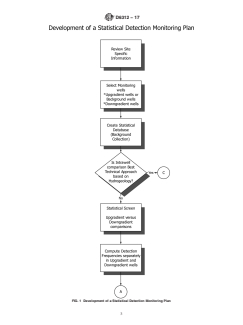
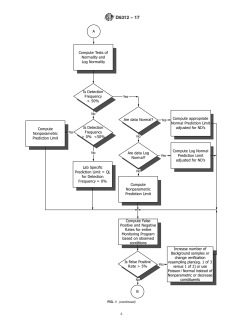
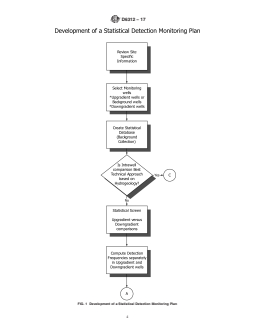
4.1 This guide is summarized in Fig. 1, which provides a
For referenced ASTM standards, visit the ASTM website, www.astm.org, or
flowchart illustrating the steps in developing a statistical
contact ASTM Customer Service at service@astm.org. For Annual Book of ASTM
monitoring plan. The monitoring plan is based either on
Standards volume information, refer to the standard’s Document Summary page on
the ASTM website. background versus monitoring well comparisons (for example,
D6312 − 17
FIG. 1 Development of a Statistical Detection Monitoring Plan
D6312 − 17
FIG. 1 (continued)
D6312 − 17
FIG. 1 (continued)
upgradient versus downgradient comparisons or intra-well comparisons. Note that the background database is intended to
comparisons, or a combination of both). Fig. 1 illustrates the expand as new data become available during the course of
various decision points at which the general comparative monitoring.
strategy is selected (that is, upgradient background versus
5. Significance and Use
intra-well background) and how the statistical methods are to
beselectedbasedonsite-specificconsiderations.Thestatistical 5.1 The principal use of this guide is in groundwater
methods include parametric and nonparametric prediction detection monitoring of hazardous and municipal solid waste
limits for background versus monitoring well comparisons and disposal facilities. There is considerable variability in the way
combined Shewhart-CUSUM control charts for intra-well in which existing regulation and guidance are interpreted and
D6312 − 17
FIG. 1 (continued)
D6312 − 17
FIG. 1 (continued)
D6312 − 17
practiced. Often, much of current practice leads to statistical measurements regardless of the detection frequency and can
decision rules that lead to excessive false positive or false adjust for multiple wells and constituents.
negative rates, or both.The significance of this proposed guide 6.1.1.13 If downgradient wells fail, determine cause.
is that it jointly minimizes false positive and false negative 6.1.1.14 Ifthedowngradientwellsfailbecauseofnaturalor
ratesatnominallevelswithoutsacrificingoneerrorforanother off-site causes, select constituents for intra-well comparisons
(while maintaining acceptable statistical power to detect actual (9).
impacts to groundwater quality (4)). 6.1.1.15 If site impacts are found, a site plan for assessment
monitoring may be necessary (10).
5.2 Using this guide, an owner/operator or regulatory
6.1.2 Intra-well Comparisons:
agency should be able to develop a statistical detection
6.1.2.1 For those facilities that either have no definable
monitoring program that will not falsely detect contamination
hydraulic gradient, have no existing contamination, have too
whenitisabsentandwillnotfailtodetectcontaminationwhen
few background wells to meaningfully characterize spatial
it is present.
variability (for example, a site with one upgradient well or a
facility in which upgradient water quality is either inaccessible
6. Procedure
or not representative of downgradient water quality), compute
NOTE 1—In the following, an overview of the general procedure is
described with specific technical details described in Section 6. intra-well comparisons using combined Shewhart-CUSUM
control charts (9).
6.1 Detection Monitoring:
6.1.2.2 For those wells and constituents that fail upgradient
6.1.1 Upgradient Versus Downgradient Comparisons:
versus downgradient comparisons, compute combined
6.1.1.1 Detection frequency ≥50%.
Shewhart-CUSUM control charts. If no volatile organic com-
6.1.1.2 If the constituent is normally distributed, compute a
pounds (VOCs) or hazardous metals are detected and no trend
normal prediction limit (5) selecting the false positive rate
is detected in other indicator constituents, use intra-well
based on number of wells, constituents, and verification
comparisons for detection monitoring of those wells and
resamples (6)adjustingestimatesofsamplemeanandvariance
constituents.
for nondetects.
6.1.2.3 If data are all non-detects after 13 quarterly sam-
6.1.1.3 If the constituent is lognormally distributed, com-
pling events, use the QL as the nonparametric prediction limit
pute a lognormal prediction limit (7).
(8). Thirteen samples provide a 99% confidence nonparamet-
6.1.1.4 If the constituent is neither normally nor lognor-
ric prediction limit with one resample (1). Note that 99%
mallydistributed,computeanonparametricpredictionlimit (7)
confidence is equivalent to a 1% false positive rate, and
unless background is insufficient to achieve a 5% site-wide
pertains to a single comparison (that is, well and constituent)
false positive rate. In this case, use a normal distribution until
and not the site-wide error rate (that is, all wells and constitu-
sufficient background data are available (7).
ents) that is set to 5%.
6.1.1.5 Ifthebackgrounddetectionfrequencyisgreaterthan
6.1.2.4 If detection frequency is greater than zero (that is,
zero but less than 50%.
the constituent is detected in at least one background sample)
6.1.1.6 Compute a nonparametric prediction limit and de-
but less than 25%, use the nonparametric prediction limit that
termine if the background sample size will provide adequate
is the largest (or second largest) of at least 13 background
protection from false positives.
samples.
6.1.1.7 If insufficient data exist to provide a site-wide false
6.1.2.5 As an alternative to 6.1.2.3 and 6.1.2.4, compute a
positive rate of 5%, more background data must be collected.
Poisson prediction limit following collection of at least four
6.1.1.8 As an alternative to 6.1.1.7 use a Poisson prediction
background samples. Since the mean and variance of the
limit which can be computed from any available set of
Poisson distribution are the same, the Poisson prediction limit
background measurements regardless of the detection fre-
is defined even if there is no variability (for example, even if
quency (see 3.3.4 of Ref (4) ).
the constituent is never detected in background). In this case,
6.1.1.9 If the background detection frequency equals zero,
one half of the quantification limit is used in place of the
use the laboratory-specific QL (recommended) or limits re-
measurements, and the Poisson prediction limit can be com-
quired by applicable regulatory agency (8).
puted directly.
6.1.1.10 This only applies for those wells and constituents
6.1.3 Verification Resampling:
that have at least 13 background samples. Thirteen samples
6.1.3.1 Verification resampling is an integral part of the
providea99%confidencenonparametricpredictionlimitwith
statistical methodology (see Section 5 of Ref (4)). Without
one resample for a single well and constituent (see Table 1).
verificationresampling,muchlargerpredictionlimitswouldbe
6.1.1.11 If less than 13 samples are available, more back-
required to obtain a site-wide false positive rate of 5%. The
ground data must be collected to use the nonparametric
resulting false negative rate would be dramatically increased.
prediction limit.
6.1.3.2 Verification resampling allows sequential applica-
6.1.1.12 AnalternativewouldbetouseaPoissonprediction
tion of a much smaller prediction limit, therefore minimizing
limit that can be computed from four or more background
both false positive and false negative rates.
4 5
Note, if background detection frequency is zero, one should question whether Some examples of inaccessible or nonrepresentative background upgradient
theanalyteisausefulindicatorofcontamination.Ifitisnot,statisticaltestingofthe wellsmayincludeslowmovinggroundwater,radialorconvergentflow,orsitesthat
constituent should not be performed. straddle groundwater divides.
D6312 − 17
TABLE 1 Probability That the First Sample or the Verification Resample Will Be Below the Maximum of n Background Measurements at
Each of k Monitoring Wells for a Single Constituent
Number of Monitoring Wells (k)
Previous
n
1 2 3 4 5 6 7 8 9 10 11 12 13 14 15
4 0.933 0.881 0.838 0.802 0.771 0.744 0.720 0.698 0.679 0.661 0.645 0.630 0.617 0.604 0.592
5 0.952 0.913 0.879 0.849 0.823 0.800 0.779 0.760 0.742 0.726 0.711 0.697 0.684 0.672 0.661
6 0.964 0.933 0.906 0.882 0.860 0.840 0.822 0.805 0.789 0.774 0.761 0.748 0.736 0.725 0.714
7 0.972 0.947 0.925 0.905 0.886 0.869 0.853 0.838 0.825 0.812 0.799 0.788 0.777 0.766 0.757
8 0.978 0.958 0.939 0.922 0.906 0.891 0.878 0.864 0.852 0.841 0.830 0.819 0.809 0.800 0.791
9 0.982 0.965 0.949 0.935 0.921 0.908 0.896 0.885 0.874 0.864 0.854 0.844 0.835 0.827 0.818
10 0.985 0.971 0.957 0.945 0.933 0.922 0.911 0.901 0.891 0.882 0.873 0.865 0.857 0.849 0.841
11 0.987 0.975 0.964 0.953 0.942 0.933 0.923 0.914 0.906 0.897 0.889 0.882 0.874 0.867 0.860
12 0.989 0.979 0.969 0.959 0.950 0.941 0.933 0.925 0.917 0.910 0.902 0.896 0.889 0.882 0.876
13 0.990 0.981 0.973 0.964 0.956 0.948 0.941 0.934 0.927 0.920 0.914 0.907 0.901 0.895 0.889
14 0.992 0.984 0.976 0.969 0.961 0.954 0.948 0.941 0.935 0.929 0.923 0.917 0.912 0.906 0.901
15 0.993 0.986 0.979 0.972 0.966 0.959 0.953 0.947 0.942 0.936 0.931 0.926 0.920 0.915 0.910
16 0.993 0.987 0.981 0.975 0.969 0.964 0.958 0.953 0.948 0.943 0.938 0.933 0.928 0.923 0.919
17 0.994 0.988 0.983 0.978 0.972 0.967 0.962 0.957 0.953 0.948 0.943 0.939 0.935 0.930 0.926
18 0.995 0.990 0.985 0.980 0.975 0.970 0.966 0.961 0.957 0.953 0.949 0.944 0.940 0.937 0.933
19 0.995 0.991 0.986 0.982 0.977 0.973 0.969 0.965 0.961 0.957 0.953 0.949 0.946 0.942 0.938
20 0.996 0.991 0.987 0.983 0.979 0.975 0.972 0.968 0.964 0.960 0.957 0.953 0.950 0.947 0.943
25 0.997 0.994 0.992 0.989 0.986 0.984 0.981 0.978 0.976 0.973 0.971 0.968 0.966 0.964 0.961
30 0.998 0.996 0.994 0.992 0.990 0.988 0.986 0.984 0.983 0.981 0.979 0.977 0.975 0.974 0.972
35 0.998 0.997 0.996 0.994 0.993 0.991 0.990 0.988 0.987 0.986 0.984 0.983 0.981 0.980 0.979
40 0.999 0.998 0.997 0.995 0.994 0.993 0.992 0.991 0.990 0.989 0.988 0.987 0.985 0.984 0.983
45 0.999 0.998 0.997 0.996 0.995 0.995 0.994 0.993 0.992 0.991 0.990 0.989 0.988 0.987 0.987
50 0.999 0.998 0.998 0.997 0.996 0.996 0.995 0.994 0.993 0.993 0.992 0.991 0.990 0.990 0.989
60 0.999 0.999 0.998 0.998 0.997 0.997 0.996 0.996 0.995 0.995 0.994 0.994 0.993 0.993 0.992
70 1.00 0.999 0.999 0.998 0.998 0.998 0.997 0.997 0.997 0.996 0.996 0.995 0.995 0.995 0.994
80 1.00 0.999 0.999 0.999 0.998 0.998 0.998 0.998 0.997 0.997 0.997 0.996 0.996 0.996 0.996
90 1.00 1.00 0.999 0.999 0.999 0.999 0.998 0.998 0.998 0.998 0.997 0.997 0.997 0.997 0.996
100 1.00 1.00 0.999 0.999 0.999 0.999 0.999 0.998 0.998 0.998 0.998 0.998 0.997 0.997 0.997
Previous Number of Monitoring Wells (k)
n 20 25 30 35 40 45 50 55 60 65 70 75 80 90 100
4 0.542 0.504 0.474 0.449 0.428 0.410 0.394 0.380 0.367 0.356 0.345 0.336 0.327 0.312 0.299
5 0.612 0.574 0.543 0.517 0.495 0.476 0.459 0.443 0.430 0.417 0.406 0.396 0.386 0.369 0.355
6 0.668 0.631 0.600 0.574 0.552 0.532 0.514 0.499 0.484 0.472 0.460 0.449 0.439 0.420 0.405
7 0.713 0.678 0.648 0.623 0.600 0.580 0.563 0.547 0.532 0.519 0.507 0.496 0.485 0.466 0.450
8 0.750 0.717 0.688 0.664 0.642 0.622 0.605 0.589 0.574 0.561 0.549 0.537 0.527 0.507 0.490
9 0.781 0.750 0.723 0.699 0.678 0.659 0.642 0.626 0.612 0.598 0.586 0.574 0.564 0.544 0.527
10 0.807 0.777 0.752 0.729 0.709 0.691 0.674 0.659 0.644 0.631 0.619 0.608 0.597 0.578 0.560
11 0.828 0.801 0.777 0.755 0.736 0.718 0.702 0.687 0.674 0.661 0.649 0.638 0.627 0.608 0.590
12 0.847 0.821 0.799 0.778 0.760 0.743 0.727 0.713 0.700 0.687 0.675 0.664 0.654 0.635 0.618
13 0.862 0.839 0.817 0.798 0.781 0.764 0.750 0.736 0.723 0.711 0.699 0.689 0.678 0.660 0.643
14 0.876 0.854 0.834 0.816 0.799 0.784 0.769 0.756 0.744 0.732 0.721 0.710 0.701 0.682 0.666
15 0.888 0.867 0.848 0.831 0.815 0.801 0.787 0.774 0.762 0.751 0.740 0.730 0.721 0.703 0.686
16 0.898 0.879 0.861 0.845 0.830 0.816 0.803 0.791 0.779 0.768 0.758 0.748 0.739 0.722 0.706
17 0.907 0.889 0.872 0.857 0.843 0.830 0.817 0.806 0.794 0.784 0.774 0.765 0.756 0.739 0.723
18 0.914 0.898 0.882 0.868 0.855 0.842 0.830 0.819 0.808 0.798 0.789 0.780 0.771 0.754 0.739
19 0.921 0.906 0.891 0.878 0.865 0.853 0.842 0.831 0.821 0.811 0.802 0.793 0.785 0.769 0.754
20 0.928 0.913 0.899 0.886 0.874 0.863 0.852 0.842 0.832 0.823 0.814 0.806 0.798 0.782 0.768
25 0.950 0.939 0.929 0.919 0.910 0.901 0.892 0.884 0.876 0.869 0.862 0.855 0.848 0.835 0.823
30 0.963 0.955 0.947 0.940 0.932 0.925 0.919 0.912 0.906 0.900 0.894 0.888 0.882 0.872 0.861
35 0.972 0.966 0.959 0.954 0.948 0.942 0.937 0.931 0.926 0.921 0.916 0.911 0.907 0.898 0.889
40 0.978 0.973 0.968 0.963 0.958 0.954 0.949 0.945 0.941 0.936 0.932 0.928 0.924 0.917 0.909
45 0.982 0.978 0.974 0.970 0.966 0.962 0.959 0.955 0.951 0.948 0.944 0.941 0.938 0.931 0.925
50 0.985 0.982 0.979 0.975 0.972 0.969 0.966 0.963 0.959 0.956 0.954 0.951 0.948 0.942 0.937
60 0.990 0.987 0.985 0.982 0.980 0.978 0.975 0.973 0.971 0.968 0.966 0.964 0.962 0.958 0.954
70 0.992 0.990 0.989 0.987 0.985 0.983 0.981 0.980 0.978 0.976 0.974 0.973 0.971 0.968 0.965
80 0.994 0.993 0.991 0.990 0.988 0.987 0.986 0.984 0.983 0.981 0.980 0.979 0.977 0.975 0.972
90 0.995 0.994 0.993 0.992 0.991 0.990 0.988 0.987 0.986 0.985 0.984 0.983 0.982 0.980 0.978
100 0.996 0.995 0.994 0.993 0.992 0.991 0.991 0.990 0.989 0.988 0.987 0.986 0.985 0.983 0.982
6.1.3.3 Astatistically significant exceedance is not declared required to achieve a site-wide false positive rate of 5% than
and should not be reported until the results of the verification forasingleverificationresample;hence,thepreferredmethods
resampleareknown.Theprobabilityofaninitialexceedanceis are pass one verification resample or pass one of two verifica-
much higher than 5% for the site as a whole. tion resamples. Also note that nonparametric limits requiring
6.1.3.4 Notethatintheparametriccaserequiringpassageof passageoftwoverificationresampleswillresultintheneedfor
two verification resamples (for example, in the state of Cali- a larger number of background samples than are typically
fornia regulation) will lead to higher false negative rates (for a available (see 7.3.3.1) (1).
fixed false positive rate) because larger prediction limits are 6.1.4 False Positive and False Negative Rates:
D6312 − 17
6.1.4.1 Conduct simulation study based on current monitor- 7.2 Upgradient Versus Downgradient Comparisons:
ing network, constituents, detection frequencies, and distribu-
7.2.1 Case One—Compounds Quantified in All Background
tional form of each monitoring constituent (seeAppendix B of
Samples:
Ref (4)). The specific objectives of the simulation study are to
7.2.1.1 Test normality of distribution using the multiple
determine if the false positive and false negative rates of the
groupversionoftheShapiro-Wilktestappliedtonbackground
current monitoring program as a whole are acceptable and to
measurements (12).ThemultiplegroupversionoftheShapiro-
determineifchangesinverificationresamplingplansorchoice
Wilk test takes into consideration that background measure-
of nonparametric versus Poisson prediction limits or inter-well
mentsarenestedwithindifferentbackgroundmonitoringwells,
versus intra-well comparison strategies will improve the over-
hence the original Shapiro-Wilk test does not directly apply.
all performance of the detection monitoring program.
NOTE 2—Background wells used for inter-well comparisons may in
6.1.4.2 Project frequency of which verification resamples
some cases include wells that are not hydraulically upgradient of the site.
will be required and false assessments for site as a whole for
7.2.1.2 Alternatively, residuals from the mean of each
each monitoring event based on the results of the simulation
upgradient well can be pooled together and tested using the
study. In this way the owner/operator will be able to anticipate
single group version of the Shapiro-Wilk test (13).
the required amount of future sampling.
6.1.4.3 Asageneralguideline,asite-widefalsepositiverate 7.2.1.3 The need for a multiple group test to incorporate
spatial variability among upgradient wells also raises the
of 5% and a false negative rate of approximately 5% for
differences on the order of three to four standard deviation question of validity of upgradient versus downgradient com-
parisons.Wheresignificantspatialvariabilityexists,itmaynot
units are recommended. Note that USEPA recommends simu-
lating the most conservative case of a release that effects a be possible to obtain a representative upgradient background,
and intra-well comparisons may be required. A one-way
single constituent in a single downgradient well. In practice,
multiple constituents in multiple wells will be impacted, analysis of variance (ANOVA) applied to the upgradient well
data provides a good way of testing for significant spatial
...
This document is not an ASTM standard and is intended only to provide the user of an ASTM standard an indication of what changes have been made to the previous version. Because
it may not be technically possible to adequately depict all changes accurately, ASTM recommends that users consult prior editions as appropriate. In all cases only the current version
of the standard as published by ASTM is to be considered the official document.
´1
Designation: D6312 − 98 (Reapproved 2012) D6312 − 17
Standard Guide for
Developing Appropriate Statistical Approaches for
Groundwater Detection Monitoring Programs at Waste
Disposal Facilities
This standard is issued under the fixed designation D6312; the number immediately following the designation indicates the year of
original adoption or, in the case of revision, the year of last revision. A number in parentheses indicates the year of last reapproval. A
superscript epsilon (´) indicates an editorial change since the last revision or reapproval.
ε NOTE—Editorial changes were made throughout in February 2012.
1. Scope Scope*
1.1 This guide covers the context of groundwater monitoring at waste disposal facilities. Regulations have required statistical
methods as the basis for investigating potential environmental impact due to waste disposal facility operation. Owner/operators
must typically perform a statistical analysis on a quarterly or semiannual basis. A statistical test is performed on each of many
constituents (for example, 10 to 50 or more) for each of many wells (5 to 100 or more). The result is potentially hundreds, and
in some cases, a thousand or more statistical comparisons performed on each monitoring event. Even if the false positive rate for
a single test is small (for example, 1 %), the possibility of failing at least one test on any monitoring event is virtually guaranteed.
This assumes you have doneperformed the correct statisticstatistics correctly in the first place.
1.2 This guide is intended to assist regulators and industry in developing statistically powerful groundwater monitoring
programs for waste disposal facilities. The purpose of this guide is to detect a potential groundwater impact from the facility at
the earliest possible time while simultaneously minimizing the probability of falsely concluding that the facility has impacted
groundwater when it has not.
1.3 When applied inappropriately, existing regulation and guidance on statistical approaches to groundwater monitoring often
suffer from a lack of statistical clarity and often implement methods that will either fail to detect contamination when it is present
(a false negative result) or conclude that the facility has impacted groundwater when it has not (a false positive). Historical
approaches to this problem have often sacrificed one type of error to maintain control over the other. For example, some regulatory
approaches err on the side of conservatism, keeping false negative rates near zero while false positive rates approach 100 %.
1.4 The purpose of this guide is to illustrate a statistical groundwater monitoring strategy that minimizes both false negative and
false positive rates without sacrificing one for the other.
1.5 This guide is applicable to statistical aspects of groundwater detection monitoring for hazardous and municipal solid waste
disposal facilities.
1.6 It is of critical importance to realize that on the basis of a statistical analysis alone, it can never be concluded that a waste
disposal facility has impacted groundwater. A statistically significant exceedance over background levels indicates that the new
measurement in a particular monitoring well for a particular constituent is inconsistent with chance expectations based on the
available sample of background measurements.
1.7 Similarly, statistical methods can never overcome limitations of a groundwater monitoring network that might arise due to
poor site characterization, well installation and location, sampling, or analysis.
1.8 It is noted that when justified, intra-well comparisons are generally preferable to their inter-well counterparts because they
completely eliminate the spatial component of variability. Due to the absence of spatial variability, the uncertainty in measured
concentrations is decreased, making intra-well comparisons more sensitive to real releases (that is, false negatives) and false
positive results due to spatial variability are completely eliminated.
This guide is under the jurisdiction of ASTM Committee D18 on Soil and Rock and is the direct responsibility of Subcommittee D18.21 on Groundwater and Vadose
Zone Investigations.
Current edition approved Feb. 15, 2012Jan. 1, 2017. Published December 2012January 2017. Originally approved in 1998. Last previous edition approved in 20052012
ɛ1
as D6312 – 98 (2005).(2012) . DOI: 10.1520/D6312-98R12E01.10.1520/D6312-17.
*A Summary of Changes section appears at the end of this standard
Copyright © ASTM International, 100 Barr Harbor Drive, PO Box C700, West Conshohocken, PA 19428-2959. United States
D6312 − 17
1.9 Finally, it should be noted that the statistical methods described here are not the only valid methods for analysis of
groundwater monitoring data. They are, however, currently the most useful from the perspective of balancing site-wide false
positive and false negative rates at nominal levels. A more complete review of this topic and the associated literature is presented
by Gibbons (1).
1.10 The values stated in both inch-pound and SI units are to be regarded as the standard. The values given in parentheses are
for information only.standard. No other units of measurement are included in this standard.
1.11 This standard does not purport to address all of the safety concerns, if any, associated with its use. It is the responsibility
of the user of this standard to establish appropriate safety and health practices and determine the applicability of regulatory
limitations prior to use.
1.12 This guide offers an organized collection of information or a series of options and does not recommend a specific course
of action. This document cannot replace education or experience and should be used in conjunction with professional judgment.
Not all aspects of this guide may be applicable in all circumstances. This ASTM standard is not intended to represent or replace
the standard of care by which the adequacy of a given professional service must be judged, nor should this document be applied
without consideration of a project’s many unique aspects. The word “Standard” in the title of this document means only that the
document has been approved through the ASTM consensus process.
2. Referenced Documents
2.1 ASTM Standards:
D653 Terminology Relating to Soil, Rock, and Contained Fluids
3. Terminology
3.1 Definitions:
3.1.1 For definitions of common technical terms in this standard, refer to Terminology D653.
3.1 Definitions:
3.1.1 For common definitions of terms in this standard, refer to Terminology D653.
3.2 Definitions of Terms Specific to This Standard:Definitions of Terms from D653 that are used in this standard and are
provided for the user.
3.2.1 assessment monitoring program, n—groundwater monitoring that is intended to determine the nature and extent of a
potential site impact following a verified statistically significant exceedance of the detection monitoring program.
3.2.2 combined Shewhart (CUSUM) control chart, n—a statistical method for intra-well comparisons that is sensitive to both
immediate and gradual releases.
3.2.3 detection limit (DL), n—the true concentration at which there is a specified level of confidence (for example, 99 %
confidence) that the analyte is present in the sample (2).
3.2.4 detection monitoring program, n—groundwater monitoring that is intended to detect a potential impact from a facility by
testing for statistically significant changes in geochemistry in a downgradient monitoring well relative to background levels.
3.2.5 intra-well comparisons, n—a comparison of one or more new monitoring measurements to statistics computed from a
sample of historical measurements from that same well.
3.2.6 inter-well comparisons, n—a comparison of a new monitoring measurement to statistics computed from a sample of
background measurements (for example, upgradient versus downgradient comparisons).
3.2.7 prediction interval or limit, n—a statistical estimate of the minimum or maximum concentration, or both, that will contain
the next series of k measurements with a specified level of confidence (for example, 99 % confidence) based on a sample of n
background measurements.
3.2.7 quantification limit (QL), n—the concentration at which quantitative determinations of an analyte’s concentration in the
sample can be reliably made during routine laboratory operating conditions (3).
3.3 Definitions of Terms Specific to This Standard:
3.3.1 false negative rate, n—in detection monitoring, the rate at which the statistical procedure does not indicate possible
contamination when contamination is present.
3.3.2 false positive rate, n—in detection monitoring, the rate at which the statistical procedure indicates possible contamination
when none is present.
3.3.3 nonparametric, adj—a term referring to a statistical technique in which the distribution of the constituent in the population
is unknown and is not restricted to be of a specified form.
The boldface numbers given in parentheses refer to a list of references at the end of the text.
For referenced ASTM standards, visit the ASTM website, www.astm.org, or contact ASTM Customer Service at service@astm.org. For Annual Book of ASTM Standards
volume information, refer to the standard’s Document Summary page on the ASTM website.
D6312 − 17
3.3.4 nonparametric prediction limit, n—the largest (or second largest) of n background samples. The confidence level
associated with the nonparametric prediction limit is a function of n and kk. .
3.3.5 parametric, adj—a term referring to a statistical technique in which the distribution of the constituent in the population
is assumed to be known.
3.3.6 prediction interval or limit, n—a statistical estimate of the minimum or maximum concentration, or both, that will contain
the next series of k measurements with a specified level of confidence (for example, 99 % confidence) based on a sample of n
background measurements.
3.3.7 verification resample, n—in the event of an initial statistical exceedance, one (or more) new independent sample is
collected and analyzed for that well and constituent which exceeded the original limit.
3.4 Symbols:
3.4.1 α—the false positive rate for an individual comparison (that is, one well and constituent).
3.4.2 α*—the site-wide false positive rate covering all wells and constituents.
3.4.3 k—the number of future comparisons for a single monitoring event (for example, the number of downgradient monitoring
wells multiplied by the number of constituents to be monitored) for which statistics are to be computed.
3.4.4 n—the number of background measurements.
3.4.5 σ —the true population variance of a constituent.
3.4.6 s—the sample-based standard deviation of a constituent computed from n background measurements.
3.4.7 s —the sample-based variance of a constituent computed from n background measurements.
3.4.8 μ—the true population mean of a constituent.
3.4.9 x¯—the sample-based mean or average concentration of a constituent computed from n background measurements.
4. Summary of Guide
4.1 This guide is summarized in Fig. 1, which provides a flowchart illustrating the steps in developing a statistical monitoring
plan. The monitoring plan is based either on background versus monitoring well comparisons (for example, upgradient versus
downgradient comparisons or intra-well comparisons, or a combination of both). Fig. 1 illustrates the various decision points at
which the general comparative strategy is selected (that is, upgradient background versus intra-well background) and how the
statistical methods are to be selected based on site-specific considerations. The statistical methods include parametric and
nonparametric prediction limits for background versus monitoring well comparisons and combined Shewhart-CUSUM control
charts for intra-well comparisons. Note that the background database is intended to expand as new data become available during
the course of monitoring.
5. Significance and Use
5.1 The principal use of this guide is in groundwater detection monitoring of hazardous and municipal solid waste disposal
facilities. There is considerable variability in the way in which existing Guide USEPA regulation and guidance are interpreted and
practiced. Often, much of current practice leads to statistical decision rules that lead to excessive false positive or false negative
rates, or both. The significance of this proposed guide is that it jointly minimizes false positive and false negative rates at nominal
levels without sacrificing one error for another (while maintaining acceptable statistical power to detect actual impacts to
groundwater quality (4)).
5.2 Using this guide, an owner/operator or regulatory agency should be able to develop a statistical detection monitoring
program that will not falsely detect contamination when it is absent and will not fail to detect contamination when it is present.
6. Procedure
NOTE 1—In the following, an overview of the general procedure is described with specific technical details described in Section 6.
6.1 Detection Monitoring:
6.1.1 Upgradient Versus Downgradient Comparisons:
6.1.1.1 Detection frequency ≥50 %.
6.1.1.2 If the constituent is normally distributed, compute a normal prediction limit (5) selecting the false positive rate based
on number of wells, constituents, and verification resamples (6) adjusting estimates of sample mean and variance for nondetects.
6.1.1.3 If the constituent is lognormally distributed, compute a lognormal prediction limit (7).
6.1.1.4 If the constituent is neither normally nor lognormally distributed, compute a nonparametric prediction limit (7) unless
background is insufficient to achieve a 5 % site-wide false positive rate. In this case, use a normal distribution until sufficient
background data are available (7).
6.1.1.5 If the background detection frequency is greater than zero but less than 50 %.
6.1.1.6 Compute a nonparametric prediction limit and determine if the background sample size will provide adequate protection
from false positives.
6.1.1.7 If insufficient data exist to provide a site-wide false positive rate of 5 %, more background data must be collected.
D6312 − 17
FIG. 1 Development of a Statistical Detection Monitoring Plan
D6312 − 17
FIG. 1 (continued)
D6312 − 17
FIG. 1 (continued)
6.1.1.8 As an alternative to 6.1.1.7 use a Poisson prediction limit which can be computed from any available set of background
measurements regardless of the detection frequency (see 3.3.4 of Ref (4) ).
6.1.1.9 If the background detection frequency equals zero, use the laboratory-specific QL (recommended) or limits required by
applicable regulatory agency (8).
6.1.1.10 This only applies for those wells and constituents that have at least 13 background samples. Thirteen samples provide
a 99 % confidence nonparametric prediction limit with one resample for a single well and constituent (see Table 1).
6.1.1.11 If less than 13 samples are available, more background data must be collected to use the nonparametric prediction limit.
6.1.1.12 An alternative would be to use a Poisson prediction limit that can be computed from four or more background
measurements regardless of the detection frequency and can adjust for multiple wells and constituents.
Note, if background detection frequency is zero, one should question whether the analyte is a useful indicator of contamination. If it is not, statistical testing of the
constituent should not be performed.
D6312 − 17
FIG. 1 (continued)
D6312 − 17
FIG. 1 (continued)
D6312 − 17
TABLE 1 Probability That the First Sample or the Verification Resample Will Be Below the Maximum of n Background Measurements at
Each ofk Monitoring Wells for a Single Constituent
Number of Monitoring Wells (k)
Previous
n
1 2 3 4 5 6 7 8 9 10 11 12 13 14 15
4 0.933 0.881 0.838 0.802 0.771 0.744 0.720 0.698 0.679 0.661 0.645 0.630 0.617 0.604 0.592
5 0.952 0.913 0.879 0.849 0.823 0.800 0.779 0.760 0.742 0.726 0.711 0.697 0.684 0.672 0.661
6 0.964 0.933 0.906 0.882 0.860 0.840 0.822 0.805 0.789 0.774 0.761 0.748 0.736 0.725 0.714
7 0.972 0.947 0.925 0.905 0.886 0.869 0.853 0.838 0.825 0.812 0.799 0.788 0.777 0.766 0.757
8 0.978 0.958 0.939 0.922 0.906 0.891 0.878 0.864 0.852 0.841 0.830 0.819 0.809 0.800 0.791
9 0.982 0.965 0.949 0.935 0.921 0.908 0.896 0.885 0.874 0.864 0.854 0.844 0.835 0.827 0.818
10 0.985 0.971 0.957 0.945 0.933 0.922 0.911 0.901 0.891 0.882 0.873 0.865 0.857 0.849 0.841
11 0.987 0.975 0.964 0.953 0.942 0.933 0.923 0.914 0.906 0.897 0.889 0.882 0.874 0.867 0.860
12 0.989 0.979 0.969 0.959 0.950 0.941 0.933 0.925 0.917 0.910 0.902 0.896 0.889 0.882 0.876
13 0.990 0.981 0.973 0.964 0.956 0.948 0.941 0.934 0.927 0.920 0.914 0.907 0.901 0.895 0.889
14 0.992 0.984 0.976 0.969 0.961 0.954 0.948 0.941 0.935 0.929 0.923 0.917 0.912 0.906 0.901
15 0.993 0.986 0.979 0.972 0.966 0.959 0.953 0.947 0.942 0.936 0.931 0.926 0.920 0.915 0.910
16 0.993 0.987 0.981 0.975 0.969 0.964 0.958 0.953 0.948 0.943 0.938 0.933 0.928 0.923 0.919
17 0.994 0.988 0.983 0.978 0.972 0.967 0.962 0.957 0.953 0.948 0.943 0.939 0.935 0.930 0.926
18 0.995 0.990 0.985 0.980 0.975 0.970 0.966 0.961 0.957 0.953 0.949 0.944 0.940 0.937 0.933
19 0.995 0.991 0.986 0.982 0.977 0.973 0.969 0.965 0.961 0.957 0.953 0.949 0.946 0.942 0.938
20 0.996 0.991 0.987 0.983 0.979 0.975 0.972 0.968 0.964 0.960 0.957 0.953 0.950 0.947 0.943
25 0.997 0.994 0.992 0.989 0.986 0.984 0.981 0.978 0.976 0.973 0.971 0.968 0.966 0.964 0.961
30 0.998 0.996 0.994 0.992 0.990 0.988 0.986 0.984 0.983 0.981 0.979 0.977 0.975 0.974 0.972
35 0.998 0.997 0.996 0.994 0.993 0.991 0.990 0.988 0.987 0.986 0.984 0.983 0.981 0.980 0.979
40 0.999 0.998 0.997 0.995 0.994 0.993 0.992 0.991 0.990 0.989 0.988 0.987 0.985 0.984 0.983
45 0.999 0.998 0.997 0.996 0.995 0.995 0.994 0.993 0.992 0.991 0.990 0.989 0.988 0.987 0.987
50 0.999 0.998 0.998 0.997 0.996 0.996 0.995 0.994 0.993 0.993 0.992 0.991 0.990 0.990 0.989
60 0.999 0.999 0.998 0.998 0.997 0.997 0.996 0.996 0.995 0.995 0.994 0.994 0.993 0.993 0.992
70 1.00 0.999 0.999 0.998 0.998 0.998 0.997 0.997 0.997 0.996 0.996 0.995 0.995 0.995 0.994
80 1.00 0.999 0.999 0.999 0.998 0.998 0.998 0.998 0.997 0.997 0.997 0.996 0.996 0.996 0.996
90 1.00 1.00 0.999 0.999 0.999 0.999 0.998 0.998 0.998 0.998 0.997 0.997 0.997 0.997 0.996
100 1.00 1.00 0.999 0.999 0.999 0.999 0.999 0.998 0.998 0.998 0.998 0.998 0.997 0.997 0.997
Previous Number of Monitoring Wells (k)
n 20 25 30 35 40 45 50 55 60 65 70 75 80 90 100
4 0.542 0.504 0.474 0.449 0.428 0.410 0.394 0.380 0.367 0.356 0.345 0.336 0.327 0.312 0.299
5 0.612 0.574 0.543 0.517 0.495 0.476 0.459 0.443 0.430 0.417 0.406 0.396 0.386 0.369 0.355
6 0.668 0.631 0.600 0.574 0.552 0.532 0.514 0.499 0.484 0.472 0.460 0.449 0.439 0.420 0.405
7 0.713 0.678 0.648 0.623 0.600 0.580 0.563 0.547 0.532 0.519 0.507 0.496 0.485 0.466 0.450
8 0.750 0.717 0.688 0.664 0.642 0.622 0.605 0.589 0.574 0.561 0.549 0.537 0.527 0.507 0.490
9 0.781 0.750 0.723 0.699 0.678 0.659 0.642 0.626 0.612 0.598 0.586 0.574 0.564 0.544 0.527
10 0.807 0.777 0.752 0.729 0.709 0.691 0.674 0.659 0.644 0.631 0.619 0.608 0.597 0.578 0.560
11 0.828 0.801 0.777 0.755 0.736 0.718 0.702 0.687 0.674 0.661 0.649 0.638 0.627 0.608 0.590
12 0.847 0.821 0.799 0.778 0.760 0.743 0.727 0.713 0.700 0.687 0.675 0.664 0.654 0.635 0.618
13 0.862 0.839 0.817 0.798 0.781 0.764 0.750 0.736 0.723 0.711 0.699 0.689 0.678 0.660 0.643
14 0.876 0.854 0.834 0.816 0.799 0.784 0.769 0.756 0.744 0.732 0.721 0.710 0.701 0.682 0.666
15 0.888 0.867 0.848 0.831 0.815 0.801 0.787 0.774 0.762 0.751 0.740 0.730 0.721 0.703 0.686
16 0.898 0.879 0.861 0.845 0.830 0.816 0.803 0.791 0.779 0.768 0.758 0.748 0.739 0.722 0.706
17 0.907 0.889 0.872 0.857 0.843 0.830 0.817 0.806 0.794 0.784 0.774 0.765 0.756 0.739 0.723
18 0.914 0.898 0.882 0.868 0.855 0.842 0.830 0.819 0.808 0.798 0.789 0.780 0.771 0.754 0.739
19 0.921 0.906 0.891 0.878 0.865 0.853 0.842 0.831 0.821 0.811 0.802 0.793 0.785 0.769 0.754
20 0.928 0.913 0.899 0.886 0.874 0.863 0.852 0.842 0.832 0.823 0.814 0.806 0.798 0.782 0.768
25 0.950 0.939 0.929 0.919 0.910 0.901 0.892 0.884 0.876 0.869 0.862 0.855 0.848 0.835 0.823
30 0.963 0.955 0.947 0.940 0.932 0.925 0.919 0.912 0.906 0.900 0.894 0.888 0.882 0.872 0.861
35 0.972 0.966 0.959 0.954 0.948 0.942 0.937 0.931 0.926 0.921 0.916 0.911 0.907 0.898 0.889
40 0.978 0.973 0.968 0.963 0.958 0.954 0.949 0.945 0.941 0.936 0.932 0.928 0.924 0.917 0.909
45 0.982 0.978 0.974 0.970 0.966 0.962 0.959 0.955 0.951 0.948 0.944 0.941 0.938 0.931 0.925
50 0.985 0.982 0.979 0.975 0.972 0.969 0.966 0.963 0.959 0.956 0.954 0.951 0.948 0.942 0.937
60 0.990 0.987 0.985 0.982 0.980 0.978 0.975 0.973 0.971 0.968 0.966 0.964 0.962 0.958 0.954
70 0.992 0.990 0.989 0.987 0.985 0.983 0.981 0.980 0.978 0.976 0.974 0.973 0.971 0.968 0.965
80 0.994 0.993 0.991 0.990 0.988 0.987 0.986 0.984 0.983 0.981 0.980 0.979 0.977 0.975 0.972
90 0.995 0.994 0.993 0.992 0.991 0.990 0.988 0.987 0.986 0.985 0.984 0.983 0.982 0.980 0.978
100 0.996 0.995 0.994 0.993 0.992 0.991 0.991 0.990 0.989 0.988 0.987 0.986 0.985 0.983 0.982
6.1.1.13 If downgradient wells fail, determine cause.
6.1.1.14 If the downgradient wells fail because of natural or off-site causes, select constituents for intra-well comparisons (9).
6.1.1.15 If site impacts are found, a site plan for assessment monitoring may be necessary (10).
6.1.2 Intra-well Comparisons:
D6312 − 17
6.1.2.1 For those facilities that either have no definable hydraulic gradient, have no existing contamination, have too few
background wells to meaningfully characterize spatial variability (for example, a site with one upgradient well or a facility in which
upgradient water quality is either inaccessible or not representative of downgradient water quality), compute intra-well
comparisons using combined Shewhart-CUSUM control charts (9).
6.1.2.2 For those wells and constituents that fail upgradient versus downgradient comparisons, compute combined Shewhart-
CUSUM control charts. If no volatile organic compounds (VOCs) or hazardous metals are detected and no trend is detected in
other indicator constituents, use intra-well comparisons for detection monitoring of those wells and constituents.
6.1.2.3 If data are all non-detects after 13 quarterly sampling events, use the QL as the nonparametric prediction limit (8).
Thirteen samples provide a 99 % confidence nonparametric prediction limit with one resample (1). Note that 99 % confidence is
equivalent to a 1 % false positive rate, and pertains to a single comparison (that is, well and constituent) and not the site-wide error
rate (that is, all wells and constituents) that is set to 5 %.
6.1.2.4 If detection frequency is greater than zero (that is, the constituent is detected in at least one background sample) but less
than 25 %, use the nonparametric prediction limit that is the largest (or second largest) of at least 13 background samples.
6.1.2.5 As an alternative to 6.1.2.3 and 6.1.2.4, compute a Poisson prediction limit following collection of at least four
background samples. Since the mean and variance of the Poisson distribution are the same, the Poisson prediction limit is defined
even if there is no variability (for example, even if the constituent is never detected in background). In this case, one half of the
quantification limit is used in place of the measurements, and the Poisson prediction limit can be computed directly.
6.1.3 Verification Resampling:
6.1.3.1 Verification resampling is an integral part of the statistical methodology (see Section 5 of Ref (4)). Without verification
resampling, much larger prediction limits would be required to obtain a site-wide false positive rate of 5 %. The resulting false
negative rate would be dramatically increased.
6.1.3.2 Verification resampling allows sequential application of a much smaller prediction limit, therefore minimizing both false
positive and false negative rates.
6.1.3.3 A statistically significant exceedance is not declared and should not be reported until the results of the verification
resample are known. The probability of an initial exceedance is much higher than 5 % for the site as a whole.
6.1.3.4 Note that in the parametric case requiring passage of two verification resamples (for example, in the state of California
regulation) will lead to higher false negative rates (for a fixed false positive rate) because larger prediction limits are required to
achieve a site-wide false positive rate of 5 % than for a single verification resample; hence, the preferred methods are pass one
verification resample or pass one of two verification resamples. Also note that nonparametric limits requiring passage of two
verification resamples will result in the need for a larger number of background samples than are typically available (see 7.3.3.1)
(1).
6.1.4 False Positive and False Negative Rates:
6.1.4.1 Conduct simulation study based on current monitoring network, constituents, detection frequencies, and distributional
form of each monitoring constituent (see Appendix B of Ref (4)). The specific objectives of the simulation study are to determine
if the false positive and false negative rates of the current monitoring program as a whole are acceptable and to determine if
changes in verification resampling plans or choice of nonparametric versus Poisson prediction limits or inter-well versus intra-well
comparison strategies will improve the overall performance of the detection monitoring program.
6.1.4.2 Project frequency of which verification resamples will be required and false assessments for site as a whole for each
monitoring event based on the results of the simulation study. In this way the owner/operator will be able to anticipate the required
amount of future sampling.
6.1.4.3 As a general guideline, a site-wide false positive rate of 5 % and a false negative rate of approximately 5 % for
differences on the order of three to four standard deviation units are recommended. Note that USEPA recommends simulating the
most conservative case of a release that effects a single constituent in a single downgradient well. In practice, multiple constituents
in multiple wells will be impacted, therefore, the actual false negative rates may be considerably smaller than estimates obtained
by means of simulation.
6.1.5 Use of DLs and QLs in Groundwater Monitoring:
6.1.5.1 The DLs indicate that the analyte is present in the sample with confidence.
6.1.5.2 The QLs indicate that the true quantitative value of the analyte is close to the measured value.
6.1.5.3 For analytes with estimated concentration exceeding the DL but not the QL, it can be concluded that the true
concentration is greater than zero; however, uncertainty in the instrument response is by definition too large to make a reliable
quantitative determination. Note that in a qualitative sense, values between the DL and QL are greater than values below the DL,
and this rank ordering can be used in a nonparametric method.
6.1.5.4 If the laboratory-specific DL for a given compound is 3μ g/L, and the QL for the same compound is 6 μg/L, then a
detection of that compound at 4 μg/L could actually represent a true concentration of anywhere between 0 and 6 μg/L. The true
concentration may well be less than the DL (1, 2, 11).
Some examples of inaccessible or nonrepresentative background upgradient wells may include slow moving groundwater, radial or convergent flow, or sites that straddle
groundwater divides.
D6312 − 17
6.1.5.5 Direct comparison of a si
...