

ASTM E2651-19
(Guide)Standard Guide for Powder Particle Size Analysis
General Information
- Abstract
SIGNIFICANCE AND USE
4.1 The myriad array of particle size analysis techniques available to the modern-day powder technologist is both daunting and confusing. Many of the techniques are applicable only to certain types of materials, and all have limited ranges of applicability with respect to powder particle size. This guide is an attempt to describe and define the applicability of each of the available techniques, so that powder technologists, and others interested in powders, may make informed and appropriate choices in characterizing their materials.
4.2 This guide is intended to be used to determine the best and most efficient way of characterizing the particle size distribution of a particular powder material. It may also be used to determine whether a reported powder particle size, or size distribution, was obtained in an appropriate and meaningful way.
4.3 Most particle size analysis techniques report particle size in terms of an “equivalent spherical diameter”: the diameter of an ideal spherical particle of the material of interest that would be detected in the same manner during analysis as the (usually irregular-shaped) actual particle under the same conditions. The different techniques must necessarily use different definitions of the equivalent spherical diameter, based on their different operating principles. However, when analyzing elongated particles, the size parameter most relevant to the intended application should be measured; for example, length (maximum dimension).
4.4 Reported particle size measurement is a function of both the actual dimension or shape factor, or both, as well as the particular physical or chemical properties of the particle being measured. Caution is required when comparing data from instruments operating on different physical or chemical parameters or with different particle size measurement ranges. Sample acquisition, handling, and preparation can also affect reported particle size results.
SCOPE
1.1 This guide covers the use of many available techniques for particle size measurement and particle size distribution analysis of solid particulate (powder) materials, off-line in a laboratory. It does not apply to in-line (on-line) analysis, nor to analysis of liquid droplets or liquid aerosols. The guide is intended to serve as a resource for powder/particle technologists in characterizing their materials.
1.2 This guide provides significant detail regarding the numerous particle size analysis methods available. Although this guide is extensive, it may not be all inclusive.
1.3 The principle of operation, range of applicability, specific requirements (if any), and limitations of each of the included particle size analysis techniques are listed and described, so that users of this guide may choose the most useful and most efficient technique for characterizing the particle size distribution of their particular material(s).
1.4 The values stated in SI units are to be regarded as standard. No other units of measurement are included in this standard.
1.5 This standard does not purport to address all of the safety concerns, if any, associated with its use. It is the responsibility of the user of this standard to establish appropriate safety, health, and environmental practices and determine the applicability of regulatory limitations prior to use.
1.6 This international standard was developed in accordance with internationally recognized principles on standardization established in the Decision on Principles for the Development of International Standards, Guides and Recommendations issued by the World Trade Organization Technical Barriers to Trade (TBT) Committee.
- Status
- Published
- Publication Date
- 31-Mar-2019
- Technical Committee
- E29 - Particle and Spray Characterization
- Drafting Committee
- E29.02 - Non-Sieving Methods
Overview
ASTM E2651-19: Standard Guide for Powder Particle Size Analysis provides comprehensive guidance for selecting and applying the most appropriate methods to analyze particle size and size distribution in solid particulate (powder) materials. Issued by ASTM International, this standard serves as an authoritative reference for powder technologists, materials scientists, and quality control professionals working in laboratory settings. The guide addresses the significance of proper technique selection, defines the principle of operations for a broad array of analytical methods, and discusses the critical factors influencing the accuracy and relevance of particle size measurements. ASTM E2651-19 reinforces the importance of careful sampling, dispersion, and data interpretation when characterizing powder materials.
Key Topics
Selection of Particle Size Analysis Techniques
- Detailed description of the working principles, applicability, and limitations of common analytical methods, such as sieving, sedimentation, centrifugal sedimentation, electrical sensing zone, image analysis (static and dynamic), laser diffraction, aerosol electrical mobility, acoustic attenuation, air permeability, and light scattering techniques.
- Provides practical guidance to match each method to specific powder materials and distributions.
Significance of Representative Sampling
- Emphasizes best practices for collecting powder samples, highlighting the necessity of probabilistic sampling and avoiding bias.
Sample Preparation and Dispersion
- Outlines procedures for proper dispersion of powder samples, whether in wet or dry environments, to minimize agglomeration and ensure repeatable results.
Interpretation of Results
- Explains the concept of “equivalent spherical diameter” and the need for caution in comparing results from different techniques or instruments.
- Procedures for reporting and representing particle size data according to ASTM standards.
Understanding Limitations
- Discusses how factors such as particle shape, density, optical/physical properties, and sample heterogeneity can impact measurement accuracy and comparability.
Applications
ASTM E2651-19 is widely relevant across multiple industries where accurate powder characterization is mission-critical, including:
- Pharmaceuticals: Controlling drug solubility and bioavailability through precise particle size distribution.
- Metals and Ceramics: Ensuring consistent sintering and mechanical properties in powder metallurgy and ceramic processing.
- Additive Manufacturing: Managing feedstock properties for optimal process performance and final product characteristics.
- Food Technology: Ensuring mouthfeel, solubility, and stability of powdered ingredients.
- Cosmetics and Pigments: Controlling the texture, coverage, and dispersibility of powders in formulations.
- Chemical Processing: Optimizing reaction rates, blending, and product uniformity.
By adhering to ASTM E2651-19, organizations can make informed decisions on method selection, ensure their results are meaningful and comparable, and uphold regulatory and customer requirements for powder quality.
Related Standards
ASTM E2651-19 references and complements a number of other ASTM standards that provide further detail on specific aspects of powder particle size analysis:
- ASTM B215 - Practices for Sampling Metal Powders
- ASTM B330 - Test Methods for Estimating Average Particle Size of Metal Powders
- ASTM B821 - Guide for Liquid Dispersion of Metal Powders for Particle Size Analysis
- ASTM B859 - Practice for De-Agglomeration Prior to Particle Size Analysis
- ASTM E11 - Specification for Woven Wire Test Sieve Cloth and Test Sieves
- ASTM E1617 - Practice for Reporting Particle Size Characterization Data
- ASTM E1638 - Terminology Relating to Sieves and Sieving Methods
- ASTM E1919 - Guide for Worldwide Published Standards Relating to Particle and Spray Characterization
- ASTM E2589 - Terminology Relating to Nonsieving Methods of Powder Characterization
For organizations focused on powder characterization and particle size distribution analysis, familiarization with ASTM E2651-19 and its related standards is crucial for achieving reliable, reproducible, and regulatory-compliant results.
Keywords: ASTM E2651-19, powder particle size analysis, particle size distribution, powder characterization, particle analysis techniques, laboratory standards, sampling, dispersion, laser diffraction, sedimentation, image analysis, material characterization.
Relations
- Effective Date
- 01-Apr-2019
- Effective Date
- 01-Feb-2024
- Refers
ASTM E2589-23a - Standard Terminology Relating to Nonsieving Methods of Powder Characterization - Effective Date
- 01-Sep-2023
- Effective Date
- 01-Apr-2019
- Effective Date
- 01-Dec-2014
- Effective Date
- 01-Apr-2014
- Effective Date
- 01-Oct-2013
- Effective Date
- 01-Oct-2013
- Effective Date
- 01-Jun-2013
- Effective Date
- 01-Nov-2012
- Effective Date
- 15-May-2012
- Effective Date
- 01-Apr-2012
- Refers
ASTM E1638-11a - Standard Terminology Relating to Sieves, Sieving Methods, and Screening Media - Effective Date
- 15-Nov-2011
- Effective Date
- 01-May-2011
- Refers
ASTM E2589-11 - Standard Terminology Relating to Nonsieving Methods of Powder Characterization - Effective Date
- 01-Apr-2011
Get Certified
Connect with accredited certification bodies for this standard

IMP NDT d.o.o.
Non-destructive testing services. Radiography, ultrasonic, magnetic particle, penetrant, visual inspection.
Inštitut za kovinske materiale in tehnologije
Institute of Metals and Technology. Materials testing, metallurgical analysis, NDT.
Q Techna d.o.o.
NDT and quality assurance specialist. 30+ years experience. NDT personnel certification per ISO 9712, nuclear and thermal power plant inspections, QA/
Sponsored listings
Frequently Asked Questions
ASTM E2651-19 is a guide published by ASTM International. Its full title is "Standard Guide for Powder Particle Size Analysis". This standard covers: SIGNIFICANCE AND USE 4.1 The myriad array of particle size analysis techniques available to the modern-day powder technologist is both daunting and confusing. Many of the techniques are applicable only to certain types of materials, and all have limited ranges of applicability with respect to powder particle size. This guide is an attempt to describe and define the applicability of each of the available techniques, so that powder technologists, and others interested in powders, may make informed and appropriate choices in characterizing their materials. 4.2 This guide is intended to be used to determine the best and most efficient way of characterizing the particle size distribution of a particular powder material. It may also be used to determine whether a reported powder particle size, or size distribution, was obtained in an appropriate and meaningful way. 4.3 Most particle size analysis techniques report particle size in terms of an “equivalent spherical diameter”: the diameter of an ideal spherical particle of the material of interest that would be detected in the same manner during analysis as the (usually irregular-shaped) actual particle under the same conditions. The different techniques must necessarily use different definitions of the equivalent spherical diameter, based on their different operating principles. However, when analyzing elongated particles, the size parameter most relevant to the intended application should be measured; for example, length (maximum dimension). 4.4 Reported particle size measurement is a function of both the actual dimension or shape factor, or both, as well as the particular physical or chemical properties of the particle being measured. Caution is required when comparing data from instruments operating on different physical or chemical parameters or with different particle size measurement ranges. Sample acquisition, handling, and preparation can also affect reported particle size results. SCOPE 1.1 This guide covers the use of many available techniques for particle size measurement and particle size distribution analysis of solid particulate (powder) materials, off-line in a laboratory. It does not apply to in-line (on-line) analysis, nor to analysis of liquid droplets or liquid aerosols. The guide is intended to serve as a resource for powder/particle technologists in characterizing their materials. 1.2 This guide provides significant detail regarding the numerous particle size analysis methods available. Although this guide is extensive, it may not be all inclusive. 1.3 The principle of operation, range of applicability, specific requirements (if any), and limitations of each of the included particle size analysis techniques are listed and described, so that users of this guide may choose the most useful and most efficient technique for characterizing the particle size distribution of their particular material(s). 1.4 The values stated in SI units are to be regarded as standard. No other units of measurement are included in this standard. 1.5 This standard does not purport to address all of the safety concerns, if any, associated with its use. It is the responsibility of the user of this standard to establish appropriate safety, health, and environmental practices and determine the applicability of regulatory limitations prior to use. 1.6 This international standard was developed in accordance with internationally recognized principles on standardization established in the Decision on Principles for the Development of International Standards, Guides and Recommendations issued by the World Trade Organization Technical Barriers to Trade (TBT) Committee.
SIGNIFICANCE AND USE 4.1 The myriad array of particle size analysis techniques available to the modern-day powder technologist is both daunting and confusing. Many of the techniques are applicable only to certain types of materials, and all have limited ranges of applicability with respect to powder particle size. This guide is an attempt to describe and define the applicability of each of the available techniques, so that powder technologists, and others interested in powders, may make informed and appropriate choices in characterizing their materials. 4.2 This guide is intended to be used to determine the best and most efficient way of characterizing the particle size distribution of a particular powder material. It may also be used to determine whether a reported powder particle size, or size distribution, was obtained in an appropriate and meaningful way. 4.3 Most particle size analysis techniques report particle size in terms of an “equivalent spherical diameter”: the diameter of an ideal spherical particle of the material of interest that would be detected in the same manner during analysis as the (usually irregular-shaped) actual particle under the same conditions. The different techniques must necessarily use different definitions of the equivalent spherical diameter, based on their different operating principles. However, when analyzing elongated particles, the size parameter most relevant to the intended application should be measured; for example, length (maximum dimension). 4.4 Reported particle size measurement is a function of both the actual dimension or shape factor, or both, as well as the particular physical or chemical properties of the particle being measured. Caution is required when comparing data from instruments operating on different physical or chemical parameters or with different particle size measurement ranges. Sample acquisition, handling, and preparation can also affect reported particle size results. SCOPE 1.1 This guide covers the use of many available techniques for particle size measurement and particle size distribution analysis of solid particulate (powder) materials, off-line in a laboratory. It does not apply to in-line (on-line) analysis, nor to analysis of liquid droplets or liquid aerosols. The guide is intended to serve as a resource for powder/particle technologists in characterizing their materials. 1.2 This guide provides significant detail regarding the numerous particle size analysis methods available. Although this guide is extensive, it may not be all inclusive. 1.3 The principle of operation, range of applicability, specific requirements (if any), and limitations of each of the included particle size analysis techniques are listed and described, so that users of this guide may choose the most useful and most efficient technique for characterizing the particle size distribution of their particular material(s). 1.4 The values stated in SI units are to be regarded as standard. No other units of measurement are included in this standard. 1.5 This standard does not purport to address all of the safety concerns, if any, associated with its use. It is the responsibility of the user of this standard to establish appropriate safety, health, and environmental practices and determine the applicability of regulatory limitations prior to use. 1.6 This international standard was developed in accordance with internationally recognized principles on standardization established in the Decision on Principles for the Development of International Standards, Guides and Recommendations issued by the World Trade Organization Technical Barriers to Trade (TBT) Committee.
ASTM E2651-19 is classified under the following ICS (International Classification for Standards) categories: 19.120 - Particle size analysis. Sieving. The ICS classification helps identify the subject area and facilitates finding related standards.
ASTM E2651-19 has the following relationships with other standards: It is inter standard links to ASTM E2651-13, ASTM E1617-09(2024), ASTM E2589-23a, ASTM E1617-09(2019), ASTM C322-09(2014), ASTM E1617-09(2014)e1, ASTM E11-13, ASTM B859-13, ASTM E1638-13, ASTM B330-12, ASTM E1638-12, ASTM E161-12, ASTM E1638-11a, ASTM E1638-11, ASTM E2589-11. Understanding these relationships helps ensure you are using the most current and applicable version of the standard.
ASTM E2651-19 is available in PDF format for immediate download after purchase. The document can be added to your cart and obtained through the secure checkout process. Digital delivery ensures instant access to the complete standard document.
Standards Content (Sample)
This international standard was developed in accordance with internationally recognized principles on standardization established in the Decision on Principles for the
Development of International Standards, Guides and Recommendations issued by the World Trade Organization Technical Barriers to Trade (TBT) Committee.
Designation: E2651 − 19
Standard Guide for
Powder Particle Size Analysis
This standard is issued under the fixed designation E2651; the number immediately following the designation indicates the year of
original adoption or, in the case of revision, the year of last revision.Anumber in parentheses indicates the year of last reapproval.A
superscript epsilon (´) indicates an editorial change since the last revision or reapproval.
1. Scope* 2. Referenced Documents
2.1 ASTM Standards:
1.1 This guide covers the use of many available techniques
B215Practices for Sampling Metal Powders
for particle size measurement and particle size distribution
B330Test Methods for Estimating Average Particle Size of
analysis of solid particulate (powder) materials, off-line in a
Metal Powders and Related Compounds Using Air Per-
laboratory.Itdoesnotapplytoin-line(on-line)analysis,norto
meability
analysis of liquid droplets or liquid aerosols. The guide is
B821Guide for Liquid Dispersion of Metal Powders and
intended to serve as a resource for powder/particle technolo-
Related Compounds for Particle Size Analysis
gists in characterizing their materials.
B859Practice for De-Agglomeration of Refractory Metal
1.2 This guide provides significant detail regarding the
Powders and Their Compounds Prior to Particle Size
numerous particle size analysis methods available. Although
Analysis
this guide is extensive, it may not be all inclusive.
C322Practice for Sampling Ceramic Whiteware Clays
1.3 The principle of operation, range of applicability, spe-
E11Specification forWovenWireTest Sieve Cloth andTest
cific requirements (if any), and limitations of each of the Sieves
included particle size analysis techniques are listed and
E161Specification for Electroformed Material and Test
described, so that users of this guide may choose the most Sieves
useful and most efficient technique for characterizing the
E1617Practice for Reporting Particle Size Characterization
particle size distribution of their particular material(s). Data
E1638Terminology Relating to Sieves, Sieving Methods,
1.4 The values stated in SI units are to be regarded as
and Screening Media
standard. No other units of measurement are included in this
E2589Terminology Relating to Nonsieving Methods of
standard.
Powder Characterization
1.5 This standard does not purport to address all of the
3. Terminology
safety concerns, if any, associated with its use. It is the
responsibility of the user of this standard to establish appro-
3.1 Definitions:
priate safety, health, and environmental practices and deter-
3.1.1 For definitions of terms used in this guide, refer to
mine the applicability of regulatory limitations prior to use.
Terminologies E1638 and E2589.
1.6 This international standard was developed in accor-
3.2 Definitions of Terms Specific to This Standard:
dance with internationally recognized principles on standard-
3.2.1 powder, n—a collection of solid particles that are
ization established in the Decision on Principles for the
usually less than 1000µm (1mm) in size.
Development of International Standards, Guides and Recom-
mendations issued by the World Trade Organization Technical
4. Significance and Use
Barriers to Trade (TBT) Committee.
4.1 The myriad array of particle size analysis techniques
available to the modern-day powder technologist is both
dauntingandconfusing.Manyofthetechniquesareapplicable
This guide is under the jurisdiction of ASTM Committee E29 on Particle and
Spray Characterization and is the direct responsibility of Subcommittee E29.02 on
Non-Sieving Methods. For referenced ASTM standards, visit the ASTM website, www.astm.org, or
Current edition approved April 1, 2019. Published April 2019. Originally contact ASTM Customer Service at service@astm.org. For Annual Book of ASTM
approved in 2008. Last previous edition approved in 2013 as E2651–13. DOI: Standards volume information, refer to the standard’s Document Summary page on
10.1520/E2651-19. the ASTM website.
*A Summary of Changes section appears at the end of this standard
Copyright © ASTM International, 100 Barr Harbor Drive, PO Box C700, West Conshohocken, PA 19428-2959. United States
E2651 − 19
only to certain types of materials, and all have limited ranges every increment of the powder must have some probability of
ofapplicabilitywithrespecttopowderparticlesize.Thisguide being selected in the sampling process.The sampling must not
isanattempttodescribeanddefinetheapplicabilityofeachof only be probabilistic, it must also be correct. That means that
the available techniques, so that powder technologists, and every sample increment must have an equal probability of
others interested in powders, may make informed and appro- being chosen. No method of sampling can guarantee a repre-
priate choices in characterizing their materials. sentative sample, but adherence to certain “Golden Rules of
Sampling” (1) will satisfy these two conditions and ensure a
4.2 This guide is intended to be used to determine the best
sample as close to representative as possible. These rules are:
and most efficient way of characterizing the particle size
6.1.1 Always sample a powder in motion (for example,
distributionofaparticularpowdermaterial.Itmayalsobeused
pouring from a blender, or off the end of a conveyor).
to determine whether a reported powder particle size, or size
6.1.2 Takesmallportionsformanyshortincrementsoftime
distribution, was obtained in an appropriate and meaningful
from the whole stream of powder.
way.
6.1.3 Never scoop a sample from a heap or container of
4.3 Most particle size analysis techniques report particle
powder.
size in terms of an “equivalent spherical diameter”: the
6.2 The preferred method of sampling is to use a spinning
diameterofanidealsphericalparticleofthematerialofinterest
(rotary) riffler; however, this is not always possible. Devices
that would be detected in the same manner during analysis as
that adhere to these rules, such as chute rifflers, spinning
the (usually irregular-shaped) actual particle under the same
rifflers, and stream samplers, are available commercially.
conditions. The different techniques must necessarily use
Examples of good powder sampling practices may be found in
differentdefinitionsoftheequivalentsphericaldiameter,based
Practices B215 and C322.
on their different operating principles. However, when analyz-
ing elongated particles, the size parameter most relevant to the
7. Dispersion
intended application should be measured; for example, length
7.1 Themethodofpowderdispersionhasasignificanteffect
(maximum dimension).
on the results of a particle size distribution analysis. The
4.4 Reportedparticlesizemeasurementisafunctionofboth
analysis will show a too-coarse, unstable, or non-repeatable
the actual dimension or shape factor, or both, as well as the
distributionifthepowderhasnotbeendispersedadequately.It
particular physical or chemical properties of the particle being
is therefore important that parties wishing to compare their
measured. Caution is required when comparing data from
analyses use the same dispersion technique.
instrumentsoperatingondifferentphysicalorchemicalparam-
7.2 Many particle size analysis instruments are capable of,
eters or with different particle size measurement ranges.
orrequire,dispersingpowdersinaliquidmedium.GuideB821
Sample acquisition, handling, and preparation can also affect
containsrecommendedliquiddispersionproceduresforcertain
reported particle size results.
metal powders and related compounds. That guide also con-
5. Reagents
tains general procedures for dispersing powders in liquids, and
assessing dispersion. Those general procedures are repeated
5.1 Purity of Reagents—Reagentgradechemicalsshouldbe
here:
used in all tests. Unless otherwise indicated, it is intended that
all reagents should conform to the specifications of the
7.3 The general procedure for determining and achieving
Committee onAnalytical Reagents of theAmerican Chemical
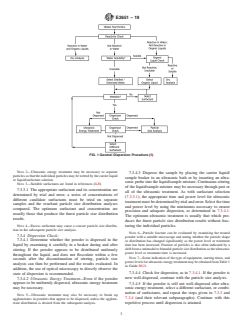
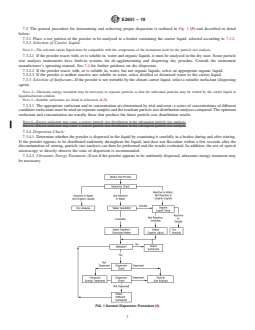
proper dispersion is outlined in Fig. 1 (5) and described in
Society. Other grades may be used, provided it is first
detail below:
ascertained that the reagent is of sufficiently high purity to
7.3.1 Place a test portion of the powder to be analyzed in a
permit its use without lessening the accuracy of the determi-
beaker containing the carrier liquid, selected according to
nation.
7.3.2.
7.3.2 Selection of Carrier Liquid:
5.2 Surfactants—Suitablesurfactantsarelistedinreferences
(1-3).
NOTE 1—The selected carrier liquid must be compatible with the
components of the instrument used for the particle size analysis.
6. Sampling
7.3.2.1 If the powder reacts with, or is soluble in, water and
6.1 The first step in performing a powder particle size
organic liquids, it must be analyzed in the dry state. Some
analysisisobtainingasampleofthepowderthatisintendedto
particle size analysis instruments have built-in systems for
be representative of the entire amount. There are two condi-
de-agglomerating and dispersing dry powders. Consult the
tions necessary for obtaining an accurate sample of a powder
instrument manufacturer’s operating manual. See 7.4 for fur-
(4):The first is that the sampling must be probabilistic; that is,
ther guidance on dry dispersion.
7.3.2.2 Ifthepowderreactswith,orissolublein,water,but
3 not organic liquids, select an appropriate organic liquid.
Reagent Chemicals, American Chemical Society Specifications, American
7.3.2.3 Ifthepowderisneitherreactivenorsolubleinwater,
Chemical Society, Washington, DC, www.chemistry.org. For suggestions on the
testing of reagents not listed by the American Chemical Society, see the United
select distilled or deionized water as the carrier liquid.
States Pharmacopeia and National Formulary, U.S. Pharmacopeial Convention,
7.3.3 Selection of Surfactant—If the powder is not wettable
Inc. (USPC), Rockville, MD, http://www.usp.org.
by the chosen carrier liquid, select a suitable surfactant
Theboldfacenumbersinparenthesesrefertothelistofreferencesattheendof
this standard. (dispersing agent).
E2651 − 19
FIG. 1 General Dispersion Procedure (5)
NOTE 2—Ultrasonic energy treatment may be necessary to separate
7.3.4.3 Disperse the sample by placing the carrier liquid/
particlessothattheindividualparticlesmaybewettedbythecarrierliquid
sample beaker in an ultrasonic bath or by inserting an ultra-
or liquid/surfactant solution.
sonicprobeintotheliquid/samplemixture.Continuousstirring
NOTE 3—Suitable surfactants are listed in references (1-3).
of the liquid/sample mixture may be necessary through part or
7.3.3.1 The appropriate surfactant and its concentration are
all of the ultrasonic treatment. As with surfactant selection
determined by trial and error; a series of concentrations of
(7.3.3.1), the appropriate time and power level for ultrasonic
different candidate surfactants must be tried on separate
treatmentmustbedeterminedbytrialanderror.Selectthetime
samples and the resultant particle size distribution analyses
and power level by using the minimums necessary to ensure
compared. The optimum surfactant and concentration are
precision and adequate dispersion, as determined in 7.3.4.1.
usually those that produce the finest particle size distribution
The optimum ultrasonic treatment is usually that which pro-
results.
duces the finest particle size distribution results without frac-
NOTE 4—Excess surfactant may cause a coarser particle size distribu- turing the individual particles.
tion in the subsequent particle size analysis.
NOTE 6—Particle fracture can be evaluated by examining the treated
7.3.4 Dispersion Check:
powder with a suitable microscope and noting whether the particle shape
7.3.4.1 Determine whether the powder is dispersed in the
or distribution has changed significantly as the power level or treatment
liquid by examining it carefully in a beaker during and after
time has been increased. Fracture of particles is also often indicated by a
shiftfromaunimodaltobimodalparticlesizedistributionastheultrasonic
stirring. If the powder appears to be distributed uniformly
power level or treatment time is increased.
throughout the liquid, and does not flocculate within a few
NOTE 7—Some indication of the type of equipment, starting times, and
seconds after the discontinuation of stirring, particle size
powerlevelsforultrasonicenergytreatmentmaybeobtainedfromTable1
analysis can then be performed and the results evaluated. In
in Guide B821.
addition, the use of optical microscopy to directly observe the
7.3.4.4 Check for dispersion, as in 7.3.4.1. If the powder is
state of dispersion is recommended.
now well-dispersed, continue with the particle size analysis.
7.3.4.2 Ultrasonic Energy Treatment—Even if the powder
appears to be uniformly dispersed, ultrasonic energy treatment
7.3.4.5 If the powder is still not well-dispersed after ultra-
may be necessary. sonic energy treatment, select a different surfactant, or combi-
nation of surfactants, and repeat the steps given in 7.3.3 and
NOTE 5—Ultrasonic treatment may also be necessary to break up
7.3.4 (and their relevant subparagraphs). Continue with this
agglomerates in powders that appear to be dispersed, unless the agglom-
erate distribution is desired from the subsequent analysis. repetitive process until dispersion is attained.
E2651 − 19
7.4 Drydispersionissometimespreferredtowetdispersion, powder increases with time, indicating the concentration of
especiallywhenworkingwithstaticimageanalysistechniques. particular particle sizes at specific times.This intensity distrib-
Sometimes, dry dispersion is the only alternative (see 7.3.2.1). uted over time is a measure of the particle size distribution.
7.4.1 Many dry dispersion units are based on vacuum or
9.2 Particle Size Range of Application—The usual range of
pressurized gas flow, or both. The generated gas flow sprays
sedimentation analysis is 0.1 to 500µm. The range can be
the particles inside a closed chamber or through an adjustable
extended down to 0.01µm by combining sedimentation with
orifice, and they fall back on suitable media like microscope
centrifugation (see Section 10).
glass slides, or are directly introduced into the instrument’s
9.3 Specific Requirements:
measurement zone. The user should adjust the unit’s param-
9.3.1 Apowdersuspensionthatremainsdispersedinastatic
eters to obtain a good dispersion, with a minimum of
liquid is necessary. (See Section 7.)
agglomerates, and without damaging the particles. The gas
9.3.2 For light or X-ray sedimentation, the suspension must
flow path, the pressure difference, and the gas release interval
beverydiluteinordertotransmitameasurableintensityatfull
areexamplesofvariablesthatshouldbeadjustedbyconsulting
dispersion.
the manufacturer’s guide.
9.3.3 Vibrationmustbelimitedduringanalysis,asvibration
PARTICLE SIZE ANALYSIS TECHNIQUES will affect sedimentation in unpredictable ways.
9.3.4 A constant temperature must be maintained during
8. Sieving
analysis,astemperaturechangeswillaffecttheliquidviscosity,
thereby changing the sedimentation rate.
8.1 Principle of Operation—Sieving consists of passing a
powder through a screen (sieve) with a specified opening size 9.3.5 The density of the powder material, plus the viscosity
and density of the liquid dispersing medium, at the analysis
and measuring, by weighing, the amount of powder either
remaining on the sieve or passing through. A particle size temperature, must all be known in order to calculate the
particle size distribution in accordance with Stokes Law.
distribution may be obtained by stacking sieves of increasing
opening size and measuring the amount collected on each 9.3.6 For X-ray sedimentation, the powder material must
fully absorb X-rays.
sieve.
8.2 ParticleSizeRangeofApplication—Althoughsievesare 9.4 Limitations:
9.4.1 Since sedimentation analysis depends on the density
available with aperture sizes down to about 5µm, the practical
lower limit for sieve analysis depends on the method of of the material analyzed, only homogeneous materials of a
single, known density may be analyzed in this way if funda-
sieving, sieve shaker effectiveness and ability of user material
to flow through desired sieve sizes in use. Specifications E11 mental particle size is desired. However, sedimentation analy-
sis may be used to comparatively characterize mixtures of
and E161 specify aperture sizes and tolerances for sieve
openings. materials of differing densities, with caution as to the signifi-
cance of the particle size information obtained.
8.3 Specific Requirements—Becausetherearemanywaysof
9.4.2 Since a dilute suspension is necessary, concentrated
agitatingsieves(sieveshakers,ultrasonics,etc.),themethodof
slurries cannot be analyzed by sedimentation.
agitation and the duration of agitation must be standardized.
9.4.3 Coarse,high-densitymaterialsmaydecreasetheupper
Guidelines for establishing sieve analysis procedures can be
particle size limit, as it is difficult to keep these materials
found in the Manual on Test Sieving Methods(6).
suspended long enough to obtain the analysis results.
8.4 Limitations:
8.4.1 Sample size varies dependent on sieve shaker, sieve
10. Centrifugal Sedimentation
diameterandsieveopeningsizesinuse.Samplesizeisvariable
10.1 Principle of Operation—Like ordinary sedimentation
dependent on sieving area and user material specific gravity.
analysis, centrifugal sedimentation analysis is based on Stokes
Usuallynotmorethantwolayersofmaterialshouldberetained
Law (7), which mathematically states that the time of fall of a
on any one sieve.
particle settling through a viscous medium is proportional to
8.4.2 Information about the largest and smallest particles in
the particle’s size and to its density. The rate of sedimentation
the powder is not available, only that they are larger than, or
is most often monitored by attenuation of a light or X-ray
smaller than, a specified size.
beam: The intensity of a collimated beam transmitted through
a suspension (usually liquid) of powder either increases or
9. Sedimentation
decreases with time, indicating the concentration of particular
9.1 Principle of Operation—Sedimentation analysis is
particle sizes at specific times. This intensity distributed over
based on Stokes Law (7), which mathematically states that the
timeisameasureoftheparticlesizedistribution.Inthecaseof
time of fall of a particle settling in a straight line through a
low density small particles, a centrifuge is employed to
viscous medium is proportional to the particle’s size and to its
accelerate the analysis and to be certain that Reynolds number
density. The rate of sedimentation is sometimes measured by
requirements are met.
weighing the settling powder at the bottom of a sedimentation
NOTE 8—Settling in centrifugal sedimentation is not in a straight line,
column as a function of time (referred to as a “sedimentation
but parabolic.
balance”). More often, sedimentation is monitored by attenu-
ation of a light or X-ray beam: The intensity of a collimated 10.2 ParticleSizeRangeofApplication—Theusualrangeof
beam transmitted through a suspension (usually liquid) of centrifugal sedimentation analysis is 0.01 to 50µm.
E2651 − 19
10.3 Specific Requirements: 11.4.3 Coarse, high-density materials may decrease the
10.3.1 A powder suspension that remains dispersed in a upperparticlesizelimit,asitisdifficulttokeepthesematerials
circulating liquid is necessary. suspended long enough to pass through the analysis aperture.
10.3.2 Foreithertypeofsedimentationanalysis,thesuspen-
12. Static Image Analysis
sion must be very dilute in order to transmit a measurable
intensity at full dispersion. 12.1 Principle of Operation—A sample of particles is dis-
10.3.3 Thetemperatureoftheliquidmustbeknowninorder
persedonaslideorothercarrierandobservedunderanoptical
to input the proper value of the liquid viscosity. or electron microscope, stereoscope, or with a simple zoom
10.3.4 Thedensityofthepowdermaterial,plustheviscosity
microscope.Particlesgenerallyfallontheirmorestablesideso
and density of the liquid dispersing medium, at the analysis it is easier to evaluate the longest side, especially when
temperature, must all be known in order to calculate the analyzing
...
This document is not an ASTM standard and is intended only to provide the user of an ASTM standard an indication of what changes have been made to the previous version. Because
it may not be technically possible to adequately depict all changes accurately, ASTM recommends that users consult prior editions as appropriate. In all cases only the current version
of the standard as published by ASTM is to be considered the official document.
Designation: E2651 − 13 E2651 − 19
Standard Guide for
Powder Particle Size Analysis
This standard is issued under the fixed designation E2651; the number immediately following the designation indicates the year of
original adoption or, in the case of revision, the year of last revision. A number in parentheses indicates the year of last reapproval. A
superscript epsilon (´) indicates an editorial change since the last revision or reapproval.
1. Scope Scope*
1.1 This guide covers the use of many available techniques for particle size measurement and particle size distribution analysis
of solid particulate (powder) materials. materials, off-line in a laboratory. It does not apply to in-line (on-line) analysis, nor to
analysis of liquid droplets or liquid aerosols. The guide is intended to serve as a resource for powder/particle technologists in
characterizing their materials.
1.2 This guide provides moresignificant detail regarding the numerous particle size analysis methods listed in Guide available.
E1919, which is a compilation of worldwide published standards relating to particle and spray characterization. Although Guide
Although E1919 and this guide are both extensive, neither is is extensive, it may not be all inclusive.
1.3 The principle of operation, range of applicability, specific requirements (if any), and limitations of each of the included
particle size analysis techniques are listed and described, so that users of this guide may choose the most useful and most efficient
technique for characterizing the particle size distribution of their particular material(s).
1.4 The values stated in SI units are to be regarded as standard. No other units of measurement are included in this standard.
1.5 This standard does not purport to address all of the safety concerns, if any, associated with its use. It is the responsibility
of the user of this standard to establish appropriate safety safety, health, and healthenvironmental practices and determine the
applicability of regulatory limitations prior to use.
1.6 This international standard was developed in accordance with internationally recognized principles on standardization
established in the Decision on Principles for the Development of International Standards, Guides and Recommendations issued
by the World Trade Organization Technical Barriers to Trade (TBT) Committee.
2. Referenced Documents
2.1 ASTM Standards:
B215 Practices for Sampling Metal Powders
B330 Test Methods for Estimating Average Particle Size of Metal Powders and Related Compounds Using Air Permeability
B821 Guide for Liquid Dispersion of Metal Powders and Related Compounds for Particle Size Analysis
B859 Practice for De-Agglomeration of Refractory Metal Powders and Their Compounds Prior to Particle Size Analysis
C322 Practice for Sampling Ceramic Whiteware Clays
E11 Specification for Woven Wire Test Sieve Cloth and Test Sieves
E161 Specification for Electroformed Material and Test Sieves
E1617 Practice for Reporting Particle Size Characterization Data
E1638 Terminology Relating to Sieves, Sieving Methods, and Screening Media
E1919 Guide for Worldwide Published Standards Relating to Particle and Spray Characterization
E2589 Terminology Relating to Nonsieving Methods of Powder Characterization
3. Terminology
3.1 Definitions:
3.1.1 For definitions of terms used in this guide, refer to Terminologies E1638 and E2589.
3.2 Definitions of Terms Specific to This Standard:
This guide is under the jurisdiction of ASTM Committee E29 on Particle and Spray Characterization and is the direct responsibility of Subcommittee E29.02 on
Non-Sieving Methods.
Current edition approved Nov. 1, 2013April 1, 2019. Published November 2013April 2019. Originally approved in 2008. Last previous edition approved in 20102013 as
E2651 – 10.E2651 – 13. DOI: 10.1520/E2651-13.10.1520/E2651-19.
For referenced ASTM standards, visit the ASTM website, www.astm.org, or contact ASTM Customer Service at service@astm.org. For Annual Book of ASTM Standards
volume information, refer to the standard’s Document Summary page on the ASTM website.
*A Summary of Changes section appears at the end of this standard
Copyright © ASTM International, 100 Barr Harbor Drive, PO Box C700, West Conshohocken, PA 19428-2959. United States
E2651 − 19
3.2.1 powder, n—a collection of solid particles that are usually less than 1000 μm (1 mm) in size.
4. Significance and Use
4.1 The myriad array of particle size analysis techniques available to the modern-day powder technologist is both daunting and
confusing. Many of the techniques are applicable only to certain types of materials, and all have limited ranges of applicability
with respect to powder particle size. This guide is an attempt to describe and define the applicability of each of the available
techniques, so that powder technologists, and others interested in powders, may make informed and appropriate choices in
characterizing their materials.
4.2 This guide is intended to be used to determine the best and most efficient way of characterizing the particle size distribution
of a particular powder material. It may also be used to determine whether a reported powder particle size, or size distribution, was
obtained in an appropriate and meaningful way.
4.3 Most particle size analysis techniques report particle size in terms of an “equivalent spherical diameter”: the diameter of an
ideal spherical particle of the material of interest that would be detected in the same manner during analysis as the (usually
irregular-shaped) actual particle under the same conditions. The different techniques must necessarily use different definitions of
the equivalent spherical diameter, based on their different operating principles. However, when analyzing elongated particles, the
size parameter most relevant to the intended application should be measured; for example, length (maximum dimension).
4.4 Reported particle size measurement is a function of both the actual dimension or shape factor, or both, as well as the
particular physical or chemical properties of the particle being measured. Caution is required when comparing data from
instruments operating on different physical or chemical parameters or with different particle size measurement ranges. Sample
acquisition, handling, and preparation can also affect reported particle size results.
5. Reagents
5.1 Purity of Reagents—Reagent grade chemicals should be used in all tests. Unless otherwise indicated, it is intended that all
reagents should conform to the specifications of the Committee on Analytical Reagents of the American Chemical Society. Other
grades may be used, provided it is first ascertained that the reagent is of sufficiently high purity to permit its use without lessening
the accuracy of the determination.
5.2 Surfactants—Suitable surfactants are listed in references (1-3).
6. Sampling
6.1 The first step in performing a powder particle size analysis is obtaining a sample of the powder that is intended to be
representative of the entire amount. There are two conditions necessary for obtaining an accurate sample of a powder (4): The first
is that the sampling must be probabilistic; that is, every increment of the powder must have some probability of being selected in
the sampling process. The sampling must not only be probabilistic, it must also be correct. That means that every sample increment
must have an equal probability of being chosen. No method of sampling can guarantee a representative sample, but adherence to
certain “Golden Rules of Sampling” (1) will satisfy these two conditions and ensure a sample as close to representative as possible.
These rules are:
6.1.1 Always sample a powder in motion (for example, pouring from a blender, or off the end of a conveyor).
6.1.2 Take small portions for many short increments of time from the whole stream of powder.
6.1.3 Never scoop a sample from a heap or container of powder.
6.2 The preferred method of sampling is to use a spinning (rotary) riffler; however, this is not always possible. Devices that
adhere to these rules, such as chute rifflers, spinning rifflers, and stream samplers, are available commercially. Examples of good
powder sampling practices may be found in Practices B215 and C322.
7. Dispersion
7.1 The method of powder dispersion has a significant effect on the results of a particle size distribution analysis. The analysis
will show a too-coarse, unstable, or non-repeatable distribution if the powder has not been dispersed adequately. It is therefore
important that parties wishing to compare their analyses use the same dispersion technique.
7.2 Many particle size analysis instruments are capable of, or require, dispersing powders in a liquid medium. Guide B821
contains recommended liquid dispersion procedures for certain metal powders and related compounds. That guide also contains
general procedures for dispersing powders in liquids, and assessing dispersion. Those general procedures are repeated here:
Reagent Chemicals, American Chemical Society Specifications, American Chemical Society, Washington, DC, www.chemistry.org. For suggestions on the testing of
reagents not listed by the American Chemical Society, see the United States Pharmacopeia and National Formulary, U.S. Pharmacopeial Convention, Inc. (USPC), Rockville,
MD, http://www.usp.org.
The boldface numbers in parentheses refer to the list of references at the end of this standard.
E2651 − 19
7.3 The general procedure for determining and achieving proper dispersion is outlined in Fig. 1 (5) and described in detail
below:
7.3.1 Place a test portion of the powder to be analyzed in a beaker containing the carrier liquid, selected according to 7.3.2.
7.3.2 Selection of Carrier Liquid:
NOTE 1—The selected carrier liquid must be compatible with the components of the instrument used for the particle size analysis.
7.3.2.1 If the powder reacts with, or is soluble in, water and organic liquids, it must be analyzed in the dry state. Some particle
size analysis instruments have built-in systems for de-agglomerating and dispersing dry powders. Consult the instrument
manufacturer’s operating manual. See 7.4 for further guidance on dry dispersion.
7.3.2.2 If the powder reacts with, or is soluble in, water, but not organic liquids, select an appropriate organic liquid.
7.3.2.3 If the powder is neither reactive nor soluble in water, select distilled or deionized water as the carrier liquid.
7.3.3 Selection of Surfactant—If the powder is not wettable by the chosen carrier liquid, select a suitable surfactant (dispersing
agent).
NOTE 2—Ultrasonic energy treatment may be necessary to separate particles so that the individual particles may be wetted by the carrier liquid or
liquid/surfactant solution.
NOTE 3—Suitable surfactants are listed in references (1-3).
7.3.3.1 The appropriate surfactant and its concentration are determined by trial and error; a series of concentrations of different
candidate surfactants must be tried on separate samples and the resultant particle size distribution analyses compared. The optimum
surfactant and concentration are usually those that produce the finest particle size distribution results.
NOTE 4—Excess surfactant may cause a coarser particle size distribution in the subsequent particle size analysis.
NOTE 4—Excess surfactant may cause a coarser particle size distribution in the subsequent particle size analysis.
7.3.4 Dispersion Check:
7.3.4.1 Determine whether the powder is dispersed in the liquid by examining it carefully in a beaker during and after stirring.
If the powder appears to be distributed uniformly throughout the liquid, and does not flocculate within a few seconds after the
discontinuation of stirring, particle size analysis can then be performed and the results evaluated. In addition, the use of optical
microscopy to directly observe the state of dispersion is recommended.
7.3.4.2 Ultrasonic Energy Treatment—Even if the powder appears to be uniformly dispersed, ultrasonic energy treatment may
be necessary.
FIG. 1 General Dispersion Procedure (5)
E2651 − 19
NOTE 5—Ultrasonic treatment may also be necessary to break up agglomerates in powders that appear to be dispersed, unless the agglomerate
distribution is desired from the subsequent analysis.
NOTE 5—Ultrasonic treatment may also be necessary to break up agglomerates in powders that appear to be dispersed, unless the agglomerate
distribution is desired from the subsequent analysis.
7.3.4.3 Disperse the sample by placing the carrier liquid/sample beaker in an ultrasonic bath or by inserting an ultrasonic probe
into the liquid/sample mixture. Continuous stirring of the liquid/sample mixture may be necessary through part or all of the
ultrasonic treatment. As with surfactant selection (7.3.3.1), the appropriate time and power level for ultrasonic treatment must be
determined by trial and error. Select the time and power level by using the minimums necessary to ensure precision and adequate
dispersion, as determined in 7.3.4.1. The optimum ultrasonic treatment is usually that which produces the finest particle size
distribution results without fracturing the individual particles.
NOTE 6—Particle fracture can be evaluated by examining the treated powder with a suitable microscope and noting whether the particle shape or
distribution has changed significantly as the power level or treatment time has been increased. Fracture of particles is also often indicated by a shift from
a unimodal to bimodal particle size distribution as the ultrasonic power level or treatment time is increased.
NOTE 7—Some indication of the type of equipment, starting times, and power levels for ultrasonic energy treatment may be obtained from Table 1 in
Guide B821.
NOTE 6—Particle fracture can be evaluated by examining the treated powder with a suitable microscope and noting whether the particle shape or
distribution has changed significantly as the power level or treatment time has been increased. Fracture of particles is also often indicated by a shift from
a unimodal to bimodal particle size distribution as the ultrasonic power level or treatment time is increased.
NOTE 7—Some indication of the type of equipment, starting times, and power levels for ultrasonic energy treatment may be obtained from Table 1 in
Guide B821.
7.3.4.4 Check for dispersion, as in 7.3.4.1. If the powder is now well-dispersed, continue with the particle size analysis.
7.3.4.5 If the powder is still not well-dispersed after ultrasonic energy treatment, select a different surfactant, or combination
of surfactants, and repeat the steps given in 7.3.3 and 7.3.4 (and their relevant subparagraphs). Continue with this repetitive process
until dispersion is attained.
7.4 Dry dispersion is sometimes preferred to wet dispersion, especially when working with static image analysis techniques.
Sometimes, dry dispersion is the only alternative (see 7.3.2.1).
7.4.1 Many dry dispersion units are based on vacuum or pressurized gas flow, or both. The generated gas flow sprays the
particles inside a closed chamber or through an adjustable orifice, and they fall back on suitable media like microscope glass slides,
or are directly introduced into the instrument’s measurement zone. The user should adjust the unit’s parameters to obtain a good
dispersion, with a minimum of agglomerates, and without damaging the particles. The gas flow path, the pressure difference, and
the gas release interval are examples of variables that should be adjusted by consulting the manufacturer’s guide.
PARTICLE SIZE ANALYSIS TECHNIQUES
8. Sieving
8.1 Principle of Operation—Sieving consists of passing a powder through a screen (sieve) with a specified opening size and
measuring, by weighing, the amount of powder either remaining on the sieve or passing through. A particle size distribution may
be obtained by stacking sieves of increasing opening size and measuring the amount collected on each sieve.
8.2 Particle Size Range of Application—Although sieves are available with aperture sizes down to about 5 μm, the practical
lower limit for sieve analysis is usually considered to be 38 μm (400 mesh). At the upper end, Specificationdepends on the method
of sieving, sieve shaker effectiveness and ability of user material to flow through desired sieve sizes in use. Specifications E11
specifiesand E161 specify aperture sizes and tolerances for sieve openings up to 125 mm.openings.
8.3 Specific Requirements—Because there are many ways of agitating sieves (sieve shakers, ultrasonics, etc.), the method of
agitation and the duration of agitation must be standardized. Guidelines for establishing sieve analysis procedures can be found
in the Manual on Test Sieving Methods(6).
8.4 Limitations:
8.4.1 A relatively large sample, 50 to 100 g, is usually required for an accurate measurement of the mass of powder retained
on each Sample size varies dependent on sieve shaker, sieve diameter and sieve opening sizes in use. Sample size is variable
dependent on sieving area and user material specific gravity. Usually not more than two layers of material should be retained on
any one sieve.
8.4.2 Information about the largest and smallest particles in the powder is not available, only that they are larger than, or smaller
than, a specified size.
9. Sedimentation
9.1 Principle of Operation—Sedimentation analysis is based on Stokes Law (7), which mathematically states that the time of
fall of a particle settling in a straight line through a viscous medium is proportional to the particle’s size and to its density. The
rate of sedimentation is sometimes measured by weighing the settling powder at the bottom of a sedimentation column as a
function of time (referred to as a “sedimentation balance”). More often, sedimentation is monitored by attenuation of a light or
E2651 − 19
X-ray beam: The intensity of a collimated beam transmitted through a suspension (usually liquid) of powder increases with time,
indicating the concentration of particular particle sizes at specific times. This intensity distributed over time is a measure of the
particle size distribution.
9.2 Particle Size Range of Application—The usual range of sedimentation analysis is 0.1 to 500 μm. The range can be extended
down to 0.01 μm by combining sedimentation with centrifugation (see Section 10).
9.3 Specific Requirements:
9.3.1 A powder suspension that remains dispersed in a static liquid is necessary. (See Section 7.)
9.3.2 For light or X-ray sedimentation, the suspension must be very dilute in order to transmit a measurable intensity at full
dispersion.
9.3.3 Vibration must be limited during analysis, as vibration will affect sedimentation in unpredictable ways.
9.3.4 A constant temperature must be maintained during analysis, as temperature changes will affect the liquid viscosity, thereby
changing the sedimentation rate.
9.3.5 The density of the powder material, plus the viscosity and density of the liquid dispersing medium, at the analysis
temperature, must all be known in order to calculate the particle size distribution in accordance with Stokes Law.
9.3.6 For X-ray sedimentation, the powder material must fully absorb X-rays.
9.4 Limitations:
9.4.1 Since sedimentation analysis depends on the density of the material analyzed, only homogeneous materials of a single,
known density may be analyzed in this way if fundamental particle size is desired. However, sedimentation analysis may be used
to comparatively characterize mixtures of materials of differing densities, with caution as to the significance of the particle size
information obtained.
9.4.2 Since a dilute suspension is necessary, concentrated slurries cannot be analyzed by sedimentation.
9.4.3 Coarse, high-density materials may decrease the upper particle size limit, as it is difficult to keep these materials suspended
long enough to obtain the analysis results.
10. Centrifugal Sedimentation
10.1 Principle of Operation—Like ordinary sedimentation analysis, centrifugal sedimentation analysis is based on Stokes Law
(7), which mathematically states that the time of fall of a particle settling through a viscous medium is proportional to the particle’s
size and to its density. The rate of sedimentation is most often monitored by attenuation of a light or X-ray beam: The intensity
of a collimated beam transmitted through a suspension (usually liquid) of powder either increases or decreases with time, indicating
the concentration of particular particle sizes at specific times. This intensity distributed over time is a measure of the particle size
distribution. In the case of low density small particles, a centrifuge is employed to accelerate the analysis and to be certain that
Reynolds number requirements are met.
NOTE 8—Settling in centrifugal sedimentation is not in a straight line, but parabolic.
10.2 Particle Size Range of Application—The usual range of centrifugal sedimentation analysis is 0.01 to 50 μm.
10.3 Specific Requirements:
10.3.1 A powder suspension that remains dispersed in a circulating liquid is necessary.
10.3.2 For either type of sedimentation analysis, the suspension must be very dilute in order to transmit a measurable intensity
at full dispersion.
10.3.3 The temperature of the liquid must be known in order to input the proper value of the liquid viscosity.
10.3.4 The density of the powder material, plus the viscosity and density of the liquid dispersing m
...