

ASTM E3338-22
(Guide)Standard Guide for Size and Shape of Solid Particles, Liquid Droplets, and Gas Bubbles, Dynamically Conveyed, Using a Dynamic Imaging Analyzer
General Information
- Abstract
SIGNIFICANCE AND USE
4.1 This guide is intended to inform those who have need for particle analysis data of their product or process, how imaging technology, in the form of a DIA, can be employed to provide the required information for a wide range of processes and material types. It expands on dynamic imaging information provided in Guide E2651 which is a broad view of particle analysis methods.
4.2 This guide can be used to assess the suitability of the technology to particular applications as well as any limitations that may be encountered. It is also intended to help the user make an informed decision on how to best use the technology to make the measurement(s) most important in providing data that best describes the process or product.
4.3 Determining particle shape of materials such as proppants, catalysts, additive manufacturing powders, and many more materials, is critical to their performance. Imaging technology can provide a consistent assessment of shape factors based on objective criteria and a statistically significant number of particles analyzed. Human visual methods generally compare a small number of particles to a standard leaving room for subjective interpretation.
4.4 Determining particle count, size and shape are important in assessing contamination of fluids such as fuels, lubricating oils, water, injectables, and other liquids where particle contamination can affect their performance. Particle shape can point to the type and source of these particles which can help analysts improve process control.
4.5 Shape information is also advantageous in categorizing particles detected so as to not skew particle analysis results. For instance, if a flowing mixture of solid particles in liquid also contains gas bubbles or water droplets, it is important to be able to identify the bubbles and droplets and not count them as solid particles.
SCOPE
1.1 This guide provides information for determining particle size and shape using Dynamic Imaging Analyzers (DIA) in multiple application points including in-line, at-line and stand alone, lab based or portable, configurations. This guide focuses on concepts and strategies for applying imaging techniques to process applications in a way that improves the knowledge of the particles contained in dynamic flows, dry and wet, which can lead to more improved control of manufacturing processes.
1.2 Analyzers may be configured for open, dry or wet analysis, or enclosed, dry or wet analysis, as appropriate for analysis of the process or test specimen. Particles in liquid borne flows can be analyzed at least up to 1000 µm and dry particle flows can be analyzed up to several cm if equipment is appropriate for the size. Limitations will be discussed in Section 6.
1.3 The values stated in SI units are to be regarded as standard. No other units of measurement are included in this standard.
1.4 This standard does not purport to address all of the safety concerns, if any, associated with its use. It is the responsibility of the user of this standard to establish appropriate safety, health, and environmental practices and determine the applicability of regulatory limitations prior to use.
1.5 This international standard was developed in accordance with internationally recognized principles on standardization established in the Decision on Principles for the Development of International Standards, Guides and Recommendations issued by the World Trade Organization Technical Barriers to Trade (TBT) Committee.
- Status
- Published
- Publication Date
- 31-Jan-2022
- Technical Committee
- E29 - Particle and Spray Characterization
- Drafting Committee
- E29.02 - Non-Sieving Methods
Overview
ASTM E3338-22 is the Standard Guide for Size and Shape of Solid Particles, Liquid Droplets, and Gas Bubbles, Dynamically Conveyed, Using a Dynamic Imaging Analyzer, published by ASTM International. This guide provides practical information on how dynamic imaging analyzers (DIA) can be applied to determine particle size and shape across various materials and process conditions. By utilizing imaging technology, ASTM E3338-22 aims to improve the accuracy, objectivity, and statistical significance of particle analysis, directly benefiting product quality and manufacturing process control.
As industries require precise knowledge about particles within products and manufacturing streams, this standard delivers guidance for the consistent assessment of particle characteristics. It informs users on the suitability of DIA technology for applications from contamination monitoring to quality control of granular products, and helps identify limitations or considerations for meaningful analysis.
Key Topics
- Dynamic Imaging Analyzer (DIA) Technology: Guidance on using DIAs to measure the size and shape of particles, droplets, and bubbles in dynamic (flowing) or static conditions.
- Application Configurations: Information on in-line, at-line, stand-alone, laboratory, and portable analysis setups for dry and wet materials.
- Sampling and Sample Preparation: Importance of representative sampling, appropriate sample reduction, and preparation techniques to ensure accurate results.
- Particle Analysis Parameters: Explanation of common particle size and shape descriptors such as Feret diameter, Martin diameter, aspect ratio, and circularity.
- Shape Factor Assessment: Use of objective, mathematical criteria for consistent and statistically significant shape characterization, surpassing subjective visual methods.
- Detection of Contamination: Capabilities of DIAs to differentiate between solid particles, liquid droplets, and gas bubbles-helpful in distinguishing contaminants and identifying their sources in fluids.
- Limitations and Best Practices: Discussion on the boundaries of analysis, including minimum particle size for reliable shape analysis, effects of particle orientation and motion, and potential need for additional sample preparation.
Applications
ASTM E3338-22 covers a broad spectrum of industrial and laboratory applications where particle size and shape analysis is critical, such as:
- Manufacturing Process Control: Real-time or batch analysis to improve process stability and product consistency.
- Quality Assurance of Powdered Materials: Assessment of proppants, catalysts, additive manufacturing powders, and various other granular materials where particle morphology affects performance.
- Fluid Contamination Monitoring: Identification, quantification, and categorization of solid, liquid, or gaseous contaminants in fuels, lubricants, injectables, and water, leading to improved product reliability and regulatory compliance.
- Research and Development: Enhanced characterization of novel materials, enabling optimization of particle-based formulations or processing methods.
- Environmental and Waste Management: Analysis of particulate distributions in waste streams, supporting compliance with environmental standards.
Related Standards
Users of ASTM E3338-22 may also reference the following standards for complementary particle characterization practices and sampling methods:
- ASTM E2651: Guide for Powder Particle Size Analysis (broader overview of particle analysis methods)
- ASTM E2589: Terminology Relating to Nonsieving Methods of Powder Characterization
- ASTM D4057: Practice for Manual Sampling of Petroleum and Petroleum Products
- ASTM B215, ASTM B821: Practices for Sampling Metal Powders and Guide for Liquid Dispersion of Metal Powders
- ISO 13322-1 & ISO 13322-2: Particle size analysis - Image analysis methods (static and dynamic imaging)
- API STD 19C: Measurement of and Specifications for Proppants Used in Hydraulic Fracturing
- DIN 66141: Representation of Particle Size Distributions - Basic Standard
For more information or to purchase the standard, visit ASTM International.
Relations
- Refers
ASTM E2589-23a - Standard Terminology Relating to Nonsieving Methods of Powder Characterization - Effective Date
- 01-Sep-2023
- Effective Date
- 01-Apr-2019
- Effective Date
- 01-Feb-2019
- Effective Date
- 01-Nov-2013
- Effective Date
- 01-Dec-2012
- Effective Date
- 01-Nov-2012
- Refers
ASTM D4057-06(2011) - Standard Practice for Manual Sampling of Petroleum and Petroleum Products - Effective Date
- 01-Jun-2011
- Refers
ASTM E2589-11 - Standard Terminology Relating to Nonsieving Methods of Powder Characterization - Effective Date
- 01-Apr-2011
- Effective Date
- 01-Dec-2010
- Effective Date
- 01-Sep-2010
- Effective Date
- 01-May-2010
- Effective Date
- 01-May-2010
- Refers
ASTM E2589-09a - Standard Terminology Relating to Nonsieving Methods of Powder Characterization - Effective Date
- 15-Dec-2009
- Refers
ASTM E2589-09 - Standard Terminology Relating to Nonsieving Methods of Powder Characterization - Effective Date
- 01-Jan-2009
- Effective Date
- 15-Dec-2008
Get Certified
Connect with accredited certification bodies for this standard

ECOCERT
Organic and sustainability certification.

Eurofins Food Testing Global
Global leader in food, environment, and pharmaceutical product testing.

IMP NDT d.o.o.
Non-destructive testing services. Radiography, ultrasonic, magnetic particle, penetrant, visual inspection.
Sponsored listings
Frequently Asked Questions
ASTM E3338-22 is a guide published by ASTM International. Its full title is "Standard Guide for Size and Shape of Solid Particles, Liquid Droplets, and Gas Bubbles, Dynamically Conveyed, Using a Dynamic Imaging Analyzer". This standard covers: SIGNIFICANCE AND USE 4.1 This guide is intended to inform those who have need for particle analysis data of their product or process, how imaging technology, in the form of a DIA, can be employed to provide the required information for a wide range of processes and material types. It expands on dynamic imaging information provided in Guide E2651 which is a broad view of particle analysis methods. 4.2 This guide can be used to assess the suitability of the technology to particular applications as well as any limitations that may be encountered. It is also intended to help the user make an informed decision on how to best use the technology to make the measurement(s) most important in providing data that best describes the process or product. 4.3 Determining particle shape of materials such as proppants, catalysts, additive manufacturing powders, and many more materials, is critical to their performance. Imaging technology can provide a consistent assessment of shape factors based on objective criteria and a statistically significant number of particles analyzed. Human visual methods generally compare a small number of particles to a standard leaving room for subjective interpretation. 4.4 Determining particle count, size and shape are important in assessing contamination of fluids such as fuels, lubricating oils, water, injectables, and other liquids where particle contamination can affect their performance. Particle shape can point to the type and source of these particles which can help analysts improve process control. 4.5 Shape information is also advantageous in categorizing particles detected so as to not skew particle analysis results. For instance, if a flowing mixture of solid particles in liquid also contains gas bubbles or water droplets, it is important to be able to identify the bubbles and droplets and not count them as solid particles. SCOPE 1.1 This guide provides information for determining particle size and shape using Dynamic Imaging Analyzers (DIA) in multiple application points including in-line, at-line and stand alone, lab based or portable, configurations. This guide focuses on concepts and strategies for applying imaging techniques to process applications in a way that improves the knowledge of the particles contained in dynamic flows, dry and wet, which can lead to more improved control of manufacturing processes. 1.2 Analyzers may be configured for open, dry or wet analysis, or enclosed, dry or wet analysis, as appropriate for analysis of the process or test specimen. Particles in liquid borne flows can be analyzed at least up to 1000 µm and dry particle flows can be analyzed up to several cm if equipment is appropriate for the size. Limitations will be discussed in Section 6. 1.3 The values stated in SI units are to be regarded as standard. No other units of measurement are included in this standard. 1.4 This standard does not purport to address all of the safety concerns, if any, associated with its use. It is the responsibility of the user of this standard to establish appropriate safety, health, and environmental practices and determine the applicability of regulatory limitations prior to use. 1.5 This international standard was developed in accordance with internationally recognized principles on standardization established in the Decision on Principles for the Development of International Standards, Guides and Recommendations issued by the World Trade Organization Technical Barriers to Trade (TBT) Committee.
SIGNIFICANCE AND USE 4.1 This guide is intended to inform those who have need for particle analysis data of their product or process, how imaging technology, in the form of a DIA, can be employed to provide the required information for a wide range of processes and material types. It expands on dynamic imaging information provided in Guide E2651 which is a broad view of particle analysis methods. 4.2 This guide can be used to assess the suitability of the technology to particular applications as well as any limitations that may be encountered. It is also intended to help the user make an informed decision on how to best use the technology to make the measurement(s) most important in providing data that best describes the process or product. 4.3 Determining particle shape of materials such as proppants, catalysts, additive manufacturing powders, and many more materials, is critical to their performance. Imaging technology can provide a consistent assessment of shape factors based on objective criteria and a statistically significant number of particles analyzed. Human visual methods generally compare a small number of particles to a standard leaving room for subjective interpretation. 4.4 Determining particle count, size and shape are important in assessing contamination of fluids such as fuels, lubricating oils, water, injectables, and other liquids where particle contamination can affect their performance. Particle shape can point to the type and source of these particles which can help analysts improve process control. 4.5 Shape information is also advantageous in categorizing particles detected so as to not skew particle analysis results. For instance, if a flowing mixture of solid particles in liquid also contains gas bubbles or water droplets, it is important to be able to identify the bubbles and droplets and not count them as solid particles. SCOPE 1.1 This guide provides information for determining particle size and shape using Dynamic Imaging Analyzers (DIA) in multiple application points including in-line, at-line and stand alone, lab based or portable, configurations. This guide focuses on concepts and strategies for applying imaging techniques to process applications in a way that improves the knowledge of the particles contained in dynamic flows, dry and wet, which can lead to more improved control of manufacturing processes. 1.2 Analyzers may be configured for open, dry or wet analysis, or enclosed, dry or wet analysis, as appropriate for analysis of the process or test specimen. Particles in liquid borne flows can be analyzed at least up to 1000 µm and dry particle flows can be analyzed up to several cm if equipment is appropriate for the size. Limitations will be discussed in Section 6. 1.3 The values stated in SI units are to be regarded as standard. No other units of measurement are included in this standard. 1.4 This standard does not purport to address all of the safety concerns, if any, associated with its use. It is the responsibility of the user of this standard to establish appropriate safety, health, and environmental practices and determine the applicability of regulatory limitations prior to use. 1.5 This international standard was developed in accordance with internationally recognized principles on standardization established in the Decision on Principles for the Development of International Standards, Guides and Recommendations issued by the World Trade Organization Technical Barriers to Trade (TBT) Committee.
ASTM E3338-22 is classified under the following ICS (International Classification for Standards) categories: 19.120 - Particle size analysis. Sieving; 71.040.50 - Physicochemical methods of analysis. The ICS classification helps identify the subject area and facilitates finding related standards.
ASTM E3338-22 has the following relationships with other standards: It is inter standard links to ASTM E2589-23a, ASTM E2651-19, ASTM D6323-19, ASTM E2651-13, ASTM D6323-12, ASTM D6323-12e1, ASTM D4057-06(2011), ASTM E2589-11, ASTM B215-10, ASTM B821-10, ASTM D7596-10, ASTM E2651-10, ASTM E2589-09a, ASTM E2589-09, ASTM E2651-08. Understanding these relationships helps ensure you are using the most current and applicable version of the standard.
ASTM E3338-22 is available in PDF format for immediate download after purchase. The document can be added to your cart and obtained through the secure checkout process. Digital delivery ensures instant access to the complete standard document.
Standards Content (Sample)
This international standard was developed in accordance with internationally recognized principles on standardization established in the Decision on Principles for the
Development of International Standards, Guides and Recommendations issued by the World Trade Organization Technical Barriers to Trade (TBT) Committee.
Designation: E3338 − 22
Standard Guide for
Size and Shape of Solid Particles, Liquid Droplets, and Gas
Bubbles, Dynamically Conveyed, Using a Dynamic Imaging
Analyzer
This standard is issued under the fixed designation E3338; the number immediately following the designation indicates the year of
original adoption or, in the case of revision, the year of last revision.Anumber in parentheses indicates the year of last reapproval.A
superscript epsilon (´) indicates an editorial change since the last revision or reapproval.
1. Scope 2. Referenced Documents
2.1 ASTM Standards:
1.1 Thisguideprovidesinformationfordeterminingparticle
B215Practices for Sampling Metal Powders
size and shape using Dynamic Imaging Analyzers (DIA) in
B821Guide for Liquid Dispersion of Metal Powders and
multiple application points including in-line, at-line and stand
Related Compounds for Particle Size Analysis
alone,labbasedorportable,configurations.Thisguidefocuses
D4057Practice for Manual Sampling of Petroleum and
on concepts and strategies for applying imaging techniques to
Petroleum Products
process applications in a way that improves the knowledge of
D6323Guide for Laboratory Subsampling of Media Related
the particles contained in dynamic flows, dry and wet, which
to Waste Management Activities
canleadtomoreimprovedcontrolofmanufacturingprocesses.
D7596Test Method for Automatic Particle Counting and
1.2 Analyzers may be configured for open, dry or wet
Particle Shape Classification of Oils Using a Direct
analysis, or enclosed, dry or wet analysis, as appropriate for
Imaging Integrated Tester
analysis of the process or test specimen. Particles in liquid
E2589Terminology Relating to Nonsieving Methods of
borne flows can be analyzed at least up to 1000 µm and dry
Powder Characterization
particleflowscanbeanalyzeduptoseveralcmifequipmentis
E2651Guide for Powder Particle Size Analysis
appropriate for the size. Limitations will be discussed in 3
2.2 API Standard:
Section 6.
API STD 19CMeasurement of and Specifications for Prop-
pants Used in Hydraulic Fracturing and Gravel-packing
1.3 The values stated in SI units are to be regarded as
Operations
standard. No other units of measurement are included in this
standard. 2.3 DIN Standard:
DIN 66141Representation of Particle Size Distributions –
1.4 This standard does not purport to address all of the
Basic Standard
safety concerns, if any, associated with its use. It is the
2.4 ISO Standards:
responsibility of the user of this standard to establish appro-
ISO 13322-1Particle sizing analysis–Image analysis meth-
priate safety, health, and environmental practices and deter-
ods–Part 1: Static image analysis methods
mine the applicability of regulatory limitations prior to use.
ISO 13322-2Particle size analysis–Image analysis meth-
1.5 This international standard was developed in accor-
ods–Part 2: Dynamic image analysis methods
dance with internationally recognized principles on standard-
ization established in the Decision on Principles for the
Development of International Standards, Guides and Recom-
For referenced ASTM standards, visit the ASTM website, www.astm.org, or
mendations issued by the World Trade Organization Technical
contact ASTM Customer Service at service@astm.org. For Annual Book of ASTM
Barriers to Trade (TBT) Committee.
Standards volume information, refer to the standard’s Document Summary page on
the ASTM website.
Available from American Petroleum Institute (API), 200 Massachusetts Ave.
NW, Suite 1100, Washington, DC 20001, http://www.api.org.
1 4
This guide is under the jurisdiction of ASTM Committee E29 on Particle and Available from Deutsches Institut für Normung e.V.(DIN), Am DIN-Platz,
Spray Characterization and is the direct responsibility of Subcommittee E29.02 on Burggrafenstrasse 6, 10787 Berlin, Germany, http://www.din.de.
Non-Sieving Methods. Available from International Organization for Standardization (ISO), ISO
Current edition approved Feb. 1, 2022. Published April 2022. DOI: 10.1520/ Central Secretariat, Chemin de Blandonnet 8, CP 401, 1214 Vernier, Geneva,
E3338-22. Switzerland, https://www.iso.org.
Copyright © ASTM International, 100 Barr Harbor Drive, PO Box C700, West Conshohocken, PA 19428-2959. United States
E3338 − 22
ISO 14488Particulate materials–Sampling and sample technology can provide a consistent assessment of shape
splitting for the determination of particulate properties factors based on objective criteria and a statistically significant
ISO 14887Sample preparation–Dispersing procedures for numberofparticlesanalyzed.Humanvisualmethodsgenerally
powders in liquids compareasmallnumberofparticlestoastandardleavingroom
for subjective interpretation.
3. Terminology
4.4 Determiningparticlecount,sizeandshapeareimportant
3.1 Definitions—For definitions of terms used in this guide,
in assessing contamination of fluids such as fuels, lubricating
refer to Terminology E2589 and ISO 13322-2.
oils, water, injectables, and other liquids where particle con-
tamination can affect their performance. Particle shape can
3.2 Definitions of Terms Specific to This Standard:
point to the type and source of these particles which can help
3.2.1 bounding box, n—in image analysis, the narrowest fit
analysts improve process control.
of a rectangular box enclosing a particle defined by the
minimum Feret diameter, X .
FE Min 4.5 Shape information is also advantageous in categorizing
particles detected so as to not skew particle analysis results.
3.2.2 dynamic imaging analyzer (DIA), n—in image
For instance, if a flowing mixture of solid particles in liquid
analysis, a type of instrument where a test specimen is
alsocontainsgasbubblesorwaterdroplets,itisimportanttobe
conducted through an illuminated measurement volume where
able to identify the bubbles and droplets and not count them as
images of the particles (solid particles, liquid droplets or
solid particles.
gaseous bubbles) of the specimen are captured and their size
and shape characteristics are determined as appropriate to the
5. Sampling and Sample Preparation
application.
5.1 Analyzers may be installed directly into a pipe with
3.2.3 pixel, n—in image analysis, the smallest addressable
flowing liquid, at-line by sampling liquid or off-line by
element of an image display.
samplingliquidsfortest.Analyzers,differentlyconfigured,can
3.2.4 smoothness, n—in image analysis, with reference to
also be used to measure size and shape of dry particles
the perimeter of the particle projection, the measure of the
conveyed through the measurement volume.
roundnessofaparticle’scontoursandisdefinedbytheratioof
5.1.1 Obtaining a representative sample for analysis is a
the area of the particle projection (Ap) to the area of the
critical first step in achieving good results. Guide E2651
smallest ellipse which encloses the particle projection (Ae);
discusses standards available for sampling and sample han-
Smoothness = Ap / Ae.
dling(reduction,dilution,etc.)thatareusedinindustrieswhere
3.2.5 transparent circularity, n—in image analysis,refersto
particle analysis is performed. One should refer to ASTM
a modification of the traditional circularity calculation by
standards for sampling practices and methods whenever pos-
replacing the outer perimeter with the sum of the outer and
sible.Agood reference for sampling of liquids, stationary and
inner perimeters of particles with transparent centers.
flowing, is Practice D4057. Good references for sampling dry
powders are Practice B215 and ISO 14488.
3.3 Symbols:
5.1.2 Preparation of the test specimen may be required in
3.3.1 A—area of the two-dimensional particle projection
order to ensure the analyzer sees a true representation of the
3.3.2 X —maximum Feret diameter
FE Max
sample. For instance, inspection of fluids which contain solid
3.3.3 X —minimum Feret diameter
FE Min
particlesrequirethetestspecimentobeagitatedtodispersethe
3.3.4 X —calculated particle length
Length particulate in the fluid and to avoid settling out of particles
prior to analysis. The particle concentration of a mixture may
3.3.5 X —minimum Martin diameter
Ma Min
also cause particles to be overlapping in the image capture
4. Significance and Use
which can lead to error in assessing size and shape.
5.1.3 Dry solid analyzers generally have a hopper and
4.1 This guide is intended to inform those who have need
vibratory feed mechanism. There is a tendency for solids of
for particle analysis data of their product or process, how
different sizes to segregate with the smallest particles collect-
imaging technology, in the form of a DIA, can be employed to
ing at the bottom of the hopper and being analyzed first. It is
provide the required information for a wide range of processes
important that the entire test specimen be analyzed in order to
andmaterialtypes.Itexpandsondynamicimaginginformation
avoid errors that could arise from partial analysis of the test
provided in Guide E2651 which is a broad view of particle
specimen.
analysis methods.
5.1.4 Dry solids in powder form may more easily be
4.2 This guide can be used to assess the suitability of the
analyzed in slurry form (see 6.2). Guide B821 and ISO 14887
technology to particular applications as well as any limitations
describe methods that may be used to slurry metal powders for
that may be encountered. It is also intended to help the user
analysis. This practice is included as a general reference as
make an informed decision on how to best use the technology
these methods may be applicable to other materials.
to make the measurement(s) most important in providing data
5.1.5 Samples obtained may require further reduction in
that best describes the process or product.
volumeinordertocreateatestspecimenthatissuitableforthe
4.3 Determining particle shape of materials such as analyzer. Guide D6323 provides an overview of standards
proppants, catalysts, additive manufacturing powders, and available to accomplish this function. In addition to creating a
many more materials, is critical to their performance. Imaging sample size appropriate for the physical restrictions of the
E3338 − 22
analyzer, the user must also ensure that a proper volume of
material is assessed in order to yield repeatable results. ISO
13322-1caninformondeterminingasufficientsamplesizefor
particle distributions.
6. Limitations
6.1 Two phase flows that tend to separate, solid-liquid or
liquid-liquid, can be difficult to sample accurately. Following
the advice in Practice D4057 is recommended in order to
maximize sampling efficacy.
6.2 Very small particles, such as those that make up
powders, may tend to agglomerate. Guide B821 offers recom-
mendations for dispersing particles in base liquids prior to
analysis. Dry solid flows can also experience agglomeration of
particles due to Van der Waal’s forces between particles or
FIG. 2 Single Probe Imaging Device
moisture, which can lead to error in size and shape analysis
without treatment of the material to mitigate the cause. Some
instruments offer a pressurized air dispersion system to dis-
perse particles prior to dry analysis.
this is done the image appears in better focus, however the
shortertimeexposurealsolimitstheamountoflightthatenters
6.3 Too many particles in the field of view can lead to the
the camera for each image with the unwanted effect of
detection of apparent doublets and agglomerations. In many
dimming the image. ISO 13322-2 contains recommendations
instances this can be recognized by visual inspection of the
on maximum particle velocities and aperture settings.
images captured. A reduction in the particle concentration,
throughdilutionorreductioninfeedrate(fordrysolidparticles
6.6 Particle shape analysis requires a particle image to
falling through air), can resolve this.
consist of several pixels. The minimum recommended pixel
count per particle image for shape analysis would be 81, or 9
6.4 Non-spherical particles may present themselves in ran-
×9,perguidanceofISO13322-2.Whereparticledistributions
dom orientations to the imaging device which can lead to
include particle images represented by less than the minimum
variation in the analysis result. In liquid based laminar flows
count there will be uncertainty in the shape analysis of the
this is much less an issue, versus turbulent flows, as the
entire distribution. For example, in the case where shape is
particles tend to flow in a manner that exposes their broadest
used to identify particles such as water droplets from solids,
dimension to the imaging device for analysis. For dry solid
droplet images of less than9×9 pixels in size will likely be
analyzers, many analyzer manufacturers have proprietary
identified as solids since no shape measurement is available.
methods to align particles in a consistent manner to the
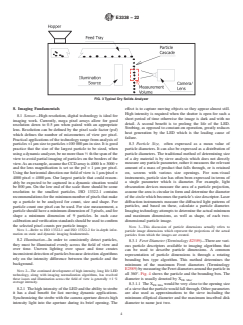
imagingdevice,butnotallapplicationsandsizerangesmaybe
6.7 The technology applies down to approximately 0.4 µm,
resolved (see Fig. 3).
the lower bounds of the visible spectrum. The upper end is
unlimited, however with fixed equipment settings the field of
6.5 Particle motions can cause images to be blurred thereby
view limits the total range of particle size that can be captured.
masking particle features and limiting the accuracy of the size
and shape analysis. To alleviate this effect the aperture setting
7. Apparatus
ofthecamera,orthetimeintervalinwhichitacceptslightrays,
can be reduced in order to reduce the effect of motion. When 7.1 Analysis of liquid-based flows are often conducted
through a cell with the imaging device on one side and the
illuminationdeviceontheother.Thespacebetweenthemisthe
measurement volume where the focal plane of the image must
be located. It is generally ideal for the focal plane to be
centered in the measurement volume to avoid flow variations
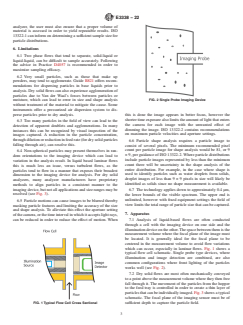
which can occur, especially in laminar flows. Fig. 1 shows a
typical flow cell schematic. Single probe type devices, where
illumination and image detection are combined, are also
common configurations where front lighting of the particles
works well (see Fig. 2).
7.2 Dry solid flows are most often mechanically conveyed
toapointabovethemeasurementvolumewheretheythenfree
fall through it. The movement of the particles from the hopper
to the feed tray is controlled in order to create a thin layer of
particlesthatcanbeindividuallyimaged.Fig.3showsatypical
schematic. The focal plane of the imaging sensor must be of
FIG. 1 Typical Flow Cell Cross Sectional sufficient depth to capture the particle field.
E3338 − 22
FIG. 3 Typical Dry Solids Analyzer
8. Imaging Fundamentals effect is to capture moving objects so they appear almost still.
High intensity is required when the shutter is open for such a
8.1 Sensor—High resolution, digital technology is ideal for
short period of time otherwise the image is dark and with no
imaging work. Currently, mega pixel arrays allow for good
detail. A second benefit is to prolong the life of the LED.
resolution down to 0.5 µm when paired with an appropriate
Strobing, as opposed to constant-on operation, greatly reduces
lens. Resolution can be defined by the pixel scale factor (psf)
heat generation by the LED which is the leading cause of
which defines the number of micrometres of view per pixel.
failure.
Practical applications of the technology range from analysis of
particles<1µmsizetoparticles>100000µminsize.Itisgood 8.3 Particle Size, often expressed as a mean value of
particle diameters. It can also be expressed as a distribution of
practice that the size of the largest particle to be sized, when
usingadynamicanalyzer,benomorethan ⁄5ththespanofthe particle diameters. The traditional method of determining size
of a dry material is by sieve analysis which does not directly
view to avoid partial imaging of particles on the borders of the
view.Asanexample,assumetheCCDarrayis4000h×3000v measure any particle parameter, rather it measures the relevant
amount of a mass of product that falls through, or is retained
and the lens magnification is set so the psf=1µmper pixel.
Usingthehorizontaldirectionourfieldofviewis1µm⁄pixel× on, screens with various size openings. For non-visual
instruments, particle size has often been expressed in terms of
4000pixel = 4000µm. Our largest particle that could reason-
ably be expected to be captured in a dynamic situation would a single parameter which is diameter. For example, light
obscuration devices measure the area of a particle projection,
be 800 µm. On the low end of the scale there should be some
resolution to the smallest particles. ISO 13322-1 contains assume the area is circular in form and determine the diameter
ofthecirclewhichbecomestheparticle’ssizedescriptor.Laser
recommendationsfortheminimumnumberofpixelsthatmake
up a particle to be analyzed for count, size and shape. For diffraction instruments measure the diffracted light patterns of
particles, and based on these, calculate a particle diameter.
particle count one pixel can be used. For size measurement, a
particleshouldhaveaminimumdimensionof3pixels,andfor Imagingtechnologyattemptstodeterminetheactualminimum
and maximum dimensions, as well as shape, of each two-
shape a minimum dimension of 9 particles. In each case
calibrationandverificationstandardsshouldbeusedtoconfirm dimensional particle image.
the selected pixel counts per particle image.
NOTE 3—This discussion of particle dimensions actually refers to
NOTE 1—Refer to ISO 13322-1 and ISO 13322-2 for in-depth infor-
particle image dimensions which represent the projections of the actual
mation on static and dynamic imaging fundamentals.
particles from which the images are created.
8.2 Illumination—In order to consistently detect particles,
8.3.1 Feret Diameter (Terminology E2589)—Therearevari-
they must
...