

ASTM A467/A467M-20
(Specification)Standard Specification for Machine and Coil Chain
General Information
- Abstract
ABSTRACT
This specification covers welded carbon steel machine chain and coil chain. Although these chains are not intended for pocket wheel use, they can be used for pocket and sprocket wheel use. There are two classes each of machine and coil chain: class MS which are machine, straight-link steel chains; class MT which are machine, twist-link steel chains; class CS which are coil, straight-link chains; and class CT, which are coil, twist-link steel chains. The steel shall be made by the open-hearth, electric-furnace, or basic-oxygen process. Classes MS, MT, CS, and CT shall be electric welded. All chain in classes MS and CS shall be subjected to proof test and all chain classes shall undergo a breaking force test.
SCOPE
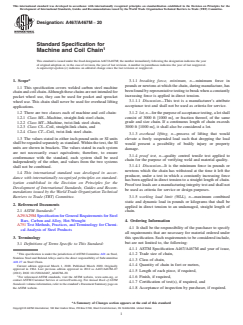
1.1 This specification covers welded carbon steel machine chain and coil chain. Although these chains are not intended for pocket wheel use, they can be used for pocket and sprocket wheel use. This chain shall never be used for overhead lifting applications.
1.2 There are two classes each of machine and coil chain:
1.2.1 Class MS—Machine, straight-link steel chain,
1.2.2 Class MT—Machine, twist-link steel chain,
1.2.3 Class CS—Coil, straight-link chain, and
1.2.4 Class CT—Coil, twist-link steel chain.
1.3 The values stated in either inch-pound units or SI units shall be regarded separately as standard. Within the text, the SI units are shown in brackets. The values stated in each system are not necessarily exact equivalents; therefore, to ensure conformance with the standard, each system shall be used independently of the other, and values from the two systems shall not be combined.
1.4 This international standard was developed in accordance with internationally recognized principles on standardization established in the Decision on Principles for the Development of International Standards, Guides and Recommendations issued by the World Trade Organization Technical Barriers to Trade (TBT) Committee.
- Status
- Published
- Publication Date
- 29-Feb-2020
- Technical Committee
- A01 - Steel, Stainless Steel and Related Alloys
- Drafting Committee
- A01.27 - Steel Chain

Overview
ASTM A467/A467M-20 is an internationally recognized standard specification developed by ASTM International for welded carbon steel machine chains and coil chains. This standard addresses the requirements for various types of welded carbon steel chains used in commercial, industrial, and general-purpose applications. The specification covers both inch-pound and SI units, and applies globally under internationally harmonized standardization principles.
ASTM A467/A467M-20 details the material, manufacturing, testing, and certification requirements for four main classes:
- MS: Machine, straight-link steel chain
- MT: Machine, twist-link steel chain
- CS: Coil, straight-link chain
- CT: Coil, twist-link steel chain
It is important to note that chains manufactured to this standard are not intended for overhead lifting applications but may be used in pocket or sprocket wheel systems.
Key Topics
Types and Classes of Chain
- Machine Chain: Includes straight-link (MS) and twist-link (MT) varieties.
- Coil Chain: Available as straight-link (CS) and twist-link (CT) varieties.
- All classes must be produced using welded carbon steel conforming to specific chemical and mechanical requirements.
Manufacturing and Material Requirements
- Chains must be manufactured using open-hearth, electric-furnace, or basic-oxygen steelmaking processes.
- All chain classes are electric welded for durability and uniformity.
- The standard specifies chemical composition limits for carbon, phosphorus, and sulfur to ensure strength and ductility.
Mechanical Performance and Testing
- Proof Testing: Every link in classes MS and CS is subject to a proof test to verify weld and material integrity.
- Breaking Force Test: All classes of chain must pass minimum breaking force requirements through direct tension tests.
- Elongation: Chain sections must meet a minimum elongation requirement as a measure of ductility.
Dimensional Requirements
- Chain links must comply with specified tolerances for material diameter, inside length, and width.
- Oversized material is permissible for certain applications, but not undersized.
Marking and Certification
- Chains may be marked at the manufacturer’s discretion but cannot be marked with indented characters.
- Certification of compliance and test results can be furnished upon request to support traceability and quality assurance.
Applications
ASTM A467/A467M-20 machine and coil chains are used in a variety of applications where welded steel chain is required but mechanical lifting over human heads is not permitted. Key areas include:
- Agricultural equipment
- Marine and dock hardware
- Construction site securing and material handling
- Commercial and industrial machinery (such as drive chains, conveyors, or as part of sprocket systems)
- Securing, tie-down, and general utility purposes
- Not for overhead lifting or critical load-carrying applications
Adhering to the ASTM A467/A467M-20 standard ensures reliable performance, durability, and consistency in supply chains and field operations.
Related Standards
Users of ASTM A467/A467M-20 may also need to refer to other ASTM standards commonly cited in conjunction, including:
- ASTM A29/A29M: Specification for General Requirements for Steel Bars, Carbon and Alloy, Hot-Wrought
- ASTM A751: Test Methods, Practices, and Terminology for Chemical Analysis of Steel Products
For additional guidance on the safe use of chain in lifting and critical applications, standards such as ASTM A391/A391M or relevant ISO and EN standards may apply.
By following ASTM A467/A467M-20, specifiers, manufacturers, and end users help ensure welded steel chains meet essential requirements for safety, performance, and consistency in non-lifting, industrial, and commercial uses.
Relations
- Effective Date
- 01-Mar-2020
- Effective Date
- 01-Nov-2015
- Effective Date
- 01-Mar-2014
- Effective Date
- 01-May-2012
- Effective Date
- 01-May-2012
- Effective Date
- 01-Oct-2011
- Effective Date
- 01-Apr-2011
- Effective Date
- 01-Oct-2008
- Effective Date
- 01-Jun-2007
- Effective Date
- 01-Apr-2007
- Effective Date
- 01-May-2006
- Effective Date
- 01-May-2005
- Effective Date
- 01-Mar-2004
- Effective Date
- 01-Mar-2004
- Effective Date
- 10-Sep-2003
Frequently Asked Questions
ASTM A467/A467M-20 is a technical specification published by ASTM International. Its full title is "Standard Specification for Machine and Coil Chain". This standard covers: ABSTRACT This specification covers welded carbon steel machine chain and coil chain. Although these chains are not intended for pocket wheel use, they can be used for pocket and sprocket wheel use. There are two classes each of machine and coil chain: class MS which are machine, straight-link steel chains; class MT which are machine, twist-link steel chains; class CS which are coil, straight-link chains; and class CT, which are coil, twist-link steel chains. The steel shall be made by the open-hearth, electric-furnace, or basic-oxygen process. Classes MS, MT, CS, and CT shall be electric welded. All chain in classes MS and CS shall be subjected to proof test and all chain classes shall undergo a breaking force test. SCOPE 1.1 This specification covers welded carbon steel machine chain and coil chain. Although these chains are not intended for pocket wheel use, they can be used for pocket and sprocket wheel use. This chain shall never be used for overhead lifting applications. 1.2 There are two classes each of machine and coil chain: 1.2.1 Class MS—Machine, straight-link steel chain, 1.2.2 Class MT—Machine, twist-link steel chain, 1.2.3 Class CS—Coil, straight-link chain, and 1.2.4 Class CT—Coil, twist-link steel chain. 1.3 The values stated in either inch-pound units or SI units shall be regarded separately as standard. Within the text, the SI units are shown in brackets. The values stated in each system are not necessarily exact equivalents; therefore, to ensure conformance with the standard, each system shall be used independently of the other, and values from the two systems shall not be combined. 1.4 This international standard was developed in accordance with internationally recognized principles on standardization established in the Decision on Principles for the Development of International Standards, Guides and Recommendations issued by the World Trade Organization Technical Barriers to Trade (TBT) Committee.
ABSTRACT This specification covers welded carbon steel machine chain and coil chain. Although these chains are not intended for pocket wheel use, they can be used for pocket and sprocket wheel use. There are two classes each of machine and coil chain: class MS which are machine, straight-link steel chains; class MT which are machine, twist-link steel chains; class CS which are coil, straight-link chains; and class CT, which are coil, twist-link steel chains. The steel shall be made by the open-hearth, electric-furnace, or basic-oxygen process. Classes MS, MT, CS, and CT shall be electric welded. All chain in classes MS and CS shall be subjected to proof test and all chain classes shall undergo a breaking force test. SCOPE 1.1 This specification covers welded carbon steel machine chain and coil chain. Although these chains are not intended for pocket wheel use, they can be used for pocket and sprocket wheel use. This chain shall never be used for overhead lifting applications. 1.2 There are two classes each of machine and coil chain: 1.2.1 Class MS—Machine, straight-link steel chain, 1.2.2 Class MT—Machine, twist-link steel chain, 1.2.3 Class CS—Coil, straight-link chain, and 1.2.4 Class CT—Coil, twist-link steel chain. 1.3 The values stated in either inch-pound units or SI units shall be regarded separately as standard. Within the text, the SI units are shown in brackets. The values stated in each system are not necessarily exact equivalents; therefore, to ensure conformance with the standard, each system shall be used independently of the other, and values from the two systems shall not be combined. 1.4 This international standard was developed in accordance with internationally recognized principles on standardization established in the Decision on Principles for the Development of International Standards, Guides and Recommendations issued by the World Trade Organization Technical Barriers to Trade (TBT) Committee.
ASTM A467/A467M-20 is classified under the following ICS (International Classification for Standards) categories: 21.220.30 - Chain drives and their components. The ICS classification helps identify the subject area and facilitates finding related standards.
ASTM A467/A467M-20 has the following relationships with other standards: It is inter standard links to ASTM A467/A467M-07(2012), ASTM A29/A29M-15, ASTM A751-14, ASTM A29/A29M-12, ASTM A29/A29M-12e1, ASTM A29/A29M-11a, ASTM A29/A29M-11, ASTM A751-08, ASTM A751-07a, ASTM A751-07, ASTM A751-01(2006), ASTM A29/A29M-05, ASTM A29/A29M-04e1, ASTM A29/A29M-04, ASTM A29/A29M-03. Understanding these relationships helps ensure you are using the most current and applicable version of the standard.
ASTM A467/A467M-20 is available in PDF format for immediate download after purchase. The document can be added to your cart and obtained through the secure checkout process. Digital delivery ensures instant access to the complete standard document.
Standards Content (Sample)
This international standard was developed in accordance with internationally recognized principles on standardization established in the Decision on Principles for the
Development of International Standards, Guides and Recommendations issued by the World Trade Organization Technical Barriers to Trade (TBT) Committee.
Designation:A467/A467M −20
Standard Specification for
Machine and Coil Chain
This standard is issued under the fixed designationA467/A467M; the number immediately following the designation indicates the year
of original adoption or, in the case of revision, the year of last revision.Anumber in parentheses indicates the year of last reapproval.
A superscript epsilon (´) indicates an editorial change since the last revision or reapproval.
1. Scope* 3.1.1 breaking force, minimum, n—minimum force in
poundsornewtonsatwhichthechain,duringmanufacture,has
1.1 This specification covers welded carbon steel machine
beenfoundbyrepresentativetestingtobreakwhenaconstantly
chainandcoilchain.Althoughthesechainsarenotintendedfor
increasing force is applied in direct tension.
pocket wheel use, they can be used for pocket and sprocket
3.1.1.1 Discussion—This test is a manufacturer’s attribute
wheel use. This chain shall never be used for overhead lifting
acceptance test and shall not be used as criteria for service.
applications.
3.1.2 lot, n—forthepurposeofacceptancetesting,alotshall
1.2 There are two classes each of machine and coil chain:
1.2.1 Class MS—Machine, straight-link steel chain, consist of 3000 ft [1000 m], or fraction thereof, of the same
1.2.2 Class MT—Machine, twist-link steel chain, grade and size chain. If a continuous length of chain exceeds
1.2.3 Class CS—Coil, straight-link chain, and 3000 ft [1000 m], it shall also be considered a lot.
1.2.4 Class CT—Coil, twist-link steel chain.
3.1.3 overhead lifting, n—process of lifting that would
1.3 The values stated in either inch-pound units or SI units
elevate a freely suspended load such that dropping the load
shallberegardedseparatelyasstandard.Withinthetext,theSI
would present a possibility of bodily injury or property
units are shown in brackets. The values stated in each system
damage.
are not necessarily exact equivalents; therefore, to ensure
3.1.4 proof test, n—quality control tensile test applied to
conformance with the standard, each system shall be used
chain for the purpose of verifying weld and material quality.
independently of the other, and values from the two systems
3.1.4.1 Discussion—It is the minimum force in pounds or
shall not be combined.
newtons which the chain has withstood at the time it left the
1.4 This international standard was developed in accor-
producer, under a test in which a constantly increasing force
dance with internationally recognized principles on standard-
has been applied in direct tension to a straight length of chain.
ization established in the Decision on Principles for the
Proof test loads are a manufacturing integrity test and shall not
Development of International Standards, Guides and Recom-
be used as criteria for service or design purposes.
mendations issued by the World Trade Organization Technical
Barriers to Trade (TBT) Committee. 3.1.5 working load limit (WLL), n—maximum combined
static and dynamic load in pounds or kilograms that shall be
2. Referenced Documents
applied in direct tension to an undamaged, straight length of
2.1 ASTM Standards: chain.
A29/A29MSpecificationforGeneralRequirementsforSteel
Bars, Carbon and Alloy, Hot-Wrought
4. Ordering Information
A751Test Methods, Practices, and Terminology for Chemi-
4.1 It shall be the responsibility of the purchaser to specify
cal Analysis of Steel Products
all requirements that are necessary for material ordered under
3. Terminology this specification. Such requirements to be considered include,
but are not limited to, the following:
3.1 Definitions of Terms Specific to This Standard:
4.1.1 ASTM Specification A467/A467M and year of issue,
This specification is under the jurisdiction ofASTM Committee A01 on Steel, 4.1.2 Trade size of chain,
Stainless Steel and RelatedAlloys and is the direct responsibility of Subcommittee
4.1.3 Class of chain,
A01.27 on Steel Chain.
Current edition approved March 1, 2020. Published March 2020. Originally 4.1.4 Quantity of chain in feet or metres,
approved in 1964. Last previous edition approved in 2012 as A467/A467M–07
4.1.5 Length of each piece, if required,
(2012). DOI: 10.1520/A0467_A0467M–20.
For referenced ASTM standards, visit the ASTM website, www.astm.org, or 4.1.6 Finish, if required,
contact ASTM Customer Service at service@astm.org. For Annual Book of ASTM
4.1.7 Certification of test(s), if required, and
Standards volume information, refer to the standard’s Document Summary page on
the ASTM website. 4.1.8 Acceptance of inspection by purchaser, if required.
*A Summary of Changes section appears at the end of this standard
Copyright © ASTM International, 100 Barr Harbor Drive, PO Box C700, West Conshohocken, PA 19428-2959. United States
A467/A467M−20
NOTE2—U-boltsofthesameorlargerdiameterandthesameorgreater
5. Manufacture
strength than the chain may be used to secure the chain to the jaws of the
5.1 Melting Process—The steel shall be made by the open-
testing machine.
hearth, electric-furnace, or basic-oxygen process.
7.2.3 Test specimens from the finished chain shall conform
5.2 Welding Process—ClassesMS,MT,CS,andCTshallbe
to the minimum breaking force requirements as prescribed in
electric welded.
Tables 1-4 for their respective sizes and classes.
7.3 Elongation:
6. Chemical Requirements
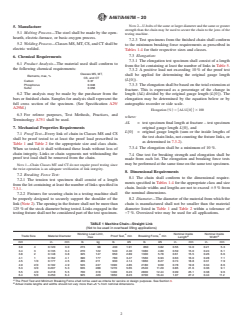
7.3.1 The elongation test specimen shall consist of a length
6.1 Product Analysis—The material used shall conform to
from the lot containing at least the number of links in Table 5.
the following chemical requirements:
7.3.2 A positive load not exceeding 10% of the proof test
Classes MS, MT,
shall be applied for determining the original gauge length
Elements, max, %
CS, and CT
(L{0}).
Carbon 0.37
Phosphorus 0.048 7.3.3 Theelongationshallbebasedonthetotalextensionat
Sulfur 0.058
fracture. This is expressed as a percentage of the change in
6.2 The analysis may be made by the purchaser from the
length (∆L) divided by the original gauge length (L{0}). The
bars or finished chain. Samples for analysis shall represent the elongation may be determined by the equation below or by
full cross section of the specimen. (See Specification A29/
autographic recorder or side scale.
A29M.)
Elongation % 5 ∆L/L 0 3100
~ ! $ $ %%
6.3 For referee purposes, Test Methods, Practices, and
where:
Terminology A751 shall be used.
∆L = test specimen final length at fracture – test specimen
original gauge length L{0}, and
7. Mechanical Properties Requirements
L{0} = original gauge length (sum or the inside lengths of
7.1 Proof Test—Every link of chain in Classes MS and CS
the test chain links, not counting the fixture links, or
shall be proof tested to at least the proof load prescribed in
as determined in 7.3.2).
Table 1 and Table 2 for the appropriate size and class chain.
7.3.4 The elongation shall be a minimum of 10%.
When so tested, it shall withstand these loads without loss of
chain integrity. Links or chain segments not withstanding the
7.4 One test for breaking strength and elongation shall be
proof test load shall be removed from the chain.
made from each lot. The elongation and breaking force tests
may be performed at the same time on the same test specimen.
NOTE 1—Chain Classes MT and CT do not require proof testing since
the twist operation is an adequate verification of link integrity.
8. Dimensional Requirements
7.2 Breaking Force Test:
8.1 The chain shall conform to the dimensional require-
7.2.1 The tension test specimen shall consist of a length
ments specified in Tables 1-4 for the appropriate class and size
fromthelotcontainingatleastthenumberoflinksspecifiedin
chain. Inside widths and lengths are not to exceed 65% from
7.3.1.
the nominal dimensions.
7.2.2 Fixtures for securing chain in a testing machine shall
be properly designed to securely support the shoulder of the 8.2 Diameter—The diameter of the material from which the
link(Note2).Theopeninginthefixtureshallnotbemorethan chain is manufactured shall not be smaller than the material
125%ofthestockdiameterbeingtested.Linksengagedinthe
diameter listed in Table 1 and Table 2 within a tolerance of
testingfixtureshallnotbeconsideredpartofthetestspecimen. −7%. Oversized wire may be used for all applications.
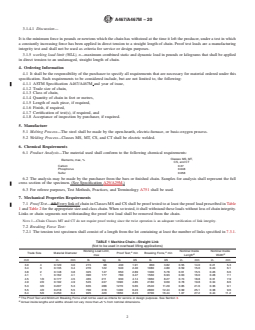
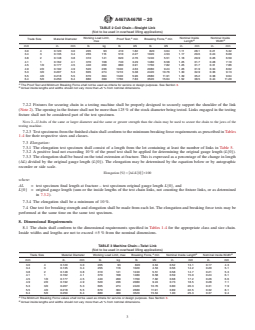
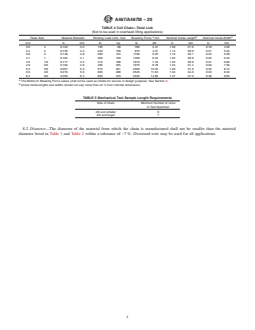
TABLE 1 Machine Chain—Straight Link
(Not to be used in overhead lifting applications)
Working Load Limit, Nominal Insid
...
This document is not an ASTM standard and is intended only to provide the user of an ASTM standard an indication of what changes have been made to the previous version. Because
it may not be technically possible to adequately depict all changes accurately, ASTM recommends that users consult prior editions as appropriate. In all cases only the current version
of the standard as published by ASTM is to be considered the official document.
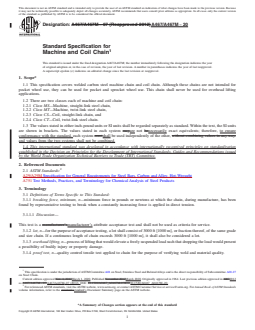
Designation: A467/A467M − 07 (Reapproved 2012) A467/A467M − 20
Standard Specification for
Machine and Coil Chain
This standard is issued under the fixed designation A467/A467M; the number immediately following the designation indicates the year
of original adoption or, in the case of revision, the year of last revision. A number in parentheses indicates the year of last reapproval.
A superscript epsilon (´) indicates an editorial change since the last revision or reapproval.
1. Scope*
1.1 This specification covers welded carbon steel machine chain and coil chain. Although these chains are not intended for
pocket wheel use, they can be used for pocket and sprocket wheel use. This chain shall never be used for overhead lifting
applications.
1.2 There are two classes each of machine and coil chain:
1.2.1 Class MS—Machine, straight-link steel chain,
1.2.2 Class MT—Machine, twist-link steel chain,
1.2.3 Class CS—Coil, straight-link chain, and
1.2.4 Class CT—Coil, twist-link steel chain.
1.3 The values stated in either inch-pound units or SI units shall be regarded separately as standard. Within the text, the SI units
are shown in brackets. The values stated in each system mayare not benecessarily exact equivalents; therefore, to ensure
conformance with the standard, each system mustshall be used independently of the other, without combining values in any way.
and values from the two systems shall not be combined.
1.4 This international standard was developed in accordance with internationally recognized principles on standardization
established in the Decision on Principles for the Development of International Standards, Guides and Recommendations issued
by the World Trade Organization Technical Barriers to Trade (TBT) Committee.
2. Referenced Documents
2.1 ASTM Standards:
A29/A29M Specification for General Requirements for Steel Bars, Carbon and Alloy, Hot-Wrought
A751 Test Methods, Practices, and Terminology for Chemical Analysis of Steel Products
3. Terminology
3.1 Definitions of Terms Specific to This Standard:
3.1.1 breaking force, minimum, n—minimum force in pounds or newtons at which the chain, during manufacture, has been
found by representative testing to break when a constantly increasing force is applied in direct tension.
3.1.1.1 Discussion—
This test is a manufacturer’smanufacturer’s attribute acceptance test and shall not be used as criteria for service.
3.1.2 lot, n—for the purpose of acceptance testing, a lot shall consist of 3000 ft [1000 m], or fraction thereof, of the same grade
and size chain. If a continuous length of chain exceeds 3000 ft [1000 m], it shall also be considered a lot.
3.1.3 overhead lifting, n—process of lifting that would elevate a freely suspended load such that dropping the load would present
a possibility of bodily injury or property damage.
3.1.4 proof test, n—quality control tensile test applied to chain for the purpose of verifying weld and material quality.
This specification is under the jurisdiction of ASTM Committee A01 on Steel, Stainless Steel and Related Alloys and is the direct responsibility of Subcommittee A01.27
on Steel Chain.
Current edition approved Nov. 1, 2012March 1, 2020. Published November 2012March 2020. Originally approved in 1964. Last previous edition approved in 20072012
as A467/A467M – 07.A467/A467M–07 (2012). DOI: 10.1520/A0467_A0467M-07R12.10.1520/A0467_A0467M–20.
For referenced ASTM standards, visit the ASTM website, www.astm.org, or contact ASTM Customer Service at service@astm.org. For Annual Book of ASTM Standards
volume information, refer to the standard’sstandard’s Document Summary page on the ASTM website.
*A Summary of Changes section appears at the end of this standard
Copyright © ASTM International, 100 Barr Harbor Drive, PO Box C700, West Conshohocken, PA 19428-2959. United States
A467/A467M − 20
3.1.4.1 Discussion—
It is the minimum force in pounds or newtons which the chain has withstood at the time it left the producer, under a test in which
a constantly increasing force has been applied in direct tension to a straight length of chain. Proof test loads are a manufacturing
integrity test and shall not be used as criteria for service or design purposes.
3.1.5 working load limit (WLL), n—maximum combined static and dynamic load in pounds or kilograms that shall be applied
in direct tension to an undamaged, straight length of chain.
4. Ordering Information
4.1 It shall be the responsibility of the purchaser to specify all requirements that are necessary for material ordered under this
specification. Such requirements to be considered include, but are not limited to, the following:
4.1.1 ASTM Specification A467/A467M and year of issue,
4.1.2 Trade size of chain,
4.1.3 Class of chain,
4.1.4 Quantity of chain in feet or metres,
4.1.5 Length of each piece, if required,
4.1.6 Finish, if required,
4.1.7 Certification of test(s), if required, and
4.1.8 Acceptance of inspection by purchaser, if required.
5. Manufacture
5.1 Melting Process—The steel shall be made by the open-hearth, electric-furnace, or basic-oxygen process.
5.2 Welding Process—Classes MS, MT, CS, and CT shall be electric welded.
6. Chemical Requirements
6.1 Product Analysis—The material used shall conform to the following chemical requirements:
Classes MS, MT,
Elements, max, %
CS, and CT
Carbon 0.37
Phosphorus 0.048
Sulfur 0.058
6.2 The analysis may be made by the purchaser from the bars or finished chain. Samples for analysis shall represent the full
cross section of the specimen. (See Specification A29/A29M.)
6.3 For referee purposes, Test Methods, Practices, and Terminology A751 shall be used.
7. Mechanical Properties Requirements
7.1 Proof Test—All Every link of chain in Classes MS and CS shall be proof tested to at least the proof load prescribed in Table
1 and Table 2 for the appropriate size and class chain. When so tested, it shall withstand these loads without loss of chain integrity.
Links or chain segments not withstanding the proof test load shall be removed from the chain.
NOTE 1—Chain Classes MT and CT do not require proof testing since the twist operation is an adequate verification of link integrity.
7.2 Breaking Force Test:
7.2.1 The tension test specimen shall consist of a length from the lot containing at least the number of links specified in 7.3.1.
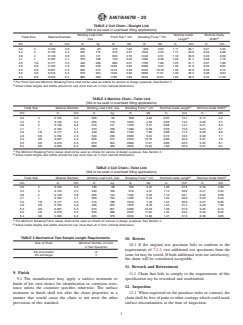
TABLE 1 Machine Chain—Straight Link
(Not to be used in overhead lifting applications)
Working Load Limit, Nominal Inside Nominal Inside
A A
Trade Size Material Diameter Proof Test, min Breaking Force, min
B B
max Length Width
mm in. mm lb kg lb kN lb kN in. mm in. mm
3.0 4 0.120 3.0 215 98 430 1.91 860 3.82 0.55 14.0 0.21 5.3
3.4 3 0.135 3.4 270 122 540 2.40 1080 4.80 0.59 15.0 0.24 6.1
3.8 2 0.148 3.8 325 147 650 2.89 1300 5.78 0.61 15.5 0.26 6.6
4.1 1 0.162 4.1 390 177 780 3.47 1560 6.93 0.63 16.0 0.28 7.1
4.5 1/0 0.177 4.5 465 211 930 4.14 1860 8.27 0.74 18.8 0.31 7.9
4.9 2/0 0.192 4.9 545 247 1090 4.85 2180 9.69 0.78 19.8 0.34 8.6
5.3 3/0 0.207 5.3 635 288 1270 5.65 2540 11.29 0.85 21.6 0.36 9.1
5.5 4/0 0.218 5.5 700 318 1400 6.23 2800 12.44 0.99 25.1 0.38 9.6
6.4 5/0 0.250 6.4 925 420 1850 8.23 3700 16.44 1.07 27.2 0.44 11.2
A
The Proof Test and Minimum Breaking Force shall not be used as criteria for service or design purposes. See Section 3.
B
Actual inside lengths and widths should not vary more than ±5 % from nominal dimensions.
A467/A467M − 20
TABLE 2 Coil Chain—Straight Link
(Not to be used in overhead lifting applications)
Working Load Limit, Nominal Inside Nominal Inside
A A
Trade Size Material Diameter Proof Test, min Breaking Force, min
B B
max Length Width
mm in. mm lb kg lb kN lb kN in. mm in. mm
3.0 4 0.120 3.0 205 93 410 1.82 820 3.64 1.11 28.1 0.21 5.32
3.4 3 0.135 3.4 255 116 510 2.27 1020 4.53 1.17 29.6 0.24 6.09
3.8 2 0.148 3.8 310 141 620 2.76 1240 5.51 1.18 29.9 0.26 6.59
4.1 1 0.162 4.1 370 168 740 3.29 1480 6.58 1.25 31.7 0.28 7.10
4.5 1/0 0.177 4.5 440 200 880 3.91 1760 7.82 1.25 31.7 0.31 7.86
4.9 2/0 0.192 4.9 520 236 1040 4.63 2080 9.24 1.26 31.9 0.34 8.62
5.3 3/0 0.207 5.3 605 274 1210 5.38 2420 10.76 1.30 32.9 0.36 9.13
5.5 4/0 0.218 5.5 670 304 1340 5.96 2680 11.91 1.39 35.2 0.38 9.64
6.4 5/0 0.250 6.4 880 399 1760 7.83 3520 15.64 1.52 38.5 0.44 11.20
A
The Proof Test and Minimum Breaking Force shall not be used as criteria for service or design purposes. See Section 3.
B
Actual inside lengths and widths should not vary more than ±5 % from nominal dimensions.
7.2.2 Fixtures for securing chain in a testing machine shall b
...