

ASTM E252-06(2021)e1
(Test Method)Standard Test Method for Thickness of Foil, Thin Sheet, and Film by Mass Measurement
General Information
- Abstract
ABSTRACT
This test method covers the standard procedures for the determination of the thickness of metallic foils, thin sheets, and films by measuring the mass of the specimen of known area and density. The apparatuses needed for this method are a precision blanking press for cutting specimens into circles of a specified area or diameter, and a balance for measuring its mass. The thickness shall then be calculated by using an equation that relates it with the specimen's mass, area, and density.
SCOPE
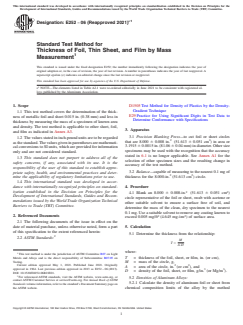
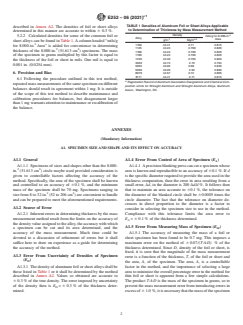
1.1 This test method covers the determination of the thickness of metallic foil and sheet 0.015 in. (0.38 mm) and less in thickness by measuring the mass of a specimen of known area and density. The test method is applicable to other sheet, foil, and film as indicated in Annex A3.
1.2 The values stated in inch-pound units are to be regarded as the standard. The values given in parentheses are mathematical conversions to SI units, which are provided for information only and are not considered standard.
1.3 This standard does not purport to address all of the safety concerns, if any, associated with its use. It is the responsibility of the user of this standard to establish appropriate safety, health, and environmental practices and determine the applicability of regulatory limitations prior to use.
1.4 This international standard was developed in accordance with internationally recognized principles on standardization established in the Decision on Principles for the Development of International Standards, Guides and Recommendations issued by the World Trade Organization Technical Barriers to Trade (TBT) Committee.
- Status
- Published
- Publication Date
- 30-Apr-2021
- Technical Committee
- B07 - Light Metals and Alloys
- Drafting Committee
- B07.05 - Testing
Overview
ASTM E252-06(2021)e1 – Standard Test Method for Thickness of Foil, Thin Sheet, and Film by Mass Measurement specifies accepted procedures for determining the thickness of metallic foils, thin sheets, and films. This method uses the specimen’s mass, known area, and known or determined density to accurately calculate material thickness. The standard is designed for materials 0.015 inches (0.38 mm) thick or less and is recognized for its straightforward, non-destructive approach.
This international standard was developed in accordance with recognized global standardization principles and is applicable to a wide array of industrial and research environments. It is also approved for use by agencies of the U.S. Department of Defense.
Key Topics
- Scope: Applies to metallic foil and thin sheets, as well as films, primarily 0.015 in. (0.38 mm) thick or less.
- Specimen Preparation: Requires cutting the material into a precise circle of specified area, typically using a precision blanking press.
- Apparatus: Utilizes a precision balance capable of measuring mass to the nearest 0.1 mg for an accurate mass determination.
- Calculation Method: Determines thickness from the measured mass, area, and known or calculated density of the specimen.
- Accuracy Requirements:
- Area control to within ±0.1%
- Minimum specimen mass recommended at 70 mg
- Repeated mass measurements should agree within 1 mg
- Error Sources: Considers error from density uncertainty, specimen area, and mass measurement.
Applications
The ASTM E252 test method is widely implemented across manufacturing, quality control, and materials research applications, especially where direct thickness measurement of very thin materials is challenging or could damage the sample. Common application areas include:
- Metals Industry: Verifying the thickness of aluminum foil, specialty alloys, and other metal sheets for quality assurance and regulatory compliance.
- Polymer and Plastics: Applicable to plastic films and thin sheets, including polyethylene, with minor procedural adaptations.
- Electronics and Packaging: Ensures uniform thickness in components such as shielding foils and packaging films.
- Research & Development: Establishes baseline characteristics during material innovation or new product development.
- Regulated Environments: Meets demands for precision in applications subject to defense or aerospace standards.
This standardized mass-based method offers a reliable alternative when micrometers or other direct measurement tools cannot achieve the required precision or could distort thin materials.
Related Standards
- ASTM D1505 – Test Method for Density of Plastics by the Density-Gradient Technique: Often used to determine the density of plastic films for use in ASTM E252 calculations.
- ASTM E29 – Practice for Using Significant Digits in Test Data to Determine Conformance with Specifications: Governs rounding and significant digit use in mass measurement and calculations.
- ISO and other ASTM methods: May reference or complement ASTM E252 when specifying material quality requirements for thin films and foils.
Practical Value
Using ASTM E252-06(2021)e1 ensures consistent, repeatable, and precise thickness measurement critical for achieving material performance, regulatory adherence, and product reliability. By relying on mass measurement, this method offers a practical solution where traditional thickness gauges are inadequate. Its applicability to both metallic and non-metallic materials broadens its relevance across diverse sectors, supporting industrial innovation and international trade compliance.
Keywords: ASTM E252, foil thickness measurement, thin sheet mass method, film thickness by mass, standard test method, material thickness testing, quality control, plastics and metals testing, ASTM standards for films, specimen mass measurement.
Relations
- Refers
ASTM D1505-10 - Standard Test Method for Density of Plastics by the Density-Gradient Technique - Effective Date
- 01-Jul-2010
- Effective Date
- 01-Oct-2008
- Effective Date
- 15-Nov-2006
- Effective Date
- 15-Sep-2006
- Effective Date
- 01-May-2006
- Effective Date
- 01-Dec-2004
- Refers
ASTM D1505-03 - Standard Test Method for Density of Plastics by the Density-Gradient Technique - Effective Date
- 01-Nov-2003
- Effective Date
- 10-May-2002
- Effective Date
- 10-May-1999
- Refers
ASTM D1505-98e1 - Standard Test Method for Density of Plastics by the Density-Gradient Technique - Effective Date
- 10-Mar-1998
Get Certified
Connect with accredited certification bodies for this standard

BSMI (Bureau of Standards, Metrology and Inspection)
Taiwan's standards and inspection authority.
Sponsored listings
Frequently Asked Questions
ASTM E252-06(2021)e1 is a standard published by ASTM International. Its full title is "Standard Test Method for Thickness of Foil, Thin Sheet, and Film by Mass Measurement". This standard covers: ABSTRACT This test method covers the standard procedures for the determination of the thickness of metallic foils, thin sheets, and films by measuring the mass of the specimen of known area and density. The apparatuses needed for this method are a precision blanking press for cutting specimens into circles of a specified area or diameter, and a balance for measuring its mass. The thickness shall then be calculated by using an equation that relates it with the specimen's mass, area, and density. SCOPE 1.1 This test method covers the determination of the thickness of metallic foil and sheet 0.015 in. (0.38 mm) and less in thickness by measuring the mass of a specimen of known area and density. The test method is applicable to other sheet, foil, and film as indicated in Annex A3. 1.2 The values stated in inch-pound units are to be regarded as the standard. The values given in parentheses are mathematical conversions to SI units, which are provided for information only and are not considered standard. 1.3 This standard does not purport to address all of the safety concerns, if any, associated with its use. It is the responsibility of the user of this standard to establish appropriate safety, health, and environmental practices and determine the applicability of regulatory limitations prior to use. 1.4 This international standard was developed in accordance with internationally recognized principles on standardization established in the Decision on Principles for the Development of International Standards, Guides and Recommendations issued by the World Trade Organization Technical Barriers to Trade (TBT) Committee.
ABSTRACT This test method covers the standard procedures for the determination of the thickness of metallic foils, thin sheets, and films by measuring the mass of the specimen of known area and density. The apparatuses needed for this method are a precision blanking press for cutting specimens into circles of a specified area or diameter, and a balance for measuring its mass. The thickness shall then be calculated by using an equation that relates it with the specimen's mass, area, and density. SCOPE 1.1 This test method covers the determination of the thickness of metallic foil and sheet 0.015 in. (0.38 mm) and less in thickness by measuring the mass of a specimen of known area and density. The test method is applicable to other sheet, foil, and film as indicated in Annex A3. 1.2 The values stated in inch-pound units are to be regarded as the standard. The values given in parentheses are mathematical conversions to SI units, which are provided for information only and are not considered standard. 1.3 This standard does not purport to address all of the safety concerns, if any, associated with its use. It is the responsibility of the user of this standard to establish appropriate safety, health, and environmental practices and determine the applicability of regulatory limitations prior to use. 1.4 This international standard was developed in accordance with internationally recognized principles on standardization established in the Decision on Principles for the Development of International Standards, Guides and Recommendations issued by the World Trade Organization Technical Barriers to Trade (TBT) Committee.
ASTM E252-06(2021)e1 is classified under the following ICS (International Classification for Standards) categories: 17.040.20 - Properties of surfaces. The ICS classification helps identify the subject area and facilitates finding related standards.
ASTM E252-06(2021)e1 has the following relationships with other standards: It is inter standard links to ASTM D1505-10, ASTM E29-08, ASTM E29-06b, ASTM E29-06a, ASTM E29-06, ASTM E29-04, ASTM D1505-03, ASTM E29-02e1, ASTM E29-93a(1999), ASTM D1505-98e1. Understanding these relationships helps ensure you are using the most current and applicable version of the standard.
ASTM E252-06(2021)e1 is available in PDF format for immediate download after purchase. The document can be added to your cart and obtained through the secure checkout process. Digital delivery ensures instant access to the complete standard document.
Standards Content (Sample)
This international standard was developed in accordance with internationally recognized principles on standardization established in the Decision on Principles for the
Development of International Standards, Guides and Recommendations issued by the World Trade Organization Technical Barriers to Trade (TBT) Committee.
´1
Designation: E252 − 06 (Reapproved 2021)
Standard Test Method for
Thickness of Foil, Thin Sheet, and Film by Mass
Measurement
This standard is issued under the fixed designation E252; the number immediately following the designation indicates the year of
original adoption or, in the case of revision, the year of last revision. A number in parentheses indicates the year of last reapproval. A
superscript epsilon (´) indicates an editorial change since the last revision or reapproval.
This standard has been approved for use by agencies of the U.S. Department of Defense.
ε NOTE—The elements listed in Table A2.1 were re-ordered editorially in June 2021 to be consistent with registered al-
loys published by the Aluminum Association.
1. Scope D1505 Test Method for Density of Plastics by the Density-
Gradient Technique
1.1 This test method covers the determination of the thick-
E29 Practice for Using Significant Digits in Test Data to
ness of metallic foil and sheet 0.015 in. (0.38 mm) and less in
Determine Conformance with Specifications
thickness by measuring the mass of a specimen of known area
and density. The test method is applicable to other sheet, foil,
3. Apparatus
and film as indicated in Annex A3.
3.1 Precision Blanking Press—to cut foil or sheet circles
1.2 The values stated in inch-pound units are to be regarded
2 2
that are 8.000 6 0.008 in. (51.613 6 0.051 cm ) in area or
as the standard. The values given in parentheses are mathemati-
3.1915 6 0.0015 in. (81.06 6 0.04 mm) in diameter. Other size
cal conversions to SI units, which are provided for information
specimens may be used with the recognition that the accuracy
only and are not considered standard.
stated in 6.1 is no longer applicable. See Annex A1 for the
1.3 This standard does not purport to address all of the
selection of other specimen sizes and the resulting change in
safety concerns, if any, associated with its use. It is the
accuracy of the test method.
responsibility of the user of this standard to establish appro-
3.2 Balance—capable of measuring to the nearest 0.1 mg of
priate safety, health, and environmental practices and deter-
2 2
thickness for the 8.000-in. (51.613 cm ) circle.
mine the applicability of regulatory limitations prior to use.
1.4 This international standard was developed in accor-
dance with internationally recognized principles on standard- 4. Procedure
ization established in the Decision on Principles for the 2 2
4.1 Blank an 8.000 6 0.008-in. (51.613 6 0.051 cm )
Development of International Standards, Guides and Recom-
circle representative of the foil or sheet, swab with acetone or
mendations issued by the World Trade Organization Technical
other suitable solvent to ensure a surface free of soil, and
Barriers to Trade (TBT) Committee.
determine the mass of the clean, dry specimen to the nearest
0.1 mg. Use a suitable solvent to remove any coating known to
2 2
2. Referenced Documents
exceed 0.005 mg/ft (4.645 mg ⁄cm ) of surface area.
2.1 The following documents of the issue in effect on the
date of material purchase, unless otherwise noted, form a part 5. Calculation
of this specification to the extent referenced herein:
5.1 Determine the thickness from the relationship:
2.2 ASTM Standards:
M
T 5
A·D
where:
This test method is under the jurisdiction of ASTM Committee B07 on Light
Metals and Alloys and is the direct responsibility of Subcommittee B07.05 on T = thickness of the foil, sheet, or film, in. (or cm),
Testing.
M = mass of the circle, g,
2 2
Current edition approved May 1, 2021. Published June 2021. Originally
A = area of the circle, in. (or cm ), and
approved in 1964. Last previous edition approved in 2013 as E252 – 06 (2013).
3 3
D = density of the foil, sheet, or film, g/in. (or Mg/m ).
DOI: 10.1520/E0252-06R21E01.
For referenced ASTM standards, visit the ASTM website, www.astm.org, or
5.2 Densities of Aluminum Alloys:
contact ASTM Customer Service at service@astm.org. For Annual Book of ASTM
5.2.1 Calculate the density of aluminum foil or sheet from
Standards volume information, refer to the standard’s Document Summary page on
the ASTM website. chemical composition limits of the alloy by the method
Copyright © ASTM International, 100 Barr Harbor Drive, PO Box C700, West Conshohocken, PA 19428-2959. United States
´1
E252 − 06 (2021)
TABLE 1 Densities of Aluminum Foil or Sheet Alloys Applicable
described in Annex A2. The densities of foil or sheet alloys
to Determination of Thickness by Mass Measurement Method
determined in this manner are accurate to within 6 0.3 %.
Density
mils/g for 8.000-in.
5.2.2 Calculated densities for some of the common foil or
Alloy
3 3A
Area
g/in. Mg/m
sheet alloys can be found in Table 1. A column headed “mils/g
1100 44.41 2.71 2.815
for 8.000-in. Area” is added for convenience in determining
1145 44.24 2.700 2.826
2 2
thickness of the 8.000-in. (51.613 cm ) specimens. The mass
1188 44.24 2.700 2.826
of the specimen in grams multiplied by this factor is equal to 1199 44.24 2.700 2.826
1235 44.33 2.705 2.820
the thickness of the foil or sheet in mils. One mil is equal to
3003 44.74 2.73 2.794
0.001 in. (0.0254 mm).
5052 43.92 2.68 2.846
5056 43.26 2.64 2.890
6. Precision and Bias 8079 44.57 2.72 2.805
8111 44.41 2.71 2.815
6.1 Following the procedure outlined in this test method,
A
Registration Record of Aluminum Association Designations and Chemical Com-
repeated mass measurements of the same specimen on different
position Limits for Wrought Aluminum and Wrought Aluminum Alloys, Aluminum
balances should result in agreement within 1 mg. It is outside
Assoc., Washington, DC.
of the scope of this test method to describe maintenance and
calibration procedures for balances, but disagreement larger
than 1 mg warrants attention to maintenance or recalibration of
the balance.
ANNEXES
(Mandatory Information)
A1. SPECIMEN SIZE AND SHAPE AND ITS EFFECT ON ACCURACY
A1.1 General A1.4 Error From Control of Area of Specimen (E )
A
A1.1.1 Specimens of sizes and shapes other than the 8.000- A1.4.1 A precision blanking press can cut a specimen whose
2 2
in. (51.613 cm ) circle maybe used provided consideration is area is known and reproducible to an accuracy of 60.1 %. If d
given to controllable factors affecting the accuracy of the is the specific diameter required to provide the area used in the
method. Specifically, the area of the specimen shall be known thickness computation, then the error in area resulting from a
and controlled to an accuracy of 60.1 %, and the minimum small error, Δd, in the diameter is 200 Δd/d %. It follows then
mass of the specimen shall be 70 mg. Specimens ranging in that to maintain an area accurate to 60.1 %, the tolerance on
2 2
size from 8 to 32 in. (52 to 206 cm ) are convenient to handle the diameter of the blanked circle shall be 60.0005 times the
and can be prepared to meet the aforementioned requirements. circle diameter. The fact that the tolerance on diameter de-
creases in direct proportion to the diameter is a factor to
A1.2 Source of Error
consider in selecting the specimen size to use in the method.
A1.2.1 Inherent errors in determining thickness by the mass Compliance with this tolerance limits the area error to
measurement method result from the limits on the accuracy of E = 6 0.1 % of the thickness determined.
A
the density value assigned to the alloy, the accuracy with which
A1.5 Error From Measuring Mass of Specimen (E )
M
a specimen can be cut and its area determined, and the
accuracy of the mass measurement. Much time could be A1.5.1 The accuracy of measuring the mass of a foil or
devoted to a discussion of refinement of errors but it shall
sheet specimen has been found to be 0.7 mg. This imposes a
suffice here to draw on experience as a guide for determining maximum error on the method of 6 0.07 ⁄(T·A·D) % of the
the accuracy of the method.
thickness determined. Since D, density of the foil or sheet, is
fixed, it is seen that the magnitude of the mass measurement
A1.3 Error From Uncertainty of Densities of Specimen
error is a function of the thickness, T, of the foil or sheet and
(E )
D
the area, A, of the specimen. The area, A, is a controllable
factor in the method, and the importance of selecting a large
A1.3.1 The density of aluminum foil or sheet alloys shall be
those listed in Table 1 or it shall be determined by the method area to minimize the overall percentage error in the method for
thin foil or sheet is apparent from a few simple calculations.
described in Annex A2. Val
...