

ASTM D522/D522M-17(2021)
(Test Method)Standard Test Methods for Mandrel Bend Test of Attached Organic Coatings
General Information
- Abstract
SIGNIFICANCE AND USE
4.1 Coatings attached to substrates are elongated when the substrates are dimensionally unstable, or are bent during the manufacture of articles or when the articles are abused in service. These test methods have been useful in rating attached coatings for their ability to resist cracking when elongated. They have been useful in evaluating the flexibility of coatings on flexible substrates. The elongation of coating films may also be tested using Test Method D2370. The correlation between elongation determined in accordance with Test Methods D522/D522M and D2370 is unknown.
SCOPE
1.1 These test methods cover the determination of the resistance to cracking (flexibility) of attached organic coatings on substrates of sheet metal or rubber-type materials.
1.2 The values stated in either SI units or inch-pound units are to be regarded separately as standard. The values stated in each system are not necessarily exact equivalents; therefore, to ensure conformance with the standard, each system shall be used independently of the other, and values from the two systems shall not be combined.
1.3 This standard does not purport to address all of the safety concerns, if any, associated with its use. It is the responsibility of the user of this standard to establish appropriate safety, health, and environmental practices and determine the applicability of regulatory limitations prior to use.
1.4 This international standard was developed in accordance with internationally recognized principles on standardization established in the Decision on Principles for the Development of International Standards, Guides and Recommendations issued by the World Trade Organization Technical Barriers to Trade (TBT) Committee.
- Status
- Published
- Publication Date
- 31-Oct-2021
- Technical Committee
- D01 - Paint and Related Coatings, Materials, and Applications
- Drafting Committee
- D01.23 - Physical Properties of Applied Paint Films
Overview
ASTM D522/D522M-17(2021), Standard Test Methods for Mandrel Bend Test of Attached Organic Coatings, establishes procedures for evaluating the flexibility and resistance to cracking of organic coatings applied to substrates such as sheet metal or rubber-type materials. This international standard, developed by ASTM International, provides a reliable means to assess how well coatings withstand elongation when the substrate is bent or deformed, which is critical during manufacturing or in-service use. The test methods include both conical and cylindrical mandrel bend tests to determine the coating's capability to resist cracking, essential for ensuring coating durability and performance in various industrial applications.
Key Topics
- Mandrel Bend Test Procedures: The document outlines standard methods for bending coated panels over a mandrel (either conical or cylindrical) and assessing the coating for cracks or fractures.
- Flexibility and Crack Resistance: Focuses on evaluating the coating’s ability to elongate and resist cracking when subjected to mechanical deformation.
- Specimen Preparation: Specifies the requirements for preparing test panels, including substrate material, thickness, panel size, edge treatment, and coating application.
- Conditioning and Measurement: Describes the process for conditioning specimens prior to testing, as well as measuring coating thickness and recording results.
- Reporting and Precision: Specifies data reporting requirements, including mean and range of elongation, film thickness, specimen preparation, and repeatability.
- Use of SI and Inch-Pound Units: Emphasizes the importance of using measurement units consistently, without combining SI and inch-pound values.
Applications
The ASTM D522/D522M mandrel bend test methods provide significant practical value in several contexts:
- Quality Assurance in Manufacturing: Ensuring that coatings applied to metal or synthetic substrates (such as steel, aluminum, tinplate, or synthetic rubber) maintain integrity during forming processes like bending, shaping, or assembly.
- Product Development and Material Selection: Assisting manufacturers and formulators in comparing coating systems for flexibility and resistance to mechanical stress, supporting the development of more durable and reliable products.
- Performance Evaluation in Service Conditions: Evaluating how coatings withstand deformation during real-world use or abuse, which is crucial for automotive parts, appliances, architectural panels, and other applications where coated substrates are bent or flexed.
- Regulatory and Procurement Compliance: Providing a standardized approach for buyers and suppliers to specify, verify, and document coating performance as part of contract requirements or compliance with industry standards.
Related Standards
Several ASTM standards are referenced or closely related to ASTM D522/D522M for testing the physical properties of coatings:
- ASTM D823: Practices for Producing Films of Uniform Thickness of Paint, Coatings, and Related Products on Test Panels.
- ASTM D1005: Test Method for Measurement of Dry-Film Thickness of Organic Coatings Using Micrometers.
- ASTM D2370: Test Method for Tensile Properties of Organic Coatings, which can also be used to test elongation but lacks direct correlation with D522/D522M.
- ASTM D7091: Practice for Nondestructive Measurement of Dry Film Thickness of Nonmagnetic Coatings Applied to Ferrous and Non-Ferrous Metals.
Summary
ASTM D522/D522M is a widely used standard for evaluating the flexibility and crack resistance of attached organic coatings through the mandrel bend test. Its robust procedures help assure product longevity and reliability where metal and flexible substrates are subject to bending or deformation. The standard supports manufacturers, research and development teams, and quality assurance professionals across industries such as automotive, construction, and appliance manufacturing, ensuring that coatings not only meet functional requirements but also comply with recognized international practices. For those seeking consistent, comparable evaluations of coating flexibility, ASTM D522/D522M provides a trusted methodology.
Relations
- Effective Date
- 01-Jun-2020
- Effective Date
- 01-Dec-2017
- Effective Date
- 01-Nov-2012
- Effective Date
- 01-Apr-2012
- Effective Date
- 01-Dec-2010
- Effective Date
- 01-Nov-2007
- Effective Date
- 01-Jun-2007
- Effective Date
- 01-Aug-2005
- Effective Date
- 10-Jul-2002
- Effective Date
- 01-Jan-2001
- Effective Date
- 01-Jan-2001
- Effective Date
- 01-Jan-2001
- Effective Date
- 01-Jan-2001
- Effective Date
- 10-Dec-1998
- Effective Date
- 10-Dec-1998
Get Certified
Connect with accredited certification bodies for this standard

DVS-ZERT GmbH
German welding certification society.
CARES (UK Certification Authority for Reinforcing Steels)
UK certification for reinforcing steels and construction.
EWF/IIW (European/International Welding Federation)
International welding personnel certification.
Sponsored listings
Frequently Asked Questions
ASTM D522/D522M-17(2021) is a standard published by ASTM International. Its full title is "Standard Test Methods for Mandrel Bend Test of Attached Organic Coatings". This standard covers: SIGNIFICANCE AND USE 4.1 Coatings attached to substrates are elongated when the substrates are dimensionally unstable, or are bent during the manufacture of articles or when the articles are abused in service. These test methods have been useful in rating attached coatings for their ability to resist cracking when elongated. They have been useful in evaluating the flexibility of coatings on flexible substrates. The elongation of coating films may also be tested using Test Method D2370. The correlation between elongation determined in accordance with Test Methods D522/D522M and D2370 is unknown. SCOPE 1.1 These test methods cover the determination of the resistance to cracking (flexibility) of attached organic coatings on substrates of sheet metal or rubber-type materials. 1.2 The values stated in either SI units or inch-pound units are to be regarded separately as standard. The values stated in each system are not necessarily exact equivalents; therefore, to ensure conformance with the standard, each system shall be used independently of the other, and values from the two systems shall not be combined. 1.3 This standard does not purport to address all of the safety concerns, if any, associated with its use. It is the responsibility of the user of this standard to establish appropriate safety, health, and environmental practices and determine the applicability of regulatory limitations prior to use. 1.4 This international standard was developed in accordance with internationally recognized principles on standardization established in the Decision on Principles for the Development of International Standards, Guides and Recommendations issued by the World Trade Organization Technical Barriers to Trade (TBT) Committee.
SIGNIFICANCE AND USE 4.1 Coatings attached to substrates are elongated when the substrates are dimensionally unstable, or are bent during the manufacture of articles or when the articles are abused in service. These test methods have been useful in rating attached coatings for their ability to resist cracking when elongated. They have been useful in evaluating the flexibility of coatings on flexible substrates. The elongation of coating films may also be tested using Test Method D2370. The correlation between elongation determined in accordance with Test Methods D522/D522M and D2370 is unknown. SCOPE 1.1 These test methods cover the determination of the resistance to cracking (flexibility) of attached organic coatings on substrates of sheet metal or rubber-type materials. 1.2 The values stated in either SI units or inch-pound units are to be regarded separately as standard. The values stated in each system are not necessarily exact equivalents; therefore, to ensure conformance with the standard, each system shall be used independently of the other, and values from the two systems shall not be combined. 1.3 This standard does not purport to address all of the safety concerns, if any, associated with its use. It is the responsibility of the user of this standard to establish appropriate safety, health, and environmental practices and determine the applicability of regulatory limitations prior to use. 1.4 This international standard was developed in accordance with internationally recognized principles on standardization established in the Decision on Principles for the Development of International Standards, Guides and Recommendations issued by the World Trade Organization Technical Barriers to Trade (TBT) Committee.
ASTM D522/D522M-17(2021) is classified under the following ICS (International Classification for Standards) categories: 25.220.60 - Organic coatings. The ICS classification helps identify the subject area and facilitates finding related standards.
ASTM D522/D522M-17(2021) has the following relationships with other standards: It is inter standard links to ASTM D1005-95(2020), ASTM D823-17, ASTM D823-95(2012), ASTM D7091-12, ASTM D2370-98(2010), ASTM D1005-95(2007), ASTM D823-95(2007), ASTM D7091-05, ASTM D2370-98(2002)e1, ASTM D1005-95(2001), ASTM D1005-95, ASTM D823-95(2001), ASTM D823-95, ASTM D2370-98(2002), ASTM D2370-98. Understanding these relationships helps ensure you are using the most current and applicable version of the standard.
ASTM D522/D522M-17(2021) is available in PDF format for immediate download after purchase. The document can be added to your cart and obtained through the secure checkout process. Digital delivery ensures instant access to the complete standard document.
Standards Content (Sample)
This international standard was developed in accordance with internationally recognized principles on standardization established in the Decision on Principles for the
Development of International Standards, Guides and Recommendations issued by the World Trade Organization Technical Barriers to Trade (TBT) Committee.
Designation: D522/D522M −17 (Reapproved 2021)
Standard Test Methods for
Mandrel Bend Test of Attached Organic Coatings
This standard is issued under the fixed designation D522/D522M; the number immediately following the designation indicates the year
of original adoption or, in the case of revision, the year of last revision.Anumber in parentheses indicates the year of last reapproval.
A superscript epsilon (´) indicates an editorial change since the last revision or reapproval.
This standard has been approved for use by agencies of the U.S. Department of Defense.
1. Scope Film Thickness of Nonmagnetic Coatings Applied to
Ferrous Metals and Nonmagnetic, Nonconductive Coat-
1.1 These test methods cover the determination of the
ings Applied to Non-Ferrous Metals
resistance to cracking (flexibility) of attached organic coatings
on substrates of sheet metal or rubber-type materials.
3. Summary of Test Method
1.2 The values stated in either SI units or inch-pound units
3.1 The coating materials under test are applied at uniform
are to be regarded separately as standard. The values stated in
thickness to panels of sheet metal or rubber-type materials.
each system are not necessarily exact equivalents; therefore, to
After drying or curing the coated panels are bent over a
ensure conformance with the standard, each system shall be
mandrel and the resistance to cracking of the coating is
used independently of the other, and values from the two
determined. In Test Method A the coated panels are bent over
systems shall not be combined.
aconicalmandrel.InTestMethodBthecoatedpanelsarebent
1.3 This standard does not purport to address all of the
over cylindrical mandrels of various diameters.
safety concerns, if any, associated with its use. It is the
responsibility of the user of this standard to establish appro-
4. Significance and Use
priate safety, health, and environmental practices and deter-
4.1 Coatings attached to substrates are elongated when the
mine the applicability of regulatory limitations prior to use.
substrates are dimensionally unstable, or are bent during the
1.4 This international standard was developed in accor-
manufacture of articles or when the articles are abused in
dance with internationally recognized principles on standard-
service.These test methods have been useful in rating attached
ization established in the Decision on Principles for the
coatings for their ability to resist cracking when elongated.
Development of International Standards, Guides and Recom-
They have been useful in evaluating the flexibility of coatings
mendations issued by the World Trade Organization Technical
onflexiblesubstrates.Theelongationofcoatingfilmsmayalso
Barriers to Trade (TBT) Committee.
be tested using Test Method D2370. The correlation between
elongation determined in accordance withTest Methods D522/
2. Referenced Documents
D522M and D2370 is unknown.
2.1 ASTM Standards:
D823Practices for Producing Films of Uniform Thickness
5. Test Specimen
of Paint, Coatings and Related Products on Test Panels
5.1 Substrates:
D1005Test Method for Measurement of Dry-Film Thick-
5.1.1 If the purpose of the test is to determine the percent of
ness of Organic Coatings Using Micrometers
elongation of the coating material, the substrate shall be
D2370Test Method for Tensile Properties of Organic Coat-
cold-rolled steel strip 0.8 mm [ ⁄32 in.] (22 gage) thick.
ings
5.1.2 If the purpose of the test is to rate the coated material
D7091Practice for Nondestructive Measurement of Dry
for resistance to cracking, the substrate may be any type of
sheet metal or rubber-type material (for example, steel,
1 aluminum, tinplate, or synthetic rubber). The thickness of the
These test methods are under the jurisdiction of ASTM Committee D01 on
Paint and Related Coatings, Materials, and Applications and are the direct
sheetmetalmaybelessthan0.8mm[ ⁄32in.]andthethickness
responsibility of Subcommittee D01.23 on Physical Properties of Applied Paint
of the rubber-type materials may be as great as 13 mm [ ⁄2 in.].
Films.
5.1.3 The recommended panel size is 100 mm [4 in.] in
Current edition approved Nov. 1, 2021. Published November 2021. Originally
widthand150mm[6in.]inlength.Themaximumsizethatthe
approved in 1939. Last previous edition approved in 2017 as D522/D522M–17.
DOI: 10.1520/D0522_D0522M-17R21.
conical mandrel can accommodate is 115 mm [4 ⁄2 in.] wide
For referenced ASTM standards, visit the ASTM website, www.astm.org, or
and 190 mm [7 ⁄2 in.] long.
contact ASTM Customer Service at service@astm.org. For Annual Book of ASTM
5.1.4 The surface preparation of the substrate shall be
Standards volume information, refer to the standard’s Document Summary page on
the ASTM website. agreed upon between the purchaser and the seller. Prior to the
Copyright © ASTM International, 100 Barr Harbor Drive, PO Box C700, West Conshohocken, PA 19428-2959. United States
D522/D522M − 17 (2021)
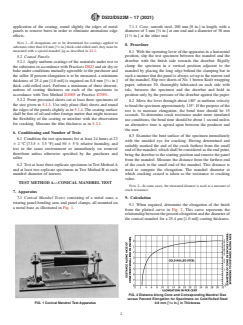
application of the coating, round slightly the edges of metal 7.1.1 Cone, smooth steel, 200 mm [8 in.] in length, with a
panels to remove burrs in order to eliminate anomalous edge diameter of 3 mm [ ⁄8 in.] at one end and a diameter of 38 mm
effects. [1 ⁄2 in.] at the other end.
NOTE 1—If elongations are to be determined for coatings applied to
8. Procedure
substrates other than 0.8 mm [ ⁄32 in.] thick cold-rolled steel, they must be
measured with a special mandrel jig as described in X1.2.
8.1 With the operating lever of the apparatus in a horizontal
position, slip the test specimen between the mandrel and the
5.2 Coated Panels:
drawbar with the finish side towards the drawbar. Rigidly
5.2.1 Apply uniform coatings of the materials under test to
clamp the specimen in a vertical position adjacent to the
thesubstratesinaccordancewithPracticesD823andairdryor
mandrel by placing the long edge behind the clamping bar in
bake under conditions mutually agreeable to the purchaser and
suchamannerthatthepanelisalwayssetuptothenarrowend
the seller. If percent elongation is to be measured, a minimum
of the mandrel. Slip two sheets of No. 1 brown Kraft wrapping
thickness of 25.4 µm [1.0 mil] is required on 0.8 mm [ ⁄32 in.]
paper, substrate 30, thoroughly lubricated on each side with
thick cold-rolled steel. Perform a minimum of three determi-
talc, between the specimen and the drawbar and hold in
nations of coating thickness on each of the specimens in
position only by the pressure of the drawbar against the paper.
accordance with Test Method D1005 or Practice D7091.
5.2.2 From precoated sheets cut at least three specimens of
8.2 Move the lever through about 180° at uniform velocity
the size given in 5.1.3. Use only plane (flat) sheets and round
tobendthespecimenapproximately135°.Ifthepurposeofthe
the edges of the panels slightly as in 5.1.4.The coating surface
test is to measure elongation, the bend time should be 15
shall be free of oil and other foreign matter that might increase
seconds. To determine crack resistance under more simulated
the flexibility of the coating or interfere with the observation
use conditions, the bend time should be about 1 second unless
for cracking. Measure the film thickness as in 5.2.1.
an alternative time is agreed upon between the producer and
the user.
6. Conditioning and Number of Tests
8.3 Examine the bent surface of the specimen immediately
6.1 Condition the test specimens for at least 24 hours at23
with the unaided eye for cracking. Having determined and
6 2°C [73.5 6 3.5°F] and 50 6 5% relative humidity, and
suitably marked the end of the crack farthest from the small
test in the same environment or immediately on removal
endofthemandrel,whichshallbeconsideredastheendpoint,
therefrom unless otherwise specified by the purchaser and
bringthedrawbartothestartingpositionandremovethepanel
seller.
from the mandrel. Measure the distance from the farthest end
of the crack to the small end of the mandrel. This distance is
6.2 Test at least three replicate specimens in Test MethodA
and at least two replicate specimens in Test Method B at each used to compute the elongation. The mandrel diameter at
which cracking ceased is taken as the resistance to cracking
mandrel diameter of interest.
value.
TEST METHOD A—CONICAL MANDREL TEST
NOTE 2—In some cases, the
...