

ASTM A563/A563M-23
(Specification)Standard Specification for Carbon and Alloy Steel Nuts (Inch and Metric)
General Information
- Abstract
ABSTRACT
This specification covers chemical and mechanical requirements for eight property classes of hex and hex-flange carbon and alloy steel nuts for general structural and mechanical uses on bolts, studs, and other externally threaded parts. Materials shall be tested and the individual grades shall conform to specified values of material such as hardness and proof load, chemical, and mechanical requirements. Classes 8S3 and 10S3 nuts have atmospheric corrosion resistance and weathering characteristics comparable to those of the steels. The atmospheric corrosion resistance of these steels is substantially better than that of carbon steel with or without copper addition. When properly exposed to the atmosphere, these steels can be used bare (uncoated) for many applications.
SCOPE
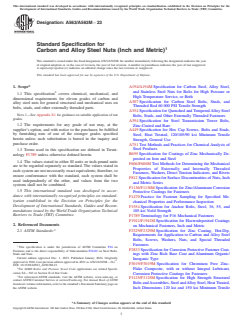
1.1 This specification2 covers chemical, mechanical, and dimensional requirements for eleven grades of carbon and alloy steel nuts for general structural and mechanical uses on bolts, studs, and other externally threaded parts.
Note 1: See Appendix X1 for guidance on suitable application of nut grades.
1.2 The requirements for any grade of nut may, at the supplier's option, and with notice to the purchaser, be fulfilled by furnishing nuts of one of the stronger grades specified herein unless such substitution is barred in the inquiry and purchase order.
1.3 Terms used in this specification are defined in Terminology F1789 unless otherwise defined herein.
1.4 The values stated in either SI units or inch-pound units are to be regarded separately as standard. The values stated in each system are not necessarily exact equivalents; therefore, to ensure conformance with the standard, each system shall be used independently of the other, and values from the two systems shall not be combined.
1.5 This international standard was developed in accordance with internationally recognized principles on standardization established in the Decision on Principles for the Development of International Standards, Guides and Recommendations issued by the World Trade Organization Technical Barriers to Trade (TBT) Committee.
- Status
- Published
- Publication Date
- 30-Nov-2023
- Technical Committee
- F16 - Fasteners
- Drafting Committee
- F16.02 - Steel Bolts, Studs and Nuts
Buy Documents
ASTM A563/A563M-23 - Standard Specification for Carbon and Alloy Steel Nuts (Inch and Metric)
REDLINE ASTM A563/A563M-23 - Standard Specification for Carbon and Alloy Steel Nuts (Inch and Metric)
Overview
ASTM A563/A563M-23: Standard Specification for Carbon and Alloy Steel Nuts (Inch and Metric) sets the requirements for chemical, mechanical, and dimensional properties of carbon and alloy steel nuts. This standard applies to eleven different grades and various property classes of hex and hex-flange nuts designed for use with bolts, studs, and other externally threaded parts in structural and mechanical applications. Both inch and metric dimensions are covered, supporting a wide range of industries and international applications.
Notably, the specification accounts for nuts with enhanced atmospheric corrosion resistance, aligning with global practices for durability and weather-resistant fasteners. The requirements ensure the nuts meet essential criteria for strength, hardness, proof load, and proper thread fit-ensuring reliable, safe installations in critical infrastructure and machinery worldwide.
Key Topics
- Range of Grades and Classes: Covers multiple grades (such as A, B, C, D, DH, 8S, 10S, and weathering grades like 8S3 and 10S3) to address various mechanical and environmental demands.
- Material and Processes: Specifies acceptable steelmaking processes, heat treatment methods, and surface finishes including coatings and lubricants.
- Mechanical Properties: Outlines mandatory hardness and proof load requirements, providing benchmarks for performance and reliability in service.
- Thread and Dimensional Requirements: Requires conforming to recognized ASME and ISO thread and size standards for interchangeability and compatibility.
- Corrosion Resistance: Identifies property classes designed to match the corrosion resistance of weathering steels, supporting bare (uncoated) use when properly exposed.
- Quality Assurance: Details requirements for lot control, traceability, and mandatory testing such as hardness, proof load, and coating thickness.
Applications
ASTM A563/A563M-23 covers carbon and alloy steel nuts suitable for:
- Structural Connections: Used in steel construction, bridges, industrial facilities, and transmission towers where high strength and consistent performance are critical.
- General Mechanical Assembly: Ensures safe, secure assemblies in machinery, automotive applications, and heavy equipment.
- Corrosive Environments: Weathering grades (such as 8S3 and 10S3) support use in outdoor, exposed, or otherwise aggressive settings without the need for protective coatings.
- Custom and High-strength Fastener Systems: When paired with compatible bolts and threaded rods manufactured to various ASTM and ASME fastener specifications.
- International Projects: With both inch and metric sizing, the standard facilitates global procurement and use.
Related Standards
ASTM A563/A563M-23 references and aligns with several key fastener and materials standards, ensuring broad compatibility and compliance, including:
- ASTM A307, A354, F1554 - Bolts, studs, and threaded rod requirements
- ASTM F606/F606M - Mechanical property test methods for fasteners
- ASTM F1941/F1941M, F2329/F2329M, and B695 - Coating specifications for corrosion protection
- ASTM F1789 - Terminology for mechanical fasteners
- ASME B1.1, B18.2.2, and B18.2.6M - Thread and dimensional standards
- SAE J995 - Mechanical and material requirements for steel nuts
These references enable users to specify complete and compatible fastener assemblies with confidence in quality, interchangeability, and international compliance.
Keywords: ASTM A563, steel nuts, carbon steel, alloy steel, structural nuts, thread specifications, corrosion resistance, mechanical properties, fastener standards, inch and metric, weathering steel nuts, coatings, construction fasteners, international standards.
Relations
- Replaces
ASTM A563/A563M-21ae1 - Standard Specification for Carbon and Alloy Steel Nuts (Inch and Metric) - Effective Date
- 01-Dec-2023
- Effective Date
- 01-Jan-2024
- Refers
ASTM A394-08(2024) - Standard Specification for Steel Transmission Tower Bolts, Zinc-Coated and Bare - Effective Date
- 01-Jan-2024
- Effective Date
- 01-Aug-2019
- Refers
ASTM A394-08(2015) - Standard Specification for Steel Transmission Tower Bolts, Zinc-Coated and Bare - Effective Date
- 15-Jun-2015
- Effective Date
- 01-Dec-2023
- Effective Date
- 01-Dec-2023
- Effective Date
- 01-Dec-2023
- Referred By
ASTM B695-21 - Standard Specification for Coatings of Zinc Mechanically Deposited on Iron and Steel - Effective Date
- 01-Dec-2023
Buy Documents
ASTM A563/A563M-23 - Standard Specification for Carbon and Alloy Steel Nuts (Inch and Metric)
REDLINE ASTM A563/A563M-23 - Standard Specification for Carbon and Alloy Steel Nuts (Inch and Metric)
Frequently Asked Questions
ASTM A563/A563M-23 is a technical specification published by ASTM International. Its full title is "Standard Specification for Carbon and Alloy Steel Nuts (Inch and Metric)". This standard covers: ABSTRACT This specification covers chemical and mechanical requirements for eight property classes of hex and hex-flange carbon and alloy steel nuts for general structural and mechanical uses on bolts, studs, and other externally threaded parts. Materials shall be tested and the individual grades shall conform to specified values of material such as hardness and proof load, chemical, and mechanical requirements. Classes 8S3 and 10S3 nuts have atmospheric corrosion resistance and weathering characteristics comparable to those of the steels. The atmospheric corrosion resistance of these steels is substantially better than that of carbon steel with or without copper addition. When properly exposed to the atmosphere, these steels can be used bare (uncoated) for many applications. SCOPE 1.1 This specification2 covers chemical, mechanical, and dimensional requirements for eleven grades of carbon and alloy steel nuts for general structural and mechanical uses on bolts, studs, and other externally threaded parts. Note 1: See Appendix X1 for guidance on suitable application of nut grades. 1.2 The requirements for any grade of nut may, at the supplier's option, and with notice to the purchaser, be fulfilled by furnishing nuts of one of the stronger grades specified herein unless such substitution is barred in the inquiry and purchase order. 1.3 Terms used in this specification are defined in Terminology F1789 unless otherwise defined herein. 1.4 The values stated in either SI units or inch-pound units are to be regarded separately as standard. The values stated in each system are not necessarily exact equivalents; therefore, to ensure conformance with the standard, each system shall be used independently of the other, and values from the two systems shall not be combined. 1.5 This international standard was developed in accordance with internationally recognized principles on standardization established in the Decision on Principles for the Development of International Standards, Guides and Recommendations issued by the World Trade Organization Technical Barriers to Trade (TBT) Committee.
ABSTRACT This specification covers chemical and mechanical requirements for eight property classes of hex and hex-flange carbon and alloy steel nuts for general structural and mechanical uses on bolts, studs, and other externally threaded parts. Materials shall be tested and the individual grades shall conform to specified values of material such as hardness and proof load, chemical, and mechanical requirements. Classes 8S3 and 10S3 nuts have atmospheric corrosion resistance and weathering characteristics comparable to those of the steels. The atmospheric corrosion resistance of these steels is substantially better than that of carbon steel with or without copper addition. When properly exposed to the atmosphere, these steels can be used bare (uncoated) for many applications. SCOPE 1.1 This specification2 covers chemical, mechanical, and dimensional requirements for eleven grades of carbon and alloy steel nuts for general structural and mechanical uses on bolts, studs, and other externally threaded parts. Note 1: See Appendix X1 for guidance on suitable application of nut grades. 1.2 The requirements for any grade of nut may, at the supplier's option, and with notice to the purchaser, be fulfilled by furnishing nuts of one of the stronger grades specified herein unless such substitution is barred in the inquiry and purchase order. 1.3 Terms used in this specification are defined in Terminology F1789 unless otherwise defined herein. 1.4 The values stated in either SI units or inch-pound units are to be regarded separately as standard. The values stated in each system are not necessarily exact equivalents; therefore, to ensure conformance with the standard, each system shall be used independently of the other, and values from the two systems shall not be combined. 1.5 This international standard was developed in accordance with internationally recognized principles on standardization established in the Decision on Principles for the Development of International Standards, Guides and Recommendations issued by the World Trade Organization Technical Barriers to Trade (TBT) Committee.
ASTM A563/A563M-23 is classified under the following ICS (International Classification for Standards) categories: 21.060.20 - Nuts. The ICS classification helps identify the subject area and facilitates finding related standards.
ASTM A563/A563M-23 has the following relationships with other standards: It is inter standard links to ASTM A563/A563M-21ae1, ASTM F1470-24, ASTM A394-08(2024), ASTM F1470-19, ASTM A394-08(2015), ASTM F3125/F3125M-23, ASTM F1789-23, ASTM B746/B746M-22e1, ASTM B695-21. Understanding these relationships helps ensure you are using the most current and applicable version of the standard.
ASTM A563/A563M-23 is available in PDF format for immediate download after purchase. The document can be added to your cart and obtained through the secure checkout process. Digital delivery ensures instant access to the complete standard document.
Standards Content (Sample)
This international standard was developed in accordance with internationally recognized principles on standardization established in the Decision on Principles for the
Development of International Standards, Guides and Recommendations issued by the World Trade Organization Technical Barriers to Trade (TBT) Committee.
Designation: A563/A563M − 23
Standard Specification for
Carbon and Alloy Steel Nuts (Inch and Metric)
This standard is issued under the fixed designation A563/A563M; the number immediately following the designation indicates the year
of original adoption or, in the case of revision, the year of last revision. A number in parentheses indicates the year of last reapproval.
A superscript epsilon (´) indicates an editorial change since the last revision or reapproval.
This standard has been approved for use by agencies of the U.S. Department of Defense.
1. Scope* A194/A194M Specification for Carbon Steel, Alloy Steel,
and Stainless Steel Nuts for Bolts for High Pressure or
1.1 This specification covers chemical, mechanical, and
High Temperature Service, or Both
dimensional requirements for eleven grades of carbon and
A307 Specification for Carbon Steel Bolts, Studs, and
alloy steel nuts for general structural and mechanical uses on
Threaded Rod 60 000 PSI Tensile Strength
bolts, studs, and other externally threaded parts.
A354 Specification for Quenched and Tempered Alloy Steel
NOTE 1—See Appendix X1 for guidance on suitable application of nut
Bolts, Studs, and Other Externally Threaded Fasteners
grades.
A394 Specification for Steel Transmission Tower Bolts,
1.2 The requirements for any grade of nut may, at the
Zinc-Coated and Bare
supplier’s option, and with notice to the purchaser, be fulfilled
A449 Specification for Hex Cap Screws, Bolts and Studs,
by furnishing nuts of one of the stronger grades specified
Steel, Heat Treated, 120/105/90 ksi Minimum Tensile
herein unless such substitution is barred in the inquiry and
Strength, General Use
purchase order.
A751 Test Methods and Practices for Chemical Analysis of
Steel Products
1.3 Terms used in this specification are defined in Termi-
B695 Specification for Coatings of Zinc Mechanically De-
nology F1789 unless otherwise defined herein.
posited on Iron and Steel
1.4 The values stated in either SI units or inch-pound units
F606/F606M Test Methods for Determining the Mechanical
are to be regarded separately as standard. The values stated in
Properties of Externally and Internally Threaded
each system are not necessarily exact equivalents; therefore, to
Fasteners, Washers, Direct Tension Indicators, and Rivets
ensure conformance with the standard, each system shall be
F812 Specification for Surface Discontinuities of Nuts, Inch
used independently of the other, and values from the two
and Metric Series
systems shall not be combined.
F1136/F1136M Specification for Zinc/Aluminum Corrosion
1.5 This international standard was developed in accor-
Protective Coatings for Fasteners
dance with internationally recognized principles on standard-
F1470 Practice for Fastener Sampling for Specified Me-
ization established in the Decision on Principles for the
chanical Properties and Performance Inspection
Development of International Standards, Guides and Recom-
F1554 Specification for Anchor Bolts, Steel, 36, 55, and
mendations issued by the World Trade Organization Technical
105-ksi Yield Strength
Barriers to Trade (TBT) Committee.
F1789 Terminology for F16 Mechanical Fasteners
F1941/F1941M Specification for Electrodeposited Coatings
2. Referenced Documents
on Mechanical Fasteners, Inch and Metric
F2329/F2329M Specification for Zinc Coating, Hot-Dip,
2.1 ASTM Standards:
Requirements for Application to Carbon and Alloy Steel
Bolts, Screws, Washers, Nuts, and Special Threaded
Fasteners
This specification is under the jurisdiction of ASTM Committee F16 on
F2833 Specification for Corrosion Protective Fastener Coat-
Fasteners and is the direct responsibility of Subcommittee F16.02 on Steel Bolts,
Studs and Nuts.
ings with Zinc Rich Base Coat and Aluminum Organic/
Current edition approved Dec. 1, 2023. Published January 2024. Originally
Inorganic Type
ɛ1
approved in 1966. Last previous edition approved in 2021 as A563/A563M – 21a .
F3019/F3019M Specification for Chromium Free Zinc-
DOI: 10.1520/A0563_A0563M-23.
Flake Composite, with or without Integral Lubricant,
For ASME Boiler and Pressure Vessel Code applications see related Specifi-
cation SA – 563 in Section II of that Code.
Corrosion Protective Coatings for Fasteners
For referenced ASTM standards, visit the ASTM website, www.astm.org, or
F3125/F3125M Specification for High Strength Structural
contact ASTM Customer Service at service@astm.org. For Annual Book of ASTM
Bolts and Assemblies, Steel and Alloy Steel, Heat Treated,
Standards volume information, refer to the standard’s Document Summary page on
the ASTM website. Inch Dimensions 120 ksi and 150 ksi Minimum Tensile
*A Summary of Changes section appears at the end of this standard
Copyright © ASTM International, 100 Barr Harbor Drive, PO Box C700, West Conshohocken, PA 19428-2959. United States
A563/A563M − 23
Strength, and Metric Dimensions 830 MPa and 1040 MPa 4.3.2 Grades C, C3, and D nuts made of any steel permitted
Minimum Tensile Strength for these grades may be heat treated by quenching in a liquid
F3148 Specification for High Strength Structural Bolt medium from a temperature above the transformation tempera-
Assemblies, Steel and Alloy Steel, Heat Treated, 144ksi ture and tempering at a temperature of at least 800 °F or
Minimum Tensile Strength, Inch Dimensions 425 °C.
F3393 Specification for Zinc-Flake Coating Systems for
4.4 Coatings and Other Finishes:
Fasteners
4.4.1 Permitted coatings, including supplementary lubrica-
G101 Guide for Estimating the Atmospheric Corrosion Re-
tion and nut overtap requirements are provided in Annex A1.
sistance of Low-Alloy Steels
4.4.2 When coated fasteners are required, the purchaser
2.2 ASME Standards:
shall specify the process and any additional special require-
ASME B1.1 Unified Screw Threads
ments.
ASME B18.2.2 Square and Hex Nuts
4.4.3 Hot-dip zinc coated nuts shall be installed with hot-dip
ASME B18.2.6 Fasteners for Use in Structural Applications
zinc coated bolts. Hot-dip zinc coated nuts and bolts shall be
ASME B18.2.6M Metric Fasteners for Use in Structural
coated per F2329/F2329M.
Applications
4.4.4 Mechanically deposited zinc coated nuts shall be
ASME B1.13M Metric Screw Threads-M Profile
installed with mechanically deposited zinc coated bolts. Me-
2.3 SAE Standard:
chanically deposited zinc coated nuts and bolts shall be coated
SAE J995 Mechanical and Material Requirements for Steel
per B695.
Nuts
4.4.5 Hot-dip and mechanically deposited zinc and Zn/Al
coating overtap allowances are specified in 7.3.
3. Ordering Information
4.5 Lubricant:
3.1 Orders for nuts under this specification shall include the
4.5.1 Hot-dip and mechanically deposited zinc-coated
following:
Grade DH and 10S nuts shall be provided with an additional
3.1.1 Quantity (number of nuts),
lubricant which shall be clean and dry to the touch (see
3.1.2 Nominal size and thread series of nuts,
Supplementary Requirement S1 to specify lubrication require-
3.1.3 Style of nut (for example, heavy hex),
ments for plain finish nuts).
3.1.4 Grade of nut,
4.5.2 See Supplementary Requirement S2 for option to
3.1.5 Coatings or finishes—If other than plain finish, specify
specify a dye in the lubricant.
the coating process or finish required, see 4.4 and Annex A1.
3.1.6 ASTM designation and year of issue, and
5. Chemical Composition
3.1.7 Any special observation or inspection requirements
shall be specified at the time of inquiry and at the time of order.
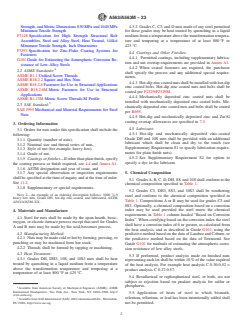
5.1 Grades A, B, C, D, DH, 8S, and 10S shall conform to the
See 11.2.
chemical composition specified in Table 1.
3.1.8 Supplementary or special requirements.
5.2 Grades C3, DH3, 8S3, and 10S3 shall be weathering
NOTE 2—An example of an ordering description follows: 1000 ⁄8-9
steel and conform to the chemical composition specified in
heavy hex nuts, Grade DH, hot-dip zinc-coated, and lubricated, ASTM
Table 1. Compositions A or B may be used for grades C3 and
A563/A563M–XX.
8S3. Optionally, a chemical composition based on a corrosion
index may be used provided the steel meets the chemical
4. Materials and Manufacture
requirements in Table 1 column headed “Based on Corrosion
4.1 Steel for nuts shall be made by the open-hearth, basic-
Index”. When certifying based on the corrosion index the steel
oxygen, or electric-furnace process except that steel for Grades
shall have a corrosion index of 6 or greater, as calculated from
A and B nuts may be made by the acid-bessemer process.
the heat analysis, and as described in Guide G101, using the
4.2 Manufacturing Method:
predictive method based on the data of Larabee and Coburn, or
4.2.1 Nuts may be made cold or hot by forming, pressing, or
the predictive method based on the data of Townsend. See
punching or may be machined from bar stock.
Guide G101 for methods of estimating the atmospheric corro-
4.2.2 Threads shall be formed by tapping or machining.
sion resistance of low alloy steels.
4.3 Heat Treatment:
5.3 If performed, product analysis made on finished nuts
4.3.1 Grades DH, DH3, 10S, and 10S3 nuts shall be heat
representing each lot shall be within 10 % of the value required
treated by quenching in a liquid medium from a temperature
of the heat analysis. For example heat analysis C 0.30-0.52 =
above the transformation temperature and tempering at a
product analysis C 0.27-0.57.
temperature of at least 800 °F or 425 °C.
5.4 Resulfurized or rephosphorized steel, or both, are not
subject to rejection based on product analysis for sulfur or
phosphorus.
Available from American Society of Mechanical Engineers (ASME), ASME
International Headquarters, Two Park Ave., New York, NY 10016-5990, http://
5.5 Application of heats of steel to which bismuth,
www.asme.org.
selenium, tellurium, or lead has been intentionally added shall
Available from SAE International (SAE), 400 Commonwealth Dr., Warrendale,
PA 15096, http://www.sae.org. not be permitted.
A563/A563M − 23
A
TABLE 1 Chemical Requirements
Nut Grade A, B, C, 8S C3, 8S3 D DH, 10S DH3, 10S3
Heat Analysis Composition Composition Composition Based on Composition % Composition % Based on
% A % B % Corrosion Corrosion
C C
Index Index
Carbon 0.55 max 0.33-0.40 0.38-0.48 0.30-0.53 0.55 max 0.20-0.55 0.20-0.53 0.30-0.53
B
Manganese 0.90-1.20 0.70-0.90 0.60 min 0.30 min 0.60 min 0.40 min 0.60 min
Phosphorus, max 0.12 0.035 0.035 0.035 0.04 0.04 0.035 0.035
D E E
Sulfur, max 0.15 0.040 0.040 0.040 0.05 0.05 0.040 0.040
B B B B B B
Silicon 0.15-0.35 0.30-0.50
B B B
Copper 0.25-0.45 0.20-0.40 0.20-0.60 0.20 min 0.20-0.60
B F B B F F
Nickel 0.25-0.45 0.50-0.80 0.20 min 0.20 min 0.20 min
B B B
Chromium 0.45-0.65 0.50-0.75 0.45 min 0.45 min 0.45 min
B B B B B B B B
Vanadium
B B F B B F F
Molybdenum 0.06 max 0.10 min 0.15 min 0.10 min
B B B B B B B B
Titanium
A
Based on heat analysis. See 5.3 for product analysis requirements.
B
Not specified.
C
See 5.2.
D
For Grades A, B, and 8S a sulfur content of 0.23 % max is acceptable with the purchasers approval.
E
For Grades D, DH, and 10S a sulfur content of 0.05 – 0.15 % is acceptable provided the manganese is 1.35 % min.
F
Either Nickel or Molybdenum must be present in the amount specified.
5.6 Chemical analyses shall be performed in accordance manufacturer in accordance with Test Methods F606/F606M.
with Test Methods, Practices, and Terminology A751. In all cases, proof load testing shall take precedence over
hardness testing in the event a conflict exists relative to
6. Mechanical Properties
minimum strength.
6.1 Hardness:
7. Dimensions
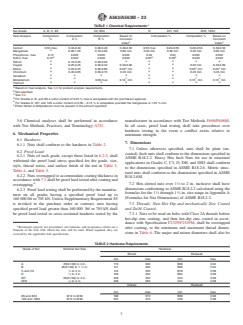
6.1.1 Nuts shall conform to the hardness in Table 2.
7.1 Unless otherwise specified, nuts shall be plain (un-
6.2 Proof Load:
coated). Inch nuts shall conform to the dimensions specified in
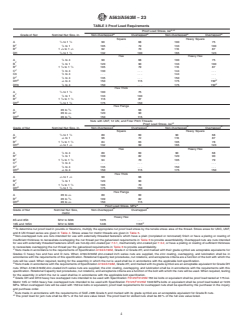
6.2.1 Nuts of each grade, except those listed in 6.2.3, shall
ASME B18.2.2. Heavy Hex Inch Nuts for use in structural
withstand the proof load stress specified for the grade, size,
applications in Grades C, C3, D, DH, and DH3 shall conform
style, thread series, and surface finish of the nut in Table 3,
to the dimensions specified in ASME B18.2.6. Metric struc-
Table 4, and Table 5.
tural nuts shall conform to the dimensions specified in ASME
6.2.2 Nuts overtapped to accommodate coating thickness in
B18.2.6M.
accordance with 7.3 shall be proof load tested after coating and
7.2 Hex-slotted nuts over 1 ⁄2 to 2 in. inclusive shall have
overtapping.
dimensions conforming to ASME B18.2.2 calculated using the
6.2.3 Proof load testing shall be performed by the manufac-
1 1
formulas for the 1 ⁄4 through 1 ⁄2-in. size range in Appendix A
turer on all grades having a specified proof load up to
(Formulas for Nut Dimensions) of ASME B18.2.2.
160 000 lbf or 705 kN. Unless Supplementary Requirement S5
is invoked in the purchase order or contract, nuts having 7.3 Threads: Nuts Hot Dip and mechanically Zinc Coated
specified proof load greater than 160 000 lbf or 705 kN shall
and Zn/Al Coated:
be proof load tested or cross-sectional hardness tested by the 7.3.1 Nuts to be used on bolts with Class 2A threads before
hot-dip zinc coating, and then hot-dip zinc coated in accor-
dance with Specification F2329/F2329M, shall be overtapped
Rotational capacity test procedures, nut rotations, and acceptance criteria are a
after coating, to the minimum and maximum thread dimen-
function of the bolt with which the nuts will be used. When required, they are
sions in Table 6. The major and minor diameters shall also be
covered by the applicable bolt specification.
TABLE 2 Hardness Requirements
Grade of Nut Nominal Nut Size Hardness
Brinell Rockwell
min max min max
A #6(0.138) to 4 in. 116 302 B68 C32
B #6(0.138) to 1 ⁄2 in. 121 302 B69 C32
C and C3 ⁄2 to 4 in. 143 352 B78 C38
D ⁄4 to 4 in. 159 352 B84 C38
DH #6(0.138) to 4 in. 248 352 C24 C38
DH3 ⁄2 to 4 in. 248 352 C24 C38
Vickers Rockwell
min max min max
8S and 8S3 M12 to M36 188 372 B89 C38
10S and 10S3 M12 to M36 272 372 C26 C38
A563/A563M − 23
TABLE 3 Proof Load Requirements
A,G
Proof Load Stress, ksi
B B B B
Grade of Nut Nominal Nut Size, in. Non-Overtapped Overtapped Non-Overtapped Overtapped
Square Heavy Square
1 1
A ⁄4 to 1 ⁄2 90 68 100 75
F
B ⁄4 to 1 105 79 133 100
F
1 1
B 1 ⁄8 to 1 ⁄2 92 70 116 87
1 1
DH ⁄4 to 1 ⁄2 132 100 165 123
Hex Heavy Hex
A ⁄4 to 4 90 68 100 75
F
B ⁄4 to 1 120 90 133 100
F
1 1
B 1 ⁄8 to 1 ⁄2 105 79 116 87
C
C ⁄2 to 4 130 . . . 144 . . .
C3 ⁄2 to 4 . . . . . . 144 . . .
C
D ⁄4 to 4 135 . . . 150 . . .
D E
DH ⁄4 to 4 150 115 175 150
E
DH3 ⁄4 to 4 150 . . . 175 150
Hex Thick
1 1
A ⁄4 to 1 ⁄2 100 75
F
B ⁄4 to 1 133 100
F
1 1
B 1 ⁄8 to 1 ⁄2 116 87
D
1 1
DH ⁄4 to 1 ⁄2 175 150
Hex Flange
A #6 to ⁄4 90 68
F
B #6 to ⁄4 120 90
D 3
DH #6 to ⁄4 150 115
Nuts with UNF, 12 UN, and Finer Pitch Threads
G
Proof Load Stress, ksi
B B B B
Grade of Nut Nominal Nut Size, in. Non-Overtapped Overtapped Non-Overtapped Overtapped
Square Heavy Square
1 1
A ⁄4 to 1 ⁄2 80 60 90 68
F
B ⁄4 to 1 96 72 116 87
F
1 1
B 1 ⁄8 to 1 ⁄2 84 63 105 78
D
1 1
DH ⁄4 to 1 ⁄2 132 99 165 123
Hex Heavy Hex
A ⁄4 to 4 80 60 90 68
F
B ⁄4 to 1 109 82 120 90
F
1 1
B 1 ⁄8 to 1 ⁄2 94 70 105 79
C
C ⁄2 to 4 . . . . . . . . . . . .
C
D ⁄4 to 4 135 . . . 150 . . .
D
DH ⁄4 to 4 150 115 175 150
Hex Thick
1 1
A ⁄4 to 1 ⁄2 90 68
F 1
B ⁄4 to 1 120 90
F
1 1
B 1 ⁄8 to 1 ⁄2 105 70
D
1 1
DH ⁄4 to 1 ⁄2 175 150
Hex Flange
A #6 to ⁄4 80 60
F
B #6 to ⁄4 109 82
D
DH #6 to ⁄4 150 115
A
Proof Load Stress, MPa
B B
Grade of Nut Nominal Nut Size, Non-Overtapped Overtapped
metric
Heavy Hex
8S and 8S3 M12 to M36 1075 . . .
E
10S and 10S3 M12 to M36 1245 1165
A
To determine nut proof load in pounds or Newtons, multiply the appropriate nut proof load stress by the tensile stress area of the thread. Stress areas for UNC, UNF,
and 8 UN thread series are given in Table 4. Stress areas for metric threads are given in Table 5.
B
Non-overtapped nuts are nuts intended for use with externally threaded fasteners which have a plain (nonplated or noncoated) finish or have a plating or coating of
insufficient thickness to necessitate overtapping the nut thread per the galvanized requirements in Table 6 to provide assemblability. Overtapped nuts are nuts intended
for use with externally threaded fasteners which are hot-dip zinc-coated per 7.3.1, mechanically zinc-coated per 7.3.2, or have a plating or coating of sufficient thickness
to necessitate overtapping the nut thread per the galvanized requirements in Table 6 to provide assemblability.
C
Nuts made in accordance to the requirements of Specification A194/A194M, Grade 2 or Grade 2H, and marked with their grade symbol are acceptable equivalents for
Grades C heavy hex and hex and D nuts. When A194/A194M zinc-coated inch series nuts are supplied, the zinc coating, overtapping, and lubrication shall be in
accordance with the requirements of this specification. Rotational Capacity test procedures, nut rotations, and acceptance criteria are a function of the bolt with which the
nuts will be used. When required, testing for the assembly in which the nut is used shall be in accordance with the applicable bolt specification.
D
Nuts made in accordance with the requirements of Specification A194/A194M, Grade 2H, and marked with its grade symbol are an acceptable equivalent for Grade DH
nuts. When A194/A194M zinc-coated inch series nuts are supplied, the zinc coating, overtapping, and lubrication shall be in accordance with the requirements with this
specification. Rotational Capacity test procedures, nut rotations, and acceptance criteria are a function of the bolt with which the nuts will be used. When required, testing
for the assembly in which the nut is used shall be in accordance with the applicable bolt specification.
E
Grade DH and DH3 heavy hex overtapped nuts intended to be used with Specification F3125/F3125M 150 ksi bolts or equivalent shall be proof load tested at 175 ksi.
Metric 10S or 10S3 heavy hex overtapped nuts intended to be used with Specification F3125/F3125M 1040 MPa bolts or equivalent shall be proof load tested at 1245
MPa. When overtapped nuts will be used with 150 ksi bolts or equivalent, proof load requirements for overtapped nuts shall be specified by the purchaser in the inquiry
and purchase order.
F
Nuts made in accordance with the requirements of SAE J995 Grade 5 and marked with its grade symbol are an acceptable equivalent for Grade B nuts.
G
The proof load for jam nuts shall be 60 % of the full size value listed. The proof load for slotted nuts shall be 80 % of the full size value listed.
A563/A563M − 23
TABLE 4 Tensile Stress Areas—Inch
overtap values are permitted as long as it is sufficient to permit
Nominal UNC Nominal UNF Nominal 8 UN free assembly with mechanically deposited zinc coated bolts.
Size– Size- Size–
Tensile Stress Tensile Stress Tensile Stress 7.3.3 Zn/Al coated nuts to be used with Zn/Al coated
Threads A Threads A 2 Threads A 2
Area, A in. Area A in. Area, A in.
s 2 s s
F3125/F3125M bolts shall be overtapped prior to zinc coating
per Inch per Inch per Inch
to the minimum and maximum dimensions in Table 6. The
#6–32 0.00909 #6–40 0.01015
major and minor diameters shall also be increased by the
#8–32 0.0140 #8–36 0.01474
allowance to provide the corresponding minimum and maxi-
#10–24 0.0175 #10–32 0.0200
mum major and minor diameters. When specified by the
#12–24 0.0242 #12–28 0.0258
1 1
⁄4 –20 0.0318 ⁄4 –28 0.0364 . . purchaser, lower overtap values are permitted as long as it is
5 5
⁄16 –18 0.0524 ⁄16 –24 0.0580 . .
sufficient to permit free assembly with Zn/Al coated bolts.
3 3
⁄8 –16 0.0775 ⁄8 –24 0.0878 . .
7 7
⁄16 –14 0.1063 ⁄16 –20 0.1187 . .
NOTE 3—It is the intent of this specification that coated nuts and bolts
1 1
⁄2 –13 0.1419 ⁄2 –20 0.1599 . .
assemble freely when ordered together. It is recognized that the batch
9 9
⁄16 –12 0.182 ⁄16 –18 0.203 . .
nature of the coating process and the cumulative effect of coating
5 5
⁄8 –11 0.226 ⁄8 –18 0.256 . .
thickness may create intermittent assembly problems. Staying within the
3 3
⁄4 –10 0.334 ⁄4 –16 0.373 . .
7 7 material limits is important for assembly strength. Users are encouraged to
⁄8 –9 0.462 ⁄8 –14 0.509 . .
use the smallest nut overtap amount which permits consistent free
1–8 0.606 1–12 0.663 1–8 0.606
1 1 1
1 ⁄8 –7 0.763 1 ⁄8 –12 0.856 1 ⁄8 –8 0.790 assembly.
1 1 1
1 ⁄4 –7 0.969 1 ⁄4 –12 1.073 1 ⁄4 –8 1.000
7.4 Threads: Nuts With Other Coatings
3 3 3
1 ⁄8 –6 1.155 1 ⁄8 –12 1.315 1 ⁄8 –8 1.233
1 1 1
1 ⁄2 –6 1.405 1 ⁄2 –12 1.581 1 ⁄2 –8 1.492 7.4.1 Nuts to be used on bolts mechanically zinc coated or
3 3
1 ⁄4 –5 1.90 . . 1 ⁄4 –8 2.08
on bolts hot-dip zinc-coated to a specification other than
2–4 ⁄2 2.50 . . 2–8 2.77
Specification F2329/F2329M, or otherwise hot-dip coated,
1 1 1
2 ⁄4 –4 ⁄2 3.25 . . 2 ⁄4 –8 3.56
1 1
2 ⁄2 –4 4.00 . . 2 ⁄2 –8 4.44 shall be overtapped by a diametral amount sufficient to permit
3 3
2 ⁄4 –4 4.93 . . 2 ⁄4 –8 5.43
assembly on the coated bolt thread, unless other requirements
3–4 5.97 . . 3–8 6.51
are specified in the inquiry or purchase order.
1 1
3 ⁄4 –4 7.10 . . 3 ⁄4 –8 7.69
1 1
3 ⁄2 –4 8.33 . . 3 ⁄2 –8 8.96
7.4.2 When specifically permitted by the purchaser, nuts for
3 3
3 ⁄4 –4 9.66 . . 3 ⁄4 –8 10.34
bolts with electrodeposited coating, such as cadmium, zinc,
4–4 11.08 . . 4–8 11.81
and so forth, or with chemically applied coating may be
A
A The inch stress area is calculated as follows:
s
overtapped by a diametral amount sufficient to permit assembly
A 50.7854 sD 2 s0.9743 ⁄ ndd
s
on the coated bolt thread.
where:A = stress area, in. , D = nominal size, (in.), and n= threads per in.
s
7.4.3 The allowable overtap amount shall not exceed that
specified in Table 6.
TABLE 5 Tensile Stress Areas - Metric
8. Testing Lot and Control
A
Nominal size Tensile stress area
A , mm
and thread pitch s
8.1 Testing Responsibility:
M12×1.75 84.3
8.1.1 Each lot shall be tested by the manufacturer prior to
M16×2.0 157
shipment in accordance with the lot control and identification
M20×2.5 245
M22×2.5 303 quality assurance plan in 8.2 – 8.5.
M24×3.0 353
8.1.2 When supplied by a source other than the
M27×3.0 459
manufacturer, the responsible party shall assure all tests have
M30×3.5 561
M36×4.0 817
been performed and the nuts conf
...
This document is not an ASTM standard and is intended only to provide the user of an ASTM standard an indication of what changes have been made to the previous version. Because
it may not be technically possible to adequately depict all changes accurately, ASTM recommends that users consult prior editions as appropriate. In all cases only the current version
of the standard as published by ASTM is to be considered the official document.
´1
Designation: A563/A563M − 21a A563/A563M − 23
Standard Specification for
Carbon and Alloy Steel Nuts (Inch and Metric)
This standard is issued under the fixed designation A563/A563M; the number immediately following the designation indicates the year
of original adoption or, in the case of revision, the year of last revision. A number in parentheses indicates the year of last reapproval.
A superscript epsilon (´) indicates an editorial change since the last revision or reapproval.
This standard has been approved for use by agencies of the U.S. Department of Defense.
ε NOTE—Table 2 was editorially corrected in March 2022.
1. Scope*
1.1 This specification covers chemical and mechanicalchemical, mechanical, and dimensional requirements for eleven grades of
carbon and alloy steel nuts for general structural and mechanical uses on bolts, studs, and other externally threaded parts.
NOTE 1—See Appendix X1 for guidance on suitable application of nut grades.
1.2 The requirements for any grade of nut may, at the supplier’s option, and with notice to the purchaser, be fulfilled by furnishing
nuts of one of the stronger grades specified herein unless such substitution is barred in the inquiry and purchase order.
1.3 Terms used in this specification are defined in Terminology F1789 unless otherwise defined herein.
1.4 The values stated in either SI units or inch-pound units are to be regarded separately as standard. The values stated in each
system are not necessarily exact equivalents; therefore, to ensure conformance with the standard, each system shall be used
independently of the other, and values from the two systems shall not be combined.
1.5 This international standard was developed in accordance with internationally recognized principles on standardization
established in the Decision on Principles for the Development of International Standards, Guides and Recommendations issued
by the World Trade Organization Technical Barriers to Trade (TBT) Committee.
2. Referenced Documents
2.1 ASTM Standards:
A194/A194M Specification for Carbon Steel, Alloy Steel, and Stainless Steel Nuts for Bolts for High Pressure or High
Temperature Service, or Both
A307 Specification for Carbon Steel Bolts, Studs, and Threaded Rod 60 000 PSI Tensile Strength
A354 Specification for Quenched and Tempered Alloy Steel Bolts, Studs, and Other Externally Threaded Fasteners
A394 Specification for Steel Transmission Tower Bolts, Zinc-Coated and Bare
This specification is under the jurisdiction of ASTM Committee F16 on Fasteners and is the direct responsibility of Subcommittee F16.02 on Steel Bolts, Nuts, Rivets
and WashersStuds and Nuts.
Current edition approved July 26, 2021Dec. 1, 2023. Published July 2021January 2024. Originally approved in 1966. Last previous edition approved in 2021 as
ɛ1
A563/A563M – 21.A563/A563M – 21a . DOI: 10.1520/A0563_A0563M-21AE01.10.1520/A0563_A0563M-23.
For ASME Boiler and Pressure Vessel Code applications see related Specification SA – 563 in Section II of that Code.
For referenced ASTM standards, visit the ASTM website, www.astm.org, or contact ASTM Customer Service at service@astm.org. For Annual Book of ASTM Standards
volume information, refer to the standard’s Document Summary page on the ASTM website.
*A Summary of Changes section appears at the end of this standard
Copyright © ASTM International, 100 Barr Harbor Drive, PO Box C700, West Conshohocken, PA 19428-2959. United States
A563/A563M − 23
A449 Specification for Hex Cap Screws, Bolts and Studs, Steel, Heat Treated, 120/105/90 ksi Minimum Tensile Strength,
General Use
A751 Test Methods and Practices for Chemical Analysis of Steel Products
B695 Specification for Coatings of Zinc Mechanically Deposited on Iron and Steel
F606/F606M Test Methods for Determining the Mechanical Properties of Externally and Internally Threaded Fasteners,
Washers, Direct Tension Indicators, and Rivets
F812 Specification for Surface Discontinuities of Nuts, Inch and Metric Series
F1136/F1136M Specification for Zinc/Aluminum Corrosion Protective Coatings for Fasteners
F1470 Practice for Fastener Sampling for Specified Mechanical Properties and Performance Inspection
F1554 Specification for Anchor Bolts, Steel, 36, 55, and 105-ksi Yield Strength
F1789 Terminology for F16 Mechanical Fasteners
F1941/F1941M Specification for Electrodeposited Coatings on Mechanical Fasteners, Inch and Metric
F2329/F2329M Specification for Zinc Coating, Hot-Dip, Requirements for Application to Carbon and Alloy Steel Bolts, Screws,
Washers, Nuts, and Special Threaded Fasteners
F2833 Specification for Corrosion Protective Fastener Coatings with Zinc Rich Base Coat and Aluminum Organic/Inorganic
Type
F3019/F3019M Specification for Chromium Free Zinc-Flake Composite, with or without Integral Lubricant, Corrosion
Protective Coatings for Fasteners
F3125/F3125M Specification for High Strength Structural Bolts and Assemblies, Steel and Alloy Steel, Heat Treated, Inch
Dimensions 120 ksi and 150 ksi Minimum Tensile Strength, and Metric Dimensions 830 MPa and 1040 MPa Minimum
Tensile Strength
F3148 Specification for High Strength Structural Bolt Assemblies, Steel and Alloy Steel, Heat Treated, 144ksi Minimum Tensile
Strength, Inch Dimensions
F3393 Specification for Zinc-Flake Coating Systems for Fasteners
G101 Guide for Estimating the Atmospheric Corrosion Resistance of Low-Alloy Steels
2.2 ASME Standards:
ASME B1.1 Unified Screw Threads
ASME B18.2.2 Square and Hex Nuts
ASME B18.2.6 Fasteners for Use in Structural Applications
ASME B18.2.6M Metric Fasteners for Use in Structural Applications
ASME B1.13M Metric Screw Threads-M Profile
2.3 SAE Standard:
SAE J995 Mechanical and Material Requirements for Steel Nuts
3. Ordering Information
3.1 Orders for nuts under this specification shall include the following:
3.1.1 Quantity (number of nuts),
3.1.2 Nominal size and thread series of nuts,
3.1.3 Style of nut (for example, heavy hex),
3.1.4 Grade of nut,
3.1.5 Coatings or finishes—If other than plain finish, specify the coating process or finish required, see 4.4 and Annex A1.
3.1.6 ASTM designation and year of issue, and
3.1.7 Any special observation or inspection requirements shall be specified at the time of inquiry and at the time of order. See 11.2.
3.1.8 Supplementary or special requirements.
Available from American Society of Mechanical Engineers (ASME), ASME International Headquarters, Two Park Ave., New York, NY 10016-5990, http://
www.asme.org.
Available from SAE International (SAE), 400 Commonwealth Dr., Warrendale, PA 15096, http://www.sae.org.
A563/A563M − 23
NOTE 2—An example of an ordering description follows: 1000 ⁄8-9 heavy hex nuts, Grade DH, hot-dip zinc-coated, and lubricated, ASTM
A563–XX.A563/A563M–XX.
4. Materials and Manufacture
4.1 Steel for nuts shall be made by the open-hearth, basic-oxygen, or electric-furnace process except that steel for Grades A and
B nuts may be made by the acid-bessemer process.
4.2 Manufacturing Method:
4.2.1 Nuts may be made cold or hot by forming, pressing, or punching or may be machined from bar stock.
4.2.2 Threads shall be formed by tapping or machining.
4.3 Heat Treatment:
4.3.1 Grades DH, DH3, 10S, and 10S3 nuts shall be heat treated by quenching in a liquid medium from a temperature above the
transformation temperature and tempering at a temperature of at least 800 °F or 425 °C.
4.3.2 Grades C, C3, and D nuts made of any steel permitted for these grades may be heat treated by quenching in a liquid medium
from a temperature above the transformation temperature and tempering at a temperature of at least 800 °F or 425 °C.
4.4 Coatings and Other Finishes:
4.4.1 Permitted coatings, including supplementary lubrication and nut overtap requirements are provided in Annex A1.
4.4.2 When coated fasteners are required, the purchaser shall specify the process and any additional special requirements.
4.4.3 Hot-dip and mechanically deposited zinc threaded components (bolts and nuts) shall be coated by the same process, limited
to one process zinc coated nuts shall be installed with hot-dip zinc coated bolts. Hot-dip zinc coated nuts and bolts shall be coated
per F2329/F2329Mitem with no mixed processes in a lot. .
4.4.4 Mechanically deposited zinc coated nuts shall be installed with mechanically deposited zinc coated bolts. Mechanically
deposited zinc coated nuts and bolts shall be coated per B695.
4.4.5 Hot-dip and mechanicalmechanically deposited zinc and Zn/Al coating overtap allowances are specified in 7.47.3.
4.5 Lubricant:
4.5.1 Hot-dip and mechanically deposited zinc-coated Grade DH and 10S nuts shall be provided with an additional lubricant
which shall be clean and dry to the touch (see Supplementary Requirement S1 to specify lubrication requirements for plain finish
nuts).
4.5.2 See Supplementary Requirement S2 for option to specify a dye in the lubricant.
5. Chemical Composition
5.1 Grades A, B, C, D, DH, 8S, and 10S shall conform to the chemical composition specified in Table 1.
5.2 Grades C3, DH3, 8S3, and 10S3 shall be weathering steel and conform to the chemical composition specified in Table 1.
Compositions A or B may be used for grades C3 and 8S3. Optionally, a chemical composition based on a corrosion index may
be used provided the steel meets the chemical requirements in Table 1 column headed “Based on Corrosion Index”. When
certifying based on the corrosion index the steel shall have a corrosion index of 6 or greater, as calculated from the heat analysis,
and as described in Guide G101, using the predictive method based on the data of Larabee and Coburn, or the predictive method
based on the data of Townsend. See Guide G101 for methods of estimating the atmospheric corrosion resistance of low alloy steels.
A563/A563M − 23
A
TABLE 1 Chemical Requirements
Nut Grade A, B, C, 8S C3, 8S3 D DH, 10S DH3, 10S3
Heat Analysis Composition Composition Composition Based on Composition % Composition % Based on
% A % B % Corrosion Corrosion
C C
Index Index
Carbon 0.55 max 0.33-0.40 0.38-0.48 0.30-0.53 0.55 max 0.20-0.55 0.20-0.53 0.30-0.53
Manganese { 0.90-1.20 0.70-0.90 0.60 min 0.30 min 0.60 min 0.40 min 0.60 min
B
Manganese 0.90-1.20 0.70-0.90 0.60 min 0.30 min 0.60 min 0.40 min 0.60 min
Phosphorus, max 0.12 0.035 0.035 0.035 0.04 0.04 0.035 0.035
D E E
Sulfur, max 0.15 0.040 0.040 0.040 0.05 0.05 0.040 0.040
B B B B B B
Silicon 0.15-0.35 0.30-0.50
B B B
Copper 0.25-0.45 0.20-0.40 0.20-0.60 0.20 min 0.20-0.60
B F B B F F
Nickel 0.25-0.45 0.50-0.80 0.20 min 0.20 min 0.20 min
B B B
Chromium 0.45-0.65 0.50-0.75 0.45 min 0.45 min 0.45 min
B B B B B B B B
Vanadium
B B F B B F F
Molybdenum 0.06 max 0.10 min 0.15 min 0.10 min
B B B B B B B B
Titanium
A
Based on heat analysis. See 5.3 for product analysis requirements.
B
Not specified.
C
See 5.2.
D
For Grades A, B, and 8S a sulfur content of 0.23 % max is acceptable with the purchasers approval.
E
For Grades D, DH, and 10S a sulfur content of 0.05 – 0.15 % is acceptable provided the manganese is 1.35 % min.
F
Either Nickel or Molybdenum must be present in the amount specified.
5.3 If performed, product analysis made on finished nuts representing each lot shall be within 10 % of the value required of the
heat analysis. For example heat analysis C 0.30-0.52 = product analysis C 0.27-0.57.
5.4 Resulfurized or rephosphorized steel, or both, are not subject to rejection based on product analysis for sulfur or phosphorus.
5.5 Application of heats of steel to which bismuth, selenium, tellurium, or lead has been intentionally added shall not be permitted.
5.6 Chemical analyses shall be performed in accordance with Test Methods, Practices, and Terminology A751.
6. Mechanical Properties
6.1 Hardness:
6.1.1 Nuts shall conform to the hardness in Table 2.
6.1.2 Jam nuts, slotted nuts, nuts smaller in width across flats or thickness than standard hex nuts (7.1), and nuts that would require
a proof load in excess of 160 000 lbf may be furnished on the basis of minimum hardness requirements specified for the grade
in Table 2, unless proof load testing is specified in the inquiry and purchase order.
6.2 Proof Load:
6.2.1 Nuts of each grade, except those listed in 6.1.26.2.3, shall withstand the proof load stress specified for the grade, size, style,
thread series, and surface finish of the nut in Table 23, Table 34, and Table 45.
6.2.2 Nuts overtapped to accommodate coating thickness in accordance with 7.47.3 shall be proof load tested after coating and
overtapping.
6.2.3 Proof load testing shall be performed by the manufacturer on all grades having a specified proof load up to 160 000 lbf or
705 kN. 160 000 lbf or 705 kN. Unless Supplementary Requirement S5 is invoked in the purchase order or contract, nuts having
specified proof load greater than 160 000 lbf or 705 kN lbf or 705 kN shall be proof load tested or cross-sectional hardness tested
by the manufacturer in accordance with Test Methods F606/F606M. In all cases, proof load testing shall take precedence over
hardness testing in the event a conflict exists relative to minimum strength.
Rotational capacity test procedures, nut rotations, and acceptance criteria are a function of the bolt with which the nuts will be used. When required, they are covered
by the applicable bolt specification.
A563/A563M − 23
TABLE 2 MechanicalHardness Requirements
A
Grade of Nut Nominal Nut Size,Size Style of Nut Proof Load Stress, ksi Hardness
in.
Non-Zinc-Coated Zinc-Coated Brinell
B B
Nuts Nuts
min
†
1 1
A ⁄4 to 1 ⁄2 square 90 68 116
A ⁄4 to 4 hex 90 68 116
A #6(0.138) to 4 in. 116 302 B68 C32
G
B ⁄4 to 1 hex 120 90 121
B #6(0.138) to 1 ⁄2 in. 121 302 B69 C32
G
1 1
B 1 ⁄8 to 1 ⁄2 hex 105 79 121
E
C ⁄2 to 4 hex 130 130 143
C and C3 ⁄2 to 4 in. 143 352 B78 C38
C
D ⁄4 to 4 hex 135 135 159
D ⁄4 to 4 in. 159 352 B84 C38
D 1
DH ⁄4 to 4 hex 150 150 248
DH #6(0.138) to 4 in. 248 352 C24 C38
DH3 ⁄2 to 4 hex 150 150 248
DH3 ⁄2 to 4 in. 248 352 C24 C38
A ⁄4 to 4 heavy hex 100 75 116
G
B ⁄4 to 1 heavy hex 133 100 121
G 1 1
B 1 ⁄8 to 1 ⁄2 heavy hex 116 87 121
C
C ⁄4 to 4 heavy hex 144 144 143
C3 ⁄4 to 4 heavy hex 144 144 143
C
D ⁄4 to 4 heavy hex 150 150 159
D F†
DH ⁄4 to 4 heavy hex 175 150 248
F†
DH3 ⁄4 to 4 heavy hex 175 150 248
1 1
A ⁄4 to 1 ⁄2 hex thick 100 75 116
G
B ⁄4 to 1 hex thick 133 100 121
G 1 1
B 1 ⁄8 to 1 ⁄2 hex thick 116 87 121
C
1 1
D ⁄4 to 1 ⁄2 hex thick 150 150 159
D
1 1
DH ⁄4 to 1 ⁄2 hex thick 175 175 248
Nuts with UNF, 12 UN, and Finer
Vickers
A ⁄4 to 4 hex 80 60 116
G
B ⁄4 to 1 hex 109 82 121
G
1 1
B 1 ⁄8 to 1 ⁄2 hex 94 70 121
C 1
D ⁄4 to 4 hex 135 135 159
D
DH ⁄4 to 4 hex 150 150 248
A ⁄4 to 4 heavy hex 90 68 116
G
B ⁄4 to 1 heavy hex 120 90 121
G
1 1
B 1 ⁄8 to 1 ⁄2 heavy hex 105 79 121
C
D ⁄4 to 4 heavy hex 150 150 159
D 1 F†
DH ⁄4 to 4 heavy hex 175 150 248
1 1
A ⁄4 to 1 ⁄2 hex thick 90 68 116
G
B ⁄4 to 1 hex thick 120 90 121
G
1 1
B 1 ⁄8 to 1 ⁄2 hex thick 105 79 121
C
1 1
D ⁄4 to 1 ⁄2 hex thick 150 150 159
D
1 1
DH ⁄4 to 1 ⁄2 hex thick 175 175 248
Proof Load Stress, MPa Hardness
Nominal Nut Size,
Grade of Nut Style of Nut Non-Zinc- Zinc-Coated Vickers
metric
B B
Coated Nuts Nuts
min
8S and 8S3 M12 to M36 heavy hex 1075 N/A 188
8S and 8S3 M12 to M36 188 372 B89 C38
F
10S and 10S3 M12 to M36 heavy hex 1245 1165 272
10S and 10S3 M12 to M36 272 372 C26 C38
A
To determine nut proof load in pounds or Newtons, multiply the appropriate nut proof load stress by the tensile stress area of the thread. Stress areas for UNC, UNF,
and 8 UN thread series are given in Table 3. Stress areas for metric threads are given in Table 4.
B
Non-zinc-coated nuts are nuts intended for use with externally threaded fasteners which have a plain (nonplated or noncoated) finish or have a plating or coating of
insufficient thickness to necessitate overtapping the nut thread to provide assemblability. Zinc-coated nuts are nuts intended for use with externally threaded fasteners
which are hot-dip zinc-coated, mechanically zinc-coated, or have a plating or coating of sufficient thickness to necessitate overtapping the nut thread to provide
assemblability.
C
Nuts made in accordance to the requirements of Specification A194/A194M, Grade 2 or Grade 2H, and marked with their grade symbol are acceptable equivalents for
Grades C heavy hex and hex and D nuts. When A194/A194M zinc-coated inch series nuts are supplied, the zinc coating, overtapping, and lubrication shall be in
accordance with the requirements of this specification. Rotational Capacity test procedures, nut rotations, and acceptance criteria are a function of the bolt with which the
nuts will be used. When required, testing for the assembly in which the nut is used shall be in accordance with the applicable bolt specification.
A563/A563M − 23
D
Nuts made in accordance with the requirements of Specification A194/A194M, Grade 2H, and marked with its grade symbol are an acceptable equivalent for Grade DH
nuts. When A194/A194M zinc-coated inch series nuts are supplied, the zinc coating, overtapping, and lubrication shall be in accordance with the requirements with this
specification. Rotational Capacity test procedures, nut rotations, and acceptance criteria are a function of the bolt with which the nuts will be used. When required, testing
for the assembly in which the nut is used shall be in accordance with the applicable bolt specification.
E
ASTM A194/A194M Grades 2 or 2H shall not be supplied for Grade C hex nuts unless approved by purchaser.
F
Overtapped nuts intended to be used with 150 ksi bolts or equivalent shall be proof load tested at 175 ksi. Metric overtapped nuts intended to be used with 1040 MPa
bolts or equivalent shall be proof load tested at 1245 MPa. When overtapped nuts will be used with 150 ksi bolts or equivalent, proof load requirements for overtapped
nuts shall be specified by the purchaser in the inquiry and purchase order.
G
Nuts made in accordance with the requirements of SAE J995 Grade 5 and marked with its grade symbol are an acceptable equivalent for Grade B nuts.
†
Editorially corrected in March 2022.
7. Dimensions
7.1 Unless otherwise specified, nuts shall be plain (uncoated). Inch nuts shall conform to the dimensions specified in ASME
B18.2.2. Heavy Hex Inch Nuts for use in structural applications in Grades C, C3, D, DH, and DH3 shall conform to the dimensions
specified in ASME B18.2.6. Metric structural nuts shall conform to the dimensions specified in ASME B18.2.6M.
7.2 Hex-slotted nuts over 1 ⁄2 to 2 in. inclusive shall have dimensions conforming to ASME B18.2.2 calculated using the formulas
1 1
for the 1 ⁄4 through 1 ⁄2-in. size range in Appendix A (Formulas for Nut Dimensions) of ASME B18.2.2.
7.3 Threads: Plain (Uncoated) Nuts
7.3.1 Unless otherwise specified, inch threads shall conform to the dimensions for coarse threads with Class 2 B tolerances
specified in ASME B1.1. Metric threads shall conform to the dimensions for coarse series threads with Class 6H tolerances
specified in ASME B1.13M.
7.3 Threads: Nuts Hot Dip and mechanically Zinc Coated and Zn/Al Coated:
7.3.1 Nuts to be used on bolts with Class 2A threads before hot-dip zinc coating, and then hot-dip zinc coated in accordance with
Specification F2329/F2329M, shall be overtapped after coating, to the minimum and maximum thread dimensions in Table 56. The
major and minor diameters shall also be increased by the allowance to provide the corresponding minimum and maximum major
and minor diameters. When specified by the purchaser, lower overtap values are permitted as long as it is sufficient to permit free
assembly with hot-dip zinc coated bolts.
7.3.2 Nuts to be used on bolts with Class 2A threads before mechanical deposited zinc coating and then mechanical deposited zinc
coated in accordance with Specification B695 Class 50 and higher shall be overtapped prior to zinc coating to the minimum and
maximum dimensions in Table 56. The major and minor diameters shall also be increased by the allowance to provide the
corresponding minimum and maximum major and minor diameters. When specified by the purchaser, lower overtap values are
permitted as long as it is sufficient to permit free assembly with mechanically deposited zinc coated bolts.
7.3.3 Nuts Zn/Al coated nuts to be used with bolts with Class 2A threads before coating is applied and then Zn/Al coated in
accordance with Zn/Al coated F1136/F1136MF3125/F3125M, F2833, or bolts F3019/F3019Mshall be overtapped prior to zinc
coating to the minimum and maximum dimensions in Table 56. The major and minor diameters shall also be increased by the
allowance to provide the corresponding minimum and maximum major and minor diameters. When specified by the purchaser,
lower overtap values are permitted as long as it is sufficient to permit free assembly with Zn/Al coated bolts.
NOTE 3—It is the intent of this specification that coated nuts and bolts assemble freely when ordered together. It is recognized that the batch nature of
the coating process and the cumulative effect of coating thickness may create intermittent assembly problems. Staying within the material limits is
important for assembly strength. Users are encouraged to use the smallest nut overtap amount which permits consistent free assembly.
7.4 Threads: Nuts With Other Coatings
7.4.1 Nuts to be used on bolts mechanically zinc coated or on bolts hot-dip zinc-coated to a specification other than Specification
F2329/F2329M, or otherwise hot-dip coated, shall be overtapped by a diametral amount sufficient to permit assembly on the coated
bolt thread, unless other requirements are specified in the inquiry or purchase order.
7.4.2 When specifically permitted by the purchaser, nuts for bolts with electrodeposited coating, such as cadmium, zinc, and so
forth, or with chemically applied coating may be overtapped by a diametral amount sufficient to permit assembly on the coated
bolt thread.
A563/A563M − 23
TABLE 3 Proof Load Requirements
A,G
Proof Load Stress, ksi
B B B B
Grade of Nut Nominal Nut Size, in. Non-Overtapped Overtapped Non-Overtapped Overtapped
Square Heavy Square
1 1
A ⁄4 to 1 ⁄2 90 68 100 75
F
B ⁄4 to 1 105 79 133 100
F
1 1
B 1 ⁄8 to 1 ⁄2 92 70 116 87
1 1
DH ⁄4 to 1 ⁄2 132 100 165 123
Hex Heavy Hex
A ⁄4 to 4 90 68 100 75
F
B ⁄4 to 1 120 90 133 100
F
1 1
B 1 ⁄8 to 1 ⁄2 105 79 116 87
C
C ⁄2 to 4 130 . . . 144 . . .
C3 ⁄2 to 4 . . . . . . 144 . . .
C
D ⁄4 to 4 135 . . . 150 . . .
D E
DH ⁄4 to 4 150 115 175 150
1 E
DH3 ⁄4 to 4 150 . . . 175 150
Hex Thick
1 1
A ⁄4 to 1 ⁄2 100 75
F
B ⁄4 to 1 133 100
F
1 1
B 1 ⁄8 to 1 ⁄2 116 87
D
1 1
DH ⁄4 to 1 ⁄2 175 150
Hex Flange
A #6 to ⁄4 90 68
F
B #6 to ⁄4 120 90
D
DH #6 to ⁄4 150 115
Nuts with UNF, 12 UN, and Finer Pitch Threads
G
Proof Load Stress, ksi
B B B B
Grade of Nut Nominal Nut Size, in. Non-Overtapped Overtapped Non-Overtapped Overtapped
Square Heavy Square
1 1
A ⁄4 to 1 ⁄2 80 60 90 68
F
B ⁄4 to 1 96 72 116 87
F 1 1
B 1 ⁄8 to 1 ⁄2 84 63 105 78
D
1 1
DH ⁄4 to 1 ⁄2 132 99 165 123
Hex Heavy Hex
A ⁄4 to 4 80 60 90 68
F
B ⁄4 to 1 109 82 120 90
F
1 1
B 1 ⁄8 to 1 ⁄2 94 70 105 79
C
C ⁄2 to 4 . . . . . . . . . . . .
C 1
D ⁄4 to 4 135 . . . 150 . . .
D
DH ⁄4 to 4 150 115 175 150
Hex Thick
1 1
A ⁄4 to 1 ⁄2 90 68
F
B ⁄4 to 1 120 90
F
1 1
B 1 ⁄8 to 1 ⁄2 105 70
D
1 1
DH ⁄4 to 1 ⁄2 175 150
Hex Flange
A #6 to ⁄4 80 60
F 3
B #6 to ⁄4 109 82
D
DH #6 to ⁄4 150 115
A
Proof Load Stress, MPa
B B
Grade of Nut Nominal Nut Size, Non-Overtapped Overtapped
metric
Heavy Hex
8S and 8S3 M12 to M36 1075 . . .
E
10S and 10S3 M12 to M36 1245 1165
A
To determine nut proof load in pounds or Newtons, multiply the appropriate nut proof load stress by the tensile stress area of the thread. Stress areas for UNC, UNF,
and 8 UN thread series are given in Table 4. Stress areas for metric threads are given in Table 5.
B
Non-overtapped nuts are nuts intended for use with externally threaded fasteners which have a plain (nonplated or noncoated) finish or have a plating or coating of
insufficient thickness to necessitate overtapping the nut thread per the galvanized requirements in Table 6 to provide assemblability. Overtapped nuts are nuts intended
for use with externally threaded fasteners which are hot-dip zinc-coated per 7.3.1, mechanically zinc-coated per 7.3.2, or have a plating or coating of sufficient thickness
to necessitate overtapping the nut thread per the galvanized requirements in Table 6 to provide assemblability.
C
Nuts made in accordance to the requirements of Specification A194/A194M, Grade 2 or Grade 2H, and marked with their grade symbol are acceptable equivalents for
Grades C heavy hex and hex and D nuts. When A194/A194M zinc-coated inch series nuts are supplied, the zinc coating, overtapping, and lubrication shall be in
accordance with the requirements of this specification. Rotational Capacity test procedures, nut rotations, and acceptance criteria are a function of the bolt with which the
nuts will be used. When required, testing for the assembly in which the nut is used shall be in accordance with the applicable bolt specification.
D
Nuts made in accordance with the requirements of Specification A194/A194M, Grade 2H, and marked with its grade symbol are an acceptable equivalent for Grade DH
nuts. When A194/A194M zinc-coated inch series nuts are supplied, the zinc coating, overtapping, and lubrication shall be in accordance with the requirements w
...