

ASTM E202-18
(Test Method)Standard Test Methods for Analysis of Ethylene Glycols and Propylene Glycols
General Information
- Abstract
SIGNIFICANCE AND USE
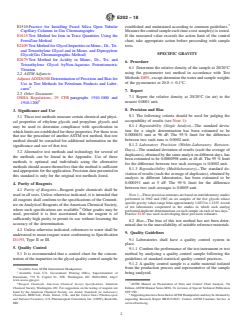
3.1 These test methods measure certain chemical and physical properties of ethylene glycols and propylene glycols and may be used to determine compliance with specification in which limits are established for these properties. For those tests that use the procedure of another ASTM test method, that test method should be consulted for additional information on the significance and use of that test.
3.2 Alternative test methods and technology for several of the methods can be found in the Appendix. Use of these methods is optional and individuals using the alternative methods should assure themselves that the method is sufficient and appropriate for the application. Precision data presented in this standard is only for the original test methods listed.
SCOPE
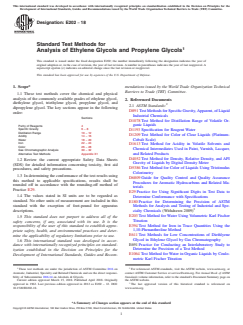
1.1 These test methods cover the chemical and physical analysis of the commonly available grades of ethylene glycol, diethylene glycol, triethylene glycol, propylene glycol, and dipropylene glycol. The key sections appear in the following order:
Sections
Purity of Reagents
4
Specific Gravity
6 – 8
Distillation Range
10 – 12
Acidity
14 – 16
Water
18 – 20
Iron
22 – 24
Color
26 – 28
Gas Chromatographic Analysis
30 – 32
Alternative Test Methods
Appendix X1
1.2 Review the current appropriate Safety Data Sheets (SDS) for detailed information concerning toxicity, first aid procedures, and safety precautions.
1.3 In determining the conformance of the test results using this method to applicable specifications, results shall be rounded off in accordance with the rounding-off method of Practice E29.
1.4 The values stated in SI units are to be regarded as standard. No other units of measurement are included in this standard with the exception of foot-pound for apparatus descriptions.
1.5 This standard does not purport to address all of the safety concerns, if any, associated with its use. It is the responsibility of the user of this standard to establish appropriate safety, health, and environmental practices and determine the applicability of regulatory limitations prior to use.
1.6 This international standard was developed in accordance with internationally recognized principles on standardization established in the Decision on Principles for the Development of International Standards, Guides and Recommendations issued by the World Trade Organization Technical Barriers to Trade (TBT) Committee.
- Status
- Published
- Publication Date
- 14-Mar-2018
- Technical Committee
- D16 - Aromatic, Industrial, Specialty and Related Chemicals
- Drafting Committee
- D16.14 - Alcohols & Glycols
Overview
ASTM E202-18 is the internationally recognized standard from ASTM International for the chemical and physical analysis of ethylene glycols and propylene glycols, which include common variants such as diethylene glycol, triethylene glycol, and dipropylene glycol. These test methods are widely adopted in industrial quality control laboratories to ensure product conformance and process consistency. The standard provides detailed procedures for measuring key properties including specific gravity, distillation range, acidity, water content, iron content, color, and conducting gas chromatographic analysis. It also addresses laboratory quality guidelines and references additional ASTM test methods and alternative technologies.
Key Topics
- Scope and Applicability: Covers the analysis of all commonly available grades of ethylene and propylene glycols.
- Test Methods Included:
- Specific Gravity determination
- Distillation Range analysis
- Acidity measurement
- Water content determination (Karl Fischer titration)
- Iron content analysis
- Color measurement (Platinum-Cobalt scale)
- Gas Chromatographic Analysis for purity and impurities
- Quality Assurance: Recommends robust laboratory quality control and the use of control samples for valid, repeatable results.
- Alternative Methods: Provides optional alternate procedures and technologies for several analyses, referenced in the appendix.
- Reporting and Precision: Details requirements for rounding, reporting limits, and notes on method precision based on multi-laboratory studies.
- Safety Considerations: Stresses the importance of consulting Safety Data Sheets (SDS) and establishing laboratory safety protocols before use.
Applications
The ASTM E202-18 standard is vital for industries where the purity and quality of ethylene glycols and propylene glycols impact product safety and performance, including:
- Chemical Manufacturing: Ensures raw material quality for producers of antifreeze, coolants, resins, and solvents.
- Pharmaceuticals & Personal Care: Validates purity and specification compliance for glycol-based ingredients.
- Testing and Certification Labs: Provides standardized procedures for third-party quality certification.
- Food and Beverage Processing: Used for analytical purposes in regulated environments, where glycols may be present as trace contaminants or process chemicals.
- Environmental Monitoring: Supports trace impurity identification during environmental audits and regulatory checks.
Benefits of following ASTM E202-18 include:
- Consistent product quality and regulatory compliance
- Reproducible results across laboratories and locations
- Enhanced trust with customers and end-users
- Minimization of contamination risks and off-specification batches
Related Standards
ASTM E202-18 references several other ASTM standards fundamental to glycol analysis and laboratory quality management:
- ASTM D1078: Test Method for Distillation Range of Volatile Organic Liquids
- ASTM D1209: Test Method for Color of Clear Liquids (Platinum-Cobalt Scale)
- ASTM E1064: Test Method for Water in Organic Liquids by Coulometric Karl Fischer Titration
- ASTM E1615: Test Method for Iron in Trace Quantities Using the FerroZine Method
- ASTM E2409: Test Method for Glycol Impurities by Gas Chromatography
- ASTM E29: Practice for Using Significant Digits in Test Data to Determine Conformance with Specifications
- ASTM D6809: Guide for Quality Control and Quality Assurance Procedures for Aromatic Hydrocarbons and Related Materials
For alternative procedures, the standard allows the use of additional test methods (e.g., ASTM D4052 for density, ASTM E611 for gas chromatography), provided their suitability is confirmed for the application.
Summary
ASTM E202-18 is the definitive standard for the analysis of ethylene glycols and propylene glycols, ensuring quality, safety, and regulatory compliance for critical industrial chemicals. Adopting this standard brings consistency and reliability to analytical results, facilitating global trade and industry best practices. For detailed procedures and compliance, users should always refer to the official ASTM documentation and consider integrating related ASTM methods as referenced.
Relations
- Effective Date
- 01-Jan-2024
- Effective Date
- 01-Jan-2024
- Effective Date
- 01-Nov-2016
- Effective Date
- 01-Jun-2013
- Effective Date
- 01-May-2013
- Effective Date
- 01-Jun-2012
- Effective Date
- 15-Nov-2011
- Effective Date
- 01-Nov-2011
- Effective Date
- 01-Jan-2010
- Effective Date
- 01-Apr-2009
- Effective Date
- 01-Oct-2008
- Effective Date
- 01-Oct-2008
- Effective Date
- 01-Jun-2007
- Effective Date
- 15-Nov-2006
- Effective Date
- 15-Sep-2006
Get Certified
Connect with accredited certification bodies for this standard

ECOCERT
Organic and sustainability certification.

Eurofins Food Testing Global
Global leader in food, environment, and pharmaceutical product testing.

Intertek Bangladesh
Intertek certification and testing services in Bangladesh.
Sponsored listings
Frequently Asked Questions
ASTM E202-18 is a standard published by ASTM International. Its full title is "Standard Test Methods for Analysis of Ethylene Glycols and Propylene Glycols". This standard covers: SIGNIFICANCE AND USE 3.1 These test methods measure certain chemical and physical properties of ethylene glycols and propylene glycols and may be used to determine compliance with specification in which limits are established for these properties. For those tests that use the procedure of another ASTM test method, that test method should be consulted for additional information on the significance and use of that test. 3.2 Alternative test methods and technology for several of the methods can be found in the Appendix. Use of these methods is optional and individuals using the alternative methods should assure themselves that the method is sufficient and appropriate for the application. Precision data presented in this standard is only for the original test methods listed. SCOPE 1.1 These test methods cover the chemical and physical analysis of the commonly available grades of ethylene glycol, diethylene glycol, triethylene glycol, propylene glycol, and dipropylene glycol. The key sections appear in the following order: Sections Purity of Reagents 4 Specific Gravity 6 – 8 Distillation Range 10 – 12 Acidity 14 – 16 Water 18 – 20 Iron 22 – 24 Color 26 – 28 Gas Chromatographic Analysis 30 – 32 Alternative Test Methods Appendix X1 1.2 Review the current appropriate Safety Data Sheets (SDS) for detailed information concerning toxicity, first aid procedures, and safety precautions. 1.3 In determining the conformance of the test results using this method to applicable specifications, results shall be rounded off in accordance with the rounding-off method of Practice E29. 1.4 The values stated in SI units are to be regarded as standard. No other units of measurement are included in this standard with the exception of foot-pound for apparatus descriptions. 1.5 This standard does not purport to address all of the safety concerns, if any, associated with its use. It is the responsibility of the user of this standard to establish appropriate safety, health, and environmental practices and determine the applicability of regulatory limitations prior to use. 1.6 This international standard was developed in accordance with internationally recognized principles on standardization established in the Decision on Principles for the Development of International Standards, Guides and Recommendations issued by the World Trade Organization Technical Barriers to Trade (TBT) Committee.
SIGNIFICANCE AND USE 3.1 These test methods measure certain chemical and physical properties of ethylene glycols and propylene glycols and may be used to determine compliance with specification in which limits are established for these properties. For those tests that use the procedure of another ASTM test method, that test method should be consulted for additional information on the significance and use of that test. 3.2 Alternative test methods and technology for several of the methods can be found in the Appendix. Use of these methods is optional and individuals using the alternative methods should assure themselves that the method is sufficient and appropriate for the application. Precision data presented in this standard is only for the original test methods listed. SCOPE 1.1 These test methods cover the chemical and physical analysis of the commonly available grades of ethylene glycol, diethylene glycol, triethylene glycol, propylene glycol, and dipropylene glycol. The key sections appear in the following order: Sections Purity of Reagents 4 Specific Gravity 6 – 8 Distillation Range 10 – 12 Acidity 14 – 16 Water 18 – 20 Iron 22 – 24 Color 26 – 28 Gas Chromatographic Analysis 30 – 32 Alternative Test Methods Appendix X1 1.2 Review the current appropriate Safety Data Sheets (SDS) for detailed information concerning toxicity, first aid procedures, and safety precautions. 1.3 In determining the conformance of the test results using this method to applicable specifications, results shall be rounded off in accordance with the rounding-off method of Practice E29. 1.4 The values stated in SI units are to be regarded as standard. No other units of measurement are included in this standard with the exception of foot-pound for apparatus descriptions. 1.5 This standard does not purport to address all of the safety concerns, if any, associated with its use. It is the responsibility of the user of this standard to establish appropriate safety, health, and environmental practices and determine the applicability of regulatory limitations prior to use. 1.6 This international standard was developed in accordance with internationally recognized principles on standardization established in the Decision on Principles for the Development of International Standards, Guides and Recommendations issued by the World Trade Organization Technical Barriers to Trade (TBT) Committee.
ASTM E202-18 is classified under the following ICS (International Classification for Standards) categories: 71.080.60 - Alcohols. Ethers. The ICS classification helps identify the subject area and facilitates finding related standards.
ASTM E202-18 has the following relationships with other standards: It is inter standard links to ASTM E203-24, ASTM E1064-24, ASTM D6809-02(2016), ASTM E2409-13, ASTM E691-13, ASTM D1613-06(2012), ASTM D1078-11, ASTM E691-11, ASTM D5386-10, ASTM D891-09, ASTM E29-08, ASTM E691-08, ASTM D6809-02(2007), ASTM E29-06b, ASTM E29-06a. Understanding these relationships helps ensure you are using the most current and applicable version of the standard.
ASTM E202-18 is available in PDF format for immediate download after purchase. The document can be added to your cart and obtained through the secure checkout process. Digital delivery ensures instant access to the complete standard document.
Standards Content (Sample)
This international standard was developed in accordance with internationally recognized principles on standardization established in the Decision on Principles for the
Development of International Standards, Guides and Recommendations issued by the World Trade Organization Technical Barriers to Trade (TBT) Committee.
Designation: E202 − 18
Standard Test Methods for
Analysis of Ethylene Glycols and Propylene Glycols
This standard is issued under the fixed designation E202; the number immediately following the designation indicates the year of
original adoption or, in the case of revision, the year of last revision. A number in parentheses indicates the year of last reapproval. A
superscript epsilon (´) indicates an editorial change since the last revision or reapproval.
This standard has been approved for use by agencies of the U.S. Department of Defense.
1. Scope* mendations issued by the World Trade Organization Technical
Barriers to Trade (TBT) Committee.
1.1 These test methods cover the chemical and physical
analysis of the commonly available grades of ethylene glycol,
2. Referenced Documents
diethylene glycol, triethylene glycol, propylene glycol, and
2.1 ASTM Standards:
dipropylene glycol. The key sections appear in the following
D891 TestMethodsforSpecificGravity,Apparent,ofLiquid
order:
Industrial Chemicals
Sections
D1078 Test Method for Distillation Range of Volatile Or-
ganic Liquids
Purity of Reagents 4
Specific Gravity 6–8
D1193 Specification for Reagent Water
Distillation Range 10–12
D1209 Test Method for Color of Clear Liquids (Platinum-
Acidity 14–16
Water 18–20 Cobalt Scale)
Iron 22–24
D1613 Test Method for Acidity in Volatile Solvents and
Color 26–28
Chemical Intermediates Used in Paint, Varnish, Lacquer,
Gas Chromatographic Analysis 30–32
Alternative Test Methods Appendix X1 and Related Products
D4052 Test Method for Density, Relative Density, and API
1.2 Review the current appropriate Safety Data Sheets
Gravity of Liquids by Digital Density Meter
(SDS) for detailed information concerning toxicity, first aid
D5386 Test Method for Color of Liquids Using Tristimulus
procedures, and safety precautions.
Colorimetry
1.3 In determining the conformance of the test results using
D6809 Guide for Quality Control and Quality Assurance
this method to applicable specifications, results shall be
Procedures for Aromatic Hydrocarbons and Related Ma-
rounded off in accordance with the rounding-off method of
terials
Practice E29.
E29 Practice for Using Significant Digits in Test Data to
1.4 The values stated in SI units are to be regarded as
Determine Conformance with Specifications
standard. No other units of measurement are included in this
E180 Practice for Determining the Precision of ASTM
standard with the exception of foot-pound for apparatus
Methods for Analysis and Testing of Industrial and Spe-
descriptions.
cialty Chemicals (Withdrawn 2009)
E203 Test Method for Water Using Volumetric Karl Fischer
1.5 This standard does not purport to address all of the
Titration
safety concerns, if any, associated with its use. It is the
E394 Test Method for Iron in Trace Quantities Using the
responsibility of the user of this standard to establish appro-
1,10-Phenanthroline Method
priate safety, health, and environmental practices and deter-
E611 Test Methods for Low Concentrations of Diethlyene
mine the applicability of regulatory limitations prior to use.
Glycol in Ethylene Glycol by Gas Chromatography
1.6 This international standard was developed in accor-
E691 Practice for Conducting an Interlaboratory Study to
dance with internationally recognized principles on standard-
Determine the Precision of a Test Method
ization established in the Decision on Principles for the
E1064 Test Method for Water in Organic Liquids by Coulo-
Development of International Standards, Guides and Recom-
metric Karl Fischer Titration
1 2
These test methods are under the jurisdiction of ASTM Committee D16 on For referenced ASTM standards, visit the ASTM website, www.astm.org, or
Aromatic, Industrial, Specialty and Related Chemicals and are the direct responsi- contact ASTM Customer Service at service@astm.org. For Annual Book of ASTM
bility of Subcommittee D16.14 on Alcohols & Glycols. Standards volume information, refer to the standard’s Document Summary page on
Current edition approved March 15, 2018. Published April 2018. Originally the ASTM website.
approved in 1962. Last previous edition approved in 2012 as E202 – 12. DOI: The last approved version of this historical standard is referenced on
10.1520/E0202-18. www.astm.org.
*A Summary of Changes section appears at the end of this standard
Copyright © ASTM International, 100 Barr Harbor Drive, PO Box C700, West Conshohocken, PA 19428-2959. United States
E202 − 18
E1510 Practice for Installing Fused Silica Open Tubular established and maintained according to common guidelines.
Capillary Columns in Gas Chromatographs Measurethecontrolsampleeachtimeatestsample(s)istested.
E1615 Test Method for Iron in Trace Quantities Using the If the measured value exceeds the action limit of the control
FerroZine Method chart, take appropriate action before proceeding with sample
E2409 TestMethodforGlycolImpuritiesinMono-,Di-,Tri- tests.
and Tetraethylene Glycol and in Mono- and Dipropylene
SPECIFIC GRAVITY
Glycol(Gas Chromatographic Method)
E2679 Test Method for Acidity in Mono-, Di-, Tri- and
6. Procedure
Tetraethylene Glycol byNon-Aqueous Potentiometric
6.1 Determine the relative density of the sample at 20/20°C
Titration
using the pycnometer test method in accordance with Test
2.2 ASTM Adjuncts:
MethodsD891,exceptdeterminethewaterandsampleweights
AdjunctADJD6300 Determination of Precision and Bias for
of the pycnometer at 20.0 6 0.1°C.
Use in Test Methods for Petroleum Products and Lubri-
cants
7. Report
2.3 Other Document:
7.1 Report the relative density at 20/20°C (in air) to the
OSHA Regulations, 29 CFR paragraphs 1910.1000 and
nearest 0.0001 unit.
1910.1200
8. Precision and Bias
3. Significance and Use
8.1 The following criteria should be used for judging the
3.1 These test methods measure certain chemical and physi-
acceptability of results (see Note 1):
cal properties of ethylene glycols and propylene glycols and
8.1.1 Repeatability (Single Analyst)—The standard devia-
may be used to determine compliance with specification in
tion for a single determination has been estimated to be
whichlimitsareestablishedfortheseproperties.Forthosetests
0.0000651 unit at 96 dF. The 95 % limit for the difference
that use the procedure of another ASTM test method, that test
between two such runs is 0.0002 unit.
method should be consulted for additional information on the
8.1.2 Laboratory Precision (Within-Laboratory, Between-
significance and use of that test.
Days)—The standard deviation of results (each the average of
3.2 Alternative test methods and technology for several of
duplicates), obtained by the same analyst on different days, has
the methods can be found in the Appendix. Use of these
been estimated to be 0.0000598 units at 48 df. The 95 % limit
methods is optional and individuals using the alternative
for the difference between two such averages is 0.0002 unit.
methods should assure themselves that the method is sufficient
8.1.3 Reproducibility (Multilaboratory)—The standard de-
and appropriate for the application. Precision data presented in
viation of results (each the average of duplicates), obtained by
this standard is only for the original test methods listed.
analysts in different laboratories, has been estimated to be
0.000191 unit at 5 dF. The 95 % limit for the difference
4. Purity of Reagents
between two such averages is 0.0005 unit.
4.1 Purity of Reagents—Reagent grade chemicals shall be
NOTE 1—These precision estimates are based on interlaboratory studies
used in all tests. Unless otherwise indicated, it is intended that
performed in 1962 and 1963 on six samples of the five glycols whose
all reagents shall conform to the specifications of the Commit-
specificgravityvaluesrangefromapproximately1.0233to1.1255.Atotal
tee onAnalytical Reagents of theAmerican Chemical Society,
of ten laboratories cooperated in the studies in which each analyst
where such specifications are available. Other grades may be
performed duplicate determinations on each sample on each of two days.
used, provided it is first ascertained that the reagent is of
Practice E180 was used in developing these precision estimates.
sufficiently high purity to permit its use without lessening the
8.2 Bias—The bias of this test method has not been deter-
accuracy of the determination.
mined due to the unavailability of suitable reference materials.
4.2 Unless otherwise indicated, references to water shall be
9. Quality Guidelines
understood to mean reagent water conforming to Specification
9.1 Laboratories shall have a quality control system in
D1193, Type II or III.
place.
5. Quality Control
9.1.1 Confirm the performance of the test instrument or test
5.1 It is recommended that a control chart for the concen- method by analyzing a quality control sample following the
tration of the impurities in the glycol quality control sample be guidelines of standard statistical quality control practices.
9.1.2 A quality control sample is a stable material isolated
4 from the production process and representative of the sample
Available from ASTM International Headquarters.
Available from U.S. Government Printing Office, Superintendent of
being analyzed.
Documents, 732 N. Capitol St., NW, Washington, DC 20401-0001, http://
www.access.gpo.gov.
6 7
Reagent Chemicals, American Chemical Society Specifications, American ASTM Manual on Presentation of Data and Control Chart Analysis, 7th
Chemical Society, Washington, DC. For suggestions on the testing of reagents not Edition, ASTM Manual Series MNL 7A (revision of Special Technical Publication
listed by the American Chemical Society, see Analar Standards for Laboratory STP 15D.
Chemicals, BDH Ltd., Poole, Dorset, U.K., and the United States Pharmacopeia SupportingdatahavebeenfiledatASTMHeadquartersandmaybeobtainedby
and National Formulary, U.S. Pharmacopeial Convention, Inc. (USPC), Rockville, requesting Research Report RR:E15-0013. Contact ASTM Customer Service at
MD. service@astm.org.
E202 − 18
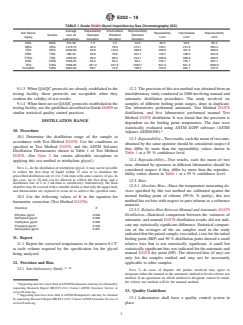
TABLE 1 Guide E2409 Glycol Impurities by Gas Chromatography (GC)
Average Repeatability Intermediate Reproducibility
Test Result, Repeatability Intermediate Reproducibility
Sample over all Standard Standard Standard
mg/kg Limit Limit Limit
Laboratories Deviation Deviation Deviation
DEG MEG 374.59 7.3 7.3 34.0 20.6 20.6 95.3
MEG DEG 1479.73 46.3 76.0 215.1 129.7 212.9 602.4
TEG DEG 3499.69 92.8 143.2 306.5 260.0 401.0 858.3
DEG TEG 489.32 56.8 70.9 201.7 159.1 198.5 564.9
TTEG TEG 1020.00 96.3 96.3 244.1 269.8 269.8 683.5
DEG TeEG 1646.25 55.4 55.4 95.4 155.1 155.1 267.1
TEG TeEG 7908.35 221.9 221.9 1350.7 621.2 621.2 3782.0
PentaEG TeEG 2084.93 58.7 72.9 156.3 164.5 204.1 437.5
9.1.3 When QA/QC protocols are already established in the 12.2 The precision of this test method was obtained from an
testing facility, these protocols are acceptable when they interlaboratory study conducted in 2000 involving manual and
confirm the validity of test results. automatic distillation procedures. The study involved six
9.1.4 WhentherearenoQA/QCprotocolsestablishedinthe samples of different boiling point ranges, done in duplicate.
testing facility, use the guidelines described in Guide D6809 or Ten laboratories performed automatic Test Method D1078
similar statistical quality control practices. distillation, and five laboratories performed manual Test
Method D1078 distillation. It was found that the precision is
DISTILLATION RANGE
dependent on the boiling point temperature. The data were
statistically evaluated using ASTM D2PP software (ASTM
10. Procedure 4
Adjunct ADJD6300).
10.1 Determine the distillation range of the sample in
12.3 Repeatability—Tworesults,eachthemeanoftworuns,
accordance with Test Method D1078. Use the conditions as
obtained by the same operator should be considered suspect if
specified in Test Method D1078, and the ASTM Solvents
they differ by more than the repeatability values shown in
Distillation Thermometer shown in Table 1 of Test Method
Table 1 at a 95 % confidence level.
D1078. (See Note 2 for certain allowable exceptions in
12.4 Reproducibility—Two results, each the mean of two
applying this test method to triethylene glycol.)
runs, obtained by operators in different laboratories should be
NOTE 2—In the distillation of triethylene glycol, it may not be possible
considered suspect if they differ by more than the reproduc-
to collect the first drop of liquid within 15 min or to maintain the
ibility values shown in Table 1 at a 95 % confidence level.
prescribed distillation rate of 4 to 5 mL/min with some sources of gas. In
this case, up to 30 min can be allowed to collect the first drop, and a
12.5 Bias:
distillation rate of 2 to 3 mL/min is satisfactory. Alternatively, the flask
12.5.1 Absolute Bias—Since the temperature measuring de-
chambermaybecoveredwithasuitableshieldsothatonlytheupperneck
vices specified by this test method are calibrated against the
and thermometer are exposed to room air to achieve the specified rates.
normal boiling point of toluene (99.9+ % purity), this test
10.2 Use the following values of K in the equation for
method has no bias with respect to pure toluene as a reference
barometric correction (Test Method D1078):
material.
Chemical K
12.5.2 Relative Bias Between Manual and Automatic D1078
Ethylene glycol 0.045 Distillation—Statistical comparison between the variances of
Diethylene glycol 0.050
automatic and manual D1078 distillation results did not indi-
Triethylene glycol 0.055
cate any statistically significant difference. Statistical compari-
Propylene glycol 0.043
Dipropylene glycol 0.051
son of the averages of the six samples used in the study
indicatedthatthepaired-sample,two-tailed,t-testfortheinitial
11. Report
boiling point (IBP) and 50 % distillation point showed a small
relative bias that is not statistically significant. A small but
11.1 Report the corrected temperatures to the nearest 0.1°C
at each volume required by the specification for the glycol statisticallysignificantbiaswasindicatedfortheautomaticand
manual D1078 dry point (DP). The observed bias (if any) are
being analyzed.
only for the samples studied and may not be necessarily
12. Precision and Bias applicable to other samples.
9, 10
12.1 Interlaboratory Study:
NOTE 3—In cases of dispute, the parties involved may agree to
designate either the manual or the automatic method to be the referee test
method. If an agreement on which method to designate cannot be made,
the referee test method will be the manual method.
SupportingdatahavebeenfiledatASTMHeadquartersandmaybeobtainedby
requesting Research Report RR:E15-1114. Contact ASTM Customer Service at
13. Quality Guidelines
service@astm.org.
Supporting data have been filed at ASTM Headquarters and may be obtained
13.1 Laboratories shall have a quality control system in
by requesting Research Report RR:E15-1123. Contact ASTM Customer Service at
service@astm.org. place.
E202 − 18
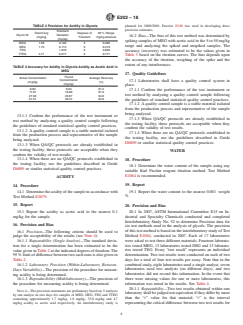
TABLE 2 Precision for Acidity in Glycols planned for 2009/2010. Practice E180 was used in developing these
precision estimates.
Standard
Grand Avg Degrees of 95 % Range
Glycol ID Deviation
16.2 Bias—The bias of this test method was determined by
(mg/kg) Freedom mg/kg absolute
(mg/kg)
spiking samples of MEG with acetic acid in the 5 to 50 mg/kg
MEG 1.66 0.100 5 0.280
range and analyzing the spiked and unspiked samples. The
DEG 1.75 0.114 5 0.319
TEG 1.370 5 3.836
accuracy (recovery) was estimated to be the values given in
TTEG 4.71 0.277 5 0.777
Table 3 based on the titration curves. The bias depends upon
the accuracy of the titration, weighing of the spike and the
extent of any interferences.
TABLE 3 Accuracy for Acidity in Glycols Acidity as Acetic Acid in
MEG
17. Quality Guidelines
Found
Actual Concentration Average Recovery
Concentration
17.1 Laboratories shall have a quality control system in
(mg/kg) (%)
(mg/kg)
place.
6.62 6.04 91.2
17.1.1 Confirm the performance of the test instrument or
11.91 10.90 91.5
test method by analyzing a quality control sample following
27.30 25.67 94.0
51.51 48.72 94.6
the guidelines of standard statistical quality control practices.
17.1.2 Aquality control sample is a stable material isolated
from the production process and representative of the sample
being analyzed.
13.1.1 Confirm the performance of the test instrument or
17.1.3 When QA/QC protocols are already established in
test method by analyzing a quality control sample following
the testing facility, these protocols are acceptable when they
the guidelines of standard statistical quality control practices.
confirm the validity of test results.
13.1.2 Aquality control sample is a stable material isolated
17.1.4 When there are no QA/QC protocols established in
from the production process and representative of the sample
the testing facility, use the guidelines described in Guide
being analyzed.
D6809 or similar statistical quality control practices.
13.1.3 When QA/QC protocols are already established in
the testing facility, these protocols are acceptable when they
WATER
confirm the validity of test results.
13.1.4 When there are no QA/QC protocols established in
18. Procedure
the testing facility, use the guidelines described in Guide
18.1 Determine the water content of the sample using any
D6809 or similar statistical quality control practices.
suitable Karl Fischer reagent titration method. Test Method
E1064 is recommended.
ACIDITY
19. Report
14. Procedure
19.1 Report the water content to the nearest 0.001 weight
14.1 Determinetheacidityofthesampleinaccordancewith
%.
Test Method E2679.
15. Report
20. Precision and Bias
15.1 Report the acidity as acetic acid to the nearest 0.1
20.1 In 2007, ASTM International Committee E15 on In-
mg/kg for the sample.
dustrial and Specialty Chemicals conducted and completed
Interlaboratory Study No. 52 to determine Precision data for
16. Precision and Bias
six test methods used in the analysis of glycols. The precision
of this test method is based on the interlaboratory study ofTest
16.1 Precision—The following criteria should be used to
Method E1064, conducted in 2007. Each of 17 laboratories
judge the acceptability of the results (see Note 4):
were asked to test three different materials. Fourteen laborato-
16.1.1 Repeatability (Single Analyst)—The standard devia-
ries tested MEG, 13 laboratories tested DEG and 13 laborato-
tion for a single determination has been estimated to be the
ries tested TEG. Every “test result” represents an individual
value given in Table 2 at the indicated degrees of freedom.The
determination. Two test results were conducted on each of two
95 % limit of difference between two such runs is also given in
days for a total of four test results per assay. Note that in the
Table 2.
combined study, eight laboratories used a single analyst, seven
16.1.2 Laboratory Precision (Within-Laboratory, Between-
laboratories used two analysts (on different days), and two
Days Variability)—The precision of the procedure for measur-
laboratories did not record this information. In the event that
ing acidity is being determined.
there were missing values for one or more laboratories, this
16.1.3 Reproducibility (Multilaboratory)—The precision of
information was noted in the results. See Table 4.
the procedure for measuring acidity is being determined.
20.1.1 Repeatability—Two test results obtained within one
NOTE 4—The precision statements are preliminary based on 5 analyses
laboratory shall be judged not equivalent if they differ by more
by one analyst on two days for samples of MEG, DEG, TEG and TTEG
than the “r” value for that material; “r” is the interval
containing approximately 1.7 mg/kg, 1.8 mg/kg, 33.0 mg/kg and 4.7
mg/kg acidity as acetic acid respectively. An interlaboratory study is representing the critical difference between two test results for
E202 − 18
TABLE 4 Test Method E1064 Water in Organic Liquids by Coulometric Karl Fischer Titration
Average over Repeatability Intermediate Reproducibility
Test Result Repeatability Intermediate Reproducibility
Sample all Laborato- Standard De- Standard De- Standard De-
% weight Limit Unit Limit
ries viation viation viation
Water MEG 0.0086 0.0009 0.0014 0.0025 0.0026 0.0038 0.0071
Water DEG 0.0649 0.0012 0.0014 0.0049 0.0032 0.0039 0.0137
Water TEG 0.0498 0.0019 0.0129 0.0157 0.0054 0.0361 0.0439
the same material, obtained by the same operator using the 21.1.3 When QA/QC protocols are already established in
same equipment on the same day in the same laboratory. the testing facility, these protocols are acceptable when they
20.1.2 Reproducibility—Two test results shall be judged not confirm the validity of test results.
equivalent if they differ by more than the “R” value for that 21.1.4 When there are no QA/QC protocols established in
material; “R” is the interval representing the difference be- the testing facility, use the guidelines described in Guide
tween two test results for the same material, obtained by D6809 or similar statistical control practices.
different operators using different equipment in different labo-
IRON
ratories.
20.1.3 Intermediate Precision—Theday-to-daystandardde-
22. Procedure
viation within a laboratory for results produced by the same
operator, determined through statistical analysis following
22.1 Determinetheironcontentofthesampleinaccordance
Practice E180. Practice E180 was used to conform to this
with Test Method E1615.
particular study design which required an estimate of interme-
diate precision. The statistical analysis was conducted using
23. Report
the SAS statistical analysis software, Version 8.0.
23.1 Report the iron content to the nearest 0.001 µg/g.
20.1.3.1 The E180 analysis considers the two test results
from each day as being run under repeatability, intermediate,
24. Precision and Bias
and reproducibility precision for each assay. The repeatability
24.1 In 2007, Committee E15 on Industrial and Specialty
precisionwouldbeestimatedfromthetwosetsofduplicatetest
ChemicalsconductedandcompletedInterlaboratoryStudy#52
results within each day, and the intermediate precision would
to determine precision data for six test methods used in the
be estimated from the agreement between the two days, all
analysis of glycols. The precision of this test method is based
pooledoverlaboratories.Caveat:Sincetwodaysisashorttime
on the interlaboratory study of E1615. Each of 15 laboratories
period, the intermediate precision would probably be underes-
were asked to test three different materials. Thirteen laborato-
timated by the E180 analysis.
ries tested MEG, 11 laboratories tested DEG, and 10 labora-
20.1.4 Any judgment in accordance with these two state-
tories tested TEG. Every test result represents an individual
ments would have an approximate 95 % probability of being
determination. Two test results were conducted on each of two
correct.
days for a total of four test results per assay. Note that in the
20.2 Bias—At the time of the study, there was no accepted
combined study, 8 laboratories used a single analyst, 7 labo-
reference material suitable for determining the bias for this test
ratories used 2 analysts (on different days) and 2 laboratories
method, therefore no statement on bias is being made.
did not record this information. In the event that there were
20.3 The precision statement was determined through sta-
missing values for one or more laboratories, this information
tistical examination of qualified results, from seventeen
was noted in the results. The details of this study are given in
laboratories, on three materials. These three materials were
an ASTM Research Report.
described as the following:
24.1.1 Repeatability—Two test results obtained within one
Fluid 1: Monoethylene Glycol
laboratory shall be judged not equivalent if they differ by more
Fluid 2: Diethylene Glycol
than the “r” value for that material; “r” is the interval
Fluid 3: Triethylene Glycol
representing the critical difference between two test results for
20.3.1 To judge the equivalency of two test results, it is
the same material, obtained by the same operator using the
recommended to choose the material closest in characteristics
same equipment on the same day in the same laboratory.
to the test material.
24.1.2 Reproducibility—Two test results shall be judged not
equivalent if they differ by more than the “R” value for that
21. Quality Guidelines
material; “R” is the interval representing the difference be-
21.1 Laboratories shall have a quality control system in tween two test results for the same material, obtained by
place.
different operators using different equipment in different labo-
21.1.1 Confirm the performance of the test instrument or ratories.
test method by analyzing a quality control sample following
the guidelines of standard statistical quality control practices.
21.1.2 A quality control sample is stable material isolated
Supporting data have been filed at ASTM Headquarters and may be obtained
from the production process and representative of the sample
by requesting Research Report RR:E15-1064. Contact ASTM Customer Service at
being analyzed. service@astm.org.
E202 − 18
24.1.3 Intermediate Precision—Theday-to-daystandardde- 28. Precision and Bias
viation within a laboratory for results produced by the same
28.1 The following criteria should be used for judging the
operator, determined through statistical analysis following
acceptability of results (see Note 5):
Practice E180. Practice E180 was used to conform to this
28.1.1 Repeatability (Single Analyst)—The standard devia-
particular study design which required an estimate of interme-
tionforasingledeterminationhasbeenestimatedtobe0.0unit
diate precision. The statistical analysis was conducted using
at 40 dF. The 95 % limit for the difference between two such
the SAS statistical analysis software, Version 8.0.
runs is two units.
24.1.3.1 The Practice E180 analysis considers the two test
28.1.2 Laboratory Precision (Within-Laboratory, Between-
results from each day as being run under repeatability condi-
Days)—The standard deviation of results (each the average of
tions and estimates the repeatability, intermediate, and repro-
duplicates), obtained by the same analyst on different days, has
ducibility precision for each assay. The repeatability precision
been estimated to be 0.64 unit at 46 dF. The 95 % limit for the
would be estimated from the two sets of duplicate test results
difference between two such averages is two units.
within each day, and the intermediate precision would be
28.1.3 Reproducibility (Multilaboratory)—The standard de-
estimatedfromtheagreementbetweenthetwodays,allpooled
viation of results (each the average of duplicates), obtained by
over laboratories. Caveat: Since two days is a short time
analysts in different laboratories, has been estimated to be 2.47
period, the intermediate precision would probably be underes-
units at 9 df. The 95 % limit for the difference between two
timated by the PracticeE180 analysis.
such averages is seven units.
24.1.4 Any judgment in accordance with these two state-
NOTE 5—These precision estimates are based on interlaboratory studies
ments would have an approximate 95 % probability of being
performed in 1962 and 1963 on a total of six samples of the five glycols
correct.
whose color ranged from 2 to 21 platinum-cobalt units. Because the test
results are based on visual comparison of the untreated sample with
24.2 Bias—At the time of the study, there was no accepted
standards, duplicate determinations at low levels of color are almost
reference material suitable for determining the bias for this test
always in perfect agreement.This was confirmed in the 1962 study of two
method, therefore no statement on bias is being made.
samples of ethylene glycol with average colors of 2 and 21 platinum-
cobalt units. The standard deviation for duplicate determinations was
24.3 The precision statement was determined through sta-
estimated to be 0.0 units at 40 dF. Therefore, the stated 95 % limit in the
tistical examination of qualified results, from fifteen
repeatability statement is based on the reporting of results to the nearest
laboratories, on three materials. These three materials were
one unit. The 1963 study omitted the duplicate determinations. A total of
described as the following:
ten laboratories cooperated in the studies in which each analyst performed
duplicate determinations on each sample on each of two days. Practice
Fluid 1: Monoethylene Glycol
E180 was used in developing these precision estimates.
Fluid 2: Diethylene Glycol
Fluid 3: Triethylene Glycol
28.1.4 Bias—The bias of this test method has not been
24.3.1 To judge the equivalency of two test results, it is determined due to the unavailability of suitable reference
recommended to choose the material closest in characteristics
materials.
to the test material.
29. Quality Guidelines
25. Quality Guidelines
29.1 Laboratories shall have a quality control system in
25.1 Laboratories shall have a quality control system in place.
place. 29.1.1 Confirm the performance of the test instrument or
25.1.1 Confirm the performance of the test instrument or test method by analyzing a quality control sample following
test method by analyzing a quality control sample following the guidelines of standard statistical quality control practices.
the guidelines of standard statistical quality control practices.
29.1.2 Aquality control sample is a stable material isolated
25.1.2 Aquality control sample is a stable material isolated from the production process and representative of the sample
from the production process and representative of the sample
being analyzed.
being analyzed. 29.1.3 When QA/QC protocols are already established in
25.1.3 When QA/QC protocols are already established in the testing faci
...
This document is not an ASTM standard and is intended only to provide the user of an ASTM standard an indication of what changes have been made to the previous version. Because
it may not be technically possible to adequately depict all changes accurately, ASTM recommends that users consult prior editions as appropriate. In all cases only the current version
of the standard as published by ASTM is to be considered the official document.
Designation: E202 − 12 E202 − 18
Standard Test Methods for
Analysis of Ethylene Glycols and Propylene Glycols
This standard is issued under the fixed designation E202; the number immediately following the designation indicates the year of
original adoption or, in the case of revision, the year of last revision. A number in parentheses indicates the year of last reapproval. A
superscript epsilon (´) indicates an editorial change since the last revision or reapproval.
This standard has been approved for use by agencies of the U.S. Department of Defense.
1. Scope*
1.1 These test methods cover the chemical and physical analysis of the commonly available grades of ethylene glycol,
diethylene glycol, triethylene glycol, propylene glycol, and dipropylene glycol. The key sections appear in the following order:
Sections
Purity of Reagents 4
Specific Gravity 6 – 8
Distillation Range 9 – 11
Distillation Range 10 – 12
Acidity 12 – 14
Acidity 14 – 16
Water 15 – 17
Water 18 – 20
Iron 18 – 20
Iron 22 – 24
Color 21 – 23
Color 26 – 28
Gas Chromatographic Analysis 24 – 26
Gas Chromatographic Analysis 30 – 32
Alternative Test Methods Appendix X1
1.2 Review the current appropriate Material Safety Data Sheets (MSDS)(SDS) for detailed information concerning toxicity, first
aid procedures, and safety precautions.
1.3 In determining the conformance of the test results using this method to applicable specifications, results shall be rounded
off in accordance with the rounding-off method of Practice E29.
1.4 The values stated in SI units are to be regarded as standard. No other units of measurement are included in this standard
with the exception of foot-pound for apparatus descriptions.
1.5 This standard does not purport to address all of the safety concerns, if any, associated with its use. It is the responsibility
of the user of this standard to establish appropriate safety safety, health, and healthenvironmental practices and determine the
applicability of regulatory limitations prior to use.
1.6 This international standard was developed in accordance with internationally recognized principles on standardization
established in the Decision on Principles for the Development of International Standards, Guides and Recommendations issued
by the World Trade Organization Technical Barriers to Trade (TBT) Committee.
2. Referenced Documents
2.1 ASTM Standards:
D891 Test Methods for Specific Gravity, Apparent, of Liquid Industrial Chemicals (Withdrawn 2018)
D1078 Test Method for Distillation Range of Volatile Organic Liquids
D1193 Specification for Reagent Water
D1209 Test Method for Color of Clear Liquids (Platinum-Cobalt Scale)
These test methods are under the jurisdiction of ASTM Committee D16 on Aromatic Hydrocarbons Aromatic, Industrial, Specialty and Related Chemicals and are the
direct responsibility of Subcommittee D16.15 on Industrial and Specialty General Standards.
Current edition approved April 1, 2012March 15, 2018. Published May 2012April 2018. Originally approved in 1962. Last previous edition approved in 20102012 as
E202–10. DOI: 10.1520/E0202-12. – 12. DOI: 10.1520/E0202-18.
For referenced ASTM standards, visit the ASTM website, www.astm.org, or contact ASTM Customer Service at service@astm.org. For Annual Book of ASTM Standards
volume information, refer to the standard’s Document Summary page on the ASTM website.
The last approved version of this historical standard is referenced on www.astm.org.
*A Summary of Changes section appears at the end of this standard
Copyright © ASTM International, 100 Barr Harbor Drive, PO Box C700, West Conshohocken, PA 19428-2959. United States
E202 − 18
D1613 Test Method for Acidity in Volatile Solvents and Chemical Intermediates Used in Paint, Varnish, Lacquer, and Related
Products
D4052 Test Method for Density, Relative Density, and API Gravity of Liquids by Digital Density Meter
D5386 Test Method for Color of Liquids Using Tristimulus Colorimetry
D6809 Guide for Quality Control and Quality Assurance Procedures for Aromatic Hydrocarbons and Related Materials
E29 Practice for Using Significant Digits in Test Data to Determine Conformance with Specifications
E180 Practice for Determining the Precision of ASTM Methods for Analysis and Testing of Industrial and Specialty Chemicals
(Withdrawn 2009)
E203 Test Method for Water Using Volumetric Karl Fischer Titration
E394 Test Method for Iron in Trace Quantities Using the 1,10-Phenanthroline Method
E611 Test Methods for Low Concentrations of Diethlyene Glycol in Ethylene Glycol by Gas Chromatography
E691 Practice for Conducting an Interlaboratory Study to Determine the Precision of a Test Method
E1064 Test Method for Water in Organic Liquids by Coulometric Karl Fischer Titration
E1510 Practice for Installing Fused Silica Open Tubular Capillary Columns in Gas Chromatographs
E1615 Test Method for Iron in Trace Quantities Using the FerroZine Method
E2409 Test Method for Glycol Impurities in Mono-, Di-, Tri- and Tetraethylene Glycol and in Mono- and Dipropylene
Glycol(Gas Chromatographic Method)
E2679 Test Method for Acidity in Mono-, Di-, Tri- and Tetraethylene Glycol byNon-Aqueous Potentiometric Titration
2.2 ASTM Adjuncts:
Adjunct ADJD6300 Determination of Precision and Bias for Use in Test Methods for Petroleum Products and Lubricants
2.3 Other Document:
OSHA Regulations, 29 CFR paragraphs 1910.1000 and 1910.1200
3. Significance and Use
3.1 These test methods measure certain chemical and physical properties of ethylene glycols and propylene glycols and may
be used to determine compliance with specification in which limits are established for these properties. For those tests that use the
procedure of another ASTM test method, that test method should be consulted for additional information on the significance and
use of that test.
3.2 Alternative test methods and technology for several of the methods can be found in the Appendix. Use of these methods
is optional and individuals using the alternative methods should assure themselves that the method is sufficient and appropriate for
the application. Precision data presented in this standard is only for the original test methods listed.
4. Purity of Reagents
4.1 Purity of Reagents—Reagent grade chemicals shall be used in all tests. Unless otherwise indicated, it is intended that all
reagents shall conform to the specifications of the Committee on Analytical Reagents of the American Chemical Society, where
such specifications are available. Other grades may be used, provided it is first ascertained that the reagent is of sufficiently high
purity to permit its use without lessening the accuracy of the determination.
4.2 Unless otherwise indicated, references to water shall be understood to mean reagent water conforming to Specification
D1193, Type II or III.
5. Quality Control
5.1 It is recommended that a control chart for the concentration of the impurities in the glycol quality control sample be
established and maintained according to common guidelines. Measure the control sample each time a test sample(s) is tested. If
the measured value exceeds the action limit of the control chart, take appropriate action before proceeding with sample tests.
SPECIFIC GRAVITY
6. Procedure
6.1 Determine the relative density of the sample at 20/20°C using the pycnometer test method in accordance with Test Methods
D891, except determine the water and sample weights of the pycnometer at 20.0 6 0.1°C.
Available from ASTM International Headquarters.
Available from U.S. Government Printing Office, Superintendent of Documents, 732 N. Capitol St., NW, Washington, DC 20401-0001, http://www.access.gpo.gov.
Reagent Chemicals, American Chemical Society Specifications, American Chemical Society, Washington, DC. For suggestions on the testing of reagents not listed by
the American Chemical Society, see Analar Standards for Laboratory Chemicals, VWR International BDH Ltd., Poole, Dorset, U.K., and the United States Pharmacopeia
and National Formulary, U.S. Pharmacopeial Convention, Inc. (USPC), Rockville, MD.
ASTM Manual on Presentation of Data and Control Chart Analysis, 7th Edition, ASTM Manual Series MNL 7A (revision of Special Technical Publication (STP)
15D).STP 15D.
E202 − 18
7. Report
7.1 Report the relative density at 20/20°C (in air) to the nearest 0.0001 unit.
8. Precision and Bias
8.1 The following criteria should be used for judging the acceptability of results (see Note 1):
8.1.1 Repeatability (Single Analyst)—The standard deviation for a single determination has been estimated to be 0.0000651 unit
at 96 dF. The 95 % limit for the difference between two such runs is 0.0002 unit.
8.1.2 Laboratory Precision (Within-Laboratory, Between-Days)—The standard deviation of results (each the average of
duplicates), obtained by the same analyst on different days, has been estimated to be 0.0000598 units at 48 df. The 95 % limit for
the difference between two such averages is 0.0002 unit.
8.1.3 Reproducibility (Multilaboratory)—The standard deviation of results (each the average of duplicates), obtained by
analysts in different laboratories, has been estimated to be 0.000191 unit at 5 dF. The 95 % limit for the difference between two
such averages is 0.0005 unit.
NOTE 1—These precision estimates are based on interlaboratory studies performed in 1962 and 1963 on six samples of the five glycols whose specific
gravity values range from approximately 1.0233 to 1.1255. A total of ten laboratories cooperated in the studies in which each analyst performed duplicate
determinations on each sample on each of two days. Practice E180 was used in developing these precision estimates.
8.2 Bias—The bias of this test method has not been determined due to the unavailability of suitable reference materials.
9. Quality Guidelines
9.1 Laboratories shall have a quality control system in place.
9.1.1 Confirm the performance of the test instrument or test method by analyzing a quality control sample following the
guidelines of standard statistical quality control practices.
9.1.2 A quality control sample is a stable material isolated from the production process and representative of the sample being
analyzed.
9.1.3 When QA/QC protocols are already established in the testing facility, these protocols are acceptable when they confirm
the validity of test results.
9.1.4 When there are no QA/QC protocols established in the testing facility, use the guidelines described in Guide D6809 or
similar statistical quality control practices.
DISTILLATION RANGE
10. Procedure
10.1 Determine the distillation range of the sample in accordance with Test Method D1078. Use the conditions as specified in
Test Method D1078, and the ASTM Solvents Distillation Thermometer shown in Table 1 of Test Method D1078. (See Note 2 for
certain allowable exceptions in applying this test method to triethylene glycol.)
NOTE 2—In the distillation of triethylene glycol, it may not be possible to collect the first drop of liquid within 15 min or to maintain the prescribed
distillation rate of 4 to 5 mL/min with some sources of gas. In this case, up to 30 min can be allowed to collect the first drop, and a distillation rate of
2 to 3 mL/min is satisfactory. Alternatively, the flask chamber may be covered with a suitable shield so that only the upper neck and thermometer are
exposed to room air to achieve the specified rates.
10.2 Use the following values of K in the equation for barometric correction (Test Method D1078):
TABLE 1 Guide E2409 Glycol Impurities by Gas Chromatography (GC)
Average Repeatability Intermediate Reproducibility
Test Result, Repeatability Intermediate Reproducibility
Sample over all Standard Standard Standard
mg/kg Limit Limit Limit
Laboratories Deviation Deviation Deviation
DEG MEG 374.59 7.3 7.3 34.0 20.6 20.6 95.3
MEG DEG 1479.73 46.3 76.0 215.1 129.7 212.9 602.4
TEG DEG 3499.69 92.8 143.2 306.5 260.0 401.0 858.3
DEG TEG 489.32 56.8 70.9 201.7 159.1 198.5 564.9
TTEG TEG 1020.00 96.3 96.3 244.1 269.8 269.8 683.5
DEG TeEG 1646.25 55.4 55.4 95.4 155.1 155.1 267.1
TEG TeEG 7908.35 221.9 221.9 1350.7 621.2 621.2 3782.0
PentaEG TeEG 2084.93 58.7 72.9 156.3 164.5 204.1 437.5
Supporting data have been filed at ASTM Headquarters and mymay be obtained by requesting Research Report:Report RR:E15-0013. Contact ASTM Customer Service
at service@astm.org.
E202 − 18
Chemical K
Ethylene glycol 0.045
Diethylene glycol 0.050
Triethylene glycol 0.055
Propylene glycol 0.043
Dipropylene glycol 0.051
11. Report
11.1 Report the corrected temperatures to the nearest 0.1°C at each volume required by the specification for the glycol being
analyzed.
12. Precision and Bias
9, 10
12.1 Interlaboratory Study:
12.2 The precision of this test method was obtained from an interlaboratory study conducted in 2000 involving manual and
automatic distillation procedures. The study involved six samples of different boiling point ranges, done in duplicate. Ten
laboratories performed automatic Test Method D1078 distillation, and five laboratories performed manual Test Method D1078
distillation. It was found that the precision is dependent on the boiling point temperature. The data were statistically evaluated using
ASTM D2PP software (ASTM Adjunct ADJD6300).
12.3 Repeatability—Two results, each the mean of two runs, obtained by the same operator should be considered suspect if they
differ by more than the repeatability values shown in Table 1 at a 95 % confidence level.
12.4 Reproducibility—Two results, each the mean of two runs, obtained by operators in different laboratories should be
considered suspect if they differ by more than the reproducibility values shown in Table 1 at a 95 % confidence level.
12.5 Bias:
12.5.1 Absolute Bias—Since the temperature measuring devices specified by this test method are calibrated against the normal
boiling point of toluene (99.9+ % purity), this test method has no bias with respect to pure toluene as a reference material.
12.5.2 Relative Bias Between Manual and Automatic D1078D1078 Distillation—Statistical comparison between the variances
of automatic and manual D1078 distillation results did not indicate any statistically significant difference. Statistical comparison
of the averages of the six samples used in the study indicated that the paired-sample, two-tailed, t-test for the initial boiling point
(IBP) and 50 % distillation point showed a small relative bias that is not statistically significant. A small but statistically significant
bias was indicated for the automatic and manual D1078 dry point (DP). The observed bias (if any) are only for the samples studied
and may not be necessarily applicable to other samples.
NOTE 3—In cases of dispute, the parties involved may agree to designate either the manual or the automatic method to be the referee test method. If
an agreement on which method to designate cannot be made, the referee test method will be the manual method.
13. Quality Guidelines
13.1 Laboratories shall have a quality control system in place.
13.1.1 Confirm the performance of the test instrument or test method by analyzing a quality control sample following the
guidelines of standard statistical quality control practices.
13.1.2 A quality control sample is a stable material isolated from the production process and representative of the sample being
analyzed.
13.1.3 When QA/QC protocols are already established in the testing facility, these protocols are acceptable when they confirm
the validity of test results.
13.1.4 When there are no QA/QC protocols established in the testing facility, use the guidelines described in Guide D6809 or
similar statistical quality control practices.
TABLE 2 Precision for Acidity in Glycols
Standard
Grand Avg Degrees of 95 % Range
Glycol ID Deviation
(mg/kg) Freedom mg/kg absolute
(mg/kg)
MEG 1.66 0.100 5 0.280
DEG 1.75 0.114 5 0.319
TEG 1.370 5 3.836
TTEG 4.71 0.277 5 0.777
Supporting data have been filed at ASTM Headquarters and mymay be obtained by requesting Research Report:Report RR:E15-1114. Contact ASTM Customer Service
at service@astm.org.
Supporting data have been filed at ASTM Headquarters and mymay be obtained by requesting Research Report:Report RR:E15-1123. Contact ASTM Customer Service
at service@astm.org.
E202 − 18
ACIDITY
14. Procedure
14.1 Determine the acidity of the sample in accordance with Test Method E2679.
15. Report
15.1 Report the acidity as acetic acid to the nearest 0.1 mg/kg for the sample.
16. Precision and Bias
16.1 Precision—The following criteria should be used to judge the acceptability of the results (see Note 4):
16.1.1 Repeatability (Single Analyst)—The standard deviation for a single determination has been estimated to be the value
given in Table 2 at the indicated degrees of freedom. The 95 % limit of difference between two such runs is also given in Table
2.
16.1.2 Laboratory Precision (Within-Laboratory, Between-Days Variability)—The precision of the procedure for measuring
acidity is being determined.
16.1.3 Reproducibility (Multilaboratory)—The precision of the procedure for measuring acidity is being determined.
NOTE 4—The precision statements are preliminary based on 5 analyses by one analyst on two days for samples of MEG, DEG, TEG and TTEG
containing approximately 1.7 mg/kg, 1.8 mg/kg, 33.0 mg/kg and 4.7 mg/kg acidity as acetic acid respectively. An interlaboratory study is planned for
2009/2010. Practice E180 was used in developing these precision estimates.
16.2 Bias—The bias of this test method was determined by spiking samples of MEG with acetic acid in the 5 to 50 mg/kg range
and analyzing the spiked and unspiked samples. The accuracy (recovery) was estimated to be the values given in Table 3 based
on the titration curves. The bias depends upon the accuracy of the titration, weighing of the spike and the extent of any
interferences.
17. Quality Guidelines
17.1 Laboratories shall have a quality control system in place.
17.1.1 Confirm the performance of the test instrument or test method by analyzing a quality control sample following the
guidelines of standard statistical quality control practices.
17.1.2 A quality control sample is a stable material isolated from the production process and representative of the sample being
analyzed.
17.1.3 When QA/QC protocols are already established in the testing facility, these protocols are acceptable when they confirm
the validity of test results.
17.1.4 When there are no QA/QC protocols established in the testing facility, use the guidelines described in Guide D6809 or
similar statistical quality control practices.
WATER
18. Procedure
18.1 Determine the water content of the sample using any suitable Karl Fischer reagent titration method. Test Method E1064
is recommended.
19. Report
19.1 Report the water content to the nearest 0.001 % mass.0.001 weight %.
20. Precision and Bias
20.1 In 2007, ASTM International Committee E15 on Industrial and Specialty Chemicals conducted and completed
Interlaboratory Study No. 52 to determine Precision data for six test methods used in the analysis of glycols. The precision of this
test method is based on the interlaboratory study of Test Method E1064, conducted in 2007. Each of 17 laboratories were asked
to test three different materials. Fourteen laboratories tested MEG, 13 laboratories tested DEG and 13 laboratories tested TEG.
TABLE 3 Accuracy for Acidity in Glycols Acidity as Acetic Acid in
MEG
Found
Actual Concentration Average Recovery
Concentration
(mg/kg) (%)
(mg/kg)
6.62 6.04 91.2
11.91 10.90 91.5
27.30 25.67 94.0
51.51 48.72 94.6
E202 − 18
Every “test result” represents an individual determination. Two test results were conducted on each of two days for a total of four
test results per assay. Note that in the combined study, eight laboratories used a single analyst, seven laboratories used two analysts
(on different days), and two laboratories did not record this information. In the event that there were missing values for one or more
laboratories, this information was noted in the results. See Table 4.
20.1.1 Repeatability—Two test results obtained within one laboratory shall be judged not equivalent if they differ by more than
the “r” value for that material; “r” is the interval representing the critical difference between two test results for the same material,
obtained by the same operator using the same equipment on the same day in the same laboratory.
20.1.2 Reproducibility—Two test results shall be judged not equivalent if they differ by more than the “R” value for that
material; “R” is the interval representing the difference between two test results for the same material, obtained by different
operators using different equipment in different laboratories.
20.1.3 Intermediate Precision—The day-to-day standard deviation within a laboratory for results produced by the same
operator, determined through statistical analysis following Practice E180. Practice E180 was used to conform to this particular
study design which required an estimate of intermediate precision. The statistical analysis was conducted using the SAS statistical
analysis software, Version 8.0.
20.1.3.1 The E180 analysis considers the two test results from each day as being run under repeatability, intermediate, and
reproducibility precision for each assay. The repeatability precision would be estimated from the two sets of duplicate test results
within each day, and the intermediate precision would be estimated from the agreement between the two days, all pooled over
laboratories. Caveat: Since two days is a short time period, the intermediate precision would probably be underestimated by the
E180 analysis.
20.1.4 Any judgment in accordance with these two statements would have an approximate 95 % probability of being correct.
20.2 Bias—At the time of the study, there was no accepted reference material suitable for determining the bias for this test
method, therefore no statement on bias is being made.
20.3 The precision statement was determined through statistical examination of qualified results, from seventeen laboratories,
on three materials. These three materials were described as the following:
Fluid 1: Monoethylene Glycol
Fluid 2: Diethylene Glycol
Fluid 3: Triethylene Glycol
20.3.1 To judge the equivalency of two test results, it is recommended to choose the material closest in characteristics to the
test material.
21. Quality Guidelines
21.1 Laboratories shall have a quality control system in place.
21.1.1 Confirm the performance of the test instrument or test method by analyzing a quality control sample following the
guidelines of standard statistical quality control practices.
21.1.2 A quality control sample is stable material isolated from the production process and representative of the sample being
analyzed.
21.1.3 When QA/QC protocols are already established in the testing facility, these protocols are acceptable when they confirm
the validity of test results.
21.1.4 When there are no QA/QC protocols established in the testing facility, use the guidelines described in Guide D6809 or
similar statistical control practices.
IRON
22. Procedure
22.1 Determine the iron content of the sample in accordance with Test Method E1615.
23. Report
23.1 Report the iron content to the nearest 0.001 μg/g.
TABLE 4 Test Method E1064 Water in Organic Liquids by Coulometric Karl Fischer Titration
Average over Repeatability Intermediate Reproducibility
Test Result Repeatability Intermediate Reproducibility
Sample all Laborato- Standard De- Standard De- Standard De-
% massweight Limit Unit Limit
ries viation viation viation
Water MEG 0.0086 0.0009 0.0014 0.0025 0.0026 0.0038 0.0071
Water DEG 0.0649 0.0012 0.0014 0.0049 0.0032 0.0039 0.0137
Water TEG 0.0498 0.0019 0.0129 0.0157 0.0054 0.0361 0.0439
E202 − 18
24. Precision and Bias
24.1 In 2007, Committee E15 on Industrial and Specialty Chemicals conducted and completed Interlaboratory Study #52 to
determine precision data for six test methods used in the analysis of glycols. The precision of this test method is based on the
interlaboratoyinterlaboratory study of E1615. Each of 15 laboratories were asked to test three different materials. Thirteen
laboratories tested MEG, 11 laboratories tested DEG, and 10 laboratories tested TEG. Every test result represents an individual
determination. Two test results were conducted on each of two days for a total of four test results per assay. Note that in the
combined study, 8 laboratories used a single analyst, 7 laboratories used 2 analysts (on different days) and 2 laboratories did not
record this information. In the event that there were missing values for one or more laboratories, this information was noted in the
results. The details of this study are given in an ASTM Research Report.
24.1.1 Repeatability—Two test results obtained within one laboratory shall be judged not equivalent if they differ by more than
the “r” value for that material; “r” is the interval representing the critical difference between two test results for the same material,
obtained by the same operator using the same equipment on the same day in the same laboratory.
24.1.2 Reproducibility—Two test results shall be judged not equivalent if they differ by more than the “R” value for that
material; “R” is the interval representing the difference between two test results for the same material, obtained by different
operators using different equipment in different laboratories.
24.1.3 Intermediate Precision—The day-to-day standard deviation within a laboratory for results produced by the same
operator, determined through statistical analysis following Practice E180. Practice E180 was used to conform to this particular
study design which required an estimate of intermediate precision. The statistical analysis was conducted using the SAS statistical
analysis software, Version 8.0.
24.1.3.1 The Practice E180 analysis considers the two test results from each day as being run under repeatability conditions and
estimates the repeatability, intermediate, and reproducibiltyreproducibility precision for each assay. The repeatability precision
would be estimated from the two sets of duplicate test results within each day, and the intermediate precision would be estimated
from the agreement between the two days, all pooled over laboratories. Caveat: Since two days is a short time period, the
intermediate precision would probably be underestimated by the PracticeE180 analysis.
24.1.4 Any judgment in accordance with these two statements would have an approximate 95 % probability of being correct.
24.2 Bias—At the time of the study, there was no accepted reference material suitable for determining the bias for this test
method, therefore no statement on bias is being made.
24.3 The precision statement was determined through statistical examination of qualified results, from fifteen laboratories, on
three materials. These three materials were described as the following:
Fluid 1: Monoethylene Glycol
Fluid 2: Diethylene Glycol
Fluid 3: Triethylene Glycol
24.3.1 To judge the equivalency of two test results, it is recommended to choose the material closest in characteristics to the
test material.
25. Quality Guidelines
25.1 Laboratories shall have a quality control system in place.
25.1.1 Confirm the performance of the test instrument or test method by analyzing a quality control sample following the
guidelines of standard statistical quality control practices.
25.1.2 A quality control sample is a stable material isolated from the production process and representative of the sample being
analyzed.
25.1.3 When QA/QC protocols are already established in the testing facility, these protocols are acceptable when they confirm
the validity of test results.
25.1.4 When there are no QA/QC protocols established in the testing facility, use the guidelines described in Guide D6809 or
similar statistical control practices.
COLOR
26. Procedure
26.1 Determine the color of the sample in accordance with Test Method D1209.
27. Report
27.1 Estimate and report the color to the nearest one platinum-cobalt unit.
Supporting data have been filed at ASTM Headquarters and mymay be obtained by requesting Research Report:Report RR:E15-1064. Contact ASTM Customer Service
at service@astm.org.
E202 − 18
28. Precision and Bias
28.1 The following criteria should be used for judging the acceptability of results (see Note 5):
28.1.1 Repeatability (Single Analyst)—The standard deviation for a single determination has been estimated to be 0.0 unit at 40
dF. The 95 % limit for the difference between two such runs is two units.
28.1.2 Laboratory Precision (Within-Laboratory, Between-Days)—The standard deviation of results (each the average of
duplicates), obtained by the same analyst on different days, has been estimated to be 0.64 unit at 46 dF. The 95 % limit for the
difference between two such averages is two units.
28.1.3 Reproducibility (Multilaboratory)—The standard deviation of results (each the average of duplicates), obtained by
analysts in different laboratories, has been estimated to be 2.47 units at 9 df. The 95 % limit for the difference between two such
averages is seven units.
NOTE 5—These precision estimates are based on interlaboratory studies performed in 1962 and 1963 on a total of six samples of the five glycols whose
color ranged from 2 to 21 platinum-cobalt units. Because the test results are based on visual comparison of the untreated sample with standards, duplicate
determinations at low levels of color are almost always in perfect agreement. This was confirmed in the 1962 study of two samples of ethylene glycol
with average colors of 2 and 21 platinum-cobalt units. The standard deviation for duplicate determinations was estimated to be 0.0 units at 40 dF.
Therefore, the stated 95 % limit in the repeatability statement is based on the reporting of results to the nearest one unit. The 1963 study omitted the
duplicate determinations. A total of ten laboratories cooperated in the studies in which each analyst performed duplicate determinations on each sample
on each of two days. Practice E180 was used in developing these precision estimates.
28.1.4 Bias—The bias of this test method has not been determined due to the unavailability of suitable reference materials.
29. Quality Guidelines
29.1 Laboratories shall have a quality control system in place.
29.1.1 Confirm the performance of the test instrument or test method by analyzing a quality control sample following the
guidelines of standard statistical quality control practices.
29.1.2 A quality control sample is a stable material isolated from the production process and representative of the sample being
analyzed.
29.1.3 When QA/QC protocols are already established in the testing facility, these protocols are acceptable when they confirm
the validity of test results.
29.1.4 When
...