

ASTM D3792-16(2022)
(Test Method)Standard Test Method for Water Content of Coatings by Direct Injection Into a Gas Chromatograph
General Information
- Abstract
SIGNIFICANCE AND USE
4.1 In order to calculate volatile organic content (VOC) in waterborne paints, it is necessary to know the water content. This gas chromatographic test method provides a relatively simple and direct way to determine water content.
SCOPE
1.1 This test method is for the determination of the total water content of waterborne paints. It has been evaluated for latex systems (styrene-butadiene, poly(vinylacetate)-acrylic, acrylic), epoxy acrylic resin systems and acrylic systems. The established working range of this test method is from 15 % to 90 %. There is no reason to believe that it will not work outside of this range.
1.2 The values stated in SI units are to be regarded as the standard. The values given in parentheses are for information only.
1.3 This standard does not purport to address all of the safety concerns, if any, associated with its use. It is the responsibility of the user of this standard to establish appropriate safety, health, and environmental practices and determine the applicability of regulatory limitations prior to use.
1.4 This international standard was developed in accordance with internationally recognized principles on standardization established in the Decision on Principles for the Development of International Standards, Guides and Recommendations issued by the World Trade Organization Technical Barriers to Trade (TBT) Committee.
- Status
- Published
- Publication Date
- 30-Nov-2022
- Technical Committee
- D01 - Paint and Related Coatings, Materials, and Applications
- Drafting Committee
- D01.21 - Chemical Analysis of Paints and Paint Materials

Overview
ASTM D3792-16(2022), Standard Test Method for Water Content of Coatings by Direct Injection Into a Gas Chromatograph, is a widely recognized method developed by ASTM International. This standard provides a direct and reliable approach to determine the total water content in waterborne paints and coatings. Precise measurement of water content is crucial for manufacturers and laboratories, particularly when calculating volatile organic content (VOC), which is a key regulatory and quality parameter for paints.
The method utilizes gas chromatography with thermal conductivity detection, allowing for accurate quantification of water levels. It is especially suitable for latex systems (such as styrene-butadiene, poly(vinylacetate)-acrylic, and acrylics), epoxy acrylic resin systems, and other waterborne acrylic coatings within a typical working range of 15% to 90% water content.
Key Topics
- Purpose: To determine the total water content in waterborne paints and coatings.
- Applicability: Evaluated for a variety of paint systems including latex, styrene-butadiene, acrylic, and epoxy acrylics.
- Methodology:
- Paint sample is diluted with dimethylformamide (DMF).
- A small aliquot is directly injected into a gas chromatograph with a thermoconductivity detector.
- Water is separated from other components using a specialized column packing and quantified by the chromatograph.
- Reporting: Results are reported as the mean of duplicate determinations, enhancing precision and repeatability.
- Range: Intended and validated for samples containing 15% to 90% water, though it may be applicable beyond this range.
- Quality and Safety: The standard mandates the use of high-purity reagents and emphasizes the need for safety, health, and environmental considerations.
Applications
ASTM D3792-16(2022) is essential across multiple industries, including:
- Paint and Coatings Manufacturing: Ensures precise formulation and regulatory compliance, especially with VOC limitations.
- Quality Control Laboratories: Offers an accurate and repeatable method for routine water content analysis to ensure batch consistency.
- Product Development: Facilitates research and development by enabling the optimization of waterborne formulations.
- Environmental Compliance: Helps manufacturers meet regulatory requirements regarding VOC emissions by providing reliable water content data.
- Contract Testing Laboratories: Provides an industry-standard method recognized by regulatory bodies and customers.
Using this standard can help avoid formulation errors, reduce regulatory risks, and ensure products meet both performance and compliance specifications.
Related Standards
- ASTM D1193: Specification for Reagent Water, ensuring purity for accurate testing.
- ASTM E180: Practice for Determining the Precision of ASTM Methods for Analysis and Testing of Industrial and Specialty Chemicals.
- Other Gas Chromatographic Methods: Various standards for quantifying organic and inorganic compounds in paint and chemical products.
- ISO Paint and Coatings Methods: International equivalents for paint analysis procedures.
ASTM D3792-16(2022) aligns with international standardization principles issued by the WTO Technical Barriers to Trade (TBT) Committee, promoting global acceptance and harmonization.
Keywords: ASTM D3792, water content determination, gas chromatography, waterborne paint analysis, VOC calculation, coatings testing, latex paint, ASTM paint standards, direct injection gas chromatograph, paint quality control
Relations
- Effective Date
- 01-Mar-2006
- Effective Date
- 10-Feb-1999
- Effective Date
- 10-Feb-1999
Frequently Asked Questions
ASTM D3792-16(2022) is a standard published by ASTM International. Its full title is "Standard Test Method for Water Content of Coatings by Direct Injection Into a Gas Chromatograph". This standard covers: SIGNIFICANCE AND USE 4.1 In order to calculate volatile organic content (VOC) in waterborne paints, it is necessary to know the water content. This gas chromatographic test method provides a relatively simple and direct way to determine water content. SCOPE 1.1 This test method is for the determination of the total water content of waterborne paints. It has been evaluated for latex systems (styrene-butadiene, poly(vinylacetate)-acrylic, acrylic), epoxy acrylic resin systems and acrylic systems. The established working range of this test method is from 15 % to 90 %. There is no reason to believe that it will not work outside of this range. 1.2 The values stated in SI units are to be regarded as the standard. The values given in parentheses are for information only. 1.3 This standard does not purport to address all of the safety concerns, if any, associated with its use. It is the responsibility of the user of this standard to establish appropriate safety, health, and environmental practices and determine the applicability of regulatory limitations prior to use. 1.4 This international standard was developed in accordance with internationally recognized principles on standardization established in the Decision on Principles for the Development of International Standards, Guides and Recommendations issued by the World Trade Organization Technical Barriers to Trade (TBT) Committee.
SIGNIFICANCE AND USE 4.1 In order to calculate volatile organic content (VOC) in waterborne paints, it is necessary to know the water content. This gas chromatographic test method provides a relatively simple and direct way to determine water content. SCOPE 1.1 This test method is for the determination of the total water content of waterborne paints. It has been evaluated for latex systems (styrene-butadiene, poly(vinylacetate)-acrylic, acrylic), epoxy acrylic resin systems and acrylic systems. The established working range of this test method is from 15 % to 90 %. There is no reason to believe that it will not work outside of this range. 1.2 The values stated in SI units are to be regarded as the standard. The values given in parentheses are for information only. 1.3 This standard does not purport to address all of the safety concerns, if any, associated with its use. It is the responsibility of the user of this standard to establish appropriate safety, health, and environmental practices and determine the applicability of regulatory limitations prior to use. 1.4 This international standard was developed in accordance with internationally recognized principles on standardization established in the Decision on Principles for the Development of International Standards, Guides and Recommendations issued by the World Trade Organization Technical Barriers to Trade (TBT) Committee.
ASTM D3792-16(2022) is classified under the following ICS (International Classification for Standards) categories: 87.040 - Paints and varnishes. The ICS classification helps identify the subject area and facilitates finding related standards.
ASTM D3792-16(2022) has the following relationships with other standards: It is inter standard links to ASTM D1193-06, ASTM D1193-99e1, ASTM D1193-99. Understanding these relationships helps ensure you are using the most current and applicable version of the standard.
ASTM D3792-16(2022) is available in PDF format for immediate download after purchase. The document can be added to your cart and obtained through the secure checkout process. Digital delivery ensures instant access to the complete standard document.
Standards Content (Sample)
This international standard was developed in accordance with internationally recognized principles on standardization established in the Decision on Principles for the
Development of International Standards, Guides and Recommendations issued by the World Trade Organization Technical Barriers to Trade (TBT) Committee.
Designation: D3792 − 16 (Reapproved 2022)
Standard Test Method for
Water Content of Coatings by Direct Injection Into a Gas
Chromatograph
This standard is issued under the fixed designation D3792; the number immediately following the designation indicates the year of
original adoption or, in the case of revision, the year of last revision. A number in parentheses indicates the year of last reapproval. A
superscript epsilon (´) indicates an editorial change since the last revision or reapproval.
This standard has been approved for use by agencies of the U.S. Department of Defense.
1. Scope 3. Summary of Test Method
1.1 This test method is for the determination of the total 3.1 A suitable aliquot of whole paint is internally
water content of waterborne paints. It has been evaluated for standardized, diluted with dimethylformamide, and then in-
latex systems (styrene-butadiene, poly(vinylacetate)-acrylic, jected into a gas chromatographic column containing a porous
acrylic), epoxy acrylic resin systems and acrylic systems. The polymer packing that separates water from other volatile
established working range of this test method is from 15 % to components.
90 %.Thereisnoreasontobelievethatitwillnotworkoutside
of this range. 4. Significance and Use
1.2 The values stated in SI units are to be regarded as the 4.1 In order to calculate volatile organic content (VOC) in
standard. The values given in parentheses are for information waterborne paints, it is necessary to know the water content.
This gas chromatographic test method provides a relatively
only.
simple and direct way to determine water content.
1.3 This standard does not purport to address all of the
safety concerns, if any, associated with its use. It is the
5. Apparatus
responsibility of the user of this standard to establish appro-
priate safety, health, and environmental practices and deter- 5.1 Gas Chromatography—Any gas-liquid chromato-
mine the applicability of regulatory limitations prior to use.
graphic instrument equipped with a thermoconductivity detec-
1.4 This international standard was developed in accor- tor may be used. Temperature programming capability is
dance with internationally recognized principles on standard-
preferable, but isothermal operations may be adequate. See
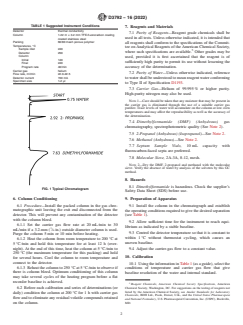
ization established in the Decision on Principles for the Table 1.
Development of International Standards, Guides and Recom-
5.2 Column—The column should be at least 1.22 m (4 ft) of
mendations issued by the World Trade Organization Technical
3.2 mm ( ⁄8 in.) outside diameter tubing of stainless steel, or
Barriers to Trade (TBT) Committee.
other suitable material, lined with a TFE-fluorocarbon coating
packed with 60/80 mesh (180 µm to 250 µm) porous polymer
2. Referenced Documents
packing material. A longer 1.83 m (6 ft) column can be used
2.1 ASTM Standards:
to improve resolution.
D1193 Specification for Reagent Water
5.3 Integrator—Any electronic integrator that can accu-
E180 Practice for Determining the Precision of ASTM
rately quantify a gas chromatographic peak is acceptable.
Methods for Analysis and Testing of Industrial and Spe-
Alternatively, a recording potentiometer with a full-scale
cialty Chemicals (Withdrawn 2009)
deflectionof1-10mV,fullscaleresponsetimeof2sorlessand
sufficient sensitivity and stability to meet the requirements of
5.1.
This test method is under the jurisdiction of ASTM Committee D01 on Paint
and Related Coatings, Materials, andApplications and is the direct responsibility of
5.4 Liquid Charging Devices—Micro syringes of 5–10-µL
Subcommittee D01.21 on Chemical Analysis of Paints and Paint Materials.
capacity with a precision of 60.01 µL. Automatic injection of
Current edition approved Dec. 1, 2022. Published December 2022. Originally
samples improves the precision of this test method.
approved in 1979. Last previous edition approved in 2016 as D3792 – 16. DOI:
10.1520/D3792-16R22.
For referenced ASTM standards, visit the ASTM website, www.astm.org, or
contact ASTM Customer Service at service@astm.org. For Annual Book of ASTM
Standards volume information, refer to the standard’s Document Summary page on HayeSep R (silanized), was used in the round robin.Any other porous polymer
the ASTM website. packing or other column giving equivalent or superior performance may be used.
The last approved version of this historical standard is referenced on These products are available from most gas chromatography suppliers and distribu-
www.astm.org. tors.
Copyright © ASTM International, 100 Barr Harbor Drive, PO Box C700, West Conshohocken, PA 19428-2959. United States
D3792 − 16 (2022)
TABLE 1 Suggested Instrument Conditions
7. Reagents and Materials
Detector thermal conductivity
7.1 Purity of Reagents—Reagent grade chemicals shall be
Column 1.22m×3.2 mm TFE-fluorocarbon coating
used in all tests. Unless otherwise indicated, it is intended that
coated stainless steel
Packing 60/80 mesh porous polymer
all reagents shall conform to the specifications of the Commit-
Temperatures, °C
tee onAnalytical Reagents of theAmerican Chemical Society,
Sample inlet 240
where such specifications are available. Other grades may be
Detector 250
Column
used, provided it is first ascertained that the reagent is of
Initial 140
sufficiently high purity to permit its use without lessening the
Final 240
accuracy of the determination.
Program rate 40/min
Carrier gas helium
7.2 Purity of Water—Unless otherwise indicated, reference
Flow rate, ml/min 22.0-22.5
Detector current 150 mA to water shall be understood to mean reagent water conforming
Specimen size 1-2 µl
to Type II of Specification D1193.
7.3 Carrier Gas—Helium of 99.995 % or higher purity.
High-purity nitrogen may also be used.
NOTE 1—Care should be taken that any moisture that may be present in
the carrier gas is eliminated through the use of a suitable carrier gas
purifier. Trace levels of water will accumulate on the column at low oven
temperatures and may affect the reproducibility as well as the accuracy of
the determination.
7.4 Dimethylformamide (DMF) (Anhydrous) gas
chromatography, spectrophotometric quality (See Note 2).
7.5 2-Propanol (Anhydrous) (Isopropanol)—See Note 2.
7.6 Methanol (Anhydrous)—See Note 2.
7.7 Septum Sample Vials, 10 mL capacity with
fluorocarbon-faced septa are preferred.
7.8 Molecular Sieve, 2A-3A, 8-12, mesh.
NOTE 2—Dry the DMF, 2-propanol and methanol with the molecular
sieve. Verify the absence of water by analysis of the solvents by this GC
method.
8. Hazards
8.1 Dimethylformamide is hazardous. Check the supplier’s
FIG. 1 Typical Chromatogram
Safety Data Sheet (SDS) before use.
6. Column Conditioning 9. Preparation of Apparatus
6.1 Procedure—Install the packed column in the gas chro- 9.1 Install the column in the chromatograph and establish
matographic unit leaving the exit end disconnected from the the operating conditions required to give the desired separation
detector. This will prevent any contamination of the detector (see Table 1).
with the column bleed.
9.2 Allow sufficient time for the instrument to reach equi-
6.1.1 Set the carrier gas flow rate at 20 mL⁄min to 30
librium as indicated by a stable baseline.
mL/min if a 3.2-mm ( ⁄8-in.) outside diameter column is used.
9.3 Control the detector temperature so that it is constant to
Purge the column 5 min or 10 min before heating.
within 1 °C without thermostat cycling, which causes an
6.1.2 Heat the column from room temperature to 200 °C at
uneven baseline.
5 °C⁄min and hold this temperature for at least 12 h (over-
night). At the end of this time, heat the column at 5 °C⁄min to
9.4 Adjust the carrier-gas flow to a constant value.
250 °C (the maximum temperature for this packing) and hold
10. Calibration
for several hours. Cool the column to room temperature and
connect to the detector.
10.1 UsingtheinformationinTable1(asaguide),selectthe
6.1
...