

ASTM D7315-17(2023)
(Test Method)Standard Test Method for Determination of Turbidity Above 1 Turbidity Unit (TU) in Static Mode
General Information
- Abstract
SIGNIFICANCE AND USE
5.1 Turbidity at the levels defined in the scope of this test method are often monitored to help control processes, monitor the health and biology of water environments and determine the impact of changes in response to environmental events (weather events, floods, etc.). Turbidity is often undesirable in drinking water, plant effluent waters, water for food and beverage processing, and for a large number of other water-dependent manufacturing processes. Removal is often accomplished by coagulation, sedimentation, and various levels of filtration. Measurement of turbidity provides an indicator of contamination, and is a vital measurement for monitoring the characteristics and or quality within the sample’s source or process.
5.2 This test method does overlap Test Method D6855 for the range of 1 to 5 TU. If the predominant measurement falls below 1.0 TU with occasional spikes above this value, Test Method D6855 may be more applicable. For measurements that are consistently above 1 TU, this test method is applicable.
5.3 This test method is suitable to turbidity such as that found in all waters that measure above 1 NTU. Examples include environmental waters (streams, rivers, lakes, reservoirs, estuaries), processes associated with water pollution control plants (wastewater treatment plants), and various industrial processes involving water with noticeable turbidity. For measurement of cleaner waters, refer to Test Method D6855.
5.4 The appropriate measurement range for a specific technology or instrument type that should be utilized is at or below 80 % of full-scale capability for the respective instrument or technology. Measurements above this level may not be dependable.
5.4.1 Dilutions of waters are not recommended, especially in the case of samples with rapidly settling particles (that is, sediments). It is recommended that an appropriate instrument design that covers the expected range be selected to avoid the need to perform dilutions.
5.5 Technol...
SCOPE
1.1 This test method covers the static determination of turbidity in water. Static refers to a sample that is removed from its source and tested in an isolated instrument. (See Section 4.)
1.2 This test method is applicable to the measurement of turbidities greater than 1.0 turbidity unit (TU). The upper end of the measurement range was left undefined because different technologies described in this test method can cover very different ranges. The round robin study covered the range of 0 to 4000 turbidity units because instrument verification in this range can typically be covered by standards that can be consistently reproduced.
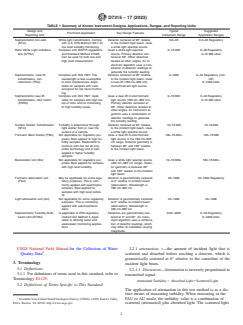
1.3 Many of the turbidity units and instrument designs covered in this test method are numerically equivalent in calibration when a common calibration standard is applied across those designs listed in Table 1. Measurement of a common calibration standard of a defined value will also produce equivalent results across these technologies.
1.3.1 In this test method calibration standards are often defined in NTU values, but the other assigned turbidity units, such as those in Table 1 are equivalent. For example, a 1 NTU formazin standard is also a 1 FNU, a 1 FAU, a 1 BU, and so forth.
1.4 This test method does not purport to cover all available technologies for high-level turbidity measurement.
1.5 This test method was tested on different natural waters and wastewater, and with standards that will serve as surrogates to samples. It is the user's responsibility to ensure the validity of this test method for waters of untested matrices.
1.6 Depending on the constituents within a high-level sample, the proposed sample preparation and measurement methods may or may not be applicable. Those samples with the highest particle densities typically prove to be the most difficult to measure. In these cases, and alternative measurement method such as the process monitoring method can be consi...
- Status
- Published
- Publication Date
- 31-Oct-2023
- Technical Committee
- D19 - Water
- Drafting Committee
- D19.07 - Sediments, Geomorphology, and Open-Channel Flow
Overview
ASTM D7315-17(2023) - Standard Test Method for Determination of Turbidity Above 1 Turbidity Unit (TU) in Static Mode is a widely recognized ASTM standard for measuring turbidity in water samples. This method specifically addresses static testing, where a sample is removed from its source and analyzed using a calibrated instrument. The standard applies to situations where turbidity consistently exceeds 1.0 TU, covering a broad upper range (up to several thousand units, depending on instrumentation), and serves critical roles in water quality management across environmental, industrial, and regulatory applications.
Key Topics
- Turbidity Monitoring: Turbidity, reflecting the optical clarity of water, is a primary indicator of contamination by suspended particles such as silt, clay, organic matter, or microorganisms.
- Measurement Range: Designed for samples with turbidity greater than 1 TU, making it suitable for environmental waters (rivers, lakes, wastewater) and industrial processes, as opposed to cleaner water samples where other standards (e.g., ASTM D6855) are more appropriate.
- Instrument Types and Units: The method accommodates various instrument designs, including nephelometric (e.g., NTU, FNU), backscatter, and attenuation-based instruments, ensuring traceability and appropriate reporting units based on technology.
- Calibration and Quality Control: Consistent calibration and verification, using standards such as formazin, are essential for reliable results. The equivalence of reporting units (NTU, FNU, FAU, BU, etc.), calibrated to common standards, supports comparability among different instrument designs.
- Interferences: The standard discusses common measurement interferences, such as bubbles, color, particle size, and contamination on sample cells, and provides recommended practices for minimizing errors.
- Instrument Performance: Measurement accuracy is linked to operation within 80% of an instrument’s full-scale capability and the proper selection of instrument design for the sample’s expected turbidity range.
Applications
ASTM D7315-17(2023) is vital for various practical applications:
- Drinking Water and Wastewater: Essential for monitoring plant effluent and source water to ensure that turbidity remains below regulatory thresholds.
- Environmental Monitoring: Applied in assessment and control in natural water bodies, especially after weather events, flooding, or significant ecological changes.
- Industrial Processes: Used in the manufacture of beverages, food, pharmaceuticals, and other products where water clarity impacts product quality.
- Regulatory Compliance: Supports documentation and reporting in compliance with local, national, or international water quality standards.
- Process Control: Facilitates on-site checks and laboratory analysis of process waters, ensuring operational stability and the effectiveness of treatment (e.g., coagulation, sedimentation, filtration).
Related Standards
For comprehensive turbidity measurement and water quality assessment, the following standards and methods are closely associated:
- ASTM D6855: Determination of Turbidity Below 5 NTU in Static Mode – recommended for cleaner water with lower turbidity.
- ASTM D1129: Terminology Relating to Water – provides definitions for terms used in water analysis.
- ASTM D1193: Specification for Reagent Water – details requirements for water used in laboratory testing.
- ISO 7027: Water quality – Determination of turbidity – international reference for non-regulatory and regulatory monitoring, particularly outside North America.
- U.S. EPA Method 180.1: Methods for Chemical Analysis of Water and Wastes, Turbidity – U.S. regulatory method specifying light source and measurement conditions.
ASTM D7315-17(2023) stands as a foundational tool for practitioners in water quality analysis, environmental monitoring, and regulatory compliance, offering a reliable framework for high-level turbidity determination in diverse settings. Employing this method supports better decision-making and process optimization in any application where water clarity and quality are critical.
Relations
- Effective Date
- 01-Nov-2023
- Refers
ASTM D6855-17(2023) - Standard Test Method for Determination of Turbidity Below 5 NTU in Static Mode - Effective Date
- 01-Nov-2023
- Effective Date
- 01-May-2020
- Effective Date
- 01-May-2020
- Refers
ASTM D6855-17 - Standard Test Method for Determination of Turbidity Below 5 NTU in Static Mode - Effective Date
- 01-Nov-2017
- Effective Date
- 01-Nov-2023
- Effective Date
- 01-Nov-2023
- Effective Date
- 01-Nov-2023
- Effective Date
- 01-Nov-2023
- Effective Date
- 01-Nov-2023
- Effective Date
- 01-Nov-2023
- Effective Date
- 01-Nov-2023
Get Certified
Connect with accredited certification bodies for this standard

CIS Institut d.o.o.
Personal Protective Equipment (PPE) certification body. Notified Body NB-2890 for EU Regulation 2016/425 PPE.

Kiwa BDA Testing
Building and construction product certification.
Kmetijski inštitut Slovenije
Agricultural Institute of Slovenia. Soil testing, plant health, agricultural product analysis.
Sponsored listings
Frequently Asked Questions
ASTM D7315-17(2023) is a standard published by ASTM International. Its full title is "Standard Test Method for Determination of Turbidity Above 1 Turbidity Unit (TU) in Static Mode". This standard covers: SIGNIFICANCE AND USE 5.1 Turbidity at the levels defined in the scope of this test method are often monitored to help control processes, monitor the health and biology of water environments and determine the impact of changes in response to environmental events (weather events, floods, etc.). Turbidity is often undesirable in drinking water, plant effluent waters, water for food and beverage processing, and for a large number of other water-dependent manufacturing processes. Removal is often accomplished by coagulation, sedimentation, and various levels of filtration. Measurement of turbidity provides an indicator of contamination, and is a vital measurement for monitoring the characteristics and or quality within the sample’s source or process. 5.2 This test method does overlap Test Method D6855 for the range of 1 to 5 TU. If the predominant measurement falls below 1.0 TU with occasional spikes above this value, Test Method D6855 may be more applicable. For measurements that are consistently above 1 TU, this test method is applicable. 5.3 This test method is suitable to turbidity such as that found in all waters that measure above 1 NTU. Examples include environmental waters (streams, rivers, lakes, reservoirs, estuaries), processes associated with water pollution control plants (wastewater treatment plants), and various industrial processes involving water with noticeable turbidity. For measurement of cleaner waters, refer to Test Method D6855. 5.4 The appropriate measurement range for a specific technology or instrument type that should be utilized is at or below 80 % of full-scale capability for the respective instrument or technology. Measurements above this level may not be dependable. 5.4.1 Dilutions of waters are not recommended, especially in the case of samples with rapidly settling particles (that is, sediments). It is recommended that an appropriate instrument design that covers the expected range be selected to avoid the need to perform dilutions. 5.5 Technol... SCOPE 1.1 This test method covers the static determination of turbidity in water. Static refers to a sample that is removed from its source and tested in an isolated instrument. (See Section 4.) 1.2 This test method is applicable to the measurement of turbidities greater than 1.0 turbidity unit (TU). The upper end of the measurement range was left undefined because different technologies described in this test method can cover very different ranges. The round robin study covered the range of 0 to 4000 turbidity units because instrument verification in this range can typically be covered by standards that can be consistently reproduced. 1.3 Many of the turbidity units and instrument designs covered in this test method are numerically equivalent in calibration when a common calibration standard is applied across those designs listed in Table 1. Measurement of a common calibration standard of a defined value will also produce equivalent results across these technologies. 1.3.1 In this test method calibration standards are often defined in NTU values, but the other assigned turbidity units, such as those in Table 1 are equivalent. For example, a 1 NTU formazin standard is also a 1 FNU, a 1 FAU, a 1 BU, and so forth. 1.4 This test method does not purport to cover all available technologies for high-level turbidity measurement. 1.5 This test method was tested on different natural waters and wastewater, and with standards that will serve as surrogates to samples. It is the user's responsibility to ensure the validity of this test method for waters of untested matrices. 1.6 Depending on the constituents within a high-level sample, the proposed sample preparation and measurement methods may or may not be applicable. Those samples with the highest particle densities typically prove to be the most difficult to measure. In these cases, and alternative measurement method such as the process monitoring method can be consi...
SIGNIFICANCE AND USE 5.1 Turbidity at the levels defined in the scope of this test method are often monitored to help control processes, monitor the health and biology of water environments and determine the impact of changes in response to environmental events (weather events, floods, etc.). Turbidity is often undesirable in drinking water, plant effluent waters, water for food and beverage processing, and for a large number of other water-dependent manufacturing processes. Removal is often accomplished by coagulation, sedimentation, and various levels of filtration. Measurement of turbidity provides an indicator of contamination, and is a vital measurement for monitoring the characteristics and or quality within the sample’s source or process. 5.2 This test method does overlap Test Method D6855 for the range of 1 to 5 TU. If the predominant measurement falls below 1.0 TU with occasional spikes above this value, Test Method D6855 may be more applicable. For measurements that are consistently above 1 TU, this test method is applicable. 5.3 This test method is suitable to turbidity such as that found in all waters that measure above 1 NTU. Examples include environmental waters (streams, rivers, lakes, reservoirs, estuaries), processes associated with water pollution control plants (wastewater treatment plants), and various industrial processes involving water with noticeable turbidity. For measurement of cleaner waters, refer to Test Method D6855. 5.4 The appropriate measurement range for a specific technology or instrument type that should be utilized is at or below 80 % of full-scale capability for the respective instrument or technology. Measurements above this level may not be dependable. 5.4.1 Dilutions of waters are not recommended, especially in the case of samples with rapidly settling particles (that is, sediments). It is recommended that an appropriate instrument design that covers the expected range be selected to avoid the need to perform dilutions. 5.5 Technol... SCOPE 1.1 This test method covers the static determination of turbidity in water. Static refers to a sample that is removed from its source and tested in an isolated instrument. (See Section 4.) 1.2 This test method is applicable to the measurement of turbidities greater than 1.0 turbidity unit (TU). The upper end of the measurement range was left undefined because different technologies described in this test method can cover very different ranges. The round robin study covered the range of 0 to 4000 turbidity units because instrument verification in this range can typically be covered by standards that can be consistently reproduced. 1.3 Many of the turbidity units and instrument designs covered in this test method are numerically equivalent in calibration when a common calibration standard is applied across those designs listed in Table 1. Measurement of a common calibration standard of a defined value will also produce equivalent results across these technologies. 1.3.1 In this test method calibration standards are often defined in NTU values, but the other assigned turbidity units, such as those in Table 1 are equivalent. For example, a 1 NTU formazin standard is also a 1 FNU, a 1 FAU, a 1 BU, and so forth. 1.4 This test method does not purport to cover all available technologies for high-level turbidity measurement. 1.5 This test method was tested on different natural waters and wastewater, and with standards that will serve as surrogates to samples. It is the user's responsibility to ensure the validity of this test method for waters of untested matrices. 1.6 Depending on the constituents within a high-level sample, the proposed sample preparation and measurement methods may or may not be applicable. Those samples with the highest particle densities typically prove to be the most difficult to measure. In these cases, and alternative measurement method such as the process monitoring method can be consi...
ASTM D7315-17(2023) is classified under the following ICS (International Classification for Standards) categories: 13.060.45 - Examination of water in general. The ICS classification helps identify the subject area and facilitates finding related standards.
ASTM D7315-17(2023) has the following relationships with other standards: It is inter standard links to ASTM D7315-17, ASTM D6855-17(2023), ASTM D1129-13(2020)e1, ASTM D1129-13(2020)e2, ASTM D6855-17, ASTM D7512-09(2015), ASTM D7725-17(2023), ASTM D7726-11(2023), ASTM D8006-16, ASTM D7937-15(2023), ASTM D2035-19, ASTM D4188-17. Understanding these relationships helps ensure you are using the most current and applicable version of the standard.
ASTM D7315-17(2023) is available in PDF format for immediate download after purchase. The document can be added to your cart and obtained through the secure checkout process. Digital delivery ensures instant access to the complete standard document.
Standards Content (Sample)
This international standard was developed in accordance with internationally recognized principles on standardization established in the Decision on Principles for the
Development of International Standards, Guides and Recommendations issued by the World Trade Organization Technical Barriers to Trade (TBT) Committee.
Designation: D7315 − 17 (Reapproved 2023)
Standard Test Method for
Determination of Turbidity Above 1 Turbidity Unit (TU) in
Static Mode
This standard is issued under the fixed designation D7315; the number immediately following the designation indicates the year of
original adoption or, in the case of revision, the year of last revision. A number in parentheses indicates the year of last reapproval. A
superscript epsilon (´) indicates an editorial change since the last revision or reapproval.
1. Scope to measure. In these cases, and alternative measurement
method such as the process monitoring method can be consid-
1.1 This test method covers the static determination of
ered.
turbidity in water. Static refers to a sample that is removed
1.7 This standard does not purport to address all of the
from its source and tested in an isolated instrument. (See
safety concerns, if any, associated with its use. It is the
Section 4.)
responsibility of the user of this standard to establish appro-
1.2 This test method is applicable to the measurement of
priate safety, health, and environmental practices and deter-
turbidities greater than 1.0 turbidity unit (TU). The upper end
mine the applicability of regulatory limitations prior to use.
of the measurement range was left undefined because different
Refer to the MSDSs for all chemicals used in this procedure.
technologies described in this test method can cover very
1.8 This international standard was developed in accor-
different ranges. The round robin study covered the range of 0
dance with internationally recognized principles on standard-
to 4000 turbidity units because instrument verification in this
ization established in the Decision on Principles for the
range can typically be covered by standards that can be
Development of International Standards, Guides and Recom-
consistently reproduced.
mendations issued by the World Trade Organization Technical
1.3 Many of the turbidity units and instrument designs
Barriers to Trade (TBT) Committee.
covered in this test method are numerically equivalent in
calibration when a common calibration standard is applied 2. Referenced Documents
across those designs listed in Table 1. Measurement of a
2.1 ASTM Standards:
common calibration standard of a defined value will also
D1129 Terminology Relating to Water
produce equivalent results across these technologies.
D1193 Specification for Reagent Water
1.3.1 In this test method calibration standards are often
D2777 Practice for Determination of Precision and Bias of
defined in NTU values, but the other assigned turbidity units,
Applicable Test Methods of Committee D19 on Water
such as those in Table 1 are equivalent. For example, a 1 NTU
D4411 Guide for Sampling Fluvial Sediment in Motion
formazin standard is also a 1 FNU, a 1 FAU, a 1 BU, and so
D5847 Practice for Writing Quality Control Specifications
forth.
for Standard Test Methods for Water Analysis
1.4 This test method does not purport to cover all available D6855 Test Method for Determination of Turbidity Below 5
NTU in Static Mode
technologies for high-level turbidity measurement.
E691 Practice for Conducting an Interlaboratory Study to
1.5 This test method was tested on different natural waters
Determine the Precision of a Test Method
and wastewater, and with standards that will serve as surro-
2.2 Other Referenced Standards:
gates to samples. It is the user’s responsibility to ensure the
U.S. EPA Method 180.1 Methods for Chemical Analysis of
validity of this test method for waters of untested matrices.
Water and Wastes, Turbidity
1.6 Depending on the constituents within a high-level
ISO 7027 Water Quality—Determination of Turbidity
sample, the proposed sample preparation and measurement
methods may or may not be applicable. Those samples with the
For referenced ASTM standards, visit the ASTM website, www.astm.org, or
highest particle densities typically prove to be the most difficult
contact ASTM Customer Service at service@astm.org. For Annual Book of ASTM
Standards volume information, refer to the standard’s Document Summary page on
the ASTM website.
1 3
This test method is under the jurisdiction of ASTM Committee D19 on Water Available from United States Environmental Protection Agency (EPA), William
and is the direct responsibility of Subcommittee D19.07 on Sediments, Jefferson Clinton Bldg., 1200 Pennsylvania Ave., NW, Washington, DC 20460,
Geomorphology, and Open-Channel Flow. http://www.epa.gov.
Current edition approved Nov. 1, 2023. Published December 2023. Originally Available from International Organization for Standardization (ISO), ISO
approved in 2007. Last previous edition approved in 2017 as D7315 – 17. DOI: Central Secretariat, BIBC II, Chemin de Blandonnet 8, CP 401, 1214 Vernier,
10.1520/D7315-17R23. Geneva, Switzerland, http://www.iso.org.
Copyright © ASTM International, 100 Barr Harbor Drive, PO Box C700, West Conshohocken, PA 19428-2959. United States
D7315 − 17 (2023)
TABLE 1 Summary of Known Instrument Designs, Applications, Ranges, and Reporting Units
Design and Typical Suggested
Prominent Application Key Design Features
Reporting Unit Instrument Range Application Ranges
Nephelometric non-ratio White light turbidimeters. Comply Detector centered at 90° relative 0.0–40 0.0–40 Regulatory
(NTU) with U.S. EPA Method 180.1 for to the incident light beam. Uses
low level turbidity monitoring. a white light spectral source.
Ratio White Light turbidime- Complies with ISWTR regulations Used a white light spectral 0–10 000 0–40 Regulatory
ters (NTRU) and Standard Method 2130B. source. Primary detector cen- 0–10 000 other
Can be used for both low and tered at 90°. Other detectors
high level measurement. located at other angles. An in-
strument algorithm uses a com-
bination of detector readings to
generate the turbidity reading.
Nephelometric, near-IR Complies with ISO 7027. The Detector centered at 90° relative 0–1000 0–40 Regulatory (non-
turbidimeters, non- wavelength is less susceptible to the incident light beam. Uses US)
ratiometric (FNU) to color interferences. Appli- a near-IR (780 nm–900 nm) 0–1000 other
cable for samples with color monochromatic light source.
and good for low level monitor-
ing.
Nephelometric near-IR Complies with ISO 7027. Appli- Uses a near-IR monochromatic 0–10 000 0–40 Regulatory
turbidimeters, ratio metric cable for samples with high lev- light source (780 nm–900 nm). 0–10 000 other
(FNRU) els of color and for monitoring Primary detector centered at
to high turbidity levels. 90°. Other detectors located at
other angles. An instrument al-
gorithm uses a combination of
detector readings to generate
the turbidity reading.
Surface Scatter Turbidimeters Turbidity is determined through Detector centered at 90° relative 10–10 000 10–10 000
(NTU) light scatter from or near the to the incident light beam. Uses
surface of a sample. a white light spectral source.
Formazin Back Scatter (FBU) Not applicable for regulatory pur- Uses a near-IR monochromatic 100–10 000+ 100–10 000
poses. Best applied to high tur- light source in the 780 nm–900
bidity samples. Backscatter is nm range. Detector geometry is
common with but not all only between 90° and 180° relative
probe technology and is best to the incident light beam.
applied in higher turbidity
samples.
Backscatter Unit (BU) Not applicable for regulatory pur- Uses a white light spectral source 10–10 000+ 100–10 000+
poses. Best applied for samples (400 nm–680 nm range). Detec-
with high level turbidity. tor geometry is between 90°
and 180° relative to the incident
light beam.
Formazin attenuation unit May be applicable for some regu- Detector is geometrically centered 20–1000 20–1000 Regulatory
(FAU) latory purposes. This is com- at 0° relative to incident beam
monly applied with spectropho- (attenuation). Wavelength is
tometers. Best applied for 780 nm–900 nm.
samples with high level turbid-
ity.
Light attenuation unit (AU) Not applicable for some regulatory Detector is geometrically centered 20–1000 20–1000
purposes. This is commonly at 0° relative to incident beam
applied with spectrophotom- (attenuation). Wavelength is
eters. 400 nm–680 nm.
Nephelometric Turbidity Multi- Is applicable to EPA regulatory Detectors are geometrically cen- 0.02–4000 0–40 Regulatory
beam Unit (NTMU) method GLI Method 2. Appli- tered at 0° and 90°. An instru- 0–4000 other
cable to drinking water and ment algorithm uses a combina-
wastewater monitoring applica- tion of detector readings, which
tions. may differ for turbidities varying
magnitude.
USGS National Field Manual for the Collection of Water 3.2.1 attenuation, v—the amount of incident light that is
Quality Data scattered and absorbed before reaching a detector, which is
geometrically centered at 0° relative to the centerline of the
3. Terminology
incident light beam.
3.1 Definitions:
3.2.1.1 Discussion—Attenuation is inversely proportional to
3.1.1 For definitions of terms used in this standard, refer to
transmitted signal.
Terminology D1129.
Attenuated Turbidity 5 Absorbed Light1Scattered Light
3.2 Definitions of Terms Specific to This Standard:
The application of attenuation in this test method is as a dis-
tinct means of measuring turbidity. When measuring in the
FAU or AU mode, the turbidity value is a combination of
Available from United Stated Geological Survey (USGS), 12201 Sunrise Valley
Drive, Reston, VA 20192, http://www.usgs.gov. scattered (attenuated) plus absorbed light. The scattered light
D7315 − 17 (2023)
is affected by particle size and is a positive response. The
3.2.10 turbidimeter, n—an instrument that measures light
absorption due to color is a negative. The sum of these two
scatter, caused by particulates within a sample and converts the
entities results in the turbidity value in the respective units.
measurement to a turbidity value.
3.2.2 calibration turbidity standard, n—a turbidity standard 3.2.10.1 Discussion—The detected light is quantitatively
that is traceable and equivalent to the reference turbidity converted to a numeric value that is traced to a light-scatter
standard to within statistical errors; calibration turbidity stan- standard. See Table 1 for examples of designs.
dards include commercially prepared 4000 NTU Formazin,
3.2.11 turbidity, n—an expression of the optical properties
stabilized formazin (see 9.2.3), and styrenedivinylbenzene
of a sample that causes light rays to be scattered and absorbed
(SDVB) (see 9.2.4).
rather than transmitted in straight lines through the sample.
3.2.2.1 Discussion—These standards may be used to cali-
3.2.11.1 Discussion—Turbidity of water is caused by the
brate the instrument. Calibration standards may be instrument
presence of matter such as clay, silt, finely divided organic
design specific. Calibration standards that exceed 10 000
matter, plankton, other microscopic organisms, organic acids,
turbidity units are commercially available.
and dyes.
3.2.3 calibration verification standards, n—defined stan-
4. Summary of Test Method
dards used to verify the accuracy of a calibration in the
measurement range of interest. 4.1 The optical property expressed as turbidity is measured
by the scattering effect that constituents within a sample have
3.2.3.1 Discussion—These standards may not be used to
on light; the higher the quantity of scattered or attenuated
perform calibrations, only calibration verifications. Included
incident light, the higher the turbidity. In samples containing
standards are opto-mechanical light scatter devices, gel-like
particulate material, light scatter and attenuation will vary (1)
standards, or any other type of stable liquid standard. Calibra-
due to size, shape and composition of the particles in the water,
tion verification standards may be instrument design specific.
and (2) the wavelength of the incident light.
3.2.4 nephelometric turbidity measurement, n—The mea-
4.2 This test method is based upon a comparison of the
surement of light scatter from a sample in a direction that is at
amount of light scattered or attenuated by the sample with the
90° with respect to the centerline of the incident light path.
amount of light scattered or attenuated by a reference suspen-
3.2.4.1 Discussion—Units are NTU (Nephelometric Turbid-
sion. Lower turbidity values are typically determined by a
ity Units). When ISO 7027 technology is employed units are in
nephelometer, which measures light scatter from a sample in a
FNU (Formazin Nephelometric Units).
direction that is at 90° with respect to the centerline of the
3.2.5 ratio turbidity measurement, n—the measurement de-
incident light path. High-level turbidity determination can be
rived through the use of a nephelometric detector that serves as
performed using many different technologies. It is critical
the primary detector and one or more other detectors used to
when reporting the measurement, traceability to the type of
compensate for variation in incident light fluctuation, stray
technology be used. Turbidity measurements are not often
light, instrument noise, or sample color.
consistent among differing technologies.
3.2.6 reference turbidity standard, n—a standard that is
5. Significance and Use
synthesized reproducibly from traceable raw materials by the
user.
5.1 Turbidity at the levels defined in the scope of this test
3.2.6.1 Discussion—All other standards are traced back to method are often monitored to help control processes, monitor
this standard. The reference standard for turbidity is formazin the health and biology of water environments and determine
(see 9.2.2). the impact of changes in response to environmental events
(weather events, floods, etc.). Turbidity is often undesirable in
3.2.7 seasoning, v—the process of conditioning labware
drinking water, plant effluent waters, water for food and
with the standard to be diluted to a lower value.
beverage processing, and for a large number of other water-
3.2.7.1 Discussion—The process reduces contamination and
dependent manufacturing processes. Removal is often accom-
dilution errors.
plished by coagulation, sedimentation, and various levels of
3.2.8 stray light, n—all light reaching the detector other than filtration. Measurement of turbidity provides an indicator of
that which is scattered by the sample. contamination, and is a vital measurement for monitoring the
characteristics and or quality within the sample’s source or
3.2.8.1 Discussion—For example: ambient light leakage,
process.
internal reflections and divergent light in optical systems. For
this test method, stray light is likely to be negligible. The
5.2 This test method does overlap Test Method D6855 for
instrument design is intended to reduce or eliminate stray light.
the range of 1 to 5 TU. If the predominant measurement falls
below 1.0 TU with occasional spikes above this value, Test
3.2.9 surface scatter turbidimeter, n—an instrument that
Method D6855 may be more applicable. For measurements
determines the turbidity through incident light scatter that
that are consistently above 1 TU, this test method is applicable.
occurs at or slightly below the surface of a water sample with
a detection angle that is at 90° relative to the incident light
5.3 This test method is suitable to turbidity such as that
beam.
found in all waters that measure above 1 NTU. Examples
3.2.9.1 Discussion—Interferences are not as substantial as include environmental waters (streams, rivers, lakes,
nephelometric non-ratio measurements. reservoirs, estuaries), processes associated with water pollution
D7315 − 17 (2023)
control plants (wastewater treatment plants), and various in- in the range of 780 nm to 900 nm. These designs are distin-
dustrial processes involving water with noticeable turbidity. guishable in the reporting units and will always begin with the
For measurement of cleaner waters, refer to Test Method letter F.
D6855. 5.7.1.2 For a specific design that falls outside of these
reporting ranges, the turbidity should be reported in turbidity
5.4 The appropriate measurement range for a specific tech-
units (TU) with a subscripted wavelength value to characterize
nology or instrument type that should be utilized is at or below
the light source that was used. See 7.4.3.
80 % of full-scale capability for the respective instrument or
5.7.1.3 Those designs listed in Table 1 cover those that were
technology. Measurements above this level may not be depend-
currently identified by the ASTM subcommittee. Future de-
able.
signs that are not covered in this document may be incorpo-
5.4.1 Dilutions of waters are not recommended, especially
rated into a future revision after review by the method
in the case of samples with rapidly settling particles (that is,
subcommittee.
sediments). It is recommended that an appropriate instrument
5.7.1.4 See Section 7 for more details regarding instrument
design that covers the expected range be selected to avoid the
designs.
need to perform dilutions.
5.7.1.5 Section 16 contains precision and bias data that
5.5 Technologies described in this standard may not mea-
incorporates the different classifications of technologies. The
sure all aspects (absorption and scatter) of a sample. Some of
precision and bias section includes the overall data set of all
the properties of the water, the suspended material, or both may
laboratories and smaller segments of this data set to provide
interfere with the certain measured property of the sample,
comparisons across distinguishing technological features that
such as the scattering of light that the particular instrument is
are exhibited by those technologies that are represented in this
measuring.
test method.
5.6 Several different technologies are available for use in
5.8 This test method covers the measurement of samples
the measurement of high-level turbidity. Some technologies
collected from waters and analyzed using typical laboratory
may be better suited for specific types of samples, depending
based or portable-based instruments.
on the application and measurement criteria. Please refer to
Table 1 and Appendix X1 which is a flow chart to help assist
6. Interferences
in selecting the best technology for the specific application.
6.1 Bubbles, although they cause turbidity, may result in
5.6.1 When measuring high levels of turbidity the samples
interferences in measured turbidity as determined by this test
will often contain significant interferences such as that from
method. Bubbles cause a positive interference and color
absorbing particles, absorbance in the matrix, and rapidly
typically causes a negative interference. Dissolved material
settling particles. These may have a significant impact on how
that imparts a color to the water may cause errors in pure
one measurement technology responds to changes in turbidity.
nephelometric readings, unless the instrument has special
Often times it will be prudent to run a series of linear dilutions
compensating features to reduce these interferences. Certain
to determine if the measured response was expected relative to
turbulent motions also create unstable reading conditions of
the dilution. In cases where the response to dilution ratio is
nephelometers.
linear, the technology may be adequately accounting for the
interferences. If the response is not expected, another technol-
6.2 Color is characterized by absorption of specific wave-
ogy should be considered to determine if a more accurate
lengths of light. If the wavelengths of incident light are
measurement could be obtained.
significantly absorbed, a negative interference will result un-
less the instrument has special compensating features. Depend-
5.7 When reporting the measured result, appropriate units
ing on the application color may or may not be considered as
should also be attached. The units are reflective of the
an interference. Some instrument designs are intended to
technology used to generate the measurements. The intention is
remove the effect that color imparts on a turbidity measure-
to provide traceability for the technology used to generate the
ment. Other designs do not remove the effects of color.
measured result, and if necessary, provide more adequate
6.2.1 Those designs where color effects can be reduced or
comparison to historical data. Section 7 describes technology
eliminated include nephelometric-based designs with incident
that each type of traceable reporting units is based.
light sources in the 780 nm to 900 nm range. Those designs
5.7.1 Table 1 contains the list of technologies and respective
that have additional detectors, such as ratioing instruments also
reporting units that will be traceable to that technology.
help to reduce the effects of color regardless of the light source.
5.7.1.1 The methods in Table 1 can be broken down into
Single detector systems with light sources below 780 nm will
two distinct groups of designs which are based on the type of
be more impacted by the effects of color in the sample, that is,
incident light source used. These are broad-band white light
color visible to the naked eye. Color can have a significant
source or light sources that provide a spectral output in the
impact on attenuation-based instruments if it has absorption
400 nm to 680 nm range. These include polychromatic light
spectrum that overlaps the spectral output of the incident light
sources, such as those that are necessary to comply with
source.
regulatory method U.S. EPA Method 180.1, but also can
include mono-chromatic light sources if the respective wave- 6.3 Scratches, finger marks, or dirt on the walls of the
length falls within the specified range. The second group of sample cell may give erroneous readings, especially at lower
instruments uses a near IR monochromatic light source that is turbidity levels. Sample cells should be kept scrupulously clean
D7315 − 17 (2023)
mark on the upper surface of the well so that the sample cell can be placed
both inside and outside and discarded when they become
in the well in an exact position each time.
etched or scratched. The sample cells must not be handled
where the light strikes them when positioned in the instrument 6.9 Condensation on optical elements or sample cells can
well. lead to severe errors in measurement.
6.4 Sample cell caps and liners must also be scrupulously 6.10 Rapidly settling particles are also an interference.
clean to prevent contamination of the sample. Seasoning of the Particles such as sand can settle rapidly and cause false high or
sample cells should be performed each time a new sample is false low turbidity readings. The user of this test method must
measured. use care to ensure particles are suspended in solution the
instant that the measurement is taken.
6.5 The optical quality and geometry of the sample cells can
also impact results. At all turbidity levels, sample cells that are
7. Apparatus
not optically consistent can result in error. Errors greater than
10 % relative to the turbidity value can be reduced through 7.1 There are several technologies that are capable of
indexing or replacement of the cells. See Section 16 for
measuring turbidity that exceeds 1.0 turbidity unit. A summary
additional information.
of these technologies is provided in Table 1. Within this table,
6.5.1 Sample cells should be optically matched or a single
suggested reporting units, which are representative to the
cell should be used to perform calibrations and measurements.
technology, are included.
6.6 Particle size and distribution will also impact turbidity
7.2 Several technologies for measuring high-level turbidity
and is sensitive to the different types of technologies used.
are discussed in this test method. They include nephelometer-
Typically, small particles will more effectively scatter light in
based instruments (see Figs. 1-3), backscatter based instru-
the nephelometric direction (at 90° relative to the incident light
ments (see Fig. 4), and attenuation-based instruments (see Fig.
beam) than larger particles. Overall, however, it is the net 5). These are all discussed in more detail.
aggregate scatter and attenuation of the available incident light
7.2.1 Nephelometers include the Photoelectric
by all particles that in the sample that contribute to the
Nephelometer, Ratio Photoelectric Nephelometer with single
measurement.
beam design, and ratio photoelectric nephelometer in the dual
beam design. The correlation between detector response and
6.7 The path-length of the sample cell or equivalent will
increasing turbidity levels is positive.
impact the sensitivity of measurements. A shorter path length
7.2.2 Backscatter turbidimeters typically employ similar
will extend the range and reduce the interference proportion-
light sources used in the photoelectric photometer but utilize a
ally. However, use of a shorter path-length will reduce the
detection angle that is capable of detecting backscattered light
sensitivity of the measurement.
from a sample. The correlation between detector response and
6.8 Ideally, the same indexed sample cell should be used
increasing turbidity levels is positive.
first for standardization followed by unknown (sample) deter-
7.2.3 Attenuation-based turbidimeters employ a detection
mination. If this is not possible, then sample cells must be
angle that is 0° relative to the incident light beam.
matched. Refer to the instrument manual or the standard’s
7.3 The resolution of the instruments should permit detec-
manufacturer for instructions regarding the matching of sample
tion of differences of at least 1 % of the range in which it is
cells.
used. See Section 14 for rounding the reporting values of
NOTE 1—Indexing of the sample cell to the instrument well is
accomplished by placing a mark on the top of the sample cell and a similar turbidity.
FIG. 1 Typical Nephelometer
D7315 − 17 (2023)
FIG. 2 Ratio Nephelometer (Single Beam Design)
NOTE 1—The blue traces show the path of the scattered light.
FIG. 3 Ratio Nephelometer (Multiple Beam Design)
7.3.1 Consult the manufacturer to determine that your to achieve a constant output. LEDs and laser diodes should be
instrument meets any of the designs that are discussed in this characterized by a wavelength of between 400 nm and 900 nm
test method.
with a bandwidth of less than 60 nm. The total distance
traversed by incident light and scattered light within the sample
7.4 The Nephelometer:
is not to exceed 10 cm. The angle of light acceptance to the
7.4.1 This instrument uses a light source for illuminating the
detector shall be centered at 90° to the centerline of the incident
sample and a single photodetector with a readout device to
light path and shall not exceed 610° from the 90° scatter path
indicate the intensity of light scattered at right angle(s) (90°) to
centerline. The detector must have a spectral response that is
the centerline of the path of the incident light. The photoelec-
sensitive to the spectral output of the incident light used.
tric nephelometer should be designed so that minimal stray
light reaches the detector in the absence of turbidity and should 7.4.2 Differences in physical design of nephelometers may
be free from significant drift after a short warm-up period. The
cause differences in measured values for turbidity even though
light source shall be a tungsten lamp operated at a color
the same suspension is used for calibrations. Comparability of
temperature between 2200 K and 3000 K (U.S. EPA Method
measurements made using instruments differing in optical and
180.1). Light-emitting diodes (LEDs) or laser diodes in defined
physical designs is not recommended. To minimize initial
wavelengths ranging from 400 nm to 680 nm and 780 nm to
differences, the following design criteria should be observed
900 nm may also be used if accurately characterized to be
(see Fig. 1).
equivalent in performance to tungsten using the same type of
7.4.3 Report in units of NTU if a white light source was
calibration and calibration verification standards. It is impor-
used or in units of FNU if a 780 nm to 900 nm light source was
tant to note that new technologies may not be covered by this
used.
test method. If LEDs or laser diodes are used, then the LED or
laser diode should be coupled with a monitor detection device 7.5 Ratio Nephelometer:
D7315 − 17 (2023)
NOTE 1—In the design shown, pathlength varies, depending on the turbidity of the sample.
FIG. 4 Geometric Diagram of a Backscatter Measurement (<90°)
NOTE 1—The scatter and attenuation path is the same as the incident light path.
FIG. 5 Technology Diagram of an Attenuation Technology
7.5.1 Ratio Nephelometer (see Fig. 2 for single beam be used. If an LED or a laser diode is used in the single beam
design; see Fig. 3 for multiple beam design)—This instrument design, then the LED or laser diode should be coupled with a
uses the measurement derived through the use of a nephelo- monitor detection device to achieve a consistent output. The
metric detector that serves as the primary detector and one or distance traversed by incident light and scattered light within
more other detectors used to compensate for variation in the sample is not to exceed 10 cm. The angle of light
incident light fluctuation, stray light, instrument noise, or acceptance to the nephelometric detector(s) should be centered
sample color. As needed by the design, additional photodetec- at 90° to the centerline of the incident light path and should not
tors may be used to detect the intensity of light scattered at exceed 610° from the scatter path centerline. The detector
other angles. The signals from these additional photodetectors must have a spectral response that is sensitive to the spectral
may be used to compensate for variations in incident light output of the incident light used. The instrument calibration
fluctuation, instrument stray light, instrument noise, sample (algorithm) must be designed such that the scaleable reading is
color, or combinations thereof. The ratio photoelectric neph- from the nephelometric detector(s), and other detectors are
elometer should be so designed that minimal stray light reaches used to compensate for instrument variation described in 7.4.1.
the detector(s), and should be free from significant drift after a 7.5.2 Differences in physical design of ratio photoelectric
short warm-up period. The light source should be a tungsten nephelometers may cause differences in measured values for
lamp, operated at a color temperature between 2200 K and turbidity even when the same suspension is used for calibra-
3000 K (U.S. EPA Method 180.1). LEDs and laser diodes in tions. Comparability of measurements made using instruments
defined wavelengths ranging from 400 nm to 900 nm may also differing in optical and physical design is not recommended. To
D7315 − 17 (2023)
minimize initial differences, the following design criteria the window of movement is less than 10° of rotation where the
should be observed (see Figs. 2 and 3). measurement is consistent. See 11.4.2.1.
7.5.3 Report in the appropriate units using Table 1 as
7.8.1.3 Cells should be handled where the light path does
guidance. not pass during measurement. Provision should be made in
7.5.3.1 FNRU, and FNMU signify the use of an incident
design to give the sample cell a proper place in which to handle
light wavelength between 780 nm to 900 nm. NTRU and the cell during calibration or sample measurement procedure.
NTMU signify the use of an incident light in the wavelength
7.8.1.4 The outside surface of a glass sample cell may be
range of 400 nm to 680 nm for a ratio technology. oiled, using silicone oil and a soft cloth, or a lint free laboratory
tissue to minimize imperfections that could cause light to
7.6 Backscatter Turbidimeters:
scatter off the surface of this sample cell, or wiped with
7.6.1 The instrumentation contains a light source that meets
alcohol. See the manufacturer’s recommendations for sample
or exceeds the criteria specified in 7.4.1 for illumination of the
cell preparation.
sample.
7.8.1.5 Preferably matched sample cells that provide con-
7.6.2 The response curve of the detector should be such that
sistent readings to within 10 % on filtered DI water should be
it overlaps the output of the light source.
used.
7.6.3 The detection angle for backscatter is between 90° and
180° relative to the centerline of the incident light beam. See
7.9 Sample Chambers:
Fig. 4.
7.9.1 For those instruments not using sample cells, the
7.6.4 When reporting turbidity, report in units that best fit
sample is placed directly into the sample chamber. For those
the light source and detector in Table 2. Report in BU (white
units, the sample chamber must be the following:
light source) or FBU (if a 780 nm to 900 nm light source was
7.9.1.1 Sample chambers should be kept scrupulously clean.
used).
Scratches, fingerprints and dirt on the walls of the sample
chamber may give erroneous results. See the manufacturer’s
7.7 Attenuation-Based Turbidimeters:
recommendations for sample chamber maintenance.
7.7.1 The instrument contains a light source that meets or
7.9.1.2 Sample chambers should be designed in such a way
exceeds the criteria specified in 7.4.1 for illumination of the
as to negate any influence from external light sources, and to
sample. Examples include monochromatic light such as those
minimize stray light interference with readings.
generated in spectrophotometers.
7.7.2 The detector response curve should overlap the inci-
8. Purity of Reagents
dent light source.
7.7.3 The detection angle for attenuation is to be set at 0°
8.1 Purity of Reagents—Reagent grade chemicals shall be
relative to the centerline of the incident light beam. See Fig. 5.
used in all tests. All reagents shall conform to the specifications
7.7.4 When reporting turbidity, report in units that best fit
of the Committee on Analytical Reagents of the American
the light source and detector in Table 1. Report in AU (white
Chemical Society, where such specifications are available.
light source) or FAU (if a 780 nm to 900 nm light source was
8.1.1 ACS grade chemicals of high purity (99+ %) shall be
used).
used in all tests. Unless otherwise indicated, it is intended that
7.8 Sample Cells (if used with typical benchtop or portable all reagents shall conform to the specifications of the Commit-
tee on Analytical Reagents of the American Chemical Society,
instruments):
7.8.1 The sample cells used in calibration and sample where such specifications are available. Other grades may be
used providing it is first ascertained that the reagent is of
measurement must be the following:
7.8.1.1 Clear, colorless glass or optically clear plastic, be sufficiently high purity to permit its use without lessening the
accuracy of the determination.
kept scrupulously clean, both inside and out, and discarded
when it becomes etched or scratched (see non-mandatory
NOTE 2—Refer to product MSDS for possible health exposure con-
Appendix X3 for sample cell cleaning procedure).
cerns.
7.8.1.2 Index marked so that repeated exact placements into
8.2 Reverse osmosis (RO) water is acceptable and preferred
the instrument sample cell compartment for measurement can
in this test method. Standard dilution waters and rinse waters
be made. The location of the index mark should be such that
should be prepared by filtration through a 0.22 μm or smaller
membrane filter or any other suitable filter within 1 h of use to
reduce background turbidity. Type III water is also acceptable
(see Specification D1193). These types of water should be used
TABLE 2 Reporting of Results for High Level Static
in preparation of turbidity standards for calibration or verifi-
Turbidity Measurements
cation.
NOTE 1—New developments in technologies may allow instruments to
extend beyond range.
Measured Value
Report to Nearest
In Appropriate Units
ACS Reagent Chemicals, Specifications and Procedures for Reagents and
Standard-Grade Reference Materials, American Chemical Society, Washington,
1.0* < 9.9 0.1
DC. For suggestions on the testing of reagents not listed by the American Chemical
10 < 99 1
Society, see Analar Standards for Laboratory Chemicals, BDH Ltd., Poole, Dorset,
100–999 5
1000< 50 U.K., and the United States Pharmacopeia and National Formulary, U.S. Pharma-
copeial Convention, Inc. (USPC), Rockville, MD.
D7315 − 17 (2023)
9. Reagents 9.2.4 SDVB standards are prepared stable suspensions of
copolymer microspheres which are used as received from the
9.1 Dilution and Final Rinsing Water, see 8.2.
manufacturer or distributor. These standards exhibit calibration
9.2 Turbidity Standards:
performance characteristics that are specific to instrument
design.
NOTE 3—A standard with a turbidity of 1.0 NTU is the lowest formazin
turbidity standard that should be produced on the bench. Skilled labora-
NOTE 8—Sealed or solid samples should not be used to standardize
tory personnel with experience in quantitative analysis shall perform
preparation of formazin standards. Close adherence to the instructions turbidimeters for the turbidity measurement of water or waste; they may
within this section is required in order to accurately prepare low-level only be used for calibration verification. These two methods (sealed or
turbidity standards.
solid examples) neglect the zeroing out of the sample cell prior to making
NOTE 4—Equivalent, commercially available, calibration standards water measurement in the cell.
may be used. These standards, such as stabilized formazin (StablCal ) and
9.2.5 Formazin Turbidity Suspension, Standard (40 NTU)—
styrenedivinylbenzene (SDVB), have a specified turbidity value and
accuracy. Such standards must be referenced (traceable) to bench-
This is an example on how to prepare a calibration standard of
synthesized formazin (see 9.2.2). Follow specific manufacturer’s calibra-
a specific turbidity value. All labware shall be seasoned (see
tion procedures.
Appendix X3). Invert 4000 NTU stock suspension 25 times to
9.2.1 All volumetric glassware must be scrupulously clean.
mix (1 s inversion cycle); immediately pipette, using a Class A
The necessary level of cleanliness can be achieved by perform-
pipette, 10.00 mL of mixed 4000 NTU stock into a 1000 mL
ing all of the following steps: washing glassware with labora-
Class A volumetric flask and dilute with water to mark. The
tory detergent followed by 3 tap water rinses; then rinse with
turbidity of this suspension is defined as 40 NTU. This
portions of 1:4 HCl followed by at least 3 tap water rinses;
40-NTU suspension must be prepared weekly.
finally, rinse with rinse water as defined in 8.2.
9.2.6 Other Formazin Calibration Standards—Using a
9.2.2 Reference Formazin Reference Turbidity Standard,
similar procedure as in 9.2.5, prepare the appropriate standards
4000 NTU—This standard is synthesized in the lab.
as required to calibrate the instrument as instructed by the
9.2.2.1 Quantitatively transfer 5.000 g of reagent grade
instrument calibration protocol.
hydrazine sulfate (99.5 %+ purity) (N H ·H SO ) into approxi-
2 4 2 4
9.2.7 Dilute Formazin Turbidity Suspension Standard (1.0
mately 400 mL of dilution water (see 8.2) contained in a 1 L
NTU)—Prepare this standard daily by inverting the 40 NTU
Class A volumetric flask; stopper and completely dissolve by
(9.2.5) stock suspension 25 times to mix (1 s inversion cycle)
swirling.
and immediately pipet a volume of 40 NTU standard. All
NOTE 5—To quantitatively transfer this powdered reagent, transfer the
glassware shall be seasoned (see Appendix X3).
hydrazine sulfate into the flask containing the dilution water. Rinse the
weighing bowl with dilution water, adding the rinsings to the flask. Repeat
NOTE 9—The instructions below result in the preparation of 200 mL of
the rinsing again adding the second rinsings to the flask.
a formazin standard. Users of this test method will need different volumes
of the standard to meet their instrument’s individual needs; glassware and
9.2.2.2 Quantitatively transfer 50.000 g of reagent grade
reagent volumes shall be adjusted accordingly.
hexamethylenetetramine (99 %+ purity) in approximately
400 mL of dilution water (see 8.2) contained in a clean flask;
9.2.7.1 Within one day of use, rinse both a glass Class A
stopper and completely dissolve by swirling. Filter this solu-
5.00 mL pipette and a glass Class A 200 mL volumetric flask
tion through a 0.2 μm filter into a clean flask.
with laboratory glassware detergent or 1:1 hydrochloric acid
9.2.2.3 Quantitatively transfer the filtered hexamethylenete-
solution. Follow with at least ten rinses with rinse water. Cap
tramine into the flask containing the hydrazine sulfate. Dilute
and store in a clean environment until use.
this mixture to 1 L using dilution water (see 8.2). Stopper and
9.2.7.2 Using the cleaned glassware, pipet 5.00 mL of
mix for at least 5 min, and no more than 10 min.
well-mixed 40.0 NTU formazin suspension (9.2.5) into the
NOTE 6—To quantitatively transfer this liquid mixture, transfer the
200 mL flask and dilute to volume with the dilution rinse water.
hexamethylenetetramine into the flask containing the hydrazine sulfate.
Stopper and invert (1 s inversion cycle) 25 times to mix. The
Rinse this flask two times using 50 mL aliquots of dilution water, adding
turbidity of this standard is 1.0 NTU.
each rinsing to the flask containing the hydrazine sulfate.
9.2.8 Miscellaneous Dilute Formazin Turbidity Suspension
9.2.2.4 Allow the solution to stand for at least 24 h at
Standard—Prepare all turbidity standards with values below 40
25 °C 6 1 °C. The 4000 NTU Formazin suspension develops
NTU daily. Standards ≥ 40 NTU have a useful life of one week.
during this time.
All labware shall be seasoned (See Appendix X3). Use Class A
NOTE 7—This suspension, if stored at 20 °C to 25 °C in amber
glassware that has been cleaned in accordance with the
polyethylene bottles, is stable for 1 year; it is stable for 1 month if stored
instructions in 9.2.1 and prepare each dilution by pipetting the
in glass at 20 °C to 25 °C.
volume of 40 NTU (9.2.5) into a 100-mL volumetric flask and
9.2.3 Stabilized formazin turbidity standards (StablCal) are
diluting to mark with dilution water (8.2). For example,
prepared stable suspensions of the formazin polymer. Prepara-
prepare the solution so that 50.0 mL of 40 NTU diluted to
tion is limited to inverting the container to re-suspend the
100 mL is 20.0 NTU and 10.0 mL of 40 NTU diluted to 100
formazin polymer. These standards require no dilution and are
mL is 4.00 NTU.
used as received from the manufacturer.
9.2.8.1 Prepare standards at the turbidity concentrations that
are required to meet the specific calibration requirements for
StableCal is a trademark of Hach Company, Loveland, CO, 80538. the instrument that is to undergo calibration.
D7315 − 17 (2023)
9.2.9 Stable turbidity standards are commercially available. 11.5.1 Rinse the clean sample cell or chamber twice with
These standards, such as stabilized formazin and styrenedivi- the sample that is to be measured, and discard the rinsings.
nylbenzene (SDVB), have a specific turbidity value and 11.5.2 Fill the sample cell or chamber to a level at which the
accuracy. Such standards must be traceable to the reference top air/liquid interface will not interfere with the subsequent
turbidity standard. reading. Follow manufacturer recommendations as to sample
cell or chamber filling.
10. Safety
11.5.3 After the sample cell is filled, use a lint-free tissue to
remove all traces of dirt or fingerprints. Tissue alone does not
10.1 Wear appropriate personal protection equipment at all
clean dirty sample cells and one of the common nonabrasive
times.
glass cleaners may be necessary.
10.2 Follow all relevant safety guidelines.
11.5.4 The cleaned sample cell is handled by its very top
10.3 Refer to instrument manuals for safety guidelines when
and placed in an indexed manner in the instrument.
installing, calibrating, measuring or performing maintenance
with any of the respective instrumentation. 12. Calibration and Calibration Verification
10.4 Refer to all Material Safety Data Sheets (MSDSs) prior 12.1 Determine if the instrument requires any maintenance
to preparing or using standards and before c
...