

ASTM D3518/D3518M-18
(Test Method)Standard Test Method for In-Plane Shear Response of Polymer Matrix Composite Materials by Tensile Test of a ±45° Laminate
General Information
- Abstract
SIGNIFICANCE AND USE
5.1 This test method is designed to produce in-plane shear property data for material specifications, research and development, quality assurance, and structural design and analysis. Factors that influence the shear response and should therefore be reported include the following: material, methods of material preparation and lay-up, specimen stacking sequence and overall thickness, specimen preparation, specimen conditioning, environment of testing, specimen alignment and gripping, speed of testing, time at temperature, void content, and volume percent reinforcement. Properties that may be derived from this test method include the following:
5.1.1 In-plane shear stress versus shear strain response,
5.1.2 In-plane shear chord modulus of elasticity,
5.1.3 Offset shear properties,
5.1.4 Maximum in-plane shear stress for a ±45° laminate, and
5.1.5 Maximum in-plane engineering shear strain for a ±45° laminate.
SCOPE
1.1 This test method determines the in-plane shear response of polymer matrix composite materials reinforced by high-modulus fibers. The composite material form is limited to a continuous-fiber-reinforced composite ±45° laminate capable of being tension tested in the laminate x direction.
1.2 The values stated in either SI units or inch-pound units are to be regarded separately as standard. The values stated in each system are not exact equivalents; therefore, each system must be used independently of the other. Combining values from the two systems may result in nonconformance with the standard.
1.2.1 Within the text, the inch-pound units are shown in brackets.
1.3 This standard does not purport to address all of the safety concerns, if any, associated with its use. It is the responsibility of the user of this standard to establish appropriate safety, health, and environmental practices and determine the applicability of regulatory limitations prior to use.
1.4 This international standard was developed in accordance with internationally recognized principles on standardization established in the Decision on Principles for the Development of International Standards, Guides and Recommendations issued by the World Trade Organization Technical Barriers to Trade (TBT) Committee.
- Status
- Published
- Publication Date
- 31-Oct-2018
- Technical Committee
- D30 - Composite Materials
- Drafting Committee
- D30.04 - Lamina and Laminate Test Methods
Buy Documents
ASTM D3518/D3518M-18 - Standard Test Method for In-Plane Shear Response of Polymer Matrix Composite Materials by Tensile Test of a ±45° Laminate
REDLINE ASTM D3518/D3518M-18 - Standard Test Method for In-Plane Shear Response of Polymer Matrix Composite Materials by Tensile Test of a ±45° Laminate
Overview
ASTM D3518/D3518M-18 is the internationally recognized standard test method for determining the in-plane shear response of polymer matrix composite materials using a tensile test of a ±45° laminate. Developed by ASTM International, this method provides critical data for understanding the shear properties of continuous-fiber-reinforced composites, especially when reinforced with high-modulus fibers.
This standard is used to generate in-plane shear property data for quality assurance, research and development, structural design, and material specification purposes. Its test results help engineers and manufacturers better characterize and predict the mechanical behavior of composite structures under various loading conditions.
Key Topics
Scope and Materials
- Applies specifically to polymer matrix composites reinforced with continuous fibers.
- Focuses on balanced, symmetric ±45° laminates suitable for tensile testing along the laminate x-direction.
Test Methodology
- Utilizes a uniaxial tensile test to derive shear properties based on the laminate's stacking sequence and geometry.
- Requires measurement of both longitudinal and transverse strains for accurate in-plane shear characterization.
Critical Factors Affecting Shear Response
- Material type and properties
- Methods of laminate preparation and specimen conditioning
- Stacking sequence, total thickness, and ply arrangement
- Test environment, including temperature and humidity
- Testing speed, alignment, gripping, and handling during the experiment
Reported Properties
- In-plane shear stress versus shear strain response
- In-plane shear chord modulus of elasticity
- Offset shear properties (such as 0.2% offset strength)
- Maximum in-plane shear stress and engineering shear strain for ±45° laminates
Data Reporting and Analysis
- Includes average values, standard deviation, and coefficient of variation for each property
- Requires detailed documentation for traceability and reproducibility
Applications
The shear response of composite materials is vital across a wide range of engineering sectors:
Aerospace and Defense:
Used for qualification and analysis of composite aircraft and spacecraft components subjected to complex loading.Automotive:
Informs design of lightweight, high-strength structures such as body panels and frames.Marine:
Supports the development of robust ship hulls and superstructures using advanced composites.Civil Engineering:
Enables reliable use of composites in bridges, buildings, and infrastructure, where shear performance is a key criterion.Research and Quality Control:
Valuable for new material development, process optimization, and validation of composite manufacturing processes.
By using ASTM D3518/D3518M-18, organizations can ensure consistent, repeatable, and industry-accepted evaluation of the shear properties of polymer matrix composite laminates.
Related Standards
ASTM D3039/D3039M:
Standard Test Method for Tensile Properties of Polymer Matrix Composite MaterialsASTM D3878:
Terminology for Composite MaterialsASTM D5229/D5229M:
Test Method for Moisture Absorption Properties and Equilibrium Conditioning of Polymer Matrix Composite MaterialsASTM E111:
Test Method for Young’s Modulus, Tangent Modulus, and Chord ModulusASTM D883:
Terminology Relating to Plastics
These related ASTM standards provide additional guidance on terminology, material conditioning, and mechanical property determination, ensuring comprehensive coverage of composite material behavior.
Keywords: ASTM D3518/D3518M-18, in-plane shear, polymer matrix composite, shear modulus, tensile test, ±45° laminate, composite material testing, shear strength, high-modulus fibers, ASTM International.
Relations
- Effective Date
- 01-Nov-2018
- Effective Date
- 01-Feb-2024
- Effective Date
- 01-Nov-2023
- Effective Date
- 01-Apr-2022
- Effective Date
- 01-Mar-2020
- Effective Date
- 01-Jan-2020
- Effective Date
- 15-Oct-2019
- Effective Date
- 01-Aug-2019
- Effective Date
- 15-Apr-2019
- Effective Date
- 15-Apr-2019
- Effective Date
- 01-Feb-2019
- Effective Date
- 01-Dec-2018
- Effective Date
- 01-Nov-2018
- Effective Date
- 01-Apr-2018
- Effective Date
- 01-Oct-2017
Buy Documents
ASTM D3518/D3518M-18 - Standard Test Method for In-Plane Shear Response of Polymer Matrix Composite Materials by Tensile Test of a ±45° Laminate
REDLINE ASTM D3518/D3518M-18 - Standard Test Method for In-Plane Shear Response of Polymer Matrix Composite Materials by Tensile Test of a ±45° Laminate
Get Certified
Connect with accredited certification bodies for this standard

BUREAU VERITAS Certification Germany
Bureau Veritas certification in Germany.

Element Materials Technology
Materials testing and product certification.

AQMS Ltd.
AQMS provides ISO certification to SMEs across the UK.
Sponsored listings
Frequently Asked Questions
ASTM D3518/D3518M-18 is a standard published by ASTM International. Its full title is "Standard Test Method for In-Plane Shear Response of Polymer Matrix Composite Materials by Tensile Test of a ±45° Laminate". This standard covers: SIGNIFICANCE AND USE 5.1 This test method is designed to produce in-plane shear property data for material specifications, research and development, quality assurance, and structural design and analysis. Factors that influence the shear response and should therefore be reported include the following: material, methods of material preparation and lay-up, specimen stacking sequence and overall thickness, specimen preparation, specimen conditioning, environment of testing, specimen alignment and gripping, speed of testing, time at temperature, void content, and volume percent reinforcement. Properties that may be derived from this test method include the following: 5.1.1 In-plane shear stress versus shear strain response, 5.1.2 In-plane shear chord modulus of elasticity, 5.1.3 Offset shear properties, 5.1.4 Maximum in-plane shear stress for a ±45° laminate, and 5.1.5 Maximum in-plane engineering shear strain for a ±45° laminate. SCOPE 1.1 This test method determines the in-plane shear response of polymer matrix composite materials reinforced by high-modulus fibers. The composite material form is limited to a continuous-fiber-reinforced composite ±45° laminate capable of being tension tested in the laminate x direction. 1.2 The values stated in either SI units or inch-pound units are to be regarded separately as standard. The values stated in each system are not exact equivalents; therefore, each system must be used independently of the other. Combining values from the two systems may result in nonconformance with the standard. 1.2.1 Within the text, the inch-pound units are shown in brackets. 1.3 This standard does not purport to address all of the safety concerns, if any, associated with its use. It is the responsibility of the user of this standard to establish appropriate safety, health, and environmental practices and determine the applicability of regulatory limitations prior to use. 1.4 This international standard was developed in accordance with internationally recognized principles on standardization established in the Decision on Principles for the Development of International Standards, Guides and Recommendations issued by the World Trade Organization Technical Barriers to Trade (TBT) Committee.
SIGNIFICANCE AND USE 5.1 This test method is designed to produce in-plane shear property data for material specifications, research and development, quality assurance, and structural design and analysis. Factors that influence the shear response and should therefore be reported include the following: material, methods of material preparation and lay-up, specimen stacking sequence and overall thickness, specimen preparation, specimen conditioning, environment of testing, specimen alignment and gripping, speed of testing, time at temperature, void content, and volume percent reinforcement. Properties that may be derived from this test method include the following: 5.1.1 In-plane shear stress versus shear strain response, 5.1.2 In-plane shear chord modulus of elasticity, 5.1.3 Offset shear properties, 5.1.4 Maximum in-plane shear stress for a ±45° laminate, and 5.1.5 Maximum in-plane engineering shear strain for a ±45° laminate. SCOPE 1.1 This test method determines the in-plane shear response of polymer matrix composite materials reinforced by high-modulus fibers. The composite material form is limited to a continuous-fiber-reinforced composite ±45° laminate capable of being tension tested in the laminate x direction. 1.2 The values stated in either SI units or inch-pound units are to be regarded separately as standard. The values stated in each system are not exact equivalents; therefore, each system must be used independently of the other. Combining values from the two systems may result in nonconformance with the standard. 1.2.1 Within the text, the inch-pound units are shown in brackets. 1.3 This standard does not purport to address all of the safety concerns, if any, associated with its use. It is the responsibility of the user of this standard to establish appropriate safety, health, and environmental practices and determine the applicability of regulatory limitations prior to use. 1.4 This international standard was developed in accordance with internationally recognized principles on standardization established in the Decision on Principles for the Development of International Standards, Guides and Recommendations issued by the World Trade Organization Technical Barriers to Trade (TBT) Committee.
ASTM D3518/D3518M-18 is classified under the following ICS (International Classification for Standards) categories: 49.025.40 - Rubber and plastics. The ICS classification helps identify the subject area and facilitates finding related standards.
ASTM D3518/D3518M-18 has the following relationships with other standards: It is inter standard links to ASTM D3518/D3518M-13, ASTM D883-24, ASTM D883-23, ASTM E456-13a(2022)e1, ASTM D5229/D5229M-20, ASTM D883-20, ASTM D3878-19a, ASTM D883-19c, ASTM D3878-19, ASTM D883-19a, ASTM D883-19, ASTM D883-18a, ASTM D883-18, ASTM D3878-18, ASTM E456-13A(2017)e3. Understanding these relationships helps ensure you are using the most current and applicable version of the standard.
ASTM D3518/D3518M-18 is available in PDF format for immediate download after purchase. The document can be added to your cart and obtained through the secure checkout process. Digital delivery ensures instant access to the complete standard document.
Standards Content (Sample)
This international standard was developed in accordance with internationally recognized principles on standardization established in the Decision on Principles for the
Development of International Standards, Guides and Recommendations issued by the World Trade Organization Technical Barriers to Trade (TBT) Committee.
Designation: D3518/D3518M − 18
Standard Test Method for
In-Plane Shear Response of Polymer Matrix Composite
Materials by Tensile Test of a 645° Laminate
This standard is issued under the fixed designation D3518/D3518M; the number immediately following the designation indicates the
year of original adoption or, in the case of revision, the year of last revision. A number in parentheses indicates the year of last
reapproval. A superscript epsilon (´) indicates an editorial change since the last revision or reapproval.
This standard has been approved for use by agencies of the U.S. Department of Defense.
1. Scope D3878Terminology for Composite Materials
D5229/D5229MTestMethodforMoistureAbsorptionProp-
1.1 This test method determines the in-plane shear response
erties and Equilibrium Conditioning of Polymer Matrix
of polymer matrix composite materials reinforced by high-
Composite Materials
modulus fibers. The composite material form is limited to a
E6Terminology Relating to Methods of MechanicalTesting
continuous-fiber-reinforced composite 645° laminate capable
E111Test Method for Young’s Modulus, Tangent Modulus,
of being tension tested in the laminate x direction.
and Chord Modulus
1.2 The values stated in either SI units or inch-pound units
E177Practice for Use of the Terms Precision and Bias in
are to be regarded separately as standard. The values stated in
ASTM Test Methods
each system are not exact equivalents; therefore, each system
E456Terminology Relating to Quality and Statistics
must be used independently of the other. Combining values
from the two systems may result in nonconformance with the
3. Terminology
standard.
3.1 Definitions—Terminology D3878 defines terms relating
1.2.1 Within the text, the inch-pound units are shown in
to high-modulus fibers and their composites. Terminology
brackets.
D883definestermsrelatingtoplastics.TerminologyE6defines
1.3 This standard does not purport to address all of the
terms relating to mechanical testing. Terminology E456 and
safety concerns, if any, associated with its use. It is the
Practice E177 define terms relating to statistics. In the event of
responsibility of the user of this standard to establish appro-
a conflict between terms, Terminology D3878 shall have
priate safety, health, and environmental practices and deter-
precedence over the other standards.
mine the applicability of regulatory limitations prior to use.
3.2 Definitions of Terms Specific to This Standard:
1.4 This international standard was developed in accor-
dance with internationally recognized principles on standard-
NOTE 1—If the term represents a physical quantity, its analytical
dimensionsarestatedimmediatelyfollowingtheterm(orlettersymbol)in
ization established in the Decision on Principles for the
fundamental dimension form, using the following ASTM standard sym-
Development of International Standards, Guides and Recom-
bology for fundamental dimensions, shown within square brackets: [M]
mendations issued by the World Trade Organization Technical
formass,[L]forlength,[T]fortime,[Θ]forthermodynamictemperature,
Barriers to Trade (TBT) Committee.
and [nd] for nondimensional quantities. Use of these symbols is restricted
to analytical dimensions when used with square brackets, as the symbols
2. Referenced Documents
may have other definitions when used without the brackets.
2.1 ASTM Standards:
3.2.1 645° laminate—in laminated composites, a balanced,
D883Terminology Relating to Plastics
symmetric lay-up composed only of+45° plies and−45° plies.
D3039/D3039MTestMethodforTensilePropertiesofPoly-
(See also ply orientation.)
mer Matrix Composite Materials
3.2.2 balanced, adj—in laminated composites, having, for
everyoff-axisplyorientedat+θ,anotherplyorientedat−θthat
1 is of the same material system and form.
This test method is under the jurisdiction of ASTM Committee D30 on
Composite Materials and is the direct responsibility of Subcommittee D30.04 on
3.2.3 lamina, n—pl. laminae, in laminated composites,a
Lamina and Laminate Test Methods.
single, thin, uniform layer that is the basic building block of a
Current edition approved Nov. 1, 2018. Published November 2018. Originally
laminate. (Syn. ply ).
approved in 1976. Last previous edition approved in 2013 as D3518/D3518M–13.
DOI: 10.1520/D3518_D3518M-18.
3.2.4 material coordinate system, n—in laminated
For referenced ASTM standards, visit the ASTM website, www.astm.org, or
composites, a 123 Cartesian coordinate system describing the
contact ASTM Customer Service at service@astm.org. For Annual Book of ASTM
principle material coordinate system for a laminated material,
Standards volume information, refer to the standard’s Document Summary page on
the ASTM website. where the 1-axis is aligned with the ply principal axis, as
Copyright © ASTM International, 100 Barr Harbor Drive, PO Box C700, West Conshohocken, PA 19428-2959. United States
D3518/D3518M − 18
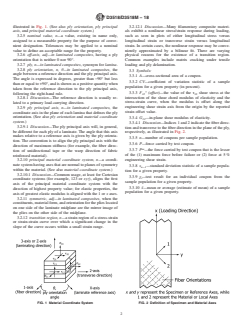
illustrated in Fig. 1. (See also ply orientation, ply principal 3.2.12.1 Discussion—Many filamentary composite materi-
axis, and principal material coordinate system.) als exhibit a nonlinear stress/strain response during loading,
3.2.5 nominal value, n—a value, existing in name only, such as seen in plots of either longitudinal stress versus
assigned to a measurable property for the purpose of conve- longitudinal strain or transverse strain versus longitudinal
nient designation. Tolerances may be applied to a nominal strain. In certain cases, the nonlinear response may be conve-
value to define an acceptable range for the property. niently approximated by a bilinear fit. There are varying
3.2.6 off-axis, adj—in laminated composites, having a ply physical reasons for the existence of a transition region.
orientation that is neither 0 nor 90°. Common examples include matrix cracking under tensile
3.2.7 ply, n—in laminated composites, synonym for lamina. loading and ply delamination.
3.2.8 ply orientation, n, θ—in laminated composites, the
3.3 Symbols:
angle between a reference direction and the ply principal axis.
3.3.1 A—cross-sectional area of a coupon.
The angle is expressed in degrees, greater than−90° but less
3.3.2 CV—coefficient of variation statistic of a sample
thanorequalto+90°,andisshownasapositivequantitywhen
population for a given property (in percent).
taken from the reference direction to the ply principal axis,
3.3.3 F ° (offset)—the value of the τ shear stress at the
following the right-hand rule.
12 12
intersection of the shear chord modulus of elasticity and the
3.2.8.1 Discussion—The reference direction is usually re-
stress-strain curve, when the modulus is offset along the
lated to a primary load-carrying direction.
engineering shear strain axis from the origin by the reported
3.2.9 ply principal axis, n—in laminated composites, the
strain offset value.
coordinate axis in the plane of each lamina that defines the ply
orientation. (See also ply orientation and material coordinate
3.3.4 G —in-plane shear modulus of elasticity.
system.)
3.3.4.1 Discussion—Indices 1 and 2 indicate the fiber direc-
3.2.9.1 Discussion—The ply principal axis will, in general,
tionandtransversetothefiberdirectionintheplaneoftheply,
be different for each ply of a laminate. The angle that this axis
respectively, as illustrated in Fig. 2.
makes relative to a reference axis is given by the ply orienta-
3.3.5 n—number of coupons per sample population.
tion. The convention is to align the ply principal axis with the
3.3.6 P—force carried by test coupon.
direction of maximum stiffness (for example, the fiber direc-
m
3.3.7 P —the force carried by test coupon that is the lesser
tion of unidirectional tape or the warp direction of fabric
of the (1) maximum force before failure or (2) force at 5%
reinforced material).
engineering shear strain.
3.2.10 principal material coordinate system, n—a coordi-
natesystemhavingaxesthatarenormaltoplanesofsymmetry
3.3.8 s —standard deviation statistic of a sample popula-
n−1
within the material. (See also material coordinate system.)
tion for a given property.
3.2.10.1 Discussion—Common usage, at least for Cartesian
3.3.9 χ—test result for an individual coupon from the
i
coordinate systems (for example, 123 or xyz), aligns the first
sample population for a given property.
axis of the principal material coordinate system with the
3.3.10 x¯—mean or average (estimate of mean) of a sample
direction of highest property value; for elastic properties, the
population for a given property.
axis of greatest elastic modulus is aligned with the 1 or x axes.
3.2.11 symmetric, adj—in laminated composites, when the
constituents,materialform,andorientationfortheplieslocated
on one side of the laminate midplane are the mirror image of
the plies on the other side of the midplane.
3.2.12 transition region, n—a strain region of a stress-strain
or strain-strain curve over which a significant change in the
slope of the curve occurs within a small strain range.
FIG. 1 Material Coordinate System FIG. 2 Definition of Specimen and Material Axes
D3518/D3518M − 18
3.3.11 ε—general symbol for strain, whether normal strain 6. Interferences
or shear strain.
6.1 Impurity of Stress Field—The material in the gage
3.3.12 ε—indicated normal strain from strain transducer or section of this specimen is not in a state of pure in-plane shear
extensometer.
stress, as an in-plane normal stress component is present
throughout the gage section and a complex stress field is
3.3.13 τ —shear stress on the plane perpendicular to the
present close to the free edges of the specimen. Although this
1-axis that acts parallel to the 2-axis.
test method is believed to provide reliable initial material
m
3.3.14 τ —the calculated value of the τ shear stress
12 12
response and can establish shear stress-shear strain response
taken at the lesser of (1) maximum shear stress before failure
well into the nonlinear region, the calculated shear stress
or (2) shear stress at 5% engineering shear strain.
values at failure do not represent true material strength values
3.3.15 γ —engineering shear strain on the plane perpen-
and should only be used with caution. Despite attempts to
dicular to the 1-axis that acts parallel to the 2-axis.
minimizetheseeffects,theshearstressatfailureobtainedfrom
m
this test method, even for otherwise identical materials that
3.3.16 γ —the value of the γ engineering shear strain at
12 12
differ only in cured ply thickness or fabric areal weight, may
the maximum shear stress before failure, or 5%, whichever is
have differing failure modes and may not be able to be
less.
statistically pooled. The technical basis for the further discus-
sion below is taken from the paper by Kellas et al.
4. Summary of Test Method
6.1.1 Effects of In-Plane Normal Stress Field—Ofparticular
4.1 Auniaxial tension test of a 645° laminate is performed
concern is the in-plane stress component normal to the fiber
in accordance with Test Method D3039/D3039M, although
direction. This component of stress is present in all plies and
with specific restrictions on stacking sequence and thickness.
throughout the gage section of the specimen.The effect of this
Use of this test for evaluation of in-plane shear response was
stressonagivenplyisminimizedbythefiberreinforcementof
originally proposed by Petit and was later improved by
the neighboring plies. Since the ply constraint is reduced with
Rosen. Using expressions derived from laminated plate
increasingplythickness,thethicknessoftheindividualpliesis
theory, the in-plane shear stress in the material coordinate
an important parameter that influences both the shear stress-
system is directly calculated from the applied axial force, and
shear strain response and the ultimate failure force of this
the related shear strain is determined from longitudinal and
specimen. Moreover, the surface plies of a given specimen,
transverse normal strain data obtained by transducers. This
being constrained by only one neighboring ply (as opposed to
data is used to create an in-plane shear stress-shear strain
interior plies, which are constrained by a ply on each side),
curve.
represent the weakest link in a 645° specimen. During the
tensile loading of this test coupon, the first ply failures consist
5. Significance and Use
primarilyofnormalstress(ormixedmode)failures,ratherthan
pure shear failures. Because of this, the actual material shear
5.1 This test method is designed to produce in-plane shear
strength cannot be obtained from this test. Except for the case
property data for material specifications, research and
of materials capable of sustaining large axial test coupon
development, quality assurance, and structural design and
strains (greater than about 3.0%), the shear stress at failure is
analysis. Factors that influence the shear response and should
believed to underestimate the actual material shear strength.
therefore be reported include the following: material, methods
6.1.2 Total Thickness Effects—As a result of the failure
of material preparation and lay-up, specimen stacking se-
processes discussed above, the shear stress-shear strain re-
quence and overall thickness, specimen preparation, specimen
sponseathigherstrainlevelsdependsuponthetotalnumberof
conditioning, environment of testing, specimen alignment and
plies. As the total number of plies in the specimen configura-
gripping, speed of testing, time at temperature, void content,
tion is increased, the relative contribution of the two weak
and volume percent reinforcement. Properties that may be
surface plies to the total force-carrying capacity is decreased.
derived from this test method include the following:
After the surface plies of the laminate fail, their portion of the
5.1.1 In-plane shear stress versus shear strain response,
force is redistributed to the remainder of the intact plies. The
5.1.2 In-plane shear chord modulus of elasticity,
higher the total number of plies, the greater the chance that the
5.1.3 Offset shear properties,
remaining plies will be able to carry the force without
5.1.4 Maximum in-plane shear stress for a 645° laminate,
immediate ultimate failure of the coupon. However, with each
and
successive ply matrix failure the number of remaining intact
5.1.5 Maximum in-plane engineering shear strain for a
plies diminishes, to the point where the applied force can no
645° laminate.
longer be carried. Because of this process, higher ply count
3 5
Petit, D. H., “A Simplified Method of Determining the In-plane Shear Kellas,S.,Morton,J.,andJackson,K.E.,“DamageandFailureMechanismsin
Stress/Strain Response of Unidirectional Composites,” Composite Materials: Test- Scaled Angled-Ply Laminates,” Fourth Composites Symposium on Fatigue and
ing and Design,ASTM STP460,American Society forTesting and Materials, 1969, Fracture, ASTM STP 1156, W. Stinchcomb and Ashbaugh, N. E., Eds., American
pp.83–93. Society for Testing and Materials, 1993, pp. 257–280.
4 6
Rosen, B. W., “A Simple Procedure for Experimental Determination of the Repeating plies (adjacent plies at the same ply orientation) have an effect
Longitudinal Shear Modulus of Unidirectional Composites,” Journal of Composite similar to thick plies, therefore, this test method prohibits constructions with
Materials, October 1972, pp. 552–554. repeating plies.
D3518/D3518M − 18
specimens tend to achieve higher failure forces. To minimize 8.2 Geometry—The coupon geometry shall be in accor-
these effects, this test method requires the use of a homoge- dance with Test Method D3039/D3039M, as modified by the
neous stacking sequence and requires a fixed number of plies, following:
for which the only repeating plies are the two required for 8.2.1 The stacking sequence shall be [45/−45] , where 4 ≤
ns
symmetry on opposite sides of the laminate mid plane. n ≤ 6 for unidirectional tape (16, 20, or 24 plies) and 2 ≤ n ≤
4 for woven fabric (8, 12, or 16 plies). The recommended
6.1.3 EffectsofLargeDeformation—Notethatextremefiber
couponwidthis25mm[1.0in.],andtherecommendedcoupon
scissoring can occur in this specimen for the cases of ductile
length range is 200 to 300 mm [8 to 12 in.], inclusive.
matrices, weak fiber/matrix interfaces, thick specimens with a
large number of repeated plies, or a combination of the above.
NOTE2—Tab
...
This document is not an ASTM standard and is intended only to provide the user of an ASTM standard an indication of what changes have been made to the previous version. Because
it may not be technically possible to adequately depict all changes accurately, ASTM recommends that users consult prior editions as appropriate. In all cases only the current version
of the standard as published by ASTM is to be considered the official document.
Designation: D3518/D3518M − 13 D3518/D3518M − 18
Standard Test Method for
In-Plane Shear Response of Polymer Matrix Composite
Materials by Tensile Test of a 645° Laminate
This standard is issued under the fixed designation D3518/D3518M; the number immediately following the designation indicates the
year of original adoption or, in the case of revision, the year of last revision. A number in parentheses indicates the year of last
reapproval. A superscript epsilon (´) indicates an editorial change since the last revision or reapproval.
This standard has been approved for use by agencies of the U.S. Department of Defense.
1. Scope
1.1 This test method determines the in-plane shear response of polymer matrix composite materials reinforced by high-modulus
fibers. The composite material form is limited to a continuous-fiber-reinforced composite 645° laminate capable of being tension
tested in the laminate x direction.
1.2 The values stated in either SI units or inch-pound units are to be regarded separately as standard. Within the text the
inch-pound units are shown in brackets. The values stated in each system are not exact equivalents; therefore, each system must
be used independently of the other. Combining values from the two systems may result in nonconformance with the standard.
1.2.1 Within the text, the inch-pound units are shown in brackets.
1.3 This standard does not purport to address all of the safety concerns, if any, associated with its use. It is the responsibility
of the user of this standard to establish appropriate safety safety, health, and healthenvironmental practices and determine the
applicability of regulatory limitations prior to use.
1.4 This international standard was developed in accordance with internationally recognized principles on standardization
established in the Decision on Principles for the Development of International Standards, Guides and Recommendations issued
by the World Trade Organization Technical Barriers to Trade (TBT) Committee.
2. Referenced Documents
2.1 ASTM Standards:
D883 Terminology Relating to Plastics
D3039/D3039M Test Method for Tensile Properties of Polymer Matrix Composite Materials
D3878 Terminology for Composite Materials
D5229/D5229M Test Method for Moisture Absorption Properties and Equilibrium Conditioning of Polymer Matrix Composite
Materials
E6 Terminology Relating to Methods of Mechanical Testing
E111 Test Method for Young’s Modulus, Tangent Modulus, and Chord Modulus
E177 Practice for Use of the Terms Precision and Bias in ASTM Test Methods
E456 Terminology Relating to Quality and Statistics
E1309 Guide for Identification of Fiber-Reinforced Polymer-Matrix Composite Materials in Databases (Withdrawn 2015)
E1434 Guide for Recording Mechanical Test Data of Fiber-Reinforced Composite Materials in Databases (Withdrawn 2015)
E1471 Guide for Identification of Fibers, Fillers, and Core Materials in Computerized Material Property Databases (Withdrawn
2015)
3. Terminology
3.1 Definitions—Terminology D3878 defines terms relating to high-modulus fibers and their composites. Terminology D883
defines terms relating to plastics. Terminology E6 defines terms relating to mechanical testing. Terminology E456 and Practice
This test method is under the jurisdiction of ASTM Committee D30 on Composite Materials and is the direct responsibility of Subcommittee D30.04 on Lamina and
Laminate Test Methods.
Current edition approved Aug. 1, 2013Nov. 1, 2018. Published September 2013November 2018. Originally approved in 1976. Last previous edition approved in 20072013
as D3518/D3518M – 94D3518/D3518M – 13.(2007). DOI: 10.1520/D3518_D3518M-13.10.1520/D3518_D3518M-18.
For referenced ASTM standards, visit the ASTM website, www.astm.org, or contact ASTM Customer Service at service@astm.org. For Annual Book of ASTM Standards
volume information, refer to the standard’s Document Summary page on the ASTM website.
Copyright © ASTM International, 100 Barr Harbor Drive, PO Box C700, West Conshohocken, PA 19428-2959. United States
D3518/D3518M − 18
E177 define terms relating to statistics. In the event of a conflict between terms, Terminology D3878 shall have precedence over
the other standards.
3.2 Definitions of Terms Specific to This Standard:
NOTE 1—If the term represents a physical quantity, its analytical dimensions are stated immediately following the term (or letter symbol) in
fundamental dimension form, using the following ASTM standard symbology for fundamental dimensions, shown within square brackets: [M] for mass,
[L] for length, [T] for time, [Θ] for thermodynamic temperature, and [nd] for nondimensional quantities. Use of these symbols is restricted to analytical
dimensions when used with square brackets, as the symbols may have other definitions when used without the brackets.
3.2.1 645° laminate—in laminated composites, a balanced, symmetric lay-up composed only of +45° plies and −45° plies. (See
also ply orientation.)
3.2.2 balanced, adj—in laminated composites, having, for every off-axis ply oriented at +θ, another ply oriented at −θ that is
of the same material system and form.
3.2.3 lamina, n—pl. laminae, in laminated composites, a single, thin, uniform layer that is the basic building block of a laminate.
(Syn. ply ).
3.2.4 material coordinate system, n—in laminated composites, a 123 Cartesian coordinate system describing the principle
material coordinate system for a laminated material, where the 1-axis is aligned with the ply principal axis, as illustrated in Fig.
1. (See also ply orientation, ply principal axis, and principal material coordinate system.)
3.2.5 nominal value, n—a value, existing in name only, assigned to a measurable property for the purpose of convenient
designation. Tolerances may be applied to a nominal value to define an acceptable range for the property.
3.2.6 off-axis, adj—in laminated composites, having a ply orientation that is neither 0 nor 90°.
3.2.7 ply, n—in laminated composites, synonym for lamina.
3.2.8 ply orientation, n, θ—in laminated composites, the angle between a reference direction and the ply principal axis. The
angle is expressed in degrees, greater than −90° but less than or equal to +90°, and is shown as a positive quantity when taken from
the reference direction to the ply principal axis, following the right-hand rule.
3.2.8.1 Discussion—The reference direction is usually related to a primary load-carrying direction.
3.2.9 ply principal axis, n—in laminated composites, the coordinate axis in the plane of each lamina that defines the ply
orientation. (See also ply orientation and material coordinate system.)
3.2.9.1 Discussion—The ply principal axis will, in general, be different for each ply of a laminate. The angle that this axis makes
relative to a reference axis is given by the ply orientation. The convention is to align the ply principal axis with the direction of
maximum stiffness (for example, the fiber direction of unidirectional tape or the warp direction of fabric reinforced material).
3.2.10 principal material coordinate system, n—a coordinate system having axes that are normal to planes of symmetry within
the material. (See also material coordinate system.)
3.2.10.1 Discussion—Common usage, at least for Cartesian coordinate systems (for example, 123 or xyz), aligns the first axis
of the principal material coordinate system with the direction of highest property value; for elastic properties, the axis of greatest
elastic modulus is aligned with the 1 or x axes.
3.2.11 symmetric, adj—in laminated composites, when the constituents, material form, and orientation for the plies located on
one side of the laminate midplane are the mirror image of the plies on the other side of the midplane.
3.2.12 transition region, n—a strain region of a stress-strain or strain-strain curve over which a significant change in the slope
of the curve occurs within a small strain range.
3.2.12.1 Discussion—Many filamentary composite materials exhibit a nonlinear stress/strain response during loading, such as
seen in plots of either longitudinal stress versus longitudinal strain or transverse strain versus longitudinal strain. In certain cases,
the nonlinear response may be conveniently approximated by a bilinear fit. There are varying physical reasons for the existence
of a transition region. Common examples include matrix cracking under tensile loading and ply delamination.
FIG. 1 Material Coordinate System
D3518/D3518M − 18
3.3 Symbols:
3.3.1 A—cross-sectional area of a coupon.
3.3.2 CV—coefficient of variation statistic of a sample population for a given property (in percent).
3.3.3 F ° (offset)—the value of the τ shear stress at the intersection of the shear chord modulus of elasticity and the
12 12
stress-strain curve, when the modulus is offset along the engineering shear strain axis from the origin by the reported strain offset
value.
3.3.4 G —in-plane shear modulus of elasticity.
3.3.4.1 Discussion—
Indices 1 and 2 indicate the fiber direction and transverse to the fiber direction in the plane of the ply, respectively, as illustrated
in Fig. 2.
3.3.5 n—number of coupons per sample population.
3.3.6 P—force carried by test coupon.
m
3.3.7 P —the force carried by test coupon that is the lesser of the (1) maximum force before failure or (2) force at 5 %
engineering shear strain.
3.3.8 s —standard deviation statistic of a sample population for a given property.
n−1
3.3.9 χ —test result for an individual coupon from the sample population for a given property.
i
3.3.10 x¯—mean or average (estimate of mean) of a sample population for a given property.
3.3.11 ε—general symbol for strain, whether normal strain or shear strain.
3.3.12 ε—indicated normal strain from strain transducer or extensometer.
3.3.13 τ —shear stress on the plane perpendicular to the 1-axis that acts parallel to the 2-axis.
m
3.3.14 τ —the calculated value of the τ shear stress taken at the lesser of (1) maximum shear stress before failure or (2) shear
12 12
stress at 5 % engineering shear strain.
3.3.15 γ —engineering shear strain on the plane perpendicular to the 1-axis that acts parallel to the 2-axis.
m
3.3.16 γ —the value of the γ engineering shear strain at the maximum shear stress before failure, or 5 %, whichever is less.
12 12
4. Summary of Test Method
4.1 A uniaxial tension test of a 645° laminate is performed in accordance with Test Method D3039/D3039M, although with
specific restrictions on stacking sequence and thickness. Use of this test for evaluation of in-plane shear response was originally
FIG. 2 Definition of Specimen and Material Axes
D3518/D3518M − 18
3 4
proposed by Petit and was later improved by Rosen. Using expressions derived from laminated plate theory, the in-plane shear
stress in the material coordinate system is directly calculated from the applied axial force, and the related shear strain is determined
from longitudinal and transverse normal strain data obtained by transducers. This data is used to create an in-plane shear
stress-shear strain curve.
5. Significance and Use
5.1 This test method is designed to produce in-plane shear property data for material specifications, research and development,
quality assurance, and structural design and analysis. Factors that influence the shear response and should therefore be reported
include the following: material, methods of material preparation and lay-up, specimen stacking sequence and overall thickness,
specimen preparation, specimen conditioning, environment of testing, specimen alignment and gripping, speed of testing, time at
temperature, void content, and volume percent reinforcement. Properties that may be derived from this test method include the
following:
5.1.1 In-plane shear stress versus shear strain response,
5.1.2 In-plane shear chord modulus of elasticity,
5.1.3 Offset shear properties,
5.1.4 Maximum in-plane shear stress for a 645° laminate, and
5.1.5 Maximum in-plane engineering shear strain for a 645° laminate.
6. Interferences
6.1 Impurity of Stress Field—The material in the gage section of this specimen is not in a state of pure in-plane shear stress,
as an in-plane normal stress component is present throughout the gage section and a complex stress field is present close to the
free edges of the specimen. Although this test method is believed to provide reliable initial material response and can establish
shear stress-shear strain response well into the nonlinear region, the calculated shear stress values at failure do not represent true
material strength values and should only be used with caution. Despite attempts to minimize these effects, the shear stress at failure
obtained from this test method, even for otherwise identical materials that differ only in cured ply thickness or fabric areal weight,
may have differing failure modes and may not be able to be statistically pooled. The technical basis for the further discussion below
is taken from the paper by Kellas et al.
6.1.1 Effects of In-Plane Normal Stress Field—Of particular concern is the in-plane stress component normal to the fiber
direction. This component of stress is present in all plies and throughout the gage section of the specimen. The effect of this stress
on a given ply is minimized by the fiber reinforcement of the neighboring plies. Since the ply constraint is reduced with increasing
ply thickness, the thickness of the individual plies is an important parameter that influences both the shear stress-shear strain
response and the ultimate failure force of this specimen. Moreover, the surface plies of a given specimen, being constrained by
only one neighboring ply (as opposed to interior plies, which are constrained by a ply on each side), represent the weakest link
in a 645° specimen. During the tensile loading of this test coupon, the first ply failures consist primarily of normal stress (or mixed
mode) failures, rather than pure shear failures. Because of this, the actual material shear strength cannot be obtained from this test.
Except for the case of materials capable of sustaining large axial test coupon strains (greater than about 3.0 %), the shear stress
at failure is believed to underestimate the actual material shear strength.
6.1.2 Total Thickness Effects—As a result of the failure processes discussed above, the shear stress-shear strain response at
higher strain levels depends upon the total number of plies. As the total number of plies in the specimen configuration is increased,
the relative contribution of the two weak surface plies to the total force-carrying capacity is decreased. After the surface plies of
the laminate fail, their portion of the force is redistributed to the remainder of the intact plies. The higher the total number of plies,
the greater the chance that the remaining plies will be able to carry the force without immediate ultimate failure of the coupon.
However, with each successive ply matrix failure the number of remaining intact plies diminishes, to the point where the applied
force can no longer be carried. Because of this process, higher ply count specimens tend to achieve higher failure forces. To
minimize these effects, this test method requires the use of a homogeneous stacking sequence and requires a fixed number of plies,
for which the only repeating plies are the two required for symmetry on opposite sides of the laminate mid plane.
6.1.3 Effects of Large Deformation—Note that extreme fiber scissoring can occur in this specimen for the cases of ductile
matrices, weak fiber/matrix interfaces, thick specimens with a large number of repeated plies, or a combination of the above. Kellas
et al suggest that a general rule of thumb for this specimen is that a fiber rotation of 1° takes place for every 2 % of axial strain
(or every 3.5 % engineering shear strain for commonly tested materials). Such fiber scissoring, if left unbounded, would lead to
an unacceptable violation of the assumption in this test method of a nominal 645° laminate. This is the principal rationale for
Petit, D. H., “A Simplified Method of Determining the In-plane Shear Stress/Strain Response of Unidirectional Composites,” Composite Materials: Testing and Design,
ASTM STP 460, American Society for Testing and Materials, 1969, pp. 83–93.
Rosen, B. W., “A Simple Procedure for Experimental Determination of the Longitudinal Shear Modulus of Unidirectional Composites,” Journal of Composite Materials,
October 1972, pp. 552–554.
Kellas, S., Morton, J., and Jackson, K. E., “Damage and Failure Mechanisms in Scaled Angled-Ply Laminates,” Fourth Composites Symposium on Fatigue and Fracture,
ASTM STP 1156, W. Stinchcomb and Ashbaugh, N. E., Eds., American Society for Testing and Materials, 1993, pp. 257–280.
Repeating plies (adjacent plies at the same ply orientation) have an effect similar to thick plies, therefore, this test method prohibits constructions with repeating plies.
D3518/D3518M − 18
terminating this test at a large strain level, even if force is still increasing on the specimen. This test method terminates data
reporting at 5 % calculated engineering shear strain; this limits fiber scissoring to about 1.5°, is approximately the limit of foil strain
gage technology (if used), and is also well beyond the strain levels required for common engineering practice. Further details of
the effects of stacking sequence, specimen geometry, and, in particular, specimen and ply thickness, are presented in the reference
by Kellas et al.
6.1.4 Effects of Edge S
...