

ASTM E3086-20
(Practice)Standard Practice for Creating Appliques for Use in Testing of Nonplanar Soft Body Armor Designed for Females
General Information
- Abstract
SIGNIFICANCE AND USE
4.1 U.S. Department of Defense and U.S. Department of Justice standards for assessing the performance of ballistic-resistant torso body armor require the use of backing assemblies made with Roma Plastilina No. 1®. The creation of appliques behind nonplanar soft armor test items must be done in a consistent manner to reduce variability within and between laboratories.
4.2 This practice is applicable for certification testing or for research and development testing.
SCOPE
1.1 This practice specifies a procedure for creating appliques (that is, build-up of clay) for use behind nonplanar, soft body armor test items and affixing the appliques to the clay block.
Note 1: This practice describes a single applique shape; additional shapes may be described in other standards.
1.2 The purpose of this practice is to specify critical parameters for creating appliques in order to improve consistency of the test setup between laboratories.
Note 2: In the past, testing of nonplanar soft armor has been done either with an unspecified buildup of clay behind the test item or with the test item pressed flat against the clay block.
1.3 This practice is applicable only to nonplanar soft body armor designed for females.
1.4 This practice is not applicable to hard armor test items.
1.5 This practice is primarily directed toward test laboratories but may be applicable to body armor manufacturers, researchers, and end users performing ballistic-resistance testing of body armor.
1.6 In this practice, “other standards and specifications” and “unless specified elsewhere” refer to documents (for example, military standards, purchase specifications) that require the use of this practice. Purchasers and other users are responsible for the “other standards and specifications” and for specifying any requirements that supersede those of this practice.
1.7 Units—The values stated in SI units are to be regarded as standard. Where appropriate, inch-pound units are included parenthetically for information purposes.
1.8 This standard does not purport to address all of the safety concerns, if any, associated with its use. It is the responsibility of the user of this standard to establish appropriate safety, health, and environmental practices and determine the applicability of regulatory limitations prior to use.
1.9 This international standard was developed in accordance with internationally recognized principles on standardization established in the Decision on Principles for the Development of International Standards, Guides and Recommendations issued by the World Trade Organization Technical Barriers to Trade (TBT) Committee.
- Status
- Published
- Publication Date
- 31-Mar-2020
- Technical Committee
- E54 - Homeland Security Applications
- Drafting Committee
- E54.04 - Public Safety Equipment
Buy Documents
ASTM E3086-20 - Standard Practice for Creating Appliques for Use in Testing of Nonplanar Soft Body Armor Designed for Females
REDLINE ASTM E3086-20 - Standard Practice for Creating Appliques for Use in Testing of Nonplanar Soft Body Armor Designed for Females
Overview
ASTM E3086-20: Standard Practice for Creating Appliques for Use in Testing of Nonplanar Soft Body Armor Designed for Females establishes a standardized procedure for preparing clay appliques used in ballistic testing of nonplanar soft body armor specifically designed for female users. Consistency in creating and applying these appliques is critical for ensuring reliable and comparable ballistic-resistance test results across laboratories and over time. This practice is particularly relevant for certification activities and product development in compliance with U.S. Department of Defense and Department of Justice requirements.
Key Topics
- Nonplanar Soft Body Armor Testing: Focuses on armor with curved or shaped surfaces designed for female anatomy, as opposed to planar or hard armor.
- Standardized Applique Creation: Provides detailed procedures for creating appliques-three-dimensional backing shapes made from modeling clay (notably Roma Plastilina No. 1®)-to be placed behind test items during ballistic evaluation.
- Consistency Across Labs: Addresses variability in test results by specifying critical parameters for applique dimensions, mold construction, clay preparation, and positioning on the clay block.
- Equipment and Materials: Outlines the required tools, including mold-grade silicone rubber, applique patterns, mold boxes, and ovens for conditioning clay components.
- Safety and Compliance: Reminds users to establish appropriate safety, health, and environmental practices, and clarifies that other specific requirements may supersede those in this standard.
Applications
- Ballistic-Resistance Certification: Used by test laboratories during compliance and certification testing to meet the standards set by the U.S. Department of Defense and Department of Justice for body armor performance.
- Research and Development: Applied by manufacturers, researchers, and developers of soft body armor to ensure repeatable and reliable test environments during R&D initiatives.
- Quality Control: Adopted to confirm that body armor products for female users meet safety requirements by subjecting them to rigorous and consistent ballistic testing procedures.
- Inter-Laboratory Comparability: Enables comparable results between testing facilities by reducing process and setup variability through standardized applique creation and placement.
Related Standards
- ASTM E3004: Specification for the preparation and verification of clay blocks used in torso body armor ballistic testing.
- ASTM E3005: Document providing terminology relevant to body armor testing, including terms for appliques and backing assemblies.
- U.S. Department of Defense/Department of Justice Ballistic Body Armor Standards: Reference guidelines that require use of standardized clay backing materials and shape-specific appliques for armor testing.
- International Standards Principles: Developed in alignment with WTO Technical Barriers to Trade Committee recommendations, ensuring global relevance.
Keywords: ASTM E3086-20, body armor testing, nonplanar soft armor, appliques, ballistic testing, female body armor, consistency in laboratory testing, Roma Plastilina No. 1, armor certification, ballistic-resistance, standardized procedures
Summary
ASTM E3086-20 provides robust guidance for the creation and use of clay appliques in the testing of nonplanar soft body armor designed for female users. By specifying methods, materials, and parameters for applique production and application, the practice enhances the reliability and consistency of ballistic-resistance testing, ultimately supporting improved product development, certification, and safety assurance within the body armor industry. Adherence to this standard helps ensure that body armor solutions deliver consistent, high-level protection through rigorous and standardized evaluation processes.
Relations
- Effective Date
- 01-Apr-2020
- Effective Date
- 01-Apr-2024
- Effective Date
- 01-Apr-2020
- Effective Date
- 01-Feb-2020
- Effective Date
- 01-Oct-2018
- Effective Date
- 01-Nov-2015
- Effective Date
- 01-Nov-2015
- Effective Date
- 01-Nov-2015
- Effective Date
- 01-Apr-2020
- Effective Date
- 01-Apr-2020
Buy Documents
ASTM E3086-20 - Standard Practice for Creating Appliques for Use in Testing of Nonplanar Soft Body Armor Designed for Females
REDLINE ASTM E3086-20 - Standard Practice for Creating Appliques for Use in Testing of Nonplanar Soft Body Armor Designed for Females
Get Certified
Connect with accredited certification bodies for this standard

CIS Institut d.o.o.
Personal Protective Equipment (PPE) certification body. Notified Body NB-2890 for EU Regulation 2016/425 PPE.

Kiwa BDA Testing
Building and construction product certification.
Kmetijski inštitut Slovenije
Agricultural Institute of Slovenia. Soil testing, plant health, agricultural product analysis.
Sponsored listings
Frequently Asked Questions
ASTM E3086-20 is a standard published by ASTM International. Its full title is "Standard Practice for Creating Appliques for Use in Testing of Nonplanar Soft Body Armor Designed for Females". This standard covers: SIGNIFICANCE AND USE 4.1 U.S. Department of Defense and U.S. Department of Justice standards for assessing the performance of ballistic-resistant torso body armor require the use of backing assemblies made with Roma Plastilina No. 1®. The creation of appliques behind nonplanar soft armor test items must be done in a consistent manner to reduce variability within and between laboratories. 4.2 This practice is applicable for certification testing or for research and development testing. SCOPE 1.1 This practice specifies a procedure for creating appliques (that is, build-up of clay) for use behind nonplanar, soft body armor test items and affixing the appliques to the clay block. Note 1: This practice describes a single applique shape; additional shapes may be described in other standards. 1.2 The purpose of this practice is to specify critical parameters for creating appliques in order to improve consistency of the test setup between laboratories. Note 2: In the past, testing of nonplanar soft armor has been done either with an unspecified buildup of clay behind the test item or with the test item pressed flat against the clay block. 1.3 This practice is applicable only to nonplanar soft body armor designed for females. 1.4 This practice is not applicable to hard armor test items. 1.5 This practice is primarily directed toward test laboratories but may be applicable to body armor manufacturers, researchers, and end users performing ballistic-resistance testing of body armor. 1.6 In this practice, “other standards and specifications” and “unless specified elsewhere” refer to documents (for example, military standards, purchase specifications) that require the use of this practice. Purchasers and other users are responsible for the “other standards and specifications” and for specifying any requirements that supersede those of this practice. 1.7 Units—The values stated in SI units are to be regarded as standard. Where appropriate, inch-pound units are included parenthetically for information purposes. 1.8 This standard does not purport to address all of the safety concerns, if any, associated with its use. It is the responsibility of the user of this standard to establish appropriate safety, health, and environmental practices and determine the applicability of regulatory limitations prior to use. 1.9 This international standard was developed in accordance with internationally recognized principles on standardization established in the Decision on Principles for the Development of International Standards, Guides and Recommendations issued by the World Trade Organization Technical Barriers to Trade (TBT) Committee.
SIGNIFICANCE AND USE 4.1 U.S. Department of Defense and U.S. Department of Justice standards for assessing the performance of ballistic-resistant torso body armor require the use of backing assemblies made with Roma Plastilina No. 1®. The creation of appliques behind nonplanar soft armor test items must be done in a consistent manner to reduce variability within and between laboratories. 4.2 This practice is applicable for certification testing or for research and development testing. SCOPE 1.1 This practice specifies a procedure for creating appliques (that is, build-up of clay) for use behind nonplanar, soft body armor test items and affixing the appliques to the clay block. Note 1: This practice describes a single applique shape; additional shapes may be described in other standards. 1.2 The purpose of this practice is to specify critical parameters for creating appliques in order to improve consistency of the test setup between laboratories. Note 2: In the past, testing of nonplanar soft armor has been done either with an unspecified buildup of clay behind the test item or with the test item pressed flat against the clay block. 1.3 This practice is applicable only to nonplanar soft body armor designed for females. 1.4 This practice is not applicable to hard armor test items. 1.5 This practice is primarily directed toward test laboratories but may be applicable to body armor manufacturers, researchers, and end users performing ballistic-resistance testing of body armor. 1.6 In this practice, “other standards and specifications” and “unless specified elsewhere” refer to documents (for example, military standards, purchase specifications) that require the use of this practice. Purchasers and other users are responsible for the “other standards and specifications” and for specifying any requirements that supersede those of this practice. 1.7 Units—The values stated in SI units are to be regarded as standard. Where appropriate, inch-pound units are included parenthetically for information purposes. 1.8 This standard does not purport to address all of the safety concerns, if any, associated with its use. It is the responsibility of the user of this standard to establish appropriate safety, health, and environmental practices and determine the applicability of regulatory limitations prior to use. 1.9 This international standard was developed in accordance with internationally recognized principles on standardization established in the Decision on Principles for the Development of International Standards, Guides and Recommendations issued by the World Trade Organization Technical Barriers to Trade (TBT) Committee.
ASTM E3086-20 is classified under the following ICS (International Classification for Standards) categories: 13.310 - Protection against crime; 13.340.01 - Protective equipment in general. The ICS classification helps identify the subject area and facilitates finding related standards.
ASTM E3086-20 has the following relationships with other standards: It is inter standard links to ASTM E3086-17, ASTM E3005-24, ASTM E3004-20, ASTM E3005-20, ASTM E3005-18, ASTM E3004-15e1, ASTM E3004-15, ASTM E3005-15, ASTM E2771-11(2019), ASTM E3110/E3110M-22. Understanding these relationships helps ensure you are using the most current and applicable version of the standard.
ASTM E3086-20 is available in PDF format for immediate download after purchase. The document can be added to your cart and obtained through the secure checkout process. Digital delivery ensures instant access to the complete standard document.
Standards Content (Sample)
This international standard was developed in accordance with internationally recognized principles on standardization established in the Decision on Principles for the
Development of International Standards, Guides and Recommendations issued by the World Trade Organization Technical Barriers to Trade (TBT) Committee.
Designation: E3086 − 20
Standard Practice for
Creating Appliques for Use in Testing of Nonplanar Soft
Body Armor Designed for Females
This standard is issued under the fixed designation E3086; the number immediately following the designation indicates the year of
original adoption or, in the case of revision, the year of last revision. A number in parentheses indicates the year of last reapproval. A
superscript epsilon (´) indicates an editorial change since the last revision or reapproval.
1. Scope 1.9 This international standard was developed in accor-
dance with internationally recognized principles on standard-
1.1 This practice specifies a procedure for creating appli-
ization established in the Decision on Principles for the
ques (that is, build-up of clay) for use behind nonplanar, soft
Development of International Standards, Guides and Recom-
body armor test items and affixing the appliques to the clay
mendations issued by the World Trade Organization Technical
block.
Barriers to Trade (TBT) Committee.
NOTE 1—This practice describes a single applique shape; additional
shapes may be described in other standards.
2. Referenced Documents
1.2 The purpose of this practice is to specify critical
2.1 ASTM Standards:
parameters for creating appliques in order to improve consis-
E3004 Specification for Preparation and Verification of Clay
tency of the test setup between laboratories.
BlocksUsedinBallistic-ResistanceTestingofTorsoBody
Armor
NOTE 2—In the past, testing of nonplanar soft armor has been done
either with an unspecified buildup of clay behind the test item or with the E3005 Terminology for Body Armor
test item pressed flat against the clay block.
3. Terminology
1.3 This practice is applicable only to nonplanar soft body
armor designed for females. 3.1 For terms not defined in this practice, the following
definitions of Terminology E3005 apply: applique, applique
1.4 This practice is not applicable to hard armor test items.
pattern, backface deformation, backing assembly, backing
1.5 This practice is primarily directed toward test laborato-
fixture, backing material, body armor, hard armor, mold box,
ries but may be applicable to body armor manufacturers,
nonplanar, soft armor, test item, and test threat.
researchers, and end users performing ballistic-resistance test-
ing of body armor.
4. Significance and Use
1.6 In this practice, “other standards and specifications” and
4.1 U.S. Department of Defense and U.S. Department of
“unless specified elsewhere” refer to documents (for example,
Justice standards for assessing the performance of ballistic-
military standards, purchase specifications) that require the use
resistant torso body armor require the use of backing assem- ®
of this practice. Purchasers and other users are responsible for
blies made with Roma Plastilina No. 1 . The creation of
the “other standards and specifications” and for specifying any
appliques behind nonplanar soft armor test items must be done
requirements that supersede those of this practice.
inaconsistentmannertoreducevariabilitywithinandbetween
laboratories.
1.7 Units—The values stated in SI units are to be regarded
as standard. Where appropriate, inch-pound units are included
4.2 This practice is applicable for certification testing or for
parenthetically for information purposes.
research and development testing.
1.8 This standard does not purport to address all of the
5. Equipment and Materials
safety concerns, if any, associated with its use. It is the
responsibility of the user of this standard to establish appro- 5.1 The following equipment and materials are required for
priate safety, health, and environmental practices and deter-
making appliques defined by this practice:
mine the applicability of regulatory limitations prior to use. 5.1.1 Clay—Unless specified elsewhere, the clay shall be ®
ROMA Plastilina No. 1 modeling clay.
This practice is under the jurisdiction of ASTM Committee E54 on Homeland
Security Applications and is the direct responsibility of Subcommittee E54.04 on
Personal Protective Equipment (PPE). For referenced ASTM standards, visit the ASTM website, www.astm.org, or
Current edition approved April 1, 2020. Published April 2020. Originally contact ASTM Customer Service at service@astm.org. For Annual Book of ASTM
approved in 2017. Last previous edition approved in 2017 as E3086 – 17. DOI: Standards volume information, refer to the standard’s Document Summary page on
10.1520/E3086-20. the ASTM website.
Copyright © ASTM International, 100 Barr Harbor Drive, PO Box C700, West Conshohocken, PA 19428-2959. United States
E3086 − 20
NOTE 3—Tolerances on the applique pattern, if required, will be
5.1.2 Backing Assembly—The backing assembly and clay
specified in other standards or specifications.
used for building up behind nonplanar test items shall meet the
requirements of Specification E3004.
6.5 Build a mold box based on the approximate inside
5.1.3 Applique pattern.
dimensions provided in Table 2. The box shall be made from a
5.1.4 Items for applique formation:
rigid material, such as metal or wood.
5.1.4.1 Mold box.
NOTE 4—The mold box does not require a top or a bottom.
5.1.4.2 Mold-grade silicone rubber, Shore 15A hardness.
5.1.4.3 Release agent.
6.5.1 Place the mold box on a flat, rigid, non-porous surface
5.1.5 Draw knife or similar striking device.
(for example, a table top), and place the applique pattern into
5.1.6 Oven for heating clay.
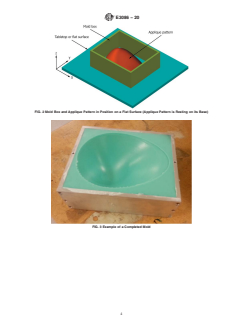
the mold box, relatively centered and flat side down. See Fig.
5.1.7 Oven for storing appliques before use in testing.
2 for a graphic showing the mold box and applique pattern in
position on a flat surface.
6. Procedure for Making Applique Molds
6.5.2 Coat the applique pattern with two coats of release
6.1 There are five possible sizes for appliques, and each
agent applied at least fi
...
This document is not an ASTM standard and is intended only to provide the user of an ASTM standard an indication of what changes have been made to the previous version. Because
it may not be technically possible to adequately depict all changes accurately, ASTM recommends that users consult prior editions as appropriate. In all cases only the current version
of the standard as published by ASTM is to be considered the official document.
Designation: E3086 − 17 E3086 − 20
Standard Practice for
Creating Appliques for Use in Testing of Nonplanar Soft
Body Armor Designed for Females
This standard is issued under the fixed designation E3086; the number immediately following the designation indicates the year of
original adoption or, in the case of revision, the year of last revision. A number in parentheses indicates the year of last reapproval. A
superscript epsilon (´) indicates an editorial change since the last revision or reapproval.
1. Scope
1.1 This practice specifies a procedure for creating appliques (that is, build-up of clay) for use behind nonplanar, soft body
armor test items and affixing the appliques to the clay block.
NOTE 1—This practice describes a single applique shape; additional shapes may be described in other standards.
1.2 The purpose of this practice is to specify critical parameters for creating appliques in order to improve consistency of the
test setup between laboratories.
NOTE 2—In the past, testing of nonplanar soft armor has been done either with an unspecified buildup of clay behind the test item or with the test item
pressed flat against the clay block.
1.3 This practice is applicable only to nonplanar soft body armor designed for females.
1.4 This practice is not applicable to hard armor test items.
1.5 This practice is primarily directed toward test laboratories but may be applicable to body armor manufacturers, researchers,
and end users performing ballistic-resistance testing of body armor.
1.6 In this practice, “other standards and specifications” and “unless specified elsewhere” refer to documents (for example,
military standards, purchase specifications) that require the use of this practice. Purchasers and other users are responsible for the
“other standards and specifications” and for specifying any requirements that supersede those of this practice.
1.7 Units—The values stated in SI units are to be regarded as standard. Where appropriate, inch-pound units are included
parenthetically for information purposes.
1.8 This standard does not purport to address all of the safety concerns, if any, associated with its use. It is the responsibility
of the user of this standard to establish appropriate safety safety, health, and healthenvironmental practices and determine the
applicability of regulatory limitations prior to use.
1.9 This international standard was developed in accordance with internationally recognized principles on standardization
established in the Decision on Principles for the Development of International Standards, Guides and Recommendations issued
by the World Trade Organization Technical Barriers to Trade (TBT) Committee.
2. Referenced Documents
2.1 ASTM Standards:
E3004 Specification for Preparation and Verification of Clay Blocks Used in Ballistic-Resistance Testing of Torso Body Armor
E3005 Terminology for Body Armor
3. Terminology
3.1 For terms not defined in this practice, the following definitions of Terminology E3005 apply: applique, applique pattern,
backface deformation, backing assembly, backing fixture, backing material, body armor, hard armor, mold box, nonplanar, soft
armor, test item, and test threat.
3.2 Definitions of Terms Specific to This Standard:
This practice is under the jurisdiction of ASTM Committee E54 on Homeland Security Applications and is the direct responsibility of Subcommittee E54.04 on Personal
Protective Equipment (PPE).
Current edition approved Feb. 1, 2017April 1, 2020. Published March 2017April 2020. Originally approved in 2017. Last previous edition approved in 2017 as E3086 – 17.
DOI: 10.1520/E3086-17.10.1520/E3086-20.
For referenced ASTM standards, visit the ASTM website, www.astm.org, or contact ASTM Customer Service at service@astm.org. For Annual Book of ASTM Standards
volume information, refer to the standard’s Document Summary page on the ASTM website.
Copyright © ASTM International, 100 Barr Harbor Drive, PO Box C700, West Conshohocken, PA 19428-2959. United States
E3086 − 20
3.2.1 applique, n—a three-dimensional item molded from backing material, that is shaped and sized for testing or conditioning
a nonplanar test item.
3.2.1.1 Discussion—
Some appliques are designed for the purpose of filling the entire space behind a nonplanar test item; other appliques are designed
to assess features of a nonplanar test item.
3.2.2 applique pattern, n—a replica of the final product (that is, applique) used for preparing the applique mold cavity.
3.2.3 mold box, n—a frame used in creation of the mold to contain and give shape to fluid material while it sets up.
4. Significance and Use
4.1 U.S. Department of Defense and U.S. Department of Justice standards for assessing the performance of ballistic-resistant ®
torso body armor require the use of backing assemblies made with Roma Plastilina No. 1 . The creation of appliques behind
nonplanar soft armor test items must be done in a consistent manner to reduce variability within and between laboratories.
4.2 This practice is applicable for certification testing or for research and development testing.
5. Equipment and Materials
5.1 The following equipment and materials are required for making appliques defined by this practice: ®
5.1.1 Clay—Unless specified elsewhere, the clay shall be ROMA Plastilina No. 1 modeling clay.
5.1.2 Backing Assembly—The backing assembly and clay used for building up behind nonplanar test items shall meet the
requirements of Specification E3004.
5.1.3 Applique pattern.
5.1.4 Items for applique formation:
5.1.4.1 Mold box.
5.1.4.2 Mold-grade silicone rubber, Shore 15A hardness.
5.1.4.3 Release agent.
5.1.5 Draw knife or similar striking device.
5.1.6 Oven for heating clay.
5.1.7 Oven for storing appliques before use in testing.
6. Procedure for Making Applique Molds
6.1 There are five possible sizes for appliques, and each applique size requires a separate mold.
6.2 Creating the mold requires a mold box, an applique pattern, and silicone. The size of the mold box and applique pattern are
dependent on the size of the applique that is required.
6.3 Create an applique pattern whose top surface conforms to the e
...