

ASTM D8336-24
(Test Method)Standard Test Method for Characterizing Tack of Prepregs Using a Continuous Application-and-Peel Procedure
General Information
- Abstract
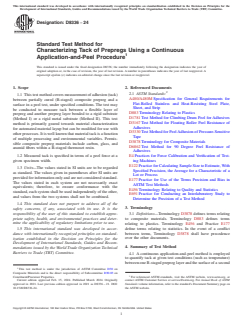
SIGNIFICANCE AND USE
5.1 Characterizing tack for different prepreg materials, test parameters, surface combinations, and environmental conditions provides insight for optimizing process parameters (particularly deposition rate and deposition temperature) for industrial automated material placement processes.
5.2 Results obtained through employing the continuous application-and-peel method, as described in studies (1-3),3 reflect the effects of adhesion forming between prepreg layers or between prepreg and metal substrate, and loss of cohesion within the resin in the prepreg, upon tack. This test method allows the adhesive properties of B-staged resin to be explored in a manner relevant for dynamic material deposition processes, where timescales for bonding of prepreg to the substrate or previously placed prepreg layers are short prior to curing. In contrast, Test Methods D3167 and D1781 determine the peel resistance of adhesive bonds for adhesion measurement and process control of laminated or bonded adherends.
5.3 The test method is suitable to quantify tack of prepregs for acceptance and process control and can be extended to determine resin shelf life or to adjust process parameters to resin out-time. Direct comparison of different resins/prepregs or processes can only be made when specimen preparation and test conditions are identical.
SCOPE
1.1 This test method covers measurement of adhesion (tack) between partially cured (B-staged) composite prepreg and a surface in a peel test, under specified conditions. The test may be conducted to measure tack between a flexible layer of prepreg and another prepreg layer bonded to a rigid substrate (Method I) or a rigid metal substrate (Method II). This test method is primarily geared towards material characterization for automated material layup but can be modified for use with other processes. It is well known that material tack is a function of multiple processing and environmental variables. Permissible composite prepreg materials include carbon, glass, and aramid fibers within a B-staged thermoset resin.
1.2 Measured tack is specified in terms of a peel force at a given specimen width.
1.3 Units—The values stated in SI units are to be regarded as standard. The values given in parentheses after SI units are provided for information only and are not considered standard. The values stated in each system are not necessarily exact equivalents; therefore, to ensure conformance with the standard, each system shall be used independently of the other, and values from the two systems shall not be combined.
1.4 This standard does not purport to address all of the safety concerns, if any, associated with its use. It is the responsibility of the user of this standard to establish appropriate safety, health, and environmental practices and determine the applicability of regulatory limitations prior to use.
1.5 This international standard was developed in accordance with internationally recognized principles on standardization established in the Decision on Principles for the Development of International Standards, Guides and Recommendations issued by the World Trade Organization Technical Barriers to Trade (TBT) Committee.
- Status
- Published
- Publication Date
- 14-Feb-2024
- Technical Committee
- D30 - Composite Materials
- Drafting Committee
- D30.03 - Constituent/Precursor Properties
Buy Documents
ASTM D8336-24 - Standard Test Method for Characterizing Tack of Prepregs Using a Continuous Application-and-Peel Procedure
REDLINE ASTM D8336-24 - Standard Test Method for Characterizing Tack of Prepregs Using a Continuous Application-and-Peel Procedure
Overview
ASTM D8336-24 is a standard test method developed by ASTM International for characterizing the tack of prepreg materials using a continuous application-and-peel procedure. This test method is crucial for quantifying the adhesion (tack) of partially cured (B-staged) composite prepreg to either another prepreg layer bonded to a rigid substrate or to a rigid metal substrate. ASTM D8336-24 offers robust guidance for industries relying on automated material placement and layup of advanced composite materials, such as carbon, glass, or aramid fibers embedded in thermoset resins. The insights from this test help optimize process parameters and ensure consistency in manufacturing composite parts.
Key Topics
- Prepreg Tack Measurement: The standard specifies procedures for measuring adhesion properties between layers of B-staged prepreg or between prepreg and metal substrates using a peel test under controlled conditions.
- Test Methods: Two main configurations are detailed:
- Method I: Prepreg to prepreg (bonded to a rigid substrate)
- Method II: Prepreg to rigid metal substrate
- Controlled Variables: Tack is influenced by prepreg material type, surface combinations, environmental conditions (temperature, humidity), and processing variables (deposition rate, compaction force).
- Data Analysis: Tack is reported as the peel force per specimen width, providing an objective metric for comparison.
- Precision and Bias: The method includes procedures for repeatable results and interlaboratory consistency, highlighting the importance of consistent sample preparation and testing conditions.
- Safety and Environmental Compliance: Users are responsible for adhering to safety, health, and environmental protocols specific to their use case.
Applications
ASTM D8336-24 is widely applicable across several domains where composite materials are manufactured and processed, including:
- Automated Composites Manufacturing: Essential for process development, quality control, and acceptance testing of prepreg tack during automated fiber placement (AFP) or automated tape laying (ATL).
- Material Evaluation: Assists in comparing different prepreg formulations, resin systems, and processing conditions for suitability in specific applications.
- Process Optimization: Insights gained from tack measurement support the optimization of deposition rates and temperatures for efficient, defect-free composite layups.
- Resin Shelf-Life Assessment: The methodology can be extended to monitor changes in prepreg tack due to resin out-time, contributing to inventory management and material shelf-life studies.
- Benchmarking and Research: Provides a standardized approach for stakeholders to benchmark new material developments against industry-accepted tack properties.
Related Standards
The procedures in ASTM D8336-24 are complemented by several other key ASTM standards relevant to composite materials and adhesive testing:
- ASTM D3167 - Test Method for Floating Roller Peel Resistance of Adhesives
- ASTM D1781 - Test Method for Climbing Drum Peel for Adhesives
- ASTM D3330 - Test Method for Peel Adhesion of Pressure-Sensitive Tape
- ASTM D883 - Terminology Relating to Plastics
- ASTM D3878 - Terminology for Composite Materials
- ASTM D6862 - Test Method for 90 Degree Peel Resistance of Adhesives
- ASTM A480/A480M - Specification for General Requirements for Flat-Rolled Stainless and Heat-Resisting Steel Plate, Sheet, and Strip
These related documents provide additional context for the characterization, terminology, and mechanical testing of adhesives and composite materials, supporting a comprehensive approach to composite process control and material selection.
Keywords: ASTM D8336-24, prepreg tack, automated composite layup, peel test, composite materials, B-staged resin, adhesion measurement, process optimization, composite standards, advanced manufacturing.
Relations
- Effective Date
- 15-Feb-2024
- Effective Date
- 01-Apr-2022
- Effective Date
- 01-Apr-2022
- Effective Date
- 15-Feb-2024
Buy Documents
ASTM D8336-24 - Standard Test Method for Characterizing Tack of Prepregs Using a Continuous Application-and-Peel Procedure
REDLINE ASTM D8336-24 - Standard Test Method for Characterizing Tack of Prepregs Using a Continuous Application-and-Peel Procedure
Get Certified
Connect with accredited certification bodies for this standard

DIN CERTCO
DIN Group product certification.

Smithers Quality Assessments
US management systems and product certification.
Sponsored listings
Frequently Asked Questions
ASTM D8336-24 is a standard published by ASTM International. Its full title is "Standard Test Method for Characterizing Tack of Prepregs Using a Continuous Application-and-Peel Procedure". This standard covers: SIGNIFICANCE AND USE 5.1 Characterizing tack for different prepreg materials, test parameters, surface combinations, and environmental conditions provides insight for optimizing process parameters (particularly deposition rate and deposition temperature) for industrial automated material placement processes. 5.2 Results obtained through employing the continuous application-and-peel method, as described in studies (1-3),3 reflect the effects of adhesion forming between prepreg layers or between prepreg and metal substrate, and loss of cohesion within the resin in the prepreg, upon tack. This test method allows the adhesive properties of B-staged resin to be explored in a manner relevant for dynamic material deposition processes, where timescales for bonding of prepreg to the substrate or previously placed prepreg layers are short prior to curing. In contrast, Test Methods D3167 and D1781 determine the peel resistance of adhesive bonds for adhesion measurement and process control of laminated or bonded adherends. 5.3 The test method is suitable to quantify tack of prepregs for acceptance and process control and can be extended to determine resin shelf life or to adjust process parameters to resin out-time. Direct comparison of different resins/prepregs or processes can only be made when specimen preparation and test conditions are identical. SCOPE 1.1 This test method covers measurement of adhesion (tack) between partially cured (B-staged) composite prepreg and a surface in a peel test, under specified conditions. The test may be conducted to measure tack between a flexible layer of prepreg and another prepreg layer bonded to a rigid substrate (Method I) or a rigid metal substrate (Method II). This test method is primarily geared towards material characterization for automated material layup but can be modified for use with other processes. It is well known that material tack is a function of multiple processing and environmental variables. Permissible composite prepreg materials include carbon, glass, and aramid fibers within a B-staged thermoset resin. 1.2 Measured tack is specified in terms of a peel force at a given specimen width. 1.3 Units—The values stated in SI units are to be regarded as standard. The values given in parentheses after SI units are provided for information only and are not considered standard. The values stated in each system are not necessarily exact equivalents; therefore, to ensure conformance with the standard, each system shall be used independently of the other, and values from the two systems shall not be combined. 1.4 This standard does not purport to address all of the safety concerns, if any, associated with its use. It is the responsibility of the user of this standard to establish appropriate safety, health, and environmental practices and determine the applicability of regulatory limitations prior to use. 1.5 This international standard was developed in accordance with internationally recognized principles on standardization established in the Decision on Principles for the Development of International Standards, Guides and Recommendations issued by the World Trade Organization Technical Barriers to Trade (TBT) Committee.
SIGNIFICANCE AND USE 5.1 Characterizing tack for different prepreg materials, test parameters, surface combinations, and environmental conditions provides insight for optimizing process parameters (particularly deposition rate and deposition temperature) for industrial automated material placement processes. 5.2 Results obtained through employing the continuous application-and-peel method, as described in studies (1-3),3 reflect the effects of adhesion forming between prepreg layers or between prepreg and metal substrate, and loss of cohesion within the resin in the prepreg, upon tack. This test method allows the adhesive properties of B-staged resin to be explored in a manner relevant for dynamic material deposition processes, where timescales for bonding of prepreg to the substrate or previously placed prepreg layers are short prior to curing. In contrast, Test Methods D3167 and D1781 determine the peel resistance of adhesive bonds for adhesion measurement and process control of laminated or bonded adherends. 5.3 The test method is suitable to quantify tack of prepregs for acceptance and process control and can be extended to determine resin shelf life or to adjust process parameters to resin out-time. Direct comparison of different resins/prepregs or processes can only be made when specimen preparation and test conditions are identical. SCOPE 1.1 This test method covers measurement of adhesion (tack) between partially cured (B-staged) composite prepreg and a surface in a peel test, under specified conditions. The test may be conducted to measure tack between a flexible layer of prepreg and another prepreg layer bonded to a rigid substrate (Method I) or a rigid metal substrate (Method II). This test method is primarily geared towards material characterization for automated material layup but can be modified for use with other processes. It is well known that material tack is a function of multiple processing and environmental variables. Permissible composite prepreg materials include carbon, glass, and aramid fibers within a B-staged thermoset resin. 1.2 Measured tack is specified in terms of a peel force at a given specimen width. 1.3 Units—The values stated in SI units are to be regarded as standard. The values given in parentheses after SI units are provided for information only and are not considered standard. The values stated in each system are not necessarily exact equivalents; therefore, to ensure conformance with the standard, each system shall be used independently of the other, and values from the two systems shall not be combined. 1.4 This standard does not purport to address all of the safety concerns, if any, associated with its use. It is the responsibility of the user of this standard to establish appropriate safety, health, and environmental practices and determine the applicability of regulatory limitations prior to use. 1.5 This international standard was developed in accordance with internationally recognized principles on standardization established in the Decision on Principles for the Development of International Standards, Guides and Recommendations issued by the World Trade Organization Technical Barriers to Trade (TBT) Committee.
ASTM D8336-24 is classified under the following ICS (International Classification for Standards) categories: 83.120 - Reinforced plastics. The ICS classification helps identify the subject area and facilitates finding related standards.
ASTM D8336-24 has the following relationships with other standards: It is inter standard links to ASTM D8336-21, ASTM E456-13a(2022)e1, ASTM E456-13a(2022), ASTM D4762-23. Understanding these relationships helps ensure you are using the most current and applicable version of the standard.
ASTM D8336-24 is available in PDF format for immediate download after purchase. The document can be added to your cart and obtained through the secure checkout process. Digital delivery ensures instant access to the complete standard document.
Standards Content (Sample)
This international standard was developed in accordance with internationally recognized principles on standardization established in the Decision on Principles for the
Development of International Standards, Guides and Recommendations issued by the World Trade Organization Technical Barriers to Trade (TBT) Committee.
Designation: D8336 − 24
Standard Test Method for
Characterizing Tack of Prepregs Using a Continuous
Application-and-Peel Procedure
This standard is issued under the fixed designation D8336; the number immediately following the designation indicates the year of
original adoption or, in the case of revision, the year of last revision. A number in parentheses indicates the year of last reapproval. A
superscript epsilon (´) indicates an editorial change since the last revision or reapproval.
1. Scope 2. Referenced Documents
2.1 ASTM Standards:
1.1 This test method covers measurement of adhesion (tack)
A480/A480M Specification for General Requirements for
between partially cured (B-staged) composite prepreg and a
Flat-Rolled Stainless and Heat-Resisting Steel Plate,
surface in a peel test, under specified conditions. The test may
Sheet, and Strip
be conducted to measure tack between a flexible layer of
D883 Terminology Relating to Plastics
prepreg and another prepreg layer bonded to a rigid substrate
D1781 Test Method for Climbing Drum Peel for Adhesives
(Method I) or a rigid metal substrate (Method II). This test
D3167 Test Method for Floating Roller Peel Resistance of
method is primarily geared towards material characterization
Adhesives
for automated material layup but can be modified for use with
D3330 Test Method for Peel Adhesion of Pressure-Sensitive
other processes. It is well known that material tack is a function
Tape
of multiple processing and environmental variables. Permis-
D3878 Terminology for Composite Materials
sible composite prepreg materials include carbon, glass, and
D6862 Test Method for 90 Degree Peel Resistance of
aramid fibers within a B-staged thermoset resin.
Adhesives
1.2 Measured tack is specified in terms of a peel force at a
E4 Practices for Force Calibration and Verification of Test-
given specimen width.
ing Machines
E122 Practice for Calculating Sample Size to Estimate, With
1.3 Units—The values stated in SI units are to be regarded
Specified Precision, the Average for a Characteristic of a
as standard. The values given in parentheses after SI units are
Lot or Process
provided for information only and are not considered standard.
E177 Practice for Use of the Terms Precision and Bias in
The values stated in each system are not necessarily exact
ASTM Test Methods
equivalents; therefore, to ensure conformance with the
E456 Terminology Relating to Quality and Statistics
standard, each system shall be used independently of the other,
E691 Practice for Conducting an Interlaboratory Study to
and values from the two systems shall not be combined.
Determine the Precision of a Test Method
1.4 This standard does not purport to address all of the
3. Terminology
safety concerns, if any, associated with its use. It is the
responsibility of the user of this standard to establish appro-
3.1 Definitions—Terminology D3878 defines terms relating
priate safety, health, and environmental practices and deter-
to composite materials. Terminology D883 defines terms
mine the applicability of regulatory limitations prior to use.
relating to plastics. Terminology E456 and Practice E177
define terms relating to statistics. In the event of a conflict
1.5 This international standard was developed in accor-
dance with internationally recognized principles on standard- between terms, Terminology D3878 shall have precedence
over the other documents.
ization established in the Decision on Principles for the
Development of International Standards, Guides and Recom-
4. Summary of Test Method
mendations issued by the World Trade Organization Technical
Barriers to Trade (TBT) Committee.
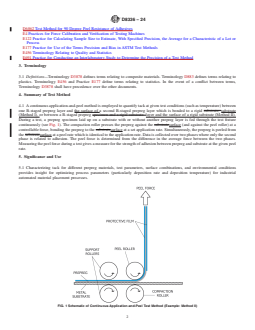
4.1 A continuous application-and-peel method is employed
to quantify tack at given test conditions (such as temperature)
between one B-staged prepreg layer and the surface of a second
This test method is under the jurisdiction of ASTM Committee D30 on
Composite Materials and is the direct responsibility of Subcommittee D30.03 on
Constituent/Precursor Properties. For referenced ASTM standards, visit the ASTM website, www.astm.org, or
Current edition approved Feb. 15, 2024. Published March 2024. Originally contact ASTM Customer Service at service@astm.org. For Annual Book of ASTM
approved in 2021. Last previous edition approved in 2021 as D8336 – 21. DOI: Standards volume information, refer to the standard’s Document Summary page on
10.1520/D8336-24. the ASTM website.
Copyright © ASTM International, 100 Barr Harbor Drive, PO Box C700, West Conshohocken, PA 19428-2959. United States
D8336 − 24
B-staged prepreg layer which is bonded to a rigid substrate in a manner relevant for dynamic material deposition
(Method I), or between a B-staged prepreg layer and the processes, where timescales for bonding of prepreg to the
surface of a rigid substrate (Method II). During a test, a prepreg substrate or previously placed prepreg layers are short prior to
specimen laid up on a substrate with or without another prepreg curing. In contrast, Test Methods D3167 and D1781 determine
layer is fed through the test fixture continuously (see Fig. 1).
the peel resistance of adhesive bonds for adhesion measure-
The compaction roller presses the prepreg against the surface ment and process control of laminated or bonded adherends.
(and against the peel roller) at a controllable force, bonding the
5.3 The test method is suitable to quantify tack of prepregs
prepreg to the surface at a set application rate. Simultaneously,
for acceptance and process control and can be extended to
the prepreg is peeled from the surface at a peel rate which is
determine resin shelf life or to adjust process parameters to
identical to the application rate. Data is collected over two
resin out-time. Direct comparison of different resins/prepregs
phases where only the second phase is related to adhesion. The
or processes can only be made when specimen preparation and
peel force is determined from the difference in the average
test conditions are identical.
force between the two phases. Measuring the peel force during
a test gives a measure for the strength of adhesion between
6. Interferences
prepreg and substrate at the given peel rate.
6.1 Material Test Face—The manufacturing of prepregs
5. Significance and Use
may cause differences in resin content and resin distribution
5.1 Characterizing tack for different prepreg materials, test
between the two sides or faces of the prepreg, which may have
parameters, surface combinations, and environmental condi-
an effect on tack. Hence, tack tests must be carried out
tions provides insight for optimizing process parameters (par-
consistently on the same prepreg face to minimize interference
ticularly deposition rate and deposition temperature) for indus-
due to the possible difference in material properties on the
trial automated material placement processes.
prepreg surfaces. It is recommended that the specimen layup
assembly should represent the layup relevant to the intended
5.2 Results obtained through employing the continuous
use of the prepreg. For the purpose of this standard, the prepreg
application-and-peel method, as described in studies (1-3),
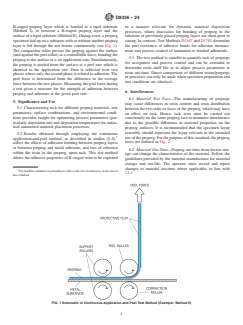
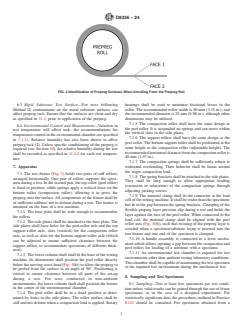
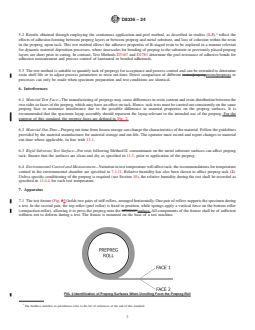
faces are defined in Fig. 2.
reflect the effects of adhesion forming between prepreg layers
or between prepreg and metal substrate, and loss of cohesion
6.2 Material Out-Time—Prepreg out-time from frozen stor-
within the resin in the prepreg, upon tack. This test method
age can change the characteristics of the material. Follow the
allows the adhesive properties of B-staged resin to be explored
guidelines provided by the material manufacturer for material
storage and out-life. The operator must record and report
changes to material out-time where applicable, in line with
The boldface numbers in parentheses refer to the list of references at the end of
13.1.
this standard.
FIG. 1 Schematic of Continuous Application-and-Peel Test Method (Example: Method II)
D8336 − 24
FIG. 2 Identification of Prepreg Surfaces When Unrolling From the Prepreg Roll
6.3 Rigid Substrate Test Surface—For tests following bearings shall be used to minimize frictional losses in the
Method II, contaminants on the metal substrate surfaces can roller. The recommended roller width is 80 mm (3.15 in.), and
affect prepreg tack. Ensure that the surfaces are clean and dry the recommended diameter is 25 mm (0.98 in.), although other
as specified in 11.3, prior to application of the prepreg. dimensions may be utilized.
7.1.5 The compaction roller shall have the same design as
6.4 Environmental Control and Measurement—Variation in
the peel roller. It is suspended on springs and can move within
test temperature will affect tack; the recommendations for
the vertical slots in the side plates.
temperature control in the environmental chamber are specified
7.1.6 The support rollers shall have the same design as the
in 7.1.11. Relative humidity has also been shown to affect
peel roller. The bottom support roller shall be positioned at the
prepreg tack (2). Unless specific conditioning of the prepreg is
same height as the compaction roller (adjustable height). The
required (see Section 10), the relative humidity during the test
recommended horizontal distance from the compaction roller is
shall be recorded as specified in 11.4.4 for each test tempera-
40 mm (1.57 in.).
ture.
7.1.7 The compaction springs shall be sufficiently robust to
withstand overloading. Their behavior shall be linear around
7. Apparatus
the target compaction load.
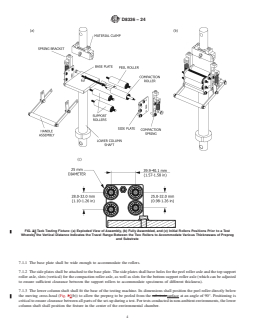
7.1 The test fixture (Fig. 3) holds two pairs of stiff rollers,
7.1.8 The spring brackets shall be attached to the side plates.
arranged horizontally. One pair of rollers supports the speci-
They shall be long enough to allow appropriate loading
men during a test. In the second pair, the top roller (peel roller)
(extension or relaxation) of the compaction springs through
is fixed in position, while springs apply a vertical force on the
adjusting jacking screws
bottom roller (compaction roller), allowing it to press the
7.1.9 The material clamp shall fit the connector at the load
prepreg onto the surface. All components of the fixture shall be
cell of the testing machine. It shall be wider than the specimens
of sufficient stiffness not to deform during a test. The fixture is
but fit in the gap between the spring brackets. Clamping of the
mounted on the base of a test machine.
flexible prepreg layer prevents slip during a test and holds the
7.1.1 The base plate shall be wide enough to accommodate
layer against the face of the peel roller. When connected to the
the rollers.
load cell, the material clamp shall be aligned with the peel
7.1.2 The side plates shall be attached to the base plate. The
roller axis (Fig. 3(b)), such that twisting of the prepreg layer is
side plates shall have holes for the peel roller axle and the top
avoided when a specimen/substrate layup is inserted into the
support roller axle, slots (vertical) for the compaction roller
test fixture and one end of the specimen is clamped.
axle, as well as slots for the bottom support roller axle (which
7.1.10 A handle assembly is connected to a lever mecha-
can be adjusted to ensure sufficient clearance between the
nism which allows opening a gap between the compaction and
support rollers to accommodate specimens of different thick-
peel rollers for loading of a substrate with a specimen.
ness).
7.1.11 An environmental test chamber is required for test
7.1.3 The lower column shaft shall fit the base of the testing
environments other than ambient testing laboratory conditions.
machine. Its dimensions shall position the peel roller directly
This chamber shall be capable of maintaining the test specimen
below the moving cross-head (Fig. 3(b)) to allow the prepreg to
at the required test environment during the mechanical test.
be peeled from the surface at an angle of 90°. Positioning is
critical to ensure clearance between all parts of the set-up
8. Sampling and Test Specimens
during a test. For tests conducted in non-ambient
environments, the lower column shaft shall position the fixture 8.1 Sampling—Test at least five specimens per test condi-
in the center of the environmental chamber. tion unless valid results can be gained through the use of fewer
7.1.4 The peel roller shall be in a fixed position as deter- specimens, as in the case of a designed experiment. For
mined by holes in the side plates. The roller surface shall be statistically significant data, the procedures outlined in Practice
stiff and not deform when a compaction load is applied. Rotary E122 should be consulted. For specimens obtained from a
D8336 − 24
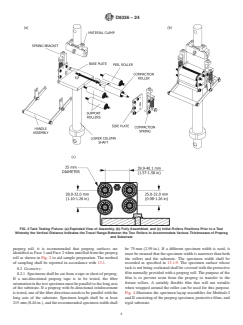
FIG. 3 Tack Testing Fixture: (a) Exploded View of Assembly, (b) Fully Assembled, and (c) Initial Rollers Positions Prior to a Test
Whereby the Vertical Distance Indicates the Travel Range Between the Two Rollers to Accommodate Various Thicknesses of Prepreg
and Substrate
prepreg roll, it is recommended that prepreg surfaces are be 75 mm (2.95 in.). If a different specimen width is used, it
identified as Face 1 and Face 2 when unrolled from the prepreg
must be ensured that the specimen width is narrower than both
roll as shown in Fig. 2 to aid sample preparation. The method
the rollers and the substrate. The specimen width shall be
of sampling shall be reported in accordance with 13.1.
recorded as specified in 13.1.9. The specimen surface whose
tack is not being evaluated shall be covered with the protective
8.2 Geometry:
film normally provided with a prepreg roll. The purpose of the
8.2.1 Specimens shall be cut from a tape or sheet of prepreg.
film is to prevent resin from the prepreg to transfer to the
If a uni-directional prepreg tape is to be tested, the fiber
fixture rollers. A suitably flexible film that will not wrinkle
orientation in the test specimen must be parallel to the long axis
when wrapped around the roller can be used for this purpose.
of the substrate. If a prepreg with bi-directional reinforcement
is tested, one of the fiber directions needs to be parallel with the Fig. 4 illustrates the specimen layup assemblies for Methods I
and II consisting of the prepreg specimen, protective films, and
long axis of the substrate. Specimen length shall be at least
215 mm (8.46 in.), and the recommended specimen width shall rigid substrate.
D8336 − 24
FIG. 4 Specimen Assembly for Both Methods I and II: (a) Side View and (b) Top View
8.2.2 Rigid substrates are recommended to be made from prepreg as the layer to be peeled (described in 8.2.1), but the
stainless steel with Specification A480/A480M No. 2B finish.
specimen layup assembly should represent the layup relevant
If other suitably rigid substrate materials are used, with a
to the intended use of the prepreg. The orientation of this
surface finish allowing the substrate to pass smoothly over the
prepreg layer does not need to be parallel with the long axis of
compaction roller, this must be recorded as specified in 13.1.8.
the substrate. The angle between the fiber orientation in
The substrate shall be at least 140 mm (5.51 in.) in length,
uni-directional prepreg tapes and the substrate axis (that is,
80 mm (3.15 in.) in width, and 0.8 mm (0.03 in.) thick. The
peel direction) or the angle between the fabric warp-direction
edges of the substrates shall be deburred if cut from a larger
in prepreg fabrics and the substrate axis can be set as in the
sheet.
production layup. The length of this layer shall correspond to
the length of the substrate; the width is the same as for the other
8.3 If tack between two layers of prepreg is to be tested
specimen layer within a tolerance specified during slitting of
(Method I), an additional layer of prepreg shall be cut from a
tape or sheet. This layer does not need to be the same type of the material, in the absence of which a general tolerance of
D8336 − 24
61 mm shall be used. A 60 mm length of the upper surface of equipped with an appropriate force-measuring device (for
the additional layer of prepreg congruent with the covered part example, a load cell). The accuracy of the test machine shall be
of the upper prepreg layer (Phase I) shall be covered with in accordance with Practices E4.
protective film, as shown in Fig. 4(a).
9.2.3 Loosen the jacking screws, such that the compaction
roller is suspended loosely by the springs and no longer
NOTE 1—Within the recommendations stated in 8.2, other dimensions
touches the peel roller, and a gap forms between the peel roller
of specimen and of rigid substrate may be used, provided that the
environmental chamber and tack test fixture can accommodate the and the compaction roller.
specimen dimensions for the application-and-peel motion.
9.2.4 Connect a stiff L-shaped steel bracket [recommended
to be at least 75 mm (2.95 in.) wide, but narrower than the
9. Calibration
80 mm (3.15 in.) wide rollers] to the load cell of the test
9.1 The accuracy of all measuring equipment shall have
machine using the material clamp (Fig. 5). Check to ensure that
certified calibrations that are current at the time of use of the
the material clamp is aligned with the peel roller, such that the
equipment.
bracket does not touch the peel roller at any point, and adjust
if necessary. Position the short flange of the bracket in the gap
9.2 Calibration of Test Apparatus:
9.2.1 The calibration is performed during installation of the between the rollers, directly on the compaction roller. Loosen
the jacking screws until the short flange makes no contact with
fixture prior to initial use to obtain the desired compaction
force. The following procedure provides a calibration curve to the compaction roller and zero the load cell reading. The
jacking screws are tightened or loosened alternatively to find
determine the required number of turns of the jacking screws to
the start point for the calibration (where the reading of the load
set a given compaction force.
cell starts to increase from zero if either screw is tightened).
9.2.2 The test machine must have an established reference
surface and procedure permitting alignment of test specimen 9.2.5 To acquire a force calibration curve, incrementally
within 2.5 mm (0.10 in.) of the loading axis of the machine. A tighten both jacking screws (by the same number of turns) and
calibrated testing machine shall be used which can be operated record the corresponding force readings for each increment
at constant crosshead speed over the specified range. The test over a range of forces which cover the compaction forces
machine mechanism shall be essentially free from inertial lag specified by the requestor. Ensure that all of the force is
at the crosshead speeds specified. The machine shall be transmitted between the lower roller and load cell through the
FIG. 5 Calibration Set-up
D8336 − 24
L-shaped bracket, that is, that the flange does not come into orientation are selected so as to imitate the layup in the
contact with the peel roller. production scenario of interest. If multiple widths of adhesive
9.2.6 Remove the L-shaped bracket from the material tape are used to fully cover the substrate, ensure that they do
clamp. not overlap to avoid thickness variations.
11.3.3 Partially peel off the protective film on the 140 mm
10. Conditioning
prepreg layer and cut it so that a recommended length of 60
10.1 When testing fresh prepreg, ensure that the prepreg has
mm (2.36 in.) remains on one end of the prepreg, as shown in
been stored according to the manufacturer’s instructions,
Fig. 6, and corresponding to Phase 1 in Fig. 4.
typically in frozen storage.
11.3.4 Trim an additional layer of protective film to a
recommended length of 135 mm (5.31 in.). The width corre-
10.2 Ensure prepreg removed from frozen storage is
sponds to the width of the prepreg specimen.
warmed to ambient conditions before being removed from a
11.3.5 Partially cover the exposed face of the 215 mm
sealed bag to avoid moisture condensation on the prepreg
prepreg layer with the 135 mm trimmed layer of protective
surfaces.
film, such that the prepreg surface stays exposed on a recom-
NOTE 2—Prepreg can be conditioned by exposure to defined tempera-
mended length of 80 mm (3.15 in.) as illustrated in Fig. 6
tures for extended periods of time or to defined level of humidity, or both
(Method I).
(2, 4).
11.3.6 For Method I, place the 215 mm prepreg layer on top
11. Procedure
of the 140 mm prepreg layer bonded to the substrate. Ensure
11.1 General Instructions: that the end of the prepreg is flush with the short edge of the
11.1.1 Report any deviations from this test method, whether substrate, and that the 215 mm prepreg layer is congruent with
intentional or inadvertent. the bonded prepreg layer on the substrate, as shown in Fig. 6.
11.1.2 All surfaces of the fixture need to be cleaned thor- For Method II, place the 215 mm prepreg layer directly on the
oughly (with acetone or a solvent based cleaner) using lint free substrate and ensure that the end of the prepreg is flush with the
cloth to remove any contamination. Ensure enough time for short edge on the substrate as shown in Fig. 6. The end of the
solvent to evaporate. 215 mm prepreg layer covered on both sides by protective
films is intended to extend beyond the end of the substrate (see
11.2 Adjustment of Compaction Force:
Fig. 4 and Fig. 6). No compaction pressure is to be applied on
11.2.1 Move the handle to lower the compaction roller.
the prepreg surface. Unlike in Test Methods D3167 and D1781,
Insert a substrate with (Method I) or without (Method II) an
the prepreg is not bonded to the substrate (Method II) or to the
attached layer of prepreg covered by protective film. Release
prepreg layer attached to the substrate (Method I). Avoid
the handle such that the compaction roller presses the surface
contamination of exposed surfaces while handling specimens
of the substrate or of the attached prepreg layer against the peel
and substrates.
roller.
11.3.7 To ensure that the adhesion between the protective
11.2.2 Adjust both jacking screws by the same amount until
film and the prepreg does not adversely affect the test results,
the substrate (Method II) or the attached prepreg layer (Method
immediately before the test separate the 215 mm protective
I) is just in contact with the peel roller and the compaction
film from the 215 mm prepreg to break the bond, and replace
roller. As a result, the axles of the compaction roller and the
it in its original position without applying compaction pressure.
peel roller shall remain parallel. This state corresponds to zero
compaction force.
11.4 Tack Testing:
11.2.3 Tighten both jacking screws by the appropriate
11.4.1 Move the handle to lower the compaction roller.
number of turns to set the target compaction force according to
While holding down the handle, insert the specimen / substrate
the calibration curve. A force of 100 N (22.48 lbf) is recom-
layup, such that the specimen is on top. The specimen/substrate
mended for a specimen width of 75 mm (2.95 in.). This
layup needs to be centered between the side plates of the
recommended compaction force can be scaled using
fixture. The end of the substrate with the extending prepreg
1.33N/mm (7.62lbf/in.) for non-standard specimen widths.
layer needs to be positioned between compaction and peel
11.2.4 Move the ha
...
This document is not an ASTM standard and is intended only to provide the user of an ASTM standard an indication of what changes have been made to the previous version. Because
it may not be technically possible to adequately depict all changes accurately, ASTM recommends that users consult prior editions as appropriate. In all cases only the current version
of the standard as published by ASTM is to be considered the official document.
Designation: D8336 − 21 D8336 − 24
Standard Test Method for
Characterizing Tack of Prepregs Using a Continuous
Application-and-Peel Procedure
This standard is issued under the fixed designation D8336; the number immediately following the designation indicates the year of
original adoption or, in the case of revision, the year of last revision. A number in parentheses indicates the year of last reapproval. A
superscript epsilon (´) indicates an editorial change since the last revision or reapproval.
1. Scope
1.1 This test method covers measurement of adhesion (tack) between partially cured (B-staged) composite prepreg and a
substratesurface in a peel test, under specified conditions. The test may be conducted to measure tack between a flexible layer of
prepreg and another prepreg layer bonded to a rigid substrate (Method I) or a rigid metal substrate (Method II). This test method
is primarily geared towards material characterization for automated material layup but can be modified for use with other
processes. It is well known that material tack is a function of multiple processing and environmental variables. Permissible
composite prepreg materials include carbon, glass, and aramid fibers within a B-staged thermoset resin.
1.2 Measured tack is specified in terms of a peel force at a given specimen width.
1.3 Units—The values stated in SI units are to be regarded as standard. The values given in parentheses after SI units are provided
for information only and are not considered standard. The values stated in each system are not necessarily exact equivalents;
therefore, to ensure conformance with the standard, each system shall be used independently of the other, and values from the two
systems shall not be combined.
1.4 This standard does not purport to address all of the safety concerns, if any, associated with its use. It is the responsibility
of the user of this standard to establish appropriate safety, health, and environmental practices and determine the applicability of
regulatory limitations prior to use.
1.5 This international standard was developed in accordance with internationally recognized principles on standardization
established in the Decision on Principles for the Development of International Standards, Guides and Recommendations issued
by the World Trade Organization Technical Barriers to Trade (TBT) Committee.
2. Referenced Documents
2.1 ASTM Standards:
A480/A480M Specification for General Requirements for Flat-Rolled Stainless and Heat-Resisting Steel Plate, Sheet, and Strip
D883 Terminology Relating to Plastics
D1781 Test Method for Climbing Drum Peel for Adhesives
D3167 Test Method for Floating Roller Peel Resistance of Adhesives
D3330 Test Method for Peel Adhesion of Pressure-Sensitive Tape
D3878 Terminology for Composite Materials
This test method is under the jurisdiction of ASTM Committee D30 on Composite Materials and is the direct responsibility of Subcommittee D30.03 on
Constituent/Precursor Properties.
Current edition approved Feb. 1, 2021Feb. 15, 2024. Published March 2021March 2024. Originally approved in 2021. Last previous edition approved in 2021 as
D8336 – 21. DOI: 10.1520/D8336-21.10.1520/D8336-24.
For referenced ASTM standards, visit the ASTM website, www.astm.org, or contact ASTM Customer Service at service@astm.org. For Annual Book of ASTM Standards
volume information, refer to the standard’s Document Summary page on the ASTM website.
Copyright © ASTM International, 100 Barr Harbor Drive, PO Box C700, West Conshohocken, PA 19428-2959. United States
D8336 − 24
D6862 Test Method for 90 Degree Peel Resistance of Adhesives
E4 Practices for Force Calibration and Verification of Testing Machines
E122 Practice for Calculating Sample Size to Estimate, With Specified Precision, the Average for a Characteristic of a Lot or
Process
E177 Practice for Use of the Terms Precision and Bias in ASTM Test Methods
E456 Terminology Relating to Quality and Statistics
E691 Practice for Conducting an Interlaboratory Study to Determine the Precision of a Test Method
3. Terminology
3.1 Definitions—Terminology D3878 defines terms relating to composite materials. Terminology D883 defines terms relating to
plastics. Terminology E456 and Practice E177 define terms relating to statistics. In the event of a conflict between terms,
Terminology D3878 shall have precedence over the other documents.
4. Summary of Test Method
4.1 A continuous application-and-peel method is employed to quantify tack at given test conditions (such as temperature) between
one B-staged prepreg layer and the surface of a second B-staged prepreg layer which is bonded to a rigid substrate, substrate
(Method I), or between a B-staged prepreg specimen and a rigid substrate. layer and the surface of a rigid substrate (Method II).
During a test, a prepreg specimen laid up on a substrate with or without another prepreg layer is fed through the test fixture
continuously (see Fig. 1). The compaction roller presses the prepreg against the substratesurface (and against the peel roller) at a
controllable force, bonding the prepreg to the substratesurface at a set application rate. Simultaneously, the prepreg is peeled from
the substratesurface at a peel rate which is identical to the application rate. Data is collected over two phases where only the second
phase is related to adhesion. The peel force is determined from the difference in the average force between the two phases.
Measuring the peel force during a test gives a measure for the strength of adhesion between prepreg and substrate at the given peel
rate.
5. Significance and Use
5.1 Characterizing tack for different prepreg materials, test parameters, surface combinations, and environmental conditions
provides insight for optimizing process parameters (particularly deposition rate and deposition temperature) for industrial
automated material placement processes.
FIG. 1 Schematic of Continuous Application-and-Peel Test Method (Example: Method II)
D8336 − 24
5.2 Results obtained through employing the continuous application-and-peel method, as described in studies (1-3), reflect the
effects of adhesion forming between prepreg layers or between prepreg and metal substrate, and loss of cohesion within the resin
in the prepreg, upon tack. This test method allows the adhesive properties of B-staged resin to be explored in a manner relevant
for dynamic material deposition processes, where timescales for bonding of prepreg to the substrate or previously placed prepreg
layers are short prior to curing. In contrast, Test Methods D3167 and D1781 determine the peel resistance of adhesive bonds for
adhesion measurement and process control of laminated or bonded adherends.
5.3 The test method is suitable to quantify tack of prepregs for acceptance and process control and can be extended to determine
resin shelf life or to adjust process parameters to resin out-time. Direct comparison of different resins/prepregresins/prepregs or
processes can only be made when specimen preparation and test conditions are identical.
6. Interferences
6.1 Material Test Face—The manufacturing of prepregs may cause differences in resin content and resin distribution between the
two sides or faces of the prepreg, which may have an effect on tack. Hence, tack tests must be carried out consistently on the same
prepreg face to minimize interference due to the possible difference in material properties on the prepreg surfaces. It is
recommended that the specimen layup assembly should represent the layup relevant to the intended use of the prepreg. For the
purpose of this standard, the prepreg faces are defined in Fig. 2.
6.2 Material Out-Time—Prepreg out-time from frozen storage can change the characteristics of the material. Follow the guidelines
provided by the material manufacturer for material storage and out-life. The operator must record and report changes to material
out-time where applicable, in line with 13.1.
6.3 Rigid Substrate Test Surface—For tests following Method II, contaminants on the metal substrate surfaces can affect prepreg
tack. Ensure that the surfaces are clean and dry as specified in 11.3, prior to application of the prepreg.
6.4 Environmental Control and Measurement—Variation in test temperature will affect tack; the recommendations for temperature
control in the environmental chamber are specified in 7.1.11. Relative humidity has also been shown to affect prepreg tack (2).
Unless specific conditioning of the prepreg is required (see Section 10), the relative humidity during the test shall be recorded as
specified in 11.4.4 for each test temperature.
7. Apparatus
7.1 The test fixture (Fig. 23) holds two pairs of stiff rollers, arranged horizontally. One pair of rollers supports the specimen during
a test. In the second pair, the top roller (peel roller) is fixed in position, while springs apply a vertical force on the bottom roller
(compaction roller), allowing it to press the prepreg onto the substrate.surface. All components of the fixture shall be of sufficient
stiffness not to deform during a test. The fixture is mounted on the base of a test machine.
FIG. 2 Identification of Prepreg Surfaces When Unrolling From the Prepreg Roll
The boldface numbers in parentheses refer to the list of references at the end of this standard.
D8336 − 24
FIG. 23 Tack Testing Fixture: (a) Exploded View of Assembly, (b) Fully Assembled, and (c) Initial Rollers Positions Prior to a Test
Whereby the Vertical Distance Indicates the Travel Range Between the Two Rollers to Accommodate Various Thicknesses of Prepreg
and Substrate
7.1.1 The base plate shall be wide enough to accommodate the rollers.
7.1.2 The side plates shall be attached to the base plate. The side plates shall have holes for the peel roller axle and the top support
roller axle, slots (vertical) for the compaction roller axle, as well as slots for the bottom support roller axle (which can be adjusted
to ensure sufficient clearance between the support rollers to accommodate specimens of different thickness).
7.1.3 The lower column shaft shall fit the base of the testing machine. Its dimensions shall position the peel roller directly below
the moving cross-head (Fig. 23(b)) to allow the prepreg to be peeled from the substratesurface at an angle of 90°. Positioning is
critical to ensure clearance between all parts of the set-up during a test. For tests conducted in non-ambient environments, the lower
column shaft shall position the fixture in the center of the environmental chamber.
D8336 − 24
7.1.4 The peel roller shall be in a fixed position as determined by holes in the side plates. The roller surface shall be stiff and not
deform when a compaction load is applied. Rotary bearings shall be used to minimize frictional losses in the roller. The
recommended roller width is 80 mm (3.15 in.), and the recommended diameter is 25 mm (0.98 in.), although other dimensions may
be utilized.
7.1.5 The compaction roller shall have the same design as the peel roller. It is suspended on springs and can move within the
vertical slots in the side plates.
7.1.6 The support rollers shall have the same design as the peel roller. The bottom support roller shall be positioned at the same
height as the compaction roller (adjustable height). The recommended horizontal distance from the compaction roller is 40 mm
(1.57 in.).
7.1.7 The compaction springs shall be sufficiently robust to withstand overloading. Their behavior shall be linear around the target
compaction load.
7.1.8 The spring brackets shall be attached to the side plates. They shall be long enough to allow appropriate loading (extension
or relaxation) of the compaction springs through adjusting jacking screws
7.1.9 The material clamp shall fit the connector at the load cell of the testing machine. It shall be wider than the specimens but
fit in the gap between the spring brackets. Clamping of the flexible prepreg layer prevents slip during a test and holds the layer
against the face of the peel roller. When connected to the load cell, the material clamp shall be aligned with the peel roller axis
(Fig. 3(b)), such that twisting of the prepreg layer is avoided when a specimen/substrate layup is inserted into the test fixture and
one end of the specimen is clamped.
7.1.10 A handle assembly is connected to a lever mechanism which allows opening a gap between the compaction and peel rollers
for loading of a substrate with a specimen.
7.1.11 An environmental test chamber is required for test environments other than ambient testing laboratory conditions. This
chamber shall be capable of maintaining the test specimen at the required test environment during the mechanical test.
8. Sampling and Test Specimens
8.1 Sampling—Test at least five specimens per test condition unless valid results can be gained through the use of fewer specimens,
as in the case of a designed experiment. For statistically significant data, the procedures outlined in Practice E122 should be
consulted. For specimens obtained from a prepreg roll, it is recommended that prepreg surfaces are identified as Face 1 and Face
2 when unrolled from the prepreg roll as shown in Fig. 32 to aid sample preparation. The method of sampling shall be reported
in accordance with 13.1.
8.2 Geometry:
8.2.1 Specimens shall be cut from a tape or sheet of prepreg. If a uni-directional prepreg tape is to be tested, the fiber orientation
in the test specimen must be parallel to the long axis of the substrate. If a prepreg with bi-directional reinforcement is tested, one
of the fiber directions needs to be parallel with the long axis of the substrate. Specimen length shall be at least 215 mm (8.46 in.),
and the recommended specimen width shall be 75 mm (2.95 in.). If a different specimen width is used, it must be ensured that the
specimen width is narrower than both the rollers and the substrate. The specimen width shall be recorded as specified in 13.1.9.
The specimen surface whose tack is not being evaluated shall be covered with the protective film normally provided with a prepreg
roll. The purpose of the film is to prevent resin from the prepreg to transfer to the fixture rollers. A suitably flexible film that will
not wrinkle when wrapped around the roller can be used for this purpose. Fig. 4 illustrates the specimen layup assemblies for
Methods I and II consisting of the prepreg specimen, protective films, and rigid substrate.
8.2.2 Rigid substrates are recommended to be made from stainless steel with Specification A480/A480M No. 2B finish. If other
suitably rigid substrate materials are used, with a surface finish allowing the substrate to pass smoothly over the compaction roller,
this must be recorded as specified in 13.1.8. The substrate shall be at least 140 mm (5.51 in.) in length, 80 mm (3.15 in.) in width,
and 0.8 mm (0.03 in.) thick. The edges of the substrates shall be deburred if cut from a larger sheet.
8.3 If tack between two layers of prepreg is to be tested (Method I), an additional layer of prepreg shall be cut from a tape or sheet.
This layer does not need to be the same type of prepreg as the layer to be peeled (described in 8.2.1), but the specimen layup
D8336 − 24
FIG. 4 Specimen Assembly for Both Methods I and II: (a) Side View and (b) Top View
assembly should represent the layup relevant to the intended use of the prepreg. The orientation of this prepreg layer does not need
to be parallel with the long axis of the substrate. The angle between the fiber orientation in uni-directional prepreg tapes and the
substrate axis (that is, peel direction) or the angle between the fabric warp-direction in prepreg fabrics and the substrate axis can
be set as in the production layup. The length of this layer shall correspond to the length of the substrate; the width is the same as
for the other specimen layer within a tolerance specified during slitting of the material, in the absence of which a general tolerance
of 61 mm shall be used. One A 60 mm length of the upper surface of the additional layer of prepreg congruent with the covered
part of the upper prepreg layer (Phase I) shall be covered with protective film. film, as shown in Fig. 4(a).
NOTE 1—Within the recommendations stated in 8.2, other dimensions of specimen and of rigid substrate may be used, provided that the environmental
chamber and tack test fixture can accommodate the specimen dimensions for the application-and-peel motion.
D8336 − 24
9. Calibration
9.1 The accuracy of all measuring equipment shall have certified calibrations that are current at the time of use of the equipment.
9.2 Calibration of Test Apparatus:
9.2.1 The calibration is performed during installation of the fixture prior to initial use to obtain the desired compaction force. The
following procedure provides a calibration curve to determine the required number of turns of the jacking screws to set a given
compaction force.
9.2.2 The test machine must have an established reference surface and procedure permitting alignment of test specimen within 2.5
mm (0.10 in.) of the loading axis of the machine. A calibrated testing machine shall be used which can be operated at constant
crosshead speed over the specified range. The test machine mechanism shall be essentially free from inertial lag at the crosshead
speeds specified. The machine shall be equipped with an appropriate force-measuring device (for example, a load cell). The
accuracy of the test machine shall be in accordance with Practices E4.
9.2.3 Loosen the jacking screws, such that the compaction roller is suspended loosely by the springs, and the axles of springs and
no longer touches the peel roller, and a gap forms between the peel roller and the compaction roller are parallel. roller.
9.2.4 Connect a stiff L-shaped steel bracket to the [recommended to be at least 75 mm (2.95 in.) wide, but narrower than the
80 mm (3.15 in.) wide rollers] to the load cell of the test machine using the material clamp (Fig. 5). Check to ensure that the
material clamp is aligned with the peel roller, such that the bracket does not touch the peel roller at any point, and adjust if
necessary. Position the short flange of the bracket in the gap between the rollers, directly on the compaction roller. Zero the load
cell reading with no force applied. Loosen the jacking screws until the short flange makes no contact with the compaction roller
FIG. 5 Calibration Set-up
D8336 − 24
and zero the load cell reading. The jacking screws are tightened or loosened alternatively to find the start point for the calibration
(where the reading of the load cell starts to increase from zero). Both jacking screws shall be adjusted by the same amount.zero
if either screw is tightened).
9.2.5 To acquire a force calibration curve, incrementally tighten both jacking screws (by the same number of turns) and record
the corresponding force readings for each increment withinover a relevant range of force readings. range of forces which cover
the compaction forces specified by the requestor. Ensure that all of the force is transmitted between the lower roller and load cell
through the L-shaped bracket, that is, that the flange does not come into contact with the peel roller.
9.2.6 Remove the L-shaped bracket from the material clamp.
10. Conditioning
10.1 When testing fresh prepreg, ensure that the prepreg has been stored according to the manufacturer’s instructions, typically
in frozen storage.
10.2 Ensure prepreg removed from frozen storage is warmed to ambient conditions before being removed from a sealed bag to
avoid moisture condensation on the prepreg surfaces.
NOTE 2—Prepreg can be conditioned by exposure to defined temperatures for extended periods of time or to defined level of humidity, or both (2,4).
11. Procedure
11.1 General Instructions:
11.1.1 Report any deviations from this test method, whether intentional or inadvertent.
11.1.2 All surfaces of the fixture need to be cleaned thoroughly (with acetone or a solvent based cleaner) using lint free cloth to
remove any contamination. Ensure enough time for solvent to evaporate.
11.2 Adjustment of Compaction Force:
11.2.1 Pull down Move the handle to lower the compaction roller. Insert a substrate with (Method I) or without (Method II) an
attached layer of prepreg. prepreg covered by protective film. Release the handle such that the compaction roller presses the surface
of the substrate or of the attached prepreg layer against the peel roller.
11.2.2 LoosenAdjust both jacking screws by the same amount until the substrate (Method II) or the attached prepreg layer (Method
I) is just in contact with the peel roller and the compaction roller. The As a result, the axles of the compaction roller and the peel
roller shall beremain parallel. This state corresponds to zero compaction force.
11.2.3 Tighten both jacking screws by the appropriate number of turns to set the target compaction force according to the
calibration curve. A force of 100 N (22.48 lbf) is recommended for a specimen width of 75 mm (2.95 in.). This recommended
compaction force can be scaled using 1.33N/mm (7.62lbf/in.) for non-standard specimen widths.
11.2.4 Pull down Move the handle to lower the compaction roller. Remove the substrate.substrate (with attached prepreg in case
of Method I).
11.3 Preparation of Substrates and Prepreg Specimens:
11.3.1 BothAll surfaces of the metal substrates need to be cleaned thoroughly (with acetone or a solvent-based cleaner) using lint
free cloth to remove any contamination. Ensure enough time for solvent to evaporate.
11.3.2 For Method I tests, bond a layer of prepreg to the substrate at an orientation required to imitate the layup in a production
scenario fully covered by protective film directly to the substrate using a suitable adhesive such as double-sided adhesive tape. The
method used to bond the prepreg to the substrate must produce a stronger bond than that between two layers of prepreg at the test
temperature. The exposed surface of the prepreg layer shall be bonded to the substrate. Ensure that the unbonded face and the fiber
D8336 − 24
orientation are selected so as to imitate the layup in the production scenario of interest. If multiple widths of adhesive tape are used
to fully cover the substrate, ensure that they do not overlap to avoid thickness variations.
11.3.3 Partially peel off the protective film on the 140 mm prepreg layer and cut it so that a recommended length of 60 mm (2.36
in.) remains on one end of the prepreg, as shown in Fig. 6, and corresponding to Phase 1 in Fig. 4.
11.3.4 Trim an additional layer of protective film to a recommended length of 135 mm (5.31 in.). The width corresponds to the
width of the prepreg specimen.
11.3.5 Partially cover the exposed face of the 215 mm prepreg layer with the 135 mm trimmed layer of protective film, such that
the prepreg surface stays exposed on a recommended length of 80 mm (3.15 in.) as illustrated in Fig. 6 (Method I).
11.3.6 Place the For Method I, place the 215 mm prepreg layer on the surface top of the 140 mm prepreg layer bonded to the
substrate. Ensure that the end of the prepreg is flush with the short edge of the substrate, and that the 215 mm prepreg layer is
congruent with the bonded prepreg layer on the substrate, as shown in Fig. 6substrate (Method I) or on the substrate (Method II),
such that the exposed surface is in contact with the substrate or. For Method II, place the 215 mm prepreg layer directly on the
substrate and ensure that the end of the prepreg is flush with the short edge on the substrate as shown in Fig. 6the exposed part
of the other prepreg layer. . The end of the exposed prepreg surface shall be flush with a short edge of the substrate. The covered
part of the prepreg surface extends over the other short edge 215 mm prepreg layer covered on both sides by protective films is
intended to extend beyond the end of the substrate (see Fig. 4 and Fig. 6). No compaction pressure is to be applied on the prepreg
surface. Unlike in Test Methods D3167 and
...