


ASTM F3681-24
(Specification)Standard Consumer Safety Specification for Beach Umbrellas and Anchor Devices
Standard Consumer Safety Specification for Beach Umbrellas and Anchor Devices
SCOPE
1.1 This consumer safety specification establishes performance requirements for beach umbrella/anchor systems to prevent the beach umbrella/anchor system from detaching from the sand, including any entity that provides the use of beach umbrellas.
1.2 No products existing or manufactured after the approval date of this consumer safety specification shall, either by label or other means, indicate compliance with this specification unless they conform to all applicable requirements contained herein.
1.3 Test methods in this specification are to be used for the evaluation of beach umbrella/anchor systems to determine the suitability of the beach umbrella/anchor system in a use environment based on safety in wind conditions.
1.4 This standard does not purport to address all of the safety concerns, if any, associated with its use. It is the responsibility of the user of this standard to establish appropriate safety, health, and environmental practices and determine the applicability of regulatory limitations prior to use.
1.5 This international standard was developed in accordance with internationally recognized principles on standardization established in the Decision on Principles for the Development of International Standards, Guides and Recommendations issued by the World Trade Organization Technical Barriers to Trade (TBT) Committee.
General Information
- Status
- Published
- Publication Date
- 31-Mar-2024
- Technical Committee
- F15 - Consumer Products
- Drafting Committee
- F15.79 - Market Umbrellas
Overview
ASTM F3681-24: Standard Consumer Safety Specification for Beach Umbrellas and Anchor Devices sets forth safety and performance requirements to ensure beach umbrellas and their anchor systems remain securely grounded in sand under typical wind conditions. Developed by ASTM International, this safety standard is targeted at manufacturers, distributors, retailers, and any entity providing beach umbrellas for use. The primary goal is to prevent detachment and potential injuries from airborne umbrellas, an issue identified by the U.S. Consumer Product Safety Commission (CPSC) due to incidents of laceration, impalement, and fatalities.
This specification includes standardized test methods, labeling, and instructional requirements, ensuring both new and existing products comply with essential consumer safety expectations in beach and recreational settings.
Key Topics
Scope and Applicability
- Covers all beach umbrella and anchor systems, including those provided for public or commercial use.
- Applies only to products conforming to the standard after its approval date.
Definitions
- Clearly defines terms such as anchor device, beach umbrella, canopy, umbrella plane, and secure anchoring in sand.
Performance Requirements
- Beach umbrella/anchor systems must remain secure in sand under wind conditions simulating up to 30 mph.
- Separate procedures for umbrellas with different canopy sizes, with anchor devices tested either through mechanical pull tests or wind tunnel evaluations.
Testing Methods
- Outlines precise test setups, including sand box dimensions, use of subangular quartz sand, force application methods, and wind tunnel specifications.
- Requires tests to be documented with time-stamped video for verification.
Marking, Labeling, and Warnings
- Detailed guidance on compliance labeling for anchor devices and umbrellas, including manufacturer details, tracking identification, and model numbers.
- Required bilingual warning labels on canopies and packaging, meeting ANSI Z535.4 standards, with explicit hazard statements about the dangers of airborne umbrellas.
Instructional Literature
- Mandatory inclusion of clear assembly, installation, operation, and safety instructions, along with replicas of required warning labels.
- Additional guidance on precautionary steps in various wind conditions.
Applications
ASTM F3681-24 is essential for:
- Manufacturers of beach umbrellas and anchor devices, to design products that meet established safety specifications and withstand wind-related hazards.
- Distributors and Retailers who are responsible for selling compliant beach umbrella systems, ensuring accurate labeling and consumer information.
- Beach Resorts and Rental Services using or supplying umbrellas in public spaces, ensuring their equipment is safe and properly anchored.
- Regulatory Agencies and safety inspectors, providing measurable criteria to assess the safety of beach umbrella installations.
- Consumers, who benefit from improved product safety, clear instructions, and actionable hazard warnings during recreational use.
Implementing this standard helps reduce risk of personal injury by maintaining product integrity and safety under real-world beach conditions.
Related Standards
The ASTM F3681-24 specification references additional industry standards and practices, including:
- ASTM D2487 – Practice for Classification of Soils for Engineering Purposes, relevant for sand specification in test methods.
- ANSI Z535 Series – Standards for safety colors, product safety signs, labels, and informational literature (including Z535.1, Z535.4, Z535.6).
These related documents provide foundational methods and marking conventions that support compliance and harmonization with global safety expectations.
Keywords: ASTM F3681-24, beach umbrella safety, anchor devices, wind resistance, consumer safety, ASTM standard, umbrella anchoring, product labeling, recreational safety, ANSI Z535, sand anchoring systems.
Frequently Asked Questions
ASTM F3681-24 is a technical specification published by ASTM International. Its full title is "Standard Consumer Safety Specification for Beach Umbrellas and Anchor Devices". This standard covers: SCOPE 1.1 This consumer safety specification establishes performance requirements for beach umbrella/anchor systems to prevent the beach umbrella/anchor system from detaching from the sand, including any entity that provides the use of beach umbrellas. 1.2 No products existing or manufactured after the approval date of this consumer safety specification shall, either by label or other means, indicate compliance with this specification unless they conform to all applicable requirements contained herein. 1.3 Test methods in this specification are to be used for the evaluation of beach umbrella/anchor systems to determine the suitability of the beach umbrella/anchor system in a use environment based on safety in wind conditions. 1.4 This standard does not purport to address all of the safety concerns, if any, associated with its use. It is the responsibility of the user of this standard to establish appropriate safety, health, and environmental practices and determine the applicability of regulatory limitations prior to use. 1.5 This international standard was developed in accordance with internationally recognized principles on standardization established in the Decision on Principles for the Development of International Standards, Guides and Recommendations issued by the World Trade Organization Technical Barriers to Trade (TBT) Committee.
SCOPE 1.1 This consumer safety specification establishes performance requirements for beach umbrella/anchor systems to prevent the beach umbrella/anchor system from detaching from the sand, including any entity that provides the use of beach umbrellas. 1.2 No products existing or manufactured after the approval date of this consumer safety specification shall, either by label or other means, indicate compliance with this specification unless they conform to all applicable requirements contained herein. 1.3 Test methods in this specification are to be used for the evaluation of beach umbrella/anchor systems to determine the suitability of the beach umbrella/anchor system in a use environment based on safety in wind conditions. 1.4 This standard does not purport to address all of the safety concerns, if any, associated with its use. It is the responsibility of the user of this standard to establish appropriate safety, health, and environmental practices and determine the applicability of regulatory limitations prior to use. 1.5 This international standard was developed in accordance with internationally recognized principles on standardization established in the Decision on Principles for the Development of International Standards, Guides and Recommendations issued by the World Trade Organization Technical Barriers to Trade (TBT) Committee.
ASTM F3681-24 is available in PDF format for immediate download after purchase. The document can be added to your cart and obtained through the secure checkout process. Digital delivery ensures instant access to the complete standard document.
Standards Content (Sample)
This international standard was developed in accordance with internationally recognized principles on standardization established in the Decision on Principles for the
Development of International Standards, Guides and Recommendations issued by the World Trade Organization Technical Barriers to Trade (TBT) Committee.
Designation: F3681 − 24
Standard Consumer Safety Specification for
Beach Umbrellas and Anchor Devices
This standard is issued under the fixed designation F3681; the number immediately following the designation indicates the year of
original adoption or, in the case of revision, the year of last revision. A number in parentheses indicates the year of last reapproval. A
superscript epsilon (´) indicates an editorial change since the last revision or reapproval.
INTRODUCTION
This consumer safety specification addresses incidents associated with beach umbrellas that were
identified by the U.S. Consumer Product Safety Commission (CPSC). Incidents identified by CPSC
and addressed in this standard include lacerations and impalement from the shaft/pole of a windblown
airborne beach umbrella. Umbrellas are commonly used as protection against sun, rain, or other
potential weather on beaches, in recreation areas, and at resorts. In windy conditions, beach umbrellas
have detached from the sand, and the windblown umbrella shaft has impacted various parts of a
bystander’s body, has caused serious injury and at least two deaths. It has been established through
empirical testing that umbrellas without effective anchoring devices are NOT safe for use on beaches.
This specification is written to address currently available beach umbrella/anchor systems and future
beach umbrella/anchor system designs. It is intended to be updated if substantive information becomes
available that necessitates additional requirements or justifies revision of existing requirements.
1. Scope Development of International Standards, Guides and Recom-
mendations issued by the World Trade Organization Technical
1.1 This consumer safety specification establishes perfor-
Barriers to Trade (TBT) Committee.
mance requirements for beach umbrella/anchor systems to
prevent the beach umbrella/anchor system from detaching from
2. Referenced Documents
the sand, including any entity that provides the use of beach
2.1 ASTM Standards:
umbrellas.
D2487 Practice for Classification of Soils for Engineering
1.2 No products existing or manufactured after the approval
Purposes (Unified Soil Classification System)
date of this consumer safety specification shall, either by label
2.2 ANSI Standards:
or other means, indicate compliance with this specification
ANSI Z535.1 Safety Colors
unless they conform to all applicable requirements contained
ANSI Z535.4 Product Safety Signs and Labels
herein.
ANSI Z535.6 Product Safety Information in Product
1.3 Test methods in this specification are to be used for the Manuals, Instructions and Other Collateral Materials
evaluation of beach umbrella/anchor systems to determine the
3. Terminology
suitability of the beach umbrella/anchor system in a use
3.1 Definitions of Terms Specific to This Standard:
environment based on safety in wind conditions.
3.1.1 anchor device, n—a device that is attached to or
1.4 This standard does not purport to address all of the
integrated into the umbrella pole and is secured in or on the
safety concerns, if any, associated with its use. It is the
sand on a beach, which enables the umbrella to perform in an
responsibility of the user of this standard to establish appro-
open upright or angled position and prevents the umbrella from
priate safety, health, and environmental practices and deter-
becoming airborne.
mine the applicability of regulatory limitations prior to use.
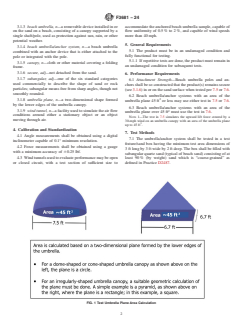
1.5 This international standard was developed in accor- 3.1.2 area of the umbrella plane, n—the number of square
feet of the umbrella plane as derived using geometric calcula-
dance with internationally recognized principles on standard-
ization established in the Decision on Principles for the tions (see calculation in 7.3).
For referenced ASTM standards, visit the ASTM website, www.astm.org, or
This consumer safety specification is under the jurisdiction of ASTM Commit- contact ASTM Customer Service at service@astm.org. For Annual Book of ASTM
tee F15 on Consumer Products and is the direct responsibility of Subcommittee Standards volume information, refer to the standard’s Document Summary page on
F15.79 on Market Umbrellas. the ASTM website.
Current edition approved April 1, 2024. Published April 2024. DOI: 10.1520/ Available from American National Standards Institute (ANSI), 25 W. 43rd St.,
F3681-24. 4th Floor, New York, NY 10036, http://www.ansi.org.
Copyright © ASTM International, 100 Barr Harbor Drive, PO Box C700, West Conshohocken, PA 19428-2959. United States
F3681 − 24
3.1.3 beach umbrella, n—a removable device installed in or accommodate the anchored beach umbrella sample, capable of
on the sand on a beach, consisting of a canopy supported by a flow uniformity of 0.5 % to 2 %, and capable of wind speeds
single shaft/pole, used as protection against sun, rain, or other more than 40 mph.
potential weather.
5. General Requirements
3.1.4 beach umbrella/anchor system, n—a beach umbrella
5.1 The product must be in an undamaged condition and
combined with an anchor device that is either attached to the
fully functional for testing.
pole or integrated with the pole.
5.1.1 If repetitive tests are done, the product must remain in
3.1.5 canopy, n—cloth or other material covering a folding
an undamaged condition for subsequent tests.
frame.
3.1.6 secure, adj—not detached from the sand.
6. Performance Requirements
3.1.7 subangular, adj—one of the six standard categories
6.1 Attachment Strength—Beach umbrella poles and an-
used commercially to describe the shape of sand or rock
chors shall be so constructed that the product(s) remains secure
particles; subangular means free from sharp angles, though not
(see 3.1.6) in or on the sand surface when tested per 7.5 or 7.6.
smoothly rounded.
6.2 Beach umbrella/anchor systems with an area of the
3.1.8 umbrella plane, n—a two-dimensional shape formed
umbrella plane 45 ft or less may use either test in 7.5 or 7.6.
by the lower edges of the umbrella canopy.
6.3 Beach umbrella/anchor systems with an area of the
3.1.9 wind tunnel, n—a facility used to simulate the air flow 2
umbrella plane over 45 ft must use the test in 7.6.
conditions around either a stationary object or an object
NOTE 1—The test in 7.5 simulates the upward lift force created by a
moving through air.
30-mph wind on an umbrella canopy with an area of the umbrella plane
up to 45 ft .
4. Calibration and Standardization
7. Test Methods
4.1 Angle measurements shall be obtained using a digital
7.1 The umbrella/anchor system shall be tested in a test
inclinometer capable of 0.1° minimum resolution.
fixture/sand box having the minimum test area dimensions of
4.2 Force measurements shall be obtained using a gauge
3 ft long by 3 ft wide by 2 ft deep. The box shall be filled with
with a minimum accuracy of 60.25 lbf.
subangular quartz sand (typical of beach sand) consisting of at
4.3 Wind tunnels used to evaluate performance may be open least 90 % (by weight) sand which is “coarse-grained” as
or closed circuit, with a test section of sufficient size to defined in Practice D2487.
FIG. 1 Test Umbrella Plane Area Calculation
F3681 − 24
7.2 The test shall be documented with time-stamped video. 7.5.5 The beach umbrella/anchor system shall remain se-
cure (see 3.1.6) to meet the performance standard.
7.3 Calculate the test umbrella plane area (see Fig. 1):
7.6 Wind Tunnel Test of Beach Umbrella/Anchor System—
7.4 The product shall be completely assembled, unless
When using this test, an anchor device that is sold separately
otherwise noted, in accordance with the manufacturer’s in-
from an umbrella must pass the test in the wind tunnel while
structions.
attached to an umbrella, which may be manufactured by a
7.5 Mechanical Pull Test of Beach Umbrella/Anchor
different entity. The test umbrella’s canopy plane area must be
System—When using this test, an anchor device that is sold
stated on the anchor product and product packaging as de-
separately from an umbrella does not have to be tested with a
scribed in 8.4.
canopy. A pole may be used that matches the specifications of
7.6.1 This test shall be conducted in a wind tunnel facility
most beach umbrella poles. However, this test is only valid for
capable of accommodating the umbrella fully assembled/
anchors intended for use with canopies that have an umbrella
opened and installed in the test fixture/sand box. For this test
plane area up to 45 ft or less, which must be stated on the
method, a wind tunnel of sufficient size is required so that the
anchor product and product packaging as described in 8.4.
beach umbrella, anchoring device, and sand box fit reasonably
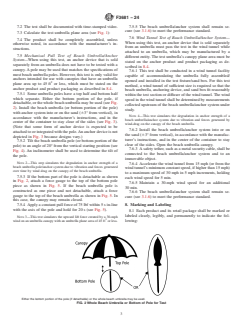
7.5.1 Some umbrella poles have a top half and bottom half
within the test section or diffuser of the wind tunnel. The wind
which separate. Either the bottom portion of the pole, if
speed in the wind tunnel shall be determined by measurements
detachable, or the whole beach umbrella may be used (see Fig.
collected upstream of the beach umbrella/anchor system under
2). Install the beach umbrella (or bottom portion of the pole)
study.
with anchor system into or on the sand (63° from vertical), in
NOTE 4—This test simulates the degradation in anchor strength of a
accordance with the manufacturer’s instructions, and in the
beach umbrella/anchor system due to vibration and forces generated by
center of the container to stay clear of the sides (see Fig. 3).
wind-drag on the canopy of the beach umbrella.
(Note that some form of anchor device is expected to be
7.6.2 Install the beach umbrella/anchor system into or on
attached to or integrated with the pole. An anchor device is not
the sand (63° from vertical), in accordance with the manufac-
depicted in Fig. 3 because designs vary.)
turer’s instructions, and in the center of the container to stay
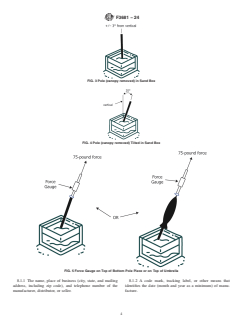
7.5.2 Tilt the beach umbrella pole (or bottom portion of the
clear of the sides. Open the beach umbrella canopy.
pole) to an angle of 20° from the vertical starting position (see
7.6.3 A safety tether, such as a metal security cable, shall be
Fig. 4). An inclinometer shall be used to determine the tilt of
connected to the beach umbrella/anchor system and to an
the pole.
immovable object.
NOTE 2—This step simulates the degradation in anchor strength of a
7.6.4 Accelerate the wind tunnel from 15 mph (or from the
beach umbrella pole/anchor system due to vibration and forces generated
wind tunnel’s minimum constant speed, if higher than 15 mph)
over time by wind drag on the canopy of the beach umbrella.
to a maximum speed of 30 mph in 5 mph increments, holding
7.5.3 If the bottom part of the pole is detachable as shown
each wind speed for 5 min.
in Fig. 2, attach a force gauge to the top of the bottom pole
7.6.5 Maintain a 30-mph wind speed for an additional
piece as shown in Fig. 5. If the beach umbrella pole is
30 min.
constructed as one piece and not detach
...
Questions, Comments and Discussion
Ask us and Technical Secretary will try to provide an answer. You can facilitate discussion about the standard in here.
Loading comments...