

ASTM C944/C944M-19
(Test Method)Standard Test Method for Abrasion Resistance of Concrete or Mortar Surfaces by the Rotating-Cutter Method
General Information
- Abstract
ABSTRACT
This test method covers the procedure for determining the abrasion resistance of either concrete or mortar surfaces using the rotating-cutter method. The method involves an abrasion device, a rotating cutter, a balance and a leveling plate. The surface description, size, and finish type of the specimen, as well as the concrete compaction, age, and strength; applied surface treatment; abrasion time; load used; depth of wear; mass loss; and abrasion time are reported. This test method has been successfully used in the quality control of highway and bridge concrete subject to traffic.
SIGNIFICANCE AND USE
4.1 This test method gives an indication of the relative wear resistance of mortar and concrete based on testing of cored or fabricated specimens. This test method has been successfully used in the quality control of highway and bridge concrete subject to traffic. Primarily intended for use on the top ends of 152-mm [6-in.] diameter concrete cores, mortar specimens, or other samples of concrete of insufficient test area to permit the conduct of tests by Test Method C418 or C779/C779M, this test method is also applicable on concrete surfaces in place by measuring the abrasion loss as described in Section 10, Procedure B, of Test Method C779/C779M.
SCOPE
1.1 This test method covers a procedure for determining the resistance of either concrete or mortar to abrasion. This test method is similar to Procedure B of Test Method C779/C779M.
1.2 The values stated in SI units or inch–pound units are to be regarded separately as standard. The values stated in each system may not be exact equivalents; therefore, each system shall be used independently of the other. Combining values from the two systems may result in non-conformance with the standard.
1.3 The text of this standard references notes and footnotes that provide explanatory material. These notes and footnotes (excluding those in tables and figures) shall not be considered as requirements of this standard.
1.4 This standard does not purport to address all of the safety concerns, if any, associated with its use. It is the responsibility of the user of this standard to establish appropriate safety, health, and environmental practices and determine the applicability of regulatory limitations prior to use.
1.5 This international standard was developed in accordance with internationally recognized principles on standardization established in the Decision on Principles for the Development of International Standards, Guides and Recommendations issued by the World Trade Organization Technical Barriers to Trade (TBT) Committee.
- Status
- Published
- Publication Date
- 30-Sep-2019
- Technical Committee
- C09 - Concrete and Concrete Aggregates
- Drafting Committee
- C09.62 - Abrasion Testing
Buy Documents
ASTM C944/C944M-19 - Standard Test Method for Abrasion Resistance of Concrete or Mortar Surfaces by the Rotating-Cutter Method
REDLINE ASTM C944/C944M-19 - Standard Test Method for Abrasion Resistance of Concrete or Mortar Surfaces by the Rotating-Cutter Method
Overview
ASTM C944/C944M-19 is the Standard Test Method for Abrasion Resistance of Concrete or Mortar Surfaces by the Rotating-Cutter Method, published by ASTM International. This test method determines how resistant concrete or mortar surfaces are to abrasive wear using a rotating-cutter apparatus. The method is widely recognized for evaluating materials in quality control settings, particularly where concrete is subjected to traffic, such as highways and bridges. It applies to cored or fabricated specimens and can also be used for concrete surfaces in place where other methods are impractical.
Key Topics
- Abrasion Resistance of Concrete and Mortar: The standard provides a uniform methodology to evaluate the durability of concrete and mortar surfaces against mechanical wear.
- Rotating-Cutter Method: Utilizes a specialized rotating cutter and apparatus to subject the surface to controlled abrasion.
- Surface and Sample Preparation: Applies to a range of specimen sizes and finished surfaces, accommodating formed or finished concrete.
- Measurement and Reporting: Involves reporting key variables such as mass loss, abrasion time, applied load (normal or double), depth of wear, surface description, size of specimen, finish type, compaction, age, strength, and any surface treatments.
- Dual Units: Permits the use of both SI and inch–pound units, though they must not be combined to ensure compliance.
- Precision and Consistency: Includes procedures to ensure repeatability and reliability, with specific guidance on acceptable variations in test results.
Applications
- Quality Control for Infrastructure: Frequently used by transportation departments and civil engineers in the assessment of highway and bridge concrete surfaces to ensure resistance to abrasive traffic loads.
- On-Site and Laboratory Testing: Adaptable for core samples or in-place testing, making it versatile for both laboratory research and field inspections.
- Surface Treatment Evaluation: Helps evaluate the effectiveness of surface treatments or finishes designed to improve abrasion resistance.
- Material Performance Assessment: Aids in material selection by providing comparative wear resistance data for different concrete or mortar mixes.
- Compliance and Specification: Supports regulatory compliance by offering a standardized basis for specifying and verifying abrasion resistance in construction and repair projects.
Related Standards
- ASTM C42/C42M: Standard Test Method for Obtaining and Testing Drilled Cores and Sawed Beams of Concrete. Often referenced for sample preparation.
- ASTM C125: Terminology Relating to Concrete and Concrete Aggregates. Defines terms relevant to this standard.
- ASTM C418: Standard Test Method for Abrasion Resistance of Concrete by Sandblasting. An alternative abrasion test method, suitable for different surfaces and specimen sizes.
- ASTM C779/C779M: Standard Test Method for Abrasion Resistance of Horizontal Concrete Surfaces. Provides Procedure B, which is closely related to and referenced by ASTM C944/C944M.
By following ASTM C944/C944M-19, professionals ensure consistent, reliable, and comparable measures of abrasion resistance for concrete and mortar surfaces, supporting durability and longevity in construction projects. This standard is an essential reference for construction quality assurance, infrastructure maintenance, and surface material evaluation in the concrete industry.
Relations
- Effective Date
- 01-Apr-2020
- Effective Date
- 15-Dec-2019
- Refers
ASTM C779/C779M-19 - Standard Test Method for Abrasion Resistance of Horizontal Concrete Surfaces - Effective Date
- 01-Oct-2019
- Effective Date
- 01-Jan-2019
- Effective Date
- 01-Oct-2018
- Effective Date
- 01-Jul-2018
- Effective Date
- 15-Mar-2018
- Effective Date
- 01-Jan-2018
- Effective Date
- 15-Dec-2016
- Effective Date
- 01-Oct-2016
- Effective Date
- 15-Dec-2015
- Effective Date
- 01-Jul-2015
- Effective Date
- 01-Feb-2015
- Effective Date
- 01-Aug-2014
- Effective Date
- 15-Dec-2013
Buy Documents
ASTM C944/C944M-19 - Standard Test Method for Abrasion Resistance of Concrete or Mortar Surfaces by the Rotating-Cutter Method
REDLINE ASTM C944/C944M-19 - Standard Test Method for Abrasion Resistance of Concrete or Mortar Surfaces by the Rotating-Cutter Method
Get Certified
Connect with accredited certification bodies for this standard

DIBt (Deutsches Institut für Bautechnik)
German Institute for Building Technology.
DIN CERTCO
DIN Group product certification.

Aboma Certification B.V.
Specialized in construction, metal, and transport sectors.
Sponsored listings
Frequently Asked Questions
ASTM C944/C944M-19 is a standard published by ASTM International. Its full title is "Standard Test Method for Abrasion Resistance of Concrete or Mortar Surfaces by the Rotating-Cutter Method". This standard covers: ABSTRACT This test method covers the procedure for determining the abrasion resistance of either concrete or mortar surfaces using the rotating-cutter method. The method involves an abrasion device, a rotating cutter, a balance and a leveling plate. The surface description, size, and finish type of the specimen, as well as the concrete compaction, age, and strength; applied surface treatment; abrasion time; load used; depth of wear; mass loss; and abrasion time are reported. This test method has been successfully used in the quality control of highway and bridge concrete subject to traffic. SIGNIFICANCE AND USE 4.1 This test method gives an indication of the relative wear resistance of mortar and concrete based on testing of cored or fabricated specimens. This test method has been successfully used in the quality control of highway and bridge concrete subject to traffic. Primarily intended for use on the top ends of 152-mm [6-in.] diameter concrete cores, mortar specimens, or other samples of concrete of insufficient test area to permit the conduct of tests by Test Method C418 or C779/C779M, this test method is also applicable on concrete surfaces in place by measuring the abrasion loss as described in Section 10, Procedure B, of Test Method C779/C779M. SCOPE 1.1 This test method covers a procedure for determining the resistance of either concrete or mortar to abrasion. This test method is similar to Procedure B of Test Method C779/C779M. 1.2 The values stated in SI units or inch–pound units are to be regarded separately as standard. The values stated in each system may not be exact equivalents; therefore, each system shall be used independently of the other. Combining values from the two systems may result in non-conformance with the standard. 1.3 The text of this standard references notes and footnotes that provide explanatory material. These notes and footnotes (excluding those in tables and figures) shall not be considered as requirements of this standard. 1.4 This standard does not purport to address all of the safety concerns, if any, associated with its use. It is the responsibility of the user of this standard to establish appropriate safety, health, and environmental practices and determine the applicability of regulatory limitations prior to use. 1.5 This international standard was developed in accordance with internationally recognized principles on standardization established in the Decision on Principles for the Development of International Standards, Guides and Recommendations issued by the World Trade Organization Technical Barriers to Trade (TBT) Committee.
ABSTRACT This test method covers the procedure for determining the abrasion resistance of either concrete or mortar surfaces using the rotating-cutter method. The method involves an abrasion device, a rotating cutter, a balance and a leveling plate. The surface description, size, and finish type of the specimen, as well as the concrete compaction, age, and strength; applied surface treatment; abrasion time; load used; depth of wear; mass loss; and abrasion time are reported. This test method has been successfully used in the quality control of highway and bridge concrete subject to traffic. SIGNIFICANCE AND USE 4.1 This test method gives an indication of the relative wear resistance of mortar and concrete based on testing of cored or fabricated specimens. This test method has been successfully used in the quality control of highway and bridge concrete subject to traffic. Primarily intended for use on the top ends of 152-mm [6-in.] diameter concrete cores, mortar specimens, or other samples of concrete of insufficient test area to permit the conduct of tests by Test Method C418 or C779/C779M, this test method is also applicable on concrete surfaces in place by measuring the abrasion loss as described in Section 10, Procedure B, of Test Method C779/C779M. SCOPE 1.1 This test method covers a procedure for determining the resistance of either concrete or mortar to abrasion. This test method is similar to Procedure B of Test Method C779/C779M. 1.2 The values stated in SI units or inch–pound units are to be regarded separately as standard. The values stated in each system may not be exact equivalents; therefore, each system shall be used independently of the other. Combining values from the two systems may result in non-conformance with the standard. 1.3 The text of this standard references notes and footnotes that provide explanatory material. These notes and footnotes (excluding those in tables and figures) shall not be considered as requirements of this standard. 1.4 This standard does not purport to address all of the safety concerns, if any, associated with its use. It is the responsibility of the user of this standard to establish appropriate safety, health, and environmental practices and determine the applicability of regulatory limitations prior to use. 1.5 This international standard was developed in accordance with internationally recognized principles on standardization established in the Decision on Principles for the Development of International Standards, Guides and Recommendations issued by the World Trade Organization Technical Barriers to Trade (TBT) Committee.
ASTM C944/C944M-19 is classified under the following ICS (International Classification for Standards) categories: 91.100.10 - Cement. Gypsum. Lime. Mortar; 91.100.30 - Concrete and concrete products. The ICS classification helps identify the subject area and facilitates finding related standards.
ASTM C944/C944M-19 has the following relationships with other standards: It is inter standard links to ASTM C418-20, ASTM C125-19a, ASTM C779/C779M-19, ASTM C125-19, ASTM C125-18b, ASTM C125-18a, ASTM C42/C42M-18, ASTM C125-18, ASTM C125-16, ASTM C42/C42M-16, ASTM C125-15b, ASTM C125-15a, ASTM C125-15, ASTM C125-14, ASTM C125-13b. Understanding these relationships helps ensure you are using the most current and applicable version of the standard.
ASTM C944/C944M-19 is available in PDF format for immediate download after purchase. The document can be added to your cart and obtained through the secure checkout process. Digital delivery ensures instant access to the complete standard document.
Standards Content (Sample)
This international standard was developed in accordance with internationally recognized principles on standardization established in the Decision on Principles for the
Development of International Standards, Guides and Recommendations issued by the World Trade Organization Technical Barriers to Trade (TBT) Committee.
Designation: C944/C944M − 19
Standard Test Method for
Abrasion Resistance of Concrete or Mortar Surfaces by the
Rotating-Cutter Method
This standard is issued under the fixed designation C944/C944M; the number immediately following the designation indicates the year
of original adoption or, in the case of revision, the year of last revision. A number in parentheses indicates the year of last reapproval.
A superscript epsilon (´) indicates an editorial change since the last revision or reapproval.
1. Scope* C125 Terminology Relating to Concrete and Concrete Ag-
gregates
1.1 This test method covers a procedure for determining the
C418 Test Method for Abrasion Resistance of Concrete by
resistance of either concrete or mortar to abrasion. This test
Sandblasting
method is similar to Procedure B of Test Method C779/
C779/C779M Test Method forAbrasion Resistance of Hori-
C779M.
zontal Concrete Surfaces
1.2 The values stated in SI units or inch–pound units are to
be regarded separately as standard. The values stated in each
3. Terminology
system may not be exact equivalents; therefore, each system
3.1 For definitions of terms used in this standard, refer to
shall be used independently of the other. Combining values
Terminology C125.
from the two systems may result in non-conformance with the
standard.
4. Significance and Use
1.3 The text of this standard references notes and footnotes
4.1 This test method gives an indication of the relative wear
that provide explanatory material. These notes and footnotes
resistance of mortar and concrete based on testing of cored or
(excluding those in tables and figures) shall not be considered
fabricated specimens. This test method has been successfully
as requirements of this standard.
used in the quality control of highway and bridge concrete
1.4 This standard does not purport to address all of the
subject to traffic. Primarily intended for use on the top ends of
safety concerns, if any, associated with its use. It is the 152-mm [6-in.] diameter concrete cores, mortar specimens, or
responsibility of the user of this standard to establish appro-
other samples of concrete of insufficient test area to permit the
priate safety, health, and environmental practices and deter- conduct of tests by Test Method C418 or C779/C779M, this
mine the applicability of regulatory limitations prior to use.
test method is also applicable on concrete surfaces in place by
1.5 This international standard was developed in accor-
measuring the abrasion loss as described in Section 10,
dance with internationally recognized principles on standard-
Procedure B, of Test Method C779/C779M.
ization established in the Decision on Principles for the
5. Apparatus
Development of International Standards, Guides and Recom-
mendations issued by the World Trade Organization Technical
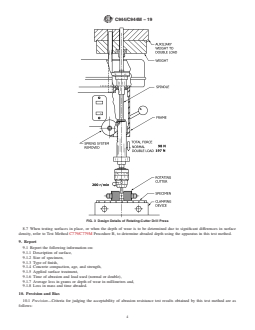
5.1 Abrasion Device—A drill press or similar device with a
Barriers to Trade (TBT) Committee.
chuck capable of holding and rotating the abrading cutter at a
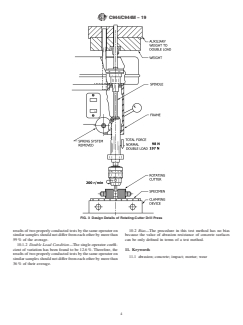
speed of 200 r/min and exerting a force of either a normal load
2. Referenced Documents
of 98 6 1 N [22 6 0.2 lbf] or a double load of 197 6 2 N [44
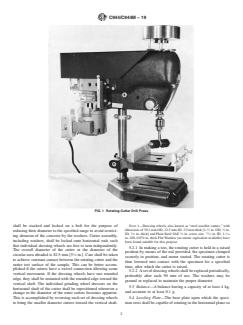
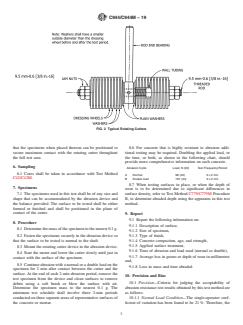
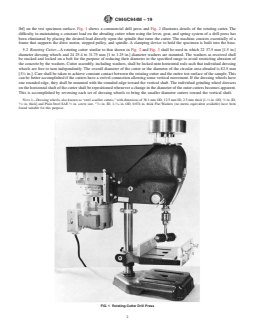
6 0.4 lbf] on the test specimen surface. Fig. 1 shows a
2.1 ASTM Standards:
commercial drill press and Fig. 2 illustrates details of the
C42/C42M Test Method for Obtaining and Testing Drilled
rotating cutter. The difficulty in maintaining a constant load on
Cores and Sawed Beams of Concrete
the abrading cutter when using the lever, gear, and spring
system of a drill press has been eliminated by placing the
desired load directly upon the spindle that turns the cutter. The
This test method is under the jurisdiction of ASTM Committee C09 on
machine consists essentially of a frame that supports the drive
Concrete and Concrete Aggregatesand is the direct responsibility of Subcommittee
C09.62 on Abrasion Testing.
motor, stepped pulley, and spindle. A clamping device to hold
Current edition approved Oct. 1, 2019. Published November 2019. Originally
the specimen is built into the base.
approved in 1980. Last previous edition approved in 2012 as C944/C944M–12.
DOI: 10.1520/C0944_C0944M-19.
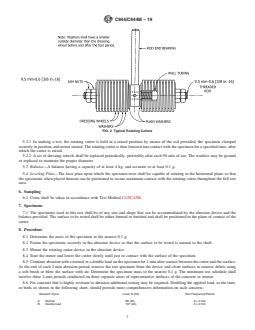
5.2 Rotating Cutter—Arotating cutter similar to that shown
For referenced ASTM standards, visit the ASTM website, www.astm.org, or
in Fig. 2 and Fig. 3 shall be used in which 22 37.5 mm [1.5 in.]
contact ASTM Customer Service at service@astm.org. For Annual Book of ASTM
diameter dressing wheels and 24 25.4 to 31.75 mm [1 to 1.25
Standards volume information, refer to the standard’s Document Summary page on
the ASTM website. in.] diameter washers are mounted. The washers as received
*A Summary of Changes section appears at the end of this standard
Copyright © ASTM International, 100 Barr Harbor Drive, PO Box C700, West Conshohocken, PA 19428-2959. United States
C944/C944M − 19
FIG. 1 Rotating-Cutter Drill Press
NOTE 1—Dressing wheels, also known as “steel scarifier cutters,” with
shall be stacked and locked on a bolt for the purpose of
1 1
dimesions of 38.1 mm OD, 12.5 mm ID, 2.5 mm thick [1- ⁄2 in. OD, ⁄2 in.
reducing their diameter to the specified range to avoid restrict-
3 1 17 1
ID, ⁄32 in. thick] and Plain Steel SAE ⁄2 in. screw size, ⁄32 in. ID, 1- ⁄16
ing abrasion of the concrete by the washers. Cutter assembly,
in. OD, 0.074 in. thick Flat Washers (no metric equivalent available) have
including washers, shall be locked onto horizontal rods such
been found suitable for this purpose.
that individual dressing wheels are free to turn independently.
5.2.1 In making a test, the rotating cutter is held in a raised
The overall diameter of the cutter or the diameter of the
position by means of the rod provided, the specimen clamped
circular area abraded is 82.5 mm [3 ⁄4 in.]. Care shall be taken
securely in position, and motor started. The rotating cutter is
to achieve constant contact between the rotating cutter and the
then lowered into contact with the sp
...
This document is not an ASTM standard and is intended only to provide the user of an ASTM standard an indication of what changes have been made to the previous version. Because
it may not be technically possible to adequately depict all changes accurately, ASTM recommends that users consult prior editions as appropriate. In all cases only the current version
of the standard as published by ASTM is to be considered the official document.
Designation: C944/C944M − 12 C944/C944M − 19
Standard Test Method for
Abrasion Resistance of Concrete or Mortar Surfaces by the
Rotating-Cutter Method
This standard is issued under the fixed designation C944/C944M; the number immediately following the designation indicates the year
of original adoption or, in the case of revision, the year of last revision. A number in parentheses indicates the year of last reapproval.
A superscript epsilon (´) indicates an editorial change since the last revision or reapproval.
1. Scope*
1.1 This test method covers a procedure for determining the resistance of either concrete or mortar to abrasion. This test method
is similar to Procedure B of Test Method C779/C779M.
1.2 The values stated in SI units or inch–pound units are to be regarded separately as standard. The values stated in each system
may not be exact equivalents; therefore, each system shall be used independently of the other. Combining values from the two
systems may result in non–conformancenon-conformance with the standard.
1.3 The text of this standard references notes and footnotes that provide explanatory material. These notes and footnotes
(excluding those in tables and figures) shall not be considered as requirements of this standard.
1.4 This standard does not purport to address all of the safety concerns, if any, associated with its use. It is the responsibility
of the user of this standard to establish appropriate safety safety, health, and healthenvironmental practices and determine the
applicability of regulatory limitations prior to use.
1.5 This international standard was developed in accordance with internationally recognized principles on standardization
established in the Decision on Principles for the Development of International Standards, Guides and Recommendations issued
by the World Trade Organization Technical Barriers to Trade (TBT) Committee.
2. Referenced Documents
2.1 ASTM Standards:
C42/C42M Test Method for Obtaining and Testing Drilled Cores and Sawed Beams of Concrete
C125 Terminology Relating to Concrete and Concrete Aggregates
C418 Test Method for Abrasion Resistance of Concrete by Sandblasting
C779/C779M Test Method for Abrasion Resistance of Horizontal Concrete Surfaces
3. Terminology
3.1 For definitions of terms used in this standard, refer to Terminology C125.
4. Significance and Use
4.1 This test method gives an indication of the relative wear resistance of mortar and concrete based on testing of cored or
fabricated specimens. This test method has been successfully used in the quality control of highway and bridge concrete subject
to traffic. Primarily intended for use on the top ends of 152-mm [6-in.] diameter concrete cores, mortar specimens, or other samples
of concrete of insufficient test area to permit the conduct of tests by Test Method C418 or C779/C779M, this test method is also
applicable on concrete surfaces in place by measuring the abrasion loss as described in Section 10, Procedure B, of Test Method
C779/C779M.
5. Apparatus
5.1 Abrasion Device—A drill press or similar device with a chuck capable of holding and rotating the abrading cutter at a speed
of 200 r/min and exerting a force of either a normal load of 98 6 1 N [22 6 0.2 lbf] or a double load of 197 6 2 N [44 6 0.4
This test method is under the jurisdiction of ASTM Committee C09 on Concrete and Concrete Aggregatesand is the direct responsibility of Subcommittee C09.62 on
Abrasion Testing.
Current edition approved Dec. 1, 2012Oct. 1, 2019. Published December 2012November 2019. Originally approved in 1980. Last previous edition approved in 20052012
ϵ1
as C944 – 99C944/C944M(2005)–12. . DOI: 10.1520/C0944_C0944M-12.10.1520/C0944_C0944M-19.
For referenced ASTM standards, visit the ASTM website, www.astm.org, or contact ASTM Customer Service at service@astm.org. For Annual Book of ASTM Standards
volume information, refer to the standard’s Document Summary page on the ASTM website.
*A Summary of Changes section appears at the end of this standard
Copyright © ASTM International, 100 Barr Harbor Drive, PO Box C700, West Conshohocken, PA 19428-2959. United States
C944/C944M − 19
lbf] on the test specimen surface. Fig. 1 shows a commercial drill press and Fig. 2 illustrates details of the rotating cutter. The
difficulty in maintaining a constant load on the abrading cutter when using the lever, gear, and spring system of a drill press has
been eliminated by placing the desired load directly upon the spindle that turns the cutter. The machine consists essentially of a
frame that supports the drive motor, stepped pulley, and spindle. A clamping device to hold the specimen is built into the base.
5.2 Rotating Cutter—A rotating cutter similar to that shown in Fig. 2 and Fig. 3 shall be used in which 22 37.5 mm [1.5 in.]
diameter dressing wheels and 24 25.4 to 31.75 mm [1 to 1.25 in.] diameter washers are mounted. The washers as received shall
be stacked and locked on a bolt for the purpose of reducing their diameter to the specified range to avoid restricting abrasion of
the concrete by the washers. Cutter assembly, including washers, shall be locked onto horizontal rods such that individual dressing
wheels are free to turn independently. The overall diameter of the cutter or the diameter of the circular area abraded is 82.5 mm
[3 ⁄4 in.]. Care shall be taken to achieve constant contact between the rotating cutter and the entire test surface of the sample. This
can be better accomplished if the cutters have a swivel connection allowing some vertical movement. If the dressing wheels have
one rounded edge, they shall be mounted with the rounded edge toward the vertical shaft. The individual grinding wheel dressers
on the horizontal shaft of the cutter shall be repositioned whenever a change in the diameter of the outer cutters becomes apparent.
This is accomplished by reversing each set of dressing wheels to bring the smaller diameter cutters toward the vertical shaft.
1 1
NOTE 1—Dressing wheels, also
...