

ASTM C490/C490M-21
(Practice)Standard Practice for Use of Apparatus for the Determination of Length Change of Hardened Cement Paste, Mortar, and Concrete
General Information
- Abstract
SIGNIFICANCE AND USE
4.1 This practice is intended to provide standard requirements for apparatus common to many test methods used in connection with cement and concrete and standardized procedures for its use. The detailed requirements as to materials, mixtures, specimens, conditioning of specimens, number of specimens, ages at which measurements are to be made, interpretation of results, and precision and bias are left to be dealt with in specific test methods.
SCOPE
1.1 This practice covers the requirements for the apparatus and equipment used to prepare specimens for the determination of length change in hardened cement paste, mortar, and concrete, the apparatus and equipment used for the determination of these length changes, and the procedures for its use.
1.2 Methods for the preparation and curing of test specimens, conditions of testing and curing, and detailed procedures for calculating and reporting test results are contained in applicable test methods.
1.3 The values stated in either SI units or inch-pound units are to be regarded separately as standard. The values stated in each system may not be exact equivalents; therefore, each system shall be used independently of the other. Combining values from the two systems may result in non-conformance with the standard.
1.4 This international standard was developed in accordance with internationally recognized principles on standardization established in the Decision on Principles for the Development of International Standards, Guides and Recommendations issued by the World Trade Organization Technical Barriers to Trade (TBT) Committee.
- Status
- Published
- Publication Date
- 30-Nov-2021
- Technical Committee
- C01 - Cement
- Drafting Committee
- C01.95 - Coordination of Standards
Buy Documents
ASTM C490/C490M-21 - Standard Practice for Use of Apparatus for the Determination of Length Change of Hardened Cement Paste, Mortar, and Concrete
REDLINE ASTM C490/C490M-21 - Standard Practice for Use of Apparatus for the Determination of Length Change of Hardened Cement Paste, Mortar, and Concrete
Overview
ASTM C490/C490M-21 is the international standard practice that specifies the requirements for apparatus used to determine length change in hardened cement paste, mortar, and concrete. Developed by ASTM International, this standard ensures consistent methods for using critical equipment in laboratories and testing environments. Its guidelines help maintain accuracy and repeatability for testing expansion or shrinkage in cementitious materials, which is vital for quality assurance, research, and compliance in the construction and materials industries.
Key Topics
Apparatus Specifications: Defines criteria for molds, length comparators, reference masses, and reference bars to ensure reliable length change measurements. Equipment must conform to strict tolerances, material requirements (including corrosion resistance), and dimension standards in either SI or inch-pound units.
Standardization of Procedures: Outlines standardized processes for preparing measurement equipment and using it during tests, including cleaning, calibration, and documentation requirements. Emphasizes the use of a reference bar to correct comparator readings and maintain measurement precision.
Dual Measurement Systems: Addresses the use of both SI and inch-pound units, requiring each system to be used independently to avoid conversion errors and non-conformance.
Environmental Controls: Stipulates temperature and humidity requirements for molding, measurement, and storage rooms, in accordance with ASTM C511, to ensure that specimen conditioning and measurement are not adversely influenced by environmental variables.
Calibration and Maintenance: Requires regular checking and documentation of apparatus dimensions and performance to maintain compliance with the standard and guarantee result accuracy.
Applications
ASTM C490/C490M-21 is fundamental for laboratories, manufacturers, and researchers working with hydraulic cements, mortars, and concrete. The standard's procedures and apparatus requirements are applied in:
Quality Control Testing: Ensures that concrete and cementitious products meet specified expansion or shrinkage parameters, which can affect structural integrity and durability.
Research and Development: Supports the assessment of new cementitious materials by providing reliable measurement practices for evaluating dimensional stability over time.
Regulatory Compliance: Establishes standardized practices required for meeting contract specifications and regulatory codes in construction and material supply.
Performance Verification: Used by independent labs to verify manufacturer claims or to settle disputes concerning material properties by referencing established apparatus and procedures.
Related Standards
ASTM C490/C490M-21 references and aligns with several other ASTM standards, enhancing its utility and integration into broader quality systems:
- ASTM C219 – Terminology Relating to Hydraulic and Other Inorganic Cements.
- ASTM C511 – Specification for Mixing Rooms, Moist Cabinets, Moist Rooms, and Water Storage Tanks Used in Testing of Hydraulic Cements and Concretes.
- ASTM C1005 – Specification for Reference Masses and Devices for Determining Mass and Volume for Use in Physical Testing of Hydraulic Cements.
These standards collectively ensure that all factors influencing length change measurement are controlled and standardized for accurate, repeatable results.
Keywords: ASTM C490/C490M, length change, cement paste, mortar, concrete, length change apparatus, molds, comparator, reference bar, testing standards, construction materials, laboratory testing, ASTM standard.
Relations
- Effective Date
- 01-Apr-2024
- Effective Date
- 01-Aug-2020
- Effective Date
- 01-Apr-2020
- Effective Date
- 15-Nov-2019
- Effective Date
- 01-Jun-2019
- Effective Date
- 01-May-2018
- Effective Date
- 15-Mar-2017
- Effective Date
- 01-Jul-2014
- Effective Date
- 01-Dec-2013
- Effective Date
- 01-Aug-2013
- Effective Date
- 15-Jun-2013
- Effective Date
- 01-Dec-2010
- Effective Date
- 01-Jun-2009
- Effective Date
- 01-Dec-2007
- Effective Date
- 01-Feb-2007
Buy Documents
ASTM C490/C490M-21 - Standard Practice for Use of Apparatus for the Determination of Length Change of Hardened Cement Paste, Mortar, and Concrete
REDLINE ASTM C490/C490M-21 - Standard Practice for Use of Apparatus for the Determination of Length Change of Hardened Cement Paste, Mortar, and Concrete
Get Certified
Connect with accredited certification bodies for this standard

DIBt (Deutsches Institut für Bautechnik)
German Institute for Building Technology.
DIN CERTCO
DIN Group product certification.

Aboma Certification B.V.
Specialized in construction, metal, and transport sectors.
Sponsored listings
Frequently Asked Questions
ASTM C490/C490M-21 is a standard published by ASTM International. Its full title is "Standard Practice for Use of Apparatus for the Determination of Length Change of Hardened Cement Paste, Mortar, and Concrete". This standard covers: SIGNIFICANCE AND USE 4.1 This practice is intended to provide standard requirements for apparatus common to many test methods used in connection with cement and concrete and standardized procedures for its use. The detailed requirements as to materials, mixtures, specimens, conditioning of specimens, number of specimens, ages at which measurements are to be made, interpretation of results, and precision and bias are left to be dealt with in specific test methods. SCOPE 1.1 This practice covers the requirements for the apparatus and equipment used to prepare specimens for the determination of length change in hardened cement paste, mortar, and concrete, the apparatus and equipment used for the determination of these length changes, and the procedures for its use. 1.2 Methods for the preparation and curing of test specimens, conditions of testing and curing, and detailed procedures for calculating and reporting test results are contained in applicable test methods. 1.3 The values stated in either SI units or inch-pound units are to be regarded separately as standard. The values stated in each system may not be exact equivalents; therefore, each system shall be used independently of the other. Combining values from the two systems may result in non-conformance with the standard. 1.4 This international standard was developed in accordance with internationally recognized principles on standardization established in the Decision on Principles for the Development of International Standards, Guides and Recommendations issued by the World Trade Organization Technical Barriers to Trade (TBT) Committee.
SIGNIFICANCE AND USE 4.1 This practice is intended to provide standard requirements for apparatus common to many test methods used in connection with cement and concrete and standardized procedures for its use. The detailed requirements as to materials, mixtures, specimens, conditioning of specimens, number of specimens, ages at which measurements are to be made, interpretation of results, and precision and bias are left to be dealt with in specific test methods. SCOPE 1.1 This practice covers the requirements for the apparatus and equipment used to prepare specimens for the determination of length change in hardened cement paste, mortar, and concrete, the apparatus and equipment used for the determination of these length changes, and the procedures for its use. 1.2 Methods for the preparation and curing of test specimens, conditions of testing and curing, and detailed procedures for calculating and reporting test results are contained in applicable test methods. 1.3 The values stated in either SI units or inch-pound units are to be regarded separately as standard. The values stated in each system may not be exact equivalents; therefore, each system shall be used independently of the other. Combining values from the two systems may result in non-conformance with the standard. 1.4 This international standard was developed in accordance with internationally recognized principles on standardization established in the Decision on Principles for the Development of International Standards, Guides and Recommendations issued by the World Trade Organization Technical Barriers to Trade (TBT) Committee.
ASTM C490/C490M-21 is classified under the following ICS (International Classification for Standards) categories: 91.100.10 - Cement. Gypsum. Lime. Mortar; 91.100.30 - Concrete and concrete products. The ICS classification helps identify the subject area and facilitates finding related standards.
ASTM C490/C490M-21 has the following relationships with other standards: It is inter standard links to ASTM C219-24, ASTM C219-20a, ASTM C219-20, ASTM C219-19a, ASTM C219-19, ASTM C1005-18, ASTM C1005-17, ASTM C219-14, ASTM C511-13, ASTM C219-13a, ASTM C219-13, ASTM C1005-10, ASTM C511-09, ASTM C219-07a, ASTM C219-07. Understanding these relationships helps ensure you are using the most current and applicable version of the standard.
ASTM C490/C490M-21 is available in PDF format for immediate download after purchase. The document can be added to your cart and obtained through the secure checkout process. Digital delivery ensures instant access to the complete standard document.
Standards Content (Sample)
This international standard was developed in accordance with internationally recognized principles on standardization established in the Decision on Principles for the
Development of International Standards, Guides and Recommendations issued by the World Trade Organization Technical Barriers to Trade (TBT) Committee.
Designation: C490/C490M − 21
Standard Practice for
Use of Apparatus for the Determination of Length Change of
Hardened Cement Paste, Mortar, and Concrete
This standard is issued under the fixed designation C490/C490M; the number immediately following the designation indicates the year
of original adoption or, in the case of revision, the year of last revision. A number in parentheses indicates the year of last reapproval.
A superscript epsilon (´) indicates an editorial change since the last revision or reapproval.
1. Scope* of Hydraulic Cements
1.1 This practice covers the requirements for the apparatus
3. Terminology
andequipmentusedtopreparespecimensforthedetermination
3.1 Definitions:
of length change in hardened cement paste, mortar, and
3.1.1 For definitions of terms used in this test method, refer
concrete, the apparatus and equipment used for the determina-
to Terminology C219.
tion of these length changes, and the procedures for its use.
1.2 Methods for the preparation and curing of test
4. Significance and Use
specimens, conditions of testing and curing, and detailed
4.1 This practice is intended to provide standard require-
procedures for calculating and reporting test results are con-
ments for apparatus common to many test methods used in
tained in applicable test methods.
connection with cement and concrete and standardized proce-
1.3 The values stated in either SI units or inch-pound units
dures for its use. The detailed requirements as to materials,
are to be regarded separately as standard. The values stated in
mixtures, specimens, conditioning of specimens, number of
each system may not be exact equivalents; therefore, each
specimens, ages at which measurements are to be made,
system shall be used independently of the other. Combining
interpretation of results, and precision and bias are left to be
values from the two systems may result in non-conformance
dealt with in specific test methods.
with the standard.
5. Apparatus
1.4 This international standard was developed in accor-
dance with internationally recognized principles on standard-
5.1 Reference Masses and Devices for Determining Mass
ization established in the Decision on Principles for the
and Volume, shall conform to the requirements of Specification
Development of International Standards, Guides and Recom-
C1005.
mendations issued by the World Trade Organization Technical
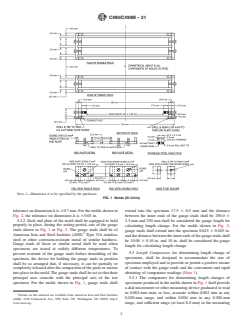
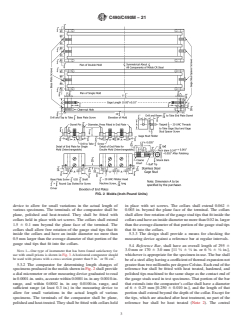
5.2 Molds, shall have either one or two compartments and
Barriers to Trade (TBT) Committee.
shall be constructed as shown in Fig. 1 or Fig. 2. Molds for test
specimens used in determining the length change of cement
2. Referenced Documents
pastes and mortars shall provide for 25 by 25 by 285-mm
2.1 ASTM Standards:
prismshavinga250-mmgaugelength,orfor1by1by11 ⁄4-in.
C219 Terminology Relating to Hydraulic and Other Inor-
prisms having a 10–in. gauge length. Molds for test specimens
ganic Cements
used in the length change of concretes shall provide for prisms
C511 Specification for Mixing Rooms, Moist Cabinets,
of the desired cross section having a 10-in. or 250-mm gauge
Moist Rooms, and Water Storage Tanks Used in the
length. In some routine tests, 25 by 25 by 160-mm specimens
Testing of Hydraulic Cements and Concretes
with a gauge length of 125 mm, or 1 by 1 by 6 ⁄4-in. specimens
C1005 Specification for Reference Masses and Devices for
with a gauge length of 5-in. are permitted, but in case of
DeterminingMassandVolumeforUseinPhysicalTesting
dispute, results obtained with specimens of 250-mm [10-in.]
gauge length shall govern.
5.2.1 The gauge length shall be considered as the nominal
This practice is under the jurisdiction ofASTM Committee C01 on Cement and
length between the innermost ends of the gauge studs. The
is the direct responsibility of Subcommittee C01.95 on Coordination of Standards.
parts of the molds shall be tight fitting and firmly held together
Current edition approved Dec. 1, 2021. Published December 2021. Originally
when assembled, and their surfaces shall be smooth and free of
approved in 1962. Last previous edition approved in 2017 as C490/C490M – 17.
DOI: 10.1520/C0490_C0490M-21.
pits. The molds shall be made of steel or other hard metal not
For referenced ASTM standards, visit the ASTM website, www.astm.org, or
readily attacked by the cement paste, mortar, or concrete. The
contact ASTM Customer Service at service@astm.org. For Annual Book of ASTM
sides of the molds shall be sufficiently rigid to prevent
Standards volume information, refer to the standard’s Document Summary page on
the ASTM website. spreading or warping. For the molds shown in Fig. 1, the
*A Summary of Changes section appears at the end of this standard
Copyright © ASTM International, 100 Barr Harbor Drive, PO Box C700, West Conshohocken, PA 19428-2959. United States
C490/C490M − 21
NOTE 1—Dimension A to be specified by the purchaser.
FIG. 1 Molds (SI Units)
tolerance on dimensionAis 60.7 mm. For the molds shown in extend into the specimen 17.5 6 0.5 mm and the distance
Fig. 2, the tolerance on dimension A is 60.03 in. between the inner ends of the gauge studs shall be 250.0 6
5.2.2 Each end plate of the mold shall be equipped to hold
2.5 mm and 250 mm shall be considered the gauge length for
properly in place, during the setting period, one of the gauge
calculating length change. For the molds shown in Fig. 2,
studs shown in Fig. 1 or Fig. 2. The gauge studs shall be of
gauge studs shall extend into the specimen 0.625 6 0.025 in.
American Iron and Steel Institute (AISI) Type 316 stainless
andthedistancebetweentheinnerendsofthegaugestudsshall
steel or other corrosion-resistant metal of similar hardness.
be 10.00 6 0.10 in. and 10 in. shall be considered the gauge
Gauge studs of Invar or similar metal shall be used when
length for calculating length change.
specimens are tested at widely different temperatures. To
5.3 Length Comparator, for determining length change of
prevent restraint of the gauge studs before demolding of the
specimens, shall be designed to accommodate the size of
specimen, the device for holding the gauge studs in position
specimen employed and to provide or permit a positive means
shall be so arranged that, if necessary, it can be partially or
of contact with the gauge studs and the convenient and rapid
completely released after the compaction of the paste or mortar
obtaining of comparator readings (Note 1).
into place in the mold.The gauge studs shall be set so that their
principal axes coincide with the principal axis of the test
5.3.1 The comparator for determining length changes of
specimen. For the molds shown in Fig. 1, gauge studs shall
specimens produced in the molds shown in Fig. 1 shall provide
a dial micrometer or other measuring device graduated to read
in 0.002-mm units or less, accurate within 0.002 mm in any
Details on this material are available from American Iron and Steel Institute
0.020-mm range, and within 0.004 mm in any 0.200-mm
(AISI), 1140 Connecticut Ave., NW, Suite 705, Washington, DC 20036, http://
www.steel.org. range, and sufficient range (at least 8.0 mm) in the measuring
C490/C490M − 21
FIG. 2 Molds (Inch-Pound Units)
device to allow for small variations in the actual length of in place with set screws. The collars shall extend 0.062 6
various specimens. The terminals of the comparator shall be 0.003 in. beyond the plane face of the terminal. The collars
plane, polished and heat-treated. They shall be fitted with shall allow free rotation of the gauge stud tips that fit inside the
collars held in place with set screws. The collars shall extend collarsandhaveaninsidediameternomorethan0.02in.larger
1.5 6 0.1 mm beyond the plane face of the terminal. The than the average diameter of that portion of the gauge stud tips
collars shall allow free rotation of the gauge stud tips that fit that fit into the collars.
inside the collars and have an inside diameter no more than 5.3.3 The design shall provide a means for checking the
0.5 mm larger than the average diameter of that portion of the measuring device against a reference bar at regular intervals.
gauge stud tips that fit into the collars.
5.4 Reference Bar, shall have an overall length of 295 6
5 1 5 1
3.0 mm or 170 6 3.0 mm [11 ⁄8 6 ⁄8 in. or 6 ⁄8 6 ⁄8 in.],
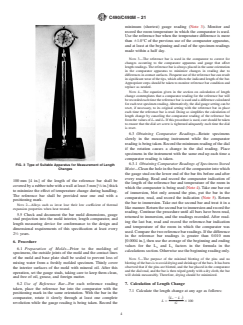
NOTE 1—One type of instrument that has been found satisfactory for
use with small prisms is shown in Fig. 3.Ahorizontal comparator should
whichever is appropriate for the specimen in use. The bar shall
2 2
be used with prisms with a cross section greater than 9 in. or 58 cm .
be of a steel alloy having a coefficient of thermal expansion not
5.3.2 The comparator for determining length changes of greater than two mi
...
This document is not an ASTM standard and is intended only to provide the user of an ASTM standard an indication of what changes have been made to the previous version. Because
it may not be technically possible to adequately depict all changes accurately, ASTM recommends that users consult prior editions as appropriate. In all cases only the current version
of the standard as published by ASTM is to be considered the official document.
Designation: C490/C490M − 17 C490/C490M − 21
Standard Practice for
Use of Apparatus for the Determination of Length Change of
Hardened Cement Paste, Mortar, and Concrete
This standard is issued under the fixed designation C490/C490M; the number immediately following the designation indicates the year
of original adoption or, in the case of revision, the year of last revision. A number in parentheses indicates the year of last reapproval.
A superscript epsilon (´) indicates an editorial change since the last revision or reapproval.
1. Scope*
1.1 This practice covers the requirements for the apparatus and equipment used to prepare specimens for the determination of
length change in hardened cement paste, mortar, and concrete, the apparatus and equipment used for the determination of these
length changes, and the procedures for its use.
1.2 Methods for the preparation and curing of test specimens, conditions of testing and curing, and detailed procedures for
calculating and reporting test results are contained in applicable test methods.
1.3 The values stated in either SI units or inch-pound units are to be regarded separately as standard. The values stated in each
system may not be exact equivalents; therefore, each system shall be used independently of the other. Combining values from the
two systems may result in non-conformance with the standard.
1.4 This international standard was developed in accordance with internationally recognized principles on standardization
established in the Decision on Principles for the Development of International Standards, Guides and Recommendations issued
by the World Trade Organization Technical Barriers to Trade (TBT) Committee.
2. Referenced Documents
2.1 ASTM Standards:
C219 Terminology Relating to Hydraulic and Other Inorganic Cements
C511 Specification for Mixing Rooms, Moist Cabinets, Moist Rooms, and Water Storage Tanks Used in the Testing of Hydraulic
Cements and Concretes
C1005 Specification for Reference Masses and Devices for Determining Mass and Volume for Use in Physical Testing of
Hydraulic Cements
3. Terminology
3.1 Definitions:
3.1.1 For definitions of terms used in this test method, refer to Terminology C219.
This practice is under the jurisdiction of ASTM Committee C01 on Cement and is the direct responsibility of Subcommittee C01.95 on Coordination of Standards.
Current edition approved March 15, 2017Dec. 1, 2021. Published March 2017December 2021. Originally approved in 1962. Last previous edition approved in 20112017
ε1
as C490/C490M – 11C490/C490M – 17. . DOI: 10.1520/C0490_C0490M-17.10.1520/C0490_C0490M-21.
For referenced ASTM standards, visit the ASTM website, www.astm.org, or contact ASTM Customer Service at service@astm.org. For Annual Book of ASTM Standards
volume information, refer to the standard’s Document Summary page on the ASTM website.
*A Summary of Changes section appears at the end of this standard
Copyright © ASTM International, 100 Barr Harbor Drive, PO Box C700, West Conshohocken, PA 19428-2959. United States
C490/C490M − 21
4. Significance and Use
4.1 This practice is intended to provide standard requirements for apparatus common to many test methods used in connection
with cement and concrete and standardized procedures for its use. The detailed requirements as to materials, mixtures, specimens,
conditioning of specimens, number of specimens, ages at which measurements are to be made, interpretation of results, and
precision and bias are left to be dealt with in specific test methods.
5. Apparatus
5.1 Reference Masses and Devices for Determining Mass and Volume, shall conform to the requirements of Specification C1005.
5.2 Molds, shall have either one or two compartments and shall be constructed as shown in Fig. 1 or Fig. 2. Molds for test
specimens used in determining the length change of cement pastes and mortars shall provide for 25 by 25 by 285-mm prisms
having a 250-mm gauge length, or for 1 by 1 by 11 ⁄4-in. prisms having a 10–in. gauge length. Molds for test specimens used in
the length change of concretes shall provide for prisms of the desired cross section having a 10-in. or 250-mm gauge length. In
some routine tests, 25 by 25 by 160-mm specimens with a gauge length of 125 mm, or 1 by 1 by 6 ⁄4-in. specimens with a gauge
length of 5-in. are permitted, but in case of dispute, results obtained with specimens of 250-mm [10-in.] gauge length shall govern.
5.2.1 The gauge length shall be considered as the nominal length between the innermost ends of the gauge studs. The parts of the
molds shall be tight fitting and firmly held together when assembled, and their surfaces shall be smooth and free of pits. The molds
NOTE 1—Dimension A to be specified by the purchaser.
FIG. 1 Molds (SI Units)
C490/C490M − 21
FIG. 2 Molds (Inch-Pound Units)
shall be made of steel or other hard metal not readily attacked by the cement paste, mortar, or concrete. The sides of the molds
shall be sufficiently rigid to prevent spreading or warping. For the molds shown in Fig. 1, the tolerance on dimension A is 60.7
mm. For the molds shown in Fig. 2, the tolerance on dimension A is 60.03 in.
5.2.2 Each end plate of the mold shall be equipped to hold properly in place, during the setting period, one of the gauge studs
shown in Fig. 1 or Fig. 2. The gauge studs shall be of American Iron and Steel Institute (AISI) Type 316 stainless steel or other
corrosion-resistant metal of similar hardness. Gauge studs of Invar or similar metal shall be used when specimens are tested at
widely different temperatures. To prevent restraint of the gauge studs before demolding of the specimen, the device for holding
the gauge studs in position shall be so arranged that, if necessary, it can be partially or completely released after the compaction
of the paste or mortar into place in the mold. The gauge studs shall be set so that their principal axes coincide with the principal
axis of the test specimen. For the molds shown in Fig. 1, gauge studs shall extend into the specimen 17.5 6 0.5 mm and the
distance between the inner ends of the gauge studs shall be 250.0 6 2.5 mm and 250 mm shall be considered the gauge length
for calculating length change. For the molds shown in Fig. 2, gauge studs shall extend into the specimen 0.625 6 0.025 in. and
the distance between the inner ends of the gauge studs shall be 10.00 6 0.10 in. and 10 in. shall be considered the gauge length
for calculating length change.
5.3 Length Comparator, for determining length change of specimens, shall be designed to accommodate the size of specimen
employed and to provide or permit a positive means of contact with the gauge studs and the convenient and rapid obtaining of
comparator readings (Note 1).
Details on this material are available from American Iron and Steel Institute (AISI), 1140 Connecticut Ave., NW, Suite 705, Washington, DC 20036, http://www.steel.org.
C490/C490M − 21
5.3.1 The comparator for determining length changes of specimens produced in the molds shown in Fig. 1 shall provide a dial
micrometer or other measuring device graduated to read in 0.002-mm units or less, accurate within 0.002 mm in any 0.020-mm
range, and within 0.004 mm in any 0.200-mm range, and sufficient range (at least 8.0 mm) in the measuring device to allow for
small variations in the actual length of various specimens. The terminals of the comparator shall be plane, polished and
heat-treated. They shall be fitted with collars held in place with set screws. The collars shall extend 1.5 6 0.1 mm beyond the plane
face of the terminal. The collars shall allow free rotation of the gauge stud tips that fit inside the collars and have an inside diameter
no more than 0.5 mm larger than the average diameter of that portion of the gauge stud tips that fit into the collars.
NOTE 1—One type of instrument that has been found satisfactory for use with small prisms is shown in Fig. 3. A horizontal comparator should be used
2 2
with prisms with a cross section greater than 9 in. or 58 cm .
5.3.2 The comparator for determining length changes of specimens produced in the molds shown in Fig. 2 shall provide a dial
micrometer or other measuring device graduated to read in 0.0001-in. units, accurate within 0.0001 in. in any 0.0010-in. range,
and within 0.0002 in. in any 0.0100-in. range, and sufficient range (at least 0.3 in.) in the measuring device to allow for small
variations in the actual length of various specimens. The terminals of the comparator shall be plane, polished and heat-treated. They
shall be fitted with collars held in place with set screws. The collars shall extend 0.062 6 0.003 in. beyond the plane face of the
terminal. The collars shall allow free rotation of the gauge stud tips that fit inside the collars and have an inside diameter no more
than 0.02 in. larger than the average diameter of that p
...