

EN ISO 21611:2026
(Main)Dentistry - Vocabulary for source conclusion for human identification by dental evidence (ISO 21611:2026)
- Abstract
This document defines the terms for the forensic reporting on human identification by dental evidence.
- Status
- Not Published
- Publication Date
- 24-Nov-2026
- Technical Committee
- CEN/TC 55 - Dentistry
- Drafting Committee
- CEN/TC 55 - Dentistry
- Current Stage
- 6055 - CEN Ratification completed (DOR) - Publishing
- Start Date
- 28-Nov-2025
- Due Date
- 04-Jul-2027
- Completion Date
- 04-Jul-2027

EN ISO 21611:2026 is a European standard from the European Committee for Standardization (CEN) that gives vocabulary for source conclusion in human identification by dental evidence. It specifies the terms used in forensic reporting so dental examiners, forensic odontologists and legal users can describe comparisons and conclusions in a common language.
What does EN ISO 21611:2026 specify?
EN ISO 21611:2026 specifies the terms used for forensic reporting on human identification by dental evidence. In practice, it is a terminology document: it sets the language for describing what was compared, what matched, what differed, and what kind of source conclusion was reached.
The document is organized into a short structure:
- Foreword
- Introduction
- Clause 1 Scope
- Clause 2 Normative references
- Clause 3 Terms and definitions
Clause 3 is the main technical part. It lists the vocabulary for comparison, discrepancy handling, and the qualitative conclusions that can be reported from dental evidence.
What are the key requirements of EN ISO 21611:2026?
EN ISO 21611:2026 is mainly about using the same words and conclusion categories in forensic odontology. The practical effect is that reports can be read and interpreted more consistently across laboratories, legal systems and expert witnesses.
The scope is limited to reporting terminology
Clause 1 says the document defines terms for forensic reporting on human identification by dental evidence. That means the standard is about language and interpretation, not about a test method or a scoring system.
The document is self-contained
Clause 2 states that there are no normative references. In practice, users do not need another standard from this document in order to understand the vocabulary it defines.
“Source” and concordance terms are central
Clause 3.1 defines source as the comprehensive collection of an individual's dental data used for identification. Clauses 3.2 to 3.5 then define concordant feature, unique concordant characteristic, concordant characteristic and concordant tooth. This matters because the report has to say what kind of dental agreement was observed, not just that something “matched”.
No fixed minimum number of matching points is required
Clause 3.2 includes a note stating that comparing dental features does not require any specific number or minimum number of concordant points to conclude identification established. That matters because the conclusion depends on the overall quality and distinctiveness of the agreement, not a fixed count.
Discrepancies are separated into explainable and unexplainable
Clauses 3.7 and 3.8 distinguish explainable discrepancy from unexplainable discrepancy. This distinction matters in practice because a difference may be acceptable if it can be reasonably explained by known factors, but an unexplainable difference can prevent a source conclusion.
Contextual evidence can support the conclusion
Clause 3.6 defines contextual evidence as information from the setting of an event or object that helps source conclusion. In practice, this allows the examiner to consider surrounding facts alongside the dental comparison.
The document standardizes qualitative conclusion categories
Clause 3.9 gives the conclusion language: lack of evidentiary quality for comparison, identification established, identity not excluded, identity probable, identity possible, inconclusive, and identity excluded. These categories are the part most likely to appear in reports, expert opinions and case records.
What terms does EN ISO 21611:2026 define?
EN ISO 21611:2026 defines the vocabulary used to describe dental comparison findings and source conclusions. Key terms include:
- Source - the complete set of an individual's dental data used for identification.
- Concordant feature - a unique oro-dental feature that can support identification.
- Concordant tooth - a tooth or representation that matches another and has no unexplained discrepancies.
- Contextual evidence - information from the case context that helps the source conclusion.
- Explainable discrepancy - a difference that can be justified by known factors.
- Unexplainable discrepancy - a difference that cannot be justified.
- Identification established - a qualitative conclusion that the two sources originate from the same source.
- Identity excluded - a conclusion that unexplainable discrepancies rule out the same source.
Who uses EN ISO 21611:2026?
EN ISO 21611:2026 is intended for people who prepare, review or use forensic dental identification reports. The introduction makes clear that it serves forensic odontology and the reporting of conclusions across legal authorities.
Typical users include:
- forensic odontologists
- dental experts involved in human identification
- forensic laboratories
- legal authorities that rely on expert reports
- standards writers and terminology managers in dentistry
For these users, the standard provides a common reporting language, which helps avoid ambiguity when conclusions are reviewed in court, in case files or in professional consultation.
Which standards are used with EN ISO 21611:2026?
EN ISO 21611:2026 has no normative references. Clause 2 makes the terminology self-contained.
The foreword also cites the ISO/IEC Directives, Part 1 and Part 2 as the procedures and editorial rules used to develop and write the document. It also points readers to the ISO Online browsing platform and IEC Electropedia for terminology databases.
What does the EN ISO 21611:2026 document contain?
EN ISO 21611:2026 contains a short vocabulary set rather than methods, equations or test procedures. Clause 3 gives the defined terms and the conclusion categories used in forensic dental reporting.
The terms cover the main elements of a dental comparison: the source, concordant features, concordant teeth, contextual evidence, and the treatment of discrepancies. The conclusion section then sets out the qualitative outcomes that can be reported, including identification established, identity not excluded, inconclusive and identity excluded.
The notes attached to the terms are important in practice because they explain how to interpret agreement and discrepancy without using a fixed numerical threshold. This makes the standard useful for drafting reports and for reading expert conclusions consistently.
Relations
- Consolidated By
ISO 21611:2026 - Dentistry — Vocabulary for source conclusion for human identification by dental evidence - Effective Date
- 12-Feb-2026
Get Certified
Connect with accredited certification bodies for this standard

BSI Group
BSI (British Standards Institution) is the business standards company that helps organizations make excellence a habit.

TÜV Rheinland
TÜV Rheinland is a leading international provider of technical services.

TÜV SÜD
TÜV SÜD is a trusted partner of choice for safety, security and sustainability solutions.
Sponsored listings
Frequently Asked Questions
EN ISO 21611:2026 is a draft published by the European Committee for Standardization (CEN). Its full title is "Dentistry - Vocabulary for source conclusion for human identification by dental evidence (ISO 21611:2026)". This standard covers: This document defines the terms for the forensic reporting on human identification by dental evidence.
This document defines the terms for the forensic reporting on human identification by dental evidence.
EN ISO 21611:2026 is classified under the following ICS (International Classification for Standards) categories: 01.040.11 - Health care technology (Vocabularies); 11.060.01 - Dentistry in general. The ICS classification helps identify the subject area and facilitates finding related standards.
EN ISO 21611:2026 has the following relationships with other standards: It is inter standard links to ISO 21611:2026. Understanding these relationships helps ensure you are using the most current and applicable version of the standard.
EN ISO 21611:2026 is available in PDF format for immediate download after purchase. The document can be added to your cart and obtained through the secure checkout process. Digital delivery ensures instant access to the complete standard document.
Standards Content (Sample)
Contents
- Introduction
- 1 Scope
- 2 Normative references
- 3 Terms and definitions
- 3.1 source
- 3.2 concordant feature
- 3.3 unique concordant characteristic
- 3.4 concordant characteristic
- 3.5 concordant tooth
- 3.6 contextual evidence
- 3.7 explainable discrepancy
- 3.8 unexplainable discrepancy
- 3.9.1 lack of evidentiary quality for comparison
- 3.9.2 identification established
- 3.9.3 identity not excluded
- 3.9.3.1 identity probable
- 3.9.3.2 identity possible
- 3.9.4 inconclusive
- 3.9.5 identity excluded
Introduction
Forensic odontology holds an indispensable role in the identification of human individuals. Dental data serves as one of the primary identifiers and therefore assumes a position of paramount importance in the human identification process.
Despite national and international organizations attempting to define the degree of certainty regarding the level of agreement, there is still no universally accepted standard terminology. Therefore, this document aims to present precise and accurate vocabulary and source conclusions for human identification through dental evidence.
To ensure consistent and reliable identification and analysis of dental evidence, it is crucial to establish a standard for the qualitative expression of source conclusions in forensic odontology. This standard will provide a common language for the analysis, interpretation, and reporting of forensic data, enabling forensic odontologists to express their findings in a standardized manner that can be understood and applied across various legal authorities.
oSIST prEN ISO 21611:2025
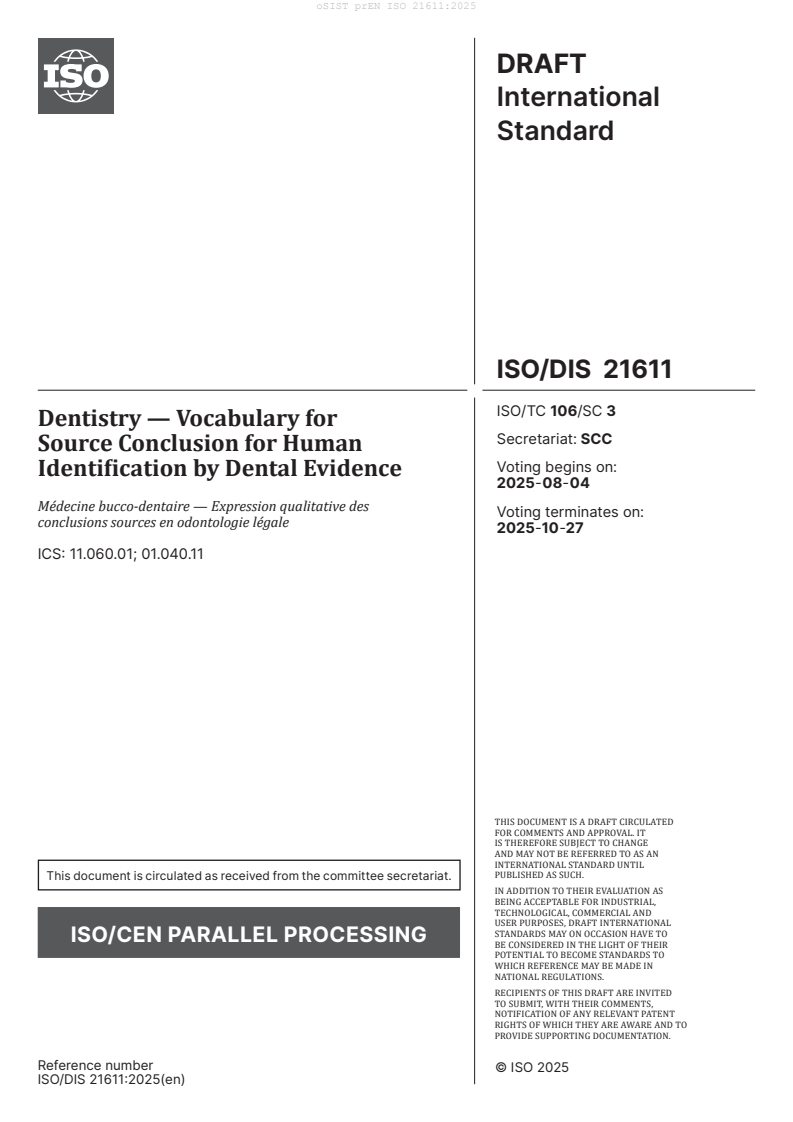
oSIST prEN ISO 21611:2025 DRAFT International Standard ISO/DIS 21611:2025(en) Dentistry — Vocabulary for Source Conclusion for Human Identification by Dental Evidence
1 Scope
This document defines the terms for the forensic reporting on human identification by dental evidence
2 Normative references
There are no normative references in this document.
3 Terms and definitions
For the purposes of this document, the following terms and definitions apply. ISO and IEC maintain terminology databases for use in standardization at the following addresses:
- ISO Online browsing platform: available at https:// www .iso .org/ obp
- IEC Electropedia: available at https:// www .electropedia .org
...