

EN 3677:2025
(Main)Aerospace series - Steel X5CrNiCu17-4 (1.4542) - Air melted - Solution treated and precipitation treated - Forgings - a or D ≤ 200 mm - Rm ≥ 1 310 MPa
- Abstract
This document specifies the requirements relating to:
Steel X5CrNiCu17-4 (1.4542)
Air melted
Solution treated and precipitation treated
Forgings
a or D ≤ 200 mm
Rm ≥ 1 310 MPa
for aerospace applications.
W.nr: 1.4542.
ASD-STAN: FE-PM3801.
- Status
- Published
- Publication Date
- 02-Dec-2025
- Technical Committee
- ASD-STAN - Aerospace
- Drafting Committee
- ASD-STAN/D 4/S 3 - Steels & Heat Resisting Alloys
- Current Stage
- 6060 - Definitive text made available (DAV) - Publishing
- Start Date
- 03-Dec-2025
- Completion Date
- 03-Dec-2025

Overview
EN 3677:2025 is a European standard developed by CEN that specifies requirements for steel forgings made from X5CrNiCu17-4 (1.4542), also known as 17-4 PH stainless steel. This document details the material characteristics and processing for air melted, solution treated, and precipitation treated forgings, with a maximum dimension (a or D) of up to 200 mm and a minimum tensile strength (Rm) of 1,310 MPa. It is specifically tailored for aerospace applications requiring high strength, corrosion resistance, and reliability in demanding environments.
This standard supersedes EN 3677:2007, integrating updated references and technical requirements to maintain compatibility with related aerospace material standards.
Key Topics
- Material Grades: Defines the use of X5CrNiCu17-4 (1.4542), a high-performance stainless steel recognized for its excellent mechanical properties and corrosion resistance.
- Manufacturing Process: Specifies air melting, along with solution and precipitation heat treatment processes to achieve desired structural and mechanical properties.
- Product Form and Dimensions: Applies exclusively to forgings with a maximum cross-section or diameter (a or D) of 200 mm or less, ensuring consistency for aerospace component production.
- Mechanical Properties: Sets requirements for minimum tensile strength (Rm ≥ 1,310 MPa), proof stress, elongation, reduction of area, and hardness, ensuring stringent quality for aerospace use.
- Testing and Inspection: References applicable European standards for microstructure, ultrasonic inspection, inclusion content, visual and dimensional inspection, reinforcing product quality and traceability through standardized methods.
- Heat Treatment: Specifies the precise conditions for solution annealing and precipitation hardening to impart the material with its critical mechanical performance.
- Marking and Traceability: Ensures all forgings are correctly marked and inspected per EN 4700-006 for full traceability in the aerospace supply chain.
Applications
EN 3677:2025 is primarily intended for the aerospace industry, where materials must withstand extreme operating conditions while maintaining safety and performance. Typical applications include:
- Aircraft Structural Components: Forged shafts, hubs, brackets, and landing gear parts, where strength and corrosion resistance are essential.
- Rotating and Static Aircraft Parts: Engine and mechanical assemblies requiring high fatigue strength.
- Spacecraft Hardware: Components exposed to variable temperatures and corrosive environments.
- Defense and Advanced Engineering: Can be referenced for demanding precision mechanical parts outside traditional aerospace, leveraging the proven reliability of 17-4 PH forgings.
By adhering to EN 3677:2025, manufacturers and suppliers ensure compatibility, performance, and regulatory compliance in critical aerospace supply chains.
Related Standards
For effective use and compliance, EN 3677:2025 cites or aligns with the following key standards:
- EN 2951: Details the micrographic determination of non-metallic inclusions in metallic materials, essential for material cleanliness and quality.
- EN 3163: Specifies requirements for softened forging stock of the same steel grade, covering pre-forging stages.
- EN 4050-4: Details ultrasonic testing and acceptance criteria for forgings and raw stock, vital for structural integrity.
- EN 4700-006: Covers technical specifications for pre-production and production forgings of steel and heat resisting alloys.
- EN 4258: Outlines the organization and application of metallic materials standards in aerospace.
- EN 4500-005: Provides rules for drafting and presentation of material standards, ensuring consistency across steel standards.
Manufacturers and engineers referencing EN 3677:2025 benefit from harmonized procedures and globally recognized benchmarks for quality and reliability in aerospace forgings.
Relations
- Effective Date
- 19-Jan-2023
- Effective Date
- 28-Jan-2026
- Effective Date
- 28-Jan-2026
- Effective Date
- 28-Jan-2026
- Effective Date
- 28-Jan-2026
- Effective Date
- 28-Jan-2026
Get Certified
Connect with accredited certification bodies for this standard

BUREAU VERITAS Certification Germany
Bureau Veritas certification in Germany.

Element Materials Technology
Materials testing and product certification.

AQMS Ltd.
AQMS provides ISO certification to SMEs across the UK.
Sponsored listings
Frequently Asked Questions
EN 3677:2025 is a standard published by the European Committee for Standardization (CEN). Its full title is "Aerospace series - Steel X5CrNiCu17-4 (1.4542) - Air melted - Solution treated and precipitation treated - Forgings - a or D ≤ 200 mm - Rm ≥ 1 310 MPa". This standard covers: This document specifies the requirements relating to: Steel X5CrNiCu17-4 (1.4542) Air melted Solution treated and precipitation treated Forgings a or D ≤ 200 mm Rm ≥ 1 310 MPa for aerospace applications. W.nr: 1.4542. ASD-STAN: FE-PM3801.
This document specifies the requirements relating to: Steel X5CrNiCu17-4 (1.4542) Air melted Solution treated and precipitation treated Forgings a or D ≤ 200 mm Rm ≥ 1 310 MPa for aerospace applications. W.nr: 1.4542. ASD-STAN: FE-PM3801.
EN 3677:2025 is classified under the following ICS (International Classification for Standards) categories: 49.025.10 - Steels. The ICS classification helps identify the subject area and facilitates finding related standards.
EN 3677:2025 has the following relationships with other standards: It is inter standard links to EN 3677:2007, EN 3163:2025, EN 4700-006:2025, EN 4050-4:2012, EN 2951:2019, EN 4632-004:2012. Understanding these relationships helps ensure you are using the most current and applicable version of the standard.
EN 3677:2025 is available in PDF format for immediate download after purchase. The document can be added to your cart and obtained through the secure checkout process. Digital delivery ensures instant access to the complete standard document.
Standards Content (Sample)
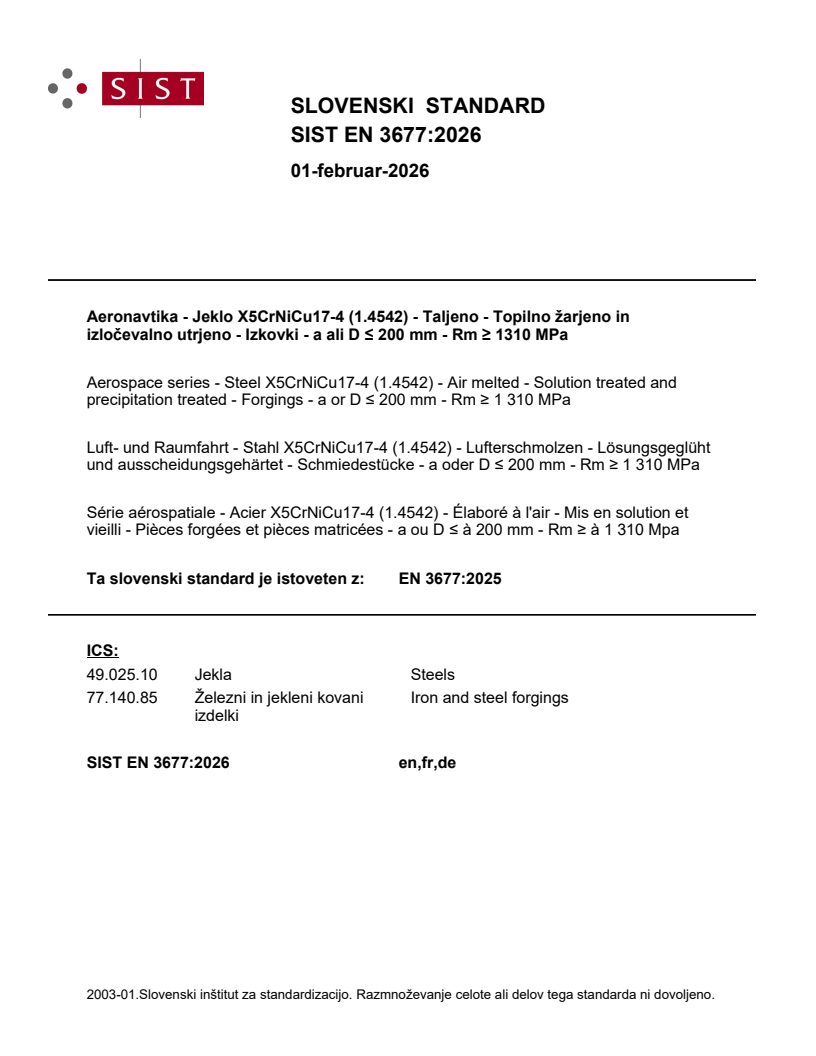
SLOVENSKI STANDARD
01-februar-2026
Aeronavtika - Jeklo X5CrNiCu17-4 (1.4542) - Taljeno - Topilno žarjeno in
izločevalno utrjeno - Izkovki - a ali D ≤ 200 mm - Rm ≥ 1310 MPa
Aerospace series - Steel X5CrNiCu17-4 (1.4542) - Air melted - Solution treated and
precipitation treated - Forgings - a or D ≤ 200 mm - Rm ≥ 1 310 MPa
Luft- und Raumfahrt - Stahl X5CrNiCu17-4 (1.4542) - Lufterschmolzen - Lösungsgeglüht
und ausscheidungsgehärtet - Schmiedestücke - a oder D ≤ 200 mm - Rm ≥ 1 310 MPa
Série aérospatiale - Acier X5CrNiCu17-4 (1.4542) - Élaboré à l'air - Mis en solution et
vieilli - Pièces forgées et pièces matricées - a ou D ≤ à 200 mm - Rm ≥ à 1 310 Mpa
Ta slovenski standard je istoveten z: EN 3677:2025
ICS:
49.025.10 Jekla Steels
77.140.85 Železni in jekleni kovani Iron and steel forgings
izdelki
2003-01.Slovenski inštitut za standardizacijo. Razmnoževanje celote ali delov tega standarda ni dovoljeno.
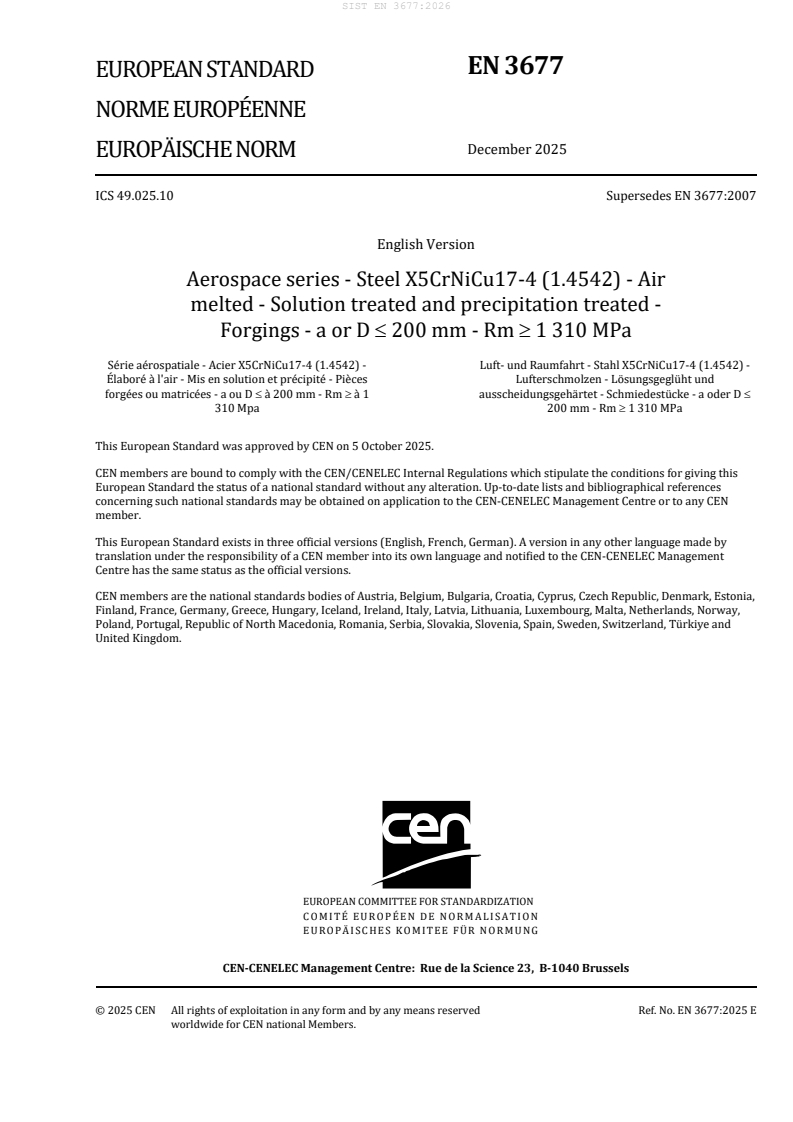
EN 3677
EUROPEAN STANDARD
NORME EUROPÉENNE
December 2025
EUROPÄISCHE NORM
ICS 49.025.10 Supersedes EN 3677:2007
English Version
Aerospace series - Steel X5CrNiCu17-4 (1.4542) - Air
melted - Solution treated and precipitation treated -
Forgings - a or D 200 mm - Rm 1 310 MPa
Série aérospatiale - Acier X5CrNiCu17-4 (1.4542) - Luft- und Raumfahrt - Stahl X5CrNiCu17-4 (1.4542) -
Élaboré à l'air - Mis en solution et précipité - Pièces Lufterschmolzen - Lösungsgeglüht und
forgées ou matricées - a ou D à 200 mm - Rm à 1 ausscheidungsgehärtet - Schmiedestücke - a oder D
310 Mpa
200 mm - Rm 1 310 MPa
This European Standard was approved by CEN on 5 October 2025.
CEN members are bound to comply with the CEN/CENELEC Internal Regulations which stipulate the conditions for giving this
European Standard the status of a national standard without any alteration. Up-to-date lists and bibliographical references
concerning such national standards may be obtained on application to the CEN-CENELEC Management Centre or to any CEN
member.
This European Standard exists in three official versions (English, French, German). A version in any other language made by
translation under the responsibility of a CEN member into its own language and notified to the CEN-CENELEC Management
Centre has the same status as the official versions.
CEN members are the national standards bodies of Austria, Belgium, Bulgaria, Croatia, Cyprus, Czech Republic, Denmark, Estonia,
Finland, France, Germany, Greece, Hungary, Iceland, Ireland, Italy, Latvia, Lithuania, Luxembourg, Malta, Netherlands, Norway,
Poland, Portugal, Republic of North Macedonia, Romania, Serbia, Slovakia, Slovenia, Spain, Sweden, Switzerland, Türkiye and
United Kingdom.
EUROPEAN COMMITTEE FOR STANDARDIZATION
COMITÉ EUROPÉEN DE NORMALISATION
EUROPÄISCHES KOMITEE FÜR NORMUNG
CEN-CENELEC Management Centre: Rue de la Science 23, B-1040 Brussels
© 2025 CEN All rights of exploitation in any form and by any means reserved Ref. No. EN 3677:2025 E
worldwide for CEN national Members.
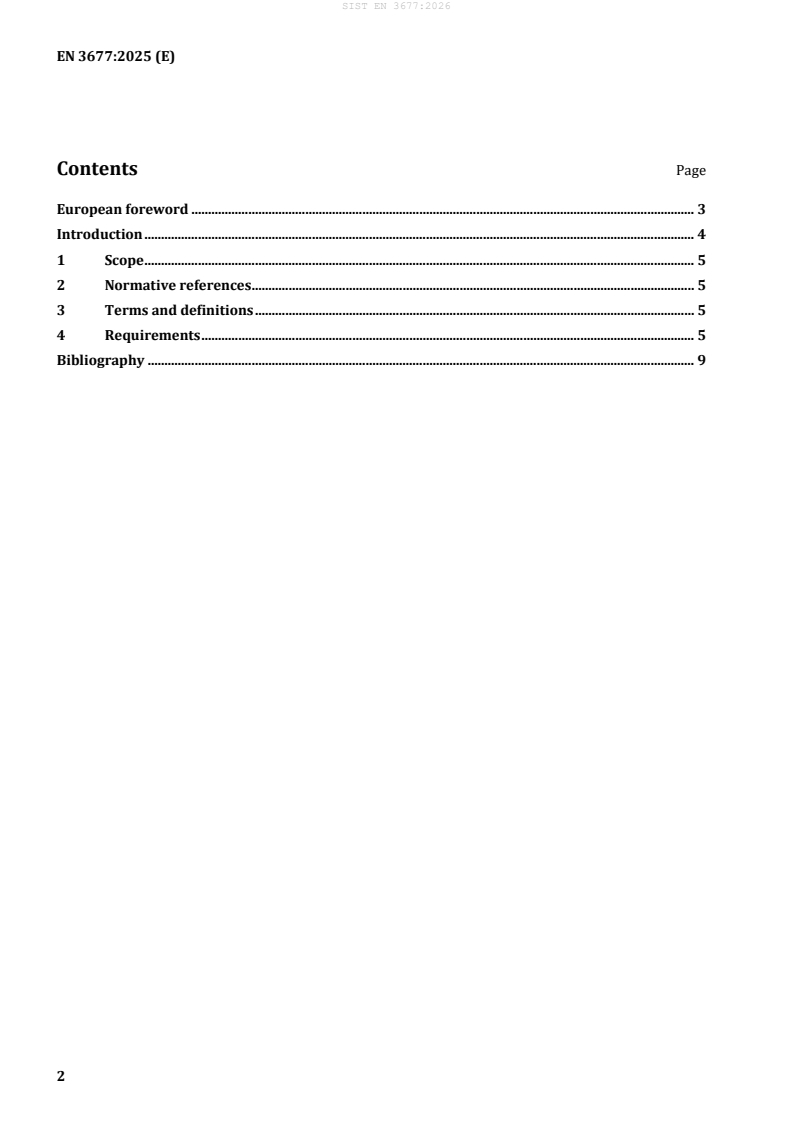
Contents Page
European foreword . 3
Introduction . 4
1 Scope . 5
2 Normative references . 5
3 Terms and definitions . 5
4 Requirements . 5
Bibliography . 9
European foreword
This document (EN 3677:2025) has been prepared by ASD-STAN.
After enquiries and votes carried out in accordance with the rules of this Association, this document has
received the approval of the National Associations and the Official Services of the member countries of
ASD-STAN, prior to its presentation to CEN.
This document shall be given the status of a national standard, either by publication of an identical text
or by endorsement, at the latest by June 2026, and conflicting national standards shall be withdrawn at
the latest by June 2026.
Attention is drawn to the possibility that some of the elements of this document may be the subject of
patent rights. CEN shall not be held responsible for identifying any or all such patent rights.
This document supersedes EN 3677:2007.
— update of the material designation;
— correction of the format of Table 1 to comply with the requirements of the EN 4500 series;
— update of Clause 2;
— addition of a bibliography.
According to the CEN-CENELEC Internal Regulations, the national standards organizations of the
following countries are bound to implement this document: Austria, Belgium, Bulgaria, Croati
...