

EN 16457:2014
(Main)Characterization of waste - Framework for the preparation and application of a testing programme - Objectives, planning and report
- Abstract
This European Standard specifies requirements for a waste testing programme regarding mainly objectives, planning and report with the intent to ensure reliable and comparable results when using the reference methods that have been developed and/or adopted by CEN/TC 292.
The planning and report aspects of this European Standard are applicable to any waste testing programme dedicated to the determination of one or several parameters. They are also applicable to all testing steps for each parameter from sampling up to reporting whether these steps are taking place in the field (e.g. sampling) or in the laboratory (e.g. analysis-quantification).
This European Standard does not address aspects of safety for activities in the field and inside laboratory.
NOTE The term planning a testing programme is used here with the general meaning of organizing a testing programme and being in accordance with the terms testing plan, sampling plan, laboratory plan used in the present European Standard.
- Status
- Published
- Publication Date
- 11-Mar-2014
- Technical Committee
- CEN/TC 444 - Environmental characterization
- Drafting Committee
- CEN/TC 444/WG 8 - Assessment
- Current Stage
- 9093 - Decision to confirm - Review Enquiry
- Start Date
- 16-May-2025
- Completion Date
- 21-Oct-2026

Overview
EN 16457:2014 - Characterization of waste: Framework for the preparation and application of a testing programme - Objectives, planning and report (CEN) provides a structured framework for organizing, planning and reporting waste testing programmes. The standard aims to ensure reliable, comparable results when using the reference methods developed or adopted by CEN/TC 292. Its scope covers the planning and reporting of testing programmes for one or multiple parameters and applies to all testing steps from field sampling to laboratory analysis and reporting. Note: EN 16457:2014 does not cover health and safety aspects.
Key topics and requirements
- Objectives and programme structure
- Define clear objectives for the testing programme and identify parameters to be measured (e.g., substances, pH, dry matter).
- Structure the programme to coordinate different testing steps and multiple parameters coherently.
- Planning and coordination
- Produce a testing plan that includes testing, sampling and laboratory plans.
- Clarify responsibilities and lines of communication among involved parties.
- Appoint a programme manager who designs the programme, coordinates sampling and laboratory activities, authorises and submits the final testing report.
- Testing steps covered
- Applicable to all steps from sampling in the field to analysis/quantification in the laboratory and final reporting.
- Ensures use of appropriate reference methods and consistency across steps.
- Reporting
- Provide an overall testing report that documents objectives, methods, standards used, deviations and results to enable interpretation and comparison.
- Scope limitations
- Does not address field or laboratory safety; focuses on planning, methodology alignment and reporting.
- Annexes
- Normative matrix mapping testing steps versus parameters and relevant standards; informative annexes on deviations (e.g., national A‑deviation noted for Germany).
Practical applications
- Develop standardized or case-by-case testing programmes for waste characterization.
- Integrate testing requirements into regulatory compliance, environmental permitting, waste acceptance procedures and contractual testing obligations.
- Improve data comparability for leaching tests, content analyses and other characterization activities used in waste management decisions.
Who should use this standard
- Testing laboratories and accreditation bodies
- Plant operators and waste producers/users
- Regulators and environmental authorities
- Consultants and contractors preparing sampling and laboratory plans
Related standards / references
EN 16457 is intended to be used alongside CEN/TC 292 reference standards (examples included in the document): EN 12457 (leaching compliance tests), EN 13137 (TOC), EN 14899 (sampling framework), and many other analysis and leaching standards. Use EN 16457 to ensure coherent application of those methods across a full testing programme.
Keywords: EN 16457, waste characterization, testing programme, sampling plan, laboratory plan, CEN/TC 292, leaching tests, programme manager, waste testing report.
Relations
- Refers
EN 15002:2015 - Characterization of waste - Preparation of test portions from the laboratory sample - Effective Date
- 28-Jan-2026
- Effective Date
- 28-Jan-2026
- Effective Date
- 28-Jan-2026
- Effective Date
- 28-Jan-2026
- Effective Date
- 28-Jan-2026
- Effective Date
- 28-Jan-2026
- Effective Date
- 28-Jan-2026
- Effective Date
- 28-Jan-2026
- Effective Date
- 28-Jan-2026
- Effective Date
- 28-Jan-2026
- Effective Date
- 28-Jan-2026
- Effective Date
- 28-Jan-2026
- Effective Date
- 28-Jan-2026
- Effective Date
- 28-Jan-2026
- Effective Date
- 28-Jan-2026
Get Certified
Connect with accredited certification bodies for this standard

CIS Institut d.o.o.
Personal Protective Equipment (PPE) certification body. Notified Body NB-2890 for EU Regulation 2016/425 PPE.

Kiwa BDA Testing
Building and construction product certification.
Kmetijski inštitut Slovenije
Agricultural Institute of Slovenia. Soil testing, plant health, agricultural product analysis.
Sponsored listings
Frequently Asked Questions
EN 16457:2014 is a standard published by the European Committee for Standardization (CEN). Its full title is "Characterization of waste - Framework for the preparation and application of a testing programme - Objectives, planning and report". This standard covers: This European Standard specifies requirements for a waste testing programme regarding mainly objectives, planning and report with the intent to ensure reliable and comparable results when using the reference methods that have been developed and/or adopted by CEN/TC 292. The planning and report aspects of this European Standard are applicable to any waste testing programme dedicated to the determination of one or several parameters. They are also applicable to all testing steps for each parameter from sampling up to reporting whether these steps are taking place in the field (e.g. sampling) or in the laboratory (e.g. analysis-quantification). This European Standard does not address aspects of safety for activities in the field and inside laboratory. NOTE The term planning a testing programme is used here with the general meaning of organizing a testing programme and being in accordance with the terms testing plan, sampling plan, laboratory plan used in the present European Standard.
This European Standard specifies requirements for a waste testing programme regarding mainly objectives, planning and report with the intent to ensure reliable and comparable results when using the reference methods that have been developed and/or adopted by CEN/TC 292. The planning and report aspects of this European Standard are applicable to any waste testing programme dedicated to the determination of one or several parameters. They are also applicable to all testing steps for each parameter from sampling up to reporting whether these steps are taking place in the field (e.g. sampling) or in the laboratory (e.g. analysis-quantification). This European Standard does not address aspects of safety for activities in the field and inside laboratory. NOTE The term planning a testing programme is used here with the general meaning of organizing a testing programme and being in accordance with the terms testing plan, sampling plan, laboratory plan used in the present European Standard.
EN 16457:2014 is classified under the following ICS (International Classification for Standards) categories: 13.030.01 - Wastes in general. The ICS classification helps identify the subject area and facilitates finding related standards.
EN 16457:2014 has the following relationships with other standards: It is inter standard links to EN 15002:2015, CEN/TS 16023:2013, EN ISO 11465:2025, EN 12457-4:2002, CEN/TS 15364:2006, EN 14582:2016, EN ISO 54321:2021, EN 14997:2015, EN ISO 18227:2025, EN 12457-1:2002, EN 13656:2020, EN 15936:2022, EN 15935:2021, CEN/TS 16229:2011, CEN/TR 16192:2020. Understanding these relationships helps ensure you are using the most current and applicable version of the standard.
EN 16457:2014 is available in PDF format for immediate download after purchase. The document can be added to your cart and obtained through the secure checkout process. Digital delivery ensures instant access to the complete standard document.
Standards Content (Sample)
2003-01.Slovenski inštitut za standardizacijo. Razmnoževanje celote ali delov tega standarda ni dovoljeno.Charakterisierung von Abfällen - Rahmen für die Vorbereitung und Anwendung eines Untersuchungsprogramms - Ziele, Planung und BerichtCaractérisation des déchets - Procédure-cadre pour l'élaboration et la mise en oeuvre d'un programme d'essai - Objectifs, planification et rapportCharacterization of waste - Framework for the preparation and application of a testing programme - Objectives, planning and report13.030.01Odpadki na splošnoWastes in generalICS:Ta slovenski standard je istoveten z:EN 16457:2014SIST EN 16457:2014en,fr,de01-julij-2014SIST EN 16457:2014SLOVENSKI
STANDARD
EUROPEAN STANDARD NORME EUROPÉENNE EUROPÄISCHE NORM
EN 16457
March 2014 ICS 13.030.01 English Version
Characterization of waste - Framework for the preparation and application of a testing programme - Objectives, planning and report
Caractérisation des déchets - Procédure-cadre pour l'élaboration et la mise en oeuvre d'un programme d'essai -Objectifs, planification et rapport
Charakterisierung von Abfällen - Rahmenbedingungen für die Vorbereitung und Anwendung eines Untersuchungsprogramms - Ziele, Planung und Bericht This European Standard was approved by CEN on 20 December 2013.
CEN members are bound to comply with the CEN/CENELEC Internal Regulations which stipulate the conditions for giving this European Standard the status of a national standard without any alteration. Up-to-date lists and bibliographical references concerning such national standards may be obtained on application to the CEN-CENELEC Management Centre or to any CEN member.
This European Standard exists in three official versions (English, French, German). A version in any other language made by translation under the responsibility of a CEN member into its own language and notified to the CEN-CENELEC Management Centre has the same status as the official versions.
CEN members are the national standards bodies of Austria, Belgium, Bulgaria, Croatia, Cyprus, Czech Republic, Denmark, Estonia, Finland, Former Yugoslav Republic of Macedonia, France, Germany, Greece, Hungary, Iceland, Ireland, Italy, Latvia, Lithuania, Luxembourg, Malta, Netherlands, Norway, Poland, Portugal, Romania, Slovakia, Slovenia, Spain, Sweden, Switzerland, Turkey and United Kingdom.
EUROPEAN COMMITTEE FOR STANDARDIZATION
COMITÉ EUROPÉEN DE NORMALISATION EUROPÄISCHES KOMITEE FÜR NORMUNG
CEN-CENELEC Management Centre:
Avenue Marnix 17,
B-1000 Brussels © 2014 CEN All rights of exploitation in any form and by any means reserved worldwide for CEN national Members. Ref. No. EN 16457:2014 ESIST EN 16457:2014
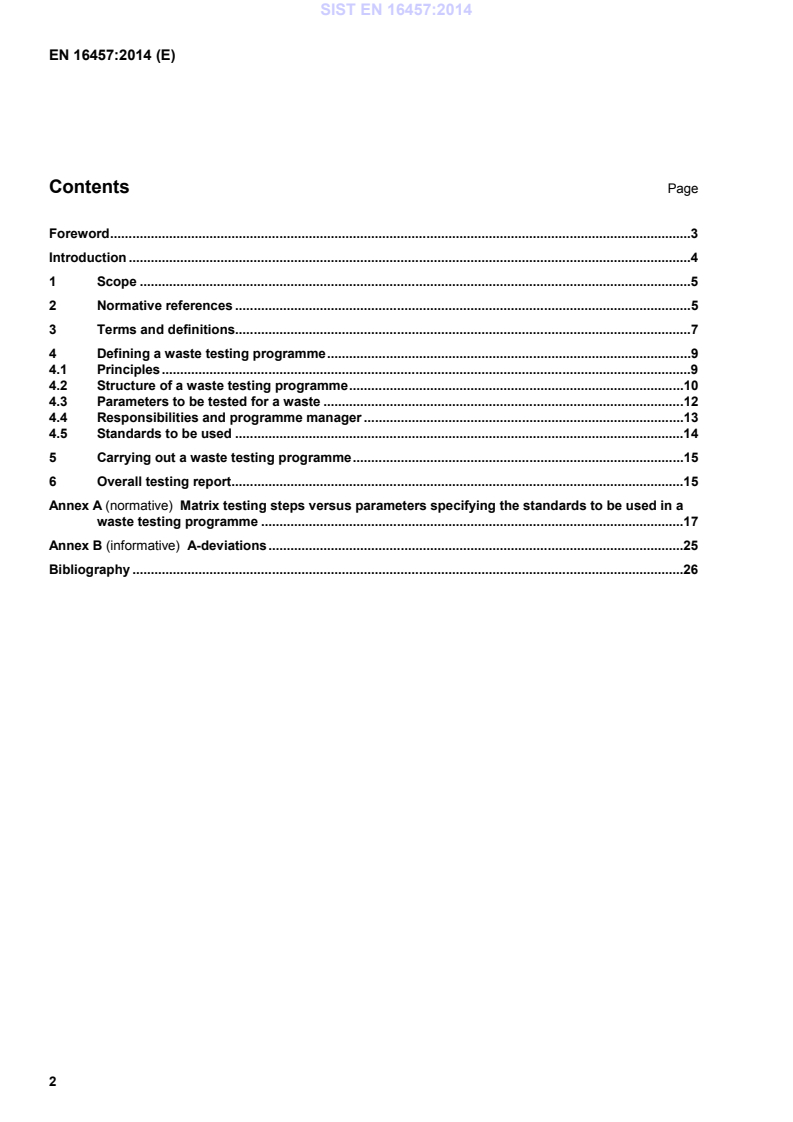
Contents Page Foreword .3 Introduction .4 1 Scope .5 2 Normative references .5 3 Terms and definitions.7 4 Defining a waste testing programme .9 4.1 Principles .9 4.2 Structure of a waste testing programme .10 4.3 Parameters to be tested for a waste .12 4.4 Responsibilities and programme manager .13 4.5 Standards to be used .14 5 Carrying out a waste testing programme .15 6 Overall testing report .15 Annex A (normative)
Matrix testing steps versus parameters specifying the standards to be used in a waste testing programme .17 Annex B (informative)
A-deviations .25 Bibliography .26
Foreword This document (EN 16457:2014) has been prepared by Technical Committee CEN/TC 292 “Characterization of waste”, the secretariat of which is held by NEN. This European Standard shall be given the status of a national standard, either by publication of an identical text or by endorsement, at the latest by September 2014 and conflicting national standards shall be withdrawn at the latest by September 2014. Attention is drawn to the possibility that some of the elements of this document may be the subject of patent rights. CEN [and/or CENELEC] shall not be held responsible for identifying any or all such patent rights. It is to be noted that for Germany an A-deviation applies (see Annex B). This document has been prepared by the ad hoc group “Testing programme” of CEN/TC 292. It has been decided by CEN/TC 292 to prepare the present document and to consider separately other issues supporting this document. This would finally result in a set of four documents on waste testing as listed in the Introduction. According to the CEN-CENELEC Internal Regulations, the national standards organizations of the following countries are bound to implement this European Standard: Austria, Belgium, Bulgaria, Croatia, Cyprus, Czech Republic, Denmark, Estonia, Finland, Former Yugoslav Republic of Macedonia, France, Germany, Greece, Hungary, Iceland, Ireland, Italy, Latvia, Lithuania, Luxembourg, Malta, Netherlands, Norway, Poland, Portugal, Romania, Slovakia, Slovenia, Spain, Sweden, Switzerland, Turkey and the United Kingdom. SIST EN 16457:2014
Introduction This European Standard was elaborated as a help for those who have to organize and apply a waste testing programme. Often several parameters need to be determined in a waste sample and for each parameter different testing steps of a different nature need to be coordinated and performed. This is done in accordance with dedicated standards developed by CEN/TC 292 (e.g. standards for the steps of sampling, extraction, leaching and analysis of eluates or extracts). In order to cope with these different parameters to be tested and with these different testing steps of different nature, the testing of a waste generally refers to different standards which should be used (and elaborated) in a coherent and coordinated way in a testing programme. This European Standard is designed for specifying such overall testing programmes. This European Standard may be used by different interested parties in waste testing: plant operators, testing institutes, accreditation bodies, etc. as well as by industries to address the waste testing part of their contracts and by regulators to address the waste testing part of their regulations. This European Standard can be used to: — produce a standardized testing programme for use in regular or routine circumstances (elaboration of daughter/derived standards dedicated to well defined testing scenarios); — incorporate the specific testing requirements of European and national legislation; — design and develop a waste testing programme for use on a case by case basis. This European Standard provides requirements on the programme, objective, plan and report for the execution of a waste testing programme. This is done with the intent to ensure reliable and comparable results when using the reference methods that have been developed by CEN/TC 292 in accordance with the principles specified in this standard and in the supporting documents (listed below). As shown in Figures 2 and 3, for waste testing, the tests to be performed consist (see also the supporting documents listed below) of two main works: the sampling in the field and the analysis-quantification in the laboratory. The needed coordination and interface is the responsibility of the programme manager (see 4.4). It is also the responsibility of the programme manager to design the testing programme, to authorize the testing report and to submit it to the customer. This European Standard includes one normative annex and one informative annex which are part of this standard. This European Standard is intended to become a part of a set of documents consisting of the present document: — EN 16457, Characterization of waste – Framework for the preparation and application of a testing programme – Objective, planning and report and of three supporting documents providing important information: — CEN/TS (WI 00292082), Characterization of waste – Framework for the preparation and application of a testing programme – Application of EN ISO/IEC 17025 (in preparation) — CEN/TS (WI 00292085), Characterization of waste – Framework for the preparation and application of a testing programme – Guidelines for the elaboration of standardised testing methods (in preparation) — CEN/TR (WI 00292084), Characterization of waste – Framework for the preparation and application of a testing programme – General information on content tests and leaching tests (in preparation) SIST EN 16457:2014
1 Scope This European Standard specifies requirements for a waste testing programme regarding mainly objectives, planning and report with the intent to ensure reliable and comparable results when using the reference methods that have been developed and/or adopted by CEN/TC 292. The planning and report aspects of this European Standard are applicable to any waste testing programme dedicated to the determination of one or several parameters. They are also applicable to all testing steps for each parameter from sampling up to reporting whether these steps are taking place in the field (e.g. sampling) or in the laboratory (e.g. analysis-quantification). This European Standard does not address aspects of safety for activities in the field and inside laboratory. NOTE The term planning a testing programme is used here with the general meaning of organizing a testing programme and being in accordance with the terms testing plan, sampling plan, laboratory plan used in the present European Standard. 2 Normative references The following documents, in whole or in part, are normatively referenced in this document and are indispensable for its application. For dated references, only the edition cited applies. For undated references, the latest edition of the referenced document (including any amendments) applies.1) EN 12457-1, Characterisation of waste - Leaching - Compliance test for leaching of granular waste materials and sludges - Part 1: One stage batch test at a liquid to solid ratio of 2 l/kg for materials with high solid content and with particle size below 4 mm (without or with size reduction) EN 12457-2, Characterisation of waste - Leaching - Compliance test for leaching of granular waste materials and sludges - Part 2: One stage batch test at a liquid to solid ratio of 10 l/kg for materials with particle size below 4 mm (without or with size reduction) EN 12457-3, Characterisation of waste - Leaching - Compliance test for leaching of granular waste materials and sludges - Part 3: Two stage batch test at a liquid to solid ratio of 2 l/kg and 8 l/kg for materials with high solid content and with particle size below 4 mm (without or with size reduction) EN 12457-4, Characterisation of waste - Leaching - Compliance test for leaching of granular waste materials and sludges - Part 4: One stage batch test at a liquid to solid ratio of 10 l/kg for materials with particle size below 10 mm (without or with size reduction) EN 13137, Characterization of waste - Determination of total organic carbon (TOC) in waste, sludges and sediments EN 13656, Characterization of waste - Microwave assisted digestion with hydrofluoric (HF), nitric (HNO3) and hydrochloric (HCl) acid mixture for subsequent determination of elements EN 13657, Characterization of waste - Digestion for subsequent determination of aqua regia soluble portion of elements EN 14039, Characterization of waste - Determination of hydrocarbon content in the range of C10 to C40 by gas chromatography EN 14345, Characterization of waste - Determination of hydrocarbon content by gravimetry
1) Useful information may be found in several CEN/TRs as mentioned in Annex A. The use of CEN/TRs is not mandatory and other sources of information may be used provided that the requirements of the basic EN or CEN/TS are fulfilled. The list of such CEN/TR is given in the Bibliography, references [5] to [15]. SIST EN 16457:2014
EN 14346, Characterization of waste - Calculation of dry matter by determination of dry residue or water content CEN/TS 14405, Characterization of waste - Leaching behaviour tests - Up-flow percolation test (under specified conditions) prEN 14429, Characterisation of waste - Leaching behaviour test - Influence of pH on leaching with initial acid/base addition EN 14582, Characterization of waste - Halogen and sulfur content - Oxygen combustion in closed systems and determination methods EN 14735, Characterization of waste - Preparation of waste samples for ecotoxicity tests EN 14899, Characterization of waste - Sampling of waste materials - Framework for the preparation and application of a Sampling Plan prEN 14997, Characterisation of waste - Leaching behaviour test - Influence of pH on leaching with continuous pH control EN 15002, Characterization of waste - Preparation of test portions from the laboratory sample EN 15169, Characterization of waste - Determination of loss on ignition in waste, sludge and sediments EN 15192, Characterisation of waste and soil - Determination of Chromium(VI) in solid material by alkaline digestion and ion chromatography with spectrophotometric detection EN 15308, Characterization of waste - Determination of selected polychlorinated biphenyls (PCB) in solid waste by using capillary gas chromatography with electron capture or mass spectrometric detection EN 15309, Characterization of waste and soil - Determination of elemental composition by X-ray fluorescence EN 15216, Characterization of waste - Determination of total dissolved solids (TDS) in water and eluates CEN/TS 15364, Characterization of waste - Leaching behaviour tests - Acid and base neutralization capacity test EN 15527, Characterization of waste - Determination of polycyclic aromatic hydrocarbons (PAH) in waste using gas chromatography mass spectrometry (GC/MS) CEN/TS 15862, Characterisation of waste - Compliance leaching test - One stage batch leaching test for monoliths at fixed liquid to surface area ratio (L/A) for test portions with fixed minimum dimensions prEN 15863, Characterisation of waste - Leaching behaviour test for basic characterisation - Dynamic monolithic leaching test with periodic leachant renewal, under fixed conditions CEN/TS 15864, Characterisation of waste - Leaching behaviour test for basic characterisation - Dynamic monolithic leaching test with continuous leachant renewal under conditions relevant for specified scenario(s) EN 15875, Characterization of waste - Static test for determination of acid potential and neutralisation potential of sulfidic waste CEN/TS 16023, Characterization of waste - Determination of gross calorific value and calculation of net calorific value EN 16192, Characterization of waste - Analysis of eluates CEN/TS 16229, Characterization of waste - Sampling and analysis of weak acid dissociable cyanide discharged into tailings ponds EN 16377, Characterization of waste - Determination of brominated flame retardants (BFR) in solid waste SIST EN 16457:2014
3 Terms and definitions For the purposes of this document, the following terms and definitions apply.2) 3.1 additional parameter (AP) parameter that needs to be tested so that the test results could be calculated and/or interpreted Note 1 to entry: For instance, the dry matter for expressing the test results on a dry basis, or pH in eluate to be able to understand and check consistency of test data and to understand/investigate unexpected outcome or unexpected variations. 3.2 analysis / quantification step in the testing programme where the magnitude of the parameters is determined and the obtained data can be directly delivered for final use and reporting or from which the data can be delivered for further calculations EXAMPLE Measuring the length with a measuring tape, measuring the temperature with a thermometer, determining (analysing) the concentrations of substances in an extract or eluate. Note 1 to entry: In the last example, the concentration of the substance in a material or the leachable fraction from a material would be calculated, using the data on the concentrations in the extract or the eluate. 3.3 customer organization or person that orders for a test and that receives the final test report [SOURCE: EN ISO 9000:2005, 3.3.5] 3.4 involved parties individuals and organizations that are directly or indirectly involved in the specification of the testing programme and or in the execution of the programme [SOURCE: EN 14899:2005, 2.7, modified] Note 1 to entry: Such parties include, for instance, the customer, (e.g. the producer or the user of the material), the regulator, a certification body, the sampler, the analyst, the laboratory. The person responsible for the final specification of the testing programme and the final test report is the programme manager. 3.5 laboratory plan plan, which is part of the testing plan, including all the required steps and relevant information pertinent to a particular laboratory activity Note 1 to entry: The laboratory plan includes the preparation of the test sample(s), the extraction, leaching or other activity with the sample(s), analysis, calculations and reporting. Note 2 to entry: The laboratory plan includes specification of the tests to be executed, the laboratory (or laboratories) involved, and the planning.
2) The terms and definitions listed in this clause are needed for the present European Standard with regards to the design and execution of a testing programme. In many other standardized documents useful terms and definitions are available and these will not be repeated here. The supporting document Guidelines for the elaboration of standardized testing methods (in preparation) referred to in the Introduction would consolidate and harmonize the definitions in all CEN/TC 292 standards. SIST EN 16457:2014
3.6 parameter measurable property whose value is a determinant of the characteristics of a waste material Note 1 to entry: For instance, relevant parameters for waste material may be substances (e.g. cadmium, mercury, lead, salt, PAH), pH, temperature, humidity, compressive strength, grain size, etc. 3.7 programme manager individual responsible for the development of the testing programme (including the sampling plan and the laboratory plan) the execution of the testing programme including the preparation and submission of the final report Note 1 to entry: The programme manager may be directly concerned with the sampling work and/or the laboratory work as employee of a sampling organization and/or a laboratory organization. He/she also may be a ‘third party’ just organizing the whole process and responsible for the final reporting. 3.8 records written and/or electronic files in which, during the sampling procedure, testing procedure, test results, time, place and instruments of testing, and observations are recorded Note 1 to entry: Records (also named testing files or work files) are the basis for calculations and for drafting the final test programme report. The report includes relevant data and observations; usually it is not necessary to include all complete testing files in the final report. It is important that the testing files be available upon request, for example, when in a later stage questions arise on the testing and the testing report. 3.9 sampling plan all the information pertinent to a particular sampling activity Note 1 to entry: The sampling plan includes the taking of the sample, the production of a laboratory sample, and the transport (to the laboratory), and may include the storage of the laboratory sample. Note 2 to entry: In case the measurement can be done directly in the field, transport and storage might not be necessary and then will not be elaborated further in the sampling plan. [SOURCE: EN 14899:2005, 3.18, modified] 3.10 sampling report report providing information on all field activities during waste sampling and including any important observation of the sampler Note 1 to entry: A sampling report is prepared for each sampling operation. Note 2 to entry: Sampling plan and sampling report can both summarize their information in a form, including nearly the same items, which facilitates reporting during the sampling activities and which facilitates comparison of planned activities and the way the sampling was executed. 3.11 testing programme total test operation, from the first step in which the objectives of the test(s) are defined to the last step in which data are analysed and reported Note 1 to entry: The test programme may include analyses of the data, evaluation and statistical treatment of the data and comparison with the legal, scientific or other requirements. Note 2 to entry: A testing programme may include data from several tests with each its own test report, e.g. in production control where each month one batch of one day’s production is tested and the testing programme provides information and conclusions on the performance of the product over the whole of the year. SIST EN 16457:2014
Note 3 to entry: If the test results are to be used for formal evaluation, such as requirements from legislation, permits, certification procedures, the objectives and requirements on the methods to be used may directly come from such formal requirements. Note 4 to entry: The testing programme objectives amongst others include specification of the location and material to be investigated, the scale of material to be tested, the parameters to be investigated, the required reliability, the reference test methods. The objectives of the testing programme need to be specified by the customer. [SOURCE: EN 14899:2005, 3.24, modified] 3.12 testing plan plan, containing both the sampling plan and the laboratory plan 3.13 testing steps main parts of the testing programme which include: 1) defining or further specifying the testing plan, 2) taking the sample, 3) sample preparation, transport to the laboratory and storage, 4) test sample and test portion preparation, 5) required treatment of the test portion, such as extraction, leaching, testing for compressive strength, 6) analysis, quantification, 7) elaborating the overall report Note 1 to entry: For all or most of the steps, specific standardized methods exist or are under development that cover that step as reference method (see 4.5 and Table A.1). Note 2 to entry: In some cases, instructions for different steps are combined in one specific standard, e.g. the extraction and the analysis of substances specified in one test standard. Often a standard on a specific step includes instructions on the final reporting of the results and observations of that step. Note 3 to entry: It might be possible that a number of parameters need to be measured which are covered by different measurement standards; however, the production of the laboratory sample may be the same for all of the parameters. In such cases, all parameters can be covered by a single testing programme. 4 Defining a waste testing programme 4.1 Principles In order to secure reliable and comparable results representative of the tested waste, the testing programme with its objectives shall be based on the following principles: a) the testing programme and its objectives are available before execution tasks are carried out; b) a sampling plan is specified in the testing programme to meet the objective and the sampling sites/locations are identified to enable representative sample(s) to be taken; c) the laboratory testing requirements are specified in the testing plan to ensure acceptance by the laboratory and guarantee that the specified tests can be performed on the samples to be provided; SIST EN 16457:2014
d) the standards specified in this standard and covering the different steps of all processes involved in the testing programme are applied. Other methods may be used in the framework of this standard provided that their comparability/traceability to the standardized methods referred in 4.5 and listed in Annex A is demonstrated in accordance with the testing objectives and with the considered and specific field of application; NOTE 1 Other methods than the ones specified in Annex A may provide adequate information, even if it is not equally precise or if it provides other information, for instance if the performance level of a waste is rather low, compared with a limit value. e) a report of the results is produced which includes all relevant information, including description and justification of any possible deviation from the applied standards; f) competent samplers and competent laboratories are used with clear identification of their responsibilities; NOTE 2 Requirements on the competence of laboratories are specified in EN ISO/IEC 17025 and in the supporting documents (listed in the Introduction). g) competence and responsibilities of the programme manager should be considered / specified before finalizing the testing programme, and where appropriate, should be included in the testing programme. 4.2 Structure of a waste testing programme 4.2.1 First actions and overview of a waste testing programme The first action to be undertaken in a waste testing programme is the specification of the objectives of the testing programme. This also requires the identification of the programme manager (see 4.4). In this first action the objectives of the testing programme are specified by the customer in consultation with the involved parties. All relevant information shall be collected from the involved parties and considered before finalizing the testing programme. NOTE Such involved parties include, for instance, the sampler and/or the analyst and/or the customer and/or the regulator and/or the waste producer. In a second action the testing programme is defined by the programme manager according to the objectives of the testing programme and the relevant/applicable legal requirements. The testing programme contains all relevant information for coordination and describes the relevant steps and actions. It is illustrated in Figure 1 showing an overview of a waste testing programme.
Figure 1 — Overview of a waste testing programme SIST EN 16457:2014
4.2.2 The seven testing steps of a waste testing programme In the field of waste testing, each test consists typically of seven steps: 1) Testing plan (sampling plan and laboratory plan); 2) Taking field sample and production of laboratory sample(s); 3) Packaging, transport and storage (from field to the laboratory); 4) Preparation of test sample and test portion; 5) Leaching, extraction; 6) Analysis, quantification; 7) Overall testing report. In Figure 1, the testing steps 2 and 3 are in the field activities while the testing steps 3, 4, 5 and 6 are in the laboratory activities. In Figure 2, the seven testing steps are shown for testing a single parameter. NOTE 1 Depending on the nature of the parameter to be tested, the testing step 5 is not always performed for instance for density, dry matter …etc. This may also apply to other steps. NOTE 2 A waste testing programme may require the testing of additional parameters, for instance dry matter in order to express the content of a substance in mg/kg on a dry matter basis (see notes in Table A.1). Before the testing programme is designed and executed, the customer appoints a programme manager. The objectives of the testing programme shall be specified by the customer. The testing programme objectives amongst others include specification of the location and material to be investigated, the scale of material to be tested, the parameters to be investigated, the required reliability and the reference test methods. NOTE 3 If the test results are to be used for formal evaluation, such as requirements from legislation, permits, certification procedures, the objectives and requirements on the methods to be used may directly come from such formal requirements. The activities from step 2 up to and including step 6 are recorded in one or more records. These records are written and/or electronic files in which, during the sampling procedure and testing procedure observations such as for instance name, location, used techniques, test results, time, place and i
...