

EN 16603-20-07:2022
(Main)Space engineering - Electromagnetic compatibility
- Abstract
EMC policy and general system requirements are specified in ECSS-E-ST-20 (equivalent to EN 16603-20).
This ECSS-E-ST-20-07 (equivalent to EN 16603-20-07) Standard addresses detailed system requirements (Clause 4), general test conditions, verification requirements at system level, and test methods at subsystem and equipment level (Clause 5) as w ell as informative limits (Annex A).
Associated to this standard is ECSS-E-ST-20-06 (equivalent to EN 16603-20-06) "Spacecraft charging", w hich addresses charging control and risks arising from environmental and vehicle-induced spacecraft charging w hen ECSS-E-ST-20-07 addresses electromagnetic effects of electrostatic discharges.
Annexes A to C of ECSS-E-ST-20 document EMC activities related to ECSS-E-ST-20-07: the EMC Control Plan (Annex A) defines the approach, methods, procedures, resources, and organization, the Electromagnetic Effects Verification Plan (Annex B) defines and specifies the verification processes, analyses and tests, and the Electromagnetic Effects Verification Report (Annex C) document verification results. The EMEVP and the EMEVR are the vehicles for tailoring this standard.
- Status
- Published
- Publication Date
- 04-Oct-2022
- Technical Committee
- CEN/CLC/TC 5 - Space
- Drafting Committee
- CEN/CLC/TC 5/WG 6 - Upstream standards
- Current Stage
- 6060 - Definitive text made available (DAV) - Publishing
- Start Date
- 05-Oct-2022
- Due Date
- 08-Jan-2023
- Completion Date
- 05-Oct-2022



Overview
EN 16603-20-07:2022 (equivalent to ECSS‑E‑ST‑20‑07) is the European/Slovenian standard for space engineering - electromagnetic compatibility (EMC). It specifies detailed system-level EMC requirements, general test conditions, verification requirements at system level and test methods at subsystem and equipment level. The standard also includes informative limits (Annex A) and is tailored to spacecraft and launch environments.
Key topics and technical requirements
- Scope and structure
- Detailed system requirements (Clause 4) covering EMC interactions with launch systems, lightning, spacecraft charging effects, DC magnetic emissions, radio‑frequency compatibility, grounding, bonding, shielding, wiring and intrasystem EMC.
- Verification and test methods (Clause 5) for both system and equipment/subsystem levels.
- EMC verification framework
- Use of an EMEVP (Electromagnetic Effects Verification Plan, Annex B) and EMEVR (Electromagnetic Effects Verification Report, Annex C) to document tailoring, analyses, tests and results.
- EMC Control Plan (Annex A) defines methods, procedures, resources and organization for EMC activities.
- Testing and measurement topics
- Conducted emission and susceptibility (low frequency to 100 MHz and below), radiated emission and susceptibility (30 MHz–18 GHz), magnetic moment/DC magnetic emission and specific transient tests.
- Electrostatic discharge (ESD) testing including wire‑coupled and chassis discharge methods.
- Test conditions and practical measurement notes: measurement tolerances, test site and ground plane requirements, power source impedance, calibration, photographic documentation and power bus voltage considerations.
- Informative limits
- Annex A provides subsystem and equipment limits (emission and susceptibility) and guidance for applying limits to tests.
Practical applications and users
This standard is intended for:
- Spacecraft EMC engineers designing to minimize electromagnetic interference and ensure RF compatibility.
- Systems engineers and integrators who must demonstrate system-level EMC with launch vehicles, ground equipment and space environment hazards.
- Test laboratories and verification teams executing subsystem and equipment EMC tests and producing EMEVP/EMEVR documentation.
- Project managers and procurement teams specifying EMC requirements for suppliers and COTS components.
Typical uses:
- Defining EMC requirements in spacecraft development contracts and verification plans.
- Planning and executing conducted and radiated emission/susceptibility tests, ESD and transient immunity campaigns.
- Tailoring EMC verification activities using the EMEVP/EMEVR process to meet mission-specific constraints.
Related standards
- ECSS‑E‑ST‑20 (general EMC policy and system requirements) - parent document.
- ECSS‑E‑ST‑20‑06 / EN 16603‑20‑06 - spacecraft charging (complements 20‑07 by addressing charging control and charging‑related risks).
- Applicable national standards and test methods for measurement equipment and RF/EMC laboratory practices.
Keywords: EN 16603-20-07:2022, space engineering, electromagnetic compatibility, EMC testing, spacecraft EMC, ECSS‑E‑ST‑20‑07, electrostatic discharge, radiated emission, conducted emission, verification plan.
Relations
- Effective Date
- 03-Jun-2020
- Effective Date
- 08-Apr-2026
- Effective Date
- 28-Jan-2026
Get Certified
Connect with accredited certification bodies for this standard

BUREAU VERITAS Certification Germany
Bureau Veritas certification in Germany.

Element Materials Technology
Materials testing and product certification.

AQMS Ltd.
AQMS provides ISO certification to SMEs across the UK.
Sponsored listings
Frequently Asked Questions
EN 16603-20-07:2022 is a standard published by the European Committee for Standardization (CEN). Its full title is "Space engineering - Electromagnetic compatibility". This standard covers: EMC policy and general system requirements are specified in ECSS-E-ST-20 (equivalent to EN 16603-20). This ECSS-E-ST-20-07 (equivalent to EN 16603-20-07) Standard addresses detailed system requirements (Clause 4), general test conditions, verification requirements at system level, and test methods at subsystem and equipment level (Clause 5) as w ell as informative limits (Annex A). Associated to this standard is ECSS-E-ST-20-06 (equivalent to EN 16603-20-06) "Spacecraft charging", w hich addresses charging control and risks arising from environmental and vehicle-induced spacecraft charging w hen ECSS-E-ST-20-07 addresses electromagnetic effects of electrostatic discharges. Annexes A to C of ECSS-E-ST-20 document EMC activities related to ECSS-E-ST-20-07: the EMC Control Plan (Annex A) defines the approach, methods, procedures, resources, and organization, the Electromagnetic Effects Verification Plan (Annex B) defines and specifies the verification processes, analyses and tests, and the Electromagnetic Effects Verification Report (Annex C) document verification results. The EMEVP and the EMEVR are the vehicles for tailoring this standard.
EMC policy and general system requirements are specified in ECSS-E-ST-20 (equivalent to EN 16603-20). This ECSS-E-ST-20-07 (equivalent to EN 16603-20-07) Standard addresses detailed system requirements (Clause 4), general test conditions, verification requirements at system level, and test methods at subsystem and equipment level (Clause 5) as w ell as informative limits (Annex A). Associated to this standard is ECSS-E-ST-20-06 (equivalent to EN 16603-20-06) "Spacecraft charging", w hich addresses charging control and risks arising from environmental and vehicle-induced spacecraft charging w hen ECSS-E-ST-20-07 addresses electromagnetic effects of electrostatic discharges. Annexes A to C of ECSS-E-ST-20 document EMC activities related to ECSS-E-ST-20-07: the EMC Control Plan (Annex A) defines the approach, methods, procedures, resources, and organization, the Electromagnetic Effects Verification Plan (Annex B) defines and specifies the verification processes, analyses and tests, and the Electromagnetic Effects Verification Report (Annex C) document verification results. The EMEVP and the EMEVR are the vehicles for tailoring this standard.
EN 16603-20-07:2022 is classified under the following ICS (International Classification for Standards) categories: 49.140 - Space systems and operations. The ICS classification helps identify the subject area and facilitates finding related standards.
EN 16603-20-07:2022 has the following relationships with other standards: It is inter standard links to EN 16603-20-07:2014, IEC 61000-4-2:2008, EN ISO 14539:2001. Understanding these relationships helps ensure you are using the most current and applicable version of the standard.
EN 16603-20-07:2022 is associated with the following European legislation: Standardization Mandates: M/496. When a standard is cited in the Official Journal of the European Union, products manufactured in conformity with it benefit from a presumption of conformity with the essential requirements of the corresponding EU directive or regulation.
EN 16603-20-07:2022 is available in PDF format for immediate download after purchase. The document can be added to your cart and obtained through the secure checkout process. Digital delivery ensures instant access to the complete standard document.
Standards Content (Sample)
SLOVENSKI STANDARD
01-december-2022
Nadomešča:
SIST EN 16603-20-07:2014
Vesoljska tehnika - Elektromagnetna združljivost
Space engineering - Electromagnetic compatibility
Raumfahrttechnik - Elektromagnetische Kompatibilität
Ingénierie spatiale - Compatibilité électromagnétique
Ta slovenski standard je istoveten z: EN 16603-20-07:2022
ICS:
33.100.01 Elektromagnetna združljivost Electromagnetic compatibility
na splošno in general
49.140 Vesoljski sistemi in operacije Space systems and
operations
2003-01.Slovenski inštitut za standardizacijo. Razmnoževanje celote ali delov tega standarda ni dovoljeno.
EUROPEAN STANDARD EN 16603-20-07
NORME EUROPÉENNE
EUROPÄISCHE NORM
October 2022
ICS 49.140
Supersedes EN 16603-20-07:2014
English version
Space engineering - Electromagnetic compatibility
Ingénierie spatiale - Compatibilité électromagnétique Raumfahrttechnik - Elektromagnetische Kompatibilität
This European Standard was approved by CEN on 29 May 2022.
CEN and CENELEC members are bound to comply with the CEN/CENELEC Internal Regulations which stipulate the conditions for
giving this European Standard the status of a national standard without any alteration. Up-to-date lists and bibliographical
references concerning such national standards may be obtained on application to the CEN-CENELEC Management Centre or to
any CEN and CENELEC member.
This European Standard exists in three official versions (English, French, German). A version in any other language made by
translation under the responsibility of a CEN and CENELEC member into its own language and notified to the CEN-CENELEC
Management Centre has the same status as the official versions.
CEN and CENELEC members are the national standards bodies and national electrotechnical committees of Austria, Belgium,
Bulgaria, Croatia, Cyprus, Czech Republic, Denmark, Estonia, Finland, France, Germany, Greece, Hungary, Iceland, Ireland, Italy,
Latvia, Lithuania, Luxembourg, Malta, Netherlands, Norway, Poland, Portugal, Republic of North Macedonia, Romania, Serbia,
Slovakia, Slovenia, Spain, Sweden, Switzerland, Türkiye and United Kingdom.
CEN-CENELEC Management Centre:
Rue de la Science 23, B-1040 Brussels
© 2022 CEN/CENELEC All rights of exploitation in any form and by any means
Ref. No. EN 16603-20-07:2022 E
reserved worldwide for CEN national Members and for
CENELEC Members.
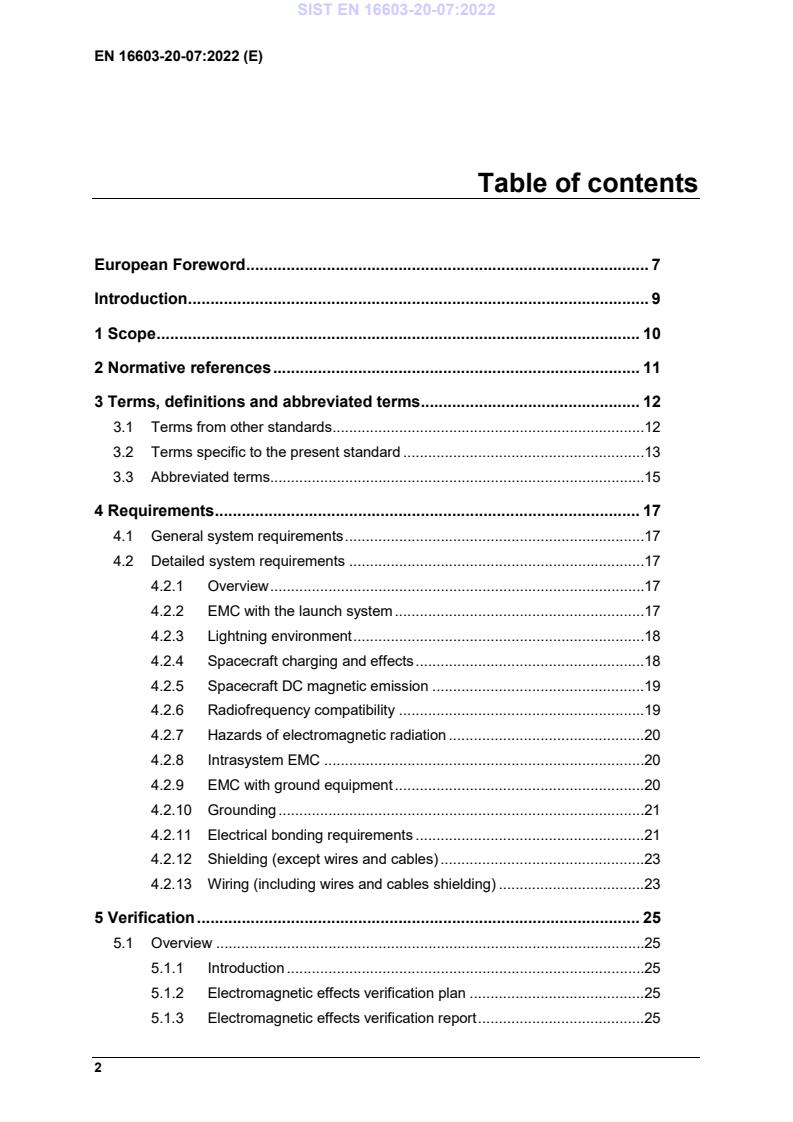
Table of contents
European Foreword . 7
Introduction . 9
1 Scope . 10
2 Normative references . 11
3 Terms, definitions and abbreviated terms . 12
3.1 Terms from other standards .12
3.2 Terms specific to the present standard .13
3.3 Abbreviated terms. 15
4 Requirements . 17
4.1 General system requirements .17
4.2 Detailed system requirements .17
4.2.1 Overview . 17
4.2.2 EMC with the launch system .17
4.2.3 Lightning environment .18
4.2.4 Spacecraft charging and effects . 18
4.2.5 Spacecraft DC magnetic emission . 19
4.2.6 Radiofrequency compatibility .19
4.2.7 Hazards of electromagnetic radiation . 20
4.2.8 Intrasystem EMC .20
4.2.9 EMC with ground equipment .20
4.2.10 Grounding .21
4.2.11 Electrical bonding requirements . 21
4.2.12 Shielding (except wires and cables) . 23
4.2.13 Wiring (including wires and cables shielding) . 23
5 Verification . 25
5.1 Overview .25
5.1.1 Introduction .25
5.1.2 Electromagnetic effects verification plan . 25
5.1.3 Electromagnetic effects verification report . 25
5.2 Test conditions . 25
5.2.1 Measurement tolerances .25
5.2.2 Test site .26
5.2.3 Ground plane .28
5.2.4 Power source impedance . 28
5.2.5 General test precautions .30
5.2.6 EUT test configurations .30
5.2.7 Operation of EUT .33
5.2.8 Use of measurement equipment . 34
5.2.9 Emission testing .36
5.2.10 Susceptibility testing .37
5.2.11 Calibration of measuring equipment . 39
5.2.12 Power bus voltage.40
5.2.13 Photographic data .40
5.3 System level .40
5.3.1 General . 40
5.3.2 Safety margin demonstration for critical or EED circuits . 40
5.3.3 EMC with the launch system .41
5.3.4 Lightning .41
5.3.5 Spacecraft and static charging .41
5.3.6 Spacecraft DC magnetic field emission . 42
5.3.7 Intra–system electromagnetic compatibility . 42
5.3.8 Radiofrequency compatibility .42
5.3.9 Grounding .42
5.3.10 Electrical bonding .42
5.3.11 Wiring and shielding .42
5.4 Equipment and subsystem level test procedures . 43
5.4.1 Overview .43
5.4.2 CE, power leads, differential mode, 30 Hz to 100 kHz . 43
5.4.3 CE, power and signal leads, 50 kHz to 100 MHz . 45
5.4.4 CE, power leads, inrush current . 48
5.4.5 DC Magnetic field emission, magnetic moment . 51
5.4.6 RE, electric field, 30 MHz to 18 GHz . 54
5.4.7 CS, power leads, 30 Hz to 100 kHz . 58
5.4.8 CS, bulk cable injection, 50 kHz to 100 MHz . 61
5.4.9 CS, power leads, transients .65
5.4.10 RS, magnetic field, 30 Hz to 100 kHz . 69
5.4.11 RS, electric field, 30 MHz to 18 GHz . 72
5.4.12 Susceptibility to wire-coupled electrostatic discharges (legacy
method) . 79
5.4.13 Susceptibility to wire-coupled electrostatic discharges (current
injection probe method) .84
5.4.14 Susceptibility to electrostatic discharges into the chassis . 87
5.4.15 CE, power leads, time domain .90
Annex A (informative) Subsystem and equipment limits. 92
A.1 Overview .92
A.2 CE on power leads, differential mode, 30 Hz to 100 MHz . 92
A.3 CE on power leads, in-rush currents .94
A.4 CE on power and signal leads, common mode, 50 kHz to 100 MHz . 94
A.5 <> .95
A.6 DC magnetic field emission .95
A.6.1 General . 95
A.6.2 Characterization .95
A.6.3 Limit . 96
A.7 RE, low-frequency magnetic field . 96
A.8 RE, low-frequency electric field .96
A.9 RE, electric field, 30 MHz to 18 GHz .97
A.10 CS, power leads, differential mode, 30 Hz to 100 kHz . 97
A.11 CS, power and signal leads, common mode, 50 kHz to 100 MHz . 98
A.12 CS, power leads, short spike transients . 99
A.13 RS, magnetic field, 30 Hz to 100 kHz. 100
A.14 RS, electric field, 30 MHz to 18 GHz . 101
A.15 Susceptibility to wire-coupled electrostatic discharges (legacy method) . 102
Figures
Figure 4-1: Bonding requirements .22
Figure 5-1: RF absorber loading diagram .27
Figure 5-2: Line impedance stabilization network schematic . 29
Figure 5-3: General test setup .31
Figure 5-4: Typical calibration fixture .35
Figure 5-5: Conducted emission, 30 Hz to 100 kHz, measurement system check . 45
Figure 5-6: Conducted emission, 30 Hz to 100 kHz, measurement setup . 45
Figure 5-7: Conducted emission, measurement system check . 46
Figure 5-8: Conducted emission, measurement setup in differential mode . 47
Figure 5-9: Conducted emission, measurement setup in common mode . 47
Figure 5-10: Inrush current: measurement system check setup . 49
Figure 5-11: Inrush current: measurement setup .49
Figure 5-12: Smooth deperm procedure .54
Figure 5-13: Electric field radiated emission. Basic test setup . 56
Figure 5-14: Electric field radiated emission. Antenna positioning . 56
Figure 5-15: Electric field radiated emission – Multiple antenna positions . 57
Figure 5-16: CS, power leads, measurement system check set-up . 59
Figure 5-17: CS, power leads, signal injection .60
Figure 5-18: Bulk cable injection, calibration set-up . 64
Figure 5-19: Signal test waveform .64
Figure 5-20: CS, power and signal leads, bulk cable injection . 65
Figure 5-21: CS, power leads, differential mode transients, calibration setup . 66
Figure 5-22: CS, power leads, differential mode transients, injection setup . 67
Figure 5-23: <> . 67
Figure 5-24: CS, power leads, common mode transients, calibration setup . 67
Figure 5-25: CS, power leads, common mode transients, probe injection setup . 68
Figure 5-26: Measurement system check configuration of the radiating system . 70
Figure 5-27: Basic test setup .70
Figure 5-28: <> . 74
Figure 5-29: Example of electric field calibration test setup . 75
Figure 5-30: RS Electric field – Multiple test antenna positions . 76
Figure 5-31: <> . 76
Figure 5-32: Susceptibility to ESD: calibration configuration . 81
Figure 5-33: Susceptibility to ESD: test equipment configuration . 82
Figure 5-34: Example of compliant discharge current shape . 83
Figure 5-35: Test setup for calibration of test waveform . 85
Figure 5-36: Typical ESD pulse measured during calibration (3 A/div, 4 ns/div) . 86
Figure 5-37: Wire-coupled ESD test setup (current injection probe method) . 86
Figure 5-38: Discharge current verification setup.89
Figure 5-39: Ideal contact discharge current waveform at 8 kV . 89
Figure 5-40: Conducted emission, power leads, time domain: measurement setup . 91
Figure A-1 : Power leads, differential mode conducted emission limit . 93
Figure A-2 : Common mode conducted emission limit . 95
Figure A-3 : Radiated electric field limit .97
Figure A-4 : Conducted susceptibility limit, frequency domain . 98
Figure A-5 : Calibration level at the measurement port of the calibration fixture . 99
Figure A-6 : CS, voltage spike in percentage of test bus voltage . 100
Figure A-7 : Radiated susceptibility limit . 101
Tables
Table 5-1: Absorption at normal incidence. 27
Table 5-2: Bandwidth and measurement time .36
Table 5-3: Maximum step sizes for susceptibility tests. 38
Table 5-4: Correspondence between test procedures and limits . 43
Table A-1 : Equipment: susceptibility to conducted interference, test signal . 99
European Foreword
This document (EN 16603-20-07:2022) has been prepared by Technical
Committee CEN/CLC/JTC 5 “Space”, the secretariat of which is held by DIN.
This standard (EN 16603-20-07:2022) originates from ECSS-E-ST-20-07C Rev.2.
This European Standard shall be given the status of a national standard, either
by publication of an identical text or by endorsement, at the latest by April 2023,
and conflicting national standards shall be withdrawn at the latest by April 2023.
Attention is drawn to the possibility that some of the elements of this document
may be the subject of patent rights. CEN [and/or CENELEC] shall not be held
responsible for identifying any or all such patent rights.
This document supersedes EN 16603-20-07:2014.
The main changes with respect to EN 16603-20-07:2014 are listed below:
- Implementation of Change Requests.
- Specification of the maximum frequency step size for susceptibility tests, in
clause 5.2.10.1.
- Addition of clause 5.2.12 “Power bus voltage”.
- Addition of clause 5.2.13 “Photographic data”.
- Specification of a method for conducted susceptibility to short transients
coupled on EUT power leads in both differential and common mode, in
clause 5.4.9.
- Specification of the radiated susceptibility tests to electric fields to follow a
substitution method, in clause 5.4.11.
- Addition of clause 5.4.13 “Susceptibility to wire-coupled electrostatic
discharges (current injection probe method)”.
- Addition of clause 5.4.14 “Susceptibility to electrostatic discharges into the
chassis”.
- Addition of clause 5.4.15 “CE, power leads, time domain”.
This document has been prepared under a standardization request given to CEN
by the European Commission and the European Free Trade Association.
This document has been developed to cover specifically space systems and has
therefore precedence over any EN covering the same scope but with a wider
domain of applicability (e.g. : aerospace).
According to the CEN-CENELEC Internal Regulations, the national standards
organizations of the following countries are bound to implement this European
Standard: Austria, Belgium, Bulgaria, Croatia, Cyprus, Czech Republic,
Denmark, Estonia, Finland, Former Yugoslav Republic of Macedonia, France,
Germany, Greece, Hungary, Iceland, Ireland, Italy, Latvia, Lithuania,
Luxembourg, Malta, Netherlands, Norway, Poland, Portugal, Romania, Serbia,
Slovakia, Slovenia, Spain, Sweden, Switzerland, Türkiye and the United
Kingdom.
Introduction
Electromagnetic compatibility (EMC) of a space system or equipment is the
ability to function satisfactorily in its electromagnetic environment without
introducing intolerable electromagnetic disturbances to anything in that
environment.
The space system is designed to be compatible with its external natural, induced,
or man-made electromagnetic environment. Natural components are lightning
for launchers, the terrestrial magnetic field for space vehicles. Spacecraft
charging is defined as voltage building-up of a space vehicle or spacecraft units
when immerged in plasma. Electrostatic discharges result from spacecraft
charging with possible detrimental effects. External man-made interference,
intentional or not, are caused by radar or telecommunication beams during
ground operations and the launching sequence. Intersystem EMC also applies
between the launcher and its payload or between space vehicles.
Intrasystem EMC is defined between all electrical, electronic, electromagnetic,
and electromechanical equipment within the space vehicle and by the presence
of its self-induced electromagnetic environment. It comprises the intentional
radiated electromagnetic fields and parasitic emission from on-board equipment.
Both conducted and radiated emissions are concerned. An electromagnetic
interference safety margin is defined at system critical points by comparison of
noise level and susceptibility at these points.
Scope
EMC policy and general system requirements are specified in ECSS-E-ST-20.
This ECSS-E-ST-20-07 Standard addresses detailed system requirements
(Clause 4), general test conditions, verification requirements at system level, and
test methods at subsystem and equipment level (Clause 5) as well as informative
limits (Annex A).
Associated to this standard is ECSS-E-ST-20-06 “Spacecraft charging”, which
addresses charging control and risks arising from environmental and vehicle-
induced spacecraft charging when ECSS-E-ST-20-07 addresses electromagnetic
effects of electrostatic discharges.
Annexes A to C of the ECSS-E-ST-20 standard document EMC activities related
to ECSS-E-ST-20-07: the EMC Control Plan (Annex A) defines the approach,
methods, procedures, resources, and organization, the Electromagnetic Effects
Verification Plan (Annex B) defines and specifies the verification processes,
analyses and tests, and the Electromagnetic Effects Verification Report (Annex C)
document verification results. The EMEVP and the EMEVR are the vehicles for
tailoring this standard.
This standard may be tailored for the specific characteristic and constrains of a
space project in conformance with ECSS-S-ST-00-02.
Normative references
The following normative documents contain provisions which, through
reference in this text, constitute provisions of this ECSS Standard. For dated
references, subsequent amendments to, or revision of any of these publications
do not apply, However, parties to agreements based on this ECSS Standard are
encouraged to investigate the possibility of applying the more recent editions of
the normative documents indicated below. For undated references, the latest
edition of the publication referred to applies.
EN reference Reference in text Title
EN 16601-00-010 ECSS-S-ST-00-01 ECSS system - Glossary of terms
EN 16603-20 ECSS-E-ST-20 Space engineering - Electrical and electronic
EN 16603-20-06 ECSS-E-ST-20-06 Space engineering - Spacecraft charging
EN 16603-33-11 ECSS-E-ST-33-11 Space engineering - Explosive subsystems and devices
EN 16603-50-14 ECSS-E-ST-50-14 Space engineering – Spacecraft discrete interfaces
IEC 61000-4-2 Electromagnetic compatibility (EMC) - Part 4-2:
(Edition 1.2) Testing and measurement techniques - Electrostatic
discharge immunity test
Terms, definitions and abbreviated terms
3.1 Terms from other standards
a. For the purpose of this Standard, the terms and definitions from
ECSS-S-ST-00-01 apply, in particular for the following terms:
1. critical item
2. customer
3. equipment
4. launcher, launch vehicle
5. mission
6. requirement
7. safety critical function
8. supplier
9. spacecraft, space vehicle
10. subsystem
11. system
12. test
13. verification
b. For the purposes of this Standard, the following terms have a specific
definition contained in ECSS-E-ST-20:
1. conducted emission
2. electromagnetic compatibility
3. electromagnetic compatibility control
4. electromagnetic interference
5. electromagnetic interference safety margin
6. emission
7. high-voltage
8. lightning indirect effects
9. radiated emission
10. radiofrequency
11. susceptibility
12. susceptibility threshold
c. For the purposes of this document, the following terms have a specific
definition contained in ECSS-E-ST-20-06:
1. electrostatic discharge (ESD)
2. secondary arc
d. For the purposes of this document, the following term has a specific
definition contained in ECSS-E-ST-33-11:
1. electro-explosive device (EED)
3.2 Terms specific to the present standard
3.2.1 ambient level
level of radiated and conducted signal, and noise that exist at the specified test
location and time when the equipment under test is not operating
NOTE E.g. atmospherics, interference from other sources,
and circuit noise or other interference generated
within the measuring set compose the “ambient
level”.
3.2.2 antenna factor
factor that, when properly applied to the voltage at the input terminals of the
measuring instrument, yields the electric or magnetic field strength
NOTE 1 This factor includes the effects of antenna effective
length, mismatch, and transmission losses.
NOTE 2 The electric field strength is normally expressed in
V/m and the magnetic field strength in A/m or T.
3.2.3 common mode voltage
voltage difference between source and receiver ground references
3.2.4 contact discharge method
method of testing in which the electrode of the high-voltage test generator is held
in contact with the discharge circuit, and the discharge actuated by a discharge
switch
3.2.5 electromagnetic environmental effects
impact of the electromagnetic environment upon equipment, systems, and
platforms
NOTE It encompasses all electromagnetic disciplines,
including electromagnetic compatibility,
electromagnetic interference, electromagnetic
vulnerability, hazards of electromagnetic radiation
to personnel, electro-explosive devices, volatile
materials, and natural phenomena effects.
3.2.6 field strength
resultant of the radiation, induction and quasi-static components of the electric
or magnetic field
NOTE The term “electric field strength” or “magnetic field
strength” is used, according to whether the
resultant, electric or magnetic field, respectively, is
measured.
3.2.7 ground plane
metal sheet or plate used as a common reference point for circuit returns and
electrical or signal potentials
3.2.8 improper response
subsystem or equipment response which can be either inadvertent or
unacceptable
3.2.9 inadvertent response
proper subsystem functional response (within normal range of limits) actuated
by electromagnetic interference, but occurring at other than the normal
operational cycle, which in turn causes improper response to the total space
system
3.2.10 line impedance stabilization network
network inserted in the supply leads of an apparatus to be tested which provides,
in a given frequency range, a specified source impedance for the measurement
of disturbance currents and voltages and which can isolate the apparatus from
the supply mains in that frequency range
3.2.11 not operating
condition wherein no power is applied to the equipment
3.2.12 overshield
shield surrounding a bundle or a shielded cable
3.2.13 passive intermodulation product
generation of a signal at frequency f = n*f1 + m*f2 from two signals at frequencies
f1 and f2, where n and m are positive or negative integers, by a passive device,
usually an electrical contact
3.2.14 port
place of access to a device or network where energy can be supplied or
withdrawn, or where the device or network variables can be observed or
measured
3.2.15 power quality requirements
requirements which define the conducted voltage noise or impedance the power
user can expect
NOTE Noise e.g. from load regulation, spikes, and sags.
3.2.16 soft magnetic material
ferromagnetic material with a coercivity smaller than 100 A/m
3.2.17 spurious emission
electromagnetic emission from the intended output terminal of an electronic
device, but outside of the designed emission bandwidth
3.2.18 test antenna
antenna of specified characteristics designated for use under specified conditions
in conducting tests
3.2.19 unit
equipment that is viewed as an entity for purposes of analysis, manufacturing,
maintenance, or record keeping
NOTE E.g. hydraulic actuators, valves, batteries, and
individual electronic boxes such as on-board
computer, inertial measurement unit, reaction
wheel, star tracker, power conditioning unit,
transmitters, receivers, or multiplexers.
3.3 Abbreviated terms
For the purpose of this standard, the abbreviated terms of ECSS-S-ST-00-01 and
the following apply:
Abbreviation Meaning
AC alternating current
ACS attitude control system
AM amplitude modulation
AWG American wire gauge
BCI bulk cable injection
CE conducted emission
CS conducted susceptibility
CW continuous wave
DC direct current
EED electro-explosive device
EGSE electrical ground support equipment
EHF extremely high frequency (30 GHz-300 GHz)
EMC electromagnetic compatibility
EMCAB electromagnetic compatibility advisory board
EMCCP electromagnetic compatibility control plan
EMEVP electromagnetic effects verification plan
EMEVR electromagnetic effects verification report
EMI electromagnetic interference
EMISM electromagnetic interference safety margin
ESD electrostatic discharge
EUT equipment under test
HV high voltage
ICD interface control document
LEO low Earth orbit
LF low frequency
LISN line impedance stabilization network
MGSE mechanical ground support equipment
PAM pulse amplitude modulation
PCM pulse coded modulation
RE radiated emission
RF radio frequency
r.m.s. root-mean-square
RS radiated susceptibility
SHF super-high frequency (3 GHz-30 GHz)
Requirements
4.1 General system requirements
EMC policy and general system requirements, and the spacecraft charging
protection programme are specified in ECSS-E-ST-20 Electromagnetic
Compatibility clause and EMC Plan DRD.
4.2 Detailed system requirements
4.2.1 Overview
This clause 4.2 defines the requirements for design and realization at system
level. They are the basis for definition of activities of the EMC programme to
ensure space-system-level compatibility with minimum impact to programme,
cost, schedule, and operational capabilities.
4.2.2 EMC with the launch system
4.2.2.1 Overview
General system requirements for “EMC with the launch system” are defined in
ECSS-E-ST-20.
4.2.2.2 Detailed system requirements
a. Overload capability of the spacecraft RF receivers during the pre-launch
and launch phases with or without fairing, shall be demonstrated by the
spacecraft supplier.
NOTE 1 It is expected the electromagnetic environment
generated by companion payloads is assessed by
the launching company and addressed in the User’s
Manual.
NOTE 2 A conductive fairing is likely to cause resonances
and cavity effects.
b. Spacecraft equipment shall not exhibit any malfunction, degradation of
performance or deviation beyond the tolerance indicated in its individual
specification after being exposed, even not operating, to the
electromagnetic environment from the launcher and launch site.
NOTE Most of spacecraft equipment is not operating
during launch. During the launching sequence
spacecraft transmitters and receivers (platform and
payload) can be either in OFF- or ON-state
depending on the launch vehicle.
c. The electromagnetic interference safety margin (EMISM) of safety critical
equipment shall be applied to equipment in ON-state during prelaunch
and launch phase and to EEDs.
4.2.3 Lightning environment
4.2.3.1 Overview
Protection of the space system against both direct and indirect effects of lightning
can be a combination of operational avoidance of the lightning environment and
electrical overstress design techniques.
4.2.3.2 Requirements to the space system
a. Assessment of risk, on the launch pad inside the protected area, for the
space system and its equipment against direct and indirect effects of
lightning before lift-off, shall be performed.
b. The spacecraft supplier shall obtain from the launching company the
electromagnetic environment imposed on the launcher payloads in case of
lightning.
4.2.4 Spacecraft charging and effects
4.2.4.1 Overview
Mitigation of risks related to spacecraft charging results of a combination of rules
and methods preventing voltage build-up and so minimizing the occurrence of
ESD, and techniques for controlling EMI from residual ESD.
ECSS-E-ST-20 addresses management of spacecraft charging protection and
system-level performance under effects of spacecraft charging and related ESD
or secondary arcs.
ECSS-E-ST-20-06 addresses charging control and risks arising from spacecraft
charging and other environmental effects on the spacecraft’s electrical behaviour.
4.2.4.2 EMI control requirements to system and equipment
in relation with ESD
a. Analysis or tests at system level shall be performed for assessing the threat
at subsystem or equipment level.
NOTE Analysis or tests can be defined in the time or
frequency domain. They are expected to evaluate
the coupling level from the ESD source to critical
points.
b. EMI control from residual ESD shall be performed by a combination of
shielding and passive or active filtering techniques, implemented on the
main structure, at subsystem level or inside equipment.
c. EMI control efficiency shall be verified by test at subsystem or equipment
level.
4.2.5 Spacecraft DC magnetic emission
4.2.5.1 Spacecraft with susceptible payload
a. As part of the EMCCP, a magnetic cleanliness control plan shall document:
1. magnetic control guidelines
2. emission limits to magnetic sources
3. a magnetic budget
4. specific test methods applied to equipments for emission
measurement and characterization
NOTE The test method described in 5.4.5 providing a
dipole model can be inadequate and replaced by a
multiple dipole model or a spherical harmonics
model.
4.2.5.2 Attitude control system (ACS)
a. As part of the EMCCP, a magnetic budget shall be maintained providing:
1. Three-axes components of the space vehicle magnetic dipole
(component decreasing with the inverse cube law with distance).
2. If the solar array is rotating in the space vehicle axes, separate
evaluation for the main body and the solar array.
3. When the space vehicle is using a magnetic sensor as part of the
ACS, evaluation of the magnetic field at its location.
NOTE 1 to item 1: Typical values lie in the range 1 Am or
less for small spacecraft to much more than 10 Am
for large spacecraft.
NOTE 2 to item 3: The angular deviation is the basic
requirement; however, the requirement is generally
expressed in terms of modification of the natural
field strength at the sensor location. For LEO
spacecraft if the error on each axis is less than 1 µT,
the modification of the direction is kept less than
20 milliradians.
b. The specified maximum magnetic field value shall comprise the remanent
magnetization (magnets, electro-magnets in off-state, or residual perm-up
due to hysteresis of soft materials), the induced magnetization of soft
materials by the geomagnetic field, and the momentum of current loops.
4.2.6 Radiofrequency compatibility
a. Spurious emissions requirements at antenna ports shall be specified for RF
compatibility purpose by the spacecraft supplier.
b. When specifying limits and frequency ranges, the following issues shall be
included:
1. sensitivity of possible victim receiver subsystems including out-of-
band response,
2. no limits apply to transmit frequencies and information carrying
modulation bandwidths,
3. highest and lowest intentional frequency used by space system
receivers,
4. antenna port attachments, gain/loss characteristics.
4.2.7 Hazards of electromagnetic radiation
Assessment of hazards to electromagnetic radiation is a part of the process
specified in ECSS-Q-ST-40-02 “Hazard analysis”, clause “Hazard analysis
requirements”.
4.2.8 Intrasystem EMC
a. Intrasystem EMC shall be achieved by:
1. allocation of equipment-level EMI requirements documented in the
EMCCP, including:
(a) limits on conducted and radiated emission,
(b) susceptibility test levels.
2. control of conducted and radiated propagation paths, as defined by
clauses 4.2.10 to 4.2.13.
NOTE to item 1: Recommended data is defined in Annex
A for equipment and subsystems.
b. <>
4.2.9 EMC with ground equipment
a. The EGSE and MGSE used for spacecraft integration and ground testing
shall:
1. not degrade the EMC performance of the spacecraft during AIT;
2. be specified to have a known and controlled impact on grounding
and isolation when used together with the spacecraft;
3. not impair the ability to verify the EMC performance of the
spacecraft during ground testing.
NOTE to item 2: This includes GSE interconnecting
elements, such as harness or piping.
b. The EGSE shall be immune to signals used for spacecraft susceptibility
tests.
4.2.10 Grounding
4.2.10.1 Overview
As specified in ECSS-E-ST-20, a controlled ground reference concept is defined
for the space system. Structural elements, antenna and RF reference grounds,
power and signal returns, shields and cable shields, safety grounds, EGSE
grounds are considered.
4.2.10.2 Requirements
a. A system-level grounding diagram shall be established including the
EGSE.
b. A ground reference shall be identified for each power, signal, or RF source
or receiver.
c. An upper value of common mode voltage shall be specified considering:
1. power quality requirements defined in ECSS-E-ST-20 for
“Spacecraft bus”,
2. type of detectors and sensitivity,
3. characteristics of analogue signal monitor receiver circuit, in
accordance with ECSS-E-ST-50-14, Table 5-2 d,
4. characteristics of bi-level signal monitor receiver circuit, in
accordance with ECSS-E-ST-50-14, clause Table 6-2 e,
5. hazards due to fault currents internal to the space vehicle or
between the space vehicle and its EGSE.
d. When power and signal share common paths (wire or structure), the
magnitude of ground impedance shall be limited over the affected signal
spectrum.
NOTE Non-exclusive techniques for reducing the
impedance are decrease of common path length,
decrease of wire and ground impedance, filters on
common paths.
4.2.11 Electrical bonding requirements
4.2.11.1 Overview
Bonding requirements are a means for fulfilling grounding requirements.
Normative provisions are specified in clause 4.2.11.2 and illustrated in Figure 4-1.
NOTE Bonding requirements for charging control are
specified in ECSS-E-ST-20-06 “Electrical
continuity”, including surfaces and structural and
mechanical parts.
Connector
< 10 mΩ
Equipment
housing
Equipment
Vehicle ground
bonding stud
< 5 mΩ
reference point
< 20 mΩ
Bonding strap
Local structure
Vehicule structure
grounding point
Figure 4-1: Bonding requirements
4.2.11.2 Normative provisions
a. A vehicle ground reference point shall be defined on the vehicle structure,
as a reference point for bonding verification.
b. An equipment bonding stud connected to the unit housing shall be
provided as a ground reference at equipment level.
c. Each unit housing shall be bonded to the nearby local structure grounding
point from the equipment bonding stud.
d. The DC resistance between the equipment bonding stud and the local
structure grounding point shall be less than 5 mΩ.
e. The loop inductance between the equipment bonding stud and the nearby
spacecraft structure shall be less than 30 nH.
f. The DC resistance between each and every local structure grounding point
and the vehicle ground reference point shall be less than 20 mΩ.
g. The DC resistance between the equipment bonding stud and each
connector housing shall be less than 10 mΩ.
h. Bonds shall be capable to carry the fault currents determined by analysis
at system level, without fusing, burning, or arcing.
i. If the structure is used as the return current path, bonding provisions shall
be such that DC and AC voltage drops along power paths comply with
clause 4.2.10.2c.
4.2.11.3 External grounds
a. The functionality of connecting grounding cables for charge equalization
shall be provided on space systems.
NOTE Charge equalization is needed prior to
implementing other procedures or the application
of power across the interface.
4.2.12 Shielding (except wires and cables)
4.2.12.1 Overview
When shielding is used to control EMC with the environment, it can be provided
by the basic space vehicle structure designed as a “Faraday cage”, by enclosures
of electronics boxes, or by cable or bundle overshields.
4.2.12.2 Requirements
a. Electronics units and cables external to the basic space vehicle structure
shall have individual shields providing attenuation to EMI.
NOTE It is important to consider apertures used for
pressure drop during ascent and for outgassing.
4.2.13 Wiring (including wires and cables
shielding)
4.2.13.1 Classification of cables
a. Categorisation of harness and separate routings for wires of different
categories shall be defined as follows:
1. applicable to critical lines as defined in ECSS-E-ST-20, Clause
“Electromagnetic interference safety margin”.
2. made on the basis of the characteristics of the signals on the wire
(and hence the interference generated), and on the susceptibility of
the circuit to EMI.
b. Wires falling into one category shall be assembled into a same bundle.
c. Bundles of different categories shall be separated either by a separation
distance of 5 cm from the outer circumference or
...