


EN 40-2:2004
(Main)Lighting columns - Part 2: General requirements and dimensions
Lighting columns - Part 2: General requirements and dimensions
This document specifies the requirements and dimensions for lighting columns, brackets, base compartments, cableways and earthing terminals. It applies to post top columns not exceeding 20 m height for post top lanterns and columns with brackets not exceeding 18 m height for side entry lanterns.
This Part does not attempt to restrict the actual appearance or shape of the column or bracket. The majority of lighting columns are normally of a stepped tubular, round, octagonal or polygonal cross-section. Lighting columns may be manufactured from materials other than those listed in the foreword (e.g. wood, plastic, cast iron) or in other forms (e.g. lattice and telescopic).
This document specifies performance related to the essential requirements of resistance to horizontal (wind) loads and performance under vehicle impact (passive safety) in support of the Essential Requirement No 4 Safety in use measured according to the corresponding test methods included in this document or available in separate documents.
Lichtmaste - Teil 2: Allgemeine Anforderungen und Maße
Diese Europäische Norm legt die Anforderungen an und Maße für Lichtmaste, Ausleger, Anschlussräume, Leitungswege und Schutzleiteranschlussklemmen fest. Sie gilt für gerade Maste für Aufsatzleuchten, die eine Höhe von 20 m nicht überschreiten, und für Auslegermaste mit Ansatzleuchten, die eine Höhe von 18 m nicht überschreiten.
Dieser Teil der Norm zielt nicht darauf ab, das aktuelle Erscheinungsbild oder die Form der Maste und Ausleger einzuschränken. Die Mehrzahl der Lichtmaste hat gewöhnlich einen zylindrisch abgesetzten, runden, achteckigen oder vieleckigen Querschnitt. Lichtmaste dürfen aus anderen als den im Vorwort angegebenen Werkstoffen (z. B. Holz, Kunststoff, Gusseisen) und in anderen Formen (z. B. gitterförmig und teleskopisch) hergestellt werden.
Diese Europäische Norm legt die wesentlichen Anforderungen bezüglich der Widerstandsfähigkeit gegen horizontale (Wind-)Lasten sowie die Widerstandsfähigkeit beim Anprall von Fahrzeugen (passive Sicherheit) zur Unterstützung der wesentlichen Anforderung Nr. 4 nach Nutzungssicherheit fest, die mit den entsprechenden Prüfverfahren dieser Europäischen Norm oder separater Europäischer Normen bestimmt wird.
Candélabres d'éclairage public - Partie 2: Prescriptions générales et dimensions
La présente partie spécifie les prescriptions et les dimensions des candélabres, des crosses, des compartiments électriques, des passages de câbles et des bornes de mise à terre. Elle s'applique aux candélabres à crosse d'une hauteur maximale de 18 m pour luminaires droits et aux candélabres à crosse d'une hauteur maximale de 18 m pour luminaires à entrée latérale. La présente partie ne prétend pas imposer de restrictions concernant l'aspect ou la forme du candélabre ou de la crosse.
Drogovi za razsvetljavo – 2. del: Splošne zahteve in mere
General Information
- Status
- Published
- Publication Date
- 05-Oct-2004
- Withdrawal Date
- 29-Apr-2005
- Technical Committee
- CEN/TC 50 - Lighting columns and spigots
- Drafting Committee
- CEN/TC 50 - Lighting columns and spigots
- Current Stage
- 6060 - Definitive text made available (DAV) - Publishing
- Start Date
- 06-Oct-2004
- Completion Date
- 06-Oct-2004
- Directive
- 89/106/EEC - Construction products
Overview
EN 40-2:2004 - Lighting columns - Part 2: General requirements and dimensions (CEN) defines the dimensional, functional and basic safety requirements for street lighting columns, brackets, base compartments, cableways and earthing terminals. It applies to post-top columns up to 20 m (for post-top lanterns) and columns with brackets up to 18 m (for side-entry lanterns). The standard sets nominal heights, connection dimensions and performance requirements (wind resistance and passive safety against vehicle impact) while not restricting column appearance or material.
Key topics and technical requirements
- Nominal heights and geometry: Standard lists selectable nominal heights for post-top and bracketed columns and defines bracket projection (recommendation w ≤ h/4) and lantern fixing angles.
- Door openings & cable entry:
- Door position and dimensions are specified; minimum distance c ≥ 300 mm (recommended ~600 mm).
- Metal door corner radius ≥ 20 mm (or half door width).
- Cable entry slot sizes and placement are specified.
- Base compartments & cableways:
- Free space and compartment dimensions must be declared.
- Cableways: minimum containing diameters - ≥ 18 mm from base to lantern, ≥ 50 mm from entry to base.
- Provision for mounting electrical equipment (metal trays with matching corrosion protection or non‑hygroscopic baseboards).
- Protection and impact resistance:
- IP requirements (EN 60529): door openings and parts above ground - IP3X for doors and up to 2.5 m; IP2X for >2.5 m.
- Mechanical impact: compartment doors must pass an IK08 impact test (EN 50102) - three impacts at defined locations; after testing the locking must remain effective, no fractures, and IP rating retained.
- Earthing terminals:
- Must resist corrosion, provide substantial contact area, be visible and accessible.
- Electrical continuity required between exposed metal parts and earthing terminal (excluding concrete reinforcement).
- Fixed part must resist rotation when clamping.
- Performance focus: Resistance to horizontal (wind) loads and passive safety (vehicle impact) measured per test methods in EN 40-2 or referenced documents.
Practical applications & users
- Used by: lighting designers, manufacturers of lighting columns, municipal procurement officers, highway authorities, civil / structural engineers and installation contractors.
- Typical applications: street and highway lighting, car parks, pedestrian areas and other outdoor luminaires where standardized column dimensions, cable access, earthing and safety are required.
Related standards
- EN 40-1 (terms), EN 40 series (design, material-specific Parts 5–7)
- EN 12767 (passive safety of support structures)
- EN 60529 (IP ratings), EN 50102 (IK code)
EN 40-2:2004 helps ensure interoperability, safe electrical access, mechanical protection and consistent dimensions for lighting columns used in urban and highway lighting projects.

Frequently Asked Questions
EN 40-2:2004 is a standard published by the European Committee for Standardization (CEN). Its full title is "Lighting columns - Part 2: General requirements and dimensions". This standard covers: This document specifies the requirements and dimensions for lighting columns, brackets, base compartments, cableways and earthing terminals. It applies to post top columns not exceeding 20 m height for post top lanterns and columns with brackets not exceeding 18 m height for side entry lanterns. This Part does not attempt to restrict the actual appearance or shape of the column or bracket. The majority of lighting columns are normally of a stepped tubular, round, octagonal or polygonal cross-section. Lighting columns may be manufactured from materials other than those listed in the foreword (e.g. wood, plastic, cast iron) or in other forms (e.g. lattice and telescopic). This document specifies performance related to the essential requirements of resistance to horizontal (wind) loads and performance under vehicle impact (passive safety) in support of the Essential Requirement No 4 Safety in use measured according to the corresponding test methods included in this document or available in separate documents.
This document specifies the requirements and dimensions for lighting columns, brackets, base compartments, cableways and earthing terminals. It applies to post top columns not exceeding 20 m height for post top lanterns and columns with brackets not exceeding 18 m height for side entry lanterns. This Part does not attempt to restrict the actual appearance or shape of the column or bracket. The majority of lighting columns are normally of a stepped tubular, round, octagonal or polygonal cross-section. Lighting columns may be manufactured from materials other than those listed in the foreword (e.g. wood, plastic, cast iron) or in other forms (e.g. lattice and telescopic). This document specifies performance related to the essential requirements of resistance to horizontal (wind) loads and performance under vehicle impact (passive safety) in support of the Essential Requirement No 4 Safety in use measured according to the corresponding test methods included in this document or available in separate documents.
EN 40-2:2004 is classified under the following ICS (International Classification for Standards) categories: 93.080.40 - Street lighting and related equipment. The ICS classification helps identify the subject area and facilitates finding related standards.
EN 40-2:2004 is associated with the following European legislation: EU Directives/Regulations: 305/2011, 89/106/EEC; Standardization Mandates: M/111. When a standard is cited in the Official Journal of the European Union, products manufactured in conformity with it benefit from a presumption of conformity with the essential requirements of the corresponding EU directive or regulation.
You can purchase EN 40-2:2004 directly from iTeh Standards. The document is available in PDF format and is delivered instantly after payment. Add the standard to your cart and complete the secure checkout process. iTeh Standards is an authorized distributor of CEN standards.
Standards Content (Sample)
2003-01.Slovenski inštitut za standardizacijo. Razmnoževanje celote ali delov tega standarda ni dovoljeno.Drogovi za razsvetljavo – 2. del: Splošne zahteve in mereLichtmaste - Teil 2: Allgemeine Anforderungen und MaßeCandélabres d'éclairage public - Partie 2: Prescriptions générales et dimensionsLighting columns - Part 2: General requirements and dimensions93.080.40Street lighting and related equipmentICS:Ta slovenski standard je istoveten z:EN 40-2:2004SIST EN 40-2:2005en01-februar-2005SIST EN 40-2:2005SLOVENSKI
STANDARD
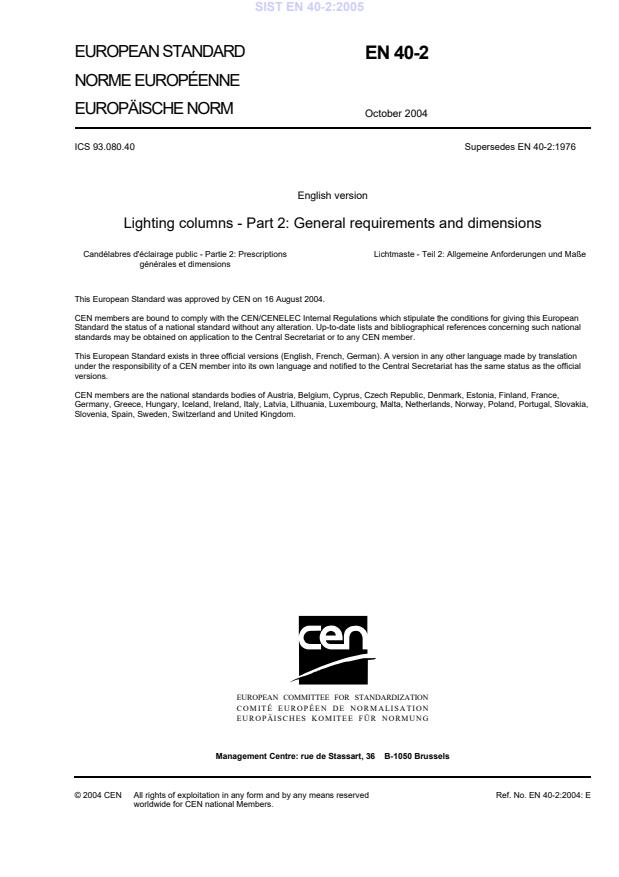
EUROPEAN STANDARDNORME EUROPÉENNEEUROPÄISCHE NORMEN 40-2October 2004ICS 93.080.40Supersedes EN 40-2:1976
English versionLighting columns - Part 2: General requirements and dimensionsCandélabres d'éclairage public - Partie 2: Prescriptionsgénérales et dimensionsLichtmaste - Teil 2: Allgemeine Anforderungen und MaßeThis European Standard was approved by CEN on 16 August 2004.CEN members are bound to comply with the CEN/CENELEC Internal Regulations which stipulate the conditions for giving this EuropeanStandard the status of a national standard without any alteration. Up-to-date lists and bibliographical references concerning such nationalstandards may be obtained on application to the Central Secretariat or to any CEN member.This European Standard exists in three official versions (English, French, German). A version in any other language made by translationunder the responsibility of a CEN member into its own language and notified to the Central Secretariat has the same status as the officialversions.CEN members are the national standards bodies of Austria, Belgium, Cyprus, Czech Republic, Denmark, Estonia, Finland, France,Germany, Greece, Hungary, Iceland, Ireland, Italy, Latvia, Lithuania, Luxembourg, Malta, Netherlands, Norway, Poland, Portugal, Slovakia,Slovenia, Spain, Sweden, Switzerland and United Kingdom.EUROPEAN COMMITTEE FOR STANDARDIZATIONCOMITÉ EUROPÉEN DE NORMALISATIONEUROPÄISCHES KOMITEE FÜR NORMUNGManagement Centre: rue de Stassart, 36
B-1050 Brussels© 2004 CENAll rights of exploitation in any form and by any means reservedworldwide for CEN national Members.Ref. No. EN 40-2:2004: ESIST EN 40-2:2005
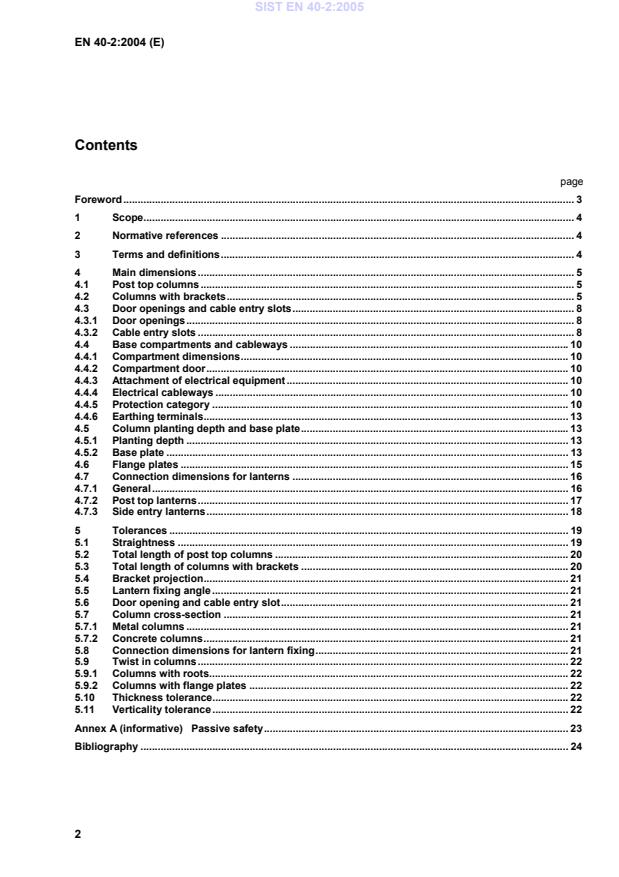
Passive safety.23 Bibliography.24
Table 1 — Nominal height for post top columns
h in m 3 4 5 6 7 8 9 10 12 14 15 16 18 20 h
Figure 1 — Nominal height (the shape of the column is not specified in this document)
4.2 Columns with brackets 4.2.1 The nominal height (h in m) shall be the height from ground level at the column to the height of the point of entry to the lantern as shown in Figure 2. SIST EN 40-2:2005
...
Questions, Comments and Discussion
Ask us and Technical Secretary will try to provide an answer. You can facilitate discussion about the standard in here.
Loading comments...