

EN 17681-2:2022
(Main)Textiles and textile products - Organic fluorine - Part 2: Determination of volatile compounds by extraction method using gas chromatography
- Abstract
This document specifies a test method (using gas chromatography, GC) for detection and quantification of selected extractable perfluorinated and polyfluorinated substances in textile materials (fibres, yarns, fabrics) and coated fabrics.
NOTE 1 CEN/TR 16741 defines which materials are applicable to this determination.
A test method (using liquid chromatography, LC) for detection and quantification of selected extractable perfluorinated and polyfluorinated substances is specified in EN 17681-1.
NOTE 2 Both this document and EN 17681-1 are needed for PFOA related substances.
Classes of regulated compounds are listed in Table 2. Classes of other non-regulated compounds that can be determined by this document are defined in Annex C, Table C.1. This document is also applicable for further PFAS substances provided that the method is validated with the additional compounds.
NOTE 3 Commission Delegated Regulation (EU) 2020/784 amending Annex I to the POP Regulation (EU) 2019/1021 as regards the listing of perfluorooctanoic acid (PFOA), its salts and PFOA-related compounds defines among other that “’…PFOA-related compounds’ means the following: … any substances that degrade to PFOA, including any substances (including salts and polymers) having a linear or branched perfluoroheptyl group with the moiety (C7F15)C as one of the structural elements.” To determine whether these are intentionally present it could be necessary to introduce an alkaline hydrolysis method to remove the side-chain from the polymer. According to Commission Regulation (EU) 2021/1297 [7], this applies similarly to C9-C14 PFCAs-related compounds. A future revision of this document will address this aspect.
- Status
- Published
- Publication Date
- 27-Sep-2022
- Technical Committee
- CEN/TC 248 - Textiles and textile products
- Drafting Committee
- CEN/TC 248/WG 26 - Methods of test for phthalates
- Current Stage
- 6060 - Definitive text made available (DAV) - Publishing
- Start Date
- 28-Sep-2022
- Due Date
- 24-Dec-2021
- Completion Date
- 28-Sep-2022



Overview
EN 17681-2:2022 - Textiles and textile products - Part 2: Determination of volatile organic fluorine compounds by extraction using gas chromatography - is a CEN standard that specifies a laboratory test method for detecting and quantifying selected extractable per‑ and polyfluoroalkyl substances (PFAS) in textile materials (fibres, yarns, fabrics) and coated fabrics. The method uses solvent extraction followed by analysis by gas chromatography (GC), typically with mass spectrometric detection (GC‑MS/MS, GC‑MS/PCI, GC‑MS/EI). The standard supports regulatory compliance related to PFOA, PFOS and related compounds and can be extended to additional PFAS after method validation.
Key topics and technical requirements
- Scope and applicability: Applies to volatile/extractable PFAS in textiles and coated materials; CEN/TR 16741 clarifies applicable materials.
- Principle: Solvent extraction of test specimen and instrumental analysis by GC with appropriate detectors and ion selection.
- Sampling and specimen preparation: Includes area‑based and mass‑based sampling rules and instructions for preparing test specimens.
- Reagents and equipment: Defines required solvents, internal standards and GC instrumentation options (GC‑MS/MS, GC‑MS with PCI or EI) and typical chromatographic conditions (Annex D).
- Analytical procedure: Preparation of stock and calibration solutions, internal standardization, extraction protocol and GC analysis (Sections 8.1–8.5).
- Quantification and quality criteria: Calibration, calculation of results, summation of PFAS groups, and determination of Limit of Detection (LoD) and Limit of Quantification (LoQ). Method reliability and reporting requirements are specified.
- Annexes:
- Annex A: usable ions and LOQ guidance for GC methods.
- Annex B: potential GC interferences.
- Annex C: list of non‑regulated PFAS that can be analyzed.
- Annex D: example chromatographic conditions.
- Regulatory context: Aligns with POP Regulation (EU) 2019/1021 and delegated/amending regulations addressing PFOA-related compounds and C9–C14 PFCAs. Note on possible need for alkaline hydrolysis for certain polymeric precursors (future revision to address).
Practical applications and users
- Compliance testing labs verifying textiles against EU POP and REACH/PFAS restrictions.
- Manufacturers and finishers performing incoming/outgoing quality control for oil/ water‑repellent finishes.
- Brand owners and retailers assessing supplier compliance and product safety.
- Environmental and forensic laboratories investigating PFAS contamination in fabrics and coated articles.
- Regulators and accreditation bodies setting test criteria and enforcement evidence.
Related standards
- EN 17681‑1:2022 - complementary method using liquid chromatography (LC) for selected extractable PFAS (both parts may be needed for PFOA‑related substances).
- CEN/TR 16741 - material applicability guidance.
- Relevant EU regulations: POP Regulation (EU) 2019/1021 (and Delegated Regulation 2020/784), Commission Regulation (EU) 2021/1297 (REACH restrictions).
Keywords: EN 17681-2:2022, PFAS testing, gas chromatography, GC‑MS, textiles, PFOA, PFOS, organic fluorine analysis, extraction method, LoD, LoQ.
Relations
- Effective Date
- 28-Jan-2026
- Effective Date
- 28-Jan-2026
- Effective Date
- 28-Jan-2026
- Effective Date
- 28-Jan-2026
Get Certified
Connect with accredited certification bodies for this standard

Control Union Certifications
Global certification for agriculture and sustainability.

Hohenstein Institut
Textile testing and certification.

Bureau Veritas Bangladesh
Bureau Veritas certification services in Bangladesh.
Sponsored listings
Frequently Asked Questions
EN 17681-2:2022 is a standard published by the European Committee for Standardization (CEN). Its full title is "Textiles and textile products - Organic fluorine - Part 2: Determination of volatile compounds by extraction method using gas chromatography". This standard covers: This document specifies a test method (using gas chromatography, GC) for detection and quantification of selected extractable perfluorinated and polyfluorinated substances in textile materials (fibres, yarns, fabrics) and coated fabrics. NOTE 1 CEN/TR 16741 defines which materials are applicable to this determination. A test method (using liquid chromatography, LC) for detection and quantification of selected extractable perfluorinated and polyfluorinated substances is specified in EN 17681-1. NOTE 2 Both this document and EN 17681-1 are needed for PFOA related substances. Classes of regulated compounds are listed in Table 2. Classes of other non-regulated compounds that can be determined by this document are defined in Annex C, Table C.1. This document is also applicable for further PFAS substances provided that the method is validated with the additional compounds. NOTE 3 Commission Delegated Regulation (EU) 2020/784 amending Annex I to the POP Regulation (EU) 2019/1021 as regards the listing of perfluorooctanoic acid (PFOA), its salts and PFOA-related compounds defines among other that “’…PFOA-related compounds’ means the following: … any substances that degrade to PFOA, including any substances (including salts and polymers) having a linear or branched perfluoroheptyl group with the moiety (C7F15)C as one of the structural elements.” To determine whether these are intentionally present it could be necessary to introduce an alkaline hydrolysis method to remove the side-chain from the polymer. According to Commission Regulation (EU) 2021/1297 [7], this applies similarly to C9-C14 PFCAs-related compounds. A future revision of this document will address this aspect.
This document specifies a test method (using gas chromatography, GC) for detection and quantification of selected extractable perfluorinated and polyfluorinated substances in textile materials (fibres, yarns, fabrics) and coated fabrics. NOTE 1 CEN/TR 16741 defines which materials are applicable to this determination. A test method (using liquid chromatography, LC) for detection and quantification of selected extractable perfluorinated and polyfluorinated substances is specified in EN 17681-1. NOTE 2 Both this document and EN 17681-1 are needed for PFOA related substances. Classes of regulated compounds are listed in Table 2. Classes of other non-regulated compounds that can be determined by this document are defined in Annex C, Table C.1. This document is also applicable for further PFAS substances provided that the method is validated with the additional compounds. NOTE 3 Commission Delegated Regulation (EU) 2020/784 amending Annex I to the POP Regulation (EU) 2019/1021 as regards the listing of perfluorooctanoic acid (PFOA), its salts and PFOA-related compounds defines among other that “’…PFOA-related compounds’ means the following: … any substances that degrade to PFOA, including any substances (including salts and polymers) having a linear or branched perfluoroheptyl group with the moiety (C7F15)C as one of the structural elements.” To determine whether these are intentionally present it could be necessary to introduce an alkaline hydrolysis method to remove the side-chain from the polymer. According to Commission Regulation (EU) 2021/1297 [7], this applies similarly to C9-C14 PFCAs-related compounds. A future revision of this document will address this aspect.
EN 17681-2:2022 is classified under the following ICS (International Classification for Standards) categories: 59.080.01 - Textiles in general. The ICS classification helps identify the subject area and facilitates finding related standards.
EN 17681-2:2022 has the following relationships with other standards: It is inter standard links to EN 17681-1:2025, EN ISO 4787:2021, EN ISO 5089:2016, EN 17681-1:2022. Understanding these relationships helps ensure you are using the most current and applicable version of the standard.
EN 17681-2:2022 is available in PDF format for immediate download after purchase. The document can be added to your cart and obtained through the secure checkout process. Digital delivery ensures instant access to the complete standard document.
Standards Content (Sample)
SLOVENSKI STANDARD
01-december-2022
Tekstil in tekstilni izdelki - Organski fluor - 2. del: Določevanje hlapnih spojin z
ekstrakcijsko metodo s plinsko kromatografijo
Textiles and textile products - Organic fluorine - Part 2: Determination of volatile
compounds by extraction method using gas chromatography
Textilien und textile Erzeugnisse - Organisches Fluor - Teil 2: Bestimmung des Gehaltes
an flüchtigen Verbindungen durch Extraktionsverfahren mittels Gaschromatographie
Textiles et produits textiles - Fluor organique - Partie 2 : Détermination de composés
volatils par une méthode d’extraction utilisant la chromatographie en phase gazeuse
Ta slovenski standard je istoveten z: EN 17681-2:2022
ICS:
59.080.01 Tekstilije na splošno Textiles in general
71.040.50 Fizikalnokemijske analitske Physicochemical methods of
metode analysis
2003-01.Slovenski inštitut za standardizacijo. Razmnoževanje celote ali delov tega standarda ni dovoljeno.
EN 17681-2
EUROPEAN STANDARD
NORME EUROPÉENNE
September 2022
EUROPÄISCHE NORM
ICS 59.080.01
English Version
Textiles and textile products - Organic fluorine - Part 2:
Determination of volatile compounds by extraction
method using gas chromatography
Textiles et produits textiles - Fluor organique - Partie 2 Textilien und textile Erzeugnisse - Organisches Fluor -
: Détermination de composés volatils par une méthode Teil 2: Bestimmung des Gehaltes an flüchtigen
d'extraction utilisant la chromatographie en phase Verbindungen durch Extraktionsverfahren mittels
gazeuse Gaschromatographie
This European Standard was approved by CEN on 24 July 2022.
CEN members are bound to comply with the CEN/CENELEC Internal Regulations which stipulate the conditions for giving this
European Standard the status of a national standard without any alteration. Up-to-date lists and bibliographical references
concerning such national standards may be obtained on application to the CEN-CENELEC Management Centre or to any CEN
member.
This European Standard exists in three official versions (English, French, German). A version in any other language made by
translation under the responsibility of a CEN member into its own language and notified to the CEN-CENELEC Management
Centre has the same status as the official versions.
CEN members are the national standards bodies of Austria, Belgium, Bulgaria, Croatia, Cyprus, Czech Republic, Denmark, Estonia,
Finland, France, Germany, Greece, Hungary, Iceland, Ireland, Italy, Latvia, Lithuania, Luxembourg, Malta, Netherlands, Norway,
Poland, Portugal, Republic of North Macedonia, Romania, Serbia, Slovakia, Slovenia, Spain, Sweden, Switzerland, Türkiye and
United Kingdom.
EUROPEAN COMMITTEE FOR STANDARDIZATION
COMITÉ EUROPÉEN DE NORMALISATION
EUROPÄISCHES KOMITEE FÜR NORMUNG
CEN-CENELEC Management Centre: Rue de la Science 23, B-1040 Brussels
© 2022 CEN All rights of exploitation in any form and by any means reserved Ref. No. EN 17681-2:2022 E
worldwide for CEN national Members.
EN 17861-2:2022 (E)
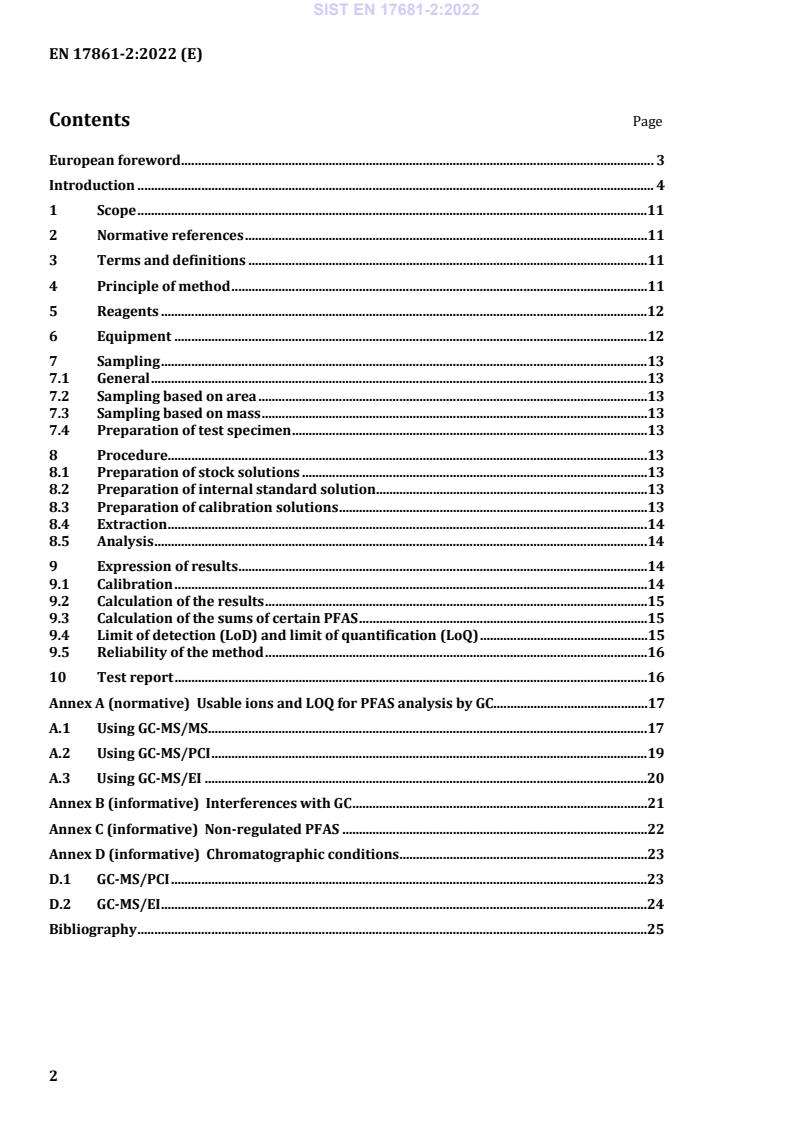
Contents Page
European foreword . 3
Introduction . 4
1 Scope .11
2 Normative references .11
3 Terms and definitions .11
4 Principle of method .11
5 Reagents .12
6 Equipment .12
7 Sampling .13
7.1 General .13
7.2 Sampling based on area .13
7.3 Sampling based on mass .13
7.4 Preparation of test specimen .13
8 Procedure.13
8.1 Preparation of stock solutions .13
8.2 Preparation of internal standard solution .13
8.3 Preparation of calibration solutions .13
8.4 Extraction .14
8.5 Analysis .14
9 Expression of results .14
9.1 Calibration .14
9.2 Calculation of the results .15
9.3 Calculation of the sums of certain PFAS .15
9.4 Limit of detection (LoD) and limit of quantification (LoQ) .15
9.5 Reliability of the method .16
10 Test report .16
Annex A (normative) Usable ions and LOQ for PFAS analysis by GC.17
A.1 Using GC-MS/MS .17
A.2 Using GC-MS/PCI .19
A.3 Using GC-MS/EI .20
Annex B (informative) Interferences with GC .21
Annex C (informative) Non-regulated PFAS .22
Annex D (informative) Chromatographic conditions .23
D.1 GC-MS/PCI .23
D.2 GC-MS/EI .24
Bibliography .25
European foreword
This document (EN 17681-2:2022) has been prepared by Technical Committee CEN/TC 248 “Textiles
and textile products”, the secretariat of which is held by BSI.
This European Standard shall be given the status of a national standard, either by publication of an
identical text or by endorsement, at the latest by March 2023, and conflicting national standards shall be
withdrawn at the latest by March 2023.
Attention is drawn to the possibility that some of the elements of this document may be the subject of
patent rights. CEN shall not be held responsible for identifying any or all such patent rights.
Any feedback and questions on this document should be directed to the users’ national standards body.
A complete listing of these bodies can be found on the CEN website.
According to the CEN-CENELEC Internal Regulations, the national standards organisations of the
following countries are bound to implement this European Standard: Austria, Belgium, Bulgaria, Croatia,
Cyprus, Czech Republic, Denmark, Estonia, Finland, France, Germany, Greece, Hungary, Iceland, Ireland,
Italy, Latvia, Lithuania, Luxembourg, Malta, Netherlands, Norway, Poland, Portugal, Republic of North
Macedonia, Romania, Serbia, Slovakia, Slovenia, Spain, Sweden, Switzerland, Türkiye and the United
Kingdom.
EN 17861-2:2022 (E)
Introduction
In the European Union, according to Regulation (EU) 2019/1021 on persistent organic pollutants (POP),
Article 3, Clause 1, in connection with Annex I amended by Commission Delegated Regulation
(EU) 2020/784, the manufacturing, placing on the market and use of perfluorooctanoic acid (PFOA), its
salts and PFOA-related compounds, whether on their own, in mixtures or in articles, is prohibited. This
is in addition to the existing prohibition of perfluorooctane sulfonic acid and its derivatives (PFOS).
According to Article 4 Clause 1. (b) this does not apply in the case of a substance present as an
unintentional trace contaminant, as specified in the relevant entries of Annex I in substances, mixtures
or articles.
Annex I Part A, describing perfluorooctane sulfonic acid and its derivatives (PFOS), contains the specific
exemption (Point 2) to concentrations of PFOS in semi-finished products or articles, or parts thereof, if
the concentration of PFOS is lower than 0,1 % mass fraction calculated with reference to the mass of
structurally or micro-structurally distinct parts that contain PFOS or, for textiles or other coated
materials, if the amount of PFOS is lower than 1 μg/m of the coated material. PFOS compounds have the
+
formula C F SO X where X = OH, Metal salt (O-M ), halide, amide and other derivatives, including
8 17 2
polymers.
In Annex I Part A, describing perfluorooctanoic acid (PFOA), its salts and PFOA-related compounds,
contains the specific exemption (Point 1) to concentrations of PFOA or any of its salts equal to or below
0,025 mg/kg (0,000 002 5 % mass fraction) where they are present in substances, mixtures or articles.
In addition, (Point 2) Article 4(1) applies to concentrations of any individual PFOA-related compound or
a combination of PFOA-related compounds equal to or below 1 mg/kg (0,000 1 % mass fraction) where
they are present in substances, mixtures or articles.
PFOA, its salts and PFOA-related compounds means the following:
i) perfluorooctanoic acid, including any of its branched isomers;
ii) its salts;
iii) PFOA-related compounds which, for the purposes of the Convention, are any substances that degrade
to PFOA, including any substances (including salts and polymers) having a linear or branched
perfluoroheptyl group with the moiety (C F )C as one of the structural elements.
7 15
The following compounds are not included as PFOA-related compounds:
iv) C F -X, where X = F, Cl, Br;
8 17
v) fluoropolymers that are covered by CF [CF ] -R’, where R’ = any group, n > 16;
3 2 n
vi) perfluoroalkyl carboxylic acids (including their salts, esters, halides and anhydrides) with ≥ 8
perfluorinated carbons;
vii) perfluoroalkane sulfonic acids and perfluoro phosphonic acids (including their salts, esters, halides
and anhydrides) with ≥ 9 perfluorinated carbons;
viii) perfluorooctane sulfonic acid and its derivatives (PFOS), as listed in Annex I.
As a further exemption in Annex I Part A (Point 5 c) the manufacturing, placing on the market and use of
PFOA, its salts and PFOA-related compounds is allowed in textiles for oil and water repellency for the
protection of workers from dangerous liquids that comprise risks to their health and safety, until 4 July
2023.
Commission Regulation (EU) 2021/1297 amending Regulation (EC) No 1907/2006 (REACH), Annex
XVII [7] restricts perfluorocarboxylic acids containing 9 to 14 carbon atoms in the chain (C9-C14 PFCAs),
their salts and C9-C14 PFCA-related substances from 25 February 2023.
This restriction concerns the following substances:
Linear and branched perfluorocarboxylic acids of the formula C F -C(= O)OH where n = 8, 9, 10, 11,
n 2n+1
12, or 13 (C9-C14 PFCAs), including their salts, and any combinations thereof;
Any C9-C14 PFCA-related substance having a perfluoro group with the formula C F - directly attached
n 2n+1
to another carbon atom, where n = 8, 9, 10, 11, 12, or 13, including their salts and any combinations
thereof;
Any C9-C14 PFCA-related substance having a perfluoro group with the formula C F - that it is not
n 2n+1
directly attached to another carbon atom, where n = 9, 10, 11, 12, 13 or 14 as one of the structural
elements, including their salts and any combinations thereof.
The following substances are excluded from this designation:
C F -X, where X = F, Cl, or Br
n 2n+1
where n = 9, 10, 11, 12, 13 or 14, including any combinations thereof,
C F -C(= O)OX' where n > 13 and X' = any group, including salts.
n 2n+1
Several per- and poly-fluorinated alkylated substances (PFAS), which are not restricted under the POP
Regulation have been added as Substances of Very High Concern (SVHC) to the Candidate List according
to Regulation (EC) No 1907/2006 (REACH), Article 59.
Per- and poly-fluorinated compounds from C4 – C14 (PFAS) occur, for example, in soil and water repellent
finishes within textiles or can be introduced as contaminants (for example from water sources).
Categories of PFAS are shown in Table 1. Table 2 lists classes of regulated compounds (i.e. listed in a
Regulation) including acids, telomers, sulfonates and sulfonamidalcohols. Compounds of concern (i.e. not
listed yet in a Regulation) are shown in the informative Annex C.
EN 17861-2:2022 (E)
Table 1 — Categories of PFAS
Applications
Type of PFAS Sub-group Category
a
Use
Sources of contamination
Surfactant in fire-fighting foam, emulsifier in
+ +
K , Li , diethanolamine
floor polish, mist suppressant for metal plating
Surfactant for alkaline
(DEA) salt
baths, surfactant for etching acids for circuit A
cleaners
boards, pesticide active ingredient for ant bait
analysed as acids
traps
PFAS salts
Amines - Mist suppressant for metal plating baths B
Ammonium salts
- Emulsifier for fluoropolymer production C
analysed as acids
Water/solvent repellence
Amphoterics - D
for leather/paper
Carboxylates - Antistatic agent in photographic paper E
PFAS substances Amides - Pesticide active ingredient F
Oxazolidinones - Waterproofing casts (electronics) G
Alcohols, silanes, Soil and water repellence
alkoxylates, fatty acid esters, for carpets, fabrics,
- H
adipates, urethanes, upholstery, apparel,
polyesters, acrylates leather, metal, glass
PFAS
polymers/oligomers
Water repellence for
Soil/oil/water repellence for plates, food
Copolymers, phosphate carpets, fabrics, upholstery,
containers, bags, wraps, folding cartons, I
esters apparel, leather, metal,
containers, carbonless forms, masking papers
glass
a
These substances are not relevant in the manufacturing process of textiles but it is possible to find them as contaminants.
Table 2 — Regulated PFAS
CAS Registry Applicable test method
PFAS
EU
Number®
No. Substance category
a
regulation
1 EN 17681-1 EN 17681-2
(Table 1)
(CAS RN®)
Perfluorinated carboxylic acids
under
1 PFHxA Perfluoro-n-hexanoic acid 307–24–4 x evaluation A and C
(REACH)
POP and
b
2 PFOA Perfluoro-n-octanoic acid 335–67–1 x A and C
REACH (SVHC)
APFO C
Perfluoro-n-octanoic acid salts
3825–26–1
- Ammonium pentadecafluorooctanoate
Na-PFO A
335–95–5
- Sodium perfluorooctanoate
b
K-PFO 2395–00–8 x POP A
2.2
- Potassium perfluorooctanoate
335–93–3
Ag-PFO A
- Silver perfluorooctanoate
335–66–0
F-PFO - Perfluorooctanoyl fluoride A
b
3 8:2 FTS 1H,1H,2H,2H-Perfluorodecanesulfonic acid 39108–34–4 x POP A
b
Me-PFOA Methyl perfluorooctanoate 376–27–2 x POP H
b
Et-PFOA Ethyl perfluorooctanoate 3108–24–5 x POP H
REACH
6 PFNA Perfluoro-n-nonanoic acid 375–95–1 x Annex XVII
and SVHC
Perfluoro-n-nonanoic acid salts REACH
NH -PFN
- Ammonium perfluorononanoate 4149–60–4 Annex XVII
6.2 x
Na-PFN
- Sodium perfluorononanoate 21049–39–8 and SVHC
CAS Registry Number® (CAS RN®) is a trademark of CAS corporation. This information is given for the convenience of users of this document and does not
constitute an endorsement by CEN of the product named. Equivalent products may be used if they can be shown to lead to the same results.
EN 17861-2:2022 (E)
CAS Registry Applicable test method PFAS
EU
Number®
No. Substance category
a
regulation
1 EN 17681-1 EN 17681-2
(Table 1)
(CAS RN®)
REACH
7 PFDA Perfluoro-n-decanoic acid 335–76–2 x Annex XVII
and SVHC
Perfluoro-n-decanoic acid salts REACH
NH -PFD
7.2 - Ammonium perfluorodecanoate 3830–45–3 x Annex XVII
Na-PFD
- Sodium perfluorodecanoate 3108–42–7 and SVHC
REACH
8 PFUnA Perfluoroundecanoic acid 2058–94–8 x Annex XVII
and SVHC
REACH
9 PFDoA Perfluorododecanoic acid 307–55–1 x Annex XVII
and SVHC
REACH
10 PFTrDA Perfluorotridecanoic acid 72629–94–8 x Annex XVII
and SVHC
REACH
11 PFTeDA Perfluorotetradecanoic acid 376–06–7 x Annex XVII
and SVHC
REACH
12 PF-3,7-DMOA Perfluoro(3,7-dimethyloctanoic acid) 172155–07–6 x
Annex XVII
b
4HPFUnA 2H,2H,3H,3H-Heptadecafluoroundecanoic acid 34598–33–9 x POP
Perfluorinated sulfonic acids
14 PFBS Perfluorobutanesulfonic acid 375–73–5 x REACH (SVHC) A
15 PFHxS Perfluorohexanesulfonic acid 355–46–4 x REACH (SVHC) H
c
PFOS Perfluorooctanesulfonic acid 1763–23–1 x POP H
CAS Registry Applicable test method PFAS
EU
Number®
No. Substance category
a
regulation
1 EN 17681-1 EN 17681-2
(Table 1)
(CAS RN®)
Perfluorooctane sulfonic acid salts C F SO X A
8 17 2
2795–39–3
- Potassium perfluorooctane sulfonate
A
29457–72–5
- Lithium perfluorooctane sulfonate
c
x POP A
16.2 PFOS-X
29081–56–9
- Ammonium perfluorooctane sulfonate
A
70225–14–8
- Bis2(hydroxyethyl)ammonium perfluorooctane sulfonate
56773–42–3
- Tetraethyl ammonium heptadecafluorooctane sulfonate A
Perfluoro-octanesulfonamides (FOSA)
c
17 PFOSA Perfluorooctane sulfonamide 754–91–6 x POP F
c
18 N-MeFOSA N-Methylperfluoro-1-octanesulfonamide 31506–32–8 x POP F
c
N-EtFOSA N-Ethylperfluoro-1-octanesulfonamide 4151–50–2 x POP F
Perfluoro-octanesulfonamido ethanol (FOSE)
c
N-MeFOSE 2-(N-methylperfluoro-1-octanesulfonamideo)-ethanol 24448–09–7 x x POP H
c
21 N-EtFOSE 2-(N-Ethylperfluoro-1-octanesulfonamido)-ethanol 1691–99–2 x x POP H
Fluorinated telomer alcohols (FTOH)
b
22 8:2 FTOH 2-Perfluorooctylethanol 678–39–7 x POP H
REACH
23 10:2 FTOH 2-Perfluorodecylethanol 865–86–1 x H
a
Annex XVII
Fluorinated telomer acrylates
b
24 8:2 FTA 1H,1H,2H,2H-Perfluorodecyl acrylate 27905–45–9 x POP H
REACH
25 10:2 FTA 1H,1H,2H,2H-Perfluorododecyl acrylate 17741–60–5 x H
a
Annex XVII
EN 17861-2:2022 (E)
CAS Registry Applicable test method PFAS
EU
Number®
No. Substance category
a
regulation
1 EN 17681-1 EN 17681-2
(Table 1)
(CAS RN®)
Other
c
26 PFOSF Heptadecafluorooctanesulfonyl fluoride 307–35–7 x POP
b
27 8:2 FTMA 1H,1H,2H,2H-heptadecafluorodecylmethacrylate 1996–88–9 x POP
1-decanaminium, N-decyl-N, N dimethyl-
28 0,1,1,2,2,3,3,4,4,5,5,6,6,7,7,8,8,8-heptadecafluoro-1- 251099–16–8 x POP A
octanesulfonate
REACH
29 HPFO-DA 2,3,3,3-tetrafluoro-2-(heptafluoropropoxy)propionic acid 13252–13–6 x A and C
(SVHC)
2,3,3,3-tetrafluoro-2-(heptafluoropropoxy)propionic acid
salts and acyl halides
REACH
d
X = F
HPFO-DA -X 21062–98–8 x A and C
29.2
(SVHC)
X = NH
62037–80–3 x
67118–55–2 x
X = K
a
Table 2 states the situation of the regulated PFAS on 2022–06–23 and might not be exhaustive. Readers should pay attention for updated information. Regulation (EU)
2021/1297 on C -C carboxylic acid substances will be enforced in 02/2023.
9 14
b
The results of PFOA and related substances to be summed up.
c
The results of PFOS and related substances to be summed up – calculated as PFOS.
d
For the halides a hydrolysation with water from the methanol extract is necessary.
1 Scope
This document specifies a test method (using gas chromatography, GC) for detection and quantification
of selected extractable perfluorinated and polyfluorinated substances in textile materials (fibres, yarns,
fabrics) and coated fabrics.
NOTE 1 CEN/TR 16741 defines which materials are applicable to this determination.
A test method (using liquid chromatography, LC) for detection and quantification of selected extractable
perfluorinated and polyfluorinated substances is specifi
...