

EN 16025-1:2013
(Main)Thermal and/or sound insulating products in building construction - Bound EPS ballastings - Part 1: Requirements for factory premixed EPS dry plaster
- Abstract
This European Standard specifies the requirements for in-situ formed bound EPS products (BEPS) for the thermal and/or sound insulation of buildings when applied to walls, ceilings, roofs and floors.
This European Standard covers products which are manufactured as premixed EPS dry plaster/mortar in a factory or mobile production unit.
This European Standard is a specification for the bound EPS products before installation.
This European Standard describes the product characteristics and includes procedures for testing, marking and labelling and the rules for evaluation of conformity.
This European Standard does not specify the required class or level of a given property to be achieved by a product to demonstrate fitness for purpose in a particular application. The classes and levels required for a given application are to be found in regulations or non-conflicting standards.
Products with a declared thermal conductivity at 10 °C greater than 0,18 W/(m . K) are not covered by this European Standard.
This European Standard does not cover factory made insulation products in the form of prefabricated shapes or boards made of bound EPS.
This European Standard also specifies performance requirements for airborne sound insulation and for acoustic absorption applications.
- Status
- Published
- Publication Date
- 30-Apr-2013
- Withdrawal Date
- 29-Nov-2013
- Technical Committee
- CEN/TC 88 - Thermal insulating materials and products
- Drafting Committee
- CEN/TC 88/WG 15 - In situ formed insulation products
- Current Stage
- 6060 - Definitive text made available (DAV) - Publishing
- Start Date
- 01-May-2013
- Due Date
- 03-Jun-2013
- Completion Date
- 01-May-2013


Overview
EN 16025-1:2013 - "Thermal and/or sound insulating products in building construction - Bound EPS ballastings - Part 1: Requirements for factory premixed EPS dry plaster" is a CEN European Standard that defines the product requirements, testing procedures, marking and conformity rules for in-situ formed bound expanded polystyrene (BEPS) products manufactured as factory premixed EPS dry plaster/mortar. It covers premixed dry EPS mortar produced in a factory or mobile unit (pre-installation product specification) used for thermal and/or acoustic insulation of walls, ceilings, roofs and floors. Products with declared thermal conductivity at 10 °C greater than 0.18 W/(m·K) and prefabricated boards/shapes are excluded.
Key topics and technical requirements
- Product scope: Factory premixed EPS dry mortar for producing bound EPS (BEPS) - not prefabricated boards.
- Declared properties: Thermal conductivity (λD), density, thickness, and acoustic properties such as airborne sound insulation and absorption.
- Mechanical and durability characteristics: Tests and requirements for compressive stress (e.g., at 2 % and 10 % deformation), compressibility, compressive creep, and apparent density.
- Moisture performance: Water vapour diffusion resistance (µ) and short-term water absorption by partial immersion.
- Acoustic measures: Dynamic stiffness for floating floor applications and performance for airborne sound insulation and acoustic absorption.
- Reaction to fire: Assessment procedures using standardised assemblies (includes EN 13501-1 and EN 13823 referenced methods).
- Quality & conformity: Initial type testing (ITT), factory production control (FPC), marking, labelling, designation code and CE marking procedures for attestation of conformity.
- Testing methods: References and procedures for sampling, specimen preparation and specific test standards (guarded hot plate, heat flow meter, etc.).
Applications
- Thermal insulation in masonry, partitions, flat roofs, pitched roofs, floors and ceilings where in-situ bound EPS mortar is used.
- Acoustic insulation and impact/noise control applications (floating floors, sound-absorbing layers).
- Use cases requiring factory-controlled premixed dry mortar for on-site hydration and installation.
Who should use this standard
- Manufacturers of premixed EPS dry plaster and mobile production units
- Specifiers and architects selecting BEPS for building thermal/acoustic performance
- Testing laboratories performing conformity and type testing
- Construction contractors and installers applying in-situ bound EPS systems
- Compliance officers and regulators verifying CE marking and conformity to EU construction product rules
Related standards (selected)
- EN 16025-2 (processing/installation)
- EN 1602, EN 1606, EN 1609 (density, creep, water absorption)
- EN 12667 / EN 12939 (thermal resistance methods)
- EN 13501-1, EN 13823 (reaction to fire)
- EN ISO 9229 (vocabulary)
Keywords: EN 16025-1:2013, bound EPS, BEPS, factory premixed EPS dry plaster, thermal insulation, acoustic insulation, EPS dry mortar, CE marking, conformity, reaction to fire.
Relations
- Effective Date
- 04-Feb-2026
- Effective Date
- 28-Jan-2026
- Effective Date
- 28-Jan-2026
- Effective Date
- 28-Jan-2026
- Effective Date
- 28-Jan-2026
- Effective Date
- 28-Jan-2026
- Effective Date
- 28-Jan-2026
- Effective Date
- 28-Jan-2026
- Effective Date
- 28-Jan-2026
- Effective Date
- 28-Jan-2026
- Effective Date
- 28-Jan-2026
- Effective Date
- 28-Jan-2026
- Effective Date
- 28-Jan-2026
- Effective Date
- 28-Jan-2026
- Effective Date
- 28-Jan-2026
Get Certified
Connect with accredited certification bodies for this standard

DIBt (Deutsches Institut für Bautechnik)
German Institute for Building Technology.
DIN CERTCO
DIN Group product certification.

Aboma Certification B.V.
Specialized in construction, metal, and transport sectors.
Sponsored listings
Frequently Asked Questions
EN 16025-1:2013 is a standard published by the European Committee for Standardization (CEN). Its full title is "Thermal and/or sound insulating products in building construction - Bound EPS ballastings - Part 1: Requirements for factory premixed EPS dry plaster". This standard covers: This European Standard specifies the requirements for in-situ formed bound EPS products (BEPS) for the thermal and/or sound insulation of buildings when applied to walls, ceilings, roofs and floors. This European Standard covers products which are manufactured as premixed EPS dry plaster/mortar in a factory or mobile production unit. This European Standard is a specification for the bound EPS products before installation. This European Standard describes the product characteristics and includes procedures for testing, marking and labelling and the rules for evaluation of conformity. This European Standard does not specify the required class or level of a given property to be achieved by a product to demonstrate fitness for purpose in a particular application. The classes and levels required for a given application are to be found in regulations or non-conflicting standards. Products with a declared thermal conductivity at 10 °C greater than 0,18 W/(m . K) are not covered by this European Standard. This European Standard does not cover factory made insulation products in the form of prefabricated shapes or boards made of bound EPS. This European Standard also specifies performance requirements for airborne sound insulation and for acoustic absorption applications.
This European Standard specifies the requirements for in-situ formed bound EPS products (BEPS) for the thermal and/or sound insulation of buildings when applied to walls, ceilings, roofs and floors. This European Standard covers products which are manufactured as premixed EPS dry plaster/mortar in a factory or mobile production unit. This European Standard is a specification for the bound EPS products before installation. This European Standard describes the product characteristics and includes procedures for testing, marking and labelling and the rules for evaluation of conformity. This European Standard does not specify the required class or level of a given property to be achieved by a product to demonstrate fitness for purpose in a particular application. The classes and levels required for a given application are to be found in regulations or non-conflicting standards. Products with a declared thermal conductivity at 10 °C greater than 0,18 W/(m . K) are not covered by this European Standard. This European Standard does not cover factory made insulation products in the form of prefabricated shapes or boards made of bound EPS. This European Standard also specifies performance requirements for airborne sound insulation and for acoustic absorption applications.
EN 16025-1:2013 is classified under the following ICS (International Classification for Standards) categories: 91.100.60 - Thermal and sound insulating materials. The ICS classification helps identify the subject area and facilitates finding related standards.
EN 16025-1:2013 has the following relationships with other standards: It is inter standard links to EN ISO 11925-2:2026, EN 13823:2010, EN 1609:2013, EN ISO 16534:2020, EN 13172:2012, EN ISO 9229:2007, EN ISO 29470:2020, EN ISO 29469:2022, EN 12086:2013, EN 13501-1:2018, EN 12350-6:2019, EN ISO 11925-2:2020, EN 12667:2001, EN 29052-1:1992, EN 933-1:2012. Understanding these relationships helps ensure you are using the most current and applicable version of the standard.
EN 16025-1:2013 is associated with the following European legislation: EU Directives/Regulations: 305/2011, 89/106/EEC; Standardization Mandates: M/103. When a standard is cited in the Official Journal of the European Union, products manufactured in conformity with it benefit from a presumption of conformity with the essential requirements of the corresponding EU directive or regulation.
EN 16025-1:2013 is available in PDF format for immediate download after purchase. The document can be added to your cart and obtained through the secure checkout process. Digital delivery ensures instant access to the complete standard document.
Standards Content (Sample)
2003-01.Slovenski inštitut za standardizacijo. Razmnoževanje celote ali delov tega standarda ni dovoljeno.Dämmstoffe für den Wärme- und/oder Schallschutz im Hochbau - Gebundene EPS-Schüttungen - Teil 1: Anforderungen an den werkmäßig vorgemischten EPS-TrockenmörtelProduits isolants thermiques et/ou acoustiques utilisés dans la construction - Empierrements en PSE lié - Partie 1: Exigences pour un pré-mélange en usine plâtre sec PSEThemal and/or sound insulating products in building construction - Bound EPS ballastings - Part 1: Requirements for factory premixed EPS dry plaster91.100.60Thermal and sound insulating materialsICS:Ta slovenski standard je istoveten z:EN 16025-1:2013SIST EN 16025-1:2013en,fr,de01-oktober-2013SIST EN 16025-1:2013SLOVENSKI
STANDARD
EUROPEAN STANDARD NORME EUROPÉENNE EUROPÄISCHE NORM
EN 16025-1
May 2013 ICS 91.100.60 English Version
Thermal and/or sound insulating products in building construction - Bound EPS ballastings - Part 1: Requirements for factory premixed EPS dry plaster
Produits isolants thermiques et/ou acoustiques utilisés dans la construction des bâtiments - Empierrements en PSE lié - Partie 1: exigences pour un pré-mélange en usine plâtre sec PSE
Wärmedämmstoffe für den Wärme- und/oder Schallschutz im Hochbau - Gebundene EPS-Schüttungen - Teil 1: Anforderungen an den werkmäßig vorgemischten EPS-Trockenmörtel This European Standard was approved by CEN on 23 February 2013.
CEN members are bound to comply with the CEN/CENELEC Internal Regulations which stipulate the conditions for giving this European Standard the status of a national standard without any alteration. Up-to-date lists and bibliographical references concerning such national standards may be obtained on application to the CEN-CENELEC Management Centre or to any CEN member.
This European Standard exists in three official versions (English, French, German). A version in any other language made by translation under the responsibility of a CEN member into its own language and notified to the CEN-CENELEC Management Centre has the same status as the official versions.
CEN members are the national standards bodies of Austria, Belgium, Bulgaria, Croatia, Cyprus, Czech Republic, Denmark, Estonia, Finland, Former Yugoslav Republic of Macedonia, France, Germany, Greece, Hungary, Iceland, Ireland, Italy, Latvia, Lithuania, Luxembourg, Malta, Netherlands, Norway, Poland, Portugal, Romania, Slovakia, Slovenia, Spain, Sweden, Switzerland, Turkey and United Kingdom.
EUROPEAN COMMITTEE FOR STANDARDIZATION
COMITÉ EUROPÉEN DE NORMALISATION EUROPÄISCHES KOMITEE FÜR NORMUNG
Management Centre:
Avenue Marnix 17,
B-1000 Brussels © 2013 CEN All rights of exploitation in any form and by any means reserved worldwide for CEN national Members. Ref. No. EN 16025-1:2013: ESIST EN 16025-1:2013
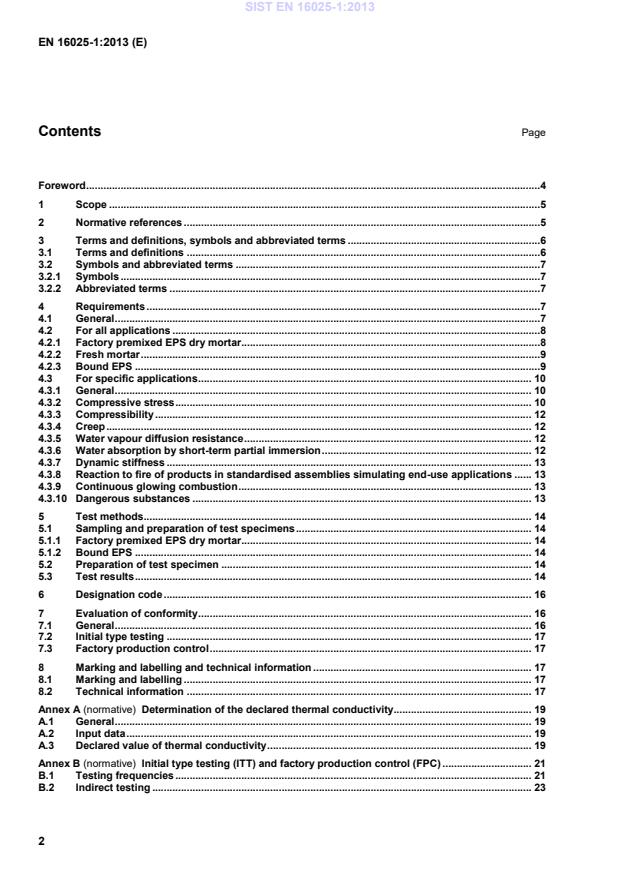
Foreword .4 1 Scope .5 2 Normative references .5 3 Terms and definitions, symbols and abbreviated terms .6 3.1 Terms and definitions .6 3.2 Symbols and abbreviated terms .7 3.2.1 Symbols .7 3.2.2 Abbreviated terms .7 4 Requirements .7 4.1 General .7 4.2 For all applications .8 4.2.1 Factory premixed EPS dry mortar .8 4.2.2 Fresh mortar .9 4.2.3 Bound EPS .9 4.3 For specific applications . 10 4.3.1 General . 10 4.3.2 Compressive stress . 10 4.3.3 Compressibility . 12 4.3.4 Creep . 12 4.3.5 Water vapour diffusion resistance . 12 4.3.6 Water absorption by short-term partial immersion . 12 4.3.7 Dynamic stiffness . 13 4.3.8 Reaction to fire of products in standardised assemblies simulating end-use applications . 13 4.3.9 Continuous glowing combustion . 13 4.3.10 Dangerous substances . 13 5 Test methods . 14 5.1 Sampling and preparation of test specimens . 14 5.1.1 Factory premixed EPS dry mortar . 14 5.1.2 Bound EPS . 14 5.2 Preparation of test specimen . 14 5.3 Test results . 14 6 Designation code . 16 7 Evaluation of conformity . 16 7.1 General . 16 7.2 Initial type testing . 17 7.3 Factory production control . 17 8 Marking and labelling and technical information . 17 8.1 Marking and labelling . 17 8.2 Technical information . 17 Annex A (normative)
Determination of the declared thermal conductivity. 19 A.1 General . 19 A.2 Input data . 19 A.3 Declared value of thermal conductivity . 19 Annex B (normative)
Initial type testing (ITT) and factory production control (FPC) . 21 B.1 Testing frequencies . 21 B.2 Indirect testing . 23 SIST EN 16025-1:2013
Annex C (normative)
Testing for reaction to fire of products . 24 C.1 Scope . 24 C.2 Product and installation parameters . 24 C.3 Standardised Mounting and fixing . 25 C.4 Fixing of the test specimen . 26 C.5 Field of application . 27 Annex ZA (informative)
Clauses of this European Standard addressing the provisions of the EU Construction Products Directive . 29 ZA.1 Scope and relevant characteristics . 29 ZA.2 Procedure for attestation of factory made bound EPS products . 31 ZA.3 CE marking and labelling. 34 Bibliography . 36
EN 13501-1, Fire classification of construction products and building elements — Part 1: Classification using data from reaction to fire tests EN 13823:2010, Reaction to fire tests for building products — Building products excluding floorings exposed to the thermal attack by a single burning item EN 29052-1, Acoustics — Determination of dynamic stiffness — Part 1: Materials used under floating floors in dwellings EN ISO 9229:2007, Thermal insulation — Vocabulary (ISO 9229:2007) EN ISO 11925-2, Reaction to fire tests — Ignitability of products subjected to direct impingement of flame — Part 2: Single-flame source test (ISO 11925-2) 3 Terms and definitions, symbols and abbreviated terms
3.1 Terms and definitions For the purposes of this document, the terms and definitions given in EN ISO 9229:2007 and the following apply. 3.1.1 fresh mortar EPS dry mortar mixed with water on the construction site 3.1.2 bound EPS (BEPS) installed and hardened fresh mortar for use as insulating material for thermal and/or impact noise insulation 3.1.3 class combination of two levels of the same or different property between which the performance falls, where the levels are given by the declared value of the characteristic concerned 3.1.4 level given value, which is the upper or lower limit of a requirement Note 1 to entry: The level is given by the declared value of the characteristic concerned. 3.1.5 factory premixed EPS dry mortar loose dry mixture of EPS aggregate and mineral binder for producing bound EPS SIST EN 16025-1:2013
% λ90/90 90 % fractile with a confidence level of 90 % for the thermal conductivity W/(m ⋅ K) λD declared value of thermal conductivity W/(m ⋅ K) λU=design value of thermal conductivity W/(m ⋅ K) µ water vapour diffusion resistance factor 1 s′ dynamic stiffness MN/m3 σ2 compressive stress at 2 % deformation kPa σ10 compressive stress at 10 % deformation kPa σc compressive stress kPa Wp water absorption by short-term partial immersion kg/m2 CC(i1/i2/25)σc declared level for compressive creep
CP declared level for compressibility
CS(2) declared level for compressive stress at 2 % deformation
CS(10) declared level for compressive stress at 10 % deformation
DLT declared level for dimensional stability under load and temperature conditions
DMD bound EPS density
FMD apparent density of fresh mortar
LD bulk density of the EPS dry mortar
MU declared range of the water vapour resistance factor
PS particle size group
SD declared level for dynamic stiffness
3.2.2 Abbreviated terms BEPS Bound EPS EPS Expanded PolyStyrene ITT Initial Type Test 4 Requirements 4.1 General Product properties shall be assessed in accordance with Clause 5. To comply with this document, products shall meet the requirements of 4.2, and the requirements of 4.3 as appropriate. SIST EN 16025-1:2013
in mm PS10 ≤ 10 PS8 ≤ 8 PS6 ≤ 6 PS5 ≤ 5 PS2 ≤ 2
The amount of dust (0 mm to 0,5 mm) in the EPS beads, regarding to the volume, shall be determined in accordance with EN 933-1. The level shall be determined according to Table 2 and recorded during the factory production control process. Table 2 — Levels of the percentage of dust (0 mm to 0,5 mm) Level Amount of dust D0 < 1 vol-% D5 < 5 vol-% D10 < 10 vol-%
4.2.1.3 Mineral binder (e.g. cement, mixtures produced by the manufacturer, including additives) The manufacturer shall inform the testing body of the binder’s active ingredients, to monitor the mixing of binder ingredients and to keep records thereon. This obligation can be waived if a ready mixed, supervised binder is used. SIST EN 16025-1:2013
production, determined with a confidence level of 90 %; the value of thermal conductivity, λ90/90, shall be rounded upwards to the nearest 0,001 W/(m ⋅ K) and
declared as λD in levels with steps of 0,001 W/(m ⋅ K). NOTE The declaration of the declared installed thermal resistance for an installed bound EPS product is given in EN 16025-2. 4.2.3.2 Bound EPS density Bound EPS density shall be determined in accordance with EN 1602 and shall be indicated by the manufacturer rounded to 1 kg/m3. The tolerances shall not exceed the values given in Table 3. NOTE There is a relationship between the thermal conductivity, dynamic stiffness, compressive stress, compressibility and the bulk density of the EPS dry mortar. SIST EN 16025-1:2013
value Mean Individual
value Bulk density of the EPS dry mortar ± 10 % ± 15 % ± 7 % ± 10 % Apparent density of fresh mortar ± 10 % ± 15 % ± 7 % ± 10 % Bound EPS density ± 10 % ± 15 % ± 7 % ± 10 %
4.2.3.3 Reaction to fire The reaction to fire classification of the products placed on the market but not simulating the end-use application shall be determined in accordance with Annex C and EN 13501-1 and using data obtained from tests carried out according to procedures EN ISO 11925-2 (see C.3.1) and EN 13823 (see C.3.2), using test specimens prepared in accordance with C.3.1.2 and C.3.2.1. 4.2.3.4 Durability characteristics 4.2.3.4.1 General The appropriate durability characteristics have been considered and are covered in 4.2.3.4.2, 4.2.3.4.3 and 4.2.3.4.4. 4.2.3.4.2 Durability of reaction to fire against ageing/degradation The reaction to fire performance of BEPS products does not decrease with time, in the applications covered by this document. 4.2.3.4.3 Durability of thermal resistance against ageing/degradation The thermal conductivity of BEPS products does not change with time. This is covered by 4.2.3.1 thermal resistance — thermal conductivity. 4.2.3.4.4 Durability of compression strength against ageing/degradation The compression strength of BEPS products does not change with time. This is covered by 4.3.2.1, compressive stress, 4.3.3.3, compressibility and 4.3.4, creep. 4.3 For specific applications 4.3.1 General If there is no intended requirement for a property described in 4.3, for a product in the end-use application, then the property need not be determined and declared by the manufacturer. 4.3.2 Compressive stress 4.3.2.1 Compressive stress at 2 % deformation Compressive stress at 2 % deformation, σ2, or compressive strength, σm, shall be determined in accordance with EN 826. No test results shall be less than the value given in Table 4 for the declared level. NOTE The compressive stress at 2 % deformation is not a design value. SIST EN 16025-1:2013
4.3.2.2 Compressive stress at 10 % deformation Compressive stress at 10 % deformation, σ10, or compressive strength, σm, shall be determined in accordance with EN 826. No test results shall be less than the value given in Table 5 for the declared level. NOTE The compressive stress at 10 % deformation is not a design value. Table 5 — Levels of compressive stress at 10 % deformation
or compressive strength Level Requirement kPa CS(10)30 ≥ 30 CS(10)40 ≥ 40 CS(10)50 ≥ 50 CS(10)60 ≥ 60 CS(10)70 ≥ 70 CS(10)80 ≥ 80 CS(10)100 ≥ 100 CS(10)120 ≥ 120 CS(10)150 ≥ 150 CS(10)200 ≥ 200 SIST EN 16025-1:2013
Example for declaration of levels. The designation code CC(2/1,5/10)6,5 defines a declared level of 2 % for the total relative thickness reduction and the declared level of 1,5 % for the compressive creep of 6,5 kPa for an extrapolated time of 10 years. 4.3.5 Water vapour diffusion resistance The water vapour diffusion resistance factor µ shall be determined in accordance with EN 12086:2013, Table 1 (SET B). None of the test results shall be out of the range declared by the manufacturer. In the absence of measurement data, the water vapour resistance diffusion factor of BEPS products may be indicated as 5 to 20. 4.3.6 Water absorption by short-term partial immersion Water absorption by short-term immersion Wp shall be determined in accordance with EN 1609:2013, 7.2.2 (procedure A). SIST EN 16025-1:2013
4.3.8 Reaction to fire of products in standardised assemblies simulating end-use applications 4.3.8.1 General The reaction to fire classification taking into account the end-use application should be determined in accordance with Annex C, using EN 13501-1 and using data obtained from tests carried out according to procedures EN ISO 11925-2 and EN 13823 and using test specimens conforming to C.3.1.2 or C.3.2.1 and mounting and fixing procedures in accordance with C.3.2.5. NOTE The ignitability procedure using EN ISO 11925-2 in Annex C is identical to the procedure given under C.3.1 and therefore need not be repeated. Accordingly, this clause contains only information relevant to testing carried out according to EN 13823 in Annex C. 4.3.8.2 Test specimens for the EN 13823 test Prepare five test specimens in accordance with C.3.2.1. 4.3.8.3 Mounting and fixing procedure Test specimens prepared in accordance with Annex C. 4.3.9 Continuous glowing combustion Where subjected to regulations, the manufacturer shall declare the glowing combustion of the product. In the absence of an existing test method, the compliance with the requirements shall be made on the basis of the existing method used in the place of use of the product. NOTE A test method is under development and the standard will be amended when this is available. 4.3.10 Dangerous substances National regulations on dangerous substances may require verification and declaration on release, and sometimes content, when construction products covered by this standard are placed on those markets. SIST EN 16025-1:2013
Determination of the declared thermal conductivity A.1 General It is the responsibility of the manufacturer to determine the declared value of thermal conductivity. He will have to demonstrate conformity of the product to its declared value. The declared value of thermal conductivity of a product is the expected value of this property during an economically reasonable working life under normal conditions, assessed through measured data at reference conditions. A.2 Input data The manufacturer shall have at least ten test results for thermal conductivity, obtained from internal or external direct measurements in order to calculate the declared value. The direct thermal conductivity measurements shall be carried out at regular intervals spread over a period of the last twelve months. If less than ten test results are available, that period may be extended until ten test results are obtained, but with a maximum period of three years, in which the product and production conditions have not changed significantly. For new products, the ten thermal conductivity test results shall be carried out spread over a minimum period of ten days. The declared values shall be calculated according to the method given in A.3 and shall be recalculated at intervals not exceeding three months of production. A.3 Declared value of thermal conductivity The value, λ90,90, shall be calculated according to Formula (A.1) and Formula (A.2) and the derivation of the declared value, λD, shall follow the rules given in 4.2.3.1 which include the rounding conditions. λ90,90 = λmean × k × sλ (A.1) where k
is a factor related to the number of test results; λ90,90 is a 90 % fractile with a confidence level of 90 % for the thermal conductivity – (W/(m ⋅ K); λmean is the mean thermal conductivity – W/(m ⋅ K); sλ
is the estimate of the standard deviation of the thermal conductivity - (W/(m ⋅ K).
()112meani−−=∑=λnsniλλ (A.2) where n
is the number of measurements. SIST EN 16025-1:2013
with a confidence level of 90 % Number of test results n k 10 2,07 11 2,01 12 1,97 13 1,93 14 1,90 15 1,87 16 1,84 17 1,82 18 1,80 19 1,78 20 1,77 22 1,74 24 1,71 25 1,70 30 1,66 35 1,62 40 1,60 45 1,58 50 1,56 100 1,47 300 1,39 500 1,36 2000 1,32 For other numbers of test results use ISO 16269-6:2005, Statistical interpretation of data — Part 6: Determination of statistical tolerance intervals, Table D.3 or linear interpolation. SIST EN 16025-1:2013
Initial type testing (ITT) and factory production control (FPC) B.1 Testing frequencies Table B.1 — Minimum number of tests for ITT and minimum product testing frequencies Clause ITTa,b,d Minimum number of tests FPCa Minimum testing frequency No Title Direct testing Indirect testing Test method Frequency 4.2.1.2 Particle size group of the EPS aggregate (new “N”) 1 1 per 500 m3 – – Particle size group of the EPS aggregate (Rec. “R”) 1 1 per 300 m3 4.2.1.4 Density of the EPS dry mortar 4 1 per 10 m³ – – 4.2.2.2 Apparent density of fresh mortar 4 1 per 200 m3 – – 4.2.3.1 Thermal conductivityb A minimum of 10 tests are needed statistically with a minimum of 4 from the ITT 1 per 24 h – – 4 per year and density of the final product (using a manufacturer correlation) 1 per week 4 per year and density of the EPS dry mortar (using a manufacturer correlation) 1 per day 4 per year and density of the fresh mortar (using a manufacturer correlation) 1 per day 4.2.3.2 Bound EPS density 4 1 per 200 m3 – – 4.2.3.3 Reaction to fire 1 See Table B.2 4.3.2 Compressive stress at 2 % and 10 % deformation or compressive strength 4 1 per 1 000 m3 – – 4.3.3 Compressibility 4 1 per 2 000 m3 – – 4.3.4 Creep 4 1 per 5 years – – 4.3.5 Water vapour diffusion resistance 4 1 per 5 years – – 4.3.6 Water absorption by short-term partial immersion 4 1 per 5 years – – 4.3.7 Dynamic stiffness 4 1 per 2 000 m3 – – 4.3.8 Reaction to fire of products in standardised assemblies simulating end-use applications 1 1 per 5 years – – SIST EN 16025-1:2013
a In line with EN 13172, the minimum testing frequencies, expressed in test results, shall be understood as the minimum for each production unit under stable conditions. In addition to the testing frequencies given above, testing of relevant properties of the product shall be repeated when changes or modifications are made that are likely to affect the conformity of the product. b ITT, see EN 13172, and is only relevant when properties are declared. c Frequencies are not given. When drafting this document, no European harmonised test method was available. d Minimum number of tests may be reduced according to EN 13172. For initial type testing of long-term thermal and mechanical properties, test results of similar products produced at different plants will be recognised until testing for a new plant is complete.
Substantial (BEPS) Test method Frequency Test method Frequency Test method Frequency
A1 EN ISO 1182 and EN ISO 1716 and EN 13823
...