

CEN/TS 18345-1:2026
(Main)Paper and board - Laboratory test method for recyclability assessment of paper and board-based materials and products - Part 1: Conventional recycling process
- Abstract
This document describes a laboratory test method for determining the key parameters for evaluating the level of technical recyclability of a paper-based material and product, emulating the relevant phases of paper and board mills with conventional recycling process.
The assessment of the technical recyclability is out of the scope of this document.
- Status
- Published
- Publication Date
- 10-Nov-2026
- Technical Committee
- CEN/TC 172 - Pulp, paper and board
- Drafting Committee
- CEN/TC 172/WG 2 - Paper and board for recycling
- Current Stage
- 6060 - Definitive text made available (DAV) - Publishing
- Start Date
- 11-Nov-2026
- Due Date
- 04-Feb-2027
- Completion Date
- 04-Feb-2027

Get Certified
Connect with accredited certification bodies for this standard

Control Union Certifications
Global certification for agriculture and sustainability.

Gozdarski inštitut Slovenije
Slovenian Forestry Institute. Forest management certification support, timber testing.
Sponsored listings
Frequently Asked Questions
CEN/TS 18345-1:2026 is a technical specification published by the European Committee for Standardization (CEN). Its full title is "Paper and board - Laboratory test method for recyclability assessment of paper and board-based materials and products - Part 1: Conventional recycling process". This standard covers: This document describes a laboratory test method for determining the key parameters for evaluating the level of technical recyclability of a paper-based material and product, emulating the relevant phases of paper and board mills with conventional recycling process. The assessment of the technical recyclability is out of the scope of this document.
This document describes a laboratory test method for determining the key parameters for evaluating the level of technical recyclability of a paper-based material and product, emulating the relevant phases of paper and board mills with conventional recycling process. The assessment of the technical recyclability is out of the scope of this document.
CEN/TS 18345-1:2026 is classified under the following ICS (International Classification for Standards) categories: 85.060 - Paper and board. The ICS classification helps identify the subject area and facilitates finding related standards.
CEN/TS 18345-1:2026 is available in PDF format for immediate download after purchase. The document can be added to your cart and obtained through the secure checkout process. Digital delivery ensures instant access to the complete standard document.
Standards Content (Sample)
SLOVENSKI STANDARD
01-januar-2027
Papir, karton in lepenka - Laboratorijska preskusna metoda za oceno sposobnosti
recikliranja materialov in izdelkov iz papirja, kartona in lepenke - 1. del: Običajni
postopek recikliranja
Paper and board - Laboratory test method for recyclability assessment of paper and
board-based materials and products - Part 1: Conventional recycling process
Papier und Pappe - Laborprüfverfahren zur Bewertung der Rezyklierbarkeit von
Materialien und Produkten auf der Basis von Papier und Pappe: Recyclingfabriken mit
konventionellem Verfahren
Papier et carton - Méthode d’essai en laboratoire pour l’évaluation de la recyclabilité des
matériaux et produits à base de papier et carton - Partie 1 : Procédé de recyclage
conventionnel
Ta slovenski standard je istoveten z: CEN/TS 18345-1:2026
ICS:
13.030.50 Recikliranje Recycling
85.020 Postopki v proizvodnji papirja Paper production processes
2003-01.Slovenski inštitut za standardizacijo. Razmnoževanje celote ali delov tega standarda ni dovoljeno.
CEN/TS 18345-1
TECHNICAL SPECIFICATION
SPÉCIFICATION TECHNIQUE
November 2026
TECHNISCHE SPEZIFIKATION
ICS 85.060
English Version
Paper and board - Laboratory test method for recyclability
assessment of paper and board-based materials and
products - Part 1: Conventional recycling process
Papier et carton - Méthode d’essai en laboratoire pour Papier und Pappe - Laborprüfverfahren zur Bewertung
l’évaluation de la recyclabilité des matériaux et der Rezyklierbarkeit von Materialien und Produkten
produits à base de papier et carton - Partie 1 : Procédé auf der Basis von Papier und Pappe: Recyclingfabriken
de recyclage conventionnel mit konventionellem Verfahren
This Technical Specification (CEN/TS) was approved by CEN on 28 October 2026 for provisional application.
The period of validity of this CEN/TS is limited initially to three years. After two years the members of CEN will be requested to
submit their comments, particularly on the question whether the CEN/TS can be converted into a European Standard.
CEN members are required to announce the existence of this CEN/TS in the same way as for an EN and to make the CEN/TS
available promptly at national level in an appropriate form. It is permissible to keep conflicting national standards in force (in
parallel to the CEN/TS) until the final decision about the possible conversion of the CEN/TS into an EN is reached.
CEN members are the national standards bodies of Austria, Belgium, Bulgaria, Croatia, Cyprus, Czech Republic, Denmark,
Estonia, Finland, France, Germany, Greece, Hungary, Iceland, Ireland, Italy, Latvia, Lithuania, Luxembourg, Malta, Netherlands,
Norway, Poland, Portugal, Republic of North Macedonia, Romania, Serbia, Slovakia, Slovenia, Spain, Sweden, Switzerland, Türkiye
and United Kingdom.
EUROPEAN COMMITTEE FOR STANDARDIZATION
C O M I T É E U R O P É E N D E N O R M A L I S A T I O N
E U R O P Ä I S C H E S K O M I T E E F Ü R N O R M U N G
CEN-CENELEC Management Centre: Rue de la Science 23, B-1040 Brussels
© 2026 CEN All rights of exploitation in any form and by any means reserved Ref. No. CEN/TS 18345-1:2026 E
worldwide for CEN national Members.
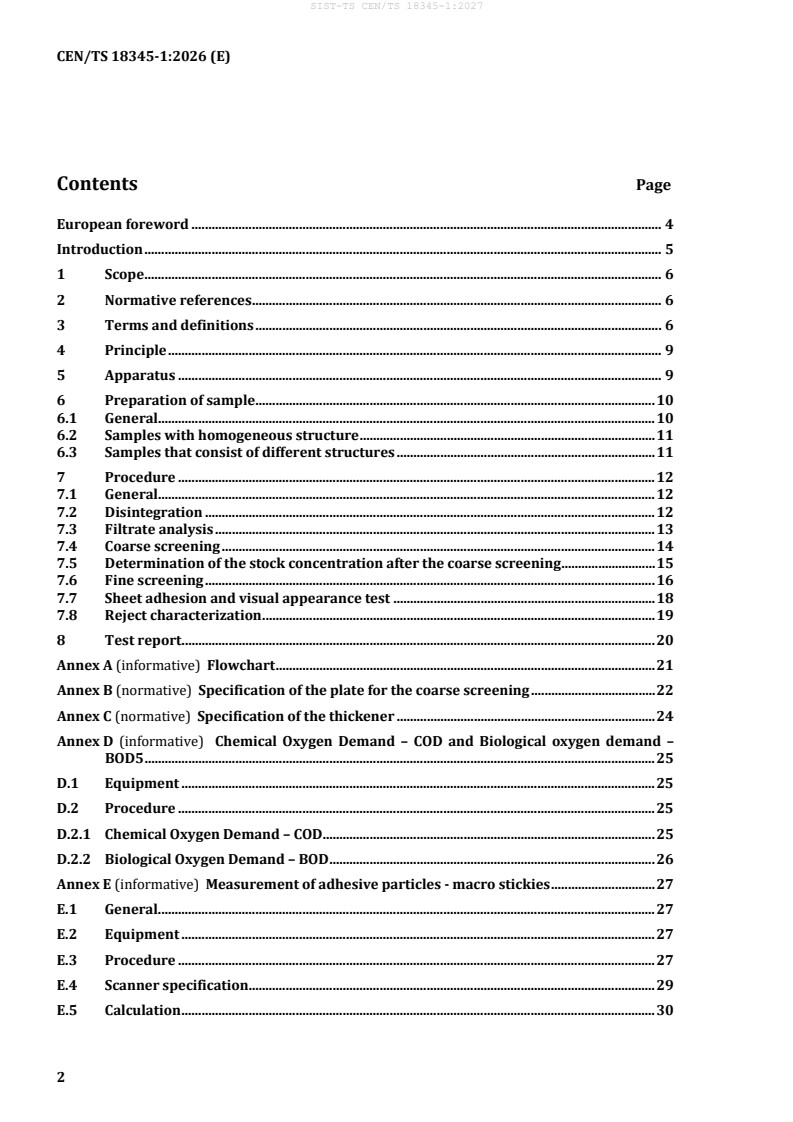
Contents Page
European foreword . 4
Introduction . 5
1 Scope . 6
2 Normative references . 6
3 Terms and definitions . 6
4 Principle . 9
5 Apparatus . 9
6 Preparation of sample . 10
6.1 General. 10
6.2 Samples with homogeneous structure . 11
6.3 Samples that consist of different structures . 11
7 Procedure . 12
7.1 General. 12
7.2 Disintegration . 12
7.3 Filtrate analysis . 13
7.4 Coarse screening . 14
7.5 Determination of the stock concentration after the coarse screening . 15
7.6 Fine screening . 16
7.7 Sheet adhesion and visual appearance test . 18
7.8 Reject characterization . 19
8 Test report . 20
Annex A (informative) Flowchart . 21
Annex B (normative) Specification of the plate for the coarse screening . 22
Annex C (normative) Specification of the thickener . 24
Annex D (informative) Chemical Oxygen Demand – COD and Biological oxygen demand –
BOD5 . 25
D.1 Equipment . 25
D.2 Procedure . 25
D.2.1 Chemical Oxygen Demand – COD . 25
D.2.2 Biological Oxygen Demand – BOD . 26
Annex E (informative) Measurement of adhesive particles - macro stickies . 27
E.1 General. 27
E.2 Equipment . 27
E.3 Procedure . 27
E.4 Scanner specification. 29
E.5 Calculation . 30
Annex F (normative) Visual impurities template . 31
Annex G (normative) Reject characterization template . 32
Bibliography . 34
European foreword
This document (CEN/TS 18345-1:2026) has been prepared by Technical Committee CEN/TC 172 “Pulp,
paper and board”, the secretariat of which is held by DIN.
Attention is drawn to the possibility that some of the elements of this document may be the subject of
patent rights. CEN shall not be held responsible for identifying any or all such patent rights.
This document has been prepared under a standardization request addressed to CEN by the European
Commission. The Standing Committee of the EFTA States subsequently approves these requests for its
Member States.
Any feedback and questions on this document should be directed to the users’ national standards body.
A complete listing of these bodies can be found on the CEN website.
According to the CEN/CENELEC Internal Regulations, the national standards organisations of the
following countries are bound to announce this Technical Specification: Austria, Belgium, Bulgaria,
Croatia, Cyprus, Czech Republic, Denmark, Estonia, Finland, France, Germany, Greece, Hungary, Iceland,
Ireland, Italy, Latvia, Lithuania, Luxembourg, Malta, Netherlands, Norway, Poland, Portugal, Republic of
North Macedonia, Romania, Serbia, Slovakia, Slovenia, Spain, Sweden, Switzerland, Türkiye and the
United Kingdom.
Introduction
The paper and paper board value chain is an example of circularity, displaying very high recycling rates.
Moreover, technical innovation is creating new products from paper and board-based materials which
are intended to become paper and board for recycling after their use.
To maintain and further increase the sustainability and circularity of the paper and board value chain
and to help EU Member States and other European countries meet high recycling targets , it is important
to ensure that paper and board-based products are recyclable by the paper industry. A laboratory test
method is needed for assessing the technical recyclability of these materials and products.
The test method in this document emulates the most common phases of the industrial processes to
measure the main parameters of recyclability of paper and board-based products based on current
knowledge and technology.
This makes it possible to:
— supplement the evaluation of recyclability required by EN 13430 with regard to paper and board-
based products that are sent for recycling in the paper industry;
— guide eco-design, in terms of recyclability, of paper and board-based products currently in use, as
well as new materials under development and new additives that can affect the recyclability of the
final product;
— support declarations related to the recyclability of materials or products based on grading systems
developed by third-party organizations and regulation.
Directives 2018/851/EU, 2018/852/EU set high recycling targets for municipal waste and paper-based packaging
(85% by 2025, 90% by 2030).
1 Scope
This document describes a laboratory test method for determining the key parameters for evaluating the
level of technical recyclability of a paper-based material and product, emulating the relevant phases of
paper and board mills with conventional recycling process.
The assessment of the technical recyclability is out of the scope of this document.
2 Normative references
The following documents are referred to in the text in such a way that some or all of their content
constitutes requirements of this document. For dated references, only the edition cited applies. For
undated references, the latest edition of the referenced document (including any amendments) applies.
EN ISO 638-1, Paper, board, pulps and cellulosic nanomaterials — Determination of dry matter content by
oven-drying method — Part 1: Materials in solid form (ISO 638-1)
ISO 3310-1, Test sieves — Technical requirements and testing — Part 1: Test sieves of metal wire cloth
ISO 5263-1, Pulps — Laboratory wet disintegration — Part 1: Disintegration of chemical pulps
ISO 5269-2, Pulps — Preparation of laboratory sheets for physical testing — Part 2: Rapid-Köthen method
ISO 5815-1, Water quality — Determination of biochemical oxygen demand after n days (BODn) — Part 1:
Dilution and seeding method with allylthiourea addition
ISO 12641-1:2025, Graphic technology — Prepress digital data exchange — Part 1: Colour targets for input
scanner calibration
ISO 13130, Laboratory glassware — Desiccators
ISO 15705, Water quality — Determination of the chemical oxygen demand index (ST-COD) — Small-scale
sealed-tube method
TAPPI/ANSI T 275, Screening of pulp (Somerville-type equipment)
3 Terms and definitions
For the purposes of this document, the following terms and definitions apply.
ISO and IEC maintain terminology databases for use in standardization at the following addresses:
— ISO Online browsing platform: available at https://www.iso.org/obp/
— IEC Electropedia: available at https://www.electropedia.org/
3.1
paper
generic term for a range of materials in the form of a coherent sheet or web, excluding sheets or laps of
pulp as commonly understood for paper making or dissolving purposes and non-woven products, made
by deposition of vegetable, mineral, animal or synthetic fibres, or their mixtures, from a fluid suspension
onto a suitable forming device, with or without the addition of other substances
Note 1 to entry: Papers may be coated, impregnated or otherwise converted, during or after their manufacture,
without necessarily losing their identity as paper. In conventional papermaking processes, the fluid medium is
water; new developments, however, include the use of air and other fluids.
Note 2 to entry: In the generic sense, the term “paper” may be used to describe both paper and board as defined in
this part of ISO 4046. The primary distinction between paper and board is normally based upon thickness or
grammage, though in some instances the distinction will be based on the characteristics and/or end-use. For
example, some materials of lower grammage, such as certain grades of folding boxboard and corrugating raw
materials, are generally referred to as “board”, while other materials of higher grammage, such as certain grades of
blotting paper, felt paper and drawing paper, are generally referred to as “paper”.
[SOURCE: ISO 4046-3:2016, 3.95]
3.2
board
cardboard
paperboard
generic term applied to certain types of paper frequently characterized by their relatively high rigidity
Note 1 to entry: In the generic sense, the term “paper” may be used to describe both paper and board as defined in
this part of ISO 4046. The primary distinction between paper and board is normally based upon thickness or
grammage, though in some instances the distinction will be based on the characteristics and/or end-use. For
example, some materials of lower grammage, such as certain grades of folding boxboard and corrugating raw
materials, are generally referred to as “board”, while other materials of higher grammage, such as certain grades of
blotting paper, felt paper and drawing paper, are generally referred to as “paper”.
[SOURCE: ISO 4046-3:2016, 3.16]
3.3
paper-based product
article, predominantly consisting of paper or board
Note 1 to entry: Moulded products are included.
3.4
recyclability
ability of a paper or board product to be recycled into new paper and board
3.5
technical recyclability
ability of a paper and board product to be recycled into new paper and board by means of an established
recycling process
Note 1 to entry: The assessment of the technical recyclability is typically done by mimicking the recycling process
by a suitable laboratory method and an appropriate assessment scheme.
Note 2 to entry: The term recyclability can also mean recyclability at scale.
3.6
paper and board mill with conventional process
type of process with low consistency pulper, coarse and fine screening steps and hydrocyclone cleaning
step for heavyweight particles without deinking or other specialized technologies
Note 1 to entry: There are typically two kinds of heavy weight cleaners installed in conventional mills – in the stock
preparation and in the approach flow system.
3.7
integrated component
packaging component, whether or not of the same material as, or distinct from, the main body of the
packaging unit, that is integral to the packaging unit and its functioning, that does not need to be
separated from the main body of the packaging unit in order to ensure the functionality of the packaging
unit and that is typically discarded at the same time as the main body of the packaging unit, although not
necessarily via the same disposal route
[SOURCE: REGULATION (EU) 2025/40]
3.8
separate component
packaging component, whether or not from the same material as the main body of the packaging unit,
that is distinct from the main body of the packaging unit, that needs to be disassembled completely and
permanently from the main body of the packaging unit and that is typically discarded prior to and
separately from the main body of the packaging unit, including packaging components that can be
separated from each other simply through mechanical stress during transportation or sorting
[SOURCE: REGULATION (EU) 2025/40]
3.9
paper and board-based composite
material made of two or more components with different properties of which paper or board is the major
one and which cannot be separated easily
3.10
semi-finished product
manufactured article ready for assembly for an end-use application
[SOURCE: ISO/TS 15791-2:2022, 3.8]
3.11
finished product
manufactured article ready for end-use
[SOURCE: ISO/TS 15791-2:2022, 3.2]
3.12
constant mass
mass of the test piece determined at the equilibrium condition after drying until the difference between
two successive dryings and weighings, separated in time by at least half the initial drying period, does
not exceed 0,1 % mass fraction of the test piece before drying
[SOURCE: EN ISO 638-1, 2022, 3.2]
3.13
stock concentration
ratio of the oven-dry organic and inorganic mass of material that can be filtered from a stock sample, to
the mass of the unfiltered sample
Note 1 to entry: The stock concentration is expressed as a percentage by mass [% (m/m)].
[SOURCE: EN ISO 4119, 1996, 3.2]
3.14
constituent
part from which a material or its components are made and which cannot be separated by hand or by
using simple physical means
[SOURCE: ISO 18601:2013, 3.12 - modified by deleting “packaging” from the term and “packaging
constituent” and by replacing “packaging” by “material” in the definition]
3.15
oven-dry mass
mass obtained on drying pulp at 105 °C ± 2 °C, until constant mass is reached
[SOURCE: ISO 801-3:1994]
4 Principle
A sample of paper-based product is submitted to disintegration and screening in defined conditions.
Amounts of reject are determined. Laboratory sheets are produced with the accepted pulps and certain
quality parameters are determined. Filtrate from the stock pulp after disintegration is analysed for dry
content by determining the evaporation residue. The complete process is described in a simplified
manner in Annex A.
5 Apparatus
The usual apparatus and, in particular, the following shall be used
5.1 Analytical balance, with an accuracy of at least ±0,001 g.
5.2 Standard disintegrator, compliant with ISO 5263-1.
5.3 pH meter
5.4 Filter paper grade 388, with diameter of 150 mm (basis weight 84 g/m , filtration speed
10 s/10 ml, deposition range 12 µm to 15 μm).
5.5 Büchner funnel, diameter 125 mm and 150 mm equipped with suction flask.
5.6 Refrigerator (optional), to store the filtrate.
5.7 Aluminium trays, for the determination of the evaporation residue.
5.8 Forced air convection oven, able to maintain the required temperatures (60 °C, 105 °C and
130°C) with accuracy of ±2 °C.
5.9 Somerville fractionator, compliant with TAPPI/ANSI T275.
5.10 Perforated screen plate, with 5 mm hole diameter (for details see Annex B).
5.11 Stopwatch/timer
5.12 Sample containers, beakers, buckets or barrels.
5.13 Filter paper grade 388, with a diameter of 125 mm (basis weight 84 g/m , filtration speed
10 s/10 ml, deposition range 12 µm to 15 μm).
5.14 Carrier boards and cover sheets, compliant with ISO 5269-2.
5.15 Desiccator, compliant with ISO 13130.
The desiccator should be filled with desiccant to such an extent that there is at least a 10 mm gap between
the desiccant and the perforated plate, sieve or grid. The use of a drying cabinet is possible, but ensure
that the results are the same.
The temperature and relative humidity in the desiccator shall be measured regularly before and after
each test with a suitable measuring device. Each laboratory should maintain a constant value, otherwise
the desiccant shall be regenerated.
No specific value is set for the temperature and relative humidity. The values are rather for checking the
correct functioning of the desiccator and the desiccant and should be recorded and checked regularly
before, during and after each test.
5.16 Thickener, as described in Annex C, with a test sieve compliant to ISO 3310-1.
5.17 Rapid Köthen sheet former, compliant with ISO 5269-2.
5.18 Metal plates (brass or steel), for adhesiveness test, weighing (3,7 ± 0,1) kg and with a diameter
of 20 cm (corresponding to a pressure of 1,18 kPa).
5.19 LED light box, with a recommended LED light source of 5 500 K to 6 500 K (daylight range) and
illuminance of at least 5 000 lx.
5.20 Glass bottle (optional), to store the filtrate.
5.21 Cutting mat, for photo documentation.
5.22 Balance, up to 2 kg with an accuracy of at least ±0,1 g.
5.23 Balance, up to 30 kg with an accuracy of ±5 g.
5.24 Digital thermometer, with an accuracy of ±0,1 °C.
5.25 Vacuum device, with a pressure difference ≥ 60 000 Pa.
5.26 Vacuum filtration unit, with 39 mm bottom inner diameter of the funnel.
5.27 Couching roller, compliant with ISO 5269-2.
5.28 Slotted screen plate, with 0,15 mm wide slots (for details see TAPPI/ANSI T275).
6 Preparation of sample
6.1 General
The preparation of samples shall differ depending on the type of the sample: if not converted, it can be
made of the same structure on its whole surface (mono-material or paper-based composite material with
various constituents, cellulosic or not). In the case of a semi-finished or a finished product, it can also
contain integrated or separate components.
NOTE 1 Information on the composition of the product can be found in the technical specification if available.
In case of finished products, they shall be emptied from any product and material not being part of this
paper-based product before testing.
The quantity of tested material or product shall be sufficient to carry out all the measurements indicated
by the method.
Samples shall be tested at least 15 days after the production date.
If the material or product has been produced less than 15 days before the test or if the production date is
unknown, it shall be stored at ambient conditions for the remaining time needed to reach 15 days from
the date of production.
If the material or product contains WSA (wet strength agent) and has been produced less than 30 days
before the test or if the production date and exact composition of the sample is unknown, it shall be stored
at ambient conditions for the remaining time needed to reach at least 30 days from the date of production.
NOTE 2 The curing time for wet strength agents used in papermaking is the time to reach maximum
effectiveness. It depends on various factors, including the type of wet strength agent and climate conditions, such
as temperature and humidity.
6.2 Samples with homogeneous structure
A minimum indicative quantity is 250 g air-dry mass.
The dry matter content shall be performed according to EN ISO 638-1.
The sample material that was used for the determination of the dry matter content shall not be used for
the disintegration.
Then weigh, using a balance (5.22), an amount of sample corresponding to an oven-dry mass of (50 ± 1) g.
6.3 Samples that consist of different structures
A minimum indicative quantity is 250 g air-dry mass and comprises at least 4 units. Separate components
shall be separated and tested individually, even if they are made of paper or board (as they can be sorted
in different streams). Integrated components, with a risk that they can damage the disintegrator, shall be
removed from the sample to be tested before the disintegration step. In such cases the ratio of the oven-
dry mass removed to the oven-dry mass of the total sample, Rem , is determined according to
D
Formula (1):
mw×
( )
SRem dm,Rem
Rem ×100 (1)
D
m ×+w m × w
( ) ( )
S dm,,S SRem dm Rem
where
Rem is the ratio of the oven-dry mass removed to the oven-dry mass of the total sample, expressed
D
in percentage (%);
m is the mass removed from total sample, expressed in gram (g);
SRem
m is the mass of sample, excluding removed mass, expressed in gram (g);
S
w is the ratio of the oven-dry mass of removed material to its mass before drying, expressed in
dm,Rem
percentage (%);
w is the ratio of the oven-dry mass of sample without removed material to its mass before
dm,S
drying, expressed in percentage (%).
NOTE Rem corresponds also to the ratio of the oven-dry mass removed to the oven-dry mass of the test piece.
D
=
Fibre-material shall not be removed as they can be fragmented or dissolved during the disintegration
step.
The dry matter content determination shall be performed on one single entire item, in oven (5.8) at
(105 ± 2) °C until constant mass is reached.
The sample material that was used for the determination of the dry matter content shall not be used for
the disintegration.
Integrated components shall not be removed from the sample to be tested.
Weigh, using an analytical balance (5.1) an amount of sample corresponding to an oven-dry mass of
(50 ± 1) g.
If the tested item weighs less than 50 g, an additional representative fraction of an item shall be weighed
in order to obtain a sample of 50 g oven-dry mass.
If the item weighs more than 50 g, the sample shall be representative from the item, i.e. contains the same
proportion of components different from the base product or material (e.g. labels, seals, hot-melt
application, metallisation, ink application, varnish etc).
Cut the sample into pieces of (3 ± 0,5) cm × (3 ± 0,5) cm, avoiding cutting non-paper and integrated
components. The removed integrated components shall be then weighed separately from the rest of the
sample, and their mass shall be added to the total coarse reject.
7 Procedure
7.1 General
After the sample preparation described in Clause 6, the following steps shall be performed:
— disintegration (7.2);
— filtrate analysis (7.3);
— coarse screening (7.4);
— fine screening (7.6);
— sheet adhesion (7.7) test and visual appearance test of the fine screening accept;
— reject characterization (7.8).
The method can also comprise the following optional phases:
— COD and BOD for the filtrate after disintegration according to Annex D;
— macro stickies analysis of the accept of the coarse screening according to Annex E;
— sheet adhesion (7.7) test and visual appearance test of the coarse screening accept.
Depending on the application of this method, external requirements or guidance may be consulted to
determine whether any optional steps are necessary.
7.2 Disintegration
Disintegrate correspondingly (50,0 ± 1,0) g oven-dry mass of the sample using the standard disintegrator
(5.2), diluting the sample with tap water at (40 ± 1) °C and measure a pH between 7 and 8 using a pH
meter (5.3), to a stock concentration of (2,50 ± 0,05) %.
The disintegration shall be set immediately without any pre-wetting or soaking of the sample.
The number of revolutions for the disintegration shall be set to 30 000 which corresponds approximately
to 10 min by default.
In a second batch under the same conditions, a number of revolutions for the disintegration set to 60 000
(approximately 20 min) can be used additionally. External requirements or guidance may be consulted
to determine whether this additional step is necessary.
NOTE 50 g of oven-dry mass sample at the concentration of 2,5 % correspond to a total mass of around 2 000 g.
7.3 Filtrate analysis
Perform the filtration of the total stock immediately after the disintegration.
Homogenize the total stock and filtrate approximately 100 g over a filter paper (5.4) using the Büchner
funnel (5.5), avoiding pre-moistening the filter paper (5.4). Use the filtrate to rinse the suction flask. Keep
the filtrate and the filter cake and transfer it back to the total stock after finishing the filtrate analysis.
Filter again approximately 200 g of total stock, retrieve the filtrate from the suction flask and filter it again
without removing filter paper and filter cake. Save the filtrate for the further procedures and return the
filter cake to the total stock. Perform the evaporation residue determination within 4 h after gathering
the filtrate.
After the filtration proceed to the determination of the evaporation residue. Pour a known amount
(approximately 70 g) of filtrate on a previously weighed aluminium tray (5.7) and dry it in an oven (5.8)
at (105 ± 2) °C until all water is evaporated and a constant mass is reached. Perform a double
determination of the evaporation residue
Measure the evaporation residue of the tap water in a double determination.
The evaporation residue shall be calculated by using Formula (2) and Formula (3):
5
m − m m − m
10 3,f 1,f 3,tw 1,tw
ER = ×− (2)
Dis,D
C m m
p 2,,f 2 tw
where
ER is the evaporation residue of disintegrated oven-dry mass pulp, expressed in milligram of
Dis,D
residue per gram of oven-dry mass in disintegrator (mg/g);
C is the stock concentration in the disintegrator, expressed in percentage (%);
p
m is the mass of the empty aluminium tray, expressed in gram (g);
1f
m is the mass of the filtrate, expressed in gram (g);
2f
m is the mass of the tray and the filtrate after drying, expressed in gram (g);
3f
m is the mass of the empty aluminium tray of the tap water evaporation residue, expressed in
1tw
gram (g);
m2tw is the mass of the tap water, expressed in gram (g);
m is the mass of the tray and the tap water after drying, expressed in gram (g).
3tw
and
100− Rem
( )
D
ER ER×
TP,,D Dis D
(3)
where
=
ER is the evaporation residue of dry test piece, including removed parts, expressed in milligram
TP,D
of residue per gram of dry test piece (mg/g);
ER is the evaporation residue of disintegrated oven-dry mass pulp, expressed in milligram of
Dis,D
residue per gram of oven-dry mass in disintegrator (mg/g);
Rem is the ratio of the oven-dry mass removed to the oven-dry mass of total sample, expressed in
D
percentage (%).
If the measurement of COD and/or BOD of the filtrate are performed, it shall be done according to
Annex D.
7.4 Coarse screening
This screening step separates the coarse reject from the total stock. Both reject and accept shall be
collected and processed in a further step.
Right after the filtration, as described in 7.3, proceed with the coarse screening using the Somerville
fractionator (5.9) equipped with a perforated screen plate (5.10) containing holes with 5 mm of diameter
and set with a water flow of (8,6 ± 0,2) l/min.
The required characteristics of the referred plate are set out in the Annex B and Figure B.1.
Wait until the screening plate is covered by approximately 2,5 cm of water, gently mix the disintegrated
stock and gradually pour the total stock into the Sommerville. Perform the coarse screening for 5 min
(5.11), starting the equipment and counting the time when the sample starts to overflow the weir.
Collect the accept of the coarse screening in a sample container (5.12) to be used for the subsequent
procedures:
— determination of the stock concentration (7.5);
— fine screening (7.6);
— sheet making (optional).
If required, two sheets with a grammage of (60 ± 2) g/m can be produced according to ISO 5269-2,
following coarse screening, with sheet adhesion and visual appearance assessed as outlined in 7.7.
Perform the sheet forming according 7.7 with the deviation to use tap water instead of filtrate. This
process is important for verifying accepted fibre results and characterizing rejected fibre, as it can also
serve as an indicator for other tests, such as macro stickies analysis.
— determination of macro stickies (optional).
If the determination of macro stickies is performed, it shall be done according to Annex E.
On completion of the coarse screening, first proceed with the reject characterization described below
(7.8). Then, transfer all the reject remaining on the plate to a sample container and wash the plate with
water to ensure that any fragments trapped in the holes of the screening plate are recovered and added
to the reject. Any particles and fragments that are trapped in the diaphragm chamber of the Somerville
fractionator shall be transferred as good as possible, to the coarse screening accept.
Drain the reject over a filter paper (5.13), whose oven-dry mass was previously determined after drying
in an oven (5.8) at (105 ± 2) °C, using a Büchner funnel (5.5). Then, dry the filter paper with the reject in
the oven at (105 ± 2) °C, until reaching a constant mass. Alternatively, if the amount of reject is too much
to be drained and collected through a filter paper, the reject shall be dried directly in a previously dried
and weighed aluminium tray (5.7) in the oven (5.8) at (105 ± 2) °C until reaching a constant mass.
The ratio of the oven-dry mass of the coarse reject of the test piece, adding removed parts, to the oven-
dry mass of the test piece are given using Formula (4):
CR CR×−100 Rem+ Rem
( )
TP,,D CSi D D D
(4)
where
CRTP,D is the ratio of the oven-dry mass of the coarse reject of the test piece, adding removed parts,
to the oven-dry mass of the test piece expressed in percentage (%);
CR is the ratio of the oven-dry mass of the coarse reject to the oven-dry mass of the coarse
CSi,D
screening input, expressed in percentage (%);
Rem is the ratio of the oven-dry mass removed to the oven-dry mass of the test piece, expressed
D
in percentage (%).
As neglectable losses are assumed in disintegration procedure and evaporation residue determination,
the coarse screening input oven-dry mass, m , is defined as being the same as the disintegrator test
CSi,D
piece oven-dry mass, m , whereas the ratio of the oven-dry mass of the coarse reject to the oven-dry
Dis,D
mass of the coarse screening input CR , is given by Formula (5):
CSi,D
m m
CR,,D CR D
CR ×=100 ×100 (5)
CSi,D
mm
CSi,D Dis,D
where
CR is the ratio of the oven-dry mass of the coarse reject to the oven-dry mass of the coarse
CSi,D
screening input, expressed in percentage (%);
m is the oven-dry mass of the coarse reject, expressed in gram (g);
CR,D
m is the oven-dry mass of the coarse screening input, expressed in gram (g);
CRSi,D
m is the oven-dry mass of pulp in disintegrator, expressed in gram (g).
Dis,D
7.5 Determination of the stock concentration after the coarse screening
A representative sample of the coarse screening accept for performing the fine screening step shall be
taken.
NOTE Integrated components and constituents in a product or fragments passing the coarse screening can
cause challenges in taking a representative sample of the coarse screening accept, as these materials or particles
can float or settle.
Homogenize the coarse screening accept and transfer a known amount of it (approximately 1 000 mg)
into the tared beaker.
Using the Büchner funnel (5.5), filter the 1 000 mg of the accept over a filter paper (5.13) with a diameter
of 125 mm, whose oven-dry mass was previously determined after drying in an oven at (105 ± 2) °C.
Then, place the filter paper between two cover sheets (5.14) and dry each side of it in the dryer of the
sheet former for 7 min at (93 ± 4) °C. Leave the filter paper to cool down in the desiccator (5.15) before
weighing it.
The stock concentration shall be confirmed by oven drying at (105 ± 2) °C. In case of different result,
recalculate the fine reject amount and the optional results from the macro stickies analysis.
=
=
The stock concentration after the coarse screening is given by Formula (6):
mm−
sfd fd
C × 100 (6)
CS
m
sw
where
C is the stock concentration after the coarse screening, expressed in percentage (%);
cs
m is the mass of the sample with the filter paper after drying, expressed in gram (g);
sfd
m is the mass of the filter paper after drying, expressed in gram (g);
fd
m is the mass of the sample before drying, expressed in gram (g).
sw
7.6 Fine screening
This screening step separates the fine reject from the remaining stock. Both reject and accept shall be
collected and processed in a further step.
Proceed with the fine screening using the Somerville fractionator (5.9) equipped with a plate containing
slots (5.28) with 0,15 mm of width and set with a water flow of (8,6 ± 0,2) l/min.
Homogenize the accept from the coarse screening and take an aliquot of 20 g oven-dry mass of the pulp
for the fine screening.
Wait until the screening plate is covered by approximately 2,5 cm of water before pouring in the 20 g
oven-dry mass accept. The pouring time shall not exceed 3 to 4 min. Perform the fine screening for 20
min, start counting the time, using a timer (5.11) when the sample starts to overflow the weir. During the
fine screening, collect the total amount of accept pulp with a thickener (5.16), as described in Annex C.
The thickener shall be placed below the outlet of the Somerville fractionator with a free fall distance
between the outlet and the thickening sieve between 15 cm and 30 cm.
When the screening starts, a sample container (5.12) shall be at the outlet of the discharge nozzle of the
thickener, in order to collect the first 50 l of filtrate. The additional filtrate from the remaining screening
can be discarded.
When the screening is finished, wait for the complete drainage of the pulp suspension in the thickening
box and collect all of the thickened pulp. Transfer the entire thickened pulp from the thickener into a
bucket (5.12), use the filtrate to transfer remaining fibres from the sieve to the bucket. Dilute the pulp to
approx. 5 l, using the collected filtrate. If appropriate use a dilution up to approx. 10 l. Use this suspension
for the subsequent procedure described in 7.7.
The fine screening and thickening process is described according to Figure 1. On the completion of the
screening, first proceed with the reject characterization described in 7.8. Then, transfer all the reject
remaining on the plate to a specific container and wash the plate with a sufficient amount of tap water to
ensure it is completely clean, making sure that any fragments trapped in the slots are also recovered.
Drain the reject over a filter paper (5.13), whose oven-dry mass was previously determined after drying
in an oven (5.8) at (105 ± 2) °C, using a Büchner funnel (5.5). Then, place the filter paper with the reject
in the oven (5.8) at (105 ± 2) °C, until reaching a constant mass. Alternatively, if the amount of reject is
too much to be drained and collected through a filter paper, the reject shall be dried directly in a
previously dried and weighed aluminium tray (5.7) in the oven (5.8) at (105 ± 2) °C until reaching a
constant mass.
Calculate the oven-dry mass of the fine reject, net of the mass of the filter paper or aluminium tray, and
express the result as a percentage with respect to oven-dry mass of the accepted pulp aliquot used for
the test (screening input) and to the oven-dry mass of the test piece by using Formula (7) and
Formula (8).
=
The results shall be rounded to the first decimal place.
m
FR,D
(7)
FR ×100
FSi,D
m
FSi,D
where
FR is the ratio of the oven-dry mass of the fine reject to the oven-dry mass of the screening input,
FSiD
expressed in percentage (%);
m is the oven-dry mass of the fine screening input, expressed in gram (g);
FSi,D
mFR,D is the oven-dry mass of the fine reject, expressed in gram (g).
and
FR FR×−100 CR (8)
( )
TP,,D FSiD TP D
where
FR is the oven-dry mass of the fine reject to the oven-dry mass of the test piece, including
TP,D
removed parts, expressed in percentage (%);
FR is the oven-dry mass of the fine reject to the oven-dry mass of the fine screening input,
SiD
expressed in percentage (%);
CR is the oven-dry mass of the coarse reject to the oven-dry mass of the test piece, adding
TP,D
removed parts, expressed in percentage (%).
=
=
Figure 1 — Flowchart for thickening step
7.7 Sheet adhesion and visual appearance test
Homogenize the stock from the thickened pulp diluted with filtrate and take a sufficient amount to form
a sheet with a grammage of (60 ± 2) g/m , corresponding to approximately (1,88 ± 0,06) g in oven-dry
mass. For the sheet forming, dilute the aliquot up to a total volume of 5 l with the collected filtrate, as
illustrated in Figure 1.
For the sheet forming, fill the Rapid-Köthen sheet former (5.17) with 2l of tap water, then pour the aliquot
of pulp in the stock container of the sheet former and add the collected filtrate up to a total volume of
approx. 7 l.
If the specified grammage of the sheet is not reached, the amount of pulp used for sheet formation shall
be adjusted.
The process described above shall be performed until obtaining two sheets with the specified gra
...