

FprEN ISO 787-9
(Main)General methods of test for pigments and extenders - Part 9: Determination of pH value of an aqueous suspension (ISO/FDIS 787-9:2026)
- Abstract
This document specifies a general method of test for determining the pH value of an aqueous suspension of a sample of pigment or extender.
- Status
- Not Published
- Publication Date
- 03-Mar-2027
- Technical Committee
- CEN/TC 298 - Pigments and extenders
- Drafting Committee
- CEN/TC 298 - Pigments and extenders
- Current Stage
- 5020 - Submission to Vote - Formal Approval
- Start Date
- 22-Oct-2026
- Due Date
- 22-Oct-2026
- Completion Date
- 22-Oct-2026
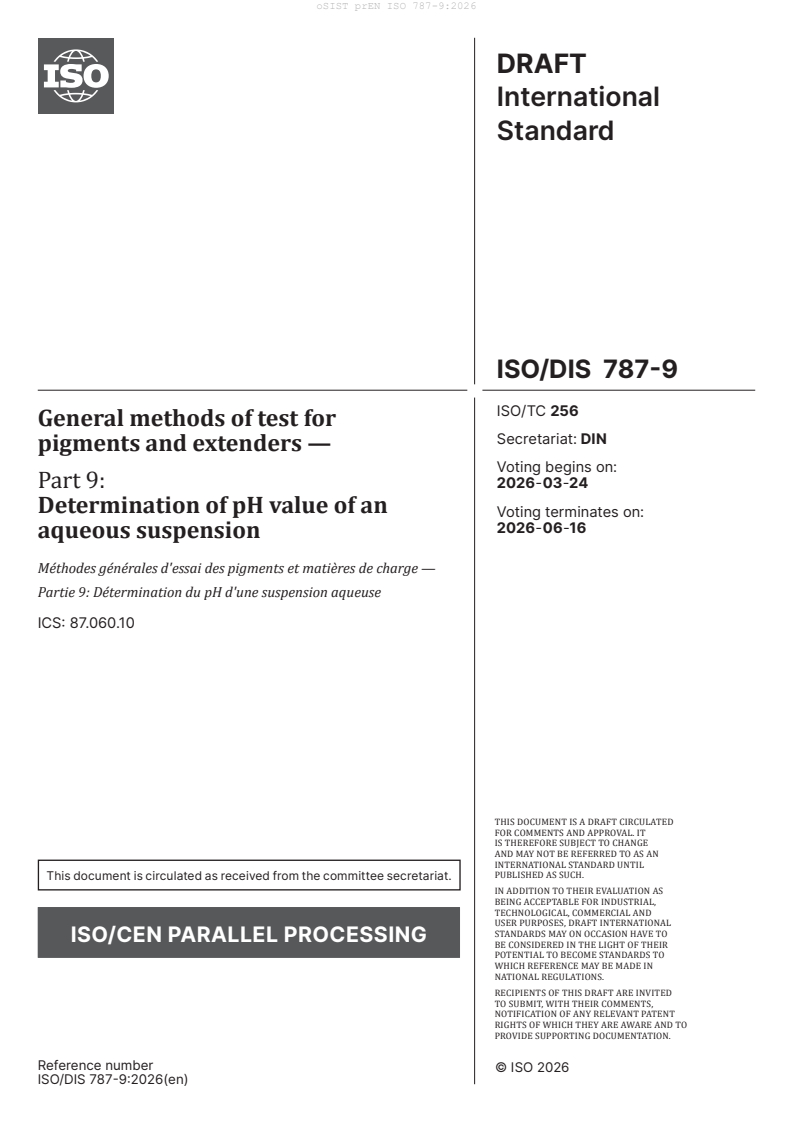

FprEN ISO 787-9 is a draft standard in the ISO 787 series for pigments and extenders, prepared by ISO/TC 256 in collaboration with CEN/TC 298 under the ISO/CEN parallel process. It specifies a general method for determining the pH value of an aqueous suspension of a pigment or extender sample. Laboratories, manufacturers, and quality control teams use it when they need a consistent pH test for these materials.
What does FprEN ISO 787-9 specify?
FprEN ISO 787-9 specifies a general test method for measuring the pH value of an aqueous suspension made from a sample of pigment or extender. The document is organized into scope, normative references, terms and definitions, reagents, apparatus, sampling, procedure, expression of results, and test report.
The scope is narrow and practical: it covers the pH measurement itself, not broader chemical characterization. In practice, that means the document is intended to give one repeatable way to prepare the suspension, measure it, and report the result.
What are the key requirements of FprEN ISO 787-9?
Sample and test medium
FprEN ISO 787-9 requires a representative sample taken in accordance with ISO 15528. The suspension is prepared at 5 % to 10 % mass fraction, using water or an ion intensity regulating solution. This matters because the result depends on a sample that reflects the bulk material and on a suspension concentration that is kept within the specified range.
The water used must be of at least grade 3 as specified in ISO 3696, with a pH between 5.0 and 7.5, and it must be protected from the atmosphere because carbon dioxide can change its pH. The optional ion intensity regulating solution is 0.1 % KCl prepared with that water. In practice, this helps limit changes caused by the test medium itself.
Apparatus and measurement
FprEN ISO 787-9 calls for a chemically resistant glass container with a ground glass or rubber stopper, a pH measuring device capable of reading to 0.1 unit, and a balance with an appropriate limit of error. The pH device has to be calibrated with buffer solutions of known pH at the test temperature.
These requirements matter because contamination, poor calibration, or weak weighing control can distort a pH result. The glass container must be cleaned before each use, rinsed with the corresponding water, and the rubber stopper must not have been used for any other purpose.
Procedure
FprEN ISO 787-9 requires the test to be carried out at room temperature. The sample is mixed vigorously by shaking, rolling, or stirring, then allowed to stand for 5 minutes before the pH is measured to the nearest 0.1 unit. The suspension may also be filtered before measurement.
If the product does not disperse easily in water, the method allows a wetting agent. Pure ethanol or methanol may be used up to 10 % of the suspension volume, but the minimum quantity should be used, and the neutrality of the wetting agent must be checked once by a blank determination. If a wetting agent is used, the water volume is reduced so the original suspension concentration is maintained.
Results and reporting
FprEN ISO 787-9 requires the pH result to be reported to the nearest 0.1 unit, together with the test temperature. The test report also has to state the product identity, a reference to the standard, the suspension concentration and liquid used, any filtering method, any wetting agent used, deviations from the procedure, any unusual observations, and the date of the test.
What terms does FprEN ISO 787-9 define?
FprEN ISO 787-9 uses the terminology of ISO 18451-1. The following terms are central to the method:
- pH value - the measured acidity or alkalinity of the suspension, reported to the nearest 0.1 unit.
- Aqueous suspension - a mixture of the pigment or extender dispersed in water or in the ion intensity regulating solution.
- Wetting agent - an additive used to help materials that do not disperse easily in water.
- Ion intensity regulating solution - the optional 0.1 % KCl solution used to control test conditions.
- Representative sample - a sample taken so the test reflects the product being assessed.
- CAS Registry Number - a chemical identifier used here for KCl as a convenience to users.
Who uses FprEN ISO 787-9?
FprEN ISO 787-9 is used by laboratories, manufacturers, and quality managers working with pigments and extenders. It is relevant for routine quality control, incoming material checks, batch testing, and comparison of product behavior under the same test conditions.
It is especially useful where a stable pH value matters for formulation, processing, or product consistency. Buyers and technical staff can also use the method to specify and compare test results in a common way.
What changed in FprEN ISO 787-9 from the previous edition?
FprEN ISO 787-9 cancels and replaces the second edition, ISO 787-9:2019, and the text says it has been technically revised. The changes listed in the document are:
- updated normative references;
- a changed specification for distilled or demineralized water in 4.1;
- the term “buffer solution” replaced by “ion intensity regulating solution” in 4.2;
- a changed quantity of wetting agent in Clause 7;
- updated test report information in Clause 9.
Which standards are used with FprEN ISO 787-9?
- ISO 3696 - gives the water quality requirement for the reagent water used in the test.
- ISO 15528 - provides the sampling method used to take a representative sample.
- ISO 18451-1 - supplies the terms and definitions used for pigments, dyestuffs, and extenders.
What does the FprEN ISO 787-9 document contain?
FprEN ISO 787-9 contains a short foreword and a nine-clause test method. The method covers reagent preparation, apparatus requirements, sampling, the test procedure, expression of results, and the required contents of the test report.
It gives the practical setup for making a 5 % to 10 % suspension, including the optional use of a wetting agent and the optional use of a filtered suspension. It also sets out what the pH meter must be able to do and how the result is to be recorded.
For users, the document is mainly a laboratory procedure document: it tells them how to prepare the suspension, how to measure the pH, and what to document so the result can be traced and compared with other tests.
Relations
- Consolidated By
ISO/FDIS 787-9 - General methods of test for pigments and extenders — Part 9: Determination of pH value of an aqueous suspension - Effective Date
- 12-Feb-2026
- Effective Date
- 30-Oct-2024
Frequently Asked Questions
FprEN ISO 787-9 is a draft published by the European Committee for Standardization (CEN). Its full title is "General methods of test for pigments and extenders - Part 9: Determination of pH value of an aqueous suspension (ISO/FDIS 787-9:2026)". This standard covers: This document specifies a general method of test for determining the pH value of an aqueous suspension of a sample of pigment or extender.
This document specifies a general method of test for determining the pH value of an aqueous suspension of a sample of pigment or extender.
FprEN ISO 787-9 is classified under the following ICS (International Classification for Standards) categories: 87.060.10 - Pigments and extenders. The ICS classification helps identify the subject area and facilitates finding related standards.
FprEN ISO 787-9 has the following relationships with other standards: It is inter standard links to ISO/FDIS 787-9, EN ISO 787-9:2019. Understanding these relationships helps ensure you are using the most current and applicable version of the standard.
FprEN ISO 787-9 is available in PDF format for immediate download after purchase. The document can be added to your cart and obtained through the secure checkout process. Digital delivery ensures instant access to the complete standard document.
Standards Content (Sample)
Contents
- 1 Scope
- 2 Normative references
- 3 Terms and definitions
- 4 Reagents
- 5 Apparatus
- 6 Sampling
- 7 Procedure
- 8 Expression of results
- 9 Test report
1 Scope
This document specifies a general method of test for determining the pH value of an aqueous suspension of a sample of pigment or extender.
2 Normative references
The following documents are referred to in the text in such a way that some or all of their content constitutes requirements of this document. For dated references, only the edition cited applies. For undated references, the latest edition of the referenced document (including any amendments) applies. ISO 3696, Water for analytical laboratory use — Specification and test methods ISO 15528, Paints, varnishes and raw materials for paints and varnishes — Sampling ISO 18451-1, Pigments, dyestuffs and extenders — Terminology — Part 1: General terms
3 Terms and definitions
For the purposes of this document, the terms and definitions given in ISO 18451-1 apply. ISO and IEC maintain terminology databases for use in standardization at the following addresses:
- ISO Online browsing platform: available at https:// www .iso .org/ obp
- IEC Electropedia: available at https:// www .electropedia .org/
4 Reagents
4.1 Distilled or demineralized water, of at least grade 3 as specified in ISO 3696, having a pH between 5,0 and 7,5.
Because water rapidly absorbs carbon dioxide, the water shall be protected from access to the atmosphere. ®1) 4.2 Ion intensity regulating solution, 0,1 % KCl (p.a.), CAS Registry Number 7447-40-7, prepared using water specified in 4.1.
...