


EN ISO 12402-2:2020
(Main)Personal flotation devices - Part 2: Lifejackets, performance level 275 - Safety requirements (ISO 12402-2:2020)
Personal flotation devices - Part 2: Lifejackets, performance level 275 - Safety requirements (ISO 12402-2:2020)
This document specifies the safety requirements for lifejackets, performance level 275. It is applicable to lifejackets for adults, children or infants, for offshore use under severe conditions, or when protective clothing is being used or additional loads are being carried.
Persönliche Auftriebsmittel - Teil 2: Rettungswesten, Stufe 275 - Sicherheitstechnische Anforderungen (ISO 12402-2:2020)
Dieses Dokument legt die sicherheitstechnischen Anforderungen für Rettungswesten, Leistungsstufe 275, fest. Es gilt für Rettungswesten, die von Erwachsenen, Kindern und Kleinkindern in Offshore-Bereichen bei extremen Bedingungen benutzt werden oder wenn Schutzkleidung oder zusätzliche Lasten getragen werden.
Équipements individuels de flottabilité - Partie 2 : Gilets de sauvetage, niveau de performance 275 - Exigences de sécurité (ISO 12402-2:2020)
Le présent document spécifie les exigences de sécurité relatives aux gilets de sauvetage, niveau de performance 275. Elle s'applique aux gilets de sauvetage pour adultes, enfants et jeunes enfants, pour une utilisation au large dans des conditions extrêmes, ou lors du port de vêtements de protection ou de charges supplémentaires.
Osebni plavajoči pripomočki - 2. del: Rešilni jopiči, lastnosti za nivo 275 - Varnostne zahteve (ISO 12402-2:2020)
General Information
Relations
Overview
EN ISO 12402-2:2020 - Personal flotation devices, Part 2: Lifejackets, performance level 275 - Safety requirements (ISO 12402-2:2020) - specifies safety, performance and marking requirements for lifejackets at performance level 275. The standard applies to lifejackets intended for adults, children and infants for offshore use under severe conditions, or where users wear protective clothing or carry additional loads. EN ISO 12402-2:2020 supersedes the 2006 edition and is the CEN-adopted version of ISO 12402-2:2020.
Key topics and technical requirements
This standard addresses the full lifecycle of lifejackets at level 275 with emphasis on safety and usability. Major topics include:
- Classification and performance levels - Part of the EN/ISO 12402 series that defines PFD classes and the specific meaning of level 275.
- Materials and components - Requirements for constituent materials and components in contact with the user.
- Inflation systems - Criteria for inflatable chambers, means of inflation (including oral inflation) and rearming/repacking information.
- Straps and fittings - Body strap, lacing and ride‑up prevention system requirements to ensure secure fit under load.
- Inflation status indicators & magnetic properties - Provisions for status indicators and electromagnetic compatibility where relevant.
- Types of buoyancy - Requirements for inherently buoyant materials and inflatable chambers and how total buoyancy is determined.
- Conspicuousness - Colour and retroreflective material requirements to improve visual detection.
- Strength and performance testing - Mechanical strength, donning, adjustment, fit and in‑water performance requirements (including multi‑chamber systems).
- Marking & documentation - Mandatory marking on the lifejacket, manufacturer’s instructions, rearming/repacking details and consumer information at point of sale.
Applications and who uses the standard
EN ISO 12402-2:2020 is used by:
- Lifejacket manufacturers and designers to design and certify lifejackets meeting level 275 safety criteria.
- Test laboratories and certification bodies for conformity assessment and performance testing.
- Procurement and specification writers in offshore, shipping, fisheries and commercial marine sectors specifying PPE for severe conditions.
- Maritime safety officers, rescue services and regulatory authorities ensuring compliance with safety and EU PPE Regulation (EU) 2016/425 where applicable.
- Distributors and retailers to provide required consumer information at point of sale.
Related standards
- EN/ISO 12402 series (other parts define different performance levels and PFD classes)
- Regulation (EU) 2016/425 on personal protective equipment (informative annex links conformity to EU requirements)
This standard is essential when specifying, manufacturing or certifying lifejackets for high-risk offshore use. Keywords: EN ISO 12402-2:2020, ISO 12402-2, lifejackets performance level 275, personal flotation devices, safety requirements.
Standards Content (Sample)
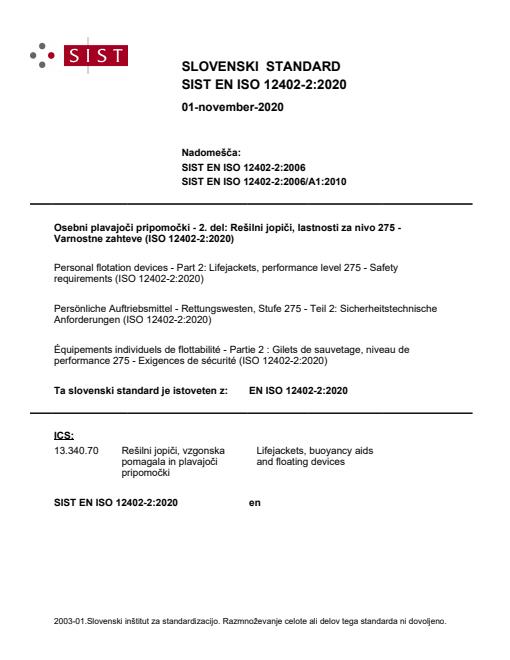
SLOVENSKI STANDARD
01-november-2020
Nadomešča:
SIST EN ISO 12402-2:2006
SIST EN ISO 12402-2:2006/A1:2010
Osebni plavajoči pripomočki - 2. del: Rešilni jopiči, lastnosti za nivo 275 -
Varnostne zahteve (ISO 12402-2:2020)
Personal flotation devices - Part 2: Lifejackets, performance level 275 - Safety
requirements (ISO 12402-2:2020)
Persönliche Auftriebsmittel - Rettungswesten, Stufe 275 - Teil 2: Sicherheitstechnische
Anforderungen (ISO 12402-2:2020)
Équipements individuels de flottabilité - Partie 2 : Gilets de sauvetage, niveau de
performance 275 - Exigences de sécurité (ISO 12402-2:2020)
Ta slovenski standard je istoveten z: EN ISO 12402-2:2020
ICS:
13.340.70 Rešilni jopiči, vzgonska Lifejackets, buoyancy aids
pomagala in plavajoči and floating devices
pripomočki
2003-01.Slovenski inštitut za standardizacijo. Razmnoževanje celote ali delov tega standarda ni dovoljeno.
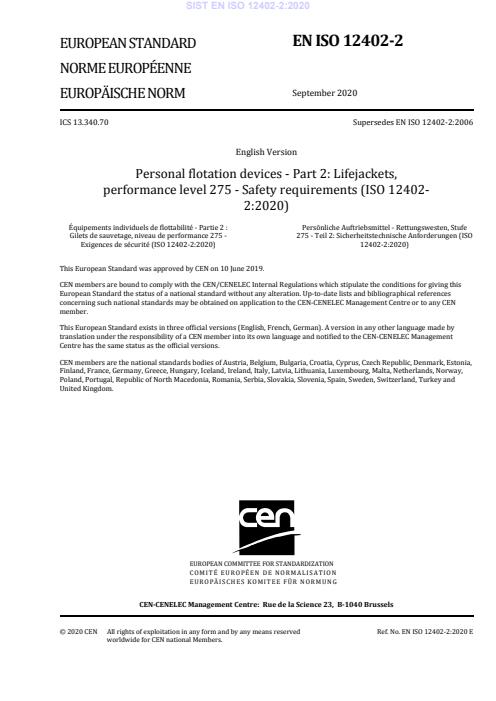
EN ISO 12402-2
EUROPEAN STANDARD
NORME EUROPÉENNE
September 2020
EUROPÄISCHE NORM
ICS 13.340.70 Supersedes EN ISO 12402-2:2006
English Version
Personal flotation devices - Part 2: Lifejackets,
performance level 275 - Safety requirements (ISO 12402-
2:2020)
Équipements individuels de flottabilité - Partie 2 : Persönliche Auftriebsmittel - Rettungswesten, Stufe
Gilets de sauvetage, niveau de performance 275 - 275 - Teil 2: Sicherheitstechnische Anforderungen (ISO
Exigences de sécurité (ISO 12402-2:2020) 12402-2:2020)
This European Standard was approved by CEN on 10 June 2019.
CEN members are bound to comply with the CEN/CENELEC Internal Regulations which stipulate the conditions for giving this
European Standard the status of a national standard without any alteration. Up-to-date lists and bibliographical references
concerning such national standards may be obtained on application to the CEN-CENELEC Management Centre or to any CEN
member.
This European Standard exists in three official versions (English, French, German). A version in any other language made by
translation under the responsibility of a CEN member into its own language and notified to the CEN-CENELEC Management
Centre has the same status as the official versions.
CEN members are the national standards bodies of Austria, Belgium, Bulgaria, Croatia, Cyprus, Czech Republic, Denmark, Estonia,
Finland, France, Germany, Greece, Hungary, Iceland, Ireland, Italy, Latvia, Lithuania, Luxembourg, Malta, Netherlands, Norway,
Poland, Portugal, Republic of North Macedonia, Romania, Serbia, Slovakia, Slovenia, Spain, Sweden, Switzerland, Turkey and
United Kingdom.
EUROPEAN COMMITTEE FOR STANDARDIZATION
COMITÉ EUROPÉEN DE NORMALISATION
EUROPÄISCHES KOMITEE FÜR NORMUNG
CEN-CENELEC Management Centre: Rue de la Science 23, B-1040 Brussels
© 2020 CEN All rights of exploitation in any form and by any means reserved Ref. No. EN ISO 12402-2:2020 E
worldwide for CEN national Members.
Contents Page
European foreword . 3
European foreword
This document (EN ISO 12402-2:2020) has been prepared by Technical Committee ISO/TC 188 "Small
craft" in collaboration with Technical Committee CEN/TC 162 “Protective clothing including hand and
arm protection and lifejackets” the secretariat of which is held by DIN.
This European Standard shall be given the status of a national standard, either by publication of an
identical text or by endorsement, at the latest by March 2021, and conflicting national standards shall
be withdrawn at the latest by March 2021.
Attention is drawn to the possibility that some of the elements of this document may be the subject of
patent rights. CEN shall not be held responsible for identifying any or all such patent rights.
This document supersedes EN ISO 12402-2:2006.
This document has been prepared under a mandate given to CEN by the European Commission and the
European Free Trade Association, and supports essential requirements of EU Directive.
For the relationship with EU Directive(s) see informative Annex ZA, which is an integral part of this
document.
According to the CEN-CENELEC Internal Regulations, the national standards organizations of the
following countries are bound to implement this European Standard: Austria, Belgium, Bulgaria,
Croatia, Cyprus, Czech Republic, Denmark, Estonia, Finland, France, Germany, Greece, Hungary, Iceland,
Ireland, Italy, Latvia, Lithuania, Luxembourg, Malta, Netherlands, Norway, Poland, Portugal, Republic of
North Macedonia, Romania, Serbia, Slovakia, Slovenia, Spain, Sweden, Switzerland, Turkey and the
United Kingdom.
Endorsement notice
The text of ISO 12402-2:2020 has been approved by CEN as EN ISO 12402-2:2020 without any
modification.
Annex ZA
(informative)
Relationship between this European Standard and the essential
requirements of Regulation (EU) 2016/425 of the European Parliament and
of the Council of 9 March 2016 on personal protective equipment aimed to
be covered
This European Standard has been prepared under a Commission's standardization request to provide
one voluntary means of conforming to essential requirements of Regulation (EU) 2016/425 of the
European Parliament and of the Council of 9 March 2016 on personal protective equipment.
Once this standard is cited in the Official Journal of the European Union under that Regulation
(EU) 2016/425, compliance with the normative clauses of this standard given in Table ZA.1 confers,
within the limits of the scope of this standard, a presumption of conformity with the corresponding
essential requirements of that Regulation (EU) 2016/425 and associated EFTA regulations.
Table ZA.1 — Correspondence between this European Standard and Regulation (EU) 2016/425
Essential Requirements of Regulation (EU) Clause(s)/sub-clause(s) of Remarks/
2016/425 this EN Notes
1.1.1 Ergonomics 5.6
1.1.2.1 Optimum level of protection 5.6
1.1.2.2 Classes of protection appropriate to 4.2
different levels of risk
1.2.1 Absence of inherent risks and other 5.1.2; 5.1.3; 5.1.5; 5.1.7; 5.2;
nuisance factors 5.3.1.1; 5.3.1.2; 5.3.2.2;
5.3.2.3; 5.3.4.3; 5.3.4.4;
5.6.1.4; 5.6.1.7; 5.6.1.8;
5.6.1.9; 5.6.1.10; 5.6.1.11
1.2.1.1 Suitable constituent materials 5.1
1.2.1.2 Satisfactory surface condition of all PPE 5.1
parts in contact with the user
1.2.1.3 Maximum permissible user impediment 5.6.1.3
1.3.1 Adaption of PPE to user morphology 5.6.2
1.3.2 Lightness and design strength 5.3.2.1; 5.3.3.1; 5.5; 5.6.1.6
1.4 Manufacturer's instructions and 5.1.6; 5.3.4.1; 6.2; 7; 8
information
2.1 PPE incorporating adjustment systems 5.1.3
2.4 PPE subject to ageing 6.2 l)
2.8 PPE for intervention in very dangerous 5.1.4
situations
2.12 PPE bearing one or more identification 6
markings or indicators directly or
indirectly relating to health and safety
2.13 PPE capable of signalling the user's 5.4
presence visually
3.4.1 Prevention of drowning 5.1.2; 5.2; 5.3.1.1; 5.3.2.2;
5.3.4.2; 5.3.4.4; 5.6.3; 5.7
WARNING 1 — Presumption of conformity stays valid only as long as a reference to this European
Standard is maintained in the list published in the Official Journal of the European Union. Users of this
standard should consult frequently the latest list published in the Official Journal of the European
Union.
WARNING 2 — Other Union legislation may be applicable to the product(s) falling within the scope of
this standard.
INTERNATIONAL ISO
STANDARD 12402-2
Second edition
2020-07
Personal flotation devices —
Part 2:
Lifejackets, performance level 275 —
Safety requirements
Équipements individuels de flottabilité —
Partie 2: Gilets de sauvetage, niveau de performance 275 — Exigences
de sécurité
Reference number
ISO 12402-2:2020(E)
©
ISO 2020
ISO 12402-2:2020(E)
© ISO 2020
All rights reserved. Unless otherwise specified, or required in the context of its implementation, no part of this publication may
be reproduced or utilized otherwise in any form or by any means, electronic or mechanical, including photocopying, or posting
on the internet or an intranet, without prior written permission. Permission can be requested from either ISO at the address
below or ISO’s member body in the country of the requester.
ISO copyright office
CP 401 • Ch. de Blandonnet 8
CH-1214 Vernier, Geneva
Phone: +41 22 749 01 11
Email: copyright@iso.org
Website: www.iso.org
Published in Switzerland
ii © ISO 2020 – All rights reserved
ISO 12402-2:2020(E)
Contents Page
Foreword .iv
Introduction .v
1 Scope . 1
2 Normative references . 1
3 Terms and definitions . 1
4 Classification of PFDs . 4
4.1 Classes . 4
4.1.1 Buoyancy aids . 4
4.1.2 Lifejackets . 4
4.1.3 Special application PFDs . 4
4.2 Performance levels . 5
4.2.1 Level 50 . 5
4.2.2 Level 100. 5
4.2.3 Level 150. 5
4.2.4 Level 275. 5
5 Requirements . 5
5.1 General . 5
5.1.1 Materials and components . 6
5.1.2 Means of inflation . . . 6
5.1.3 Body strap and lacing ends requirements . 7
5.1.4 Inflation status indicators . 7
5.1.5 Ride-up prevention system . 7
5.1.6 Rearming and repacking information . 7
5.1.7 Oral inflation . 7
5.1.8 Magnetic properties . 7
5.2 Combination of lifejackets and accessories . 7
5.3 Types of buoyancy . . 8
5.3.1 General. 8
5.3.2 Inflatable buoyancy chambers . 8
5.3.3 Inherently buoyant material . 9
5.3.4 Total buoyancy provided . 9
5.4 Conspicuousness .10
5.4.1 Colour .10
5.4.2 Retroreflective material .10
5.5 Strength .10
5.6 Performance .10
5.6.1 General.10
5.6.2 Donning, adjustment and fit .12
5.6.3 In-water performance .12
5.7 Multi-chamber buoyancy systems .13
6 Marking .13
6.1 General .13
6.2 Information on the lifejacket .13
7 Information supplied by the manufacturer .15
8 Consumer information at point of sale .15
8.1 General .15
8.2 Plain text version.15
8.3 Data list .17
8.4 Marking information .18
8.5 Colour-code .18
Bibliography .20
ISO 12402-2:2020(E)
Foreword
ISO (the International Organization for Standardization) is a worldwide federation of national standards
bodies (ISO member bodies). The work of preparing International Standards is normally carried out
through ISO technical committees. Each member body interested in a subject for which a technical
committee has been established has the right to be represented on that committee. International
organizations, governmental and non-governmental, in liaison with ISO, also take part in the work.
ISO collaborates closely with the International Electrotechnical Commission (IEC) on all matters of
electrotechnical standardization.
The procedures used to develop this document and those intended for its further maintenance are
described in the ISO/IEC Directives, Part 1. In particular the different approval criteria needed for the
different types of ISO documents should be noted. This document was drafted in accordance with the
editorial rules of the ISO/IEC Directives, Part 2 (see www .iso .org/ directives).
Attention is drawn to the possibility that some of the elements of this document may be the subject of
patent rights. ISO shall not be held responsible for identifying any or all such patent rights. Details of
any patent rights identified during the development of the document will be in the Introduction and/or
on the ISO list of patent declarations received (see www .iso .org/ patents).
Any trade name used in this document is information given for the convenience of users and does not
constitute an endorsement.
For an explanation of the voluntary nature of standards, the meaning of ISO specific terms and
expressions related to conformity assessment, as well as information about ISO's adherence to the
World Trade Organization (WTO) principles in the Technical Barriers to Trade (TBT), see www .iso .org/
iso/ foreword .html.
This document was prepared by Technical Committee ISO/TC 188, Small craft, Subcommittee SC 1,
Personal safety equipment.
This second edition cancels and replaces the first edition (ISO 12402-2:2006), which has been
technically revised. It also incorporates the Amendment ISO 12402-2:2006/Amd. 1:2010.
The main changes compared to the previous edition are as follows:
a) new terms and definitions added;
b) level 50 was modified (see 4.2.1);
c) general requirements were modified (see 5.1);
d) requirements for lifting loops were moved to ISO 12402-8:2020;
e) requirements for different types of buoyancy were modified (see 5.3 and Table 2);
f) requirements on strength were added (see 5.5);
g) requirements on performance were modified (see 5.6).
A list of all parts in the ISO 12402 series can be found on the ISO website.
Any feedback or questions on this document should be directed to the user’s national standards body. A
complete listing of these bodies can be found at www .iso .org/ members .html.
iv © ISO 2020 – All rights reserved
ISO 12402-2:2020(E)
Introduction
ISO 12402 (all parts):2020 deals with personal floatation devices (PFDs) for persons engaged in
activities, whether in relation to their work or their leisure, in or near water. PFDs manufactured,
selected, and maintained to this International Standard give a reasonable assurance of safety from
drowning to a person who is immersed in water. ISO 12402 (all parts):2020 does not include the
following:
— requirements for lifejackets on seagoing ships, which are regulated by the International Maritime
1)
Organization (IMO) under the International Convention for the Safety of Life at Sea (SOLAS);
— throwable devices and flotation cushions.
ISO 12402 (all parts):2020 allows for the buoyancy of a PFD to be provided by a variety of materials or
designs, some of which can require preparation before entering the water (e.g. inflation of chambers by
gas from a cylinder or blown in orally). PFDs can be divided into the following two main classes:
— those which provide face up in-water support to the user regardless of physical conditions
(lifejackets), and
— those which require the user to make swimming and other postural movements to position the user
with the face out of the water (buoyancy aids).
Within these main two classes there are a number of levels of support, types of buoyancy, activation
methods for inflatable devices, and auxiliary items (such as location aids), which all affect the user's
probability of survival. Within the different types of buoyancy allowed, inflatable PFDs either provide
full buoyancy without any user intervention other than arming (i.e. PFDs inflated by a fully automatic
method) or require the user to initiate the inflation. Hybrid PFDs always provide some buoyancy but
rely on the same methods as inflatable PFDs to achieve full buoyancy. With inherently buoyant PFDs,
the user only needs to put the PFD on to achieve the performance of its class.
PFDs that do not require intervention (automatically operating PFDs) are suited to activities where
persons are likely to enter the water unexpectedly; whereas PFDs requiring intervention (e.g. manually
inflated PFDs) are only suitable for use if the user believes there will be sufficient time to produce
full buoyancy, if automatic operation would result in entrapment, or if help is close at hand. In every
circumstance, the user should ensure that the operation of the PFD is suited to the specific application.
The conformity of a PFD to this part of the ISO 12402 series: 2020 does not imply that it is suitable for
all circumstances. The relative amount of required inspection and maintenance is another factor of
paramount importance in the choice and application of specific PFDs.
ISO 12402 (all parts):2020 is intended to serve as a guide to manufacturers, purchasers, and users of
such safety equipment in ensuring that the equipment provides an effective standard of performance in
use. Equally essential is the need for the designer to encourage the wearing of the equipment by making
it comfortable and attractive for continuous wear on or near water, rather than for it to be stored in
a locker for emergency use. The primary function of a PFD is to support the user in reasonable safety
in the water. Within the two classes, alternative attributes make some PFDs better suited to some
circumstances than others or make them easier to use and care for than others. Important alternatives
provided by ISO 12402 (all parts):2020 are the following:
— to provide higher levels of support (levels 100, 150, or 275) that generally float the user with greater
water clearance, when required for increasingly severe conditions; or to provide lighter or less
bulky PFDs (levels 50 or 100);
— to provide the kinds of flotation (inherently buoyant foam, hybrid, and inflatable) that
accommodate the sometimes conflicting needs of reliability and durability, in-water performance,
and continuous wear;
1) The International Maritime Organization (IMO) is an institution with domicile in London issuing regulations
which are then published as laws by its Member States.
ISO 12402-2:2020(E)
— to provide automatically operating (inherently buoyant or automatically inflated) PFDs that float
users without any intervention on their part, except in initially donning the PFD (and regular
inspection and rearming of inflatable types), or to provide user control of the inflatable PFDs
buoyancy by manual and oral operation; and
— to assist in detection (location aids) and recovery of the user.
PFDs provide various degrees of buoyancy in garments that are light in weight and only as bulky and
restrictive as needed for their intended use. They need to be secure when worn, in order to provide
positive support in the water and to allow users to swim or actively assist themselves or others. The
PFD selected ensures that the user is supported with the mouth and nose clear of the water under the
expected conditions of use and the user's ability to assist.
Under certain conditions (such as rough water and waves), the use of watertight and multilayer clothing,
which provide (intentionally or otherwise) additional buoyancy, or the use of equipment with additional
weight (such as tool belts) can alter the performance of the PFD. Users, owners and employers need to
ensure that this is taken into account when selecting a PFD. Similarly, it is possible that PFDs do not
perform as well in extremes of temperature, although meeting ISO 12402 (all parts):2020 requirements.
PFDs can also be affected by other conditions of use, such as chemical exposure and welding, and can
require additional protection to meet the specific requirements of use. Taking a PFD into such conditions
necessitates the assurance that the PFD will not be adversely affected. ISO 12402 (all parts):2020 also
allows a PFD to be an integral part of a safety harness designed to conform to ISO 12401:2009 or an
integral part of a garment with other uses, for example to provide thermal protection during immersion,
in which case the complete assembly as used is expected to conform to ISO 12402 (all parts):2020.
In compiling the attributes required of a PFD, consideration has also been given to the potential length
of service that the user might expect. Whilst a PFD needs to be of substantial construction and material,
its potential length of service often depends on the conditions of use and storage, which are the
responsibility of the owner, user and/or employer. Furthermore, whilst the performance tests included
are believed to assess relevant aspects of performance in real-life use, they do not accurately simulate
all conditions of use. For example, the fact that a device passes the self-righting tests in swimming attire,
as described herein, does not guarantee that it will self-right an unconscious user wearing clothing;
neither can it be expected to completely protect the airway of an unconscious person in rough water.
Waterproof clothing can trap air and further impair the self-righting action of a lifejacket.
It is essential that owners, users and employers choose those PFDs that meet the correct standards for
the circumstances in which they will be used.
The characteristics of the product properties, alternative choices and the limitations to normal use are
to be explained to potential buyers by manufacturers and distributors of PFDs prior to purchase.
Similarly, it is advised that regulators regarding the use of these garments consider carefully which
class and performance levels are most appropriate for the foreseeable conditions of use, allowing
for the higher risk circumstances. These higher risk circumstances should account for the highest
probabilities of occurrence of accidental immersion and expected consequences. Requirements and
recommendations for the correct selection and application of PFDs are given in ISO 12402-10:2020.
vi © ISO 2020 – All rights reserved
INTERNATIONAL STANDARD ISO 12402-2:2020(E)
Personal flotation devices —
Part 2:
Lifejackets, performance level 275 — Safety requirements
1 Scope
This document specifies the safety requirements for lifejackets, performance level 275. It is applicable
to lifejackets for adults, children or infants, for offshore use under severe conditions, or when protective
clothing is being used or additional loads are being carried.
2 Normative references
The following documents are referred to in the text in such a way that some or all of their content
constitutes requirements of this document. For dated references, only the edition cited applies. For
undated references, the latest edition of the referenced document (including any amendments) applies.
ISO 12402-5:2020, Personal flotation devices — Part 5: Buoyancy aids (level 50) — Safety requirements
ISO 12402-6:2020, Personal flotation devices — Part 6: Special application lifejackets and buoyancy aids —
Safety requirements and additional test methods
ISO 12402-7:2020, Personal flotation devices — Part 7: Materials and components — Safety requirements
and test methods
ISO 12402-8:2020, Personal flotation devices — Part 8: Accessories — Safety requirements and test methods
ISO 12402-9:2020, Personal flotation devices — Part 9: Evaluation
ISO 13688:2013, Protective clothing — General requirements
IMO Resolution A.658 (16), Use and fitting of retro-reflective materials on life-saving appliances
3 Terms and definitions
For the purposes of this document, the following terms and definitions apply.
ISO and IEC maintain terminological databases for use in standardization at the following addresses:
— ISO Online browsing platform: available at https:// www .iso .org/ obp
— IEC Electropedia: available at http:// www .electropedia .org/
3.1
personal flotation device
PFD
garment or device which, when correctly worn and used in water, provides the user with a specific
amount of buoyancy which increases the likelihood of survival
3.2
inherently buoyant
permanently less dense than water
ISO 12402-2:2020(E)
3.3
automatic inflation
inflation of the PFD (3.1) without the user carrying out any action at the time of water immersion
3.4
manual inflation
inflation of the PFD (3.1) resulting from the user operating a mechanism
3.5
oral inflation
inflation resulting from the user blowing air into the PFD (3.1) by mouth
3.6
emergency position-indicating light
device which emits light so as to increase the chances of a user being located
3.7
multi-chamber buoyancy system
PFD (3.1) with buoyancy to meet the applicable PFD performance requirement provided by two or more
independent chambers
Note 1 to entry: This excludes supplemental inflation chambers.
3.8
deck safety harness
device that allows a user to be securely attached to a strong point on a vessel or on shore, preventing a
fall into the water or, if falling occurs, preventing separation from the vessel or shore
3.9
buddy line
length of cord which can be tied or otherwise fixed to another person or to that person's PFD (3.1) or
other objects, so as to keep a user in the vicinity of that person or object with a view to making location
and thus rescue easier
3.10
lifting loop
device which facilitates manual recovery of a person from water
3.11
sprayhood
cover brought or placed in front of the airways of a user in order to reduce or eliminate the splashing of
water from waves or the like onto the airways, and thereby promoting the survival of the user in rough
water conditions
3.12
protective cover
cover that is normally in place over the functional elements of a PFD (3.1) in order to protect them from
physical damage, or snagging on external objects
Note 1 to entry: The protective cover may be designed to provide additional properties, i.e. to make the PFDs
suitable for use when the subject is exposed to additional hazards, e.g. significant abrasion, molten metal splash,
flame and fire.
Note 2 to entry: The inflatable chamber of an inflatable PFD is an example of a functional element.
3.13
overpressure relief valve
valve which may be used in an inflatable system to avoid the likelihood of destruction caused by
overpressure
2 © ISO 2020 – All rights reserved
ISO 12402-2:2020(E)
3.14
whistle
device which, when blown by mouth, produces an audible sound which can aid in the location of the user
3.15
hybrid PFD
PFD (3.1) of combined buoyancy types, i.e. inherent and inflatable
3.16
bunching
curling or folding of internal buoyant material upon itself, from its original position, within the envelope
3.17
sheltered waters
water with protection from significant breaking waves, current, or strong winds, where the possibility
of being blown or carried away from shore or a place of safety is minimal
3.18
offshore
water that is unprotected and influenced by a variety threat conditions such as waves, tide, currents, or
wind, at sea or on inland waters
3.19
primary means of inflation
means of inflating an inflation chamber that meets the applicable PFD performance requirements and
that requires the least amount of intervention by the user, generally according to the following order of
precedence: automatic (easiest), manual (second), and oral (most difficult)
3.20
secondary means of inflation
alternate method of inflation which is provided in case the primary means of inflation (3.19) fails
3.21
primary chamber
inflation chamber associated with the primary means of inflation (3.19) that alone meets the applicable
PFD (3.1) performance requirements
3.22
back-up chamber
inflation chamber other than the primary chamber(s) (3.21) or supplemental chamber (3.23) that, when
used alone, provides performance in case the primary chamber fails to function
3.23
supplemental chamber
inflation chamber other than a primary chamber (3.21) or back-up chamber (3.22) that is intended
for deployment after stabilization in the water, and provides enhanced performance such as higher
freeboard, improved head support, additional stability, splash protection, location, detection
3.24
status indicator
part or parts of an inflation system which provide user feedback to assist in keeping an inflatable PFD
in an armed and ready condition
3.25
adult lifejacket
PFD (3.1) intended for users with a body mass greater than 40 kg
3.26
infant lifejacket
lifejacket intended for users with a body mass less than or equal to 15 kg
ISO 12402-2:2020(E)
3.27
child lifejacket
lifejacket intended for users with a body mass greater than 15 kg and less than or equal to 40 kg
3.28
structural parts, materials and components
parts, materials, or components that are integral to the device and that are essential for its correct
function and performance
3.29
ride-up prevention system
system that helps to secure the PFD (3.1) in its functional position on the body and prevents the PFD
from riding up the body towards the head
Note 1 to entry: A crotch strap is one example of a ride-up prevention system.
3.30
collar handle
device on the upper back of a PFD (3.1) which facilitates getting hold of the wearer
3.31
personal locator device
PLD
device that aids the (electronic) detection and location of people in distress and emergency situations
4 Classification of PFDs
4.1 Classes
4.1.1 Buoyancy aids
A buoyancy aid is a garment or device that, when worn correctly, provides support without significant
face-up turning ability and therefore can require an action by the user to position the face clear of
the water.
A buoyancy aid provides suitable performance in sheltered waters and, at higher levels of support, it
can be suitable for use in other waters.
4.1.2 Lifejackets
A lifejacket is a garment or device that, when worn correctly, maintains the user in a face-up flotation
position, without additional action, with various levels of performance suitable for sheltered and
unsheltered waters.
A lifejacket has a buoyancy distribution sufficient to turn most users to a position where the mouth is
clear of the water even when exhausted.
4.1.3 Special application PFDs
A special application PFD shall have performance equivalent to a lifejacket or buoyancy aid, but has
additional features and requirements related to specific applications for use. These PFDs can require
additional action by the user, or can only be suitable for certain activities or user groups according to
ISO 12402-6:2020.
4 © ISO 2020 – All rights reserved
ISO 12402-2:2020(E)
4.2 Performance levels
4.2.1 Level 50
This level is intended for use by those who have help or a means of rescue close at hand, and who are
able to swim. This device often has minimal bulk, but requires active participation by the user and
cannot be expected to keep the user safe for a long period of time.
As tested in swimming attire (when fully inflated, if inflatable) the device helps to support the user in a
position with the mouth and nose clear of the water. It can support a fully clothed user in this position.
4.2.2 Level 100
This level is intended for use in sheltered or calm water, where users may have to wait for rescue.
As tested in swimming attire (when fully inflated, if inflatable) the device has some turning ability to
bring the user into a position with the mouth and nose clear of the water. It is intended to maintain a
fully clothed user in this position without active participation.
4.2.3 Level 150
This level is intended for general, offshore, and rough water use.
As tested in swimming attire (when fully inflated, if inflatable) the device is capable of turning an
unconscious user into a position with the mouth and nose clear of the water. It is intended to maintain a
fully clothed user in this position without active participation.
4.2.4 Level 275
This level is intended primarily for offshore use under severe weather or sea conditions. It is of value
to those who are wearing clothing which traps air and adversely affects the self-righting capacity of
the lifejacket. It is also intended for a user who requires a high level of buoyancy, for example when
carrying heavy objects.
As tested in swimming attire, (when fully inflated, if inflatable) it is capable of turning an unconscious
user into a position with the mouth and nose clear of the water. It is intended to maintain a fully clothed
user in this position without active participation.
5 Requirements
5.1 General
A lifejacket, performance level 275, shall meet the requirements specified in this clause, when tested in
accordance with ISO 12402-9:2020.
It shall meet the requirements of ISO 13688:2013, 4.2 (innocuousness), and 4.4 (comfort).
There shall be no damage impairing the performance of the PFD when tested in accordance with
ISO 12402-9:2020, 5.5.2. In addition, for an inflatable device, any status indicators shall maintain a
positive indication and the gas cylinder shall not become loosened or dislodged.
The interface between the gas cylinder and the inflation system as well as the interface between the
inflation system and the lifejacket shall remain secure during use, such that none of the mentioned
components can come loose. The lifejacket shall remain functional.
ISO 12402-2:2020(E)
5.1.1 Materials and components
Structural parts, materials and components used for the construction of a lifejacket, performance
level 275, shall be tested in accordance with ISO 12402-7:2020 and comply with ISO 12402-7:2020,
Clause 4. The structural materials and components shall comply as specified in 5.1.1.1 to 5.1.1.12.
5.1.1.1 Sewing thread
Shall be tested in accordance with and comply with ISO 12402-7:2020, 4.2.
5.1.1.2 Fabric
Shall be tested in accordance with and comply with ISO 12402-7:2020, 4.3.
5.1.1.3 Structural webbing and tie tapes
Shall be tested in accordance with and comply with ISO 12402-7:2020, 4.4.
5.1.1.4 Structural lacing
Shall be tested in accordance with and comply with ISO 12402-7:2020, 4.5.
5.1.1.5 Structural zippers
Shall be tested in accordance with and comply with ISO 12402-7:2020, 4.6.
5.1.1.6 Hardware
Shall be tested in accordance with and comply with ISO 12402-7:2020, 4.7.
5.1.1.7 Foam flotation material
Shall be tested in accordance with and comply with ISO 12402-7:2020, 4.8.
5.1.1.8 Inflation chamber materials
Shall be tested in accordance with and comply with ISO 12402-7:2020, 4.9.
5.1.1.9 Polymeric foam coatings
Shall be tested in accordance with and comply with ISO 12402-7:2020, 4.10.
5.1.1.10 Inflation systems for hybrid and solely inflatable lifejackets
Shall be tested in accordance with and comply with ISO 12402-7:2020, 4.11.
5.1.1.11 Gas-filled cylinders
Shall be tested in accordance with and comply with ISO 12402-7:2020, 4.12.
5.1.1.12 Non-structural parts
Non-structural parts, materials and components shall not hinder compliance with the standard.
5.1.2 Means of inflation
Inflatable lifejackets shall have automatic inflation as their primary means of inflation, except for
manual-only inflatable PFDs, as specified in ISO 12402-6:2020, 6.3. They shall also have manual
6 © ISO 2020 – All rights reserved
ISO 12402-2:2020(E)
secondary means of inflation and each chamber shall have at least oral means of inflation. If the
inflation systems are located on separate inflation chambers, see 5.7.
5.1.3 Body strap and lacing ends requirements
The free end of any body strap and lacing necessary for the performance of the PFD shall be provided
with a means, such that the strap (lacing) does not disengage from the hardware when tested in
accordance with ISO 12402-9:2020, 5.
...
Frequently Asked Questions
EN ISO 12402-2:2020 is a standard published by the European Committee for Standardization (CEN). Its full title is "Personal flotation devices - Part 2: Lifejackets, performance level 275 - Safety requirements (ISO 12402-2:2020)". This standard covers: This document specifies the safety requirements for lifejackets, performance level 275. It is applicable to lifejackets for adults, children or infants, for offshore use under severe conditions, or when protective clothing is being used or additional loads are being carried.
This document specifies the safety requirements for lifejackets, performance level 275. It is applicable to lifejackets for adults, children or infants, for offshore use under severe conditions, or when protective clothing is being used or additional loads are being carried.
EN ISO 12402-2:2020 is classified under the following ICS (International Classification for Standards) categories: 13.340.70 - Lifejackets, buoyancy aids and floating devices. The ICS classification helps identify the subject area and facilitates finding related standards.
EN ISO 12402-2:2020 has the following relationships with other standards: It is inter standard links to EN ISO 12402-2:2006, EN ISO 12402-2:2006/A1:2010. Understanding these relationships helps ensure you are using the most current and applicable version of the standard.
EN ISO 12402-2:2020 is associated with the following European legislation: EU Directives/Regulations: 2016/425, 89/686/EEC; Standardization Mandates: M/031. When a standard is cited in the Official Journal of the European Union, products manufactured in conformity with it benefit from a presumption of conformity with the essential requirements of the corresponding EU directive or regulation.
You can purchase EN ISO 12402-2:2020 directly from iTeh Standards. The document is available in PDF format and is delivered instantly after payment. Add the standard to your cart and complete the secure checkout process. iTeh Standards is an authorized distributor of CEN standards.
La norme EN ISO 12402-2:2020, intitulée "Dispositifs de flottabilité personnelle - Partie 2 : Gilets de sauvetage, niveau de performance 275 - Exigences de sécurité", se distingue par son étendue et sa pertinence dans le domaine des équipements de sécurité maritime. Spécifiquement, ce document établit les exigences de sécurité pour les gilets de sauvetage de niveau de performance 275, garantissant ainsi une protection optimale pour les utilisateurs en cas d'urgence en mer. L'application de cette norme couvre une large gamme d'utilisateurs, notamment les adultes, les enfants et les nourrissons. Cette inclusivité est particulièrement cruciale, car elle répond aux besoins spécifiques de sécurité pour différents groupes d'âge, surtout dans des environnements offshore où les conditions peuvent être sévères. De plus, la norme prend en compte l'utilisation de vêtements de protection et le transport de charges supplémentaires, augmentant ainsi sa portée et sa pertinence. Parmi les points forts de la norme EN ISO 12402-2:2020, on note la rigueur des exigences de performance imposées aux gilets de sauvetage, qui doivent résister à des situations difficiles. Cela inclut des tests rigoureux de flottabilité et de stabilité afin d'assurer que ces dispositifs fonctionnent efficacement même dans des conditions extrêmes. En intégrant ces exigences, la norme contribue à améliorer la sécurité globale pour les personnes naviguant sur des eaux ouvertes et démontre ainsi son importance dans la prévention des accidents maritimes. En somme, la norme SIST EN ISO 12402-2:2020 est essentielle pour toute entité impliquée dans la conception, la fabrication et la distribution de gilets de sauvetage. Sa capacité à s'adapter à divers types d'utilisateurs et d'environnements marins, tout en maintenant un engagement envers des normes de sécurité élevées, en fait un document fondamental pour garantir la sécurité en mer.
Die Norm EN ISO 12402-2:2020 legt umfassende Sicherheitsanforderungen für Rettungswesten mit der Leistungsstufe 275 fest. Sie richtet sich sowohl an Erwachsene als auch an Kinder oder Säuglinge und ist speziell für den Einsatz in Offshore-Umgebungen unter extremen Bedingungen konzipiert. Die Norm berücksichtigt auch Szenarien, in denen Schutzkleidung getragen wird oder zusätzliche Lasten transportiert werden. Ein herausragendes Merkmal dieser Norm ist ihre Fokussierung auf die Leistung und Sicherheit der Rettungswesten. Durch die Definition spezifischer Anforderungen für verschiedene Einsatzbedingungen gewährleistet die Norm, dass die getesteten Produkte den hohen Ansprüchen in anspruchsvollen Umgebungen gerecht werden. Diese Sicherheitsstandards tragen dazu bei, das Risiko von Ertrinken unter extremen Bedingungen erheblich zu reduzieren. Darüber hinaus fördert die Norm die Entwicklung von qualitativ hochwertigen und zuverlässigen Rettungswesten, die sowohl den physischen als auch psychischen Komfort der Benutzer in den Vordergrund stellen. Die Berücksichtigung von verschiedenen Altersgruppen und speziellen Anforderungen macht sie besonders relevant für ein breites Publikum, einschließlich Familien, die Aktivitäten auf dem Wasser planen. Die Relevanz der EN ISO 12402-2:2020 kann nicht hoch genug eingeschätzt werden, da sie nicht nur Unternehmen und Herstellern von Rettungswesten hilft, sondern auch den Endbenutzern ein höheres Maß an Sicherheit und Vertrauen in die verwendeten Produkte bietet. Hierdurch wird ein signifikanter Beitrag zur allgemeinen Sicherheit auf See geleistet.
SIST EN ISO 12402-2:2020は、パーソナルフロートデバイスに関する重要な標準であり、ライフジャケットの性能レベル275に関する安全要件を規定しています。この文書は、大人、子供、または乳児向けのライフジャケットに適用され、厳しい条件下でのオフショアでの使用や、保護服を着用している場合、または追加の荷物を運んでいる場合にも対応しています。 この標準の大きな強みは、使用者の安全を最優先に考慮した詳細な基準が設定されている点です。特に、厳しい海洋環境においても機能することが求められるライフジャケットの設計が強調されており、性能レベル275に対応することで、極端な条件における漂流や危機的状況への耐性が確保されています。また、この標準は、安全性を確保するために厳格な試験や評価手順を示しており、製品の信頼性を高めています。 さらに、この標準は国際的に認められた基準であるため、多くの国や地域での規制要件に整合性を持ちます。このことは、製造業者が製品を国際市場に展開する際に大きな利点となります。EN ISO 12402-2:2020は、消費者にとっても信頼できる製品選択の指針となるため、リスク管理の観点からも非常に重要です。 全体として、SIST EN ISO 12402-2:2020は、ライフジャケットの設計と製造に関する包括的かつ厳格な安全要件を提供し、その関連性と重要性は現在の市場においても非常に高いと言えるでしょう。安全性、信頼性、国際的な基準との整合性を持つこの標準は、ライフジャケットの使用者の保護を確実にするための必須の指針です。
The EN ISO 12402-2:2020 standard, titled "Personal flotation devices - Part 2: Lifejackets, performance level 275 - Safety requirements," is a crucial document that outlines the safety requirements for lifejackets, ensuring a comprehensive approach to personal flotation device design and performance. Its scope is significant, covering lifejackets intended for adults, children, and infants, specifically designed for offshore use in severe conditions. This inclusion underlines the standard's commitment to safety in challenging environments, making it relevant to a wide array of users, including recreational boaters and commercial mariners. One of the primary strengths of EN ISO 12402-2:2020 is its rigorous performance level classification, particularly the performance level 275, which denotes high buoyancy and stability in turbulent waters. This performance classification is essential for safe navigation and survival in extreme maritime conditions, providing users with confidence in the efficacy of the lifejackets. Additionally, the standard's applicability when protective clothing is worn or when additional loads are carried speaks to its versatility and thoroughness in addressing real-world scenarios faced by users during offshore activities. Moreover, the standard also emphasizes critical aspects such as buoyancy, visibility, and comfort, which are paramount in ensuring that lifejackets function effectively when needed most. The incorporation of these factors further enhances the overall safety profile of the lifejackets covered by this standard. By providing clear specifications and performance criteria, EN ISO 12402-2:2020 enables manufacturers to uphold high-quality production standards and ensures that end-users receive reliable and effective personal flotation devices. In summary, the EN ISO 12402-2:2020 standard stands out for its comprehensive safety specifications and its ability to address the unique challenges posed by offshore environments, reinforcing its relevance in the field of personal flotation devices. Its focused approach to performance, along with its guidance on user demographics, makes it an essential reference for manufacturers and users alike, ensuring that safety remains paramount in maritime activities.
EN ISO 12402-2:2020 표준은 개인 구조 장비 중 생명 구명 조끼에 관한 안전 요구사항을 명확하게 규정하고 있습니다. 이 문서는 성인, 아동 및 유아를 포함한 다양한 사용자에게 적용되는 생명 구명 조끼에 대한 성능 수준 275의 안전 기준을 제시합니다. 특히, 이 표준은 해양에서의 사용이 예상되는 극한 조건을 고려하고 있으며, 보호 복장을 착용하거나 추가 짐을 운반하는 경우에도 적용할 수 있어 사용자의 안전을 극대화하는 데 기여합니다. 표준의 강점 중 하나는 생명 구명 조끼의 성능 기준을 “성능 수준 275”로 설정하여, 사용자가 극한 상황에서도 생존할 수 있도록 하는 체계적이고 철저한 안전 요구사항을 제공하는 것입니다. 이러한 기준은 생명 구명 조끼의 실효성을 높이는 데 중점을 두고 있으며, 사용자의 생명 보호를 최우선으로 하는 자세를 보여줍니다. EN ISO 12402-2:2020은 해양 산업과 관련된 다양한 분야에 걸쳐 필수적으로 충족해야 할 기준을 제시하여, 안전한 작업 환경을 조성하는 데 중요한 역할을 하고 있습니다. 다양한 환경에서의 생명 구명 조끼의 사용에 대한 구체적인 지침을 제공함으로써, 제조업체와 사용자 모두에게 실질적인 참고 자료가 되고 있습니다. 이 표준은 또한 국제적으로 통용되기 때문에, 여러 국가와 지역에서 조화롭게 적용될 수 있는 큰 장점을 지니고 있습니다. 결론적으로, EN ISO 12402-2:2020 표준은 생명 구명 조끼에 대한 안전 요구사항을 체계적으로 규정하여 사용자의 안전을 보장하는 데 중요한 기초를 제공합니다. 이 문서는 해양 환경에서의 다양한 조건을 고려한 생명 구명 조끼의 필요성과 중요성을 다시금 일깨워 주며, 글로벌 안전 기준의 일환으로서 그 가치를 더욱 부각시킵니다.
Questions, Comments and Discussion
Ask us and Technical Secretary will try to provide an answer. You can facilitate discussion about the standard in here.
Loading comments...