

EN 13138-2:2021
(Main)Buoyant aids for swimming instruction - Part 2: Safety requirements and test methods for buoyant aids to be held
- Abstract
This document specifies safety requirements for construction, performance, sizing and marking for swimming devices intended to assist users with movement through the water in the early stages of water awareness, while learning to swim or while learning part of a swimming stroke. It also gives methods of test for verification of these requirements.
This part 2 of EN 13138 applies only to class C swimming devices that are designed to be held in the hands or by the body. Typical swimming devices include kick boards and pull/kick boards. These swimming devices are used to assist in learning to swim or to assist with swimming strokes and improving specific elements of the stroke, which have either inherent buoyancy or can be inflated.
It does not apply to pull buoys, swim rings, lifebuoys, buoyancy aids, lifejackets or aquatic toys.
- Status
- Published
- Publication Date
- 12-Oct-2021
- Withdrawal Date
- 29-Apr-2022
- Technical Committee
- CEN/TC 162 - Protective clothing including hand and arm protection and lifejackets
- Drafting Committee
- CEN/TC 162/WG 10 - Buoyant aids for swimming instruction
- Current Stage
- 6060 - Definitive text made available (DAV) - Publishing
- Start Date
- 13-Oct-2021
- Due Date
- 24-Mar-2020
- Completion Date
- 13-Oct-2021


Overview
EN 13138-2:2021 - published by CEN - is the European standard that specifies safety requirements and test methods for buoyant aids to be held (Class C swimming devices). It covers construction, performance, sizing and marking for swimming devices intended to assist users in early water awareness, learning to swim or improving parts of a stroke. Typical products in scope include kick boards and pull/kick boards (both inherently buoyant and inflatable designs). The standard does not apply to pull buoys, swim rings, lifebuoys, buoyancy aids, lifejackets or aquatic toys.
Key topics and technical requirements
- Classification and scope: Applies only to Class C devices (held in hands or by the body) used to assist stroke elements and swimming exercises.
- Design and materials: Requirements for safe construction, durability of components, and mechanical properties of materials used in swimming devices.
- Buoyancy performance: Definitions (e.g., buoyancy, inherent buoyancy, original and minimum buoyancy) and requirements to ensure devices provide appropriate upthrust and body position.
- Conditioning and test methods: Procedures to simulate normal use and storage (chlorinated water immersion, temperature cycles) and subsequent verification tests.
- Inflatable device tests: Annexes define valve efficiency, seam strength/durability and puncture resistance procedures for inflatable variants.
- Marking, warnings and user information: Mandatory product markings, warning labels, consumer instructions and point-of-sale information to ensure safe and correct use.
- Safety hazards: Tests and guidance to reduce risks such as entanglement on protruding parts and resistance of markings to saliva (child safety considerations).
- Normative references: Cross-references standards such as EN 71-1 (safety of toys) and various textile colourfastness and test standards.
Applications and users
EN 13138-2:2021 is used by:
- Manufacturers and product designers - to design compliant kick boards, pull/kick boards and inflatables.
- Testing laboratories - to perform standardized conditioning and test methods for certification and quality control.
- Regulatory bodies and conformity assessors - to evaluate product safety for market access in Europe.
- Pool operators, swim schools and procurement teams - to specify safe, standards-compliant training aids.
- Retailers and product managers - to ensure correct product labelling and consumer information.
Practical benefits include improved product safety, clearer labeling for consumers, and consistent test evidence to support conformity and market acceptance.
Related standards
- EN 13138-1: Safety requirements and test methods for buoyant aids to be worn (Class B)
- EN 13138-3: Safety requirements and test methods for swim seats (Class A)
- EN 71-1: Safety of toys - mechanical and physical properties (referenced)
Relations
- Effective Date
- 31-Aug-2016
- Effective Date
- 28-Jan-2026
- Effective Date
- 28-Jan-2026
- Effective Date
- 28-Jan-2026
- Effective Date
- 28-Jan-2026
- Effective Date
- 28-Jan-2026
- Effective Date
- 28-Jan-2026
Get Certified
Connect with accredited certification bodies for this standard

CIS Institut d.o.o.
Personal Protective Equipment (PPE) certification body. Notified Body NB-2890 for EU Regulation 2016/425 PPE.

Kiwa BDA Testing
Building and construction product certification.
Kmetijski inštitut Slovenije
Agricultural Institute of Slovenia. Soil testing, plant health, agricultural product analysis.
Sponsored listings
Frequently Asked Questions
EN 13138-2:2021 is a standard published by the European Committee for Standardization (CEN). Its full title is "Buoyant aids for swimming instruction - Part 2: Safety requirements and test methods for buoyant aids to be held". This standard covers: This document specifies safety requirements for construction, performance, sizing and marking for swimming devices intended to assist users with movement through the water in the early stages of water awareness, while learning to swim or while learning part of a swimming stroke. It also gives methods of test for verification of these requirements. This part 2 of EN 13138 applies only to class C swimming devices that are designed to be held in the hands or by the body. Typical swimming devices include kick boards and pull/kick boards. These swimming devices are used to assist in learning to swim or to assist with swimming strokes and improving specific elements of the stroke, which have either inherent buoyancy or can be inflated. It does not apply to pull buoys, swim rings, lifebuoys, buoyancy aids, lifejackets or aquatic toys.
This document specifies safety requirements for construction, performance, sizing and marking for swimming devices intended to assist users with movement through the water in the early stages of water awareness, while learning to swim or while learning part of a swimming stroke. It also gives methods of test for verification of these requirements. This part 2 of EN 13138 applies only to class C swimming devices that are designed to be held in the hands or by the body. Typical swimming devices include kick boards and pull/kick boards. These swimming devices are used to assist in learning to swim or to assist with swimming strokes and improving specific elements of the stroke, which have either inherent buoyancy or can be inflated. It does not apply to pull buoys, swim rings, lifebuoys, buoyancy aids, lifejackets or aquatic toys.
EN 13138-2:2021 is classified under the following ICS (International Classification for Standards) categories: 13.340.70 - Lifejackets, buoyancy aids and floating devices; 97.220.40 - Outdoor and water sports equipment. The ICS classification helps identify the subject area and facilitates finding related standards.
EN 13138-2:2021 has the following relationships with other standards: It is inter standard links to EN 13138-2:2014, EN 20105-A02:1994, EN ISO 105-X12:2016, EN ISO 105-E04:2013, EN 71-1:2014+A1:2018, EN ISO 105-E03:2010, EN ISO 3696:1995. Understanding these relationships helps ensure you are using the most current and applicable version of the standard.
EN 13138-2:2021 is associated with the following European legislation: EU Directives/Regulations: 89/686/EEC; Standardization Mandates: M/031. When a standard is cited in the Official Journal of the European Union, products manufactured in conformity with it benefit from a presumption of conformity with the essential requirements of the corresponding EU directive or regulation.
EN 13138-2:2021 is available in PDF format for immediate download after purchase. The document can be added to your cart and obtained through the secure checkout process. Digital delivery ensures instant access to the complete standard document.
Standards Content (Sample)
SLOVENSKI STANDARD
01-december-2021
Nadomešča:
SIST EN 13138-2:2015
Plavajoči pripomočki za učenje plavanja - 2. del: Varnostne zahteve in preskusne
metode za plavajoče pripomočke, ki se držijo z rokami
Buoyant aids for swimming instruction - Part 2: Safety requirements and test methods for
buoyant aids to be held
Auftriebshilfen für das Schwimmenlernen - Teil 2: Sicherheitstechnische Anforderungen
und Prüfverfahren für Auftriebshilfen, die gehalten werden
Aides à la flottabilité pour l'apprentissage de la natation - Partie 2 : Exigences de
sécurité et méthodes d'essai pour les aides à la flottabilité à tenir
Ta slovenski standard je istoveten z: EN 13138-2:2021
ICS:
13.340.70 Rešilni jopiči, vzgonska Lifejackets, buoyancy aids
pomagala in plavajoči and floating devices
pripomočki
97.220.40 Oprema za športe na Outdoor and water sports
prostem in vodne športe equipment
2003-01.Slovenski inštitut za standardizacijo. Razmnoževanje celote ali delov tega standarda ni dovoljeno.
EN 13138-2
EUROPEAN STANDARD
NORME EUROPÉENNE
October 2021
EUROPÄISCHE NORM
ICS 97.220.40; 13.340.70 Supersedes EN 13138-2:2014
English Version
Buoyant aids for swimming instruction - Part 2: Safety
requirements and test methods for buoyant aids to be held
Aides à la flottabilité pour l'apprentissage de la Auftriebshilfen für das Schwimmenlernen - Teil 2:
natation - Partie 2 : Exigences de sécurité et méthodes Sicherheitstechnische Anforderungen und
d'essai pour les aides à la flottabilité à tenir Prüfverfahren für Auftriebshilfen, die gehalten werden
This European Standard was approved by CEN on 4 July 2021.
CEN members are bound to comply with the CEN/CENELEC Internal Regulations which stipulate the conditions for giving this
European Standard the status of a national standard without any alteration. Up-to-date lists and bibliographical references
concerning such national standards may be obtained on application to the CEN-CENELEC Management Centre or to any CEN
member.
This European Standard exists in three official versions (English, French, German). A version in any other language made by
translation under the responsibility of a CEN member into its own language and notified to the CEN-CENELEC Management
Centre has the same status as the official versions.
CEN members are the national standards bodies of Austria, Belgium, Bulgaria, Croatia, Cyprus, Czech Republic, Denmark, Estonia,
Finland, France, Germany, Greece, Hungary, Iceland, Ireland, Italy, Latvia, Lithuania, Luxembourg, Malta, Netherlands, Norway,
Poland, Portugal, Republic of North Macedonia, Romania, Serbia, Slovakia, Slovenia, Spain, Sweden, Switzerland, Turkey and
United Kingdom.
EUROPEAN COMMITTEE FOR STANDARDIZATION
COMITÉ EUROPÉEN DE NORMALISATION
EUROPÄISCHES KOMITEE FÜR NORMUNG
CEN-CENELEC Management Centre: Rue de la Science 23, B-1040 Brussels
© 2021 CEN All rights of exploitation in any form and by any means reserved Ref. No. EN 13138-2:2021 E
worldwide for CEN national Members.
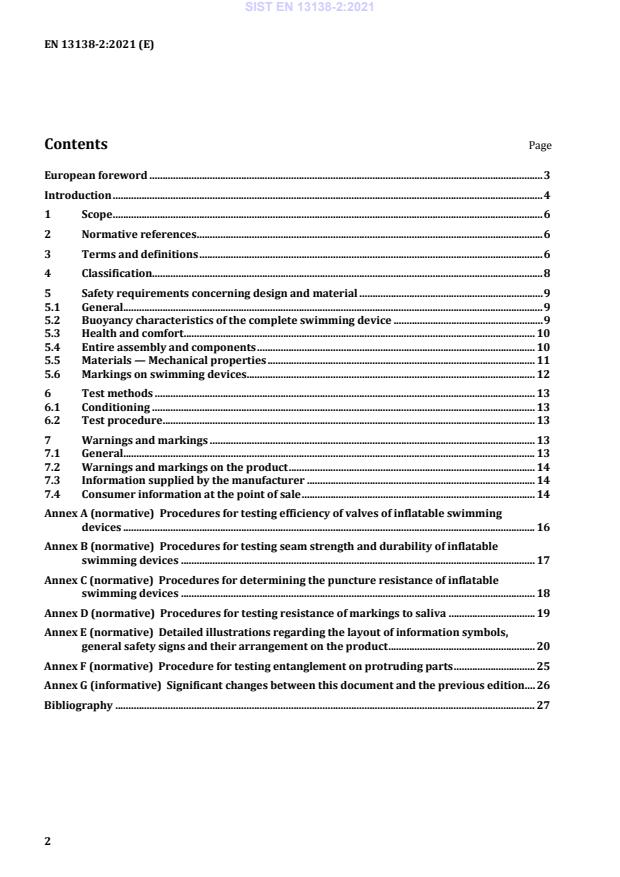
Contents Page
European foreword . 3
Introduction . 4
1 Scope . 6
2 Normative references . 6
3 Terms and definitions . 6
4 Classification. 8
5 Safety requirements concerning design and material . 9
5.1 General. 9
5.2 Buoyancy characteristics of the complete swimming device . 9
5.3 Health and comfort . 10
5.4 Entire assembly and components . 10
5.5 Materials — Mechanical properties . 11
5.6 Markings on swimming devices. 12
6 Test methods . 13
6.1 Conditioning . 13
6.2 Test procedure . 13
7 Warnings and markings . 13
7.1 General. 13
7.2 Warnings and markings on the product . 14
7.3 Information supplied by the manufacturer . 14
7.4 Consumer information at the point of sale . 14
Annex A (normative) Procedures for testing efficiency of valves of inflatable swimming
devices . 16
Annex B (normative) Procedures for testing seam strength and durability of inflatable
swimming devices . 17
Annex C (normative) Procedures for determining the puncture resistance of inflatable
swimming devices . 18
Annex D (normative) Procedures for testing resistance of markings to saliva . 19
Annex E (normative) Detailed illustrations regarding the layout of information symbols,
general safety signs and their arrangement on the product . 20
Annex F (normative) Procedure for testing entanglement on protruding parts . 25
Annex G (informative) Significant changes between this document and the previous edition. 26
Bibliography . 27
European foreword
This document (EN 13138-2:2021) has been prepared by Technical Committee CEN/TC 162 “Protective
clothing including hand and arm protection and lifejackets”, the secretariat of which is held by DIN.
This European Standard shall be given the status of a national standard, either by publication of an
identical text or by endorsement, at the latest by April 2022 and conflicting national standards shall be
withdrawn at the latest by April 2022.
Attention is drawn to the possibility that some of the elements of this document may be the subject of
patent rights. CEN shall not be held responsible for identifying any or all such patent rights.
This document supersedes EN 13138-2:2014.
Annex G provides details of significant technical changes between this European Standard and the
previous edition EN 13138-2:2014.
EN 13138, Buoyant aids for swimming instruction consists of the following parts dealing with buoyant
swimming devices for swimming instructions for the various stages of the learning process:
— Part 1: Safety requirements and test methods for buoyant aids to be worn
— Part 2: Safety requirements and test methods for buoyant aids to be held
— Part 3: Safety requirements and test methods for swim seats into which a user is positioned
Any feedback and questions on this document should be directed to the users’ national standards body.
A complete listing of these bodies can be found on the CEN website.
According to the CEN-CENELEC Internal Regulations, the national standards organisations of the
following countries are bound to implement this European Standard: Austria, Belgium, Bulgaria, Croatia,
Cyprus, Czech Republic, Denmark, Estonia, Finland, France, Germany, Greece, Hungary, Iceland, Ireland,
Italy, Latvia, Lithuania, Luxembourg, Malta, Netherlands, Norway, Poland, Portugal, Republic of North
Macedonia, Romania, Serbia, Slovakia, Slovenia, Spain, Sweden, Switzerland, Turkey and the United
Kingdom.
Introduction
The entire process of learning to swim is considered to include two stages:
— getting familiar with the water environment and movements in it, and
— acquiring skills in standard swimming strokes.
Buoyant aids for swimming instruction (in brief: swimming device(s)) are intended to assist users (in
particular children) to learn to swim. The design and purpose of the swimming devices are related to the
above stages.
Swimming devices are intended to give the user positive buoyancy in the water while maintaining the
correct body position for swimming. However, it should not be assumed that standard conformity of the
swimming devices will by itself eliminate the risk of drowning as this depends also on the behaviour of
the user and any supervision.
Although this document sets performance requirements to ensure that swimming devices perform
appropriately, it is essential that the swimming devices are used correctly and under constant and close
supervision. It is important to ensure that they are securely fitted to the appropriate size of user and that
when correctly fitted, they cannot become displaced. Swim seats however should allow immediate escape
in case of capsizing. Therefore, the use of these swimming devices is recommended to be restricted to
water out of standing depth of the user.
The highest degree of protection against drowning can only be achieved by using lifejackets. It is essential
that there is a clear distinction between rescue intended to preserve life and those which are intended
only to assist buoyancy for the user when learning to swim. As swimming devices are not life preservers,
they should only be used in swimming pools and other situations free from current, tides and waves.
The bulk storage of some types of swimming devices could, under certain conditions, result in a potential
fire hazard. The perceived risk of such a hazard was evaluated against the actual risk to the user from
materials treated with certain known toxic fire-retardant chemicals. However, the fire hazard is less of a
problem to the user than the risk associated with the swimming devices being put in the mouth, especially
by children. For this reason, flammability requirements are not included in this document.
For the above reasons and to differentiate these swimming devices from aquatic toys, advisory safety
measures, including marking, warning notices and user instructions are included in this document.
The range both of the design and function of buoyant aids for swimming instruction varies considerably
and for this reason, the standard for swimming devices has been prepared in three parts, namely
swimming devices that are intended to allow the user to become familiar with water (passive user),
swimming devices that are worn (active user) and those devices that are held by the user to improve
swimming strokes.
— Part 1 of this series is only for products that are securely attached to the body (Class B swimming
devices = for an active user). They are intended to introduce the user to the range of swimming
strokes.
— Part 2 of this series is for products that are held either in the hands or by the body (class C
devices = for an active user) and are intended to assist with improving specific elements of the
swimming stroke. For adult beginners or more advanced users they can also be used for further
stages of the process to learn to swim.
— Part 3 of this series deals only with products (swim seats) to assist children up to 36 months in their
first attempts to learn to swim (i.e. to get familiar with the ―in-water-environment) and moving
through it. The child is positioned inside the buoyant structure, which provides buoyancy and lateral
support to the body, thereby keeping the child’s head above water level (Class A swimming
devices = for a passive user).
Swim seats allow young children to experience the water environment and being moved through it.
Movements of lower limbs and arms are possible. The use of swim seats does however not replicate any
form of a correct swimming stroke.
Swim seats complying with this document provide a stable, floating position for a child sitting in the swim
seat and avoid entrapment in case of capsizing. Children in swim seats do however require very close
parental supervision. Overload beyond specified body mass, breaking waves and violent external forces
are remaining risks that can cause capsizing. Use of these swimming devices in water that is of the child’s
standing depth will increase the risk of capsizing and will hinder or block the escape from the seat in case
of emergency.
1 Scope
This document specifies safety requirements for construction, performance, sizing and marking for
swimming devices intended to assist users with movement through the water in the early stages of water
awareness, while learning to swim or while learning part of a swimming stroke. It also gives methods of
test for verification of these requirements.
This part 2 of EN 13138 applies only to class C swimming devices that are designed to be held in the hands
or by the body. Typical swimming devices include kick boards and pull/kick boards. These swimming
devices are used to assist in learning to swim or to assist with swimming strokes and improving specific
elements of the stroke, which have either inherent buoyancy or can be inflated.
It does not apply to pull buoys, swim rings, lifebuoys, buoyancy aids, lifejackets or aquatic toys.
2 Normative references
The following documents are referred to in the text in such a way that some or all of their content
constitutes requirements of this document. For dated references, only the edition cited applies. For
undated references, the latest edition of the referenced document (including any amendments) applies.
EN 71-1:2014+A1:2018, Safety of toys — Part 1: Mechanical and physical properties
EN 20105-A02:1994, Textiles — Tests for colour fastness — Part A02: Grey scale for assessing change in
colour (ISO 105-A02:1993)
EN ISO 105-E03:2010, Textiles — Tests for colour fastness — Part E03: Colour fastness to chlorinated
water (swimming-pool water) (ISO 105-E03:2010)
EN ISO 105-E04:2013, Textiles — Tests for colour fastness — Part E04: Colour fastness to perspiration
(ISO 105-E04:2013)
EN ISO 105-X12:2016, Textiles — Tests for colour fastness — Part X12: Colour fastness to rubbing
(ISO 105-X12:2016)
EN ISO 3696:1995, Water for analytical laboratory use — Specification and test methods (ISO 3696:1987)
3 Terms and definitions
For the purposes of this document, the following terms and definitions apply.
ISO and IEC maintain terminological databases for use in standardization at the following addresses:
— IEC Electropedia: available at https://www.electropedia.org/
— ISO Online browsing platform: available at https://www.iso.org/obp
3.1
buoyancy
resultant upthrust of a swimming device when totally submerged in fresh water with its uppermost part
just below the water surface
3.2
inherent buoyancy
upthrust provided by material which is less dense than water or by sealed chambers that are not
inflatable and are filled with air or gas
3.3
buoyant aid for swimming instruction
garment or swimming device which when worn or held correctly will provide the buoyancy required to
become familiar with movement through the water, assist with learning to swim or to improve swimming
strokes
Note 1 to entry: In brief: swimming device.
3.4
minimum buoyancy
least buoyancy required by the standard
3.5
original buoyancy
buoyancy (3.1) provided by a complete swimming device when first tested
3.6
class A swimming device
swimming device for children up to 36 months of age in which the child is in contact with the water
positioned inside the buoyant structure so that it will keep the passive user in a stable floating position
where the base of the chin is at or above the surface of the water
Note 1 to entry: This swimming device is intended to allow the user to become familiar with the water
environment.
Note 2 to entry: For swimming devices class A for children above 36 months see EN ISO 25649-4.
3.7
class B swimming device
swimming device intended to be worn, to be securely attached to the body and to introduce the active
user to the range of swimming strokes
3.8
class C swimming device
swimming device intended to be held either in the hands or by the body and to assist with swimming
strokes and/or improving specific elements of the strokes
3.9
conditioning
process to which the complete swimming device is submitted that includes immersion in chlorinated
swimming pool water and storage in cold and hot conditions and comprising a number of cycles, to
simulate the conditions to which the swimming device is likely to be subjected in normal use and storage
3.10
component
sub-group of the entire swimming device which contributes to either buoyancy, function or safety
3.11
swim seat
buoyant swimming device intended to introduce the user to the aquatic environment and to build water
confidence as a pre-requisite to learning to swim
Note 1 to entry: Swim seats provide safety for the user but do not guarantee protection against drowning.
Note 2 to entry: Swim seats are learning aids and not aquatic toys as defined in EN 71-1:2014+A1:2018.
3.12
swim seat system
all integrated components (parts) of a swim seat which contribute to stable floating conditions and to
safety during normal use or after a capsizing emergency
3.13
escape
complete separation between the test dummy and the swim seat in case of a deliberate capsizing of the
swim seat or swim seat system
3.14
assessment panel
group of three people, all of whom are experienced in assessing buoyant swimming devices appointed to
witness and assess the swimming device
3.15
kick board
buoyant swimming device designed to be held in the hands or by the arms in order to support the body
in the water to assist the user to improve swimming strokes
3.16
sinking angle
angle to which a test manikin is intentionally calibrated when hung on its centre of gravity and completely
immersed under water
3.17
passive user
user who does not need to make conscious efforts to keep their airway above water level since this is
achieved by the swimming device
3.18
active user
user who needs to make conscious efforts to keep their airway above water level since this is not achieved
by the swimming device
3.19
swimming device intended to be worn
swimming device having either inherent buoyancy or may be inflated to provide buoyancy and which is
securely attached to the body in such a way that it cannot be accidentally be removed and so as to provide
the user with buoyancy
3.20
swimming device intended to be held
device held either in the hands or by the body and which provides buoyancy whilst it is being held by the
user
4 Classification
Buoyant swimming devices shall be classified according to Table 1.
Table 1 — Classification of buoyant aids for swimming instruction
Class Description
A Buoyant swimming device in which the child is in contact with the water positioned
inside the buoyant structure. This swimming device is intended to allow the user to
become familiar with the water environment and movements through it. The swimming
device will keep the passive user in a stable floating position so that the base of the chin
is at or above the surface of the water
B Buoyant swimming device intended to be worn, to be securely attached to the body and
to introduce the active user to the range of swimming strokes.
C Swimming device intended to be held either in the hands or by the body and to assist
with swimming strokes and/or improving specific elements of the strokes
5 Safety requirements concerning design and material
5.1 General
Construction of a buoyant swimming device shall be such that it corresponds in terms of design,
dimensions, safety, strength and durability for its intended use. The requirements set out were chosen to
ensure compliance with these considerations. Where buoyant swimming devices are provided in several
components, the requirements apply to each of the components as specified in the relevant paragraphs
below.
Where buoyancy is not inherent, components shall have a minimum of two independent chambers
safeguarding function and safety if one chamber fails. A swimming device shall be only class A or class B
or class C.
Hand-held swimming devices shall be assessed by the assessment panel to determine whether they
comply with the ergonomic requirements of the intended user group.
There are no colour requirements for these swimming devices.
5.2 Buoyancy characteristics of the complete swimming device
5.2.1 General
When tested in accordance with the procedures 5.2.2, the swimming device shall, with all of its buoyant
components, have a minimum buoyancy of 15 N.
NOTE For illustration of class of swimming device, see Figure 1.
5.2.2 Measurement of buoyancy of complete swimming device
5.2.2.1 Apparatus
The standard equipment required consists of a weighted cage, whose submerged weight is greater than
1,1 times the expected buoyancy value of the swimming device, and a tank of fresh water, deep enough
to accommodate the swimming device horizontally with its upper surfa
...