


CEN/CLC/TR 17603-11:2021
(Main)Space engineering - Technology readiness level (TRL) guidelines
General Information
- Abstract
The present handbook is provided to support the implementation of the requirements of ECSS-E-AS-11 to space projects.
With this purpose, this handbook provides guidelines on the w ay to assess the maturity of a technology of a product in a
given environment, to use the TRL assessment outcome in the product development framew ork, and to introduce some
further refinements for specific disciplines or products to w hich the TRL assessment methodology can be extended.
The concept of Manufacturing Readiness Level (MRL) is not addressed in this document, w hilst the concept of TRL can
be applied to the technology-related aspects of manufacturing.
- Status
- Published
- Publication Date
- 28-Sep-2021
- Technical Committee
- CEN/CLC/TC 5 - Space
- Drafting Committee
- CEN/CLC/TC 5/WG 6 - Upstream standards
- Current Stage
- 6060 - Definitive text made available (DAV) - Publishing
- Start Date
- 29-Sep-2021
- Due Date
- 06-Apr-2022
- Completion Date
- 29-Sep-2021


Overview
CEN/CLC/TR 17603-11:2021 - Space engineering: Technology readiness level (TRL) guidelines - is a technical report that supports implementation of ECSS-E-AS-11 for space projects. It provides practical guidance on how to assess technology maturity using the TRL scale, how to apply TRL outcomes in product development and project decision‑making, and how to refine TRL practice for discipline‑specific cases (software, EEE components, materials and manufacturing processes). The report clarifies that TRL is a maturity assessment tool (not a development method) and that Manufacturing Readiness Level (MRL) is out of scope, although TRL may be applied to manufacturing‑related technology aspects.
Key topics and requirements
- Purpose and scope: Guidance to implement ECSS-E-AS-11 / ISO 16290 in space engineering projects.
- TRL history and definitions: Evolution of TRL use and its adoption in ECSS; explanation of terms (element, critical function, relevant/operational environment).
- Technology Readiness Assessment (TRA): Principles, prerequisites, independent verification, and a typical TRA process.
- TRL evaluation by level (TRL 1–9): Descriptions and milestones for progressing from basic principles to flight‑proven systems.
- Project implementation: How TRL links to project phases, Technology Readiness Status Lists (TRSL), the critical item list, risk management and milestone expectations.
- Modeling and demonstrators: Guidance on model types, technology demonstrators and reassessment for reuse or new environments.
- Discipline‑specific annexes: Practical considerations and criteria for software, EEE components, and materials/manufacturing processes.
- Verification and evidence: Emphasis on reproducible verification, documentation, and independent assessment of TRL claims.
Practical applications - who uses this standard
- Systems engineers and project managers: Inform technology selection, schedule and risk trade‑offs across mission phases.
- Technology developers and R&T&D teams: Structure development plans and prepare evidence to demonstrate maturity.
- TRA participants and independent assessors: Apply consistent criteria and provide verified maturity statements.
- Product assurance, procurement and quality teams: Integrate TRL evidence into critical‑item control, supplier selection and verification planning.
- Space agencies, primes, SMEs and test laboratories: Align technology roadmaps, demonstrator programmes, and mission readiness decisions.
Related standards and references
- ISO 16290:2013 - Definition of TRLs and assessment criteria (adopted by ECSS-E-AS-11).
- ECSS-E-AS-11 / ECSS-E-HB-11A - Adoption notice and origin of guidance.
- ECSS family standards for system engineering, verification, software, product assurance and project reviews (referenced in the report for integration with TRL practice).
Keywords: Technology Readiness Level, TRL guidelines, space engineering, technology readiness assessment, ECSS‑E‑AS‑11, ISO 16290, TRA, software TRL, EEE components, materials and manufacturing.
Get Certified
Connect with accredited certification bodies for this standard

BUREAU VERITAS Certification Germany
Bureau Veritas certification in Germany.

Element Materials Technology
Materials testing and product certification.

AQMS Ltd.
AQMS provides ISO certification to SMEs across the UK.
Sponsored listings
Frequently Asked Questions
CEN/CLC/TR 17603-11:2021 is a technical report published by the European Committee for Standardization (CEN). Its full title is "Space engineering - Technology readiness level (TRL) guidelines". This standard covers: The present handbook is provided to support the implementation of the requirements of ECSS-E-AS-11 to space projects. With this purpose, this handbook provides guidelines on the w ay to assess the maturity of a technology of a product in a given environment, to use the TRL assessment outcome in the product development framew ork, and to introduce some further refinements for specific disciplines or products to w hich the TRL assessment methodology can be extended. The concept of Manufacturing Readiness Level (MRL) is not addressed in this document, w hilst the concept of TRL can be applied to the technology-related aspects of manufacturing.
The present handbook is provided to support the implementation of the requirements of ECSS-E-AS-11 to space projects. With this purpose, this handbook provides guidelines on the w ay to assess the maturity of a technology of a product in a given environment, to use the TRL assessment outcome in the product development framew ork, and to introduce some further refinements for specific disciplines or products to w hich the TRL assessment methodology can be extended. The concept of Manufacturing Readiness Level (MRL) is not addressed in this document, w hilst the concept of TRL can be applied to the technology-related aspects of manufacturing.
CEN/CLC/TR 17603-11:2021 is classified under the following ICS (International Classification for Standards) categories: 49.140 - Space systems and operations. The ICS classification helps identify the subject area and facilitates finding related standards.
CEN/CLC/TR 17603-11:2021 is associated with the following European legislation: Standardization Mandates: M/496. When a standard is cited in the Official Journal of the European Union, products manufactured in conformity with it benefit from a presumption of conformity with the essential requirements of the corresponding EU directive or regulation.
CEN/CLC/TR 17603-11:2021 is available in PDF format for immediate download after purchase. The document can be added to your cart and obtained through the secure checkout process. Digital delivery ensures instant access to the complete standard document.
Standards Content (Sample)
SLOVENSKI STANDARD
01-november-2021
Vesoljska tehnika - Smernice za ravni tehnološke zrelosti (TRL)
Space engineering - Technology readiness level (TRL) guidelines
Raumfahrttechnik - Richtlinien zum technischen Reifegrad (TRL)
Ingénierie spatiale - Guide d’utilisation des Niveaux de Maturité Technologique (NMT)
Ta slovenski standard je istoveten z: CEN/CLC/TR 17603-11:2021
ICS:
49.140 Vesoljski sistemi in operacije Space systems and
operations
2003-01.Slovenski inštitut za standardizacijo. Razmnoževanje celote ali delov tega standarda ni dovoljeno.
TECHNICAL REPORT
CEN/CLC/TR 17603-11
RAPPORT TECHNIQUE
TECHNISCHER BERICHT
September 2021
ICS 49.140
English version
Space engineering - Technology readiness level (TRL)
guidelines
Ingénierie spatiale - Guide d'utilisation des Niveaux de Raumfahrttechnik - Richtlinien zum technischen
Maturité Technologique (NMT) Reifegrad (TRL)
This Technical Report was approved by CEN on 26 March 2021. It has been drawn up by the Technical Committee CEN/CLC/JTC
5.
CEN and CENELEC members are the national standards bodies and national electrotechnical committees of Austria, Belgium,
Bulgaria, Croatia, Cyprus, Czech Republic, Denmark, Estonia, Finland, France, Germany, Greece, Hungary, Iceland, Ireland, Italy,
Latvia, Lithuania, Luxembourg, Malta, Netherlands, Norway, Poland, Portugal, Republic of North Macedonia, Romania, Serbia,
Slovakia, Slovenia, Spain, Sweden, Switzerland, Turkey and United Kingdom.
CEN-CENELEC Management Centre:
Rue de la Science 23, B-1040 Brussels
© 2021 CEN/CENELEC All rights of exploitation in any form and by any means Ref. No. CEN/CLC/TR 17603-11:2021 E
reserved worldwide for CEN national Members and for
CENELEC Members.
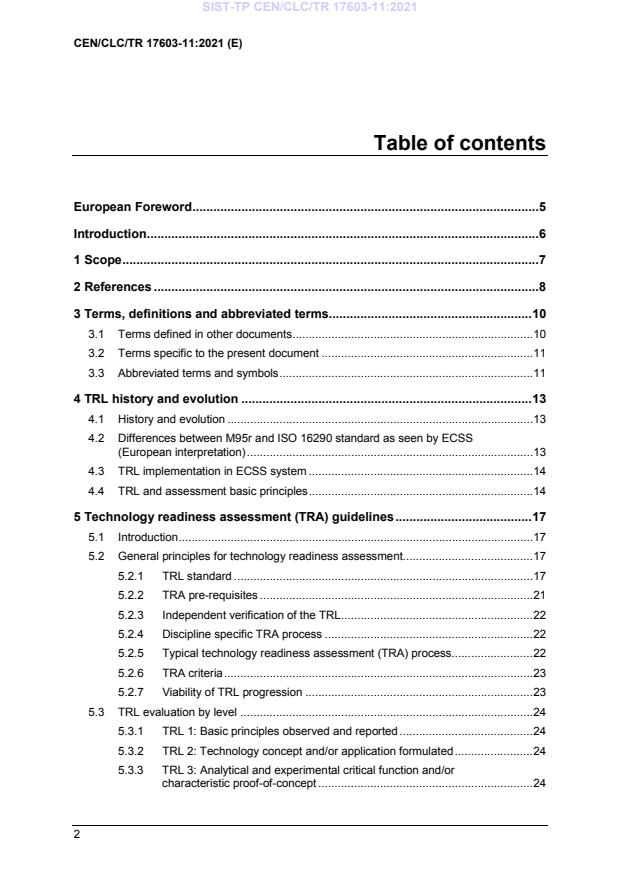
Table of contents
European Foreword . 5
Introduction . 6
1 Scope . 7
2 References . 8
3 Terms, definitions and abbreviated terms . 10
3.1 Terms defined in other documents . 10
3.2 Terms specific to the present document . 11
3.3 Abbreviated terms and symbols . 11
4 TRL history and evolution . 13
4.1 History and evolution . 13
4.2 Differences between M95r and ISO 16290 standard as seen by ECSS
(European interpretation) . 13
4.3 TRL implementation in ECSS system . 14
4.4 TRL and assessment basic principles . 14
5 Technology readiness assessment (TRA) guidelines . 17
5.1 Introduction . 17
5.2 General principles for technology readiness assessment. 17
5.2.1 TRL standard . 17
5.2.2 TRA pre-requisites . 21
5.2.3 Independent verification of the TRL . 22
5.2.4 Discipline specific TRA process . 22
5.2.5 Typical technology readiness assessment (TRA) process. 22
5.2.6 TRA criteria . 23
5.2.7 Viability of TRL progression . 23
5.3 TRL evaluation by level . 24
5.3.1 TRL 1: Basic principles observed and reported . 24
5.3.2 TRL 2: Technology concept and/or application formulated . 24
5.3.3 TRL 3: Analytical and experimental critical function and/or
characteristic proof-of-concept . 24
5.3.4 TRL 4 : Component and/or breadboard functional verification in
laboratory environment . 25
5.3.5 TRL 5 : Component and/or breadboard critical function verification in
a relevant environment . 26
5.3.6 TRL 6: Model demonstrating the critical functions of the element in a
relevant environment . 27
5.3.7 TRL 7 : Model demonstrating the element performance for the
operational environment . 28
5.3.8 TRL 8 : Actual system completed and accepted for flight (“flight
qualified”) . 28
5.3.9 TRL 9: Actual system “flight proven” through successful mission
operations . 29
5.4 Guidelines for other uses of TRLs in R&T&D activities . 29
6 Implementation in projects . 32
6.1 General . 32
6.2 Critical functions and technologies in projects . 33
6.2.1 Overview . 33
6.2.2 Technology readiness status list (TRSL) and transference to critical
item list . 34
6.3 Technology readiness assessment (TRA) in projects . 34
6.4 Typical levels linked to project phases and milestones . 35
7 Links with model philosophy and technology demonstration and
reassessment . 39
7.1 Links with model types and technology demonstration . 39
7.1.1 Link between TRL and model types . 39
7.1.2 Link between TRL and technology demonstrators . 42
7.2 Re-assessment of TRL for re-use of element with existing TRA . 44
7.2.1 Technical guidelines . 44
7.2.2 Technology re-use in a new environment . 46
Annex A TRL considerations for software . 47
A.1 Terms specific to the present annex . 47
A.2 ISO TRL scale and software developments . 48
A.3 Basic principles . 48
A.4 Use of TRL with Software . 49
A.5 Relationship between TRL and criticality categories . 56
Annex B TRL considerations for EEE components . 57
Annex C TRL considerations for materials and manufacturing processes . 59
Figures
Figure 4-1: Illustration of differences between M95r (European interpretation) and
ECSS-E-AS-11. 14
Figure 4-2: Evolution technology maturity . 15
Figure 5-1: Illustration of a new RF transistor then RF amplifier progressing through
TRL . 21
Figure 5-2: Example of ESA technology activity template . 30
Figure 5-3: Illustration of a Technology Roadmap . 31
Figure 6-1: Risk versus TRL and complexity . 33
Figure 6-2: Evolution of technology options during preliminary project phases . 35
Figure 6-3: Project phases and generalised institutional expectation of TRA outcome . 37
Figure 6-4: Project phases and generalised commercial expectation of TRA outcome . 38
Tables
Table 5-1: TRL summary - Milestones and work achievement (adapted from ISO
16290) . 18
Table 6-1: Benefits of use of TRA . 36
Table 7-1: Models types associated to TRLs . 40
Table 7-2: Use of commonly-used models for TRL progression . 42
Table 7-3: Links between TRL and Heritage Category . 45
Table 7-4: Technology maturity transfer for re-use . 46
Table A-1 : Link between Software development status and TRL . 50
Table B-1 : Milestones and work achievement for EEE components TRL. 57
Table C-1 : Use of TRL for with materials and manufacturing process development . 60
European Foreword
This document (CEN/CLC/TR 17603-11:2021) has been prepared by Technical Committee
CEN/CLC/JTC 5 “Space”, the secretariat of which is held by DIN.
It is highlighted that this technical report does not contain any requirement but only collection of data
or descriptions and guidelines about how to organize and perform the work in support of EN 16603-
11.
This Technical report (CEN/CLC/TR 17603-11:2021) originates from ECSS-E-HB-11A.
Attention is drawn to the possibility that some of the elements of this document may be the subject of
patent rights. CEN [and/or CENELEC] shall not be held responsible for identifying any or all such
patent rights.
This document has been prepared under a mandate given to CEN by the European Commission and
the European Free Trade Association.
This document has been developed to cover specifically space systems and has therefore precedence
over any TR covering the same scope but with a wider domain of applicability (e.g.: aerospace).
Introduction
This Handbook supports the application of the TRL, and provides guidelines to its use in projects and
its independent verification within each specific project context.
This Handbook provides guidelines for best practice for interpretation of the requirements contained
in ECSS-E-AS-11 and for the implementation of the process of technology readiness assessment for
technologies applied to a critical function of an element.
The ECSS-E-AS-11 - “Adoption Notice of ISO 16290 Definition of the Technology Readiness Levels
(TRLs) and their criteria of assessment” adopts ISO 16290 with a minimum set of modifications, to
allow for reference and for a consistent integration in ECSS system of standards.
TRL is a scale for technology maturity assessment and not a method of technology engineering nor
development. TRL is used in R&T&D activities and also in project activities.
For project activities, a technology readiness assessment informs the project manager (until the end of
B phase) of the risk when adopting a new technology for a critical function of an element of the
system. In the C and D phases TRL is no longer used by the project and the maturity of technology is
managed in the critical item list.
For other projects the information of the declared technology maturity can be reused and an
assessment of the new project use conditions are considered in the assessment.
In this handbook the three main actors and the respective role of each actor are clearly identified. The
three discrete actors are: technology developers, projects teams (using the technology) and the TRA
participants (i.e. those who perform the technology readiness assessment).
Scope
The present handbook is provided to support the implementation of the requirements of ECSS-E-AS-11
to space projects.
With this purpose, this handbook provides guidelines on the way to assess the maturity of a
technology of a product in a given environment, to use the TRL assessment outcome in the product
development framework, and to introduce some further refinements for specific disciplines or
products to which the TRL assessment methodology can be extended.
The concept of Manufacturing Readiness Level (MRL) is not addressed in this document, whilst the
concept of TRL can be applied to the technology-related aspects of manufacturing.
References
The following documents are referenced in this text or provide additional information useful for the
reader.
EN Reference Reference in text Title
EN 16601-00-01 ECSS-S-ST-00-01 ECSS system – Glossary of terms
EN 16603-10 ECSS-E-ST-10 Space engineering – System engineering general
requirements
EN 16603-10-02 ECSS-E-ST-10-02 Space engineering – Verification
EN 16603-10-03 ECSS-E-ST-10-03 Space engineering – Testing
EN 16603-10-06 ECSS-E-ST-10-06 Space engineering – Technical requirements
specification
EN 16603-10-24 ECSS-E-ST-10-24 Space engineering – Interface management
EN 16603-11 ECSS-E-AS-11 Adoption notice of ISO 16290, Space systems –
Definition of the Technology Readiness Levels (TRLs)
and their criteria of assessment (1 October 2014)
TR 17603-10-02 ECSS-E-HB-10-02 Space engineering – Verification guidelines
EN 16603-40 ECSS-E-ST-40 Space engineering – Software
EN 16603-70 ECSS-E-ST-70 Space engineering – Ground systems and operations
EN 16601-10-10 ECSS-M-ST-10-01 Space project management – Organization and
conduct of reviews
EN 16601-60 ECSS-M-ST-60 Space project management – Cost and schedule
management
EN 16601-80 ECSS-M-ST-80 Space project management – Risk management
EN 16602-10 ECSS-Q-ST-10 Space product assurance – Product assurance
management
EN 16602-10-04 ECSS-Q-ST-10-04 Space product assurance – Critical-item control
EN 16602-20 ECSS-Q-ST-20 Space product assurance – Quality assurance
EN 16602-20-10 ECSS-Q-ST-20-10 Space product assurance – Off-the-shelf items
utilization in space systems
EN 16602-30 ECSS-Q-ST-30 Space product assurance – Dependability
EN 16602-40 ECSS-Q-ST-40 Space product assurance - Safety
EN 16602-60 ECSS-Q-ST-60 Space product assurance – Electrical, electronic and
electromechanical (EEE) components
EN Reference Reference in text Title
EN 16602-60-13 ECSS-Q-ST-60-13 Space product assurance – Commercial electrical,
electronic and electromechanical (EEE) components
EN 16602-70 ECSS-Q-ST-70 Space product assurance – Materials, mechanical parts
and processes
EN 16602-70-71 ECSS-Q-ST-70-71 Spaced product assurance – Materials, processes and
their data selection
EN 16602-80 ECSS-Q-ST-80 Space product assurance – Software product assurance
ISO 16290:2013 Space systems - Definition of the Technology
Readiness Levels (TRLs) and their criteria of
assessment
Mankins 95 reference TECHNOLOGY READINESS LEVELS, A White
(M95r) Paper, April 6, 1995, John C. Mankins Advanced
Concepts Office, Office of Space Access and
Technology NASA 1
https://www.hq.nasa.gov/office/codeq/trl/trl.pdf
Terms, definitions and abbreviated terms
3.1 Terms defined in other documents
a. For the purpose of this document, the terms and definitions from ECSS-E-AS-11 apply, in
particular for the following terms:
1. critical function of an element
NOTE The synonym of “critical function” is “critical function of an element”.
2. element
NOTE It is important to realize that the term element has a different meaning in
ECSS-E-AS-11 (that refer to ISO 16290) than in the ECSS Glossary of
terms (ECSS-S-ST-00-02). This guidelines use the term element as defined
in ISO 16290.
3. breadboard
4. laboratory environment
5. mature technology
6. operational environment
7. relevant environment
8. reproducible process
9. validation
b. For the purpose of this document the terms from ECSS-S-ST-00-01, except the terms listed in
3.1a apply, in particular for the following terms:
1. commissioning result review
2. component (context EEE)
NOTE For TRL 4 and TRL 5 the term “component” is understood as “part of a
larger whole”.
3. environment
4. ground segment
5. technology readiness level
c. For the purpose of this document the terms from ECSS-E-ST-70, except the terms listed in 3.1a.
and 3.1b apply, in particular for the following term:
1. Ground Segment QR (GSQR)
2. Operations QR (OQR)
3. Software Requirement Specification (SRS)
3.2 Terms specific to the present document
3.2.1 Research and Technology and Development (R&T&D)
activities to mature from research to technology to development as they are progressing from lower to
high TRL levels
3.3 Abbreviated terms and symbols
For the purpose of this document, the abbreviated terms from ECSS-S-ST-00-01 and the following
apply:
Abbreviation Meaning
acceptance review
AR
critical design review
CDR
commissioning readiness review
CRR
critical item list
CIL
development model
DM
displacement damage
DD
electrical, electronic and electromechanical
EEE
engineering model
EM
electromagnetic compatibility
EMC
engineering qualification model
EQM
equipment qualification status review
EQSR
European Space Components Coordination
ESCC
flight model
FM
In-orbit operations review
IOOR
International Standardization Organization
ISO
invitation to tender
ITT
Launch and early orbit phase
LEOP
Mankins 95 reference
M95r
mission definition review
MDR
National Aeronautics and Space Administration
NASA
new work item proposal
NWIP
Product Assurance
PA
printed circuit board
PCB
preliminary design review
PDR
protoflight model
PFM
proof of concept
POC
preliminary requirements review
PRR
qualification model
QM
Abbreviation Meaning
quality management system
QMS
qualification review
QR
reliability, availability, maintainability and safety
RAMS
radiofrequency
RF
Research and Technology and Development
R&T&D
single event effect
SEE
single event latch-up
SEL
structural model
SM
software problem report
SPR
software reuse file
SRF
structural thermal model
STM
total ionising dose
TID
thermal model
TM
terms of reference
ToR
technology plan
TP
technology readiness assessment
TRA
technology readiness level
TRL
technology readiness status list
TRSL
verification and validation
V&V
working group
WG
with respect to
w.r.t.
TRL history and evolution
4.1 History and evolution
The TRL methodology was originated at NASA in the 1970s in order to establish a method by which
NASA selected new technology amongst numerous candidates for their complex spaceflight
programmes. The scale progressed until 1995 with the definition of nine levels that became the
Mankins 95 reference (M95r) [see clause2]. From that moment, the principle of a maturity scale was
adopted by many companies and government agencies around the world. However, although they
were somewhat similar, different definitions or interpretation of the M95r were used. ECSS decided,
in 2008, to first make a harmonization at European level and then to propose to ISO a global
harmonization in 2009. This then resulted in an ISO New Work Item Proposal (NWIP) “Definition of
the Technology Readiness Levels (TRLs) and their criteria of assessment”.
The ISO standard 16290 was published in 2013 and as a result, TRL are now globally harmonized.
ECSS actively contributed to this ISO standard by providing members to the ISO WG. The ISO
standard concerns the definition and the criteria of assessment, however the procedure for the TRL
assessment or the way to use them within a project’s framework was not the purpose of the standard.
The standard is applicable primarily to space system hardware, although the definitions are used in a
wider domain in many cases.
It is important to recognise that the ISO standard introduces some modifications with regards to the
M95r previous interpretation in ECSS documents.
4.2 Differences between M95r and ISO 16290 standard
as seen by ECSS (European interpretation)
Below is given a summary of the differences between M95r and ISO 16290 standard, supported by
Figure 4-1:
• ISO levels 1, 2, 3 and 4 definitions are equivalent to M95r (see clause 2) .
• ISO level 5 is a new intermediate level defined for when breadboards at sub-scales are used (the
breadboards used to demonstrate the critical function in a relevant environment are not full
scale or full function representations of the flight equipment).
• ISO level 6 is equivalent to M95r level 5.
• ISO level 7 is equivalent to M95r level 6.
• ISO does not recognize M95r level 7 which was “System prototype demonstration in space
environment”.
• ISO levels 8 and 9 are equivalent to M95r definitions respectively defining “flight qualified”
(qualified for flight) and “flight proven” for the actual systems.
Differences between M95r and ISO are summed up in Figure 4-1.
Mankins 95 reference ISO 16290 standard
TRL 1 Basic principles observed and reported Basic principles observed and reported
Equivalent
TRL 2 Technology concept and/or application formulated Technology concept and/or application formulated
Equivalent
TRL 3 Analytical and experimental critical function and/or Analytical and experimental critical function and/or
Equivalent
characteristic proof-ofconcept characteristic proof-ofconcept
TRL 4 Component and/or breadboard validation in Component and/or breadboard functional verification
Equivalent
laboratory environment in laboratory environment
TRL 5 Component and/or breadboard validation in relevant Component and/or breadboard critical function
Split
environment verification in a relevant environment
TRL 6 System/subsystem model or prototype demonstration Model demonstrating the critical functions of the
Shifted
in a relevant environment (ground or space) element in a relevant environment
TRL 7 System prototype demonstration in a space Model demonstrating the element performance for the
Removed
environment operational environment
TRL 8 Actual system completed and “flight qualified” Actual system completed and accepted for flight
Equivalent
through test and demonstration (ground or space) (“flight qualified”)
TRL 9 Actual system “flight proven” through successful Actual system “flight proven” through successful
Equivalent
mission operations mission operations
Figure 4-1: Illustration of differences between M95r (European interpretation) and
ECSS-E-AS-11
The M95r scale is now obsolete and for the remainder of this handbook, the term TRL is referring to
ECSS-E-AS-11 definition.
4.3 TRL implementation in ECSS system
TRL are implemented in ECSS system following four ways:
1. adoption of the ISO 16290 with an Adoption Notice (AN ref ECSS-E-AS-11),
2. introduction in the ECSS standards of the reference to the AN when TRL are used,
3. introduction in the ECSS standards of the requirements to manage the use of TRL,
4. provision of guidelines in this handbook.
The adoption notice ECSS-E-AS-11 was necessary to provide a concise method of introducing the ISO
standard in ECSS system. The AN was needed to make normative the TRL following ECSS editorial
rules, to align the terms definition and to make reference when necessary to ECSS type of reviews.
This handbook provides guidelines on the way to assess a product, to use the TRL assessment
outcome in the product and project development framework, and to introduce some refinements for
specific disciplines or products.
4.4 TRL and assessment basic principles
Technology readiness assessment (TRA, see clause 5) allows for the assignment of a measure of the
maturity of a technology. It is important to make clear that undertaking a TRA is not a method to
develop technologies. The way to develop, to test, to qualify or to verify the development cycle of
products, or the model philosophy defined by projects, are not the object of TRL but the purpose of
others discipline-specific ECSS standards and handbooks.
The measure provided by TRL assessment is valid for a given element, at a given point in time, and a
given defined environment. It changes if the conditions (such as operational environment) that
prevailed at the time of the assessment are no longer valid. Such a situation leads to TRL reassessment
and re-grading, which can occur in particular when the re-build or re-use of an element is envisioned
with variation in the design, development process, targeted environment or operations.
During Research and Development, or Research and Technology (R&T&D) activities, TRL can be used
by the specialists developing the technologies to present their development plans (e.g. technology
roadmaps) and to communicate with non-specialists or project managers, the costs or risks involved in
taking particular technology choices with different TRLs.
In the framework of projects, TRL is used during preliminary phases (0, A, B) as a tool supporting the
decision whether or not to use or integrate specific technology in a space mission, and allowing such
decision to be taken with sufficient knowledge of any risk relating to the degree of maturity.
Generally R&T&D programs push (“research push”) the technologies maturity as far as the
intermediate TRLs. Projects then pull some technologies and develop these to the higher levels of
maturity.
The intermediate levels of maturity (typically TRLs 4, 5 and 6) are sometimes called “valley of death”
since some technologies are developed until TRL 4 or below, however they are not developed beyond
this achieved level (i.e. in the absence of a project “pull”), noting that projects are normally interested
in TRL 6 or above (see Figure 4-2).
The costs associated with a specific technology achieving a higher level of TRL are generally
increasing with each level attained.
Figure 4-2: Evolution technology maturity
It is important to highlight the following aspects in the application of TRL:
• TRL assessment is not intrinsic to a technology: if a new target environment has different
constraints or performance requirements, a TRL needs to be reduced (e.g. a TRL 9 in one
application falls even as far as TRL 4 in another).
• TRL 5 and higher are assessed to a specific mission environment. When an element at a TRL
higher than 5 is intended to be used in a different environment, in this case there is a potential
that the TRL is downgraded.
• TRL does not take into account industrial capacities of production or technology access
constraints (e.g. export control regulations).
• TRL does not take into account technology obsolescence, however conversely obsolescence can
drive the need for a TRL re-assessment.
• If the production of anything inside an element is discontinued, the TRL of the element can be
affected (see example "Heritage category C" in Table 7-3).
• TRL does not replace development cycle or quality rules.
• TRL is not mandatorily incremental: it is not mandatory to achieve level 5 (sub-scale) before
proceeding to level 6. More generally, it is not mandatory to go systematically through all
levels.
• A TRL can only be reached by an element if all of the sub-elements are at least at the same level.
• An R&T&D action does not necessarily lead to an increment in TRL.
• The time or effort to move from one TRL to another is technology dependent and cannot be
linearly projected along the TRL scale.
• The proof necessary for the assessment of TRL is as follows:
− For TRL 7 and 8, when the derivation of the evidence for the assessment of TRL is based
on testing, the test is performed using the requirements of ECSS-E-ST-10-03. It is
important to note that testing alone is not sufficient when assessing a product for TRL 7
and TRL 8.
− However, for TRL 1 to 6 where the derivation of the evidence for the assessment of TRL
is selected to be based on testing, the test is performed using the state-of-the-art rules
relevant to the TRL being assessed. For further details of the expected documentation see
clause 5.
Technology readiness assessment (TRA)
guidelines
5.1 Introduction
The value of a technology readiness assessment (TRA) exercise is to inform new programmes about
the work already achieved on new technologies and optimise synergies between programmes.
Technologies are often developed in the frame of institutional programmes, or through R&T&D
activities to prepare commercial programmes. For teams working in technology development, TRL is
a way to promote (i.e. push) technologies into programmes. Determining the evolution of TRL helps
to build roadmaps and to optimise funding opportunities by providing a framework for the
assessment of risk associated with the related technology.
This clause 5 provides a set of guidelines to perform a TRA, starting with some general description of
a typical process for conducting a TRA, followed by a series of detailed guidelines for a TRA, one for
each Technology Readiness Level is proposed.
As stated in the Introduction, it is important to recall that there are potentially three entities concerned
with the TRA: the entity requesting the TRA, the supplier of the technology, and the TRA participants
(selected to achieve an independent assessment).
NOTE The entity requesting the TRA, e.g. a project or an R&T&D programme,
can be internal or external to the technology developer organisation.
5.2 General principles for technology readiness
assessment
5.2.1 TRL standard
A TRA implements the requirements of TRL Adoption Notice ECSS-E-AS-11 (which adopts the
definitions and criteria of assessment of ISO 16290) which are provided in Table 5-1.
Table 5-1: TRL summary - Milestones and work achievement (adapted from ISO 16290)
Technology Readiness Level Milestone achieved for the element Work achievement (documented)
TRL 1: Potential applications are identified following basic • Expression of the basic principles intended for use.
Basic principles observed and observations but element concept not yet formulated.
• Identification of potential applications.
reported
TRL 2: Formulation of potential applications and preliminary • Formulation of potential applications.
Technology concept and/or element concept. No proof of concept yet.
• Preliminary conceptual design of the element,
application formulated
providing understanding of how the basic principles
would be used.
TRL 3: Element concept is elaborated and expected performance • Preliminary performance requirements (can target
Analytical and experimental critical is demonstrated through analytical models supported by several missions) including definition of functional
function and/or characteristic proof- experimental data and characteristics. performance requirements.
of-concept
• Conceptual design of the element.
• Experimental data inputs, laboratory-based
experiment definition and results.
• Element analytical models for the proof-of-concept.
TRL 4: Element functional performance is demonstrated by • Preliminary performance requirements (can target
Component and/or breadboard breadboard testing in laboratory environment. several missions) with definition of functional
functional verification in laboratory performance requirements.
environment
• Conceptual design of the element.
• Functional performance test plan.
• Breadboard definition for the functional performance
verification.
• Breadboard test reports.
Technology Readiness Level Milestone achieved for the element Work achievement (documented)
TRL 5: Critical functions of the element are identified and the • Preliminary definition of performance requirements
Component and/or breadboard associated relevant environment is defined. Breadboards and of the relevant environment.
critical function verification in a not full-scale are built for verifying the performance
• Identification and analysis of the element critical
relevant environment through testing in the relevant environment, subject to
functions.
scaling effects.
• Preliminary design of the element, supported by
appropriate models for the critical functions
verification.
• Critical function test plan. Analysis of scaling effects.
• Breadboard definition for the critical function
verification.
• Breadboard test reports.
TRL 6: Critical functions of the element are verified, performance • Definition of performance requirements and of the
Model demonstrating the critical is demonstrated in the relevant environment and relevant environment.
functions of the element in a representative model(s) in form, fit and function.
• Identification and analysis of the element critical
relevant environment
functions.
• Design of the element, supported by appropriate
models for the critical functions verification.
• Critical function test plan.
• Model definition for the critical function verifications.
• Model test reports.
TRL 7: Performance is demonstrated for the operational • Definition of performance requirements, including
Model demonstrating the element environment, on the ground or if necessary in space. A definition of the operational environment.
performance for the operational representative model, fully reflecting all aspects of the
• Model definition and realisation.
environment flight model design, is build and tested with adequate
• Model test plan.
margins for demonstrating the performance in the
• Model test results.
operational environment.
Technology Readiness Level Milestone achieved for the element Work achievement (documented)
TRL 8: Flight model is qualified and integrated in the final • Flight model is built and integrated into the final
Actual system completed and system ready for flight. system.
accepted for flight (“flight
• Flight acceptance of the final system.
qualified”)
TRL 9: Technology is mature. The element is successfully in • Commissioning in early operation phase.
Actual system “flight proven” service for the assigned mission in the actual operational
• In-orbit operation report.
through successful mission environment.
operations
NOTE: The present Table, taken from ISO 16290, is reproduced with the permission of the International Organization for Standardization, ISO. This standard can be
. Copyright remains with ISO. The
obtained from any ISO member and from the Web site of the ISO Central Secretariat at the following address: www.iso.org
standard can be obtained from ISO or its members, see www.iso.org
5.2.2 TRA pre-requisites
A pre-requisite of any TRA is the clear identification of the element that is subject to assessment.
In general, the reason for this clear identification is that:
• the degree of integration of the element under assessment increases when moving up in the
TRL scale (particularly for TRL 5 and over),
• when moving up the TRL scale, critical function of an element and performance need to be
demonstrated in varying ways:
− in the laboratory environment (TRL 4),
− in the relevant environment (TRL 5 and 6),
− for the operational environment (TRL 7), or
− in the flight configuration of the complete system (TRL 8 and 9),
• other products interfacing with or integrated in the product can have an impact on the critical
function of an element, and therefore influence the TRL.
Many of these interactions are easily predictable, but some others can be not so evident until verified
by test. For example, electromagnetic compatibility (EMC) is an issue to be considered when
increasing the level of integration.
The level of integration and correspondent environment typically increases when TRL is
incrementing. For example a transistor, using new technology, can be assessed as a single component
in low TRL (e.g. until level 4). It is then integrated into an equipment (e.g. amplifier) which is finally
itself integrated in the flight system (e.g. level 5 to 7 and finally 8 to 9). See Figure 5-1 as an example of
this integration.
Figure 5-1: Illustration of a new RF transistor then RF amplifier progressing
through TRL
5.2.3 Independent verification of the TRL
The following are guidelines to ensure independent verification of the TRL:
• In order to ensure that a TRA of an element is objective, it is completed by independent
expertise in the discipline, i.e. not part of the technology developer engineering team.
NOTE In project framework the PA manager could be part of the independent
verification function.
• Principle of independence in TRA process is similar to any review process (see example of
independence principle in ECSS-M-ST-10-01 where review board is independent from project
team).
• Access, for TRA team, to the necessary information and data concerning the technology and the
level to be assessed (see more details in 5.3) is ensured by the entity requesting the TRA.
5.2.4 Discipline specific TRA process
Software, EEE components and Materials, and Manufacturing Processes have their own dedicated
development and qualification processes consistent with the generic TRA approach given. For these
disciplines more specific TRA guidelines are undertaken as covered respectively in Annex A, Annex B
and Annex C.
5.2.5 Typical technology readiness assessment (TRA) process
For the main milestones in the technology development, a TRA could be requested. It is necessary to
follow some basic principles, which are captured in a specific Terms of Reference (ToR) for the
assessment team:
• TRA inputs:
− Formal ToR for the assessment generally including:
o clear identification of the element to be assessed,
o target TRL and recall of its targeted achievements (see in 5.3, for each level, the
detailed evaluation aspects),
o identification of key technology data to be provided concerning:
∗ element definition status (see in 5.3, for each level, the detailed associated
documentation),
∗ performance requirements status (see in 5.3, for each level, the detailed
associated documentation),
∗ V&V status (see in 5.3, for each level, the detailed associated
documentation),
∗ others existing element TRA (e.g. previous TRA reports of lower levels)
o expected TRA output,
o planning for the assessment,
o identification of TRA participants and expertise (see 5.2.3 for principle of
independence).
− Key technology data as identified in the ToR or asked by the TRA participants.
NOTE For low TRL, the TRA process could be streamlined and adapted to the
context.
• TRA organisation:
− Identification of TRA participants including:
o TRA leader, independent from the technology development,
o technical experts, one or more of whom are independent,
o in a project framework, project participants (e.g. PA manager).
− Implementation of the TRA itself (often involving formal meetings of TRA participants).
• TRA outputs:
− Development and endorsement of a TRA report by the TRA participants (in line with the
ToR).
o TRA report details whether the targeted TRL is reached or identifies the lacking
aspects and associated evidence necessary to reach the targeted TRL.
5.2.6 TRA criteria
Generally speaking, a set of specific criteria is applied in conducting a TRA. The principal areas for
TRA criteria are:
• Element definition status:
A description of the element, the associated critical function of an element and technology being
assessed including also other technologies that are involved and, if appropriate, the interactions
between the various technologies
NOTE In case of multiple technologies being assessed within a single element,
the TRA assess each technology.
• Performance requirements status:
− Identified applications
− Functional performance, operational performance
• V&V status:
− Test environment (i.e. “laboratory”, “relevant”, or “operational” environments)
− Test support used (e.g. “breadboard”, “representative models”, “qualification models”)
5.2.7 Viability of TRL progression
It is good practice to include as part of the TRA an optional evaluation of viability for further
progression of the ele
...