

EN 2234:2018
(Main)Aerospace series - Cable, electrical, fire resistant - Technical specification
- Abstract
This document specifies the required characteristics and test procedures for fire resistant or fire-proof electrical cables for use in aircraft electrical systems. These cables should also maintain a specific surface resistance when they are subjected to a flame of 1 100 °C after 5 minutes (fire resistant) or 15 minutes (fire-proof) exposure.
The insulation of these cables is designed to withstand aircraft voltages at a frequency not exceeding 2 000 Hz. Unless specified by individual product standards the maximum demonstrated ac voltage of rating of these cables is 115 V rms (phase to neutral) and 200 V rms (phase to phase) and a long term temperature of up to 260 °C (ambient temperature plus temperature rise in conductor).
- Status
- Published
- Publication Date
- 15-May-2018
- Withdrawal Date
- 29-Nov-2018
- Technical Committee
- ASD-STAN - Aerospace
- Drafting Committee
- ASD-STAN/D 2 - Electrical
- Current Stage
- 9093 - Decision to confirm - Review Enquiry
- Start Date
- 21-Jan-2024
- Completion Date
- 21-Oct-2026



Overview
EN 2234:2018 - "Aerospace series - Cable, electrical, fire resistant - Technical specification" - is a CEN standard that defines required characteristics, construction and test procedures for fire resistant / fire‑proof electrical cables intended for aircraft electrical systems. It requires cables to withstand a 1 100 °C flame for specified durations (5 minutes for fire resistant, 15 minutes for fire‑proof) while maintaining surface resistance and electrical integrity. Insulation is specified for aircraft voltage environments up to 2 000 Hz, with typical maximum demonstrated AC ratings of 115 V rms (phase-to-neutral) and 200 V rms (phase-to-phase) and long‑term temperatures to 260 °C (ambient + conductor rise).
Key topics
- Scope & performance: Flame exposure criteria (1 100 °C), electrical rating limits, and long‑term temperature capability.
- Materials & construction:
- Conductors: nickel‑clad copper alloy for 0.25 mm² and 0.4 mm²; nickel‑clad copper for ≥0.6 mm². Nickel content ≥27 % by mass.
- Mechanical rules: allowed strand joints, lay lengths, compaction limits, sheath and insulation fit and strippability.
- Electrical and environmental requirements:
- Voltage proof, insulation resistance, surface resistance, arc tracking, wet/dry arc propagation.
- Thermal endurance, accelerated ageing, thermal shock, and resistance to fluids.
- Fire and safety tests:
- Flammability, fire resistance, smoke density and toxicity testing.
- Mechanical tests:
- Tensile, bend/cold bend, abrasion, torsion, flexure endurance and continuity/plating tests.
- Quality assurance & testing regime:
- Qualification, first article inspection, production routine tests, periodic re‑qualification (typically every three years).
- Identification & delivery:
- Marking per ISO 2574, packaging, labelling requirements and standard delivery lengths.
Applications
EN 2234:2018 is used by:
- Aerospace cable designers and manufacturers developing fire resistant aircraft wiring.
- Aircraft OEMs and MRO organizations specifying and procuring electrical cables for cockpits, avionics bays, engines and other systems where fire performance is critical.
- Certification and safety engineers validating cable performance against prescribed fire, smoke, toxicity and electrical tests.
- Suppliers preparing qualification evidence, first‑article inspection records and production test data.
Keywords: EN 2234:2018, fire resistant electrical cable, aerospace cables, aircraft electrical systems, cable testing, fire‑proof cable, aerospace standard.
Related standards
Normative references include EN 3475‑100 (test methods), EN 3838 (user‑applied markings), EN 9102 / EN 9133 (quality/qualification), ISO 2574 and ISO 8815 (identification & vocabulary), and IEC 60028 (copper resistance).
Relations
- Replaces
EN 2234:2012 - Aerospace series - Cable, electrical, fire resistant - Technical specification - Effective Date
- 04-Feb-2015
- Effective Date
- 14-Oct-2026
- Effective Date
- 25-Aug-2026
- Effective Date
- 09-Feb-2026
- Effective Date
- 28-Jan-2026
- Effective Date
- 28-Jan-2026
- Effective Date
- 28-Jan-2026
- Effective Date
- 28-Jan-2026
- Effective Date
- 28-Jan-2026
- Effective Date
- 28-Jan-2026
- Effective Date
- 28-Jan-2026
- Effective Date
- 28-Jan-2026
- Effective Date
- 28-Jan-2026
- Effective Date
- 28-Jan-2026
- Effective Date
- 28-Jan-2026
Get Certified
Connect with accredited certification bodies for this standard

BUREAU VERITAS Certification Germany
Bureau Veritas certification in Germany.

Element Materials Technology
Materials testing and product certification.

AQMS Ltd.
AQMS provides ISO certification to SMEs across the UK.
Sponsored listings
Frequently Asked Questions
EN 2234:2018 is a standard published by the European Committee for Standardization (CEN). Its full title is "Aerospace series - Cable, electrical, fire resistant - Technical specification". This standard covers: This document specifies the required characteristics and test procedures for fire resistant or fire-proof electrical cables for use in aircraft electrical systems. These cables should also maintain a specific surface resistance when they are subjected to a flame of 1 100 °C after 5 minutes (fire resistant) or 15 minutes (fire-proof) exposure. The insulation of these cables is designed to withstand aircraft voltages at a frequency not exceeding 2 000 Hz. Unless specified by individual product standards the maximum demonstrated ac voltage of rating of these cables is 115 V rms (phase to neutral) and 200 V rms (phase to phase) and a long term temperature of up to 260 °C (ambient temperature plus temperature rise in conductor).
This document specifies the required characteristics and test procedures for fire resistant or fire-proof electrical cables for use in aircraft electrical systems. These cables should also maintain a specific surface resistance when they are subjected to a flame of 1 100 °C after 5 minutes (fire resistant) or 15 minutes (fire-proof) exposure. The insulation of these cables is designed to withstand aircraft voltages at a frequency not exceeding 2 000 Hz. Unless specified by individual product standards the maximum demonstrated ac voltage of rating of these cables is 115 V rms (phase to neutral) and 200 V rms (phase to phase) and a long term temperature of up to 260 °C (ambient temperature plus temperature rise in conductor).
EN 2234:2018 is classified under the following ICS (International Classification for Standards) categories: 49.060 - Aerospace electric equipment and systems. The ICS classification helps identify the subject area and facilitates finding related standards.
EN 2234:2018 has the following relationships with other standards: It is inter standard links to EN 2234:2012, EN 3475-701:2026, ISO 8815:1994, ISO 2574:1994, EN 3475-505:2023, EN 3475-404:2025, EN 3475-302:2006, EN 3475-513:2005, EN 3475-811:2009, EN 3475-603:2002, EN 3475-705:2005, EN 3475-508:2002, EN 3475-406:2002, EN 3475-505:2012, EN 3475-418:2007. Understanding these relationships helps ensure you are using the most current and applicable version of the standard.
EN 2234:2018 is available in PDF format for immediate download after purchase. The document can be added to your cart and obtained through the secure checkout process. Digital delivery ensures instant access to the complete standard document.
Standards Content (Sample)
2003-01.Slovenski inštitut za standardizacijo. Razmnoževanje celote ali delov tega standarda ni dovoljeno.LMDLuft- und Raumfahrt - Elektrische Leitungen, feuerbeständig - Technische LieferbedingungenSérie aérospatiale - Câbles électriques résistant au feu - Spécification techniqueAerospace series - Cable, electrical, fire resistant - Technical specification49.060Aerospace electric equipment and systems13.220.50Požarna odpornost gradbenih materialov in elementovFire-resistance of building materials and elementsICS:Ta slovenski standard je istoveten z:EN 2234:2018SIST EN 2234:2018en,fr,de01-julij-2018SIST EN 2234:2018SLOVENSKI
STANDARDSIST EN 2234:20121DGRPHãþD
EUROPEAN STANDARD NORME EUROPÉENNE EUROPÄISCHE NORM
EN 2234
May
t r s z ICS
v {ä r x r Supersedes EN
t t u vã t r s tEnglish Version
Aerospace series æ Cableá electricalá fire resistant æ Technical specification Série aérospatiale æ Câbles électriques résistant au feu æSpécification technique
Luftæ und Raumfahrt æ Elektrische Leitungená feuerbeständig æ Technische Lieferbedingungen This European Standard was approved by CEN on
x November
t r s yä
egulations which stipulate the conditions for giving this European Standard the status of a national standard without any alterationä Upætoædate lists and bibliographical references concerning such national standards may be obtained on application to the CENæCENELEC Management Centre or to any CEN memberä
translation under the responsibility of a CEN member into its own language and notified to the CENæCENELEC Management Centre has the same status as the official versionsä
CEN members are the national standards bodies of Austriaá Belgiumá Bulgariaá Croatiaá Cyprusá Czech Republicá Denmarká Estoniaá Finlandá Former Yugoslav Republic of Macedoniaá Franceá Germanyá Greeceá Hungaryá Icelandá Irelandá Italyá Latviaá Lithuaniaá Luxembourgá Maltaá Netherlandsá Norwayá Polandá Portugalá Romaniaá Serbiaá Slovakiaá Sloveniaá Spainá Swedená Switzerlandá Turkey and United Kingdomä
EUROPEAN COMMITTEE FOR STANDARDIZATION COMITÉ EUROPÉEN DE NORMALISATION EUROPÄISCHES KOMITEE FÜR NORMUNG
CEN-CENELEC Management Centre:
Rue de la Science 23,
B-1040 Brussels
t r s z CEN All rights of exploitation in any form and by any means reserved worldwide for CEN national Membersä Refä Noä EN
t t u vã t r s z ESIST EN 2234:2018
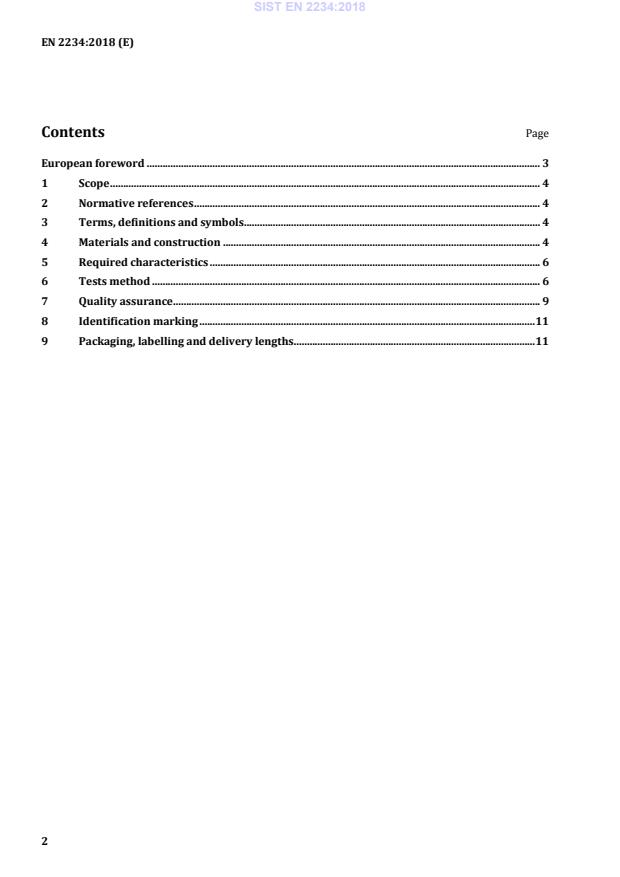
Page European foreword . 3 1 Scope . 4 2 Normative references . 4 3 Terms, definitions and symbols . 4 4 Materials and construction . 4 5 Required characteristics . 6 6 Tests method . 6 7 Quality assurance . 9 8 Identification marking . 11 9 Packaging, labelling and delivery lengths . 11
The insulation of these cables is designed to withstand aircraft voltages at a frequency not exceeding 2 000 Hz. Unless specified by individual product standards the maximum demonstrated ac voltage of rating of these cables is 115 V rms (phase to neutral) and 200 V rms (phase to phase) and a long term temperature of up to 260 °C (ambient temperature plus temperature rise in conductor). 2 Normative references The following documents are referred to in the text in such a way that some or all of their content constitutes requirements of this document. For dated references, only the edition cited applies. For undated references, the latest edition of the referenced document (including any amendments) applies. EN 3475-100 (all parts), Aerospace series — Cables, electrical, aircraft use — Test methods — Part 100: General EN 3838, Aerospace series — Requirements and tests on user-applied markings on aircraft electrical cables
EN 9102, Aerospace series — Quality systems — First article inspection EN 9133, Aerospace series — Quality Management Systems — Qualification Procedure for Aerospace Standard Products ISO 2574, Aircraft — Electrical cables — Identification marking ISO 8815, Aircraft — Electrical cables and cable harnesses — Vocabulary IEC 60028:1925, International standard of resistance for copper 3 Terms, definitions and symbols For the purposes of this document, the terms, definitions and symbols given in ISO 8815 and EN 3475-100 apply. ISO and IEC maintain terminological databases for use in standardization at the following addresses:
IEC Electropedia: available at http://www.electropedia.org/
ISO Online browsing platform: available at http://www.iso.org/obp
4 Materials and construction 4.1 Conductors 4.1.1 Materials The individual strands used for the conductors shall be cylindrical and shall be: of nickel clad copper alloy for nominal cross section of 0,25 mm2 and 0,4 mm2;
of nickel clad copper for nominal sections ≥ 0,6 mm2. SIST EN 2234:2018
...