

EN 14081-2:2018+A1:2022
(Main + Amendment)Timber structures - Strength graded structural timber with rectangular cross section - Part 2: Machine grading; additional requirements for type testing
- Abstract
This document specifies requirements, additional to those of EN 14081-1, for type testing of machine graded structural timber with rectangular cross-sections shaped by sawing, planning or other methods, and having deviations from the target sizes corresponding to EN 336. This includes requirements for strength grading machines.
- Status
- Published
- Publication Date
- 07-Jun-2022
- Withdrawal Date
- 30-Dec-2022
- Technical Committee
- CEN/TC 124 - Timber structures
- Drafting Committee
- CEN/TC 124/WG 2 - Solid timber
- Current Stage
- 9093 - Decision to confirm - Review Enquiry
- Start Date
- 28-May-2025
- Completion Date
- 07-Oct-2026



Overview
EN 14081-2:2018+A1:2022 - "Timber structures - Strength graded structural timber with rectangular cross section - Part 2: Machine grading; additional requirements for type testing" (CEN) specifies the additional requirements, beyond EN 14081‑1, for type testing of machine‑graded structural timber. It covers rectangular sawn or planed sections (size deviations per EN 336) and sets requirements for strength grading machines, their settings, verification and reporting. The 2022 Amendment A1 updates sampling, verification methods, introduces adaptive and fixed settings, standardized areas, and revised cost‑matrix principles.
Key topics and technical requirements
- Scope and purpose
- Applies to machine‑graded structural timber with rectangular cross‑sections and to strength grading machines used for type testing.
- Requirements for grading machines (Clause 5)
- Machine performance and characteristics required for acceptable type testing.
- Derivation of machine settings (Clause 6)
- Sampling strategy, grading process, destructive testing and calculation of grade‑determining properties.
- Requirements for setting areas (including standardized areas), derivation and verification of settings, and reporting obligations.
- Introduction of fixed settings and reporting requirements for approved settings.
- Verification and commissioning (Clause 7)
- Additional checks when installing a new grading machine or changing machine scope (repeatability, installation checks).
- Output control systems (Clause 8)
- Specific requirements for machines operated under output control: initial settings, sampling, destructive testing and verification.
- Adaptive settings (Clause 9)
- New approach allowing fine adjustment of settings using continuous Indicating Property (IP) monitoring during grading.
- Annexes
- Practical guidance: sampling growth areas, prediction limit method (statistical example), cost matrix calculation and setting examples for strength classes.
Practical applications and users
This standard is intended for:
- Sawmills and timber producers implementing machine grading for structural timber.
- Grading machine manufacturers and integrators designing, commissioning and validating machines.
- Testing laboratories and certification bodies performing type testing, verification and issuing Approved Grading Reports (AGR).
- Quality managers and factory production control (FPC) teams ensuring compliance with EN 14081 series.
- Structural engineers and specifiers who rely on certified strength‑graded timber for design.
Practical benefits include consistent grade assignment, traceable machine settings, statistical verification methods, and improved control (including adaptive methods) to maintain structural performance while optimising yield.
Related standards
- EN 14081-1 (General requirements)
- EN 14081-3 (Factory production control)
- EN 384, EN 408, EN 14358 (referenced documents for testing and characteristic value determination)
Keywords: EN 14081-2:2018+A1:2022, machine grading, strength graded structural timber, type testing, grading machines, adaptive settings, machine control, output control, CEN.
Relations
- Effective Date
- 18-Jan-2023
- Effective Date
- 23-Feb-2022
- Effective Date
- 28-Jan-2026
- Effective Date
- 28-Jan-2026
- Effective Date
- 28-Jan-2026
- Effective Date
- 28-Jan-2026
- Effective Date
- 28-Jan-2026
- Effective Date
- 28-Jan-2026
- Effective Date
- 28-Jan-2026
- Effective Date
- 28-Jan-2026
- Effective Date
- 28-Jan-2026
- Effective Date
- 28-Jan-2026
- Effective Date
- 28-Jan-2026
- Effective Date
- 28-Jan-2026
- Referred By
EN 1912:2012 - Structural Timber - Strength classes - Assignment of visual grades and species - Effective Date
- 28-Jan-2026
Get Certified
Connect with accredited certification bodies for this standard

Gozdarski inštitut Slovenije
Slovenian Forestry Institute. Forest management certification support, timber testing.
Sponsored listings
Frequently Asked Questions
EN 14081-2:2018+A1:2022 is a standard published by the European Committee for Standardization (CEN). Its full title is "Timber structures - Strength graded structural timber with rectangular cross section - Part 2: Machine grading; additional requirements for type testing". This standard covers: This document specifies requirements, additional to those of EN 14081-1, for type testing of machine graded structural timber with rectangular cross-sections shaped by sawing, planning or other methods, and having deviations from the target sizes corresponding to EN 336. This includes requirements for strength grading machines.
This document specifies requirements, additional to those of EN 14081-1, for type testing of machine graded structural timber with rectangular cross-sections shaped by sawing, planning or other methods, and having deviations from the target sizes corresponding to EN 336. This includes requirements for strength grading machines.
EN 14081-2:2018+A1:2022 is classified under the following ICS (International Classification for Standards) categories: 79.040 - Wood, sawlogs and sawn timber. The ICS classification helps identify the subject area and facilitates finding related standards.
EN 14081-2:2018+A1:2022 has the following relationships with other standards: It is inter standard links to EN 14081-2:2018, EN 14081-2:2018/FprA1, EN ISO 3166-1:2020, EN 14358:2016, EN 408:2010+A1:2012, EN 384:2016+A2:2022, EN 13556:2003, EN 14081-1:2016+A1:2019, EN 14081-3:2022, EN 14081-3:2012, EN 338:2016, EN 384:2016+A1:2018, EN 338:2009, EN 384:2016, EN 1912:2012. Understanding these relationships helps ensure you are using the most current and applicable version of the standard.
EN 14081-2:2018+A1:2022 is available in PDF format for immediate download after purchase. The document can be added to your cart and obtained through the secure checkout process. Digital delivery ensures instant access to the complete standard document.
Standards Content (Sample)
SLOVENSKI STANDARD
01-september-2022
Lesene konstrukcije - Po trdnosti razvrščen konstrukcijski les pravokotnega
prečnega prereza - 2. del: Strojno razvrščanje - Dodatne zahteve za preskušanje
tipa (vključno z dopolnilom A1)
Timber structures - Strength graded structural timber with rectangular cross section -
Part 2: Machine grading; additional requirements for type testing
Holzbauwerke - Nach Festigkeit sortiertes Bauholz für tragende Zwecke mit
rechteckigem Querschnitt - Teil 2: Maschinelle Sortierung; zusätzliche Anforderungen an
die Erstprüfung
Structures en bois - Bois de structure à section rectangulaire classé pour sa résistance -
Partie 2 : Classement mécanique par machine; exigences supplémentaires concernant
les essais de type
Ta slovenski standard je istoveten z: EN 14081-2:2018+A1:2022
ICS:
79.040 Les, hlodovina in žagan les Wood, sawlogs and sawn
timber
91.080.20 Lesene konstrukcije Timber structures
2003-01.Slovenski inštitut za standardizacijo. Razmnoževanje celote ali delov tega standarda ni dovoljeno.
EN 14081-2:2018+A1
EUROPEAN STANDARD
NORME EUROPÉENNE
June 2022
EUROPÄISCHE NORM
ICS 79.040 Supersedes EN 14081-2:2018
English Version
Timber structures - Strength graded structural timber
with rectangular cross section - Part 2: Machine grading;
additional requirements for type testing
Structures en bois - Bois de structure à section Holzbauwerke - Nach Festigkeit sortiertes Bauholz für
rectangulaire classé pour sa résistance - Partie 2 : tragende Zwecke mit rechteckigem Querschnitt - Teil
Classement mécanique par machine; exigences 2: Maschinelle Sortierung; zusätzliche Anforderungen
supplémentaires concernant les essais de type an die Erstprüfung
This European Standard was approved by CEN on 13 August 2018 and includes Amendment 1 approved by CEN on 13 March
2022.
CEN members are bound to comply with the CEN/CENELEC Internal Regulations which stipulate the conditions for giving this
European Standard the status of a national standard without any alteration. Up-to-date lists and bibliographical references
concerning such national standards may be obtained on application to the CEN-CENELEC Management Centre or to any CEN
member.
This European Standard exists in three official versions (English, French, German). A version in any other language made by
translation under the responsibility of a CEN member into its own language and notified to the CEN-CENELEC Management
Centre has the same status as the official versions.
CEN members are the national standards bodies of Austria, Belgium, Bulgaria, Croatia, Cyprus, Czech Republic, Denmark, Estonia,
Finland, France, Germany, Greece, Hungary, Iceland, Ireland, Italy, Latvia, Lithuania, Luxembourg, Malta, Netherlands, Norway,
Poland, Portugal, Republic of North Macedonia, Romania, Serbia, Slovakia, Slovenia, Spain, Sweden, Switzerland, Turkey and
United Kingdom.
EUROPEAN COMMITTEE FOR STANDARDIZATION
COMITÉ EUROPÉEN DE NORMALISATION
EUROPÄISCHES KOMITEE FÜR NORMUNG
CEN-CENELEC Management Centre: Rue de la Science 23, B-1040 Brussels
© 2022 CEN All rights of exploitation in any form and by any means reserved Ref. No. EN 14081-2:2018+A1:2022 E
worldwide for CEN national Members.
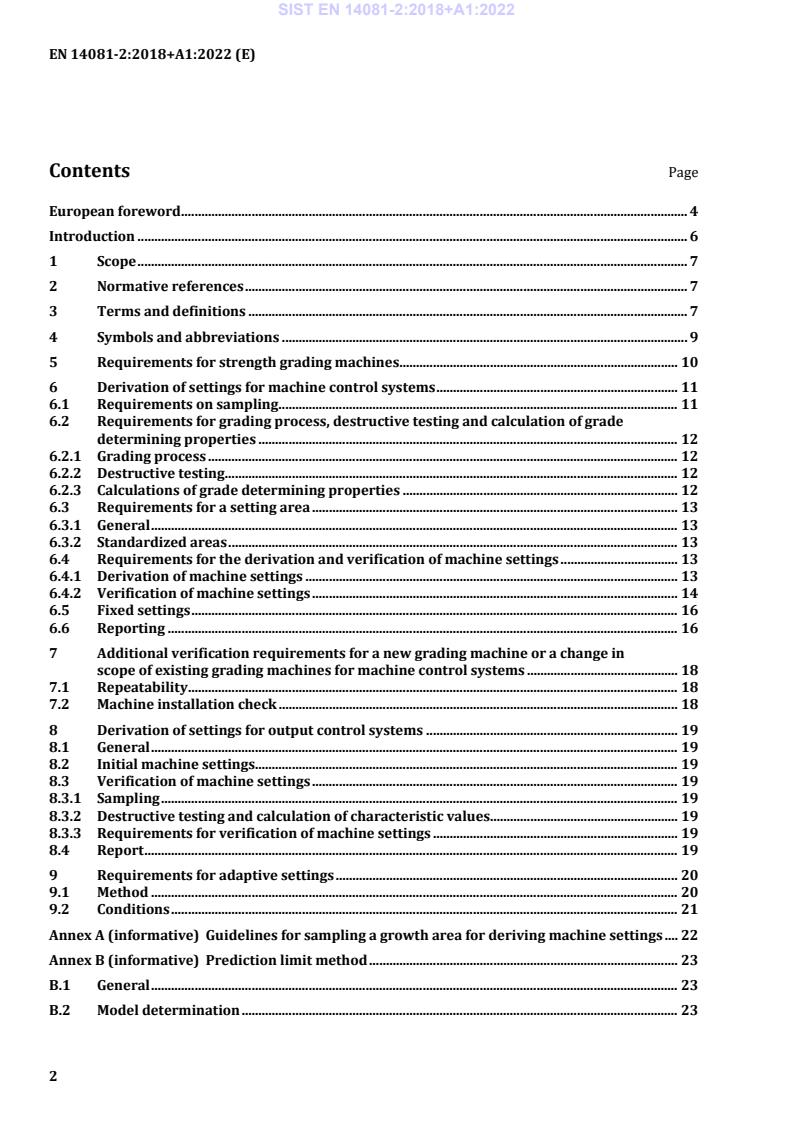
Contents Page
European foreword . 4
Introduction . 6
1 Scope . 7
2 Normative references . 7
3 Terms and definitions . 7
4 Symbols and abbreviations . 9
5 Requirements for strength grading machines . 10
6 Derivation of settings for machine control systems . 11
6.1 Requirements on sampling . 11
6.2 Requirements for grading process, destructive testing and calculation of grade
determining properties . 12
6.2.1 Grading process . 12
6.2.2 Destructive testing . 12
6.2.3 Calculations of grade determining properties . 12
6.3 Requirements for a setting area . 13
6.3.1 General . 13
6.3.2 Standardized areas . 13
6.4 Requirements for the derivation and verification of machine settings . 13
6.4.1 Derivation of machine settings . 13
6.4.2 Verification of machine settings . 14
6.5 Fixed settings . 16
6.6 Reporting . 16
7 Additional verification requirements for a new grading machine or a change in
scope of existing grading machines for machine control systems . 18
7.1 Repeatability . 18
7.2 Machine installation check . 18
8 Derivation of settings for output control systems . 19
8.1 General . 19
8.2 Initial machine settings. 19
8.3 Verification of machine settings . 19
8.3.1 Sampling . 19
8.3.2 Destructive testing and calculation of characteristic values. 19
8.3.3 Requirements for verification of machine settings . 19
8.4 Report . 19
9 Requirements for adaptive settings . 20
9.1 Method . 20
9.2 Conditions . 21
Annex A (informative) Guidelines for sampling a growth area for deriving machine settings . 22
Annex B (informative) Prediction limit method . 23
B.1 General . 23
B.2 Model determination . 23
B.3 Settings calculation . 24
Annex C (normative) Determination of the global cost matrix . 25
C.1 Introduction. 25
C.2 Optimum grading . 25
C.3 IP grading . 25
C.4 Calculation of size matrix . 26
C.5 Calculation of elementary cost matrix . 26
C.5.1 Introduction. 26
C.5.2 Factors for wrongly upgraded pieces . 26
C.5.3 Factors for wrongly downgraded pieces . 27
C.5.4 Examples of elementary cost matrices for C, T and D classes . 27
C.6 Calculation of a global cost matrix. 30
Annex D (informative) Settings for C and T-classes . 31
Bibliography . 36
European foreword
This document (EN 14081-2:2018+A1:2022) has been prepared by Technical Committee CEN/TC 124
“Timber structures”, the secretariat of which is held by AFNOR.
This European Standard shall be given the status of a national standard, either by publication of an
identical text or by endorsement, at the latest by December 2022, and conflicting national standards shall
be withdrawn at the latest by December 2022.
Attention is drawn to the possibility that some of the elements of this document may be the subject of
patent rights. CEN shall not be held responsible for identifying any or all such patent rights.
This document includes Amendment 1 approved by CEN on 13 March 2022.
This document supersedes !EN 14081-2:2018".
The start and finish of text introduced or altered by amendment is indicated in the text by tags !".
This document has been prepared under a Standardization Request given to CEN by the European
Commission and the European Free Trade Association.
Compared to EN 14081-2:2010+A1:2012, the following main modifications have been made:
— new definitions added in Clause 3;
— new requirements for sampling, settings areas and minimum cross-section area;
— introduction of standardized areas;
— method for deriving settings is no longer normative, since several methods may be used; an example
of a method is given in Annex B;
— new method for verification of settings;
— cost matrix requirements are changed, to better allow settings that aim for reduced reject rather than
yield in the highest grade;
— new method for output control systems;
— introduction of adaptive settings;
— introduction of fixed settings.
This standard is part of a series of standards on Timber structures — Strength graded structural timber
with rectangular cross section ("EN 14081") that includes:
— Part 1: General requirements;
— Part 2: Machine grading; additional requirements for type testing;
— Part 3: Machine grading; additional requirements for factory production control.
Any feedback and questions on this document should be directed to the users’ national standards body.
A complete listing of these bodies can be found on the CEN website.
According to the CEN-CENELEC Internal Regulations, the national standards organizations of the
following countries are bound to implement this European Standard: Austria, Belgium, Bulgaria, Croatia,
Cyprus, Czech Republic, Denmark, Estonia, Finland, France, Germany, Greece, Hungary, Iceland, Ireland,
Italy, Latvia, Lithuania, Luxembourg, Malta, Netherlands, Norway, Poland, Portugal, Republic of North
Macedonia, Romania, Serbia, Slovakia, Slovenia, Spain, Sweden, Switzerland, Turkey and the United
Kingdom.
Introduction
Machine grading is in common use in a number of countries. There are two basic systems, referred to as
“output control” and “machine control”. Both systems require a visual override inspection to cater for
performance reducing characteristics that are not automatically sensed by the machine.
The output control system is suitable for use where the grading machines are situated in sawmills grading
limited sizes, species and grades in repeated production runs of around one working shift or more. This
enables the system to be controlled by testing timber specimens from the daily output. These tests
together with statistical procedures are used to monitor and adjust the machine settings to maintain the
required strength properties for each strength class. With this system it is permissible for machine
approval requirements to be less demanding and for machines of the same type to have non-identical
performance.
The machine control system was developed in Europe. Because of the large number of sizes, species and
grades used it was not possible to carry out quality-control tests on timber specimens drawn from
production. The system relies therefore on the machines being strictly assessed and controlled, and on
considerable research effort to derive the machines settings, which, under basic machine control
operation, remain constant for all machines of the same type.
Additional factory production control requirements are given in EN 14081-3.
This standard provides a new approach, applicable to both machine control and output control systems,
which permits fine adjustment of settings on a grading machine based on continuous monitoring of
Indicating Property (IP) data during grading. This approach is called “adaptive settings”.
The acceptability of grading machines and the derivation of settings rely on statistical procedures and
the results will therefore depend on the method used. For this reason this document gives appropriate
statistical procedures.
Grading assignments to strength classes are based on grading reports. When these grading reports are
evaluated and approved by CEN/TC 124 /WG 2 /TG 1, they become Approved Grading Reports (AGR).
The requirements in this European Standard are based on machines in current use and on future types
of machines as far as these can be foreseen. It is recognized that additional clauses or standards may be
required if unforeseen developments take place.
Since the previous version of this European Standard (EN 14081-2:2010+A1:2012), grading settings
work, and research data, have provided more information about the variation in wood properties. Several
new rules were created by CEN/TC 124 /WG 2 to update the procedures and ensure safety of grading –
particularly of settings covering many countries, and are referenced in the guidance paper (see Annex A).
This new version of the standard updates the procedures according to the guidance paper.
1 Scope
This document specifies requirements, additional to those of EN 14081-1, for type testing of machine
graded structural timber with rectangular cross-sections shaped by sawing, planning or other methods,
and having deviations from the target sizes corresponding to EN 336. This includes requirements for
strength grading machines.
2 Normative references
The following documents are referred to in the text in such a way that some or all of their content
constitutes requirements of this document. For dated references, only the edition cited applies. For
undated references, the latest edition of the referenced document (including any amendments) applies.
EN 384, Structural timber — Determination of characteristic values of mechanical properties and density
EN 408, Timber structures — Structural timber and glued laminated timber — Determination of some
physical and mechanical properties
EN 14358, Timber structures — Calculation and verification of characteristic values
EN 13556, Round and sawn timber — Nomenclature of timbers used in Europe
EN ISO 3166-1, Codes for the representation of names of countries and their subdivisions — Part 1: Country
code (ISO 3166-1)
3 Terms and definitions
For the purposes of this document, the following terms and definitions apply.
ISO and IEC maintain terminological databases for use in standardization at the following addresses:
— IEC Electropedia: available at https://www.electropedia.org/
— ISO Online browsing platform: available at https://www.iso.org/obp
3.1
assigned grade
grade to which a piece of timber is assigned when using the appropriate setting for that specific grade
3.2
characteristic value
representative value of a material property used for design, which is based either on 5-percentile values
(e.g. strength properties and density) or on a mean value (e.g. modulus of elasticity)
3.3
critical feed speed
speed, within the intended usable range, at which the grading machine is least accurate in measuring its
indicating property
3.4
depth
in the case of bending, the cross sectional dimension parallel to the direction of loading, and in the case
of tension, the width
3.5
grade combination
set of one or more grades plus reject graded together
3.6
grade determining property (GDP)
mechanical or physical property, for which a particular value of that property is required for the material
to be assigned to that grade
Note 1 to entry: E.g. bending strength, mean MOE and density for the C and D strength classes of EN 338.
3.7
growth area
source from which timber is intended to be strength graded
3.8
indicating property (IP)
measurement or combination of measurements made by the grading machine, used in estimating one or
more of the grade determining properties, and upon which the settings are based
3.9
optimum grade
grade to which a piece of timber is assigned, such that the highest possible yield is obtained in the highest
grade when using the GDPs as the indicating properties
3.10
p-percentile
value for which the probability of getting lower values is p %
3.11
sample
number of ungraded specimens of one timber species or species combination, one timber source, with
sizes and quality representative of the timber population (of the species/species combination from the
timber source)
3.12
setting (S)
value of the parameters used to set the machine to grade timber, which are mathematically related to the
indicating property
3.13
setting area
combination of countries and / or standardized areas for which the same settings are valid
Note 1 to entry: a setting area is usually part of a test area.
3.14
standardized area
countries that can be combined to one setting area without further justification
3.15
test area
combination of countries and / or standardized areas from which timber is to be tested to obtain a setting
area
Note 1 to entry: test area is part of a growth area.
3.16
thickness
lesser dimension perpendicular to the longitudinal axis of a piece of timber
3.17
timber source
identifiable geographical origin of a species or species combination from which timber is, or is intended
to be, strength graded
3.18
width
larger dimension perpendicular to the longitudinal axis of a piece of timber
4 Symbols and abbreviations
For the purposes of this document, the following symbols and abbreviations apply.
a
slope in the DENS formula
DENS
a
slope in the MOE formula
MOE
a
slope in the MOR formula
MOR
b thickness for edgewise bending and width for flatwise bending
b
intercept in the DENS formula
DENS
b
intercept in the MOE formula
MOE
b
intercept in the MOR formula
MOR
c load configuration constant
DENS density
DENS
required density
req
E modulus of elasticity parallel to grain
E
optimum modulus of elasticity
optimum
E
assigned modulus of elasticity
assigned
f
measured first-mode longitudinal resonant frequency
f strength
f
assigned characteristic strength
k,assigned
f
assigned strength
assigned
f
optimum characteristic strength
k,optimum
f
optimum strength
optimum
F force
h depth
IP indicating property
IP
mean value of IP of the reference sample
mean,ref,grade
IP
running value of IP
mean,prod,grade
l span
MOE modulus of elasticity parallel to the grain
MOE
required MOE
req
MOR bending strength
MOR
required MOR
req
correlation coefficient between IP and grade determining property in the whole
r
ungraded data set which is used for determination of initial settings
S
adaptive setting
adapt
s
standard error of density estimates
δ,DENS
S
setting for DENS
DENS
S
initial setting
ini
S
setting for MOE
MOE
s
standard error of MOR estimates
δ,MOR
s
standard error of the estimate
δ
S
setting for MOR
MOR
t a factor from Student's t-distribution
u timber moisture content
β
achieved safety index
ach
β
target safety index
tar
δ generic deformation
µ mean value
ρ timber density
5 Requirements for strength grading machines
The machine shall be of a type that meets the requirements given in Clauses 6 and 7 if it is part of a
machine control system, or Clause 8 if it is a part of an output control system. It shall be installed and set
up according to the manufacturer's specification and to any additional requirements resulting from the
tests given here. The following information shall be provided in the manufacturer's specification for the
machine:
a) specification and description of the mechanical and electrical operation of the machine, and the
software used by the machine to grade timber (this includes information on data processing such as
smoothing of the output signals);
b) range of environmental conditions under which the machine will operate;
c) installation, maintenance and operating instructions;
d) method, extent and frequency of calibration procedures, including the use of control planks if
applicable;
e) species populations, sizes and tolerances, surface finish, moisture content, grades, environmental
operating temperature range, throughput speed, and limits of warp of the timber to be graded;
f) checking and adjustment procedures for all components that may affect the machine’s grading
accuracy.
Operational accuracy of transducers shall ensure that production machines meet the requirements of this
European Standard, and are compatible with grade settings derived for the machine type.
The grading machine shall not damage the timber during the grading operation to an extent that it affects
the intended use of the timber. For example, in bending type machines, damage should not be caused by
large compression perpendicular to grain stresses and/or large bending stresses.
NOTE When approving a new machine, consideration of already approved machines having the same
technology can contribute to the approval procedure, including settings derivation.
Grading machines whose indicating property does not take account of the material properties along the
whole length of each piece of timber, but whose indicating property measurements are influenced by
strength reducing characteristics away from the measuring position (as in bending type machines), shall
measure the indicating property to within 800 mm of each end of the piece of timber. Where the
indicating property is influenced only by strength reducing characteristics at the measuring position (as
in radiation type machines), the measurements shall be made to within 150 mm of each end.
When a new species is required to be graded by a machine that has already been shown to meet the
requirements of this European Standard, those requirements given in this clause that are not likely to be
affected by species differences may be disregarded for the new species.
Machine settings that were derived in accordance with previous versions of this standard remain valid
unless there is evidence that the required grade determining properties are not met. In that case, new
settings shall be derived according to this version of the standard.
6 Derivation of settings for machine control systems
6.1 Requirements on sampling
Sampling shall be representative of the timber to be graded. The timber shall represent the timber source,
species, range of sizes and quality to be graded in production with the most demanding surface finish for
the performance of the grading machine.
NOTE 1 Annex A gives guidance on sampling.
For each species or species combination, the minimum number of specimens required for deriving or
expanding settings shall be taken from Table 1:
Table 1 — Minimum number of specimens required for deriving or expanding settings
Specimens Total number of samples Specimens per sample
Total settings area (see 6.4.2.2) ≥ 450 ≥ 4 ≥ 100
Expansion check:
≥ 150 ≥ 1 ≥ 100
for each additional country or
standardized area (see 6.4.2.3)
NOTE 2 Usually it is necessary to increase the total number of specimens to take into account the variability of
the timber source, the performance of the machine, and the range of sizes and grades to be produced.
The minimum size of a setting area defined in this standard is normally a country or standardized area.
Parts of countries or standardized areas may also be considered if they are clearly geographically defined.
Sampling for a setting area that includes more than one country shall contain at least one sample from
each country, unless information exists which verifies that timber from one country can be safely graded
using settings from another country without being included in the sampling.
The range of permitted thickness and width for which settings shall be used in production shall not be
extrapolated more than 10 % from the maximum and minimum thickness and widths tested. This
requirement should be considered when carrying out the sampling.
The minimum cross section area for which settings shall be used in production shall not be extrapolated
more than 10 % from the minimum cross section area tested. This requirement should be considered
when carrying out the sampling.
A minimum of 40 pieces shall be included in the sampling on all ends of the cross section thickness and
width. This means that at least 40 pieces shall be in the range of 10 % of the upper tested timber thickness
and width and at least 40 pieces shall be in the range of 10 % of the lower tested timber thickness and
width.
A minimum of 40 pieces shall be included in the sampling for the smallest cross section area.
6.2 Requirements for grading process, destructive testing and calculation of grade
determining properties
6.2.1 Grading process
Each piece shall be graded by the machine at the critical feed speed while documenting the moisture
content, all variables necessary for calculating the IP, and any other variables that may affect the IP.
6.2.2 Destructive testing
Each piece shall be tested to determine the grade determining properties in accordance with EN 384 and
EN 408. The characteristic values shall be calculated based on EN 384 and rounded to three significant
digits.
In the case of a portable machine, the k factor (given in EN 384) shall be taken as 1.
v
6.2.3 Calculations of grade determining properties
One or more models (e.g. mathematical, statistical) relating the machine's measured parameters to one
or more indicating properties to the grade determining properties shall be developed. Models may
include variables such as size and moisture content, or may be determined from the data after adjusting
the properties for such variables.
Where the machine measures the moisture content of each piece, moisture content may be used to adjust
the settings model.
The moisture range for which the grade determining properties apply shall be defined.
The effect of moisture content on the IP values when deriving settings shall be accounted for e.g. by
correction of the IP values to u = 12 % according to EN 384.
6.3 Requirements for a setting area
6.3.1 General
A setting area shall be established as follows:
a) a test program shall be performed with samples from countries and/or standardized areas (see 6.3.2)
which constitute the test area;
b) based on the data of this specific test area, settings shall be derived (see 6.4);
c) the setting area may be expanded to a country or standardized area when all pieces from that country
or standardized area are graded with the derived settings and all characteristic values according to
EN 384 of the GDP of the grades meet the requirements of the strength classes in the strength class
combination. (see 6.4.2.3).
6.3.2 Standardized areas
The standardized areas given in Table 2 may be used for forming a test area and/or deriving settings. For
a standardized area, a representative sample from one country can be considered representative for the
other countries in the same standardized area.
These standardized areas are valid for machines and grading principles without further verifications for
all species growing there.
NOTE These standardized areas can be used for the development of setting areas to limit the number of
samples from a country or standardized area.
Table 2 — Standardized areas
Standardized area Countries belonging to the standardized area
a
Alp area Liechtenstein , Slovenia, Switzerland, Austria
a
Balkan area
Montenegro , Macedonia, Albania, Bosnia-Herzegovina, Croatia, Serbia,
Kosovo
Baltic area Estonia, Latvia, Lithuania
Benelux area Luxembourg, Belgium, Netherlands
Black Sea area Moldova, Romania
a
French area Andorra , France
a These countries alone cannot be considered representative for the standardized area.
6.4 Requirements for the derivation and verification of machine settings
6.4.1 Derivation of machine settings
Settings shall be derived, rounded to not more than four significant digits, using an appropriate method
to grade one or more grades in one pass so that the grade determining properties for each grade within
each grade combination are met. The characteristic values shall be calculated according to EN 384. The
minimum number of pieces shall be 20 in each grade within each grade combination. Additionally, for
each grade combination, settings shall be derived such that a minimum of 5 pieces or 0,5 % of the total
data set, whichever is the higher, are assigned as reject.
NOTE Annex B provides a simple method, although other methods can provide much better yields.
6.4.2 Verification of machine settings
6.4.2.1 Introduction
The purpose of verification is to validate the settings by checking that the required characteristic values
of the grade determining properties are met. Verification is carried out on verification samples,
depending on the situation:
For new settings, the verification is performed on the whole sample, and again on verification samples
that are drawn from the whole sample.
For expansion of existing settings to a larger setting area (an expansion check), the verification sample is
the sample or samples from the additional country or standardized area being checked. For this check,
each additional country or standardized area is verified separately.
For verifying that existing settings are grading timber that meets the required characteristic values, the
verification sample is a set of new specimens covering a particular area. This verification applies to the
area sampled and not the whole settings area.
Characteristic values shall be derived according to EN 384 and EN 14358, using specific rules cited in
Table 3, depending on the property and the number of specimens. The characteristic values shall be
rounded to three significant digits.
Verification of the derived characteristic values against the strength class values, after any adjustment
from EN 384, shall be done according to Table 3, depending of the sub-clause cited in this table.
Table 3 — Requirement for derivation and verification of characteristic values
Requirements
Calculation (derived characteristic value / strength
class value)
Number of specimens Number of specimens 6.4.2.2
6.4.2.3 6.4.2.4
≥ 40 < 40 Step 1 Step 2
Non parametric; Parametric;
Strength no confidence interval with confidence interval ≥ 100% ≥ 90% ≥ 100% ≥ 90%
adjustment adjustment
MOE Simple mean ≥ 100% ≥ 95% ≥ 100% ≥ 95%
Non parametric; Parametric;
Density no confidence interval with confidence interval ≥ 100% ≥ 90% ≥ 100% ≥ 90%
adjustment adjustment
6.4.2.2 Verification for new settings
When calculating new settings, the settings shall be verified for each grade within all desired grade
combinations, on the whole setting area, by the following procedure.
Step 1: verification of the whole sample
To verify a particular grade in a particular grade combination, the rules cited in Table 3 shall apply.
There shall be at least 20 specimens for this calculation.
Step 2: verification for countries, standardized areas and parts of countries
The whole sample shall be divided into at least 4 verification samples. For each country or standardized
area there shall be at least one verification sample made only with the specimens from that country or
standardized area. Countries or standardized areas may be divided into more than one verification
sample on the basis of sampling location, and this is most appropriate for large countries, and countries
where there are large differences that may affect grading (e.g. growth conditions and forest practices).
Where timber is sampled across a national border, the sample shall be apportioned to a country or
standardized area with due consideration to geography and forest practice.
To verify a particular grade in a particular grade combination, the rules given in Table 3 shall apply.
This procedure may also be used for an additional verification of settings on non-geographical subsets of
the whole sample, such as certain thickness and width range.
If any part of this verification fails (in steps 1 or 2), the settings are not verified. The verification may be
performed again after adjusting the settings and/or grade combinations; or restricting settings to a
smaller setting area or a smaller range of width and thickness; or after additional sampling.
Step 3: Global cost matrix
In order to assess the performance of the machine, a global cost matrix shall be calculated according to
Annex C for each grade combination.
In order to approve a grade combination, none of the cell values of the global cost matrix indicating
wrongly upgraded pieces shall be greater than 0,40.
If any cell value is higher than 0,40 for a grade combination, alternative solutions such as increasing the
sample size or improving the IP prediction may be investigated. If no solution passes, the grade
combination is not verified.
6.4.2.3 Verification of expansion of existing settings to a larger setting area (expansion check)
When expanding existing settings to new areas, the settings shall be verified for each grade within all
grade combinations by the following procedure. This shall be done on the new parts of the setting area
and each country or standardized area shall be verified separately.
The sampling for the country or standardized area shall comply with the requirements of 6.1. The range
of thickness and width in this sampling shall comply with the requirements of 6.1 for meeting the
permitted thickness and width range of the settings being checked.
To verify a particular grade in a particular grade combination, the rules given in Table 3 shall apply.
There shall be at least 20 specimens for this calculation.
For countries/standardized areas with large variation in timber quality, additional verification checks on
samples smaller than the country/standardized area may be made according to 6.4.2.3.
If a country or standardized area passes this verification check, the grade combinations for which there
is a pass may be expanded to this country or standardized area.
6.4.2.4 Checking that existing settings are grading correctly in a particular location
When checking that existing settings are grading timber that meets the required characteristic values,
the settings shall be verified for grades within grade combinations that are desired to be checked, by the
following procedure.
A number of specimens are graded under production conditions, and tested in accordance with 6.2.2.
To verify a particular grade in a particular grade combination, the rules given in Table 3 shall apply.
At least 40 specimens are required for this calculation.
This procedure verifies that existing settings are grading correctly for the location and cross-section sizes
sampled. It does not verify the settings for the whole settings area. The settings for a whole settings area
can be verified by the procedure in 6.4.2.2 using sampling that meets the requirements for new settings.
6.5 Fixed settings
Unless there is evidence of unsafe grading, settings given in Annex D can be used for Norway spruce (Picea
abies) and Silver fir (Abies alba) grown in Europe without further justification. Settings are given for the
grade combinations C24/C18 and T14/T11 as well as for the respective single grades. Settings are given
for IPs which are calculated based on Formula (1):
2 f l ρ
( )
−6
(1)
IP= 10
1−−0,01 u 12
( )
where
f is measured frequency (first mode of longitudinal vibration), in Hz;
l is measured length of timber, in m;
u is timber moisture content, in %;
ρ
is timber density, in kg/m .
!When density is measured by the machine, the settings tables given in Annex D (Tables D.1 and D.3)
based on frequency and density shall be used.
When density is not measured, the value of 450kg/m shall be used for density in Formula (1), and the
settings tables given in Annex D (Tables D.2 and D.4) based on frequency shall be used."
6.6 Reporting
The following is a list of information that shall be included in a report on the derivation of grading
machine settings:
a) general:
1) details of the grading machine, the timber species and setting area and the grades to be graded;
2) a note of any strength reducing characteristics that are not detected by the grading machine nor
by the visual override inspection;
3) details of the sampling method (see 6.1) and explanation of its representativeness with regard
to the growth area;
4) details of the testing, which shall be carried out to EN 408 as required by EN 384, including any
adjustment for test span. For MOE, the clause number in EN 408 shall be given in the report and
details of conversion to shear free MOE should be given, including reference to any supporting
documents;
5) range of timber sizes to be graded in production (see 6.1 above);
6) if the settings are for a machine that has not previously been approved for grading in Europe
according to this standard:
i) information of this method of operation according to requirements of Clause 5;
ii) the description of how the IPs are calculated and how parameters of grading influence them;
iii) repeatability check according to 7.1 which shall include a graph of all indicating property
values for each pass (see 7.1) of each piece plotted against the median value of indicating
property for each piece;
7) the report should reference all previous reports that are still relevant (including repeatability);
8) table showing the different cross sections and lengths, number of specimens, countries and the
moisture content for each sample;
9) table with means and coefficients of variation of the grade determining properties for all samples
and the total data set;
10) the critical feed speed used during grading of the total sample (see 6.2.1);
11) the formula for the mathematical model involving the indicating property, grade determining
properties and the settings;
12) a table giving the settings;
13) the following scatter plots for the total data set, with each sample in a clearly distinguishable
manner, together with coefficients of determination for each sample referenced to the relevant
IP model(s) to be used in production;
i) MOR versus IP;
ii) MOE versus IP;
iii) density versus IP;
14) details on moisture content both at time of testing and time of grading;
b) for each strength class or strength class combination each report shall include:
1) table giving the required characteristic values and the achieved values using the settings
developed for the grades;
2) table giving all settings;
3) t
...