


EN 16737:2016
(Main)Structural timber - Visual strength grading of tropical hardwood
Structural timber - Visual strength grading of tropical hardwood
This European Standard specifies a method of strength grading tropical hardwood visually for structural use.
The permissible limits of characteristics for a single visual strength grade of timber are specified, designated “Structural Tropical Hardwood” (STH) grade.
The method is only suitable for pieces of timber with a rectangular cross-section that is constant along their lengths.
Characteristics related to durability are not covered in this standard. For some end uses, additional requirements may be specified at the time of grading, e.g. sapwood exclusion.
Bauholz für tragende Zwecke - Visuelle Sortierung von Tropenholz nach der Festigkeit
Diese Europäische Norm legt ein Verfahren zur visuellen Festigkeitssortierung von Tropenholz für tragende Zwecke fest.
Die für eine visuelle Festigkeitsklasse zulässigen Grenzwerte der Eigenschaften werden festgelegt und als Sortierklasse "Tropenholz für tragende Zwecke" ("Structural Tropical Hardwood" (STH)) bezeichnet.
Das Verfahren ist ausschließlich für Holzstücke mit einem über die gesamte Länge gleich bleibenden rechtwinkligen Querschnitt geeignet.
Merkmale, die die Dauerhaftigkeit betreffen, sind nicht Gegenstand dieser Norm. Für einige Endanwendungen dürfen zusätzliche Anforderungen zum Zeitpunkt der Sortierung, z. B. Ausschluss von Splintholz, festgelegt werden.
Bois de structure - Classement visuel des bois feuillus tropicaux de structure
La présente Norme européenne spécifie une méthode permettant de classer visuellement les bois feuillus tropicaux selon leur résistance en vue d'un usage structurel.
Les limites admissibles des critères sont spécifiées pour une classe visuelle unique de résistance de bois feuillus tropicaux de structure appelée (STH) « Bois feuillus tropicaux de structure ».
La méthode spécifiée n'est applicable qu'aux pièces de bois de section rectangulaire constante sur toute la longueur.
Les caractéristiques liées à la durabilité ne sont pas couvertes par cette norme. Pour certaines utilisations, des exigences complémentaires peuvent être indiquées au moment du classement, par exemple l’exclusion de l’aubier.
Konstrukcijski les - Vizualno razvrščanje tropskega lesa po trdnosti
Ta dokument določa metodo vizualnega razvrščanja tropskega lesa po trdnosti za uporabo pri konstrukcijah. Ta metoda je primerna samo za kose lesa s pravokotnim prečnim prerezom, ki je stalen po njihovi dolžini.
General Information
Overview
EN 16737:2016 - published by CEN - specifies a method for visual strength grading of tropical hardwood for structural use. It defines a single permissible visual grade, Structural Tropical Hardwood (STH), and sets rules for inspection, measurement and limiting values of strength‑reducing features. The standard applies only to pieces with a rectangular cross‑section constant along their length and does not cover durability (e.g., natural decay resistance), although additional end‑use requirements such as sapwood exclusion may be applied at grading.
Key topics and technical requirements
- Scope and supervision
- Visual grading must be performed by competent persons (per EN 14081‑1).
- Sizes and processing
- Minimum thickness at grading: 22 mm; minimum cross‑sectional area: 2 200 mm².
- Post‑grading reductions in cross‑section beyond set limits require re‑grading (≤5 mm reduction for 22–100 mm dimensions; ≤10 mm for >100 mm).
- Moisture content
- For dry grading (to assess fissures/distortion): mean moisture content ≤20% and no individual measurement >24%.
- Measurement of strength‑reducing characteristics
- Knots: measured using the EN 1310 alternative method (perpendicular to the grain); arris, splay and cluster knots have specific measurement rules; single pin knots may be ignored, tightly grouped pin knots treated as one.
- Slope of grain: measured with a cranked scribe over a representative distance; interlocked grain is assessed separately.
- Density: if unusually low, measure and adjust to 12% moisture content; a piece is considered unusually low if more than 20% below the mean value for the intended EN 338 strength class (per EN 1912).
- Fissures, wane, distortion (bow/spring/twist): measured per EN 1310 and assessed at time of grading; limits are tied to moisture state.
- Marking and documentation
- Graded timber must be marked to show conformance to the STH grade and traceability to grading operations.
- Species and densities
- Annex A lists tropical hardwood species and reference densities to aid grading decisions.
Applications and users
- Who uses EN 16737:2016:
- Timber graders, sawmills and visual grading stations
- Timber merchants and procurement teams sourcing tropical hardwood for load‑bearing use
- Structural engineers, architects and contractors specifying timber members
- Certification bodies and building regulators verifying compliance
- Practical uses:
- Quality control and acceptance of tropical hardwood beams, joists, studs and other structural members
- Basis for assigning strength classes (in conjunction with EN 1912/EN 338) and for procurement specifications where tropical hardwood is preferred for mechanical properties or aesthetics
Related standards
- EN 14081‑1 (grading supervision, general requirements)
- EN 1310 (measurement methods for features)
- EN 336 (sizes/permitted deviations)
- EN 338, EN 1912 (strength classes and assignments)
- EN 384 (determination of characteristic values)
- EN 350‑2 (density, durability data)
Keywords: EN 16737:2016, Structural Tropical Hardwood, STH grade, visual strength grading, tropical hardwood, structural timber, CEN.
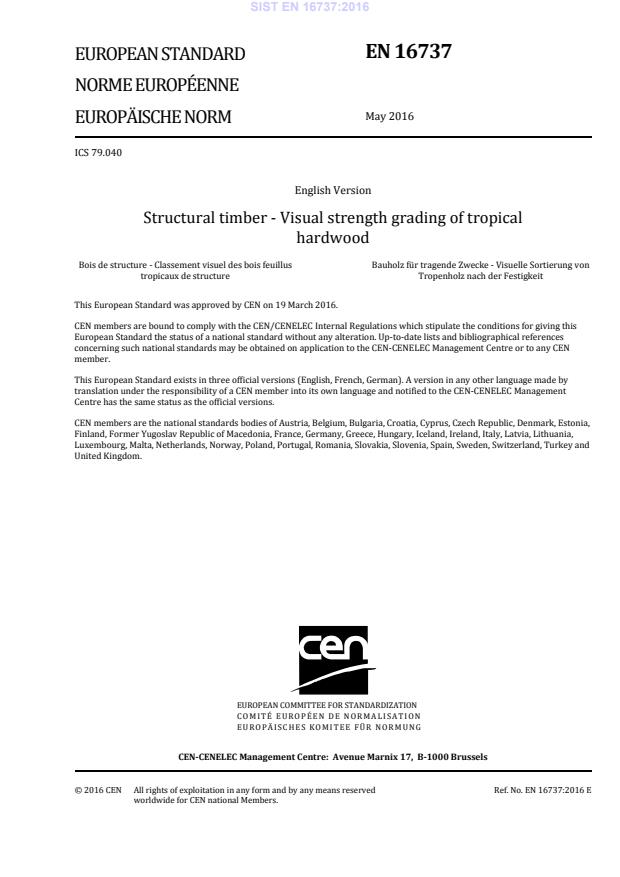

Standards Content (Sample)
2003-01.Slovenski inštitut za standardizacijo. Razmnoževanje celote ali delov tega standarda ni dovoljeno.VWLBauholz für tragende Zwecke - Visuelle Sortierung von Tropenholz nach der FestigkeitBois de structure - Classement virtuel des bois feuillus tropicaux de structureStructural timber - Visual strength grading of tropical hardwood79.040Les, hlodovina in žagan lesWood, sawlogs and sawn timberICS:Ta slovenski standard je istoveten z:EN 16737:2016SIST EN 16737:2016en,fr,de01-julij-2016SIST EN 16737:2016SLOVENSKI
STANDARD
EUROPEAN STANDARD NORME EUROPÉENNE EUROPÄISCHE NORM
EN 16737
May
t r s x ICS
y {ä r v r English Version
Structural timber æ Visual strength grading of tropical hardwood Bois de structure æ Classement visuel des bois feuillus tropicaux de structure
Bauholz für tragende Zwecke æ Visuelle Sortierung von Tropenholz nach der Festigkeit This European Standard was approved by CEN on
s { March
t r s xä
egulations which stipulate the conditions for giving this European Standard the status of a national standard without any alterationä Upætoædate lists and bibliographical references concerning such national standards may be obtained on application to the CENæCENELEC Management Centre or to any CEN memberä
translation under the responsibility of a CEN member into its own language and notified to the CENæCENELEC Management Centre has the same status as the official versionsä
CEN members are the national standards bodies of Austriaá Belgiumá Bulgariaá Croatiaá Cyprusá Czech Republicá Denmarká Estoniaá Finlandá Former Yugoslav Republic of Macedoniaá Franceá Germanyá Greeceá Hungaryá Icelandá Irelandá Italyá Latviaá Lithuaniaá Luxembourgá Maltaá Netherlandsá Norwayá Polandá Portugalá Romaniaá Slovakiaá Sloveniaá Spainá Swedená Switzerlandá Turkey and United Kingdomä
EUROPEAN COMMITTEE FOR STANDARDIZATION COMITÉ EUROPÉEN DE NORMALISATION EUROPÄISCHES KOMITEE FÜR NORMUNG
CEN-CENELEC Management Centre:
Avenue Marnix 17,
B-1000 Brussels
t r s x CEN All rights of exploitation in any form and by any means reserved worldwide for CEN national Membersä Refä Noä EN
s x y u yã t r s x ESIST EN 16737:2016
European foreword . 3 1 Scope . 4 2 Normative references . 4 3 Terms and definitions . 4 4 Strength graded timber. 6 4.1 Supervision of strength grading operations. 6 4.2 Sizes . 6 4.3 Processing of visually graded timber. 6 4.4 Moisture content . 6 5 Measurement of strength-reducing characteristics . 7 5.1 Knots . 7 5.1.1 General . 7 5.1.2 Knot size: requisite comparisons . 7 5.1.3 Pin knots . 10 5.2 Slope of grain . 10 5.3 Density . 11 5.4 Fissures . 11 5.5 Wane . 11 5.6 Distortion . 11 5.6.1 Bow and spring . 11 5.6.2 Twist . 11 5.7 Biological characteristics . 11 5.7.1 Fungal biodegradation . 11 5.7.2 Insect attack . 12 5.7.3 Marine borers . 12 5.8 Other defects and characteristics . 12 6 Limiting values of characteristics for STH grade . 13 7 Marking . 13 Annex A (informative)
Tropical hardwood species and their densities . 14
to 100 mm, or; b) 10 mm for dimensions > 100 mm. Where graded timber is reduced in cross section beyond the above limits, it shall be re-graded if it is to conform to this standard. Where graded timber is reduced in length, or a piece of graded timber is cross-cut into two or more pieces, each resulting piece may be assumed to conform to the permissible limits of characteristics in Table 1 of this standard. 4.4 Moisture content Dry graded timber shall have at the time it is graded for fissures and distortion a mean moisture content of 20 % or less with no individual measurement exceeding 24 %. NOTE The end use determines whether timber needs to be dry graded or not. If timber is not dry graded, it may be needed to check fissures and distortion also at the time of end use. SIST EN 16737:2016
a)
b)
c) 2
d)
e)
f) Figure 1 — Measuring knot sizes 1 on faces and 2 on edges 5.1.2 Knot size: requisite comparisons For knots that are contained entirely within a single face or edge, the size of the knot shall be compared to the full size of the face or edge in which it appears (Figure 2). SIST EN 16737:2016
X is related to the thickness t and Y is compared to the width w. Figure 2 — Measuring knot sizes For arris knots that are not elongated, the size of the knot on both the face and the edge shall be measured. The larger of the two sizes shall be compared to the thickness of the piece (Figure 3).
The greater of X and Y is compared to the thickness. Figure 3 — Measuring knot sizes For arris knots that appear on both faces and occupy the full size of an edge, or are elongated across at least 75 % of an edge, the size of the knot on both faces shall be measured. The larger of the two sizes shall be compared to the width of the piece (Figure 4). SIST EN 16737:2016
Y is measured on both faces and the larger value is compared to the width. Figure 4 — Measuring knot sizes
For splay knots or branch knots that are elongated across a face, the size of the knot shall be measured on the edge and compared to the thickness of the piece (Figure 5).
X is compared to the thickness. Figure 5 — Measuring knot sizes For knot clusters, where no grain recovery is evident between adjacent knots, the knot size shall be measured on the surface on which the cluster is transversely cut. The size of the knot shall be the overall width of the knot cluster d, or the sum of the individual knot widths d1 d2 d3…dn, whichever is the lesser (Figure 6). SIST EN 16737:2016
a) b) The size of the knot shall be lesser of d and d1+d2+d3.dn. Figure 6 — Measuring the size of a knot cluster
5.1.3 Pin knots Single pin knots may be ignored. Tightly grouped pin knots shall be treated as a single knot. 5.2 Slope of grain The method of measurement of slope of grain by use of a cranked scribe is given in EN 1310:1997, 4.4.1. The slope of grain shall be expressed as the number of units of length over which unit deviation occurs. The slope of grain s
...
Frequently Asked Questions
EN 16737:2016 is a standard published by the European Committee for Standardization (CEN). Its full title is "Structural timber - Visual strength grading of tropical hardwood". This standard covers: This European Standard specifies a method of strength grading tropical hardwood visually for structural use. The permissible limits of characteristics for a single visual strength grade of timber are specified, designated “Structural Tropical Hardwood” (STH) grade. The method is only suitable for pieces of timber with a rectangular cross-section that is constant along their lengths. Characteristics related to durability are not covered in this standard. For some end uses, additional requirements may be specified at the time of grading, e.g. sapwood exclusion.
This European Standard specifies a method of strength grading tropical hardwood visually for structural use. The permissible limits of characteristics for a single visual strength grade of timber are specified, designated “Structural Tropical Hardwood” (STH) grade. The method is only suitable for pieces of timber with a rectangular cross-section that is constant along their lengths. Characteristics related to durability are not covered in this standard. For some end uses, additional requirements may be specified at the time of grading, e.g. sapwood exclusion.
EN 16737:2016 is classified under the following ICS (International Classification for Standards) categories: 79.040 - Wood, sawlogs and sawn timber. The ICS classification helps identify the subject area and facilitates finding related standards.
You can purchase EN 16737:2016 directly from iTeh Standards. The document is available in PDF format and is delivered instantly after payment. Add the standard to your cart and complete the secure checkout process. iTeh Standards is an authorized distributor of CEN standards.
Questions, Comments and Discussion
Ask us and Technical Secretary will try to provide an answer. You can facilitate discussion about the standard in here.
Loading comments...