

EN ISO 14644-15:2026
(Main)Cleanrooms and associated controlled environments - Part 15: Assessment of suitability for use of equipment and materials by airborne chemical concentration (ISO 14644-15:2026)
- Abstract
This document specifies requirements and guidelines for assessing the chemical airborne cleanliness of equipment and materials which are foreseen to be used in cleanrooms and associated controlled environments that are linked to the ISO standard for air cleanliness by chemical concentration (see ISO 14644-8).
This document does not apply to the following:
health and safety requirements;
compatibility with cleaning agents and techniques;
cleanability;
biocontamination;
specific requirements of equipment and materials for processes and products;
design details of equipment.
- Status
- Published
- Publication Date
- 19-May-2026
- Technical Committee
- CEN/TC 243 - Cleanroom technology
- Drafting Committee
- CEN/TC 243 - Cleanroom technology
- Current Stage
- 6060 - Definitive text made available (DAV) - Publishing
- Start Date
- 20-May-2026
- Completion Date
- 20-May-2026

Overview
EN ISO 14644-15:2026 is an international standard developed by CEN and ISO that specifies requirements and guidelines for the assessment of suitability for use of equipment and materials in cleanrooms and associated controlled environments based on airborne chemical concentration. This document focuses on ensuring that equipment and materials do not compromise the chemical cleanliness of environments where contamination control is critical. EN ISO 14644-15 aligns with the framework set by ISO 14644-8, which defines standards for air cleanliness by chemical concentration (ACC).
By providing standardized assessment methods, EN ISO 14644-15 enables manufacturers, facility managers, and quality assurance professionals to choose and qualify equipment and materials that support compliance with chemical contamination requirements in cleanrooms.
Key Topics
- Airborne Chemical Concentration (ACC): Evaluation and measurement of chemicals present in air, ensuring their concentration does not exceed levels appropriate for sensitive applications.
- Test Setups: Guidelines for closed, closed special application, and open design test environments depending on object size and operational conditions.
- Emission Rate Assessment: Calculation methods for determining the specific emission rates of equipment and materials, which inform their suitability for cleanroom use.
- Representative Mode: Requirements for assessing equipment and materials in conditions that closely simulate their actual use in production or research environments.
- Visual Inspection: Procedures for identifying visible sources of contamination before and after quantitative testing.
- Documentation and Reporting: Detailed requirements for recording test conditions, results, and inspections to ensure traceability and accountability.
Exclusions: The standard does not address health and safety, material cleanability, compatibility with cleaning agents, biocontamination, product/process-specific requirements, or detailed design of equipment.
Applications
EN ISO 14644-15 is vital for organizations working in sectors where chemical contamination can affect product quality or safety, including:
- Pharmaceuticals and Biotechnology: Qualification of laboratory and production equipment to ensure GMP (Good Manufacturing Practice) compliance with respect to airborne chemical pollutants.
- Semiconductor and Microelectronics: Selection of tools, materials, and apparatus that minimize airborne molecular contamination (AMC), crucial for yield and reliability.
- Aerospace and Optics: Assessment of assembly tools, storage systems, and components to prevent surface and air contamination during sensitive manufacturing steps.
- Medical Devices: Verification of production and packaging environments to avoid chemical residues that could impact device safety or efficacy.
- Food and Healthcare Environments: Ensuring that surfaces, fixtures, and operative equipment do not emit undesirable chemicals that could compromise hygiene or product integrity.
By following EN ISO 14644-15, organizations can:
- Select or qualify new materials and equipment prior to installation
- Assess emission performance for regulatory or customer requirements
- Support continuous improvement in contamination control programs
- Generate objective data for change control and risk assessment processes
Related Standards
For comprehensive contamination control in cleanrooms and controlled environments, refer to the following standards:
- ISO 14644-1: Cleanrooms and associated controlled environments - Part 1: Classification of air cleanliness by particle concentration
- ISO 14644-8: Cleanrooms and associated controlled environments - Part 8: Assessment of air cleanliness by chemical concentration (ACC)
- ISO 14644-14: Assessment of suitability for use of equipment by airborne particle concentration
- ISO 14644-9: Classification of surface cleanliness by particle concentration
- ISO 16000-6 and ISO 16017-1: Methods for sampling and analysis of volatile organic compounds (VOCs)
- ISO 2889: Sampling airborne radioactive materials from the stack and ducts of nuclear facilities
EN ISO 14644-15:2026 plays a central role in the identification, assessment, and control of airborne chemical emissions from materials and equipment, empowering cleanroom operators and manufacturers to maintain strict chemical cleanliness in sensitive environments.
Relations
- Effective Date
- 17-Mar-2025
- Effective Date
- 08-Jul-2026
- Effective Date
- 12-Feb-2026
Get Certified
Connect with accredited certification bodies for this standard

CIS Institut d.o.o.
Personal Protective Equipment (PPE) certification body. Notified Body NB-2890 for EU Regulation 2016/425 PPE.

Kiwa BDA Testing
Building and construction product certification.
Kmetijski inštitut Slovenije
Agricultural Institute of Slovenia. Soil testing, plant health, agricultural product analysis.
Sponsored listings
Frequently Asked Questions
EN ISO 14644-15:2026 is a standard published by the European Committee for Standardization (CEN). Its full title is "Cleanrooms and associated controlled environments - Part 15: Assessment of suitability for use of equipment and materials by airborne chemical concentration (ISO 14644-15:2026)". This standard covers: This document specifies requirements and guidelines for assessing the chemical airborne cleanliness of equipment and materials which are foreseen to be used in cleanrooms and associated controlled environments that are linked to the ISO standard for air cleanliness by chemical concentration (see ISO 14644-8). This document does not apply to the following: health and safety requirements; compatibility with cleaning agents and techniques; cleanability; biocontamination; specific requirements of equipment and materials for processes and products; design details of equipment.
This document specifies requirements and guidelines for assessing the chemical airborne cleanliness of equipment and materials which are foreseen to be used in cleanrooms and associated controlled environments that are linked to the ISO standard for air cleanliness by chemical concentration (see ISO 14644-8). This document does not apply to the following: health and safety requirements; compatibility with cleaning agents and techniques; cleanability; biocontamination; specific requirements of equipment and materials for processes and products; design details of equipment.
EN ISO 14644-15:2026 is classified under the following ICS (International Classification for Standards) categories: 13.040.35 - Cleanrooms and associated controlled environments. The ICS classification helps identify the subject area and facilitates finding related standards.
EN ISO 14644-15:2026 has the following relationships with other standards: It is inter standard links to EN ISO 14644-15:2017, ISO 14644-8:2022, ISO 14644-15:2026. Understanding these relationships helps ensure you are using the most current and applicable version of the standard.
EN ISO 14644-15:2026 is available in PDF format for immediate download after purchase. The document can be added to your cart and obtained through the secure checkout process. Digital delivery ensures instant access to the complete standard document.
Standards Content (Sample)
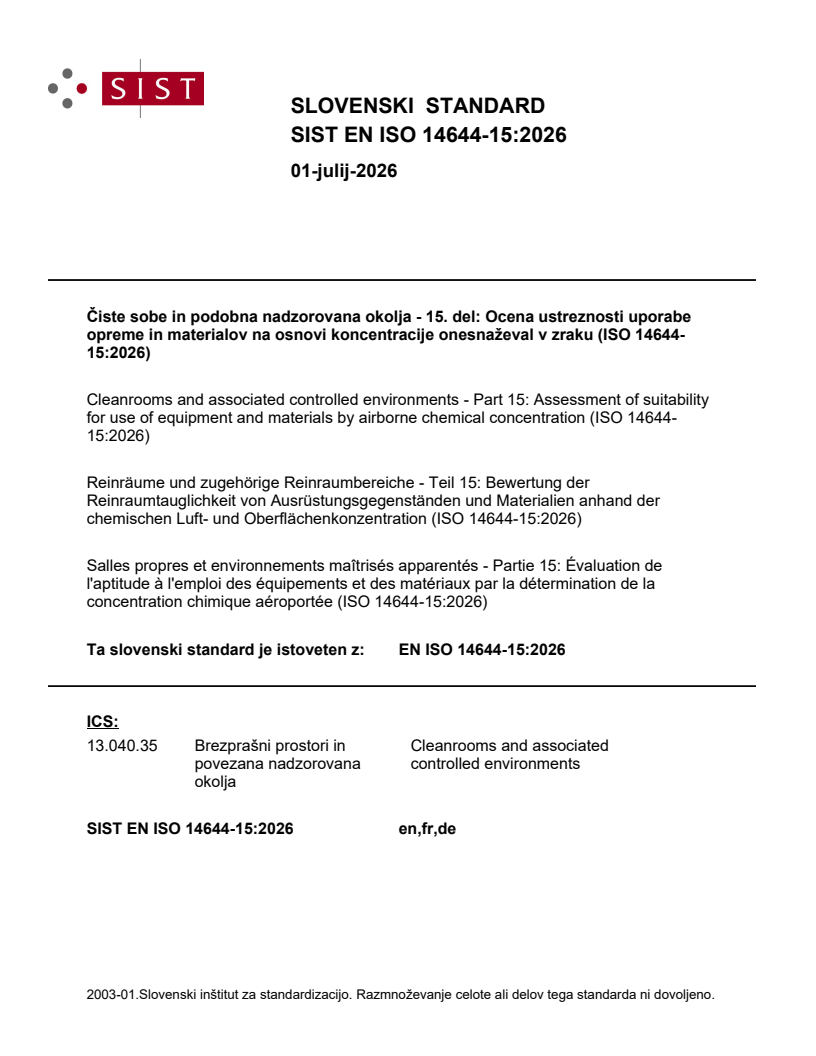
SLOVENSKI STANDARD
01-julij-2026
Čiste sobe in podobna nadzorovana okolja - 15. del: Ocena ustreznosti uporabe
opreme in materialov na osnovi koncentracije onesnaževal v zraku (ISO 14644-
15:2026)
Cleanrooms and associated controlled environments - Part 15: Assessment of suitability
for use of equipment and materials by airborne chemical concentration (ISO 14644-
15:2026)
Reinräume und zugehörige Reinraumbereiche - Teil 15: Bewertung der
Reinraumtauglichkeit von Ausrüstungsgegenständen und Materialien anhand der
chemischen Luft- und Oberflächenkonzentration (ISO 14644-15:2026)
Salles propres et environnements maîtrisés apparentés - Partie 15: Évaluation de
l'aptitude à l'emploi des équipements et des matériaux par la détermination de la
concentration chimique aéroportée (ISO 14644-15:2026)
Ta slovenski standard je istoveten z: EN ISO 14644-15:2026
ICS:
13.040.35 Brezprašni prostori in Cleanrooms and associated
povezana nadzorovana controlled environments
okolja
2003-01.Slovenski inštitut za standardizacijo. Razmnoževanje celote ali delov tega standarda ni dovoljeno.
EN ISO 14644-15
EUROPEAN STANDARD
NORME EUROPÉENNE
May 2026
EUROPÄISCHE NORM
ICS 13.040.35 Supersedes EN ISO 14644-15:2017
English Version
Cleanrooms and associated controlled environments - Part
15: Assessment of suitability for use of equipment and
materials by airborne chemical concentration (ISO 14644-
15:2026)
Salles propres et environnements maîtrisés apparentés Reinräume und zugehörige Reinraumbereiche - Teil
- Partie 15: Évaluation de l'aptitude à l'emploi des 15: Bewertung der Reinraumtauglichkeit von
équipements et des matériaux par la détermination de Ausrüstungsgegenständen und Materialien anhand der
la concentration chimique aéroportée (ISO 14644- chemischen Luft- und Oberflächenkonzentration (ISO
15:2026) 14644-15:2026)
This European Standard was approved by CEN on 7 March 2026.
CEN members are bound to comply with the CEN/CENELEC Internal Regulations which stipulate the conditions for giving this
European Standard the status of a national standard without any alteration. Up-to-date lists and bibliographical references
concerning such national standards may be obtained on application to the CEN-CENELEC Management Centre or to any CEN
member.
This European Standard exists in three official versions (English, French, German). A version in any other language made by
translation under the responsibility of a CEN member into its own language and notified to the CEN-CENELEC Management
Centre has the same status as the official versions.
CEN members are the national standards bodies of Austria, Belgium, Bulgaria, Croatia, Cyprus, Czech Republic, Denmark, Estonia,
Finland, France, Germany, Greece, Hungary, Iceland, Ireland, Italy, Latvia, Lithuania, Luxembourg, Malta, Netherlands, Norway,
Poland, Portugal, Republic of North Macedonia, Romania, Serbia, Slovakia, Slovenia, Spain, Sweden, Switzerland, Türkiye and
United Kingdom.
EUROPEAN COMMITTEE FOR STANDARDIZATION
COMITÉ EUROPÉEN DE NORMALISATION
EUROPÄISCHES KOMITEE FÜR NORMUNG
CEN-CENELEC Management Centre: Rue de la Science 23, B-1040 Brussels
© 2026 CEN All rights of exploitation in any form and by any means reserved Ref. No. EN ISO 14644-15:2026 E
worldwide for CEN national Members.
Contents Page
European foreword . 3
European foreword
This document (EN ISO 14644-15:2026) has been prepared by Technical Committee ISO/TC 209
"Cleanrooms and associated controlled environments" in collaboration with Technical Committee
CEN/TC 243 “Cleanroom technology” the secretariat of which is held by BSI.
This European Standard shall be given the status of a national standard, either by publication of an
identical text or by endorsement, at the latest by November 2026, and conflicting national standards
shall be withdrawn at the latest by November 2026.
Attention is drawn to the possibility that some of the elements of this document may be the subject of
patent rights. CEN shall not be held responsible for identifying any or all such patent rights.
This document supersedes EN ISO 14644-15:2017.
Any feedback and questions on this document should be directed to the users’ national standards
body/national committee. A complete listing of these bodies can be found on the CEN website.
According to the CEN-CENELEC Internal Regulations, the national standards organizations of the
following countries are bound to implement this European Standard: Austria, Belgium, Bulgaria,
Croatia, Cyprus, Czech Republic, Denmark, Estonia, Finland, France, Germany, Greece, Hungary, Iceland,
Ireland, Italy, Latvia, Lithuania, Luxembourg, Malta, Netherlands, Norway, Poland, Portugal, Republic of
North Macedonia, Romania, Serbia, Slovakia, Slovenia, Spain, Sweden, Switzerland, Türkiye and the
United Kingdom.
Endorsement notice
The text of ISO 14644-15:2026 has been approved by CEN as EN ISO 14644-15:2026 without any
modification.
International
Standard
ISO 14644-15
Second edition
Cleanrooms and associated
2026-05
controlled environments —
Part 15:
Assessment of suitability for use
of equipment and materials by
airborne chemical concentration
Salles propres et environnements maîtrisés apparentés —
Partie 15: Évaluation de l'aptitude à l'emploi des équipements et
des matériaux par la détermination de la concentration chimique
aéroportée
Reference number
ISO 14644-15:2026(en) © ISO 2026
ISO 14644-15:2026(en)
© ISO 2026
All rights reserved. Unless otherwise specified, or required in the context of its implementation, no part of this publication may
be reproduced or utilized otherwise in any form or by any means, electronic or mechanical, including photocopying, or posting on
the internet or an intranet, without prior written permission. Permission can be requested from either ISO at the address below
or ISO’s member body in the country of the requester.
ISO copyright office
CP 401 • Ch. de Blandonnet 8
CH-1214 Vernier, Geneva
Phone: +41 22 749 01 11
Email: copyright@iso.org
Website: www.iso.org
Published in Switzerland
ii
ISO 14644-15:2026(en)
Contents Page
Foreword .iv
Introduction .v
1 Scope . 1
2 Normative references . 1
3 Terms and definitions . 1
4 Symbols . 4
5 Test setup . 4
5.1 General .4
5.2 Closed design .5
5.3 Closed design special application .6
5.4 Open design .7
6 Representative mode . 7
6.1 Equipment .7
6.2 Material .7
7 Visual inspection . 8
7.1 General .8
7.2 Equipment .8
7.3 Material .8
8 Test description . 9
9 Calculation of the measured concentrations . 9
10 Calculation of specific emission rate . 10
10.1 Calculation of specific emission rate — Closed design.10
10.2 Calculation of specific emission rate — Open design .10
11 Assessment . .11
11.1 General .11
11.2 Required input data .11
11.3 Calculation to determine the effect on a cleanroom or controlled zone . 12
11.4 Assessment of the suitability of material(s) or equipment for an existing cleanroom or
controlled zone . 12
12 Documentation .12
12.1 General . 12
12.2 Common documentation requirements . 13
12.3 Test documentation . . 13
12.4 Visual inspection . 13
12.4.1 Equipment . 13
12.4.2 Materials . 13
Annex A (informative) Example calculation for suitability assessment of one equipment
(existing installation) . 14
Annex B (informative) Example calculation for suitability assessment of wall material (existing
cleanroom/clean zone installation) .16
Annex C (informative) Suitability assessment of a combination of equipment and floor material
in a cleanroom to be designed . 17
Bibliography . 19
iii
ISO 14644-15:2026(en)
Foreword
ISO (the International Organization for Standardization) is a worldwide federation of national standards
bodies (ISO member bodies). The work of preparing International Standards is normally carried out through
ISO technical committees. Each member body interested in a subject for which a technical committee
has been established has the right to be represented on that committee. International organizations,
governmental and non-governmental, in liaison with ISO, also take part in the work. ISO collaborates closely
with the International Electrotechnical Commission (IEC) on all matters of electrotechnical standardization.
The procedures used to develop this document and those intended for its further maintenance are described
in the ISO/IEC Directives, Part 1. In particular, the different approval criteria needed for the different types
of ISO document should be noted. This document was drafted in accordance with the editorial rules of the
ISO/IEC Directives, Part 2 (see www.iso.org/directives).
ISO draws attention to the possibility that the implementation of this document may involve the use of (a)
patent(s). ISO takes no position concerning the evidence, validity or applicability of any claimed patent
rights in respect thereof. As of the date of publication of this document, ISO had not received notice of (a)
patent(s) which may be required to implement this document. However, implementers are cautioned that
this may not represent the latest information, which may be obtained from the patent database available at
www.iso.org/patents. ISO shall not be held responsible for identifying any or all such patent rights.
Any trade name used in this document is information given for the convenience of users and does not
constitute an endorsement.
For an explanation of the voluntary nature of standards, the meaning of ISO specific terms and expressions
related to conformity assessment, as well as information about ISO's adherence to the World Trade
Organization (WTO) principles in the Technical Barriers to Trade (TBT), see www.iso.org/iso/foreword.html.
This document was prepared by Technical Committee ISO/TC 209, Cleanrooms and associated controlled
environments, in collaboration with the European Committee for Standardization (CEN) Technical Committee
CEN/TC 243, Cleanroom technology,in accordance with the Agreement on technical cooperation between ISO
and CEN (Vienna Agreement).
This second edition cancels and replaces the first edition (ISO 14644-15:2017), of which it constitutes a
minor revision. The changes are as follows:
— term class (classification, classified) changed to level or assessment where appropriate and Introduction
reworded to accommodate the change;
— phrase “has to be” changed to “shall be”;
— updated ‘document titles’ and ‘Source’ dates where appropriate;
— removed references not mentioned in the text from the bibliography;
— minor editorial changes.
A list of all parts in the ISO 14644 series can be found on the ISO website.
Any feedback or questions on this document should be directed to the user’s national standards body. A
complete listing of these bodies can be found at www.iso.org/members.html.
iv
ISO 14644-15:2026(en)
Introduction
Cleanrooms and associated controlled environments provide for the control of contamination to levels
appropriate for accomplishing contamination-sensitive activities. Products and processes that benefit from
the control of contamination include those in industries such as aerospace, microelectronics, optics, nuclear,
and life sciences (pharmaceuticals, medical devices, food, healthcare).
The assessment of suitability of equipment for use in cleanrooms and associated controlled environments
is related to the assessment of air cleanliness for chemical contamination. Examples and suitability
assessments are given in Annexes A, B and C.
v
International Standard ISO 14644-15:2026(en)
Cleanrooms and associated controlled environments —
Part 15:
Assessment of suitability for use of equipment and materials
by airborne chemical concentration
1 Scope
This document specifies requirements and guidelines for assessing the chemical airborne cleanliness
of equipment and materials which are foreseen to be used in cleanrooms and associated controlled
environments that are linked to the ISO standard for air cleanliness by chemical concentration (see
ISO 14644-8).
This document does not apply to the following:
— health and safety requirements;
— compatibility with cleaning agents and techniques;
— cleanability;
— biocontamination;
— specific requirements of equipment and materials for processes and products;
— design details of equipment.
2 Normative references
The following documents are referred to in the text in such a way that some or all of their content constitutes
requirements of this document. For dated references, only the edition cited applies. For undated references,
the latest edition of the referenced document (including any amendments) applies.
ISO 14644-8:2022, Cleanrooms and associated controlled environments — Part 8: Assessment of air cleanliness
by chemical concentration (ACC)
3 Terms and definitions
For the purposes of this document, the following terms and definitions apply.
ISO and IEC maintain terminology databases for use in standardization at the following addresses:
— ISO Online browsing platform: available at https:// www .iso .org/ obp
— IEC Electropedia: available at https:// www .electropedia .org/
ISO 14644-15:2026(en)
3.1
air cleanliness by chemical concentration
ACC
quantity of chemicals detected in the air, expressed in terms of an ISO-ACC level N, which represents the
maximum allowable concentration of a given chemical species or a group of chemical species, expressed in
grams per cubic metre
Note 1 to entry: This definition does not include macromolecules of biological origin, which are judged to be particles.
[SOURCE: ISO 14644-8:2022, 3.1.2]
3.2
breakthrough volume
maximum purge gas (3.12) volume that can be drawn through a trapping system without loss of analyte at a
specific temperature
3.3
chemical contamination
non-particulate substances that can have a deleterious effect on the product, process or equipment
[SOURCE: ISO 14644-8:2022, 3.1.1]
3.4
cleanliness
condition not exceeding a specified level of contamination
3.5
cleanroom
room within which the number concentration of airborne particles is controlled and classified, and which
is designed, constructed and operated in a manner to control the introduction, generation, and retention of
particles inside the room
Note 1 to entry: The class of airborne particle concentration is specified.
Note 2 to entry: Levels of other cleanliness attributes such as chemical, viable or nanoscale concentrations in the air,
and also surface cleanliness in terms of particle, nanoscale, chemical and viable concentrations may also be specified
and controlled.
Note 3 to entry: Other relevant physical parameters may also be controlled as required, e.g. temperature, humidity,
pressure, vibration and electrostatic.
[SOURCE: ISO 14644-1:2015, 3.1.1]
3.6
clean zone
defined space within which the number concentration of airborne particles is controlled and classified, and
which is constructed and operated in a manner to control the introduction, generation, and retention of
contaminants inside the space
Note 1 to entry: The class of airborne particle concentration is specified.
Note 2 to entry: Levels of other cleanliness attributes such as chemical, viable or nanoscale concentrations in the air,
and also surface cleanliness in terms of particle, nanoscale, chemical and viable concentrations may also be specified
and controlled.
Note 3 to entry: A clean zone(s) may be a defined space within a cleanroom or may be achieved by a separative device.
Such a device may be located inside or outside a cleanroom.
Note 4 to entry: Other relevant physical parameters may also be controlled as required, e.g. temperature, humidity,
pressure, vibration and electrostatic.
[SOURCE: ISO 14644-1:2015, 3.1.2]
ISO 14644-15:2026(en)
3.7
controlled zone
designated space in which the concentration of at least one contamination category (particles, chemical,
biocontamination) in air and/or on surfaces is controlled and specified and which is constructed and used in
a manner to minimize the introduction and impact of contamination
Note 1 to entry: Levels of cleanliness attributes such as chemical and viable concentrations in the air or cleanliness in
terms of particle, chemical and viable concentrations on surfaces may be specified by level(s).
Note 2 to entry: Other relevant parameters may also be controlled as necessary, e.g. temperature, humidity and
pressure, vibration and electrostatic.
Note 3 to entry: A controlled zone can be a defined space within a cleanroom or may be achieved by a separative
device. Such a device may be located inside or outside a cleanroom.
3.8
emission
contaminants that are discharged into the environment
[SOURCE: ISO 2889:2023, 3.29]
Note 1 to entry: For the purposes of this document, only chemical emission is considered.
3.9
emission rate
rate describing the mass of one or more volatile chemical(s) emitted from the equipment or material per
time unit
3.10
equipment
system designed for specific function(s), integrating materials, components and/or controls
EXAMPLE Testing and manufacturing equipment and machinery; equipment for transport and handling; storage
units; tools; furniture; doors; ceilings; IT hardware; handling robots.
[SOURCE: ISO 14644-14:2025, 3.6]
3.11
material
single substance or composite
Note 1 to entry: It might be necessary to provide material in a representative form to enable testing.
3.12
purge gas
gas or gas mixture to carry contaminant to a defined outlet
Note 1 to entry: In a controlled or clean zone (3.6) or a cleanroom (3.5), filtered air might be used as purge gas.
Note 2 to entry: A test environment (3.16) might be purged with air or other gases or gas mixtures to carry the
contaminant to a trapping system or measurement device.
3.13
representative form
material sample produced to represent the intrinsic physical and chemical properties of an object
3.14
representative mode
mode of operation that reflects the intended use of the equipment
ISO 14644-15:2026(en)
3.15
specific emission rate
normalized mass flow of chemical contaminants emitted from a test object
Note 1 to entry: Material-specific emission rate (3.9) is based on surface area.
Note 2 to entry: Equipment-specific emission rate is based on one single unit of equipment.
3.16
test environment
space in which the test is carried out, described by a set of parameters
[SOURCE: ISO 14644-14:2025, 3.7]
4 Symbols
Symbol Meaning Unit
p Background concentration in the test environment without the test g/m
b
object
p Concentration in the test environment with the test object g/m
o
p Chemical mass concentration in the cleanroom/controlled zone g/m
c
p Chemical mass co
...