

EN ISO 21487:2023
(Main)Small craft - Permanently installed petrol and diesel fuel tanks (ISO 21487:2022)
- Abstract
This document specifies requirements for the design, installation and testing of petrol and diesel fuel tanks for internal combustion engines, that are intended to be permanently installed in small craft.
- Status
- Published
- Publication Date
- 14-Mar-2023
- Technical Committee
- CEN/TC 464 - Small Craft
- Drafting Committee
- CEN/TC 464 - Small Craft
- Current Stage
- 6060 - Definitive text made available (DAV) - Publishing
- Start Date
- 15-Mar-2023
- Completion Date
- 15-Mar-2023



Overview
EN ISO 21487:2023 (identical to ISO 21487:2022) defines requirements for the design, installation and testing of permanently installed petrol and diesel fuel tanks for small craft. Prepared by ISO/TC 188 in collaboration with CEN/TC 464 and endorsed as a European Standard, it replaces the 2012 edition and supports conformity to EU Directive 2013/53/EU where applicable. The standard focuses on safety, durability and environmental performance of fuel tanks and related fixed fuel system components on boats and small vessels.
Key topics and technical requirements
The standard addresses practical and technical areas including:
- Scope and definitions - applicability to permanently installed tanks for internal combustion engines in small craft.
- General properties - material compatibility, resistance to liquids, and rules for copper‑based alloys.
- Tank provisions and installation - mechanical fixing (non‑integral and integral), ventilation of petrol tank spaces, separation from living quarters, and routing of fuel lines and hoses.
- Design requirements - construction principles for petrol and diesel tanks (including metallic and non‑metallic options).
- Type tests - mandatory testing regimes for verification:
- Leakage tests and pressure/strength tests
- Pressure‑impulse tests (for petrol tanks)
- Fire‑resistance tests for non‑metallic tanks, both standalone and as installed
- Annex A (informative) - permeation testing to measure evaporative emissions from non‑metallic petrol tanks and support future environmental controls.
- Marking and documentation - requirements for traceability and compliance information.
Applications and users
EN ISO 21487:2023 is intended for professionals involved in the lifecycle of small craft fuel systems:
- Boat designers and naval architects - to specify compliant fuel tank designs.
- Marine equipment manufacturers and fabricators - for materials selection, construction and factory testing.
- Boatbuilders and installers - to ensure safe installation, ventilation and separation practices on board.
- Certification bodies, surveyors and test laboratories - to perform prescribed type tests and verify conformity.
- Regulatory authorities and fleet operators - to demonstrate compliance with EU Directive 2013/53/EU and to control evaporative emissions.
Practical benefits include improved fire safety, reduced leaking and permeation risks, better environmental performance, and a clear pathway to regulatory conformity and CE-related requirements.
Related standards
Normative and associated documents referenced include:
- ISO 10088 - Small craft permanently installed fuel systems
- ISO 12215‑5 and ISO 12215‑6 - Hull construction and scantlings (relevant for installation and structural arrangements)
Keywords: EN ISO 21487:2023, ISO 21487:2022, small craft fuel tanks, petrol and diesel tanks, fuel tank design, fuel tank testing, permeation testing, fire‑resistance, marine fuel system installation.
Relations
- Effective Date
- 22-Mar-2023
- Effective Date
- 20-May-2026
- Effective Date
- 09-Feb-2026
- Effective Date
- 09-Feb-2026
- Effective Date
- 28-Jan-2026
- Effective Date
- 12-Feb-2026
- Effective Date
- 18-Jan-2023
Get Certified
Connect with accredited certification bodies for this standard

DNV
DNV is an independent assurance and risk management provider.

Lloyd's Register
Lloyd's Register is a global professional services organisation specialising in engineering and technology.

FSC International
Forest Stewardship Council certification.
Sponsored listings
Frequently Asked Questions
EN ISO 21487:2023 is a standard published by the European Committee for Standardization (CEN). Its full title is "Small craft - Permanently installed petrol and diesel fuel tanks (ISO 21487:2022)". This standard covers: This document specifies requirements for the design, installation and testing of petrol and diesel fuel tanks for internal combustion engines, that are intended to be permanently installed in small craft.
This document specifies requirements for the design, installation and testing of petrol and diesel fuel tanks for internal combustion engines, that are intended to be permanently installed in small craft.
EN ISO 21487:2023 is classified under the following ICS (International Classification for Standards) categories: 47.080 - Small craft. The ICS classification helps identify the subject area and facilitates finding related standards.
EN ISO 21487:2023 has the following relationships with other standards: It is inter standard links to EN ISO 21487:2018, ISO 10088:2022, ISO 12215-5:2019, ISO 12215-6:2008, EN ISO 6888-2:2021/A1:2023, ISO 21487:2022, EN ISO 21487:2012. Understanding these relationships helps ensure you are using the most current and applicable version of the standard.
EN ISO 21487:2023 is associated with the following European legislation: EU Directives/Regulations: 2013/53/EU; Standardization Mandates: M/542. When a standard is cited in the Official Journal of the European Union, products manufactured in conformity with it benefit from a presumption of conformity with the essential requirements of the corresponding EU directive or regulation.
EN ISO 21487:2023 is available in PDF format for immediate download after purchase. The document can be added to your cart and obtained through the secure checkout process. Digital delivery ensures instant access to the complete standard document.
Standards Content (Sample)
SLOVENSKI STANDARD
01-maj-2023
Nadomešča:
SIST EN ISO 21487:2018
Mala plovila - Trajno vgrajeni rezervoarji za bencinsko in dizelsko gorivo (ISO
21487:2022)
Small craft - Permanently installed petrol and diesel fuel tanks (ISO 21487:2022)
Kleine Wasserfahrzeuge - Fest eingebaute Ottokraftstoff- und Dieselkraftstofftanks (ISO
21487:2022)
Petits navires - Réservoirs à carburant essence et diesel installés à demeure (ISO
21487:2022)
Ta slovenski standard je istoveten z: EN ISO 21487:2023
ICS:
47.020.20 Ladijski motorji Marine engines and
propulsion systems
47.080 Čolni Small craft
2003-01.Slovenski inštitut za standardizacijo. Razmnoževanje celote ali delov tega standarda ni dovoljeno.
EN ISO 21487
EUROPEAN STANDARD
NORME EUROPÉENNE
March 2023
EUROPÄISCHE NORM
ICS 47.080 Supersedes EN ISO 21487:2012
English Version
Small craft - Permanently installed petrol and diesel fuel
tanks (ISO 21487:2022)
Petits navires - Réservoirs à carburant essence et Kleine Wasserfahrzeuge - Fest eingebaute
diesel installés à demeure (ISO 21487:2022) Ottokraftstoff- und Dieselkraftstofftanks (ISO
21487:2022)
This European Standard was approved by CEN on 18 January 2023.
CEN members are bound to comply with the CEN/CENELEC Internal Regulations which stipulate the conditions for giving this
European Standard the status of a national standard without any alteration. Up-to-date lists and bibliographical references
concerning such national standards may be obtained on application to the CEN-CENELEC Management Centre or to any CEN
member.
This European Standard exists in three official versions (English, French, German). A version in any other language made by
translation under the responsibility of a CEN member into its own language and notified to the CEN-CENELEC Management
Centre has the same status as the official versions.
CEN members are the national standards bodies of Austria, Belgium, Bulgaria, Croatia, Cyprus, Czech Republic, Denmark, Estonia,
Finland, France, Germany, Greece, Hungary, Iceland, Ireland, Italy, Latvia, Lithuania, Luxembourg, Malta, Netherlands, Norway,
Poland, Portugal, Republic of North Macedonia, Romania, Serbia, Slovakia, Slovenia, Spain, Sweden, Switzerland, Türkiye and
United Kingdom.
EUROPEAN COMMITTEE FOR STANDARDIZATION
COMITÉ EUROPÉEN DE NORMALISATION
EUROPÄISCHES KOMITEE FÜR NORMUNG
CEN-CENELEC Management Centre: Rue de la Science 23, B-1040 Brussels
© 2023 CEN All rights of exploitation in any form and by any means reserved Ref. No. EN ISO 21487:2023 E
worldwide for CEN national Members.
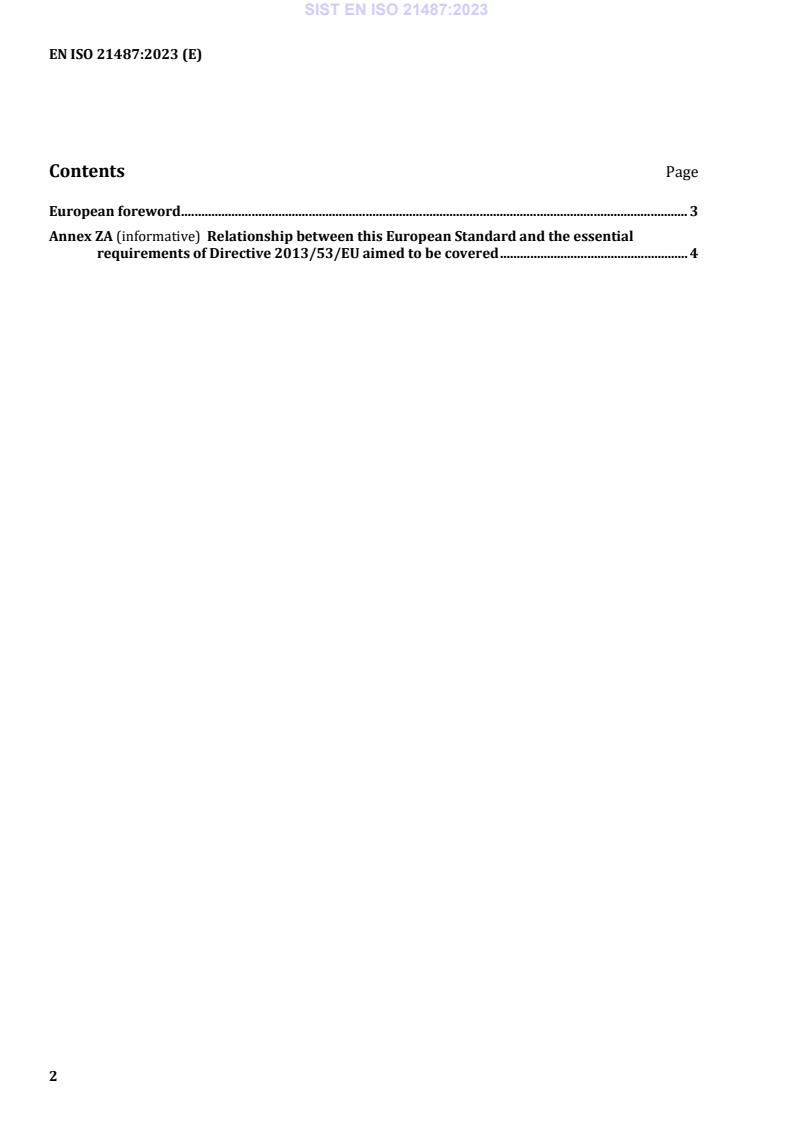
Contents Page
European foreword . 3
Annex ZA (informative) Relationship between this European Standard and the essential
requirements of Directive 2013/53/EU aimed to be covered . 4
European foreword
This document (EN ISO 21487:2023) has been prepared by Technical Committee ISO/TC 188 "Small
craft" in collaboration with Technical Committee CEN/TC 464 “Small Craft” the secretariat of which is
held by SIS.
This European Standard shall be given the status of a national standard, either by publication of an
identical text or by endorsement, at the latest by September 2023, and conflicting national standards
shall be withdrawn at the latest by March 2024.
Attention is drawn to the possibility that some of the elements of this document may be the subject of
patent rights. CEN shall not be held responsible for identifying any or all such patent rights.
This document supersedes EN ISO 21487:2012.
This document has been prepared under a Standardization Request given to CEN by the European
Commission and the European Free Trade Association, and supports essential requirements of EU
Directive(s) / Regulation(s).
For the relationship with EU Directive(s) / Regulation(s), see informative Annex ZA, which is an
integral part of this document.
Any feedback and questions on this document should be directed to the users’ national standards
body/national committee. A complete listing of these bodies can be found on the CEN website.
According to the CEN-CENELEC Internal Regulations, the national standards organizations of the
following countries are bound to implement this European Standard: Austria, Belgium, Bulgaria,
Croatia, Cyprus, Czech Republic, Denmark, Estonia, Finland, France, Germany, Greece, Hungary,
Iceland, Ireland, Italy, Latvia, Lithuania, Luxembourg, Malta, Netherlands, Norway, Poland, Portugal,
Republic of North Macedonia, Romania, Serbia, Slovakia, Slovenia, Spain, Sweden, Switzerland,
Türkiye and the United Kingdom.
Endorsement notice
The text of ISO 21487:2022 has been approved by CEN as EN ISO 21487:2023 without any
modification.
Annex ZA
(informative)
Relationship between this European Standard and the essential
requirements of Directive 2013/53/EU aimed to be covered
This European Standard has been prepared under a Commission’s standardization request
M/542/C(2015) 8736 final to provide one voluntary means of conforming to essential requirements
of Directive 2013/53/EU.
Once this standard is cited in the Official Journal of the European Union under that Directive,
compliance with the normative clauses of this standard given in Table ZA.1 confers, within the limits
of the scope of this standard, a presumption of conformity with the corresponding essential
requirements of that Directive, and associated EFTA regulations.
Table ZA.1 — Correspondence between this European Standard and Annex I and II of Directive
2013/53/EU
Essential Requirements of Clause(s)/sub-clause(s) Remarks/Notes
Directive 2013/53/EU of this EN
Annex I, Part A. - Fuel Tanks 4,5,6,7 This standard specifies the
requirements for the design and
testing of petrol and diesel fuel
tank only, it does provide
technical requirements for: —
Construction of fuel tanks; —
Installation of fuel lines and
hoses; — Ventilation of petrol
fuel tank spaces.; — Separation
of petrol fuel tanks from living
quarters.
Annex II – Components of water- 4,5,6,7 In respect to fuel tanks supplied
craft (4) - Fuel tanks intended as components only
for fixed installations and fuel
hoses.
Table ZA.2 — Applicable Standards to confer presumption of conformity as described in this
Annex ZA
Column 1 Column 2 Column 3 Column 4
Reference in International
Title Corresponding European
Clause 2 Standard Edition
Standard Edition
ISO 10088:2013 ISO 10088:2013 Small craft — Permanently EN ISO 10088:2017
installed fuel systems
ISO 12215- ISO 12215-5:2019 Small craft — Hull EN ISO 12215-5:2019
5:2019 construction and scantlings
— Part 5: Design pressures
for monohulls,
design stresses, scantlings
determination
ISO 12215- ISO 12215-6:2008 Small craft — Hull EN ISO 12215-6:2018
6:2008 construction and scantlings
— Part 6: Structural
arrangements and
details
The documents listed in the Column 1 of Table ZA.2, in whole or in part, are normatively referenced in
this document, i.e. are indispensable for its application. The achievement of the presumption of
conformity is subject to the application of the edition of Standards as listed in Column 4 or, if no
European Standard Edition exists, the International Standard Edition given in Column 2 of Table ZA.2.
WARNING 1 — Presumption of conformity stays valid only as long as a reference to this European
Standard is maintained in the list published in the Official Journal of the European Union. Users of this
standard should consult frequently the latest list published in the Official Journal of the European
Union.
WARNING 2 — Other Union legislation may be applicable to the product(s) falling within the scope of
this standard.
INTERNATIONAL ISO
STANDARD 21487
Third edition
2022-11
Small craft — Permanently installed
petrol and diesel fuel tanks
Petits navires — Réservoirs à carburant essence et diesel installés à
demeure
Reference number
ISO 21487:2022(E)
ISO 21487:2022(E)
© ISO 2022
All rights reserved. Unless otherwise specified, or required in the context of its implementation, no part of this publication may
be reproduced or utilized otherwise in any form or by any means, electronic or mechanical, including photocopying, or posting on
the internet or an intranet, without prior written permission. Permission can be requested from either ISO at the address below
or ISO’s member body in the country of the requester.
ISO copyright office
CP 401 • Ch. de Blandonnet 8
CH-1214 Vernier, Geneva
Phone: +41 22 749 01 11
Email: copyright@iso.org
Website: www.iso.org
Published in Switzerland
ii
ISO 21487:2022(E)
Contents Page
Foreword .iv
Introduction .v
1 Scope . 1
2 Normative references . 1
3 Terms and definitions . 1
4 General properties . 2
4.1 Resistance to liquids in contact . 2
4.2 Copper-based alloys . 2
4.3 Provisions to tanks . 2
4.4 Installation of tanks . 3
4.4.1 Non-integral tank mechanical fixing . 3
4.4.2 Other installation requirements . 3
5 Petrol fuel tanks: design and type tests . 3
5.1 Design . 3
5.2 Tests . 4
6 Diesel fuel tanks: design and type tests . 4
6.1 Design . 4
6.2 Tests . 4
7 Type tests . 5
7.1 General . 5
7.2 Pressure tests . 5
7.2.1 Leakage test . 5
7.2.2 Pressure/strength type test . 6
7.3 Pressure-impulse type test for petrol fuel tanks . 7
7.4 General fire-resistance test for non-metallic fuel tanks . 7
7.5 Fire-resistance test for non-metallic fuel tanks as installed . 10
8 Marking . .11
Annex A (informative) Permeation testing of non-metallic fuel tanks.12
Bibliography .16
iii
ISO 21487:2022(E)
Foreword
ISO (the International Organization for Standardization) is a worldwide federation of national standards
bodies (ISO member bodies). The work of preparing International Standards is normally carried out
through ISO technical committees. Each member body interested in a subject for which a technical
committee has been established has the right to be represented on that committee. International
organizations, governmental and non-governmental, in liaison with ISO, also take part in the work.
ISO collaborates closely with the International Electrotechnical Commission (IEC) on all matters of
electrotechnical standardization.
The procedures used to develop this document and those intended for its further maintenance are
described in the ISO/IEC Directives, Part 1. In particular, the different approval criteria needed for the
different types of ISO documents should be noted. This document was drafted in accordance with the
editorial rules of the ISO/IEC Directives, Part 2 (see www.iso.org/directives).
Attention is drawn to the possibility that some of the elements of this document may be the subject of
patent rights. ISO shall not be held responsible for identifying any or all such patent rights. Details of
any patent rights identified during the development of the document will be in the Introduction and/or
on the ISO list of patent declarations received (see www.iso.org/patents).
Any trade name used in this document is information given for the convenience of users and does not
constitute an endorsement.
For an explanation of the voluntary nature of standards, the meaning of ISO specific terms and
expressions related to conformity assessment, as well as information about ISO’s adherence to
the World Trade Organization (WTO) principles in the Technical Barriers to Trade (TBT), see
www.iso.org/iso/foreword.html.
This document was prepared by Technical Committee ISO/TC 188, Small craft, in collaboration with
the European Committee for Standardization (CEN) Technical Committee CEN/TC 464, Small craft, in
accordance with the Agreement on technical cooperation between ISO and CEN (Vienna Agreement).
This third edition cancels and replaces the second edition (ISO 21487:2012), which has been technically
revised. It also incorporates the Amendments ISO 21487:2012/Amd 1:2014 and ISO 21487:2012/Amd
2:2015.
The main changes are as follows:
— an Introduction has been added to explain the addition of Annex A;
— the Scope has been amended to include installation of fuel tanks;
— some definitions have been updated;
— Clause 4 has been updated, in particular 4.2, 4.3.9 and 4.4.1;
— sublause 5.2 has been updated and Table 2 has been introduced for tests;
— subclause 6.2 has been redrafted;
— Clause 7 has been revised;
— Annex A has been added, which provides a permeation test to determine the evaporative emissions
from non-metallic tanks.
Any feedback or questions on this document should be directed to the user’s national standards body. A
complete listing of these bodies can be found at www.iso.org/members.html.
iv
ISO 21487:2022(E)
Introduction
This document provides requirements for the design, installation and testing of permanently installed
fuel tanks for small craft.
Some countries have environmental controls for evaporative emissions from petrol fuel systems.
Annex A describes the limits and test procedures for the control of evaporative emissions from
permanently installed petrol fuel tanks. The details in Annex A allow for future standardization and
application of evaporative emissions on small craft.
As the international community further restricts fuel system emissions, it is anticipated that Annex A
will have increased global acceptance.
v
INTERNATIONAL STANDARD ISO 21487:2022(E)
Small craft — Permanently installed petrol and diesel fuel
tanks
1 Scope
This document specifies requirements for the design, installation and testing of petrol and diesel fuel
tanks for internal combustion engines, that are intended to be permanently installed in small craft.
2 Normative references
The following documents are referred to in the text in such a way that some or all of their content
constitutes requirements of this document. For dated references, only the edition cited applies. For
undated references, the latest edition of the referenced document (including any amendments) applies.
ISO 10088:2022, Small craft — Permanently installed fuel systems
ISO 12215-5:2019, Small craft — Hull construction and scantlings — Part 5: Design pressures for monohulls,
design stresses, scantlings determination
ISO 12215-6:2008, Small craft — Hull construction and scantlings — Part 6: Structural arrangements and
details
3 Terms and definitions
For the purposes of this document, the following terms and definitions apply.
ISO and IEC maintain terminology databases for use in standardization at the following addresses:
— ISO Online browsing platform: available at https:// www .iso .org/ obp
— IEC Electropedia: available at https:// www .electropedia .org/
3.1
petrol
hydrocarbon fuel, or blend of hydrocarbon fuel and denatured ethanol, that is liquid at atmospheric
pressure and is used in spark ignition engines (3.3)
3.2
diesel
hydrocarbon fuel, biofuel, or blend of these, that is liquid at atmospheric pressure and is used in
compression ignition engines (3.4)
3.3
spark ignition engine
engine in which an electrical spark is produced to ignite the fuel/air mixture
3.4
compression ignition engine
engine in which ignition is obtained by means of compressing the fuel/air mixture
3.5
permanently installed
securely fastened by bolts, brackets, screws, paint, adhesive, welding or other means, so that it cannot
be unattached without the use of tools or chemicals
ISO 21487:2022(E)
3.6
integral tank
fuel tank that forms part of the outer hull envelope, so that at least one boundary of the tank is formed
by the hull
Note 1 to entry: Structural components, such as bulkheads, are not part of the hull.
3.7
non-integral tank
fuel tank that does not rely on any portion of the craft to retain fuel
3.8
tank range
set of fuel tanks characterized by the following attributes: general geometric shape, material and wall
thickness
3.9
craft
small craft
recreational boat, and other watercraft using similar equipment, of up to 24 m length of hull (L )
H
Note 1 to entry: The measurement methodology for length of hull is defined in ISO 8666.
[SOURCE: ISO 8666:2020, 3.15, modified — Note 1 to entry has been added.]
4 General properties
4.1 Resistance to liquids in contact
4.1.1 All seals such as gaskets, O-rings and joint-rings shall be of non-wicking, i.e. non-fuel absorbent,
material.
4.1.2 All materials used shall be resistant to deterioration by the fuel for which the system is designed
and to other liquids or compounds with which the material can come in contact as installed under
normal operating conditions, e.g. grease, lubricating oil, bilge solvents and sea water.
4.2 Copper-based alloys
Copper-based alloy fittings are not permitted on aluminium alloy fuel tanks unless a galvanic barrier is
arranged between the fitting and the tank.
4.3 Provisions to tanks
4.3.1 There shall be provisions to determine the fuel level or quantity in the tank, considering the
requirements in 5.1.2 for petrol fuel tanks and in 6.1.5 for diesel fuel tanks.
4.3.2 Metal tanks shall be designed and installed so that no exterior surface traps water.
4.3.3 All rigid tubes and pipes which extend near the tank bottom shall have sufficient clearance to
prevent contact between the tube and the bottom of the tank during normal operation of the craft.
4.3.4 On metallic tanks, all metallic non-integral tank supports, chocks or hangers shall either be
separated from the surface of the tank by a non-metallic, non-hygroscopic, non-abrasive material, or
welded to the tank.
ISO 21487:2022(E)
4.3.5 If baffles are provided, the total open area provided in the baffles shall be not greater than
30 % of the tank cross-section in the plane of the baffle.
4.3.6 Baffle openings shall be designed so that they do not trap vapour across the top of the tank and
do not prevent the fuel flow across the bottom of the tank.
4.3.7 The fuel fill pipe on the tank shall have a minimum inside diameter of 28,5 mm.
4.3.8 Each ventilation pipe on the tank shall have a minimum inside diameter of 11 mm or a ventilation
opening designed to prevent the tank pressure from exceeding 80 % of the maximum test pressure
marked on the tank label when tested in accordance with ISO 10088:2022.
4.3.9 Tanks shall be constructed using suitable metallic materials and shall meet the minimum
material thicknesses required for corrosion resistance as listed in Table 1.
Other materials are permitted if the tank manufacturer can demonstrate equivalent fuel and corrosion
resistance.
Table 1 — Metallic tank materials
Minimum nominal
sheet thickness for
Material Fuel
corrosion resistance
mm
Copper, internally tin-coated 1,5 Petrol only
Aluminium alloys containing no more than 0,1 % copper 2,0 Diesel and petrol
Stainless steel, with all welding deposits removed 1 Diesel and petrol
Mild steel 2 Diesel only
Mild steel externally hot-dip zinc-coated after fabrication 1,5 Diesel only
Mild steel externally and internally hot-dip zinc-coated after
1,5 Petrol only
fabrication
Aluminized steel 1,2 Diesel and petrol
4.4 Installation of tanks
4.4.1 Non-integral tank mechanical fixing
Non-integral tanks shall be installed so that the loads due to the mass of the tank when filled to its
maximum capacity are safely distributed into the structure, with due consideration given to upward
and downward acceleration due to the craft’s movements at maximum speed.
NOTE Continuous flexible supports spreading loads are preferable to rigid ones. Metal or textile hold-down
straps are considered as a good practice provided that chafe and corrosion are kept to a minimum.
4.4.2 Other installation requirements
All other installation requirements (e.g. filling, vent lines, fuel circuit) shall be in accordance with
ISO 10088:2022.
5 Petrol fuel tanks: design and type tests
5.1 Design
5.1.1 Petrol fuel tanks shall not be integral with the hull.
ISO 21487:2022(E)
5.1.2 Petrol fuel tanks shall have all fittings and openings on top, except non-metallic integrally
moulded or welded metallic fill and ventilation pipes, which may be connected to the sides or ends of
petrol fuel tanks, provided that they are welded to the tank and reach above the top of the tank.
5.1.3 Tank drains shall not be fitted on petrol fuel tanks.
5.2 Tests
5.2.1 Petrol fuel tanks shall be leakage-tested in accordance with Table 2.
5.2.2 Petrol fuel tanks shall be pressure-impulse-tested in accordance with Table 2.
5.2.3 Non-metallic petrol fuel tanks shall be fire-tested in accordance with Table 2.
6 Diesel fuel tanks: design and type tests
6.1 Design
6.1.1 Diesel fuel tanks may be non-integral, or integral with the structure of the craft. If an integral
tank is installed in a cored hull construction, the core shall not deteriorate from exposure to diesel fuel,
and to commonly used additives, and shall not permit fuel to migrate.
6.1.2 Diesel fuel integral tanks shall be built in accordance with ISO 12215-5:2019.
NOTE National standards and classification rules can be applied to prove structural integrity and welding
quality.
6.1.3 If fittings in the bottom, sides or ends are installed, each connection shall have a shut-off valve
directly connected to the tank. The valve shall be protected or located to prevent physical damage, or
be of at least 25 mm nominal diameter.
6.1.4 Diesel fuel tank drains, where fitted, shall have a shut-off valve with a plug fitted
...