

prEN 14509-2
(Main)Factory-made double skin metal faced insulating sandwich panels - Part 2: Structural applications
- Abstract
This document covers structural double skin metal faced insulating sandwich panels intended to be used as elements for structural applications in construction works in roofs, in external and internal walls (including partitions) and in ceilings (hereafter referred to as structural sandwich panels).
The structural sandwich panels consist of two faces made of:
— steel;
— stainless steel;
— aluminium;
— aluminium alloys;
— copper
and insulating core made of
— rigid polyurethane foam (PU) (see 3.1.23);
— expanded polystyrene (EPS) (see 3.1.21);
— extruded polystyrene foam (XPS) (see 3.1.22);
— phenolic foam (PF) (see 3.1.20);
— mineral wool (MW) (see 3.1.19)
either by using an auto-adhesive bonding technique or by using a separate adhesive layer.
Products which are
— curved;
— perforated (perforated face);
— used for stabilization purposes having insulation core material of phenolic foam;
— consisting of two or more clearly specified layers of different insulating core materials (multi-layered) or of different materials per face;
— used as ceilings when fastening is under permanent tension load;
— parts of clean room kits, conditioning room kits, cold storage room kits and cold storage building envelope and building kits;
— reused
are excluded from this product definition.
- Status
- Not Published
- Publication Date
- 07-Jun-2027
- Current Stage
- 4020 - Submission to enquiry - Enquiry
- Start Date
- 27-Aug-2026
- Due Date
- 24-Feb-2026
- Completion Date
- 27-Aug-2026
- Mandate
- M/XXX - M/XXX

prEN 14509-2 is a draft European Standard from CEN for factory-made double skin metal faced insulating sandwich panels used in structural applications. It specifies the product characteristics, test and assessment methods, and AVCP rules for panels intended for roofs, external and internal walls, partitions and ceilings.
What does prEN 14509-2 specify?
prEN 14509-2 covers structural sandwich panels made with two metal faces and an insulating core, bonded either by auto-adhesive bonding or by a separate adhesive layer. The scope is focused on panels used as structural elements in construction works, so the document is aimed at products that contribute to load-bearing or load-sharing performance as well as building-envelope performance.
The document applies to faces made of steel, stainless steel, aluminium, aluminium alloys or copper, and to cores made of rigid polyurethane foam (PU), expanded polystyrene (EPS), extruded polystyrene foam (XPS), phenolic foam (PF) or mineral wool (MW). It excludes curved panels, perforated-face panels, panels for stabilization with phenolic foam core, multi-layered products, panels used as ceilings under permanent tension load, panels that are part of clean room, conditioning room or cold storage kits, and reused products.
The document is organized into:
- Clause 1 Scope
- Clause 2 Normative references
- Clause 3 Terms, definitions, symbols, subscripts and abbreviations
- Clause 4 Characteristics
- Clause 5 Testing, assessment and sampling methods
- Clause 6 Assessment and verification of constancy of performance (AVCP)
- Annex A on dangerous substances in indoor air
- Annex ZA on the link with Regulation (EU) No. 305/2011
| Annex | What it covers |
|---|---|
| Annex A | Essential characteristics for release of dangerous substances for products in contact with indoor air |
| Annex ZA | Relationship with Regulation (EU) No. 305/2011, including DoP, CE marking and AVCP tasks |
What are the key requirements of prEN 14509-2?
Product characteristics and declaration basis
prEN 14509-2 sets out the characteristics that can be declared for the panel components and for the finished product. Clause 4 groups these into metallic faces, core material, fixings, mechanical performance, fire performance, thermal performance, water performance, acoustic performance, other performances, release of dangerous substances, durability, environmental sustainability and attached documentation.
In practice, this means a manufacturer has to identify the panel build-up and then declare the relevant performance values for that build-up. The document is not only about the panel itself - it also requires the supporting documentation that makes the declaration traceable.
Mechanical and structural performance
prEN 14509-2 covers yield strength of the faces, compressive strength and compressive E-modulus of the core, and tensile and shear strength of fixings. It also covers cross panel tensile properties, shear strength and shear modulus for short-term loading, long-term shear strength and creep coefficients for roofs and ceilings, wrinkling strength, wrinkling strength over a central support, support distribution, racking strength and impact strength.
These points matter because they are the basis for structural design and for deciding whether a panel is suitable for a roof, wall or ceiling application. Clause 4 and Clause 5 link the declared values to test, calculation or tabulated methods, so the reader knows whether performance comes from testing, design calculation or assessed data.
Fire, thermal, water and acoustic performance
prEN 14509-2 includes propensity to undergo continuous smouldering, reaction to fire class declaration, fire resistance class declarations for EI, R and REI, and external fire performance for roofs. It also includes thermal transmittance, air permeability of the panel and joints, water vapour permeability, water permeability, airborne sound insulation index and sound absorption coefficient.
In practice, this is the set of properties that building specifiers and approval bodies use to check the panel against the intended building use. The document distinguishes between panel-level behaviour and joint behaviour, which matters because joints often govern air leakage, water ingress and thermal continuity.
Dangerous substances and durability
Clause 4.10 and Annex A address release of dangerous substances for products in contact with indoor air. Clause 5.10 states that testing is carried out according to EN 16516, with results expressed as a concentration in the reference room and assessed from the median of tested samples with a 95 % confidence interval.
This matters for internal walls, ceilings and roofs where indoor air exposure is relevant. The document also covers durability of mechanical resistance against corrosion and after ageing, so the panel’s long-term performance can be linked to the chosen face material, coating and adhesive system.
Environmental sustainability and product documentation
Clause 4.12 covers environmental sustainability characteristics such as reference service life, life cycle assessment indicators, resource use, waste, output flows and biogenic carbon content. Clause 4.13 requires attached documentation for off-the-shelf and custom-made products, including drawings, dimensions, materials, thickness values, tolerances, adhesive information, load and exposure scenarios and calculation references.
For buyers and engineers, this means the declaration is not only a performance summary - it also includes the technical basis needed to compare products and to support design, procurement and environmental reporting. For custom-made products, the attached documentation is tied to the specific load and exposure scenarios used for the declaration.
AVCP, sampling and factory production control
Clause 6 sets out assessment and verification of constancy of performance. It combines product assessment, sampling, initial inspection of the factory and factory production control (FPC), plus continuous surveillance where required.
This is the part that links type testing to routine production. In practice, a manufacturer needs controlled raw materials, traceability, marking, and documented checks so that production panels match the declared performance.
What terms does prEN 14509-2 define?
- Sandwich panel - a building product with two metal faces on either side of a thermally insulating core, bonded so the three parts act compositely under load.
- Face - a flat, lightly profiled or profiled thin metal sheet bonded to the core.
- Core - the insulating layer bonded between the two metal faces.
- Fixing - the mechanical connection between the sandwich panel and the supporting structure, usually through visible or hidden fasteners.
- Hidden fixing - a fixing placed in the longitudinal joint of adjacent panels.
- Visible fixing - fasteners visible on the face of the panel and penetrating the faces and core.
- Product family - a group of products from one manufacturer for which one assessment result applies to the whole range.
- Wrinkling strength - the characteristic stress at failure when the compressed face wrinkles during bending.
Who uses prEN 14509-2?
prEN 14509-2 is used by panel manufacturers, test laboratories, notified bodies, designers, specifiers and quality teams working with structural sandwich panels. It is especially relevant in roofing, wall cladding, internal partitions and ceiling applications where structural behaviour, fire class, air tightness, water tightness and durability all matter.
Manufacturers use it to define product families, plan testing, prepare declarations of performance and run factory production control. Engineers and buyers use it to judge whether a panel is suitable for a given roof, wall or ceiling use, and notified bodies use it when they assess AVCP tasks under Annex ZA.
Which standards are used with prEN 14509-2?
| Standard | Contribution to prEN 14509-2 |
|---|---|
| EN 485-2, EN 485-4, EN 1172, EN 1396, EN 10088-1, EN 10088-2, EN 10143, EN 10169, prEN 10346, EN ISO 9445-2 | Define metallic face products, delivery conditions, tolerances and material forms |
| EN 13162, EN 13163, EN 13164, EN 13165, EN 13166 | Define MW, EPS, XPS, PU and PF core materials |
| EN 13501-1, EN 13501-2, EN 13501-5, EN 16733, CEN/TS 1187, FprEN 15254-5, FprEN 15254-7 | Provide fire classification, smouldering, roof fire exposure and extended application routes |
| EN 16516 | Provides the test method for emissions into indoor air |
| EN 15804 and prEN 18159 | Provide environmental product declaration rules and product-category rules |
| EN ISO 6892-1 | Provides tensile testing method for metallic materials |
| EN 10204 | Supports inspection documentation for metallic products |
| EN ISO 12944-2 | Helps classify corrosive environments for corrosion protection |
| EN 12085 | Gives test specimen dimension rules for thermal insulation products |
| prEN 14509-3, prEN 14509-4, prEN 14509-5 | Provide the companion test methods, fixing methods and design methods for the series |
What does the prEN 14509-2 document contain?
prEN 14509-2 contains detailed characteristic lists, test and assessment methods, sampling rules and AVCP provisions for structural sandwich panels. Clause 5 includes methods for metallic faces, core properties, fixings, mechanical performance, fire performance, thermal performance, water performance, acoustic performance, durability and environmental sustainability.
It also contains assessment tables and procedures in Annex ZA for DoP and CE marking under Regulation (EU) No. 305/2011, plus the indoor-air substance list in Annex A. For users, the practical value is that the document ties each declared property to a method, a reporting basis and, where needed, a factory control task.
Get Certified
Connect with accredited certification bodies for this standard

DIBt (Deutsches Institut für Bautechnik)
German Institute for Building Technology.
DIN CERTCO
DIN Group product certification.

Aboma Certification B.V.
Specialized in construction, metal, and transport sectors.
Sponsored listings
Frequently Asked Questions
prEN 14509-2 is a draft published by the European Committee for Standardization (CEN). Its full title is "Factory-made double skin metal faced insulating sandwich panels - Part 2: Structural applications". This standard covers: This document covers structural double skin metal faced insulating sandwich panels intended to be used as elements for structural applications in construction works in roofs, in external and internal walls (including partitions) and in ceilings (hereafter referred to as structural sandwich panels). The structural sandwich panels consist of two faces made of: — steel; — stainless steel; — aluminium; — aluminium alloys; — copper and insulating core made of — rigid polyurethane foam (PU) (see 3.1.23); — expanded polystyrene (EPS) (see 3.1.21); — extruded polystyrene foam (XPS) (see 3.1.22); — phenolic foam (PF) (see 3.1.20); — mineral wool (MW) (see 3.1.19) either by using an auto-adhesive bonding technique or by using a separate adhesive layer. Products which are — curved; — perforated (perforated face); — used for stabilization purposes having insulation core material of phenolic foam; — consisting of two or more clearly specified layers of different insulating core materials (multi-layered) or of different materials per face; — used as ceilings when fastening is under permanent tension load; — parts of clean room kits, conditioning room kits, cold storage room kits and cold storage building envelope and building kits; — reused are excluded from this product definition.
This document covers structural double skin metal faced insulating sandwich panels intended to be used as elements for structural applications in construction works in roofs, in external and internal walls (including partitions) and in ceilings (hereafter referred to as structural sandwich panels). The structural sandwich panels consist of two faces made of: — steel; — stainless steel; — aluminium; — aluminium alloys; — copper and insulating core made of — rigid polyurethane foam (PU) (see 3.1.23); — expanded polystyrene (EPS) (see 3.1.21); — extruded polystyrene foam (XPS) (see 3.1.22); — phenolic foam (PF) (see 3.1.20); — mineral wool (MW) (see 3.1.19) either by using an auto-adhesive bonding technique or by using a separate adhesive layer. Products which are — curved; — perforated (perforated face); — used for stabilization purposes having insulation core material of phenolic foam; — consisting of two or more clearly specified layers of different insulating core materials (multi-layered) or of different materials per face; — used as ceilings when fastening is under permanent tension load; — parts of clean room kits, conditioning room kits, cold storage room kits and cold storage building envelope and building kits; — reused are excluded from this product definition.
prEN 14509-2 is classified under the following ICS (International Classification for Standards) categories: 91.100.60 - Thermal and sound insulating materials. The ICS classification helps identify the subject area and facilitates finding related standards.
prEN 14509-2 is associated with the following European legislation: EU Directives/Regulations: 305/2011; Standardization Mandates: M/120, M/616, M/XXX. When a standard is cited in the Official Journal of the European Union, products manufactured in conformity with it benefit from a presumption of conformity with the essential requirements of the corresponding EU directive or regulation.
prEN 14509-2 is available in PDF format for immediate download after purchase. The document can be added to your cart and obtained through the secure checkout process. Digital delivery ensures instant access to the complete standard document.
Standards Content (Sample)
SLOVENSKI STANDARD
01-november-2026
Tovarniško izdelane izolacijske plošče z obojestranskim kovinskim oplaščenjem
za konstrukcijsko uporabo
Factory-made double skin metal faced insulating panels for structural applications
Werkmäßig hergestellte Elemente mit beidseitigen Metalldeckschichten für tragende
Anwendungen
Panneaux isolants à deux parements métalliques manufacturés pour applications
structurelles
Ta slovenski standard je istoveten z: prEN 14509-2
ICS:
91.100.60 Materiali za toplotno in Thermal and sound insulating
zvočno izolacijo materials
2003-01.Slovenski inštitut za standardizacijo. Razmnoževanje celote ali delov tega standarda ni dovoljeno.
DRAFT
EUROPEAN STANDARD
NORME EUROPÉENNE
EUROPÄISCHE NORM
August 2026
ICS 91.100.60
English Version
Factory-made double skin metal faced insulating panels
for structural applications
Panneaux isolants à deux parements métalliques Werkmäßig hergestellte Elemente mit beidseitigen
manufacturés pour applications structurelles Metalldeckschichten für tragende Anwendungen
This draft European Standard is submitted to CEN members for enquiry. It has been drawn up by the Technical Committee
CEN/TC 128.
If this draft becomes a European Standard, CEN members are bound to comply with the CEN/CENELEC Internal Regulations
which stipulate the conditions for giving this European Standard the status of a national standard without any alteration.
This draft European Standard was established by CEN in three official versions (English, French, German). A version in any other
language made by translation under the responsibility of a CEN member into its own language and notified to the CEN-CENELEC
Management Centre has the same status as the official versions.
CEN members are the national standards bodies of Austria, Belgium, Bulgaria, Croatia, Cyprus, Czech Republic, Denmark, Estonia,
Finland, France, Germany, Greece, Hungary, Iceland, Ireland, Italy, Latvia, Lithuania, Luxembourg, Malta, Netherlands, Norway,
Poland, Portugal, Republic of North Macedonia, Romania, Serbia, Slovakia, Slovenia, Spain, Sweden, Switzerland, Türkiye and
United Kingdom.
Recipients of this draft are invited to submit, with their comments, notification of any relevant patent rights of which they are
aware and to provide supporting documentation.
Warning : This document is not a European Standard. It is distributed for review and comments. It is subject to change without
notice and shall not be referred to as a European Standard.
EUROPEAN COMMITTEE FOR STANDARDIZATION
COMITÉ EUROPÉEN DE NORMALISATION
EUROPÄISCHES KOMITEE FÜR NORMUNG
CEN-CENELEC Management Centre: Rue de la Science 23, B-1040 Brussels
© 2026 CEN All rights of exploitation in any form and by any means reserved Ref. No. prEN 14509-2:2026 E
worldwide for CEN national Members.
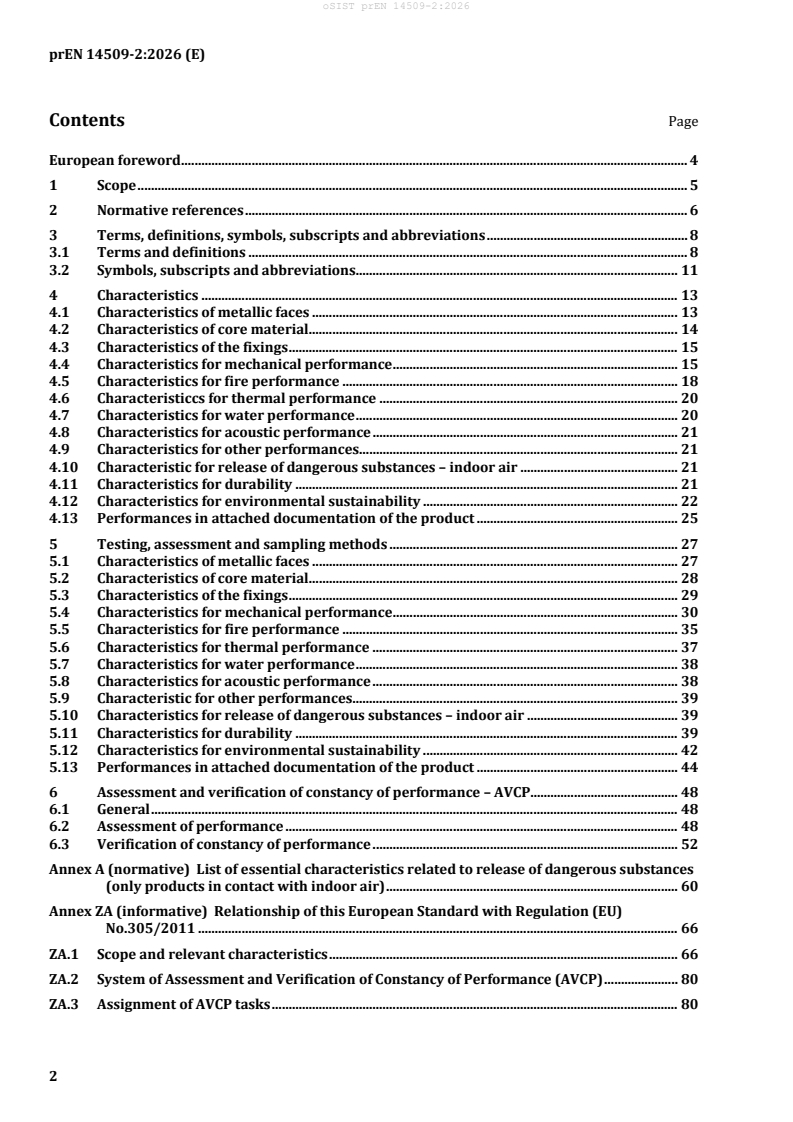
Contents Page
European foreword . 4
1 Scope . 5
2 Normative references . 6
3 Terms, definitions, symbols, subscripts and abbreviations . 8
3.1 Terms and definitions . 8
3.2 Symbols, subscripts and abbreviations. 11
4 Characteristics . 13
4.1 Characteristics of metallic faces . 13
4.2 Characteristics of core material . 14
4.3 Characteristics of the fixings . 15
4.4 Characteristics for mechanical performance . 15
4.5 Characteristics for fire performance . 18
4.6 Characteristiccs for thermal performance . 20
4.7 Characteristics for water performance . 20
4.8 Characteristics for acoustic performance . 21
4.9 Characteristics for other performances . 21
4.10 Characteristic for release of dangerous substances – indoor air . 21
4.11 Characteristics for durability . 21
4.12 Characteristics for environmental sustainability . 22
4.13 Performances in attached documentation of the product . 25
5 Testing, assessment and sampling methods . 27
5.1 Characteristics of metallic faces . 27
5.2 Characteristics of core material . 28
5.3 Characteristics of the fixings . 29
5.4 Characteristics for mechanical performance . 30
5.5 Characteristics for fire performance . 35
5.6 Characteristics for thermal performance . 37
5.7 Characteristics for water performance . 38
5.8 Characteristics for acoustic performance . 38
5.9 Characteristic for other performances. 39
5.10 Characteristics for release of dangerous substances – indoor air . 39
5.11 Characteristics for durability . 39
5.12 Characteristics for environmental sustainability . 42
5.13 Performances in attached documentation of the product . 44
6 Assessment and verification of constancy of performance – AVCP. 48
6.1 General . 48
6.2 Assessment of performance . 48
6.3 Verification of constancy of performance . 52
Annex A (normative) List of essential characteristics related to release of dangerous substances
(only products in contact with indoor air) . 60
Annex ZA (informative) Relationship of this European Standard with Regulation (EU)
No.305/2011 . 66
ZA.1 Scope and relevant characteristics . 66
ZA.2 System of Assessment and Verification of Constancy of Performance (AVCP) . 80
ZA.3 Assignment of AVCP tasks . 80
Bibliography . 93
European foreword
This document (prEN 14509-2:2026) has been prepared by Technical Committee CEN/TC 128 “Roof
covering products for discontinuous laying and products for wall cladding”, the secretariat of which is
held by NBN.
This document is currently submitted to the CEN Enquiry.
This document has been prepared under a standardization request addressed to CEN by the European
Commission. The Standing Committee of the EFTA States subsequently approves these requests for its
Member States.
For the relationship with EU Legislation, see informative Annex ZA, which is an integral part of this
document.
1 Scope
This document covers structural double skin metal faced insulating sandwich panels intended to be used
as elements for structural applications in construction works in roofs, in external and internal walls
(including partitions) and in ceilings (hereafter referred to as structural sandwich panels).
The structural sandwich panels consist of two faces made of:
— steel;
— stainless steel;
— aluminium;
— aluminium alloys;
— copper
and insulating core made of
— rigid polyurethane foam (PU) (see 3.1.23);
— expanded polystyrene (EPS) (see 3.1.21);
— extruded polystyrene foam (XPS) (see 3.1.22);
— phenolic foam (PF) (see 3.1.20);
— mineral wool (MW) (see 3.1.19)
either by using an auto-adhesive bonding technique or by using a separate adhesive layer.
Products which are
— curved;
— perforated (perforated face);
— used for stabilization purposes having insulation core material of phenolic foam;
— consisting of two or more clearly specified layers of different insulating core materials (multi-
layered) or of different materials per face;
— used as ceilings when fastening is under permanent tension load;
— parts of clean room kits, conditioning room kits, cold storage room kits and cold storage building
envelope and building kits;
— reused
are excluded from this product definition.
2 Normative references
The following documents are referred to in the text in such a way that some or all of their content
constitutes requirements of this document. For dated references, only the edition cited applies. For
undated references, the latest edition of the referenced document (including any amendments) applies.
EN 485-2:2016+A1:2018, Aluminium and aluminium alloys — Sheet, strip and plate — Part 2: Mechanical
properties
EN 485-4:1993, Aluminium and aluminium alloys — Sheet, strip and plate — Part 4: Tolerances on shape
and dimensions for cold-rolled products
EN 1172:2011, Copper and copper alloys — Sheet and strip for building purposes
EN 1396:2023, Aluminium and aluminium alloys — Coil coated sheet and strip for general applications —
Specifications
EN 10088-1:2023, Stainless steels — Part 1: List of stainless steels
EN 10088-2:2024, Stainless steels — Part 2: Technical delivery conditions for sheet/plate and strip of
corrosion resistant steels for general purposes
EN 10143:2006, Continuously hot-dip coated steel sheet and strip — Tolerances on dimensions and shape
EN 10169:2022, Continuously organic coated (coil coated) steel flat products — Technical delivery
conditions
prEN 10346:2025, Continuously hot-dip coated steel flat products for cold forming — Technical delivery
conditions
EN 13162:2012+A1:2015, Thermal insulation products for buildings — Factory made mineral wool (MW)
products — Specification
EN 13163:2012+A2:2016, Thermal insulation products for buildings — Factory made expanded
polystyrene (EPS) products — Specification
EN 13164:2012+A1:2015, Thermal insulation products for buildings — Factory made extruded polystyrene
foam (XPS) products — Specification
EN 13165:2012+A2:2016, Thermal insulation products for buildings — Factory made rigid polyurethane
foam (PU) products — Specification
EN 13166:2012+A2:2016, Thermal insulation products for buildings — Factory made phenolic foam (PF)
products — Specification
EN 13501-1:2018, Fire classification of construction products and building elements — Part 1:
Classification using data from reaction to fire tests
EN 13501-2:2023, Fire classification of construction products and building elements — Part 2:
Classification using data from fire resistance and/or smoke control tests, excluding ventilation services
EN 13501-5:2016, Fire classification of construction products and building elements — Part 5:
Classification using data from external fire exposure to roofs tests
EN 13523-2:2021, Coil coated metals — Test methods — Part 2: Gloss
prEN 14509-3:2026, Factory made double skin metal faced insulating sandwich panels — Part 3: Test
methods for determining mechanical strength, building physical behaviour and durability
prEN 14509-4:2026, Factory made double skin metal faced insulating sandwich panels — Part 4: Test
methods for fixing of panels and for determining restraining effect on substructure
prEN 14509-5:2026, Factory made double skin metal faced insulating sandwich panels — Part 5: Design
methods — Determination criteria for combining actions and spans
FprEN 15254-5:2026, Extended application of results from fire resistance tests — Non-loadbearing walls
— Part 5: Metal sandwich panel construction
FprEN 15254-7:2026, Extended application of results from fire resistance tests — Non-loadbearing ceilings
— Part 7: Metal sandwich panel construction
EN 15804:2012+A2:2019, Sustainability of construction works — Environmental product declarations —
Core rules for the product category of construction products
EN 16516:2017+A1:2020, Construction products: Assessment of release of dangerous substances —
Determination of emissions into indoor air
EN 16733:2016, Reaction to fire tests for building products — Determination of a building product’s
propensity to undergo continuous smouldering
prEN 18159:2025, Double skin metal faced insulating sandwich panels for roofing and cladding —
Environmental Product Declarations — Product category rules complementary to EN 15804 for double skin
metal faced insulating sandwich panels for roofing and cladding
EN ISO 6892-1:2019, Metallic materials — Tensile testing — Part 1: Method of test at room temperature
(ISO 6892-1:2019)
EN ISO 9445-2:2010, Continuously cold-rolled stainless steel — Tolerances on dimensions and form — Part
2: Wide strip and plate/sheet (ISO 9445-2:2009)
EN ISO 12944-2:2017, Paints and varnishes — Corrosion protection of steel structures by protective paint
systems — Part 2: Classification of environments (ISO 12944-2:2017)
CEN/TS 1187:2012, Test methods for external fire exposure to roofs
As impacted by EN 15804:2012+A2:2019/AC:2021.
3 Terms, definitions, symbols, subscripts and abbreviations
3.1 Terms and definitions
For the purposes of this document, the following terms and definitions apply.
ISO and IEC maintain terminology databases for use in standardization at the following addresses:
— ISO Online browsing platform: available at https://www.iso.org/obp
— IEC Electropedia: available at https://www.electropedia.org/
3.1.1
auto-adhesive bond
self-adhesion of the core to the face(s) occurring automatically without the use of an adhesive
Note 1 to entry: This technique is used for producing sandwich panels by foaming.
3.1.2
bond
adhesion between the face(s) and the core
3.1.3
core
layer of material, having insulating properties, which is bonded between two metal faces
3.1.4
edge
side of the panel where adjacent sandwich panels join together in the same plane
3.1.5
face
flat, lightly profiled or profiled thin metal sheet bonded to the core
3.1.6
flat face
face without any rolled or pressed profile or raised strengthening rib
3.1.7
lightly profiled face
face with a rolled or pressed profile not exceeding 5 mm in depth
3.1.8
profiled face
face with a rolled or pressed profile exceeding 5 mm in depth
3.1.9
incompletely bonded face
metal face whose bond to the core is adequate for sandwich action but does not include the entire surface
of the core
Note 1 to entry: An example is a trapezoidally profiled face that has voids between the raised profiles and the
core.
3.1.10
incompletely bonded panel
panel in which one or both faces are incompletely bonded
3.1.11
fastener
component (screw incl. washer, with or without sealant if relevant) used for fixing the panel to the
supporting structure
3.1.12
fastening
fastening is local interaction of a fastener (self tapping/self drilling screws) with a surrounding material
of the connected elements
3.1.13
fixing
mechanical connection between the sandwich panel and the supporting structure, typically with one
fastener or more fasteners in a visible fixing (through the sandwich panel) or in a hidden fixing (placed
in the longitudinal joint of the sandwich panel)
Note 1 to entry: Fixing is covering only the failure modes in sandwich panels caused by the fastening.
3.1.14
hidden fixing
mechanical connection between the sandwich panel and the supporting structure, placed in the
longitudinal joint of adjacent sandwich panels consisting of one or more fasteners (with or without
washer) going through or connecting both sheets in a certain arrangement in relation to the sandwich
panel geometry, with or without load spreading component
3.1.15
visible fixing
one or more fasteners in a certain minimum distance to the sandwich panel edges and between
themselves (if applicable), visible on the visible side of the face of the sandwich panel, penetrating the
inner and the outer face and the core of the sandwich panel
Note 1 to entry: Visible fixings can be covered by flashings after installation.
3.1.16
joint
interface between two sandwich panels where the meeting edges have been designed to allow the
sandwich panels to join together in the same plane
Note 1 to entry: The joint may incorporate interlocking parts that enhance the mechanical properties of the
system as well as improving the thermal, acoustic and fire performance and restrict air movement.
Note 2 to entry: The term “joint” does not refer to a junction between cut sandwich panels or a junction where
the sandwich panels are not installed in the same plane.
3.1.17
lamella
core material consisting of mineral wool that has been cut and orientated with the fibres perpendicular
to the faces prior to bonding
3.1.18
load spreading component
flat or profiled metal component used to distribute the load from the fasteners to the panel
3.1.19
mineral wool
MW
insulating wool produced from molten stone, slag or glass
[SOURCE: EN 13162:2012+A1:2015]
3.1.20
phenolic foam
PF
rigid cellular foam, the polymer structure of which is made primarily from the polycondensation of
phenol, its homologues and/or derivatives, with or without aldehydes or ketones
[SOURCE: EN 13166:2012+A2:2016]
3.1.21
expanded polystyrene
EPS
rigid cellular plastic material, manufactured by moulding beads or granules of expandable polystyrene
or one of its copolymers, with an air filled closed cellular structure
[SOURCE: EN 13163:2012+A2:2016]
3.1.22
extruded polystyrene foam
XPS
rigid cellular plastics insulation material expanded and extruded with or without a skin, from polystyrene
or one of its copolymers and which has a closed cell structure
[SOURCE: EN 13164:2012+A1:2015]
3.1.23
rigid polyurethane
PU
family of rigid cellular thermoset polymeric insulation products with a substantially closed cell structure
including both polymer types based on PIR and PUR
[SOURCE: EN 13165:2012+A2:2016]
3.1.24
pre-manufactured
component or material that is supplied to the manufacturer ready for direct incorporation into the
sandwich panel
3.1.25
product family
group of products produced by one manufacturer for which the assessment results for one or more
characteristics from any one product within the range are valid for all other products within this range
3.1.26
sandwich panel
building product consisting of two metal faces positioned on either side of a core that is a thermally
insulating material, which is firmly bonded to both faces so that the three components act compositely
when under load
3.1.27
shift
period of production during a working day, normally 6 h to 8 h but can be less
3.1.28
stiffness parameter
parameter expressing stiffening effect on supporting structure given by sandwich panels when fastened
to supporting structure
3.1.29
wrinkling strength
characteristic value of wrinkling stress at the moment of failure
Note 1 to entry: wrinkling stress is the stress in the compressed face of a panel undergoing failure in bending
where the failure mode takes the form of a “wrinkle” extending over the full width of the panel near the section of
maximum bending moment
3.1.30
ventilated cavity wall
sandwich panel used as an additional layer on an existing wall with ventilated air gap
3.2 Symbols, subscripts and abbreviations
3.2.1 Symbols
For the purposes of this document, the following symbols, subscripts and abbreviations apply.
A elongation of face material
C parameter used in connection to airborne sound insulation (C ),
tr
parameter describing the air permeability of a joint,
rotational spring stiffness
D overall thickness of the panel
E modulus of elasticity
G shear modulus
L length of span,
length of measurement
R sound reduction index (R ),
w
strength,
T temperature
U thermal transmittance (U )
d,S
b width of rib and valley in metal face profile
bowing
d depth,
continuous depth of core (d ),
C
depth of stiffener (d )
s
f strength
h depth of metal face profile
k support distribution parameter,
relation between strength after ageing and initial strength
n parameter describing the air permeability of a joint
p pitch of stiffeners and lightly profiled faces
s parameter describing the water vapour permeability of a joint
t thickness of face sheet
w cover width
x, y, z coordinates
α sound absorption (α )
w
λ thermal conductivity
λ (design value)
D
φ creep coefficient
σ strength,
stress,
wrinkling strength (σ )
w
3.2.2 Subscripts
C core
D expressed thermal conductivity (λ )
D
R resistance
S sandwich
T temperature
c compression
d design,
expressed thermal transmittance including the influence of the joints U
d,S
h head of the screw
k characteristic
m mean
rep repeated
s support,
stiffener
t tensile,
tension,
time,
thickness
tol tolerance
tr traffic (C )
tr
v shear
w wrinkling (σ ),
w
sound insulation index (R )
w
0 basic value,
time (e.g. t = 0)
θ compression creep index
3.2.3 Abbreviations
DUR ageing method of tensile strength for determining durability performance
EPS expanded polystyrene
GU reflectivity
MW mineral wool (covers stone wool and glass wool)
PCS gross calorific potential
PE polyester coating
PU rigid polyurethane foam (covers also PIR)
PF phenolic foam
SLS serviceability limit state
ULS ultimate limit state
XPS extruded polystyrene foam
4 Characteristics
4.1 Characteristics of metallic faces
4.1.1 Yield strength – face
4.1.1.1 General
The tensile yield strength of the metal indicates the maximum stress that can be applied before
permanent shape change is achieved in ductile materials.
4.1.1.2 Steel faces
When assessed in accordance with the assessment method given in Clause 5.1.1.1, relevant for the
declared performance, the assessment result is expressed as indication of the used steel grade for each
face if different.
The performance shall have a minimum value of 220 MPa for steel faces.
4.1.1.3 Stainless steel faces
When assessed in accordance with the assessment method given in Clause 5.1.1.2, relevant for the
declared performance, the assessment result is expressed as indication of the used stainless steel grade
together with the value of the yield strength in [MPa] for each face if different.
The performance (0,2 %-strain limit) shall have a minimum value of 220 MPa for stainless steel faces.
4.1.1.4 Aluminium faces
When assessed in accordance with the assessment method given in Clause 5.1.1.3, relevant for the
declared performance, the assessment result is expressed as indication of the used aluminium alloy
designation code together with the value of the yield strength [MPa] for each face if different.
The performance (0,2 %-strain limit) shall have a minimum value of 140 MPa for aluminium faces.
4.1.1.5 Copper faces
When assessed in accordance with the assessment method given in Clause 5.1.1.4, relevant for the
declared performance, the assessment result is expressed as indication of the used copper number /
material condition, with extension R. R is an indication on ultimate tensile strength in MPa, together with
the value of the yield strength [MPa] for each face if different.
The performance (0,2 %-strain limit) shall have a minimum value of 140 MPa for copper faces.
4.1.2 Reflectivity
The reflectivity indicates the amount of reflection of light from a surface. When assessed with the method
given in Clause 5.1.2, the result of the reflectivity GU is expressed as a gloss unit.
4.2 Characteristics of core material
4.2.1 Compressive strength – core material
The compressive strength of the core material, f , indicates the stress at failure of a specimen when tested
Cc
in uniaxial unconfined compression. When tested in accordance with the method given in Clause 5.2.1,
the result of the performance of the compressive strength is expressed in megapascal (MPa).
4.2.2 Compressive E-modulus – core material
The compressive E-modulus of the core material, E , indicates the proportional relationship between
Cc
stress and strain during the deformation of the specimen with linear-elastic behaviour under
compression. When tested in accordance with the method given in Clause 5.2.2, the performance of the
compressive modulus is expressed in megapascals (MPa).
4.2.3 Thermal conductivity – core material
The thermal conductivity of the core material indicates heat flow through a unit length of material under
the influence of a thermal gradient. In case of core materials with cell structure, the aged value shall be
expressed. When tested in accordance with the method given in Clause 5.2.3, the thermal conductivity of
the core material (aged value) λD is expressed in W/mK.
4.3 Characteristics of the fixings
4.3.1 Tensile strength – fixings
The tensile strength of the fixings indicates the characteristic pull-through tensile resistance, F , of
Rtk, rep
the fixing between the sandwich panel and the supporting structure material. When tested in accordance
with the method given in Clause 5.3.1, the performance of the tensile strength of the fixings is expressed
in kilo Newton (kN).
4.3.2 Shear strength – fixings
The shear strength of the fixings indicates the characteristic shear resistance of the fixing, F , between
Rvk
the sandwich panel and the supporting structure material. When tested in accordance with the method
given in Clause 5.3.2, the performance of the shear strength of the fixings is expressed in kilo Newton
(kN).
4.4 Characteristics for mechanical performance
4.4.1 Cross panel tensile strength
The cross panel tensile strength of the sandwich panel, f , indicates the tensile strength perpendicular to
Ct
the panel faces. When tested in accordance with the method given in Clause 5.4.1, the performance of the
cross panel tensile strength is expressed in megapascal (MPa). The result obtained for the characteristic
value shall be equal or higher than 0,05 MPa.
4.4.2 Cross panel tensile modulus
The cross panel tensile modulus, E , indicates the proportional relationship between stress and strain
Ct
during the deformation of the specimen perpendicular to the panel faces with linear-elastic behaviour
under tension. When tested in accordance with the method given in Clause 5.4.2, the performance of the
cross panel tensile modulus is expressed in megapascals (MPa).
4.4.3 Cross panel tensile strength – elevated temperature
o
The cross panel tensile strength at elevated temperature, f , indicates the tensile strength
Ct,+80 C
perpendicular to the panel faces of specimens which have been heated for 20 h to 24 h in a heating
chamber at a temperature of 80°C (+3°/-1°). When tested in accordance with the method given in
Clause 5.4.3, the performance of the cross panel tensile strength at elevated temperature is expressed in
megapascals (MPa).
4.4.4 Shear strength for short-term loading
The shear strength for short term loading, f , indicates the strength of a sandwich panel against
Cv
structural failure when the sandwich panel fails in shear. When tested in accordance with the method
given in Clause 5.4.4, the performance of the shear strength for short-term loading is expressed in
megapascals (MPa) together with test setup.
4.4.5 Shear modulus for short-term loading
The shear modulus, G , for short-term loading indicates the elastic shear stiffness of a material and is
c
defined as the ratio of shear stress to the shear strain. When tested in accordance with the method given
in Clause 5.4.5, the performance of the shear modulus of the sandwich panel is expressed in megapascals
(MPa) together with test setup.
4.4.6 Shear strength after long-term loading t = 2 000 h (for roof applications)
The shear strength after long-term loading, f (t = 2 000 h), indicates the strength of a sandwich panel
Cv 2000
against structural failure when the sandwich panel fails in shear after long-term loading. It is used for all
panels carrying long-term or permanent loads, e.g. snow. When assessed in accordance with the method
given in Clause 5.4.6, the performance of the shear strength after long term loading is expressed in
megapascals (MPa), together with the test method and time duration.
4.4.7 Shear strength after long-term loading t = 100 000 h (for ceiling and roof applications)
The shear strength after long-term loading, f (t = 100 000 h), indicates the strength of a sandwich
Cv 100000
panel against structural failure when the sandwich panel fails in shear after long-term loading. It is used
for all panels carrying long-term or permanent loads, self-weight or other permanent loads. When
assessed in accordance with the method given in Clause 5.4.7, the performance of the shear strength after
long term loading is expressed in megapascals (MPa), together with the test method and time duration.
4.4.8 Creep coefficient t = 2 000 h (for roof applications)
The creep coefficient, φ (t = 2 000 h), indicates the ratio of time-dependent creep deformation to elastic
t
deformation after t = 2 000 h. When assessed in accordance with the method given in Clause 5.4.8, the
performance of the creep coefficient of the sandwich panel is as a single value for φ , for load duration
of 2 000 h.
4.4.9 Creep coefficient t = 100 000 h (for ceiling and roof applications)
The creep coefficient, φ (t = 100 000 h), indicates the ratio of time-dependent creep deformation to
t
elastic deformation after t = 100 000 h. When assessed in accordance with the method given in
Clause 5.4.9, the performance of the creep coefficients of the sandwich panel is expressed as a single value
for φ , for load duration 100 000 h.
4.4.10 Wrinkling strength
The wrinkling strength, σ , indicates the strength against local buckling of a face of a panel with
w
consequential failure. When tested in accordance with the method given in Clause 5.4.10, the
performance of the wrinkling strength is expressed in megapascal (MPa) together with the relevant face.
4.4.11 Wrinkling strength – elevated temperature
The wrinkling strength, σ , at elevated temperature indicates the strength against local buckling of a
wT
face of a panel with consequential failure at 80°C. When calculated in accordance with the method given
in Clause 5.4.11, the performance of the wrinkling strength at elevated temperature is expressed in
megapascals (MPa) together with the relevant face.
4.4.12 Wrinkling strength – over a central support
The wrinkling strength, σ , indicates the strength against local buckling of a face of a panel with
ws
consequential failure over a central support. The wrinkling strength, σ , indicates the value for the head
wsh
of the screws and σ , indicates the value for the facing in contact with the support. When tested in
wss
accordance with the method given in Clause 5.4.12, the performance of the wrinkling strength over a
central support in the case with interaction with fasteners is expressed in megapascals (MPa) with the
relevant face, sum of characteristic tensile strength of the fixing, minimum diameter of washer and
number of fasteners (test according to prEN 14509-3:2026, Figure 15). The value to be expressed is the
value of wrinkling strength over a central support with interaction of the compression stress with the
relevant face corresponding to compression strength f (test according to prEN 14509-3:2026,
Cc
Figure 14)
NOTE The wrinkling strength over central support is relevant for sandwich panels which are continuous over
two or more spans.
4.4.13 Wrinkling strength – over a central support at elevated temperature
The wrinkling strength, σ , indicates the strength against local buckling of a face of a panel with
wsT
consequential failure over a central support at 80°C. The wrinkling strength, σ , indicates the value for
wshT
the head of the screws and σwssT, indicates the value for the facing in contact with the support. When
calculated in accordance with the method given in Clause 5.4.13, the performance of the wrinkling
strength over a central support at elevated temperature is expressed in megapascals (MPa) together with
the relevant face or sum of characteristic tensile strength of the fixing, minimum diameter of washer and
number of fasteners used in test. The value to be expressed is the value of wrinkling strength over a
central support at elevated temperature with interaction of the compression stress with the relevant face
corresponding to compression strength (test according to prEN 14509-3:2026, Figure 14).
f
Cc
4.4.14 Support distribution parameter
The support distribution parameter, k, indicates the distribution of the reaction capacity at a support.
When tested in accordance with the method given in Clause 5.4.14, the performance of the stress
distribution factor over a support, k, is expressed as a numbered value.
4.4.15 Racking strength – rotational spring stiffness
The rotational spring stiffness, C , indicates the partial torsional restraint provided to purlins by
D,A
sandwich panels. When tested in accordance with the method given in Clause 5.4.15, the performance of
rotational spring stiffness is expressed in kNm/(rad)/m.
NOTE Racking strength of the sandwich panels are in this standard limited to the stabilization purposes of the
supporting member which are dealt with: stiffness parameters (rotational spring stiffness CD,A, compression creep
coefficient φθt, shear stiffness factor kv), as specified in prEN 14509-4:2026, 5.2.2.2, 5.2.2.3 and 5.3 respectively.
4.4.16 Racking strength – compression creep coefficient
The compression creep coefficient, φ , indicates the ratio of time-dependent creep deformation under
θt
compression. When calculated in accordance with the method given in Clause 5.4.16, the performance of
the compression creep coefficient, φ , is expressed as indication of a value φ (dimensionless).
θt θ
4.4.17 Racking strength – shear stiffness factor
The shear stiffness factor, k , indicates the shear stiffness of a fixing of sandwich panels. When assessed
V
in accordance with the method given in Clause 5.4.17, the performance of the shear stiffness factor, k , is
V
expressed as indication of a value k in kN/mm.
V
4.4.18 Impact strength – resistance to access load
The impact strength – resistance to access load under repeated access loads indicates the strength of roof
or ceiling panels e.g. with respect to a single person walking on the panel, for repeated access both during
and after erection. When tested in accordance with the method given in Clause 5.4.18, the performance
of impact strength – resistance to access loads is expressed with indication of a level according to 5.4.18,
Table 7. The determined residual tensile strength after 2 000 steps shall be for the level for occasional
access during erection and for maintenance purpose without protection (OA-E-M) larger or equal 0,8 of
initial tensile strength.
4.4.19 Impact strength
The impact strength indicates the resistance to point loads on a roof or ceiling sandwich panel. When
tested in accordance with the method given in Clause 5.4.18, the performance of the impact strength is
expressed with indication of a level according to 5.4.18, Table 7.
4.5 Characteristics for fire performance
4.5.1 Propensity to undergo continuous smouldering
The propensity to undergo continuous smouldering indicates the ability of a core material to smoulder
continuously when exposed to an open flame under the influence of natural convective airflow. This only
occurs in case of sandwich panels for ventilated cavity wall applications. Only for these applications when
tested in accordance with the method given in Clause 5.5.1, the performance of propensity to undergo
continuous smouldering of the core material is expressed in accordance with EN 16733:2016, Clause 11.
4.5.2 Reaction to fire – class declaration
4.5.2.1 General
The reaction to fire indicates the degree of contribution of the material/product to the behaviour of the
factory-made double skin metal faced insulating sandwich panels for structural applications in the event
of fire. When tested in accordance with the test method given in Clause 5.5.2, relevant for the claimed
class, the test results are expressed as a class according to the classification published in the Official
Journal of the European Union on this specific matter.
NOTE The applicable document at the time this standard was drafted is Commission Delegated Regulation (EU)
2016/364 of 1 July 2015. https://eur-lex.europa.eu/eli/reg_del/2016/364.
4.5.2.2 Classification without further testing (WFT)
Whether products covered by this standard fulfil the conditions, under which they have demonstrated of
having a stable reaction to fire performance in a given reaction to fire class, based on testing to the
appropriate EN test methods, the established assigned class applies to these products without the need
of carrying out further reaction to fire tests.
NOTE The rules to apply this classification are published as Commission Decisions or Commission Delegated
Regulations.
4.5.2.3 Classification without testing (WT)
Whether products covered by this standard are made from one or more of the materials that have been
considered, under established conditions, as belonging to the category “No contribution to fire” because
of their low level of combustibility, the reaction to fire class A applies to these products without the need
of carrying out reaction to fire tests.
NOTE The rules to apply this classification are published as Commission Decisions or Commission Delegated
Regulations.
4.5.3 Resistance to fire EI – class declaration – testing
The resistance to fire is the capability of the product to provide, in the event of fire and for a given time,
one or more of the following behaviours:
— integrity (E);
— insulation (I).
When tested in accordance with the test method indicated in 5.5.3 (test method relevant for the product
covered by the standard if any), the result is expressed as class in minutes according to the classification
published in the Official Journal of the European Union on this specific matter, completed by the
established suffixes.
NOTE The applicable document at the time this standard was drafted is Commission Delegated Regulation (EU)
2024/1681 of 6 March 2024. https://eur-lex.europa.eu/eli/reg_del/2024/1681.
The resistance to fire is expressed as EI together with the maximum span related to the resistance to fire
classification.
4.5.4 Resistance to fire R – class declaration – testing
The resistance to fire is the capability of the product to provide, in the event of fire and for a given time,
one or more of the following behaviours:
— load-bearing capacity (R).
When tested in accordance with the test method indicated in 5.5.3 (test method relevant for the product
covered by the standard if any), the result is expressed as class in minutes according to the classification
published in the Official Journal of the European Union on this specific matter, completed by the
established suffixes.
NOTE The applicable document at the time this standard was drafted is Commission Delegated Regulation (EU)
2024/1681 of 6 March 2024. https://eur-lex.europa.eu/eli/reg_del/2024/1681.
The resistance to fire is expressed as R (whatever is relevant) together with the maximum span related
to the resistance to fire classification.
4.5.5 Resistance to fire REI – class declaration – testing
The resistance to fire is the capability of the product to provide, in the event of fire and for a given time,
one or more of the following behaviours:
— load-bearing capacity (R);
— in
...