

EN 13501-2:2023
(Main)Fire classification of construction products and building elements - Part 2: Classification using data from fire resistance and/or smoke control tests, excluding ventilation services
- Abstract
This document specifies the procedure for classification of construction products and building elements using data from fire resistance and/or smoke leakage/control tests and/or mechanical tests which are within the direct field of application of the relevant test method. Classification on the basis of extended application of test results is also included in the scope of this document.
This document deals with:
a) loadbearing elements without a fire separating function:
- walls;
- floors;
- roofs;
- beams;
- columns;
- balconies;
- walkways;
- stairs.
b) loadbearing elements with a fire separating function, with or without glazing, services and fixtures:
- walls;
- floors;
- roofs;
- raised floors.
c) products and systems for protecting elements or parts of the works:
- ceilings with no independent fire resistance;
- fire protective coatings, claddings and screens;
d) non-loadbearing elements or parts of works, with or without glazing, services and fixtures:
- partitions;
- facades (curtain walls) and external walls;
- ceilings with independent fire resistance;
- raised floors;
- fire resisting doorsets, shutter assemblies and openable windows and their closing devices;
- smoke control doorsets and shutter assemblies and their closing devices;
- conveyor systems and their closures;
- penetration seals;
- linear joint seals;
- combined penetration seals;
- service ducts and shafts;
- air transfer grilles.
- chimneys.
e) wall and ceiling coverings with fire protection ability.
f) lift landing doors which are tested according to EN 81-58 are excluded from this document. Lift landing doors which are tested in accordance with EN 1634-1 are classified in accordance with 7.5.5.
Relevant test methods which have been prepared for these construction products are listed in Clauses 2 and 7.
- Status
- Published
- Publication Date
- 30-May-2023
- Technical Committee
- CEN/TC 127 - Fire safety in buildings
- Drafting Committee
- CEN/TC 127/WG 7 - Classification
- Current Stage
- 6060 - Definitive text made available (DAV) - Publishing
- Start Date
- 31-May-2023
- Due Date
- 28-Jul-2022
- Completion Date
- 31-May-2023

Overview
EN 13501-2:2023 specifies how to classify construction products and building elements using data from fire resistance and/or smoke control tests (ventilation services excluded). It updates and replaces the 2016 edition and defines the procedure to convert test results - including relevant mechanical tests and extended application of test data - into harmonized fire resistance and smoke-control classes used across Europe. The standard applies to a wide range of loadbearing and non-loadbearing elements, protective systems and wall/ceiling coverings.
Key topics and technical requirements
- Scope of classification: Classification is based on fire resistance tests, smoke leakage/control tests and directly related mechanical tests. Extended application of test results is included where justified.
- Covered elements: Includes (but is not limited to)
- Loadbearing elements without fire-separating function: walls, floors, roofs, beams, columns, balconies, walkways, stairs
- Loadbearing elements with fire-separating function: walls, floors, roofs, raised floors
- Protection systems: ceilings without independent fire resistance, protective coatings, claddings, screens
- Non-loadbearing elements: partitions, facades (curtain walls), ceilings with independent resistance, raised floors, fire doorsets, smoke control doorsets, conveyor closures, penetration and linear joint seals, service ducts/shafts, air transfer grilles, chimneys
- Wall and ceiling coverings with fire protection ability
- Performance characteristics: The standard addresses resistance performance designations such as R (loadbearing), E (integrity), I (insulation), W (radiation), M (mechanical), C (self‑closing), S (smoke control), O, G, K, plus classification periods and designatory letters.
- Classification procedure: Rules for test selection, number of required tests, field of application, combinations of classes, and presentation/declaration of classification are provided. Normative test methods referenced are listed in Clauses 2 and 7.
- Exclusions/clarifications: Ventilation services are excluded. Lift landing doors tested to EN 81‑58 are excluded; if tested per EN 1634‑1 they are classified under the relevant clause.
Practical applications and users
EN 13501-2:2023 is essential for:
- Manufacturers of construction products and fire‑protection systems who need harmonized fire performance classification for product documentation and CE marking.
- Fire testing laboratories and certification bodies applying test results to produce classification reports.
- Architects, fire safety engineers and specifiers selecting elements that meet project fire performance requirements.
- Building control authorities and consultants verifying compliance with building codes and national fire safety regulations.
Related standards
Relevant and commonly referenced documents include other parts of EN 13501 (Part 1 and others), EN test standards cited in the text such as EN 1363‑1, EN 1364, EN 1365, EN 1634‑1, EN 15882‑5, EN 81‑58, and product‑specific EXAP or test standards referenced in Clauses 2 and 7.
Keywords: EN 13501-2:2023, fire classification, fire resistance, smoke control, construction products, building elements, fire resistance tests, fire performance classification.
Relations
- Effective Date
- 03-Feb-2021
- Effective Date
- 02-Sep-2026
- Refers
EN 1364-5:2026 - Fire resistance tests for non-loadbearing elements - Part 5: Air transfer grilles - Effective Date
- 29-Jul-2026
- Effective Date
- 29-Jul-2026
- Effective Date
- 29-Jul-2026
- Effective Date
- 28-Jan-2026
- Effective Date
- 28-Jan-2026
- Effective Date
- 28-Jan-2026
- Effective Date
- 28-Jan-2026
- Effective Date
- 28-Jan-2026
- Effective Date
- 28-Jan-2026
- Effective Date
- 28-Jan-2026
- Effective Date
- 28-Jan-2026
- Effective Date
- 28-Jan-2026
- Effective Date
- 28-Jan-2026
Get Certified
Connect with accredited certification bodies for this standard

CIS Institut d.o.o.
Personal Protective Equipment (PPE) certification body. Notified Body NB-2890 for EU Regulation 2016/425 PPE.

Kiwa BDA Testing
Building and construction product certification.
Kmetijski inštitut Slovenije
Agricultural Institute of Slovenia. Soil testing, plant health, agricultural product analysis.
Sponsored listings
Frequently Asked Questions
EN 13501-2:2023 is a standard published by the European Committee for Standardization (CEN). Its full title is "Fire classification of construction products and building elements - Part 2: Classification using data from fire resistance and/or smoke control tests, excluding ventilation services". This standard covers: This document specifies the procedure for classification of construction products and building elements using data from fire resistance and/or smoke leakage/control tests and/or mechanical tests which are within the direct field of application of the relevant test method. Classification on the basis of extended application of test results is also included in the scope of this document. This document deals with: a) loadbearing elements without a fire separating function: - walls; - floors; - roofs; - beams; - columns; - balconies; - walkways; - stairs. b) loadbearing elements with a fire separating function, with or without glazing, services and fixtures: - walls; - floors; - roofs; - raised floors. c) products and systems for protecting elements or parts of the works: - ceilings with no independent fire resistance; - fire protective coatings, claddings and screens; d) non-loadbearing elements or parts of works, with or without glazing, services and fixtures: - partitions; - facades (curtain walls) and external walls; - ceilings with independent fire resistance; - raised floors; - fire resisting doorsets, shutter assemblies and openable windows and their closing devices; - smoke control doorsets and shutter assemblies and their closing devices; - conveyor systems and their closures; - penetration seals; - linear joint seals; - combined penetration seals; - service ducts and shafts; - air transfer grilles. - chimneys. e) wall and ceiling coverings with fire protection ability. f) lift landing doors which are tested according to EN 81-58 are excluded from this document. Lift landing doors which are tested in accordance with EN 1634-1 are classified in accordance with 7.5.5. Relevant test methods which have been prepared for these construction products are listed in Clauses 2 and 7.
This document specifies the procedure for classification of construction products and building elements using data from fire resistance and/or smoke leakage/control tests and/or mechanical tests which are within the direct field of application of the relevant test method. Classification on the basis of extended application of test results is also included in the scope of this document. This document deals with: a) loadbearing elements without a fire separating function: - walls; - floors; - roofs; - beams; - columns; - balconies; - walkways; - stairs. b) loadbearing elements with a fire separating function, with or without glazing, services and fixtures: - walls; - floors; - roofs; - raised floors. c) products and systems for protecting elements or parts of the works: - ceilings with no independent fire resistance; - fire protective coatings, claddings and screens; d) non-loadbearing elements or parts of works, with or without glazing, services and fixtures: - partitions; - facades (curtain walls) and external walls; - ceilings with independent fire resistance; - raised floors; - fire resisting doorsets, shutter assemblies and openable windows and their closing devices; - smoke control doorsets and shutter assemblies and their closing devices; - conveyor systems and their closures; - penetration seals; - linear joint seals; - combined penetration seals; - service ducts and shafts; - air transfer grilles. - chimneys. e) wall and ceiling coverings with fire protection ability. f) lift landing doors which are tested according to EN 81-58 are excluded from this document. Lift landing doors which are tested in accordance with EN 1634-1 are classified in accordance with 7.5.5. Relevant test methods which have been prepared for these construction products are listed in Clauses 2 and 7.
EN 13501-2:2023 is classified under the following ICS (International Classification for Standards) categories: 13.220.50 - Fire-resistance of building materials and elements. The ICS classification helps identify the subject area and facilitates finding related standards.
EN 13501-2:2023 has the following relationships with other standards: It is inter standard links to EN 13501-2:2016, EN 15269-5:2026, EN 1364-5:2026, EN 15254-5:2026, EN 15254-7:2026, EN 15725:2023, EN 15882-3:2009, EN 1443:2019, EN 15269-5:2014+A1:2016, EN ISO 13943:2023, EN 13381-5:2014, EN 1365-3:1999, EN 15269-7:2009, EN 1363-1:2020, EN 17020-2:2022. Understanding these relationships helps ensure you are using the most current and applicable version of the standard.
EN 13501-2:2023 is associated with the following European legislation: EU Directives/Regulations: 305/2011; Standardization Mandates: M/117. When a standard is cited in the Official Journal of the European Union, products manufactured in conformity with it benefit from a presumption of conformity with the essential requirements of the corresponding EU directive or regulation.
EN 13501-2:2023 is available in PDF format for immediate download after purchase. The document can be added to your cart and obtained through the secure checkout process. Digital delivery ensures instant access to the complete standard document.
Standards Content (Sample)
SLOVENSKI STANDARD
01-september-2023
Nadomešča:
SIST EN 13501-2:2016
Požarna klasifikacija gradbenih proizvodov in elementov stavb - 2. del:
Klasifikacija na podlagi podatkov iz preskusov požarne odpornosti in/ali
dimotesnosti, izvzete so prezračevalne naprave
Fire classification of construction products and building elements - Part 2: Classification
using data from fire resistance and/or smoke control tests, excluding ventilation services
Klassifizierung von Bauprodukten und Bauarten zu ihrem Brandverhalten - Teil 2:
Klassifizierung mit Ergebnissen aus Feuerwiderstandsprüfungen und/oder
Rauchschutzprüfungen, mit Ausnahme von Lüftungsanlagen
Classement au feu des produits et éléments de construction - Partie 2 : Classement à
partir des données d’essais de résistance au feu et/ou de contrôle des fumées à
l’exclusion des produits utilisés dans les systèmes de ventilation
Ta slovenski standard je istoveten z: EN 13501-2:2023
ICS:
13.220.50 Požarna odpornost Fire-resistance of building
gradbenih materialov in materials and elements
elementov
2003-01.Slovenski inštitut za standardizacijo. Razmnoževanje celote ali delov tega standarda ni dovoljeno.
EN 13501-2
EUROPEAN STANDARD
NORME EUROPÉENNE
May 2023
EUROPÄISCHE NORM
ICS 13.220.50 Supersedes EN 13501-2:2016
English Version
Fire classification of construction products and building
elements - Part 2: Classification using data from fire
resistance and/or smoke control tests, excluding
ventilation services
Classement au feu des produits et éléments de Klassifizierung von Bauprodukten und Bauarten zu
construction - Partie 2 : Classement à partir des ihrem Brandverhalten - Teil 2: Klassifizierung mit
données d'essais de résistance au feu et/ou de contrôle Ergebnissen aus Feuerwiderstandsprüfungen
des fumées à l'exclusion des produits utilisés dans les und/oder Rauchschutzprüfungen, mit Ausnahme von
systèmes de ventilation Lüftungsanlagen
This European Standard was approved by CEN on 27 February 2023.
CEN members are bound to comply with the CEN/CENELEC Internal Regulations which stipulate the conditions for giving this
European Standard the status of a national standard without any alteration. Up-to-date lists and bibliographical references
concerning such national standards may be obtained on application to the CEN-CENELEC Management Centre or to any CEN
member.
This European Standard exists in three official versions (English, French, German). A version in any other language made by
translation under the responsibility of a CEN member into its own language and notified to the CEN-CENELEC Management
Centre has the same status as the official versions.
CEN members are the national standards bodies of Austria, Belgium, Bulgaria, Croatia, Cyprus, Czech Republic, Denmark, Estonia,
Finland, France, Germany, Greece, Hungary, Iceland, Ireland, Italy, Latvia, Lithuania, Luxembourg, Malta, Netherlands, Norway,
Poland, Portugal, Republic of North Macedonia, Romania, Serbia, Slovakia, Slovenia, Spain, Sweden, Switzerland, Türkiye and
United Kingdom.
EUROPEAN COMMITTEE FOR STANDARDIZATION
COMITÉ EUROPÉEN DE NORMALISATION
EUROPÄISCHES KOMITEE FÜR NORMUNG
CEN-CENELEC Management Centre: Rue de la Science 23, B-1040 Brussels
© 2023 CEN All rights of exploitation in any form and by any means reserved Ref. No. EN 13501-2:2023 E
worldwide for CEN national Members.
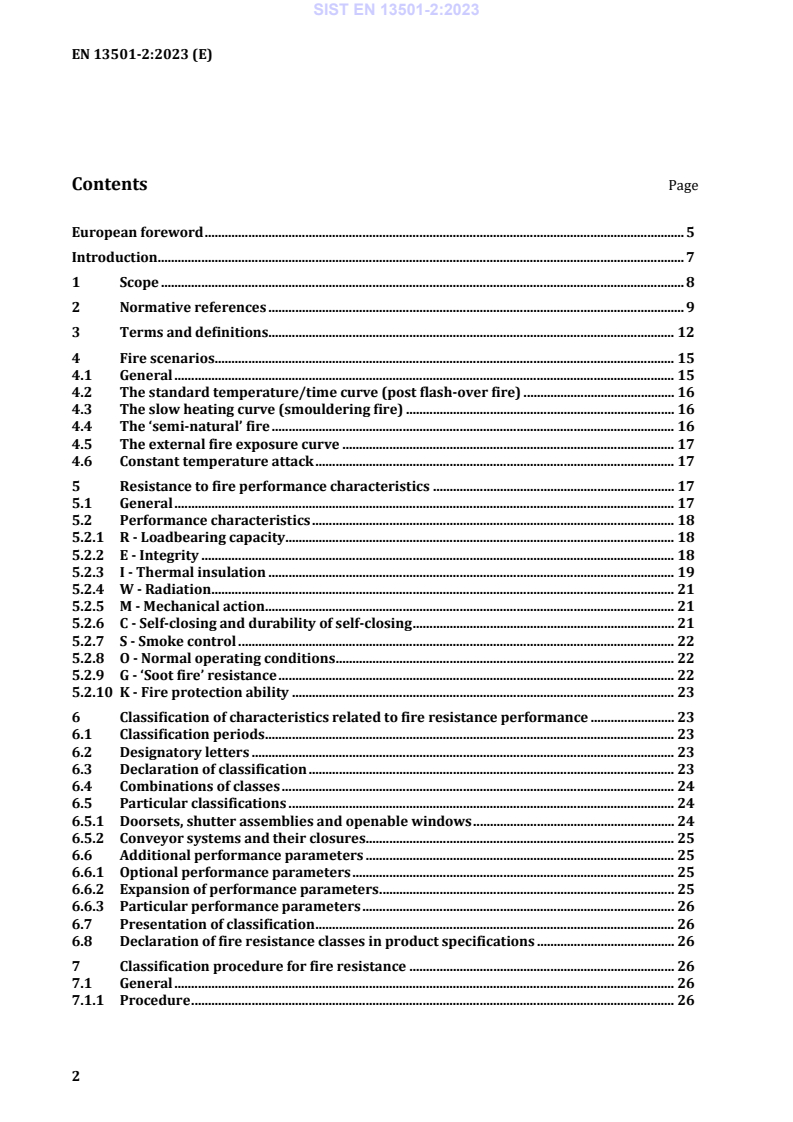
Contents Page
European foreword . 5
Introduction. 7
1 Scope . 8
2 Normative references . 9
3 Terms and definitions. 12
4 Fire scenarios . 15
4.1 General . 15
4.2 The standard temperature/time curve (post flash-over fire) . 16
4.3 The slow heating curve (smouldering fire) . 16
4.4 The ‘semi-natural’ fire . 16
4.5 The external fire exposure curve . 17
4.6 Constant temperature attack . 17
5 Resistance to fire performance characteristics . 17
5.1 General . 17
5.2 Performance characteristics . 18
5.2.1 R - Loadbearing capacity . 18
5.2.2 E - Integrity . 18
5.2.3 I - Thermal insulation . 19
5.2.4 W - Radiation . 21
5.2.5 M - Mechanical action . 21
5.2.6 C - Self-closing and durability of self-closing . 21
5.2.7 S - Smoke control . 22
5.2.8 O - Normal operating conditions . 22
5.2.9 G - ‘Soot fire’ resistance . 22
5.2.10 K - Fire protection ability . 23
6 Classification of characteristics related to fire resistance performance . 23
6.1 Classification periods . 23
6.2 Designatory letters . 23
6.3 Declaration of classification . 23
6.4 Combinations of classes . 24
6.5 Particular classifications . 24
6.5.1 Doorsets, shutter assemblies and openable windows . 24
6.5.2 Conveyor systems and their closures. 25
6.6 Additional performance parameters . 25
6.6.1 Optional performance parameters . 25
6.6.2 Expansion of performance parameters . 25
6.6.3 Particular performance parameters . 26
6.7 Presentation of classification . 26
6.8 Declaration of fire resistance classes in product specifications . 26
7 Classification procedure for fire resistance . 26
7.1 General . 26
7.1.1 Procedure . 26
7.1.2 General rules for deducing the number of standard temperature/time fire resistance
tests . 28
7.1.3 Field of application . 30
7.2 Classification of loadbearing elements without a fire separating function . 30
7.2.1 General . 30
7.2.2 Classification of loadbearing walls without separating function . 30
7.2.3 Classification of loadbearing floors and roofs without fire separating function . 31
7.2.4 Classification of beams . 32
7.2.5 Classification of columns . 33
7.2.6 Classification of balconies, walkways and stairs . 34
7.3 Classification of loadbearing elements with fire separating function . 35
7.3.1 General . 35
7.3.2 Classification of loadbearing walls with fire separating function . 36
7.3.3 Classification of loadbearing floors and roofs with fire separating function . 38
7.3.4 Classification of raised floors . 39
7.4 Products and systems for protecting elements or parts of works . 41
7.4.1 General . 41
7.4.2 Tests to be carried out . 41
7.4.3 Test methods . 42
7.4.4 Performance criteria . 42
7.4.5 Classes . 42
7.4.6 Classification of protected structural members . 42
7.5 Classification of non-loadbearing elements. 45
7.5.1 General . 45
7.5.2 Partitions . 46
7.5.3 Classification of facades (curtain walling) and external walls (including glazed
elements) . 47
7.5.4 Classification of ceilings with independent fire resistance . 49
7.5.5 Classification of fire doorsets, shutter assemblies and openable windows including
their closing devices . 51
7.5.6 Classification of closure and conveyor system assemblies . 54
7.5.7 Classification of penetration seals . 56
7.5.8 Classification of linear joint seals . 57
7.5.9 Classification of service ducts and shafts . 59
7.5.10 Classification of chimneys . 61
7.5.11 Classification of air transfer grilles . 63
7.6 Classification of wall and ceiling coverings for fire protection ability . 65
7.6.1 General . 65
7.6.2 Test method . 65
7.6.3 Tests to be carried out . 65
7.6.4 Performance criteria for fire protection ability . 66
7.6.5 Classes . 67
Annex A (normative) Classification report . 68
A.1 General . 68
A.2 Content and format . 68
A.3 Classification report format . 69
Annex B (informative) Presentation of characterization data and their field of application for
products and systems for protecting elements or parts of work . 73
B.1 General . 73
B.2 Characterization data for protective vertical membranes . 73
B.3 Characterization data for applied protection to concrete members . 74
B.4 Characterization data for applied protection to steelwork . 75
B.5 Characterization data for applied protection to concrete/profiled sheet steel
composite members . 77
B.6 Characterization data for applied protection to concrete filled hollow steel columns
..................................................................................................................................................................... 78
B.7 Characterization data for applied protection to timber members . 79
Bibliography . 86
European foreword
This document (EN 13501-2:2023) has been prepared by Technical Committee CEN/TC 127 “Fire
safety in buildings”, the secretariat of which is held by BSI.
This European Standard shall be given the status of a national standard, either by publication of an
identical text or by endorsement, at the latest by November 2023 and conflicting national standards
shall be withdrawn at the latest by November 2023.
Attention is drawn to the possibility that some of the elements of this document may be the subject
of patent rights. CEN shall not be held responsible for identifying any or all such patent rights.
This document supersedes EN 13501-2:2016.
Changes have been made in this revision to bring it in line with the relevant current EC Decisions on
fire resistance classification and experience in use of the first edition. In comparison with the previous
edition, the following technical modifications have been made:
— in 7.5.2.1: adding reference to new EXAP standards;
— in all paragraphs concerned: introduction of proposal from CEN/TC 166 for chimney;
— in all paragraphs concerned: introduction of proposal for air transfer grilles;
— in all paragraphs concerned: introduction of EN 15882-5;
— in all paragraphs concerned: update on criterion description for load bearing elements
(EN 1363-1):
— in 7.3.2: modification related to EN 1365-1;
— in 7.5.2.1: introduction of EN 15254-3;
— in 7.3.4.4: modification of classification table;
— in 7.5.9.4: modification of classification table.
— in 7.5.5.3.4: improvement and clarification on S to answer concerns/request from different
a
national standardisation bodies.
EN 13501, Fire classification of construction products and building elements, consists of the following
parts:
— Part 1: Classification using data from reaction to fire tests
— Part 2: Classification using data from fire resistance and/or smoke control tests, excluding
ventilation services
— Part 3: Classification using data from fire resistance tests on products and elements used in building
service installations: fire resisting ventilation ducts and fire dampers and/or power, control and
communication cables (under revision)
— Part 4: Classification using data from fire resistance tests on components of smoke control systems
— Part 5: Classification using data from external fire exposure to roof tests
— Part 6: Classification using data from reaction to fire tests on power, control and communication
cables
Any feedback and questions on this document should be directed to the users’ national standards
body. A complete listing of these bodies can be found on the CEN website.
According to the CEN-CENELEC Internal Regulations, the national standards organizations of the
following countries are bound to implement this European Standard: Austria, Belgium, Bulgaria,
Croatia, Cyprus, Czech Republic, Denmark, Estonia, Finland, France, Germany, Greece, Hungary,
Iceland, Ireland, Italy, Latvia, Lithuania, Luxembourg, Malta, Netherlands, Norway, Poland, Portugal,
Republic of North Macedonia, Romania, Serbia, Slovakia, Slovenia, Spain, Sweden, Switzerland,
Türkiye and the United Kingdom.
Introduction
The aim of this document is to define a harmonized procedure for the classification for fire resistance
of construction products and building elements. This classification is based on the test procedures
listed in Clause 2 and the relevant field of application procedures.
This document is prepared in support of the second basic requirement for construction works, in the
REGULATION (EU) No 305/2011 OF THE EUROPEAN PARLIAMENT AND OF THE COUNCIL of 9 March
2011 and is detailed in the Interpretative Document number 2 (ID2): Safety in case of fire (OJC62 Vol
37). It reflects the Commission Decision (EU) 2000/367/EC of 3 May 2000 amended by 2003/629/EC
of 27 August 2003 and 2011/232/EC of 11 April 2011 as regards the classification of the resistance
to fire performance of construction products, construction works and parts thereof.
CEN, CENELEC and EOTA committees preparing technical specifications which contain performance
requirements against fire resistance tests are expected to refer to the fire resistance classification
given in this document and not refer directly to any specific fire test method.
This document has been prepared under a Standardization Request given to CEN by the European
Commission and the European Free Trade Association.
This document provides for a common understanding for these requirements. It interprets the
functional requirements for the different groups of building elements and explains the method for
deriving their classification on the basis of test results (Direct field of application) and/or extended
application results for individual elements.
NOTE Test reports constitute the basis for extended application reports as explained in EN 15725.
1 Scope
This document specifies the procedure for classification of construction products and building
elements using data from fire resistance and/or smoke leakage/control tests and/or mechanical tests
which are within the direct field of application of the relevant test method. Classification on the basis
of extended application of test results is also included in the scope of this document.
This document deals with:
a) loadbearing elements without a fire separating function:
— walls;
— floors;
— roofs;
— beams;
— columns;
— balconies;
— walkways;
— stairs;
b) loadbearing elements with a fire separating function, with or without glazing, services and
fixtures:
— walls;
— floors;
— roofs;
— raised floors;
c) products and systems for protecting elements or parts of the works:
— ceilings with no independent fire resistance;
— fire protective coatings, claddings and screens;
d) non-loadbearing elements or parts of works, with or without glazing, services and fixtures:
— partitions;
— facades (curtain walls) and external walls;
— ceilings with independent fire resistance;
— raised floors;
— fire resisting doorsets, shutter assemblies and openable windows and their closing devices;
— smoke control doorsets and shutter assemblies and their closing devices;
— conveyor systems and their closures;
— penetration seals;
— linear joint seals;
— combined penetration seals;
— service ducts and shafts;
— air transfer grilles;
— chimneys;
e) wall and ceiling coverings with fire protection ability;
f) lift landing doors which are tested according to EN 81-58 are excluded from this document. Lift
landing doors which are tested in accordance with EN 1634-1 are classified in accordance with
7.5.5.
Relevant test methods which have been prepared for these construction products are listed in
Clauses 2 and 7.
2 Normative references
The following documents are referred to in the text in such a way that some or all of their content
constitutes requirements of this document. For dated references, only the edition cited applies. For
undated references, the latest edition of the referenced document (including any amendments)
applies.
EN 1191, Windows and doors — Resistance to repeated opening and closing — Test method
EN 1363-1, Fire resistance tests — Part 1: General requirements
EN 1363-2, Fire resistance tests — Part 2: Alternative and additional procedures
EN 1364-1, Fire resistance tests for non-loadbearing elements — Part 1: Walls
EN 1364-2, Fire resistance tests for non-loadbearing elements — Part 2: Ceilings
EN 1364-3, Fire resistance tests for non-loadbearing elements — Part 3: Curtain walling — Full
configuration (complete assembly)
EN 1364-4, Fire resistance tests for non-loadbearing elements — Part 4: Curtain walling — Part
configuration
EN 1364-5, Fire resistance tests for non-loadbearing elements — Part 5: Air transfer grilles
EN 1365-1, Fire resistance tests for loadbearing elements — Part 1: Walls
EN 1365-2, Fire resistance tests for loadbearing elements — Part 2: Floors and roofs
EN 1365-3, Fire resistance tests for loadbearing elements — Part 3: Beams
EN 1365-4, Fire resistance tests for loadbearing elements — Part 4: Columns
EN 1365-5, Fire resistance tests for loadbearing elements — Part 5: Balconies and walkways
EN 1365-6, Fire resistance tests for loadbearing elements — Part 6: Stairs
EN 1366-3, Fire resistance tests for service installations — Part 3: Penetration seals
EN 1366-4, Fire resistance tests for service installations — Part 4: Linear joint seals
EN 1366-5, Fire resistance tests for service installations — Part 5: Service ducts and shafts
EN 1366-6, Fire resistance tests for service installations — Part 6: Raised access and hollow core floors
EN 1366-7, Fire resistance tests for service installations — Part 7: Conveyor systems and their closures
EN 1366-13, Fire resistance tests for service installations — Part 13: Chimneys
EN 1443:2019, Chimneys — General requirements
EN 1634-1, Fire resistance and smoke control tests for door and shutter assemblies, openable windows
and elements of building hardware — Part 1: Fire resistance test for door and shutter assemblies and
openable windows
EN 1634-3, Fire resistance and smoke control tests for door and shutter assemblies, openable windows
and elements of building hardware — Part 3: Smoke control test for door and shutter assemblies
EN 12604, Industrial, commercial and garage doors and gates — Mechanical aspects — Requirements
and test methods
EN 13216-1, Chimneys — Test methods for system chimneys — Part 1: General test methods
EN 13381-1, Test methods for determining the contribution to the fire resistance of structural members
— Part 1: Horizontal protective membranes
EN 13381-2, Test methods for determining the contribution to the fire resistance of structural members
— Part 2: Vertical protective membranes
EN 13381-3, Test methods for determining the contribution to the fire resistance of structural members
— Part 3: Applied protection to concrete members
EN 13381-4, Test methods for determining the contribution to the fire resistance of structural members
— Part 4: Applied passive protection to steel members
EN 13381-5, Test methods for determining the contribution to the fire resistance of structural members
— Part 5: Applied protection to concrete/profiled sheet steel composite member
EN 13381-6, Test methods for determining the contribution to the fire resistance of structural members
— Part 6: Applied protection to concrete filled hollow steel columns
EN 13381-7, Test methods for determining the contribution to the fire resistance of structural members
— Part 7: Applied protection to timber members
EN 13381-8, Test methods for determining the contribution to the fire resistance of structural members
— Part 8: Applied reactive protection to steel members
EN 14135, Coverings — Determination of fire protection ability
EN 15080-8, Extended application of results from fire resistance tests — Part 8: Beams
EN 15080-12, Extended application of results from fire resistance tests — Part 12: Loadbearing
masonry walls
EN 15254-2, Extended application of results from fire resistance tests — Non-loadbearing walls — Part
2: Masonry and Gypsum Blocks
EN 15254-4, Extended application of results from fire resistance tests — Non-loadbearing walls — Part
4: Glazed constructions
EN 15254-3, Extended application of results from fire resistance tests — Non-loadbearing walls — Part
3: Lightweight partitions
EN 15254-5, Extended application of results from fire resistance tests — Non-loadbearing walls — Part
5: Metal sandwich panel construction
EN 15254-6, Extended application of results from fire resistance tests — Non-loadbearing walls — Part
6: Curtain walling
EN 15254-7, Extended application of results from fire resistance tests — Non-loadbearing ceilings —
Part 7: Metal sandwich panel construction
EN 15269 (all parts) , Extended application of test results for fire resistance and/or smoke control for
door, shutter and openable window assemblies, including their elements of building hardware
EN 15725, Extended application reports on the fire performance of construction products and building
elements
EN 15882-3, Extended applications of results from fire resistance tests for service installations — Part
3: Penetration seals
EN 15882-4, Extended application of results from fire resistance tests for service installations — Part 4:
Linear joint seals
EN 15882-5, Extended application of results from fire resistance tests for service installations — Part 5:
Combined penetration seals
EN 16034, Pedestrian doorsets, industrial, commercial, garage doors and openable windows — Product
standard, performance characteristics — Fire resisting and/or smoke control characteristics
EN 17020 (all parts), Extended application of test results on durability of self-closing for fire resistance
and/or smoke control doorsets and openable windows
EN ISO 13943, Fire safety — Vocabulary (ISO 13943)
EN 15269-4 and EN 15269-6 are under preparation.
3 Terms and definitions
For the purposes of this document, the terms and definitions given in EN ISO 13943 and the following
apply.
3.1
element (of building construction)
defined part of a construction component, such as wall, partition, floor, roof, beam or column
Note 1 to entry: Element covers both individual products and elements made up of one or more products.
3.2
ceiling
non-loadbearing element of a building construction designed to provide horizontal fire separation
3.3
self-supporting ceiling
ceiling with a span from wall to wall, without any additional suspension devices
3.4
doorset or shutter assembly
pedestrian doorset or industrial type doorset including any frame or guide, door leaf or leaves, rolling
or folding curtain, etc., which is provided to give a fire resisting capability when used for the closing
of permanent openings in fire resisting elements, which includes any side panel(s), flush over panel(s)
transom panel(s) and/or glazing together with the building hardware and any seals (whether
provided for the purpose of fire resistance or smoke control or for other purposes such as draught or
acoustics) which form the assembly
3.5
floor
horizontal separating element of building construction which is loadbearing
3.6
roof
horizontal or sloped separating element of building construction which is loadbearing and includes
the roof covering
3.7
suspended ceiling
lining plus any supporting framework, including hangers, fixings and any insulation material
suspended from the structural building member
3.8
ceiling system
full ceiling assembly submitted for test, including hangers and fixings, e.g. lighting and ventilation
ductings and access points
3.9
loadbearing wall
wall designed to support a vertically applied load
3.10
non-loadbearing wall
wall designed not to be subjected to any load other than its self-weight
3.11
internal wall
wall with or without glazing which provides fire separation and which may be exposed separately to
a fire from either side
3.12
external wall
wall forming the external envelope of a building including glazing which may be exposed separately
to an internal or an external fire
3.13
insulated wall
wall, with or without glazing, which satisfies both the integrity and insulation criteria for the achieved
fire resistance period
3.14
un-insulated wall
wall, with or without glazing, which satisfies the integrity and, where required, the radiation criteria
for the achieved fire resistance period but which is not intended to provide insulation
Note 1 to entry: Such a wall can consist entirely of un-insulated fire-resistant glazing.
3.15
separating wall
wall with or without glazing provided within a building or between adjoining buildings to prevent the
transfer of fire from one side to the other
3.16
curtain wall
external non-loadbearing wall which is independent of the structural frame and supported in place in
front of loadbearing structures. A curtain wall typically includes panels, glazing, seals, fixings,
transoms and mullions
3.17
fire resistant glazing
glazing system consisting of one or more transparent or translucent panes with a suitable method of
mounting, with e.g. frames, seals and fixing materials, capable of satisfying the appropriate fire
resistance criteria
3.18
insulated glazing
fire resistant glazing which satisfies both the integrity and insulation criteria for the achieved fire
resistance period
3.19
un-insulated glazing
fire resistant glazing which satisfies the integrity and, where required, the radiation criteria for the
achieved fire resistance period but which is not intended to provide insulation
3.20
glazed element
building element with one or more (light-transmissive) panes, fire resistant or not, that are built in a
frame with fixings and seals
3.21
test specimen
element (or part) of building construction provided for the purpose of determining either its
performance related to safety in case of fire (e.g. fire resistance classification) or its contribution to
the performance of another building element
3.22
loadbearing element
element that is intended for use in supporting an external load in a building and maintaining this
support in the event of a fire
3.23
separating element
element that is intended for use in maintaining separation between two adjacent areas of a building
in the event of a fire
3.24
smoke leakage/smoke control
ability of an element of construction to reduce the passage of hot and/or cold gases or smoke from
one side of the element to the other to below specified levels
3.25
sustained flaming
continuous flaming for a period of time longer than 10 s
3.26
load level
magnitude of the test load (mechanical actions) in relation to the loadbearing capacity of the member
at ambient temperature
Note 1 to entry: The loadbearing capacity of the member at ambient temperature is determined by testing or
calculation, taking into account the actual mechanical properties of the loadbearing element tested.
3.27
covering
product intended to protect underlying products against damage during a specified fire exposure
3.28
direct field of application
DIAP
outcome of a process (involving the application of defined rules) whereby a test result is deemed to
be equally valid for variations in one or more of the product properties and/or intended end use
applications
3.29
extended field of application
EXAP
outcome of a process (involving the application of defined rules that can incorporate calculation
procedures) that predicts, for a variation of a product property and/or its intended end use
application(s), a test result on the basis of one or more test results to the same test standard
3.30
closure and conveyor system assembly
complete assembly of the closure for the conveyor system and, where relevant, its frame or guide,
which is provided for closing off a permanent opening in a separating element
Note 1 to entry: This includes the anchoring parts for the connection with the separating element, a length of
any penetrating component on either side of the construction and the penetration seal, any sealing system
between the closure for a conveyor system, the conveyor system and any closing and/or separating device.
3.31
extended application result
predicted result for a performance parameter obtained following the process of extended field of
application
3.32
extended application report
document reporting extended application results, including all details of the process leading to those
results, prepared in accordance with EN 15725
3.33
air transfer grille
device consisting of an active/reactive part which could include a decorative cover as to be used in
practice, allowing movement of air at ambient temperature and pressure and providing fire resistance
in case of fire
3.34
chimney
structure consisting of a wall or walls enclosing a flue or flues conveying the products of combustion
into the outside atmosphere
4 Fire scenarios
4.1 General
The second basic requirement for construction work of the Construction Products Regulation
addresses e.g. spread of fire and smoke and the loadbearing capacity of the construction. These
requirements are considered to be satisfied by proving fire resistance of loadbearing and/or
separating elements.
Fire resistance of loadbearing and/or separating elements shall be assessed using one or more of the
levels of thermal attack given in 4.2 to 4.6. Further clauses of this document identify which attack(s)
shall be used for which elements.
NOTE 1 The various levels of thermal action given in 4.2 to 4.6 reflect different fire scenarios and the
standards which prescribe their translation into practical tests give tolerances for their application.
NOTE 2 Other heating curves exist, for example the hydrocarbon curve. Also, for extreme fire scenarios (e.g.
traffic tunnels, nuclear plants), more severe conventional curves can be specified. These are not, however, used
for the classification of elements according to this document.
4.2 The standard temperature/time curve (post flash-over fire)
When applied as a basis for testing, the standard temperature/time relationship shall be applied for
the full duration of the test. The relationship, which is a model of a fully developed fire in a
compartment, is given by the following relationship:
T = 345 log (8t +1) + 20 (1)
where
t is the time from the start of the test in minutes (min);
T is the mean furnace temperature in degrees Celsius (°C).
NOTE Further details relating to the practical application of this curve and other test parameters,
e.g. tolerances, are given in EN 1363-1.
4.3 The slow heating curve (smouldering fire)
The smouldering fire test shall only be used if it is expected that the fire resistance performance of
the element may be reduced by exposure to temperatures associated with the growth stage of a fire.
It is, therefore, particularly relevant to elements whose performance may be dependent upon high
heating rates below approximately 500 °C (as provided during the standard temperature/time curve)
for achievement of their classifications (i.e. mainly reactive or intumescent products).
The slow heating curve is given by the following relationship:
for 0 < t ≤ 21
0,25
T 154t+ 20 (2)
for t > 21
T 345log 8 t− 20++1 20 (3)
( ( ) )
where
t is the time from start of test in minutes (min);
T is the mean furnace temperature in degrees Celsius (°C).
NOTE Further details relating to the practical application of this curve, and other test parameters
e.g. tolerances, are given in EN 1363-2.
4.4 The ‘semi-natural’ fire
During the ‘semi-natural’ fire test the temperature of the fire gases adjacent to the soffit of the ceiling
shall reach 1 000 °C within 10 min to 20 min of the start of the test.
Because of the difficulties in achieving the necessary thermal attack in a conventional furnace, the
attack shall be provided by fire from wooden cribs made from softwood.
NOTE 1 The ‘semi-natural’ fire is a fire which produces direct flame impingement with a high convective heat
transfer content which is not realized in furnace tests using the standard temperature/time curve. The term
‘semi-natural’ fire corresponds to the single burning item exposure required for ceilings in 4.3.1.3.4 (a) of the
Interpretative Document 2 (not to be confused with the “single burning item” test for reaction to fire). It is
relevant only for lightweight suspended horizontal protective membranes having a low thermal inertia.
=
=
NOTE 2 Further details relating to the practical application of this thermal attack, and other test parameters,
are given in EN 13381-1.
4.5 The external fire exposure curve
This is a temperature/time relationship which represents the exposure of the external face of a wall
to fire which may emerge from a window of a building, or from a free-burning external fire.
The curve is defined by the relationship:
-0,32t -3,8t
T = 660 (1-0,687e – 0,313e ) + 20 (4)
where
t is the time from start of test in minutes (min);
T is the mean furnace temperature in degrees Celsius (°C).
NOTE Further details relating to the practical application of this curve, and other test parameters e.g.
tolerances, are given in EN 1363-2.
4.6 Constant temperature attack
In addition to the heating regimes given above, the evaluation of some elements shall be made using
a notional constant value of temperature. The specified temperature depends upon the type of
element. The rate at which this temperature is achieved is specified in each relevant test standard.
The following temperatures shall be used for the elements indicated:
— 20 °C for evaluating the leakage rate of smoke control doors at ambient temperature;
— 200 °C for evaluating the leakage rate of medium temperature smoke control doors;
— 500 °C for evaluating the fire performance of raised floors;
— 1 000 °C for evaluating soot fire resistance of chimneys and chimney related products.
— Test temperatures depending on declared temperature class according EN 1443:2019, Table 2
for evaluating thermal resistance of chimneys and chimney related products or the relevant
product standard and for chimney components according to the appropriate dependent product
standard. The nominal working temperature shall be tested according to
...