

FprEN 14541-1
(Main)Plastics pipes and fittings - Utilisation of thermoplastic materials in a circular economy - Part 1: Vocabulary
- Abstract
This document specifies the general terms and definitions relevant to the utilization of thermoplastics materials in a circular economy in pipes, fittings and ancillaries for both pressure and non-pressure piping systems.
This document is intended to be used by specification writers in conjunction with CEN/TS 14541 2 when preparing normative documents under the scope of CEN/TC 155.
- Status
- Not Published
- Publication Date
- 10-Feb-2027
- Technical Committee
- CEN/TC 155 - Plastics piping systems and ducting systems
- Drafting Committee
- CEN/TC 155/WG 25 - Recycling of PVC-U, PE and PP materials
- Current Stage
- 4599 - Dispatch of FV draft to CMC - Finalization for Vote
- Start Date
- 20-Oct-2026
- Due Date
- 27-Jul-2027
- Completion Date
- 20-Oct-2026

FprEN 14541-1 is a CEN draft European Standard for the vocabulary used when thermoplastic materials are used in a circular economy in plastics pipes, fittings and ancillaries. It gives the general terms and definitions needed by specification writers working on pressure and non-pressure piping systems.
This document is the first part of the EN 14541 series and is intended to support the preparation of normative documents under CEN/TC 155. In practice, it gives a common language for recycled, reworked and virgin materials so product standards can describe material use consistently.
What does FprEN 14541-1 specify?
FprEN 14541-1 specifies the general terms and definitions relevant to the utilisation of thermoplastic materials in a circular economy for pipes, fittings and ancillaries in both pressure and non-pressure piping systems. The document is a vocabulary standard, so its main function is to define how material-related terms are used in standards and product specifications.
The document is organized into four clauses and one informative annex:
| Part | Content |
|---|---|
| Clause 1 | Scope |
| Clause 2 | Normative references |
| Clause 3 | Terms and definitions |
| Clause 4 | Abbreviations |
| Annex A | Examples of terms and definitions used in existing product standards |
Annex A gives examples from existing product standards to show how the terms can be applied in practice.
What are the key requirements of FprEN 14541-1?
FprEN 14541-1 is built around the controlled use of vocabulary. Clause 3 sets the definitions that specification writers use when writing product standards, purchasing specifications, or certification rules.
Material categories
- Virgin material is plastics material that has not been used or processed beyond initial manufacture. In practice, this is the baseline material category and is described as not containing reworked material or recycled material.
- Reworked material is material from rejected unused products or trimmings that can be reclaimed within the same product type, same process and same manufacturer. This matters because it defines material that stays inside the same manufacturing loop.
- Pre-consumer material is diverted from the waste stream during manufacturing, excluding reworked material. This helps distinguish manufacturing scrap from post-use waste.
- Post-consumer material comes from households or other end-user facilities after the product can no longer serve its intended purpose. This matters when a standard needs to separate consumer-derived material from factory-derived material.
- Recycled material is plastics material resulting from recycling of pre-consumer and post-consumer plastics products. The definition also recognises that recycling can be chemical or physical.
Recycling-related terms
- Recycled content is the proportion by mass of recycled material in a product. In practice, this is the term used when a standard or declaration needs a measurable recycled share.
- Recycling is processing plastics products into recycled material for the original or another purpose, excluding energy recovery.
- Physical recycling is recycling without significantly changing the chemical structure of the polymer. Clause 3.8 notes that this includes mechanical recycling or recycling by dissolution.
- Chemical recycling converts the material to monomer or new raw materials and changes the chemical structure. The note says the resulting materials are identical to virgin materials.
Specification and control terms
- Agreed specification is the specification of relevant material characteristics agreed between the recycled-material supplier and the pipe and/or fitting manufacturer. This is important where suppliers and manufacturers need a shared technical basis, often in third-party certification.
- Contaminant and extraneous polymer identify unwanted matter or unintended foreign polymer in the material. These terms help when checking material quality and mixture purity.
What terms does FprEN 14541-1 define?
FprEN 14541-1 defines the vocabulary that supports circular-economy material use in plastics piping:
- Virgin material - material that has not been used or processed beyond initial manufacture.
- Reworked material - rejected unused products or trimmings reclaimed by the same manufacturer in the same process.
- Recycled material - material produced by recycling pre-consumer or post-consumer plastics products.
- Physical recycling - recycling that does not significantly change the polymer’s chemical structure.
- Chemical recycling - conversion to monomer or new raw materials by chemical processes.
- Agreed specification - the jointly agreed description of relevant material characteristics.
- PE, PP, PVC-C, PVC-U, ABS - abbreviated terms for polyethylene, polypropylene, chlorinated poly(vinyl chloride), unplasticized poly(vinyl chloride), and acrylonitrile butadiene styrene.
Who uses FprEN 14541-1?
FprEN 14541-1 is used by specification writers preparing normative documents for thermoplastics piping systems. It is also relevant to pipe and fitting manufacturers, recycled-material suppliers, and conformity or certification organizations that need consistent terminology for material declarations and agreements.
The document is especially useful where product standards need to say which material types are allowed, how recycled content is described, or how material quality is discussed across the value chain.
What changed in FprEN 14541-1 from the previous edition?
FprEN 14541-1 will supersede EN 14541-1:2022. The foreword lists these changes:
- title and scope amended to reflect “Utilisation of thermoplastic materials in a circular economy”
- the definition of virgin material improved and its notes amended
- the definition of reworked material and its notes amended
- a note added to post-consumer material
- recyclate changed to recycled material
- mechanical recycling changed to physical recycling, with a note clarifying types of physical recycling
- a note added to chemical recycling
- new term extraneous polymer added
Which standards are used with FprEN 14541-1?
FprEN 14541-1 refers to these standards in its text:
- EN ISO 472:2013 - supplies general plastics vocabulary used as the basis for several definitions.
- CEN/TR 15353 - provides guidance and source terminology for recycled plastics.
- EN ISO 1043-1 - provides abbreviated terms for plastics and recycled-material-related symbols.
The introduction also points to CEN/TS 14541-2, which gives recommendations for relevant characteristics, and to the EN 14541 series as a whole.
What does the FprEN 14541-1 document contain?
FprEN 14541-1 contains defined terms with notes and source references, plus a short list of abbreviations. The definitions are written to align, as far as possible, with existing practice in the thermoplastics pipes and fittings value chain and with European policy vocabulary.
Annex A is informative and shows how the new terms are used in existing product standards such as EN 1555-2, EN-ISO 1452-1, EN ISO 15875-1 and prEN 13476-3. This makes the document useful not only for drafting but also for checking how vocabulary choices affect product-standard wording.
Relations
- Effective Date
- 15-Jan-2025
Get Certified
Connect with accredited certification bodies for this standard

DIN CERTCO
DIN Group product certification.

Smithers Quality Assessments
US management systems and product certification.
Sponsored listings
Frequently Asked Questions
FprEN 14541-1 is a draft published by the European Committee for Standardization (CEN). Its full title is "Plastics pipes and fittings - Utilisation of thermoplastic materials in a circular economy - Part 1: Vocabulary". This standard covers: This document specifies the general terms and definitions relevant to the utilization of thermoplastics materials in a circular economy in pipes, fittings and ancillaries for both pressure and non-pressure piping systems. This document is intended to be used by specification writers in conjunction with CEN/TS 14541 2 when preparing normative documents under the scope of CEN/TC 155.
This document specifies the general terms and definitions relevant to the utilization of thermoplastics materials in a circular economy in pipes, fittings and ancillaries for both pressure and non-pressure piping systems. This document is intended to be used by specification writers in conjunction with CEN/TS 14541 2 when preparing normative documents under the scope of CEN/TC 155.
FprEN 14541-1 is classified under the following ICS (International Classification for Standards) categories: 83.140.30 - Plastics pipes and fittings for non fluid use. The ICS classification helps identify the subject area and facilitates finding related standards.
FprEN 14541-1 has the following relationships with other standards: It is inter standard links to EN 14541-1:2022. Understanding these relationships helps ensure you are using the most current and applicable version of the standard.
FprEN 14541-1 is available in PDF format for immediate download after purchase. The document can be added to your cart and obtained through the secure checkout process. Digital delivery ensures instant access to the complete standard document.
Standards Content (Sample)
SLOVENSKI STANDARD
01-maj-2026
Polimerne cevi in fitingi - Uporaba termoplastičnih materialov v krožnem
gospodarstvu - 1. del: Slovar
Plastics pipes and fittings - Utilisation of thermoplastic materials in a circular economy -
Part 1: Vocabulary
Kunststoff-Rohrleitungen und -Formstücke - Verwendung von thermoplastischen
Rezyklaten - Teil 1: Begriffe
Tubes et raccords en plastique - Utilisation de recyclats thermoplastiques - Partie 1 :
Vocabulaire
Ta slovenski standard je istoveten z: prEN 14541-1
ICS:
01.040.23 Tekočinski sistemi in sestavni Fluid systems and
deli za splošno rabo (Slovarji) components for general use
(Vocabularies)
23.040.20 Cevi iz polimernih materialov Plastics pipes
23.040.45 Fitingi iz polimernih Plastics fittings
materialov
2003-01.Slovenski inštitut za standardizacijo. Razmnoževanje celote ali delov tega standarda ni dovoljeno.
DRAFT
EUROPEAN STANDARD
prEN 14541-1
NORME EUROPÉENNE
EUROPÄISCHE NORM
March 2026
ICS 83.140.30 Will supersede EN 14541-1:2022
English Version
Plastics pipes and fittings - Utilisation of thermoplastic
materials in a circular economy - Part 1: Vocabulary
Tubes et raccords en plastique - Utilisation de recyclats Kunststoff-Rohrleitungen und -Formstücke -
thermoplastiques - Partie 1 : Vocabulaire Verwendung von thermoplastischen Rezyklaten - Teil
1: Begriffe
This draft European Standard is submitted to CEN members for enquiry. It has been drawn up by the Technical Committee
CEN/TC 155.
If this draft becomes a European Standard, CEN members are bound to comply with the CEN/CENELEC Internal Regulations
which stipulate the conditions for giving this European Standard the status of a national standard without any alteration.
This draft European Standard was established by CEN in three official versions (English, French, German). A version in any other
language made by translation under the responsibility of a CEN member into its own language and notified to the CEN-CENELEC
Management Centre has the same status as the official versions.
CEN members are the national standards bodies of Austria, Belgium, Bulgaria, Croatia, Cyprus, Czech Republic, Denmark, Estonia,
Finland, France, Germany, Greece, Hungary, Iceland, Ireland, Italy, Latvia, Lithuania, Luxembourg, Malta, Netherlands, Norway,
Poland, Portugal, Republic of North Macedonia, Romania, Serbia, Slovakia, Slovenia, Spain, Sweden, Switzerland, Türkiye and
United Kingdom.
Recipients of this draft are invited to submit, with their comments, notification of any relevant patent rights of which they are
aware and to provide supporting documentation.
Warning : This document is not a European Standard. It is distributed for review and comments. It is subject to change without
notice and shall not be referred to as a European Standard.
EUROPEAN COMMITTEE FOR STANDARDIZATION
COMITÉ EUROPÉEN DE NORMALISATION
EUROPÄISCHES KOMITEE FÜR NORMUNG
CEN-CENELEC Management Centre: Rue de la Science 23, B-1040 Brussels
© 2026 CEN All rights of exploitation in any form and by any means reserved Ref. No. prEN 14541-1:2026 E
worldwide for CEN national Members.
prEN 14541-1:2026 (E)
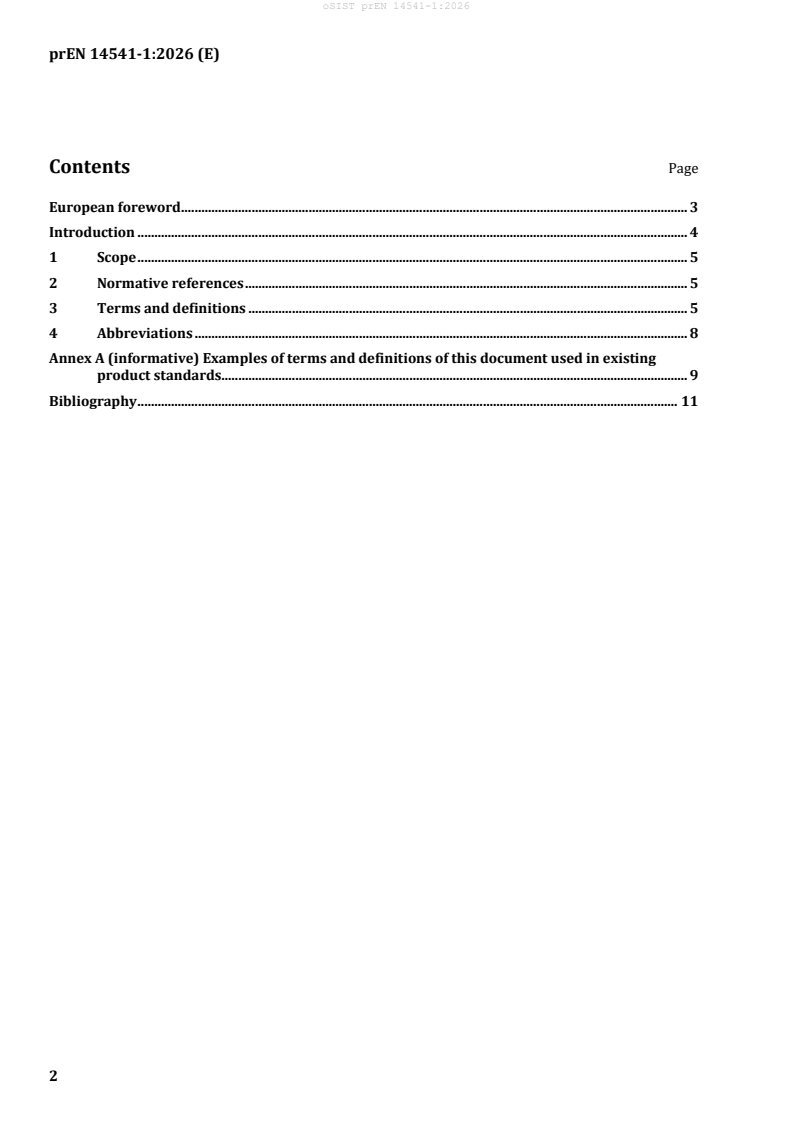
Contents Page
European foreword . 3
Introduction . 4
1 Scope . 5
2 Normative references . 5
3 Terms and definitions . 5
4 Abbreviations . 8
Annex A (informative) Examples of terms and definitions of this document used in existing
product standards . 9
Bibliography . 11
prEN 14541-1:2026 (E)
European foreword
This document (prEN 14541-1:2026) has been prepared by Technical Committee CEN/TC 155 “Plastics
piping systems and ducting systems”, the secretariat of which is held by NEN.
This document is currently submitted to the CEN enquiry.
This document will supersede EN 14541:2022.
prEN 14541-1:2026 includes the following significant technical changes with respect to 14541:2022:
— Title and scope amended: “Utilisation of thermoplastic materials in a circular economy”
— Clause 3.1 definition “virgin material” improved and notes amended
— Clause 3.2 definition “reworked material” and notes amended
— Clause 3.4 “post-consumer material” note added
— Clause 3.5 term “recyclate” changed in to “recycled material”
— Clause 3.8 term “mechanical recycling” changed in “physical recycling” and note added to clarify
types of physical recycling
— Clause 3.9 “chemical recycling” note added to clarify types of recycling
— Clause 3.16 New term “extraneous polymer” added
This document is part of the EN 14541 series, which consists of the following parts under the general title
Plastics pipes and fittings — Utilization of thermoplastic materials in a circular economy.
a) Part 1: Vocabulary (this document);
b) Part 2: Recommendations for relevant characteristics.
prEN 14541-1:2026 (E)
Introduction
The EN 14541 series is intended to give recommendations to the value chain of thermoplastics piping
systems to stimulate the use of recycled thermoplastics material (e.g. PVC-U, PVC-C, PE, PP, and ABS) as
defined in the European circular economy policy.
This part of the EN 14541 series defines the relevant terms and definitions relevant to the utilization of
thermoplastics materials in a circular economy thermoplastics material in thermoplastics pipes and
fittings. The commonly used terms and definitions are reviewed, and as much as possible aligned with
the practises within the thermoplastics pipes and fittings value chain and the vocabulary used in
European policy documents (e.g. circular economy, sustainability) and existing international standards.
Part 2 is a CEN/TS document in which recommendations are given about the relevant characteristics for
defining (e.g. fingerprinting) commonly used thermoplastics recycled material intended to be used in
thermoplastics pipes and fittings.
The CEN/TS 18116:2024 (Thermoplastics pipes and fittings - Design for recycling) specifies design for
recycling guidelines for thermoplastics pipes and fittings, used as construction products or used for water
supply to irrigation systems. The guidelines are developed to facilitate mechanical recycling but could
also be beneficial for chemical recycling.
CEN/TC 249 “Plastics” developed a series of CEN publications on “Plastics Recycling” which consists of:
EN 15343 [1], EN 15344 [2], EN 15345 [3], EN 15346 [4], CEN/TS 16010 [5] and CEN/TS 16011 [6].
Other documents relevant for recycling are e.g. ISO 15270 [8] and Waste Framework Directive [9].
prEN 14541-1:2026 (E)
1 Scope
This document specifies the general terms and definitions relevant to the utilization of thermoplastics
materials in a circular economy in pipes, fittings and ancillaries for both pressure and non-pressure
piping systems.
This document is intended to be used by specification writers in conjunction with CEN/TS 14541-2 [7]
when preparing normative documents under the scope of CEN/TC 155.
2 Normative references
The following documents are referred to in the text in such a way that some or all of their content
constitutes requirements of this document. For dated references, only the edition cited applies. For
undated references, the latest edition of the referenced document (including any amendments) applies.
EN ISO 472:2013, Plastics — Vocabulary (ISO 472:2013)
CEN/TR 15353, Plastics — Recycled plastics - Guidelines for the development of standards for recycled
plastics
EN ISO 1043-1, Plastics — Symbols and abbreviated terms — Part 1: Basic polymers and their special
characteristics (ISO 1043-1)
3 Terms and definitions
For the purposes of this document, the terms and definitions given in EN ISO 472:2013 and
CEN/TR 15353, the abbreviated terms related to recycled material given in EN ISO 1043-1 and the
following apply.
ISO and IEC maintain terminological databases for use in standardization at the following addresses:
— ISO Online browsing platform: available at https://www.iso.org/obp
— IEC Electropedia: available at https://www.electropedia.org/
3.1
virgin material
plastics material that has not been subjected to use or processing other than that required for its initial
manufacture
Note 1 to entry: virgin material is based on fossil or bio-based sources
Note 2 to entry: Does not contain any reworked material or recycled material
Note 3 to entry: Sometimes also referred to as “primary material”
Note 4 to entry: It is understood that the addition of additives such as stabilizers and pigments is still resulting
into a virgin (plastics) material
[SOURCE: ISO 472:2013, 2.1231, modified – Note 1, 3 and 3 to entry added]
As impacted by
...