


EN 1555-4:2025
(Main)Plastics piping systems for the supply of gaseous fuels - Polyethylene (PE) - Part 4: Valves
Plastics piping systems for the supply of gaseous fuels - Polyethylene (PE) - Part 4: Valves
This document specifies the characteristics of valves made from polyethylene (PE) for piping systems in the field of the supply of gaseous fuels.
It is applicable to isolating unidirectional and bi-directional valves with spigot ends or electrofusion sockets intended to be fused with PE pipes or fittings conforming to EN 1555 2 and EN 1555 3 respectively.
Valves made from materials other than PE, designed for the supply of gaseous fuels conforming to the relevant standards can be used in PE piping systems according to EN 1555 (all parts), provided that they have PE connections for butt fusion or electrofusion ends, including integrated material transition joints, conforming to EN 1555 3.
It also specifies the test parameters for the test methods referred to in this document.
In conjunction with EN 1555-1, EN 1555-2, EN 1555-3 and EN 1555-5, this document is applicable to PE pipes, fittings and valves, their joints and, joints with components of PE and other materials intended to be used under the following conditions:
a) a maximum operating pressure, MOP, up to and including 10 bar at a design reference temperature of 20 °C;
NOTE 1 For the purpose of this document and the references to ISO 8233, MOP is considered to be nominal pressure.
b) an operating temperature between −20 °C to 40 °C.
For operating temperatures between 20 °C and 40 °C, derating coefficients are specified in EN 1555 5.
The EN 1555 series covers a range of MOPs and gives requirements concerning colours.
It is the responsibility of the purchaser or specifier to make the appropriate selections from these aspects, taking into account their particular requirements and any relevant national regulations and installation practices or codes.
This document covers valve bodies designed for connection with pipes with a nominal outside diameter dn ≤ 400 mm.
NOTE 2 Additional information related to the installation of PE 100-RC systems is given in EN 1555-1:2025, Annex A.
NOTE 3 Additional information about the suitability of PE pipe systems for hydrogen and its admixtures is given in EN 1555-1:2025, Annex B.
Kunststoff-Rohrleitungssysteme für die Gasversorgung - Polyethylen (PE) - Teil 4: Armaturen
Dieses Dokument legt die Eigenschaften von Armaturen aus Polyethylen (PE) für Rohrleitungssysteme im Bereich der Versorgung mit gasförmigen Brennstoffen fest.
Es ist anwendbar für Absperrarmaturen mit einer und mit zwei Durchflussrichtungen, die über Schweißenden oder Heizwendel-Schweißmuffen verfügen, und dafür vorgesehen sind, mit Rohren oder Formstücken aus PE nach EN 1555 2 beziehungsweise EN 1555 3 verschweißt zu werden.
Armaturen aus anderen Werkstoffen als PE, die für die Versorgung mit gasförmigen Brennstoffen in Übereinstimmung mit den maßgebenden Normen ausgelegt sind, können in PE Rohrleitungssystemen nach EN 1555 (alle Teile) unter der Voraussetzung verwendet werden, dass sie über PE Anschlüsse für Stumpf- oder Heizwendelschweißung einschließlich integrierter Werkstoffübergangsverbindungen nach EN 1555 3 verfügen.
Es legt auch die Prüfparameter für die Prüfverfahren fest, auf die in diesem Dokument verwiesen wird.
In Verbindung mit EN 1555 1, EN 1555 2, EN 1555 3 and EN 1555 5 ist dieses Dokument anwendbar für Rohre, Formstücke und Armaturen aus PE, deren Verbindungen untereinander sowie Verbindungen mit Rohrleitungsteilen aus PE und anderen Werkstoffen, die für die Verwendung unter den folgenden Bedingungen vorgesehen sind:
a) für einen maximal zulässigen Betriebsdruck MOP (en: maximum operating pressure) bis einschließlich 10 bar bei einer Bezugstemperatur von 20 °C für Bemessungszwecke;
ANMERKUNG 1 Für die Anwendung dieses Dokumentes und der Verweisungen auf ISO 8233 wird MOP als Nenndruck angesehen.
b) für eine Betriebstemperatur zwischen −20 °C und 40 °C.
Für Betriebstemperaturen zwischen 20 °C und 40 °C sind Minderungsfaktoren in EN 1555 5 festgelegt.
Die Normenreihe EN 1555 deckt einen Bereich von maximal zulässigen Betriebsdrücken ab und enthält Anforderungen bezüglich Farben.
Es liegt in der Verantwortung des Auftraggebers oder Planers, aus diesen Kriterien die geeignete Auswahl zu treffen, unter Berücksichtigung ihrer spezifischen Anforderungen und aller relevanten nationalen Vorschriften und Verfahrensweisen oder Festlegungen für die Verlegung.
Dieses Dokument behandelt Armaturenkörper, die für die Verbindung mit Rohren mit einem Nennaußendurchmesser dn ≤ 400 mm ausgelegt sind.
ANMERKUNG 2 Zusätzliche Informationen bezüglich der Verlegung von PE-100-RC-Systemen sind in EN 1555 1:2025, Anhang A, angegeben.
ANMERKUNG 3 Zusätzliche Informationen über die Eignung von PE-Rohrleitungssystemen für Wasserstoff und dessen Beimischungen sind in EN 1555 1:2025, Anhang B, angegeben.
Systèmes de canalisations en plastique pour la distribution de combustibles gazeux - Polyéthylène (PE) - Partie 4 : Robinets
Le présent document spécifie les caractéristiques des robinets en polyéthylène (PE) pour les systèmes de canalisations destinés à la distribution de combustibles gazeux.
Il s’applique aux robinets d’isolement unidirectionnels et aux robinets d’isolement bidirectionnels avec des extrémités à bouts mâles ou des emboîtures électrosoudables prévues pour être soudées à des tubes ou à des raccords en PE conformes à l’EN 1555 2 et à l’EN 1555 3, respectivement.
Les robinets fabriqués à partir d’autres matières que le PE, conçus pour la distribution de combustibles gazeux conformes aux normes applicables, peuvent être utilisés dans les systèmes de canalisations en PE conformément à l’EN 1555 (toutes les parties), à condition qu’ils aient des raccordements en PE pour soudage bout à bout ou des extrémités électrosoudables ainsi que des assemblages de transition intégrés conformes à l’EN 1555 3.
Il spécifie également les paramètres d’essai pour les méthodes d’essai référencées dans le présent document.
Conjointement avec l’EN 1555 1, l’EN 1555 2, l’EN 1555 3 et l’EN 1555 5, le présent document s’applique aux tubes, raccords et robinets en PE et à leurs assemblages, ainsi qu’aux assemblages avec des composants en PE et en d’autres matières, destinés à être utilisés dans les conditions suivantes :
a) une pression maximale de service (MOP) inférieure ou égale à 10 bar , à une température de référence de calcul de 20 °C ;
NOTE 1 Pour les besoins du présent document et en référence à l’ISO 8233, la MOP est considérée comme la pression nominale.
b) une température de service comprise entre –20 °C et 40 °C.
Pour des températures de service comprises entre 20 °C et 40 °C, les facteurs de réduction sont spécifiés dans l’EN 1555 5.
La série EN 1555 couvre une gamme de MOP et donne les exigences concernant les couleurs.
Il est de la responsabilité de l’acheteur ou du concepteur du réseau d’effectuer les choix appropriés à partir de ces données, en tenant compte des exigences particulières et de toute réglementation nationale applicable, ainsi que des pratiques ou codes de pose.
Le présent document couvre les corps de robinets conçus pour être raccordés à des tubes d’un diamètre extérieur nominal dn ≤ 400 mm.
NOTE 2 Des informations additionnelles concernant la pose de systèmes en PE 100 RC sont données dans l’EN 1555 1:2025, Annexe A.
NOTE 3 Des informations additionnelles sur l’aptitude à l’emploi des systèmes de canalisations en PE pour l’hydrogène et ses mélanges sont données dans l’EN 1555 1:2025, Annexe B.
Cevni sistemi iz polimernih materialov za oskrbo s plinastimi gorivi - Polietilen (PE) - 4. del: Ventili
General Information
- Status
- Published
- Publication Date
- 07-Oct-2025
- Technical Committee
- CEN/TC 155 - Plastics piping systems and ducting systems
- Drafting Committee
- CEN/TC 155/WG 32 - Valves
- Current Stage
- 6060 - Definitive text made available (DAV) - Publishing
- Start Date
- 08-Oct-2025
- Due Date
- 11-Aug-2025
- Completion Date
- 08-Oct-2025
Relations
- Effective Date
- 26-Apr-2023
- Effective Date
- 09-Feb-2026
- Effective Date
- 28-Jan-2026
- Effective Date
- 28-Jan-2026
- Effective Date
- 28-Jan-2026
- Effective Date
- 28-Jan-2026
- Effective Date
- 28-Jan-2026
- Effective Date
- 28-Jan-2026
- Effective Date
- 28-Jan-2026
- Effective Date
- 28-Jan-2026
- Effective Date
- 28-Jan-2026
- Effective Date
- 28-Jan-2026
- Effective Date
- 28-Jan-2026
- Effective Date
- 28-Jan-2026
- Effective Date
- 28-Jan-2026
Overview
EN 1555-4:2025 - Plastics piping systems for the supply of gaseous fuels - Polyethylene (PE) - Part 4: Valves defines the required characteristics, testing parameters and delivery conditions for polyethylene valves used in PE piping systems for gaseous fuels. The standard applies to isolating unidirectional and bi‑directional valves with spigot ends or electrofusion sockets intended to be fused to PE pipes and fittings (EN 1555-2 / EN 1555-3). It covers valve bodies for pipe outside diameters up to dn ≤ 400 mm and systems with a maximum operating pressure (MOP) up to 10 bar at 20 °C and temperatures between −20 °C and 40 °C.
Key topics and technical requirements
- Scope and applicability: PE valves and valves of other materials when fitted with PE connections or integrated transition joints that conform to EN 1555-3.
- Materials: Requirements for PE valve compounds and for non‑PE components (metal parts, seals, greases and lubricants), including assembly considerations.
- Design and geometry: Design features for valve bodies, valve ends (spigot or electrofusion), operating devices and seals; specified dimensional measurements.
- Mechanical & physical performance: Requirements for assembled valve strength, air flow rate characteristics and conditioning procedures prior to testing.
- Leakage and durability testing: Test parameters and methods for seat and packing leaktightness (Annex A) and leaktightness/ease of operation after tensile loading (Annex B).
- Marking, technical file and delivery: Minimum marking, additional marking options, required documentation and delivery conditions that support traceability and compliance.
- Hydrogen suitability reference: EN 1555-1 contains guidance on the suitability of PE systems for hydrogen and hydrogen blends (annexes referenced).
Practical applications and who uses it
EN 1555-4:2025 is used by:
- Manufacturers of PE valves and valve components to design and certify products for gas distribution.
- Specifiers, purchasers and pipeline operators selecting valves for natural gas, biomethane or approved hydrogen blends.
- Test laboratories performing mechanical, leakage and conditioning tests specified by the standard.
- Installers and contractors ensuring correct fusion connections (butt fusion or electrofusion) and compliance with system MOP and temperature limits. Practical uses include distribution mains, service connections and branch isolation where PE piping systems are installed.
Related standards
- EN 1555-1, EN 1555-2, EN 1555-3, EN 1555-5 (PE piping system family)
- CEN/TS 1555-7 (Guidance for assessment of conformity)
- EN 12007-2 (recommended installation practice)
- ISO 8233 referenced for MOP interpretation
EN 1555-4:2025 provides the valve-specific rules needed to ensure safe, compatible and testable PE gas piping systems - essential for manufacturers, specifiers and operators in the gas distribution sector.

Get Certified
Connect with accredited certification bodies for this standard

Institut za varilstvo d.o.o. (Welding Institute)
Slovenia's leading welding institute since 1952. ISO 3834, EN 1090, pressure equipment certification, NDT personnel, welder qualification. Only IIW Au
Sponsored listings
Frequently Asked Questions
EN 1555-4:2025 is a standard published by the European Committee for Standardization (CEN). Its full title is "Plastics piping systems for the supply of gaseous fuels - Polyethylene (PE) - Part 4: Valves". This standard covers: This document specifies the characteristics of valves made from polyethylene (PE) for piping systems in the field of the supply of gaseous fuels. It is applicable to isolating unidirectional and bi-directional valves with spigot ends or electrofusion sockets intended to be fused with PE pipes or fittings conforming to EN 1555 2 and EN 1555 3 respectively. Valves made from materials other than PE, designed for the supply of gaseous fuels conforming to the relevant standards can be used in PE piping systems according to EN 1555 (all parts), provided that they have PE connections for butt fusion or electrofusion ends, including integrated material transition joints, conforming to EN 1555 3. It also specifies the test parameters for the test methods referred to in this document. In conjunction with EN 1555-1, EN 1555-2, EN 1555-3 and EN 1555-5, this document is applicable to PE pipes, fittings and valves, their joints and, joints with components of PE and other materials intended to be used under the following conditions: a) a maximum operating pressure, MOP, up to and including 10 bar at a design reference temperature of 20 °C; NOTE 1 For the purpose of this document and the references to ISO 8233, MOP is considered to be nominal pressure. b) an operating temperature between −20 °C to 40 °C. For operating temperatures between 20 °C and 40 °C, derating coefficients are specified in EN 1555 5. The EN 1555 series covers a range of MOPs and gives requirements concerning colours. It is the responsibility of the purchaser or specifier to make the appropriate selections from these aspects, taking into account their particular requirements and any relevant national regulations and installation practices or codes. This document covers valve bodies designed for connection with pipes with a nominal outside diameter dn ≤ 400 mm. NOTE 2 Additional information related to the installation of PE 100-RC systems is given in EN 1555-1:2025, Annex A. NOTE 3 Additional information about the suitability of PE pipe systems for hydrogen and its admixtures is given in EN 1555-1:2025, Annex B.
This document specifies the characteristics of valves made from polyethylene (PE) for piping systems in the field of the supply of gaseous fuels. It is applicable to isolating unidirectional and bi-directional valves with spigot ends or electrofusion sockets intended to be fused with PE pipes or fittings conforming to EN 1555 2 and EN 1555 3 respectively. Valves made from materials other than PE, designed for the supply of gaseous fuels conforming to the relevant standards can be used in PE piping systems according to EN 1555 (all parts), provided that they have PE connections for butt fusion or electrofusion ends, including integrated material transition joints, conforming to EN 1555 3. It also specifies the test parameters for the test methods referred to in this document. In conjunction with EN 1555-1, EN 1555-2, EN 1555-3 and EN 1555-5, this document is applicable to PE pipes, fittings and valves, their joints and, joints with components of PE and other materials intended to be used under the following conditions: a) a maximum operating pressure, MOP, up to and including 10 bar at a design reference temperature of 20 °C; NOTE 1 For the purpose of this document and the references to ISO 8233, MOP is considered to be nominal pressure. b) an operating temperature between −20 °C to 40 °C. For operating temperatures between 20 °C and 40 °C, derating coefficients are specified in EN 1555 5. The EN 1555 series covers a range of MOPs and gives requirements concerning colours. It is the responsibility of the purchaser or specifier to make the appropriate selections from these aspects, taking into account their particular requirements and any relevant national regulations and installation practices or codes. This document covers valve bodies designed for connection with pipes with a nominal outside diameter dn ≤ 400 mm. NOTE 2 Additional information related to the installation of PE 100-RC systems is given in EN 1555-1:2025, Annex A. NOTE 3 Additional information about the suitability of PE pipe systems for hydrogen and its admixtures is given in EN 1555-1:2025, Annex B.
EN 1555-4:2025 is classified under the following ICS (International Classification for Standards) categories: 23.060.99 - Other valves. The ICS classification helps identify the subject area and facilitates finding related standards.
EN 1555-4:2025 has the following relationships with other standards: It is inter standard links to EN 1555-4:2021, ISO 8233:2024, EN ISO 3126:2005, EN 1555-3:2025, EN ISO 1167-4:2007, EN ISO 1167-1:2006, EN 1704:1997, EN ISO 3127:2017, EN ISO 1133-1:2022, EN 736-1:2018, EN ISO 11357-6:2025, EN 1555-2:2025, EN 1705:2025, EN 682:2002, EN 1680:2025. Understanding these relationships helps ensure you are using the most current and applicable version of the standard.
EN 1555-4:2025 is available in PDF format for immediate download after purchase. The document can be added to your cart and obtained through the secure checkout process. Digital delivery ensures instant access to the complete standard document.
Standards Content (Sample)
SLOVENSKI STANDARD
01-december-2025
Cevni sistemi iz polimernih materialov za oskrbo s plinastimi gorivi - Polietilen
(PE) - 4. del: Ventili
Plastics piping systems for the supply of gaseous fuels - Polyethylene (PE) - Part 4:
Valves
Kunststoff-Rohrleitungssysteme für die Gasversorgung - Polyethylen (PE) - Teil 4:
Armaturen
Systèmes de canalisations en plastique pour la distribution de combustibles gazeux -
Polyéthylène (PE) - Partie 4 : Robinets
Ta slovenski standard je istoveten z: EN 1555-4:2025
ICS:
23.060.99 Drugi ventili Other valves
83.140.30 Polimerne cevi in fitingi za Plastics pipes and fittings for
snovi, ki niso tekočine non fluid use
91.140.40 Sistemi za oskrbo s plinom Gas supply systems
2003-01.Slovenski inštitut za standardizacijo. Razmnoževanje celote ali delov tega standarda ni dovoljeno.
EN 1555-4
EUROPEAN STANDARD
NORME EUROPÉENNE
October 2025
EUROPÄISCHE NORM
ICS 23.060.99 Supersedes EN 1555-4:2021
English Version
Plastics piping systems for the supply of gaseous fuels -
Polyethylene (PE) - Part 4: Valves
Systèmes de canalisations en plastique pour la Kunststoff-Rohrleitungssysteme für die Gasversorgung
distribution de combustibles gazeux - Polyéthylène - Polyethylen (PE) - Teil 4: Armaturen
(PE) - Partie 4 : Robinets
This European Standard was approved by CEN on 25 August 2025.
CEN members are bound to comply with the CEN/CENELEC Internal Regulations which stipulate the conditions for giving this
European Standard the status of a national standard without any alteration. Up-to-date lists and bibliographical references
concerning such national standards may be obtained on application to the CEN-CENELEC Management Centre or to any CEN
member.
This European Standard exists in three official versions (English, French, German). A version in any other language made by
translation under the responsibility of a CEN member into its own language and notified to the CEN-CENELEC Management
Centre has the same status as the official versions.
CEN members are the national standards bodies of Austria, Belgium, Bulgaria, Croatia, Cyprus, Czech Republic, Denmark, Estonia,
Finland, France, Germany, Greece, Hungary, Iceland, Ireland, Italy, Latvia, Lithuania, Luxembourg, Malta, Netherlands, Norway,
Poland, Portugal, Republic of North Macedonia, Romania, Serbia, Slovakia, Slovenia, Spain, Sweden, Switzerland, Türkiye and
United Kingdom.
EUROPEAN COMMITTEE FOR STANDARDIZATION
COMITÉ EUROPÉEN DE NORMALISATION
EUROPÄISCHES KOMITEE FÜR NORMUNG
CEN-CENELEC Management Centre: Rue de la Science 23, B-1040 Brussels
© 2025 CEN All rights of exploitation in any form and by any means reserved Ref. No. EN 1555-4:2025 E
worldwide for CEN national Members.
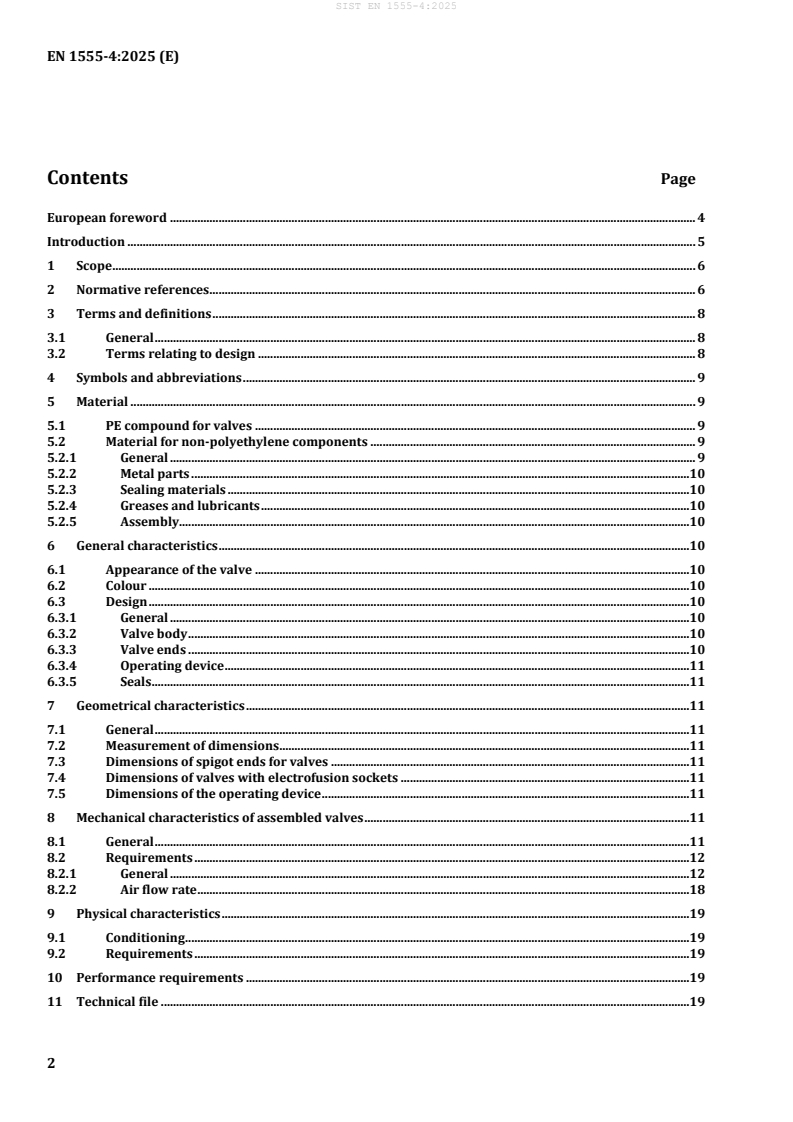
Contents Page
European foreword . 4
Introduction . 5
1 Scope . 6
2 Normative references. 6
3 Terms and definitions . 8
3.1 General . 8
3.2 Terms relating to design . 8
4 Symbols and abbreviations . 9
5 Material . 9
5.1 PE compound for valves . 9
5.2 Material for non-polyethylene components . 9
5.2.1 General . 9
5.2.2 Metal parts .10
5.2.3 Sealing materials .10
5.2.4 Greases and lubricants .10
5.2.5 Assembly.10
6 General characteristics .10
6.1 Appearance of the valve .10
6.2 Colour .10
6.3 Design .10
6.3.1 General .10
6.3.2 Valve body .10
6.3.3 Valve ends .10
6.3.4 Operating device .11
6.3.5 Seals .11
7 Geometrical characteristics .11
7.1 General .11
7.2 Measurement of dimensions. 11
7.3 Dimensions of spigot ends for valves . 11
7.4 Dimensions of valves with electrofusion sockets . 11
7.5 Dimensions of the operating device . 11
8 Mechanical characteristics of assembled valves . 11
8.1 General .11
8.2 Requirements .12
8.2.1 General .12
8.2.2 Air flow rate .18
9 Physical characteristics .19
9.1 Conditioning .19
9.2 Requirements .19
10 Performance requirements .19
11 Technical file .19
12 Marking . 20
12.1 General . 20
12.2 Minimum required marking . 20
12.3 Additional marking . 21
13 Delivery conditions . 21
Annex A (normative) Determination of the leaktightness of seat(s) and packing . 22
A.1 General . 22
A.2 Test piece . 22
A.3 Procedure . 22
A.3.1 Conditioning . 22
A.3.2 Internal leaktightness test (fully closed valve) . 22
A.3.3 External leaktightness test (half open valve) . 22
A.4 Test report . 23
Annex B (normative) Test method for leaktightness and ease of operation after tensile loading . 24
B.1 Apparatus . 24
B.2 Test piece . 24
B.3 Conditions . 24
B.4 Procedure . 24
B.5 Test report . 25
Bibliography . 26
European foreword
This document (EN 1555-4:2025) has been prepared by Technical Committee CEN/TC 155 “Plastics piping
systems and ducting systems”, the secretariat of which is held by NEN.
This European Standard shall be given the status of a national standard, either by publication of an identical
text or by endorsement, at the latest by April 2026, and conflicting national standards shall be withdrawn
at the latest by April 2026.
Attention is drawn to the possibility that some of the elements of this document may be the subject of
patent rights. CEN shall not be held responsible for identifying any or all such patent rights.
This document supersedes EN 1555-4:2021.
— reference to information related to the suitability of PE pipe systems for 100 % hydrogen and its
admixtures with natural gas has been made.
EN 1555 consists of the following parts:
— EN 1555-1, Plastics piping systems for the supply of gaseous fuels — Polyethylene (PE) — Part 1: General;
— EN 1555-2, Plastics piping systems for the supply of gaseous fuels — Polyethylene (PE) — Part 2: Pipes;
— EN 1555-3, Plastics piping systems for the supply of gaseous fuels — Polyethylene (PE) — Part 3: Fittings;
— EN 1555-4, Plastics piping systems for the supply of gaseous fuels — Polyethylene (PE) — Part 4: Valves
(this document);
— EN 1555-5, Plastics piping systems for the supply of gaseous fuels — Polyethylene (PE) — Part 5: Fitness
for purpose of the system;
In addition, the following document provides guidance on the assessment of conformity:
— CEN/TS 1555-7, Plastics piping systems for the supply of gaseous fuels — Polyethylene (PE) —Part 7:
Guidance for assessment of conformity.
Any feedback and questions on this document should be directed to the users’ national standards body. A
complete listing of these bodies can be found on the CEN website.
According to the CEN-CENELEC Internal Regulations, the national standards organisations of the following
countries are bound to implement this European Standard: Austria, Belgium, Bulgaria, Croatia, Cyprus,
Czech Republic, Denmark, Estonia, Finland, France, Germany, Greece, Hungary, Iceland, Ireland, Italy,
Latvia, Lithuania, Luxembourg, Malta, Netherlands, Norway, Poland, Portugal, Republic of North
Macedonia, Romania, Serbia, Slovakia, Slovenia, Spain, Sweden, Switzerland, Türkiye and the United
Kingdom.
Introduction
This document, specifies the requirements for a piping system and its components made from polyethylene
(PE) and which is intended to be used for the supply of gaseous fuels.
Requirements and test methods for material and components, other than valves, are specified in
EN 1555-1, EN 1555-2 and EN 1555-3.
Characteristics for fitness for purpose are covered in EN 1555-5. CEN/TS 1555-7 [1] gives guidance for
assessment of conformity. Recommended practice for installation is given in EN 12007-2 [2] prepared by
CEN/TC 234.
This part of EN 1555 covers the characteristics of valves.
1 Scope
This document specifies the characteristics of valves made from polyethylene (PE) for piping systems in
the field of the supply of gaseous fuels.
It is applicable to isolating unidirectional and bi-directional valves with spigot ends or electrofusion
sockets intended to be fused with PE pipes or fittings conforming to EN 1555-2 and EN 1555-3
respectively.
Valves made from materials other than PE, designed for the supply of gaseous fuels conforming to the
relevant standards can be used in PE piping systems according to EN 1555 (all parts), provided that they
have PE connections for butt fusion or electrofusion ends, including integrated material transition joints,
conforming to EN 1555-3.
It also specifies the test parameters for the test methods referred to in this document.
In conjunction with EN 1555-1, EN 1555-2, EN 1555-3 and EN 1555-5, this document is applicable to PE
pipes, fittings and valves, their joints and, joints with components of PE and other materials intended to be
used under the following conditions:
a) a maximum operating pressure, MOP, up to and including 10 bar at a design reference temperature
of 20 °C;
NOTE 1 For the purpose of this document and the references to ISO 8233, MOP is considered to be nominal
pressure.
b) an operating temperature between −20 °C to 40 °C.
For operating temperatures between 20 °C and 40 °C, derating coefficients are specified in EN 1555-5.
The EN 1555 series covers a range of MOPs and gives requirements concerning colours.
It is the responsibility of the purchaser or specifier to make the appropriate selections from these aspects,
taking into account their particular requirements and any relevant national regulations and installation
practices or codes.
This document covers valve bodies designed for connection with pipes with a nominal outside diameter
d ≤ 400 mm.
n
NOTE 2 Additional information related to the installation of PE 100-RC systems is given in EN 1555-1:2025, Annex
A.
NOTE 3 Additional information about the suitability of PE pipe systems for hydrogen and its admixtures is given
in EN 1555-1:2025, Annex B.
2 Normative references
The following documents are referred to in the text in such a way that some or all of their content
constitutes requirements of this document. For dated references, only the edition cited applies. For
undated references, the latest edition of the referenced document (including any amendments) applies.
EN 682, Elastomeric Seals — Materials requirements for seals used in pipes and fittings carrying gas and
hydrocarbon fluids
EN 736-1, Valves — Terminology — Part 1: Definition of types of valves
1 5 2
1 bar = 0,1 MPa =10 Pa; 1 MPa = 1 N/mm .
EN 736-2, Valves — Terminology — Part 2: Definition of components of valves
EN 1555-1:2025, Plastics piping systems for the supply of gaseous fuels — Polyethylene (PE) — Part 1:
General
EN 1555-2, Plastics piping systems for the supply of gaseous fuels — Polyethylene (PE) — Part 2: Pipes
EN 1555-3:2025, Plastics piping systems for the supply of gaseous fuels — Polyethylene (PE) — Part 3:
Fittings
EN 1555-5, Plastics piping systems for the supply of gaseous fuels — Polyethylene (PE) — Part 5: Fitness for
purpose of the system
EN 1680, Plastics piping systems — Valves for polyethylene (PE) piping systems — Test method for
leaktightness under and after bending applied to the operating mechanisms
EN 1704, Plastics piping systems — Thermoplastics valves — Test method for the integrity of a valve after
temperature cycling under bending
EN 1705, Plastics piping systems — Thermoplastics valves — Test method for the integrity of a valve after an
external blow
EN 12100, Plastics piping systems — Polyethylene (PE) valves — Test method for resistance to bending
between supports
EN 12119, Plastics piping systems — Polyethylene (PE) valves — Test method for resistance to thermal
cycling
EN ISO 1133-1, Plastics — Determination of the melt mass-flow rate (MFR) and melt volume-flow rate (MVR)
of thermoplastics — Part 1: Standard method (ISO 1133-1)
EN ISO 1167-1, Thermoplastics pipes, fittings and assemblies for the conveyance of fluids — Determination
of the resistance to internal pressure — Part 1: General method (ISO 1167-1)
EN ISO 1167-4, Thermoplastics pipes, fittings and assemblies for the conveyance of fluids —Determination of
the resistance to internal pressure — Part 4: Preparation of assemblies (ISO 1167-4)
EN ISO 3126, Plastics piping systems — Plastics components — Determination of dimensions (ISO 3126)
EN ISO 3127, Thermoplastics pipes — Determination of resistance to external blows — Round-the-clock
method (ISO 3127)
EN ISO 11357-6, Plastics — Differential scanning calorimetry (DSC) — Part 6: Determination of oxidation
induction time (isothermal OIT) and oxidation induction temperature (dynamic OIT) (ISO 11357-6)
EN ISO 17778, Plastics piping systems — Fittings, valves and ancillaries — Determination of gaseous flow
rate/pressure drop relationships (ISO 17778)
ISO 8233, Thermoplastics valves — Torque — Test method
ISO 18488, Polyethylene (PE) materials for piping systems — Determination of Strain Hardening Modulus in
relation to slow crack growth — Test method
3 Terms and definitions
For the purposes of this document, the terms and definitions given in EN 1555-2 and EN 1555-3, EN 736-1,
EN 736-2 and the following apply.
ISO and IEC maintain terminology databases for use in standardization at the following addresses:
— ISO Online browsing platform: available at https://www.iso.org/obp/
— IEC Electropedia: available at https://www.electropedia.org/
3.1 General
3.1.1
external leaktightness
leaktightness of the valve body enveloping the space containing the gas, with respect to the atmosphere
3.1.2
internal leaktightness
leaktightness between the inlet and the outlet of the valve, with the valve in the closed position
3.1.3
leakage
emission of gas from a valve body, or any component of a valve
3.1.4
valve body
main part of a valve which consists of an operating stop system and contains the obturator, seat(s), stem(s)
or shaft(s) and packing seals, and provides the terminal ends for connection to the PE pipe/fittings as
applicable
3.1.5
operating device
part of a valve for connection with the operating key which allows the opening and the closing of the valve
3.2 Terms relating to design
3.2.1
isolating valve
valve intended for use only in the closed or fully open position
[SOURCE: EN 736-1:2018]
3.2.2
full bore valve
valve with a flow section equal to or greater than 80 % of the section corresponding to the nominal inside
diameter of the body end port
[SOURCE: EN 736-3:2008, 3.3.1 – modified: Note has been omitted] [3]
3.2.3
clearway valve
valve designed to have an unobstructed flow way, which allows for the passage of a theoretical sphere with
a diameter that is not less than the nominal inside diameter of the body end port
[SOURCE: EN 736-3:2008, 3.3.1 – modified: Note has been omitted] [3]
3.2.4
reduced bore valve
valve with a flow section equal to or greater than 36 % of the section corresponding to the nominal inside
diameter of the body end port and which does not correspond to the full bore valve
[SOURCE: EN 736-3:2008, 3.3.1 – modified: Note has been omitted] [3]
4 Symbols and abbreviations
For the purpose of this document the symbols and abbreviations given in EN 1555-2 and EN 1555-3 apply.
5 Material
5.1 PE compound for valves
The stress-bearing PE parts of injection moulded valve components, for example the main body of the
valve, shall only be made from virgin material conforming to EN 1555-1.
NOTE Virgin material, see definition in EN 1555-2.
The stress bearing PE parts of valves made from pipe shall be made from pipe conforming to EN 1555-2,
except for the geometrical characteristics.
Other materials may be used for non-stress-bearing parts.
A valve can only be designated as a PE 100-RC valve if the stress bearing part is produced from PE 100-RC
materials which fulfil the requirements of EN 1555-1:2025, Tables 1 and 2, and are declared as PE 100-RC
by the raw material producer, and it fulfils the requirements of Table 1 of this document for PE 100-RC.
5.2 Material for non-polyethylene components
5.2.1 General
All components shall conform to the relevant EN standard(s). Alternative standards may be applied in
cases where the suitable EN standard(s) do not exist. In all cases, fitness for purpose of the components
shall be demonstrated.
The materials and the constituent elements used in making the valve (including elastomers, greases and
any metal parts as may be used) shall be as resistant to the external and internal environments as the other
elements of the piping system, and shall have an expected lifetime under the following conditions at least
equal to that of the PE pipes conforming to EN 1555-2, with which they are intended to be used:
a) during storage;
b) under the effect of gaseous fuels conveyed therein;
c) with respect to the service environment and operating conditions.
The requirements for the level of material performance of non-polyethylene parts shall be at least as
stringent as that of the PE compound for the piping system. Reworked materials shall not be used for stress
bearing polymeric parts.
Other materials used in valves in contact with the PE pipe shall not adversely affect pipe performance or
initiate stress cracking.
The valve manufacturer shall ensure that any transition joint between polyethylene and non-polyethylene
parts and the valve body fulfil the requirements of EN 1555-3.
5.2.2 Metal parts
All metal parts susceptible to corrosion shall be adequately protected, providing this is necessary for the
durability and function of the system.
When dissimilar metallic materials are used which may be in contact with moisture, steps shall be taken
to avoid the possibility of galvanic corrosion.
5.2.3 Sealing materials
Elastomeric seals shall conform to EN 682.
The temperature range is specified by the sealing materials product standard.
Other sealing materials are permitted if proven suitable for gas supply systems.
5.2.4 Greases and lubricants
Greases or lubricants shall not exude onto fusion areas and shall not affect the long term performance of
the valve materials.
5.2.5 Assembly
Ancillary co
...
Questions, Comments and Discussion
Ask us and Technical Secretary will try to provide an answer. You can facilitate discussion about the standard in here.
Loading comments...