


EN ISO 19905-1:2023
(Main)Oil and gas industries including lower carbon energy - Site-specific assessment of mobile offshore units - Part 1: Jack-ups: elevated at a site (ISO 19905-1:2023, Corrected version 2024-07)
Oil and gas industries including lower carbon energy - Site-specific assessment of mobile offshore units - Part 1: Jack-ups: elevated at a site (ISO 19905-1:2023, Corrected version 2024-07)
This document specifies requirements and provides recommendation and guidance for the elevated site-specific assessment (SSA-E) of independent leg jack‑up units for use in the petroleum and natural gas industries. It addresses:
a) occupied non-evacuated, occupied evacuated and unoccupied jack‑ups;
b) the installed (or elevated) phase at a specific site.
It also addresses the requirement that the as-installed condition matches the assumptions used in the assessment.
This document does not address the site-specific assessment of installation and removal (SSA-I).
To ensure acceptable reliability, the provisions of this document form an integrated approach, which is used in its entirety for the site-specific assessment of a jack‑up.
When assessing a jack-up operating in regions subject to sea ice and icebergs, it is intended that the assessor supplements the provisions of this document with the relevant provisions relating to ice actions contained in ISO 19906 and procedures for ice management contained in ISO 35104. This document does not address design, transit to and from site, or installation and removal from site.
This document is applicable only to independent leg mobile jack-up units that are structurally sound and adequately maintained, which is normally demonstrated through holding a valid recognized classification society, classification certificate. Jack‑ups that do not hold a valid recognized classification society certificate are assessed according to the provisions of ISO 19902, supplemented by methodologies from this document, where applicable.
NOTE 1 Well conductors can be a safety-critical element for jack‑up operations. However, the integrity of well conductors is not part of the site-specific assessment process for jack‑ups and is, therefore, not addressed in this document. See A.1 for guidance on this topic.
NOTE 2 RCS rules and the IMO MODU code (International Maritime Organisation Mobile Offshore Drilling Unit code) provide guidance for the design of jack-ups.
Öl- und Gasindustrie einschließlich kohlenstoffarmer Energieträger – Standortspezifische Beurteilung mobiler Offshore-Einheiten - Teil 1: Hubinseln: aufgeständert an einem Standort (ISO 19905-1:2023, korrigierte Fassung 2024-07)
Industries du pétrole et du gaz, y compris les énergies à faible teneur en carbone - Évaluation spécifique du site d'unités mobiles en mer - Partie 1: Plateformes auto-élévatrices : Surélévées sur un site (ISO 19905-1:2023, Version corrigée 2024-07)
Le présent document spécifie les exigences et fournit des recommandations pour l'évaluation spécifique du site en condition surélevée (SSA-E) d'unités de plateformes auto-élévatrices à jambes indépendantes à utiliser dans les industries du pétrole et du gaz naturel. Il traite :
a) des plates‐formes auto‑élévatrices occupées et non évacuées, occupées et évacuées, et non occupées ;
b) de la phase installée (ou surélevée sur les jambes) sur un site spécifique.
Il couvre également l'exigence d'adéquation de la configuration à l'état installé avec les hypothèses utilisées dans l'évaluation.
Le présent document ne traite pas de l'évaluation spécifique du site pour l'installation et l’enlèvement (SSA-I).
Pour assurer une fiabilité acceptable, les dispositions du présent document forment une approche intégrée qui est utilisée dans sa totalité pour l'évaluation spécifique du site d'une plateforme.
Lors de l'évaluation d'une plate‐forme auto‐élévatrice opérant dans des régions sujettes à la glace de mer et aux icebergs, il est prévu que l'évaluateur complète les dispositions du présent document par les dispositions pertinentes se rapportant aux actions de la glace contenues dans l'ISO 19906 et par les procédures se rapportant à la gestion de la glace contenues dans l'ISO 35104. Le présent document ne traite pas de la conception, du transport vers et depuis un site ou de l'installation et l’enlèvement du site.
Le présent document n'est applicable qu'aux unités de plateformes auto-élévatrices à jambes indépendantes dont la structure est saine et entretenue de manière adéquate, ce qui est normalement démontré par la mise à disposition d'un certificat de classification en cours de validité, délivré par une société de classification reconnue (RCS). Les plates‐formes auto-‑élévatrices qui ne possèdent pas de certificat en cours de validité délivré par une société de certification reconnue sont évaluées conformément aux dispositions de l'ISO 19902, complétées par des méthodologies issues du présent document, le cas échéant.
NOTE 1 Les tubes conducteurs de puits peuvent être un élément critique en termes de sécurité pour les opérations des plates‐formes auto‑élévatrices. Cependant, l'intégrité des tubes conducteurs de puits ne fait pas partie du processus d'évaluation spécifique du site des plates‐formes auto‑élévatrices et, en conséquence, n'est pas traitée dans le présent document. Voir A.1 pour des recommandations sur ce sujet.
NOTE 2 Les règles RCS et le code MODU (Mobile Offshore Drilling Unit) de l'OMI (Organisation maritime internationale) fournissent des recommandations pour la conception des plateformes auto-élévatrices.
Naftna in plinska industrija, vključno z nizkoogljično energijo - Ocenjevanje premičnih naftnih ploščadi na področju postavitve - 1. del: Dvižne ploščadi (ISO 19905-1:2023)
Ta dokument določa zahteve ter podaja priporočila in smernice za ocenjevanje dvižnih ploščadi s samostojnimi nogami na področju postavitve (SSA-E) za uporabo v industriji za predelavo nafte in zemeljskega plina. Obravnava:
a) neevakuirane dvižne ploščadi s posadko, evakuirane dvižne ploščadi s posadko in dvižne ploščadi brez posadke;
b) fazo postavitve (ali dviga) na določenem področju.
Prav tako obravnava zahtevo, da se mora konfiguracija pri namestitvi ujemati s predpostavkami, ki se uporabljajo pri ocenjevanju.
Ta dokument ne obravnava ocenjevanja namestitve na področje postavitve in odstranitve z njega (SSA-I).
Pri določbah tega dokumenta je zaradi zagotavljanja sprejemljive zanesljivosti uporabljen celosten pristop, ki se v celoti uporablja za ocenjevanje dvižne ploščadi na področju postavitve.
Pri ocenjevanju dvižne ploščadi, ki obratuje v območjih, kjer se na morju pojavljajo led in ledene gore, naj bi ocenjevalec določbe tega dokumenta dopolnil z ustreznimi določbami v zvezi z ukrepi in postopki za ravnanje v primeru ledu iz standardov ISO 19906 in ISO 35104. Ta dokument ne obravnava načrtovanja, prevoza na področje postavitve ali z njega ali namestitve na področje postavitve in odstranitve z njega.
Ta dokument se uporablja samo za premične dvižne ploščadi s samostojnimi nogami, ki so strukturno trdne in ustrezno vzdrževane, kar se običajno izkazuje z veljavnim certifikatom priznanega klasifikacijskega zavoda. Dvižne ploščadi, ki nimajo veljavnega certifikata priznanega klasifikacijskega zavoda, so ocenjene v skladu z določbami standarda ISO 19902, ki jih dopolnjujejo metodologije iz tega dokumenta, kjer je to primerno.
OPOMBA 1: Vodniki vrtine so lahko varnostno-kritični element delovanja dvižnih ploščadi. Vendar pa celovitost vodnikov vrtin ni del postopka ocenjevanja dvižnih ploščadi na področju postavitve in se zato v tem dokumentu ne obravnava. Za navodila v zvezi s to temo glej točko A.1.
OPOMBA 2: Pravila RCS in kodeks IMO MODU (International Maritime Organisation Mobile Offshore Drilling Unit) podajajo napotke za zasnovo dvižnih ploščadi.
General Information
- Status
- Published
- Publication Date
- 07-Nov-2023
- Current Stage
- 6060 - Definitive text made available (DAV) - Publishing
- Start Date
- 08-Nov-2023
- Completion Date
- 08-Nov-2023
Relations
- Effective Date
- 19-Jan-2023
- Effective Date
- 31-Jul-2024
Overview
EN ISO 19905-1:2023 (Corrected version 2024-07) specifies requirements, recommendations and guidance for the site-specific elevated assessment (SSA‑E) of independent‑leg jack‑up mobile offshore units (jack‑ups) in the petroleum, natural gas and lower‑carbon energy industries. The standard applies to jack‑ups in their installed (elevated) phase at a specific site and covers occupied non‑evacuated, occupied evacuated and unoccupied operations. It requires that the as‑installed condition matches assumptions used in the assessment and mandates an integrated approach-used in its entirety-for acceptable reliability. The document does not address installation/removal (SSA‑I), transit, design, or well‑conductor integrity.
Key topics and technical requirements
- Scope and applicability
- Applies only to structurally sound, adequately maintained independent‑leg jack‑ups (normally demonstrated by a valid recognized classification society certificate). Units without such certification are assessed per ISO 19902, with applicable methodologies from this document.
- Assessment approach
- Selection and determination of assessment situations, planning, competency, reporting and regulatory considerations.
- Data assembly
- Required jack‑up, site, operational, metocean, geophysical/geotechnical, earthquake and ice data to support the SSA‑E.
- Actions and loading
- Metocean actions (waves, currents, wind), functional actions, displacement‑dependent and dynamic effects, earthquake loading and guidance on ice actions where relevant.
- Structural modelling
- Modelling philosophy, levels of finite‑element modelling, leg and hull modelling (detailed and equivalent "stick" models), stiffness adjustment and leg inclination effects.
- Exposure levels and criteria
- Definition of exposure levels (e.g., L1–L3), reaction point and foundation fixity considerations, hull elevation and leg length reserve.
- Integrated methodology
- The standard emphasizes using the full set of provisions together; assessors must supplement with ISO 19906 (ice actions) and ISO 35104 (ice management) for ice‑prone regions.
Applications and users
EN ISO 19905-1 is used for:
- Site‑specific assessment (SSA‑E) of jack‑ups deployed for drilling, production support or other offshore operations.
- Engineering and structural integrity assessments by: operators, offshore asset owners, marine and structural engineering consultants, classification societies, regulators and safety assessors.
- Preparing permitting documentation, verifying operational limits at a given site, and supporting risk‑based decision making for jack‑up operations.
Related standards
- ISO 19906 - guidance on ice actions (supplementary for ice regions)
- ISO 35104 - ice management procedures
- ISO 19902 - assessment of non‑classed or structurally different units and supplementary methodologies
This standard is essential for practitioners performing jack‑up site evaluations, helping ensure safe, compliant and site‑appropriate offshore operations. Keywords: EN ISO 19905-1:2023, site‑specific assessment, jack‑up, SSA‑E, mobile offshore units, metocean, structural modelling, classification society.


Frequently Asked Questions
EN ISO 19905-1:2023 is a standard published by the European Committee for Standardization (CEN). Its full title is "Oil and gas industries including lower carbon energy - Site-specific assessment of mobile offshore units - Part 1: Jack-ups: elevated at a site (ISO 19905-1:2023, Corrected version 2024-07)". This standard covers: This document specifies requirements and provides recommendation and guidance for the elevated site-specific assessment (SSA-E) of independent leg jack‑up units for use in the petroleum and natural gas industries. It addresses: a) occupied non-evacuated, occupied evacuated and unoccupied jack‑ups; b) the installed (or elevated) phase at a specific site. It also addresses the requirement that the as-installed condition matches the assumptions used in the assessment. This document does not address the site-specific assessment of installation and removal (SSA-I). To ensure acceptable reliability, the provisions of this document form an integrated approach, which is used in its entirety for the site-specific assessment of a jack‑up. When assessing a jack-up operating in regions subject to sea ice and icebergs, it is intended that the assessor supplements the provisions of this document with the relevant provisions relating to ice actions contained in ISO 19906 and procedures for ice management contained in ISO 35104. This document does not address design, transit to and from site, or installation and removal from site. This document is applicable only to independent leg mobile jack-up units that are structurally sound and adequately maintained, which is normally demonstrated through holding a valid recognized classification society, classification certificate. Jack‑ups that do not hold a valid recognized classification society certificate are assessed according to the provisions of ISO 19902, supplemented by methodologies from this document, where applicable. NOTE 1 Well conductors can be a safety-critical element for jack‑up operations. However, the integrity of well conductors is not part of the site-specific assessment process for jack‑ups and is, therefore, not addressed in this document. See A.1 for guidance on this topic. NOTE 2 RCS rules and the IMO MODU code (International Maritime Organisation Mobile Offshore Drilling Unit code) provide guidance for the design of jack-ups.
This document specifies requirements and provides recommendation and guidance for the elevated site-specific assessment (SSA-E) of independent leg jack‑up units for use in the petroleum and natural gas industries. It addresses: a) occupied non-evacuated, occupied evacuated and unoccupied jack‑ups; b) the installed (or elevated) phase at a specific site. It also addresses the requirement that the as-installed condition matches the assumptions used in the assessment. This document does not address the site-specific assessment of installation and removal (SSA-I). To ensure acceptable reliability, the provisions of this document form an integrated approach, which is used in its entirety for the site-specific assessment of a jack‑up. When assessing a jack-up operating in regions subject to sea ice and icebergs, it is intended that the assessor supplements the provisions of this document with the relevant provisions relating to ice actions contained in ISO 19906 and procedures for ice management contained in ISO 35104. This document does not address design, transit to and from site, or installation and removal from site. This document is applicable only to independent leg mobile jack-up units that are structurally sound and adequately maintained, which is normally demonstrated through holding a valid recognized classification society, classification certificate. Jack‑ups that do not hold a valid recognized classification society certificate are assessed according to the provisions of ISO 19902, supplemented by methodologies from this document, where applicable. NOTE 1 Well conductors can be a safety-critical element for jack‑up operations. However, the integrity of well conductors is not part of the site-specific assessment process for jack‑ups and is, therefore, not addressed in this document. See A.1 for guidance on this topic. NOTE 2 RCS rules and the IMO MODU code (International Maritime Organisation Mobile Offshore Drilling Unit code) provide guidance for the design of jack-ups.
EN ISO 19905-1:2023 is classified under the following ICS (International Classification for Standards) categories: 75.180.10 - Exploratory, drilling and extraction equipment. The ICS classification helps identify the subject area and facilitates finding related standards.
EN ISO 19905-1:2023 has the following relationships with other standards: It is inter standard links to EN ISO 19905-1:2016, EN ISO 19905-1:2023/A1:2025. Understanding these relationships helps ensure you are using the most current and applicable version of the standard.
You can purchase EN ISO 19905-1:2023 directly from iTeh Standards. The document is available in PDF format and is delivered instantly after payment. Add the standard to your cart and complete the secure checkout process. iTeh Standards is an authorized distributor of CEN standards.
Standards Content (Sample)
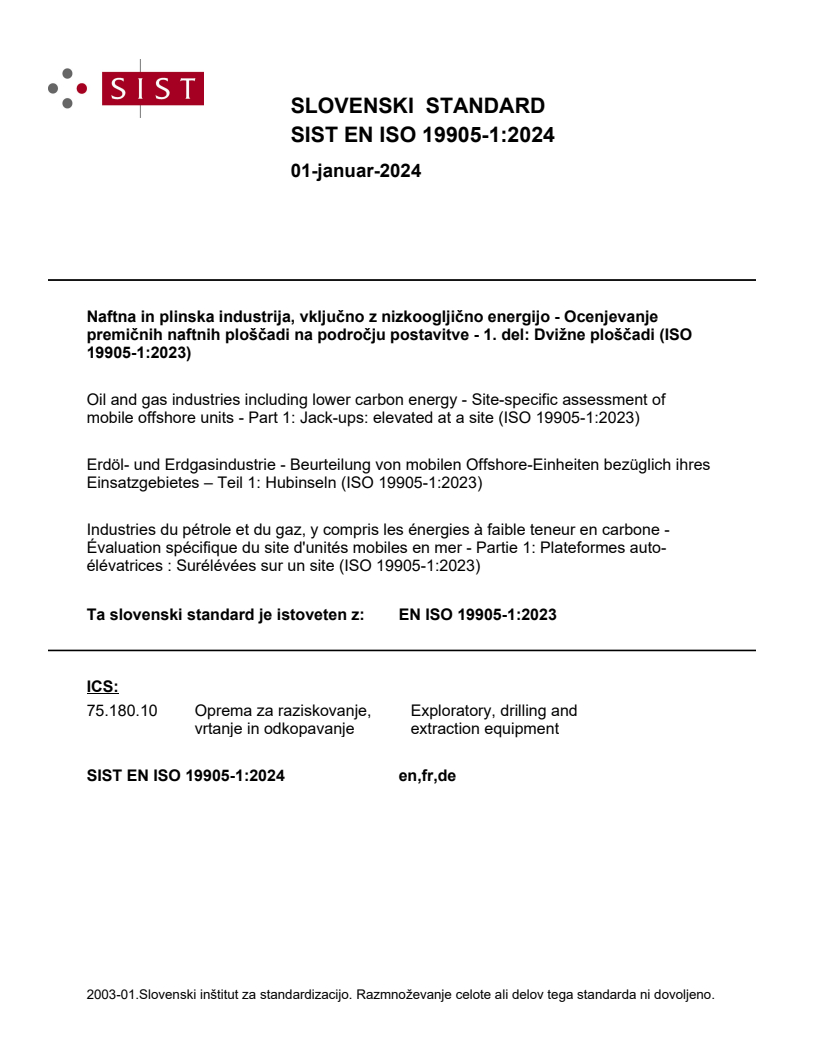
SLOVENSKI STANDARD
01-januar-2024
Naftna in plinska industrija, vključno z nizkoogljično energijo - Ocenjevanje
premičnih naftnih ploščadi na področju postavitve - 1. del: Dvižne ploščadi (ISO
19905-1:2023)
Oil and gas industries including lower carbon energy - Site-specific assessment of
mobile offshore units - Part 1: Jack-ups: elevated at a site (ISO 19905-1:2023)
Erdöl- und Erdgasindustrie - Beurteilung von mobilen Offshore-Einheiten bezüglich ihres
Einsatzgebietes – Teil 1: Hubinseln (ISO 19905-1:2023)
Industries du pétrole et du gaz, y compris les énergies à faible teneur en carbone -
Évaluation spécifique du site d'unités mobiles en mer - Partie 1: Plateformes auto-
élévatrices : Surélévées sur un site (ISO 19905-1:2023)
Ta slovenski standard je istoveten z: EN ISO 19905-1:2023
ICS:
75.180.10 Oprema za raziskovanje, Exploratory, drilling and
vrtanje in odkopavanje extraction equipment
2003-01.Slovenski inštitut za standardizacijo. Razmnoževanje celote ali delov tega standarda ni dovoljeno.
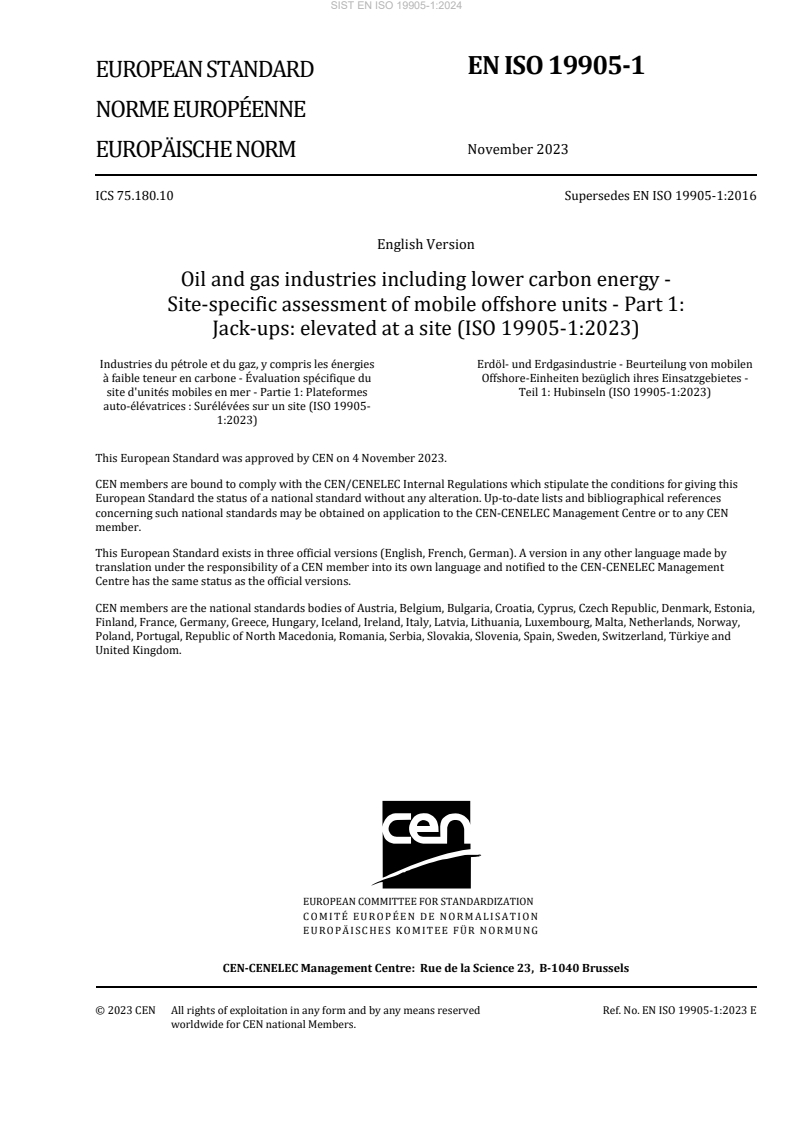
EN ISO 19905-1
EUROPEAN STANDARD
NORME EUROPÉENNE
November 2023
EUROPÄISCHE NORM
ICS 75.180.10 Supersedes EN ISO 19905-1:2016
English Version
Oil and gas industries including lower carbon energy -
Site-specific assessment of mobile offshore units - Part 1:
Jack-ups: elevated at a site (ISO 19905-1:2023)
Industries du pétrole et du gaz, y compris les énergies Erdöl- und Erdgasindustrie - Beurteilung von mobilen
à faible teneur en carbone - Évaluation spécifique du Offshore-Einheiten bezüglich ihres Einsatzgebietes -
site d'unités mobiles en mer - Partie 1: Plateformes Teil 1: Hubinseln (ISO 19905-1:2023)
auto-élévatrices : Surélévées sur un site (ISO 19905-
1:2023)
This European Standard was approved by CEN on 4 November 2023.
CEN members are bound to comply with the CEN/CENELEC Internal Regulations which stipulate the conditions for giving this
European Standard the status of a national standard without any alteration. Up-to-date lists and bibliographical references
concerning such national standards may be obtained on application to the CEN-CENELEC Management Centre or to any CEN
member.
This European Standard exists in three official versions (English, French, German). A version in any other language made by
translation under the responsibility of a CEN member into its own language and notified to the CEN-CENELEC Management
Centre has the same status as the official versions.
CEN members are the national standards bodies of Austria, Belgium, Bulgaria, Croatia, Cyprus, Czech Republic, Denmark, Estonia,
Finland, France, Germany, Greece, Hungary, Iceland, Ireland, Italy, Latvia, Lithuania, Luxembourg, Malta, Netherlands, Norway,
Poland, Portugal, Republic of North Macedonia, Romania, Serbia, Slovakia, Slovenia, Spain, Sweden, Switzerland, Türkiye and
United Kingdom.
EUROPEAN COMMITTEE FOR STANDARDIZATION
COMITÉ EUROPÉEN DE NORMALISATION
EUROPÄISCHES KOMITEE FÜR NORMUNG
CEN-CENELEC Management Centre: Rue de la Science 23, B-1040 Brussels
© 2023 CEN All rights of exploitation in any form and by any means reserved Ref. No. EN ISO 19905-1:2023 E
worldwide for CEN national Members.
Contents Page
European foreword . 3
European foreword
This document (EN ISO 19905-1:2023) has been prepared by Technical Committee ISO/TC 67 "Oil and
gas industries including lower carbon energy" in collaboration with Technical Committee CEN/TC 12
“Oil and gas industries including lower carbon energy” the secretariat of which is held by NEN.
This European Standard shall be given the status of a national standard, either by publication of an
identical text or by endorsement, at the latest by May 2024, and conflicting national standards shall be
withdrawn at the latest by May 2024.
Attention is drawn to the possibility that some of the elements of this document may be the subject of
patent rights. CEN shall not be held responsible for identifying any or all such patent rights.
This document supersedes EN ISO 19905-1:2016.
Any feedback and questions on this document should be directed to the users’ national standards
body/national committee. A complete listing of these bodies can be found on the CEN website.
According to the CEN-CENELEC Internal Regulations, the national standards organizations of the
following countries are bound to implement this European Standard: Austria, Belgium, Bulgaria,
Croatia, Cyprus, Czech Republic, Denmark, Estonia, Finland, France, Germany, Greece, Hungary, Iceland,
Ireland, Italy, Latvia, Lithuania, Luxembourg, Malta, Netherlands, Norway, Poland, Portugal, Republic of
North Macedonia, Romania, Serbia, Slovakia, Slovenia, Spain, Sweden, Switzerland, Türkiye and the
United Kingdom.
Endorsement notice
The text of ISO 19905-1:2023 has been approved by CEN as EN ISO 19905-1:2023 without any
modification.
INTERNATIONAL ISO
STANDARD 19905-1
Third edition
2023-10
Oil and gas industries including
lower carbon energy — Site-specific
assessment of mobile offshore units —
Part 1:
Jack-ups: elevated at a site
Industries du pétrole et du gaz, y compris les énergies à faible teneur
en carbone — Évaluation spécifique du site d'unités mobiles en
mer —
Partie 1: Plateformes auto-élévatrices : Surélévées sur un site
Reference number
ISO 19905-1:2023(E)
ISO 19905-1:2023(E)
© ISO 2023
All rights reserved. Unless otherwise specified, or required in the context of its implementation, no part of this publication may
be reproduced or utilized otherwise in any form or by any means, electronic or mechanical, including photocopying, or posting on
the internet or an intranet, without prior written permission. Permission can be requested from either ISO at the address below
or ISO’s member body in the country of the requester.
ISO copyright office
CP 401 • Ch. de Blandonnet 8
CH-1214 Vernier, Geneva
Phone: +41 22 749 01 11
Email: copyright@iso.org
Website: www.iso.org
Published in Switzerland
ii
ISO 19905-1:2023(E)
Contents Page
Foreword . viii
Introduction . xi
1 Scope . 1
2 Normative references . 1
3 Terms and definitions . 2
4 Symbols and abbreviated terms . 15
4.1 Symbols . 15
4.1.1 General . 15
4.1.2 Symbols used in A.6 . 17
4.1.3 Symbols used in A.7 . 19
4.1.4 Symbols used in A.8 . 21
4.1.5 Symbols used in A.9 and Annex E . 22
4.1.6 Symbols used in A.10 . 25
4.1.7 Symbols used in A.11 . 26
4.1.8 Symbols used in A.12 . 27
4.2 Abbreviated terms . 31
5 Overall considerations . 32
5.1 General . 32
5.1.2 Competency . 33
5.1.3 Planning . 33
5.1.4 Assessment situations and associated criteria . 33
5.1.5 Reporting . 33
5.1.6 Regulations . 33
5.1.7 Classification of unit . 34
5.2 Assessment approach . 34
5.3 Selection of assessment situations . 36
5.4 Determination of assessment situations . 37
5.4.1 General . 37
5.4.2 Reaction point and foundation fixity . 37
5.4.3 Extreme storm event approach angle . 37
5.4.4 Weights and centre of gravity . 37
5.4.5 Hull elevation . 37
5.4.6 Leg length reserve. 38
5.4.7 Adjacent structures . 38
5.4.8 Other . 38
5.5 Exposure levels . 38
5.5.1 Determination of exposure level . 38
5.5.2 Exposure level L1 . 38
5.5.3 Exposure level L2 . 38
5.5.4 Exposure level L3 . 39
5.5.5 Exposure level for earthquake . 39
5.6 Analytical tools . 39
6 Data to assemble for each site . 39
6.1 Applicability . 39
6.2 Jack-up data. 39
6.3 Site and operational data . 40
6.4 Metocean data . 40
ISO 19905-1:2023(E)
6.5 Geophysical and geotechnical data . 41
6.6 Earthquake data . 42
6.7 Ice data . 42
7 Actions . 42
7.1 Applicability . 42
7.2 General . 42
7.3 Metocean actions . 43
7.3.1 General . 43
7.3.2 Hydrodynamic model . 43
7.3.3 Wave and current actions . 43
7.3.4 Wind actions . 43
7.4 Functional actions . 44
7.5 Displacement dependent effects . 44
7.6 Dynamic effects . 44
7.7 Earthquakes. 44
7.8 Ice actions . 44
7.9 Other actions . 44
8 Structural modelling . 44
8.1 Applicability . 44
8.2 Overall considerations . 45
8.2.1 General . 45
8.2.2 Modelling philosophy . 45
8.2.3 Levels of FE modelling . 45
8.3 Modelling the leg . 46
8.3.1 General . 46
8.3.2 Detailed leg . 46
8.3.3 Equivalent leg (stick model) . 46
8.3.4 Combination of detailed and equivalent leg . 46
8.3.5 Stiffness adjustment . 46
8.3.6 Leg inclination . 46
8.4 Modelling the hull . 46
8.4.1 General . 46
8.4.2 Detailed hull model . 46
8.4.3 Equivalent hull model . 46
8.5 Modelling the leg-to-hull connection . 47
8.5.1 General . 47
8.5.2 Guide systems . 47
8.5.3 Elevating system . 47
8.5.4 Fixation system . 47
8.5.5 Shock pad floating jacking systems . 47
8.5.6 Jackcase and associated bracing . 47
8.6 Modelling the spudcan and foundation . 47
8.6.1 Spudcan structure . 47
8.6.2 Seabed reaction point . 47
8.6.3 Foundation modelling . 48
8.7 Mass modelling . 48
8.8 Application of actions . 49
8.8.1 Assessment actions . 49
8.8.2 Functional actions due to fixed load and variable load . 50
8.8.3 Hull sagging . 51
8.8.4 Metocean actions . 51
8.8.5 Inertial actions . 51
8.8.6 Large displacement effects . 51
8.8.7 Conductor actions . 51
iv © ISO 2023 – All right reserved
ISO 19905-1:2023(E)
8.8.8 Earthquake actions . 51
8.8.9 Ice actions . 51
9 Foundations . 52
9.1 Applicability . 52
9.2 General . 52
9.3 Geotechnical analysis of independent leg foundations . 52
9.3.1 Foundation modelling and assessment. 52
9.3.2 Leg penetration during preloading . 53
9.3.3 Yield interaction . 54
9.3.4 Foundation stiffnesses . 54
9.3.5 Vertical-horizontal foundation capacity envelopes . 54
9.3.6 Acceptance checks . 55
9.4 Other considerations . 56
9.4.1 Skirted spudcans . 56
9.4.2 Hard sloping strata . 57
9.4.3 Footprint considerations . 57
9.4.4 Leaning instability . 57
9.4.5 Leg extraction difficulties . 57
9.4.6 Cyclic mobility, liquefaction and liquefaction-induced lateral flow . 57
9.4.7 Scour . 58
9.4.8 Spudcan interaction with adjacent infrastructure . 58
9.4.9 Geohazards . 58
9.4.10 Carbonate material . 58
10 Structural response . 58
10.1 Applicability . 58
10.2 General considerations . 59
10.3 Types of analyses and associated methods . 59
10.4 Common parameters . 60
10.4.1 General . 60
10.4.2 Natural periods and related considerations . 60
10.4.3 Damping . 61
10.4.4 Foundations . 61
10.4.5 Storm excitation . 61
10.5 Storm analysis . 61
10.5.1 General . 61
10.5.2 Two-stage deterministic storm analysis . 62
10.5.3 Stochastic storm analysis . 63
10.5.4 Initial leg inclination . 64
10.5.5 Limit state checks . 64
10.6 Fatigue analysis . 64
10.7 Earthquake analysis . 64
10.8 Ice . 66
10.8.1 General . 66
10.8.2 ULS . 66
10.8.3 ALS . 66
10.8.4 Assessments in the area types . 67
10.8.5 Additional factors for arctic and cold regions . 67
10.9 Accidental situations . 67
10.10 Alternative analysis methods . 67
10.10.1 Ultimate strength analysis . 67
10.10.2 Methodology . 67
11 Long-term applications . 68
11.1 Applicability . 68
11.2 Assessment data . 68
ISO 19905-1:2023(E)
11.3 Special requirements . 68
11.3.1 Fatigue assessment . 68
11.3.2 Weight control . 68
11.3.3 Corrosion protection . 69
11.3.4 Marine growth . 69
11.3.5 Foundations . 69
11.4 Survey requirements . 69
12 Structural strength . 69
12.1 Applicability . 69
12.1.1 General . 69
12.1.2 Truss type legs . 70
12.1.3 Other leg types . 70
12.1.4 Fixation system and/or elevating system . 70
12.1.5 Spudcan strength including connection to the leg . 70
12.1.6 Overview of the assessment procedure . 71
12.2 Classification of member cross-sections . 71
12.2.1 Member types . 71
12.2.2 Material yield strength . 71
12.2.3 Classification definitions . 71
12.3 Section properties of non-circular prismatic members . 72
12.3.1 General . 72
12.3.2 Plastic and compact sections . 72
12.3.3 Semi-compact sections . 72
12.3.4 Slender sections . 72
12.3.5 Cross-section properties for the assessment . 72
12.4 Effects of axial force on bending moment . 73
12.5 Strength of tubular members . 73
12.6 Strength of non-circular prismatic members . 73
12.7 Assessment of joints . 73
13 Acceptance criteria . 73
13.1 Applicability . 73
13.1.1 General . 73
13.1.2 Ultimate limit states . 74
13.1.3 Serviceability and accidental limit states . 74
13.1.4 Fatigue limit states . 74
13.2 General formulation of the assessment check . 74
13.3 Leg strength assessment . 75
13.4 Holding system strength assessment . 76
13.5 Spudcan strength assessment . 76
13.6 Hull elevation assessment . 76
13.7 Leg length reserve assessment . 76
13.8 Overturning stability assessment . 77
13.9 Foundation integrity assessment . 78
13.9.1 Foundation capacity check . 78
13.10 Displacement check . 79
13.11 Interaction with adjacent infrastructure . 79
13.12 Temperatures . 79
Annex A (informative) Additional information and guidance . 80
Annex B (normative) Summary of partial action and partial resistance factors . 283
Annex C (informative) Additional information on structural modelling and response
analysis . 285
vi © ISO 2023 – All right reserved
ISO 19905-1:2023(E)
Annex D (informative) Foundations — Recommendations for the acquisition of site-specific
geotechnical data . 295
Annex E (informative) Foundations — Additional information and alternative approaches . 301
Annex F (informative) Guidance on Clause A.12 — Structural strength. 328
Annex G (informative) Contents list for typical site-specific assessment report . 342
Annex H (informative) Regional information . 349
Bibliography . 358
ISO 19905-1:2023(E)
Foreword
ISO (the International Organization for Standardization) is a worldwide federation of national
standards bodies (ISO member bodies). The work of preparing International Standards is normally
carried out through ISO technical committees. Each member body interested in a subject for which a
technical committee has been established has the right to be represented on that committee.
International organizations, governmental and non-governmental, in liaison with ISO, also take part in
the work. ISO collaborates closely with the International Electrotechnical Commission (IEC) on all
matters of electrotechnical standardization.
The procedures used to develop this document and those intended for its further maintenance are
described in the ISO/IEC Directives, Part 1. In particular, the different approval criteria needed for the
different types of ISO documents should be noted. This document was drafted in accordance with the
editorial rules of the ISO/IEC Directives, Part 2 (see www.iso.org/directives).
Attention is drawn to the possibility that some of the elements of this document may be the subject of
patent rights. ISO shall not be held responsible for identifying any or all such patent rights. Details of
any patent rights identified during the development of the document will be in the Introduction and/or
on the ISO list of patent declarations received (see www.iso.org/patents).
Any trade name used in this document is information given for the convenience of users and does not
constitute an endorsement.
For an explanation of the voluntary nature of standards, the meaning of ISO specific terms and
expressions related to conformity assessment, as well as information about ISO's adherence to the
World Trade Organization (WTO) principles in the Technical Barriers to Trade (TBT), see
www.iso.org/iso/foreword.html.
This document was prepared by Technical Committee ISO/TC 67, Oil and gas industries including lower
carbon energy, Subcommittee SC 7, Offshore structures, in collaboration with the European Committee
for Standardization (CEN) Technical Committee CEN/TC 12, Oil and gas industries including lower
carbon energy, in accordance with the Agreement on technical cooperation between ISO and CEN
(Vienna Agreement).
This third edition cancels and replaces the second edition (ISO 19905-1:2016), which has been
technically revised.
The main changes are as follows:
updates regarding operations in arctic areas in: Scope, 5.1.4, Figure 5.2-1, 6.7, 7.2, 7.6, 7.8, 10.8,
Table 10.3-1 and A.10.8, and added 8.8.9;
need for Classification revised in Scope and expanded in 5.1.7;
Clause 3 updated to align with 19900 and other sources. Further definitions added;
added definitions of symbols for undrained shear strength in 4.1.2;
added definitions of symbols for horizontal and moment capacity coefficients and cyclic
degradation factors in 4.1.5;
interaction with SSA-I explained in 5.1;
viii © ISO 2023 – All right reserved
ISO 19905-1:2023(E)
exposure levels (in 5.5) revised to align with ISO 19900:2019;
requirements and information on earthquake response analysis gathered in 10.7 and A.10.7
respectively and referenced from 8.6, 8.7, 8.8, A.8.6.3, A.8.7;
9.3, A.9.3.1.2, A.9.3.3.1 and A.9.4.1 expanded to include foundation capacities and stiffnesses based
on strength parameters rather than applied preload. Clause E.4 added to address the former;
clarifications of Step 2 foundation checks in 9.3.6;
9.4.6 on cyclic mobility expanded to address liquefaction and liquefaction-induced lateral flow and
A.9.4.6 expanded accordingly;
...
The standard EN ISO 19905-1:2023 provides a comprehensive framework for the site-specific assessment of mobile offshore units, specifically focusing on independent leg jack-up units utilized in the oil and gas industries. The document outlines precise requirements, recommendations, and guidance for the elevated site-specific assessment (SSA-E) of these units, ensuring that each evaluation is thorough and aligns with operational safety protocols. One of the notable strengths of this standard is its clear delineation of the types of jack-ups it addresses: occupied non-evacuated, occupied evacuated, and unoccupied units. This categorization ensures that the guidance is relevant to a variety of operational scenarios. Moreover, the emphasis on the installed phase at a specific site allows for an accurate assessment that correlates with real-world conditions, critical for ensuring the integrity and safety of operations. The standard’s insistence on the as-installed condition matching the assumptions used in the assessment is an essential component of maintaining reliability. This connection between theoretical evaluation and practical application enhances the overall rigor of the SSA-E process. Furthermore, the integrated approach recommended within the document promotes a holistic assessment, advocating for the use of all provisions in conjunction to achieve dependable outcomes. Another significant aspect is the guidance provided for situations involving sea ice and icebergs, directing assessors to supplement the standard with ISO 19906 and ISO 35104 provisions. This consideration for environmental factors showcases the standard's relevance to diverse operational contexts and its adaptability to various geographical challenges. The document also sets forth prerequisites for the jack-ups, stipulating that only those with valid classification society certificates are applicable under its provisions. This requirement ensures that the units in question are structurally sound and adequately maintained, thereby reinforcing safety during operations. It further allows for the application of methodologies from this standard to jack-ups without a recognized classification, as per ISO 19902, enhancing its versatility. While EN ISO 19905-1:2023 richly informs those involved in primary jack-up operations, it thoughtfully delineates the boundaries of its scope by not addressing the installation and removal processes or the integrity of well conductors. This focused approach permits practitioners to understand the specific parameters within which they must operate, avoiding potential ambiguities. Overall, EN ISO 19905-1:2023 stands as a critical resource for professionals in the oil and gas sectors, providing robust guidance for the elevated site-specific assessment of jack-up units. Its strengths in clarity, comprehensive scope, and adaptability ensure that it is highly relevant to current and future operations in the context of mobile offshore drilling.
EN ISO 19905-1:2023の標準文書は、石油および天然ガス産業における独立脚式ジャックアップユニットの現地特定評価に関する要求事項と推奨事項を提供しています。この文書は特に、サイトにおけるさまざまな状況下でのジャックアップユニットの評価を対象としており、占有された非避難型、占有された避難型、および無人のジャックアップユニットの状況を考慮しています。 この標準の強みは、特定のサイトにおけるジャックアップユニットの高度な評価を実施するための包括的かつ整合性のあるアプローチを提供している点です。このような統合的手法により、評価の信頼性が確保され、ジャックアップユニットの運用におけるリスクを軽減できるのが大きなメリットです。また、設置された条件が評価時の仮定と一致する必要があることを明確に定義しているため、運用者は安全性を高めるための重要な基準を持つことができます。 さらに、氷や氷山の影響を受ける地域でのジャックアップユニットを評価する場合には、ISO 19906およびISO 35104に関連する氷の作用と管理手順に関する規定を補足することが推奨されており、地域特有の条件に適応した評価が行える点も評価の要素です。 ただし、この文書は設置および撤去の現地特定評価については扱っていないため、その点に留意する必要があります。また、現地特定評価における整合性を確保するために、十分に維持管理された構造的に健全な独立脚式モバイルジャックアップユニットにのみ適用されることも重要です。そのため、関連の格付け団体の証明書を持たないジャックアップユニットは、ISO 19902の規定に従って評価されることになります。 全体として、EN ISO 19905-1:2023は、石油および天然ガス業界におけるジャックアップユニットの運用において、現地特定評価を実施するための重要な指針を提供しており、多様な運用条件に対応した柔軟性と安全性を兼ね備えています。
표준 EN ISO 19905-1:2023은 석유 및 가스 산업, 특히 저탄소 에너지 분야에서의 모바일 해양 유닛의 현장 특정 평가를 위한 요구사항과 지침을 규정하고 있습니다. 이 문서는 독립 다리 잭업 유닛에 대한 고립된 사이트 특정 평가(SSA-E)의 필요 조건을 명시하며, 이를 통해 잭업이 처리 해야 할 다양한 상황, 즉 점유된 비대피, 점유된 대피 및 비점유 잭업을 포함한 모든 가능한 시나리오에 대해 포괄적으로 다룹니다. 이 표준의 주요 강점은 잭업 유닛이 특정 위치에서 설치된 상태에서의 평가를 위한 체계적이고 통합된 접근 방식을 제시한다는 점입니다. 이는 신뢰성 있는 평가를 보장하고, 잭업의 설치 상태가 평가에 사용된 가정과 일치해야 함을 강조합니다. 특히, 해빙 및 빙산의 영향을 받을 수 있는 지역에서 운영되는 잭업을 평가할 때 ISO 19906 및 ISO 35104에 관련된 얼음 작용과 얼음 관리 절차를 보완하도록 안내합니다. 이 문서는 설계, 현장으로의 이동, 현장에서의 설치 및 제거와 관련된 사항을 다루지 않으며, 이는 표준의 명확한 범위 설정의 일환으로, 사용자가 집중해야 할 영단어를 분명히 합니다. 또한, 독립 다리 모바일 잭업 유닛이 구조적으로 건전하고 적절히 유지 관리되어야 함을 강조하며, 이를 위해 유효한 분류 인증서를 보유해야 한다는 점이 중요한 요소로 언급됩니다. 인증서가 유효하지 않은 경우 ISO 19902의 조항에 따라 평가가 이루어야 하며, 이는 표준의 유연성과 실용성을 잘 보여줍니다. 전반적으로 EN ISO 19905-1:2023은 잭업 유닛의 안전하고 효율적인 운영을 위한 필수적인 기준을 제공하는 표준으로, 석유 및 가스 산업에서의 응용 가능성과 акту성에 기여합니다.
Das Dokument SIST EN ISO 19905-1:2024 legt spezifische Anforderungen und Empfehlungen für die standortspezifische Bewertung von mobilen Offshore-Einheiten, insbesondere von Jack-ups, welche in der Erdöl- und Erdgasindustrie eingesetzt werden, dar. Der Schwerpunkt liegt auf der erhöhten standortspezifischen Bewertung (SSA-E) von unabhängigen Beine-Jack-ups, die an einem bestimmten Standort in Betrieb sind. Die Stärken der Norm liegen vor allem in ihrer umfassenden und integrativen Herangehensweise. Sie definiert klar die Kriterien für occupied non-evacuated, occupied evacuated und unoccupied Jack-ups und stellt sicher, dass der Zustand der montierten Einheiten den Annahmen der Bewertung entspricht. Dies fördert die Zuverlässigkeit der Beurteilungen erheblich und bietet den Fachleuten im Bereich der verwandten Industrien wertvolle Leitlinien für die Durchführung der gewünschten Bewertungen. Besonders relevant wird die Norm in Regionen, die von Meereseis und Eisbergen betroffen sind, da sie den Bewertenden anregt, die entsprechenden Vorschriften aus ISO 19906 sowie die Verfahren für das Eismanagement aus ISO 35104 zu berücksichtigen. Dadurch wird eine erweiterte Sicherheitsbewertung gewährleistet, die über die grundlegenden Anforderungen hinausgeht. Darüber hinaus ist die Norm relevant für den Einsatz von mobilen Jack-up-Einheiten, die strukturell einwandfrei sind und ordnungsgemäß gewartet werden, was durch das Vorhandensein eines anerkannten Klassifikationszertifikats nachgewiesen wird. Dies stellt sicher, dass nur hochwertige und obere Standards erfüllende Einheiten in die Bewertung einfließen, was die Sicherheit und Effizienz der Offshore-Operationen erhöht. Die in diesem Dokument enthaltenen Hinweise bezüglich der Verknüpfung mit ISO 19902 für Jack-ups ohne gültiges Klassifikationszertifikat erweitern den Anwendungsbereich der Norm und bieten zusätzliche Flexibilität bei der Durchführung der Bewertungen. Insgesamt stellt die Norm eine wertvolle Ressource für alle Beteiligten in der Öl- und Gasindustrie dar, die sich mit der Bewertung und den sicherheitstechnischen Anforderungen an Jack-ups befassen.
La norme EN ISO 19905-1:2023, intitulée "Industries du pétrole et du gaz, y compris les énergies à faible carbone - Évaluation spécifique au site des unités mobiles offshore - Partie 1 : Jack-ups : élevés à un site", offre un cadre de référence essentiel pour l’évaluation sur site des unités jack-up dans l'industrie pétrolière et gazière. Le champ d'application de cette norme comprend les évaluations spécifiques au site (SSA-E) des unités jack-up à jambes indépendantes, qu'elles soient occupées ou non, qu'elles soient évacuées ou non, et cela dans leur phase installée à un lieu spécifique. Cette approche intégrée est une force significative de la norme, garantissant que les conditions retrouvées lors de l'installation correspondent aux hypothèses formulées lors de l'évaluation. En abordant les Jack-ups qui opèrent dans des régions soumises à la glace marine et aux icebergs, la norme souligne l'importance d'un complément d'évaluation adapté, en se référant à ISO 19906 et ISO 35104 pour la gestion de la glace, ce qui ajoute une pertinence supplémentaire pour les opérations dans des environnements extrêmes. Un aspect critique de cette norme est qu'elle s'applique uniquement aux unités jack-up mobiles à jambes indépendantes qui sont structurellement saines et bien entretenues, exigence généralement prouvée par un certificat de classification d'une société reconnue. Cela introduit un niveau de rigueur et de sécurité dans l'évaluation qui est crucial pour les opérations en mer. Les méthodes supplémentaires fournies pour les Jack-ups sans certificat valide, en se basant sur ISO 19902, montrent une flexibilité dans l'application, tout en maintenant des normes élevées de sécurité et d'efficacité. Il est également important de noter que, bien que les conducteurs de puits soient un élément critique pour la sécurité des opérations de jack-up, leur intégrité n'est pas traitée dans le processus d'évaluation spécifique au site selon cette norme. Cela dénote une concentration précise des critères de l'évaluation sans dilution par des aspects non inclus, ce qui renforce la clarté et la praticabilité des directives fournies. En conclusion, la norme EN ISO 19905-1:2023 est d'une pertinence notable pour l'industrie pétrolière et gazière, présentant des forces considérables avec son approche intégrée et ses exigences rigoureuses pour les évaluations des unités jack-up. Elle s'affirme comme un outil indispensable pour garantir la sécurité et la fiabilité des opérations offshore.
Questions, Comments and Discussion
Ask us and Technical Secretary will try to provide an answer. You can facilitate discussion about the standard in here.
Loading comments...