

prEN 18364
(Main)Circular Economy - Product-related data and information sharing along value networks
- Abstract
This document provides guidance to support information sharing on circular economy aspects throughout value networks by providing product-group agnostic data entries in a common data dictionary.
This document provides a framework to guide organizations of all types and sizes.
This document complements content-related aspects addressed in other standards or applications for data or information sharing through a digital product passport (DPP)and does not overlap with the DPP framework and system developed by CEN/CLC/JTC 24.
This document is intended to help to set a framework for how to support information sharing on circular economy aspects throughout value networks but is not foreseen to be used for conformity assessment with regulations.
- Status
- Not Published
- Publication Date
- 01-Nov-2027
- Technical Committee
- CEN/TC 473 - Circular Economy
- Drafting Committee
- WG 02 - Information sharing
- Current Stage
- 4020 - Submission to enquiry - Enquiry
- Start Date
- 06-Aug-2026
- Due Date
- 20-Oct-2025
- Completion Date
- 06-Aug-2026

prEN 18364 is a CEN draft European Standard on product-related data and information sharing along value networks for the circular economy. It provides guidance for organizations of all types and sizes and sets product-group agnostic data entries in a common data dictionary. The document helps users share information on materials, repair, reuse, remanufacturing, recycling, and circularity-related footprint data, while complementing Digital Product Passport (DPP) content without overlapping the DPP framework developed by CEN/CLC/JTC 24.
What does prEN 18364 specify?
prEN 18364 gives a framework for circular economy information sharing across a product’s value network. It is organized as a short front matter, then clauses on scope, terms, framework guidance, circular economy relevant parameters, and an example structure for data entries, followed by two informative annexes.
Clause 2 has no normative references. Clause 3 defines the main terms, symbols, and abbreviations. Clause 4 explains how to share information across the value network and what information is useful at different life-cycle stages. Clause 5 describes the circular economy parameters that can be represented as data. Clause 6 shows how those parameters can be structured as Common Data Dictionary (CDD) entries.
| Annex | What it covers |
|---|---|
| Annex A | Clarifications on life cycle impacts, including carbon footprint and environmental footprint |
| Annex B | Clarifications on Common Data Dictionary use, IDs, interoperability, and data entry structure |
What are the key requirements of prEN 18364?
prEN 18364 is guidance, not a conformity-assessment standard, so its main value is to help organizations decide what information to share and how to structure it. The key technical points are about who receives information, what they need to do with it, and how to make that information machine-readable and traceable.
Share information to support circular actions
Clause 4.1 says information should help subsequent holders act on embedded circularity aspects in a product, resource, material, or component. In practice, that means the data should not stop at the manufacturer - it should support the next user, repairer, remanufacturer, recycler, or other actor who needs to preserve value.
Map the information need to the value network
Clause 4.2.1 asks organizations to identify subsequent holders, users, and other actors, and to consider their upstream and downstream information needs. This matters because the same product may need different guidance for suppliers, resellers, users, service providers, and end-of-life operators.
Include material and disassembly information
Clause 4.2.2 recommends a practical list of included materials, ideally combined with a disassembly manual or assembly structure. The list should focus on materials that create health or ecological risk, affect circularity value, or risk contaminating material flows, so people can sort and recover them safely.
Provide repair and maintenance guidance
Clause 4.2.3 links the information content to the product design, the business model, and the availability of parts and tools. In practice, this means the information should help users and service providers replace wear parts, find suitable tools, and understand how design choices affect long-term maintenance.
Support reuse with testing and refitting information
Clause 4.2.4.1 points to test guidance for reuse, including mechanical integrity, corrosion, function, insulation, dimensions, and compliance checks. Clause 4.2.4.2 adds that reused parts should match the original design specifications and that refitting should be documented with usage history, test results, and remaining-lifetime information.
Support remanufacturing, refurbishing, and recycling
Clause 4.2.5.1 calls for information on original specifications, usage history, and reprocessing requirements so remanufacturing and refurbishing can restore performance and safety. Clause 4.2.5.2 covers recycling and says recyclers need composition data, disassembly guidance, hazardous-substance information, and handling rules for biological recovery or energy recovery.
Use the circular economy parameters and CDD structure
Clause 5 identifies the main data themes: environmental impacts, durability, reliability, repairability, maintainability, reused parts, recycled content, recycling, and related efficiency measures. Clause 6 then shows how to express those themes as CDD-style entries with an ID, preferred name, definition, source, data type, unit, and value format. That structure matters because it supports interoperability between data systems.
What terms does prEN 18364 define?
- CDD (Common Data Dictionary) - A standardized structure for data entries that makes information easier to classify, exchange, and process across systems.
- DPP (Digital Product Passport) - The digital information system for product-related data that this document complements on content-related aspects.
- LCA (Life Cycle Assessment) - A method used in the document’s footprint discussion to assess environmental impacts across a product life cycle.
- Value network - A network of interlinked value chains and interested parties that exchange product-related information.
- Durability - The ability of a product or part to function as required under specified use, maintenance, and repair conditions until technical end of life.
- Reliability - The probability that a product functions as required under given conditions, including maintenance, for a given duration without a limiting event.
Who uses prEN 18364?
prEN 18364 is written for organizations of all types and sizes that create, use, pass on, repair, recover, recycle, or assess products and materials. It is relevant to product designers, manufacturers, suppliers, buyers, resellers, users, repairers, remanufacturers, refurbishers, recyclers, and dismantling or material-handling operators.
It also matters to quality, sustainability, and product-information teams that need a common structure for circular economy data. In practice, these users need it to decide what to document, how to communicate it to the next actor, and how to keep it usable across systems.
Which standards are used with prEN 18364?
Clause 2 has no normative references, but the document builds on several related standards and documents named in the text.
- EN 61360-1 and IEC 61360-2 - provide the basis for structuring standardized data entries and classification.
- prEN IEC 61360-7:2025 - supplies the cross-domain concept example used for the hierarchy of data entries.
- EN 62656-1:2015 - defines the logical structure for standardized product ontology registers and data parcels.
- EN IEC 63000 - gives a documentation structure for hazardous substances information.
- EN IEC 82474-1 - is the material declaration framework that the document says the parameters can later fit into.
- ISO 59040 - provides the product circularity data sheet concept that this document complements.
- ISO 59014, ISO 59010, and ISO 59020 - cover secondary material recovery, business model and value network transition, and circularity performance assessment.
- ISO 59004:2024 and IEC 60050-193:2026 - supply core circular economy vocabulary used in the definitions.
- EN ISO 14044, CEN ISO/TS 14027, ISO 14054, and ISO 14033 - provide the life cycle assessment, product category rules, natural capital, and data traceability context for footprint-related information.
- EN 45552 and ISO 26000:2010 - underpin the definitions of durability and user-related terminology.
What does the prEN 18364 document contain?
prEN 18364 contains a resource-flow figure, a clause-level framework for circular information sharing, and a large set of circular economy parameter definitions for data exchange. It also includes a summary table of classes and properties and CDD-style entries with IDs, units, and value formats for topics such as durability, reliability, repairability, recycled content, carbon footprint, and environmental footprint.
Annex A explains how to interpret life cycle impacts and footprint information, including system boundaries and comparability issues. Annex B explains how the Common Data Dictionary supports machine-readable, interoperable data sharing and why IDs and standardized structure matter in practice.
Get Certified
Connect with accredited certification bodies for this standard

BSI Group
BSI (British Standards Institution) is the business standards company that helps organizations make excellence a habit.

Bureau Veritas
Bureau Veritas is a world leader in laboratory testing, inspection and certification services.

DNV
DNV is an independent assurance and risk management provider.
Sponsored listings
Frequently Asked Questions
prEN 18364 is a draft published by the European Committee for Standardization (CEN). Its full title is "Circular Economy - Product-related data and information sharing along value networks". This standard covers: This document provides guidance to support information sharing on circular economy aspects throughout value networks by providing product-group agnostic data entries in a common data dictionary. This document provides a framework to guide organizations of all types and sizes. This document complements content-related aspects addressed in other standards or applications for data or information sharing through a digital product passport (DPP)and does not overlap with the DPP framework and system developed by CEN/CLC/JTC 24. This document is intended to help to set a framework for how to support information sharing on circular economy aspects throughout value networks but is not foreseen to be used for conformity assessment with regulations.
This document provides guidance to support information sharing on circular economy aspects throughout value networks by providing product-group agnostic data entries in a common data dictionary. This document provides a framework to guide organizations of all types and sizes. This document complements content-related aspects addressed in other standards or applications for data or information sharing through a digital product passport (DPP)and does not overlap with the DPP framework and system developed by CEN/CLC/JTC 24. This document is intended to help to set a framework for how to support information sharing on circular economy aspects throughout value networks but is not foreseen to be used for conformity assessment with regulations.
prEN 18364 is classified under the following ICS (International Classification for Standards) categories: 13.020.20 - Environmental economics. Sustainability. The ICS classification helps identify the subject area and facilitates finding related standards.
prEN 18364 is available in PDF format for immediate download after purchase. The document can be added to your cart and obtained through the secure checkout process. Digital delivery ensures instant access to the complete standard document.
Standards Content (Sample)
SLOVENSKI STANDARD
01-oktober-2026
Krožno gospodarstvo - Izmenjava podatkov in informacij o izdelkih vzdolž
vrednostnih omrežij
Circular Economy - Product-related data and information sharing along value networks
Circular Economy - Produktbezogener Daten- und Informationsaustausch entlang von
Wertschöpfungsnetzen
Économie circulaire - Partage de données et d'informations relatives aux produits dans
les réseaux de valeur
Ta slovenski standard je istoveten z: prEN 18364
ICS:
13.020.20 Okoljska ekonomija. Environmental economics.
Trajnostnost Sustainability
2003-01.Slovenski inštitut za standardizacijo. Razmnoževanje celote ali delov tega standarda ni dovoljeno.
DRAFT
EUROPEAN STANDARD
NORME EUROPÉENNE
EUROPÄISCHE NORM
August 2026
ICS
English Version
Circular Economy - Product-related data and information
sharing along value networks
Économie circulaire - Partage de données et Circular Economy - Produktbezogener Daten- und
d'informations relatives aux produits dans les réseaux Informationsaustausch entlang von
de valeur Wertschöpfungsnetzen
This draft European Standard is submitted to CEN members for enquiry. It has been drawn up by the Technical Committee
CEN/TC 473.
If this draft becomes a European Standard, CEN members are bound to comply with the CEN/CENELEC Internal Regulations
which stipulate the conditions for giving this European Standard the status of a national standard without any alteration.
This draft European Standard was established by CEN in three official versions (English, French, German). A version in any other
language made by translation under the responsibility of a CEN member into its own language and notified to the CEN-CENELEC
Management Centre has the same status as the official versions.
CEN members are the national standards bodies of Austria, Belgium, Bulgaria, Croatia, Cyprus, Czech Republic, Denmark, Estonia,
Finland, France, Germany, Greece, Hungary, Iceland, Ireland, Italy, Latvia, Lithuania, Luxembourg, Malta, Netherlands, Norway,
Poland, Portugal, Republic of North Macedonia, Romania, Serbia, Slovakia, Slovenia, Spain, Sweden, Switzerland, Türkiye and
United Kingdom.
Recipients of this draft are invited to submit, with their comments, notification of any relevant patent rights of which they are
aware and to provide supporting documentation.
Warning : This document is not a European Standard. It is distributed for review and comments. It is subject to change without
notice and shall not be referred to as a European Standard.
EUROPEAN COMMITTEE FOR STANDARDIZATION
COMITÉ EUROPÉEN DE NORMALISATION
EUROPÄISCHES KOMITEE FÜR NORMUNG
CEN-CENELEC Management Centre: Rue de la Science 23, B-1040 Brussels
© 2026 CEN All rights of exploitation in any form and by any means reserved Ref. No. prEN 18364:2026 E
worldwide for CEN national Members.
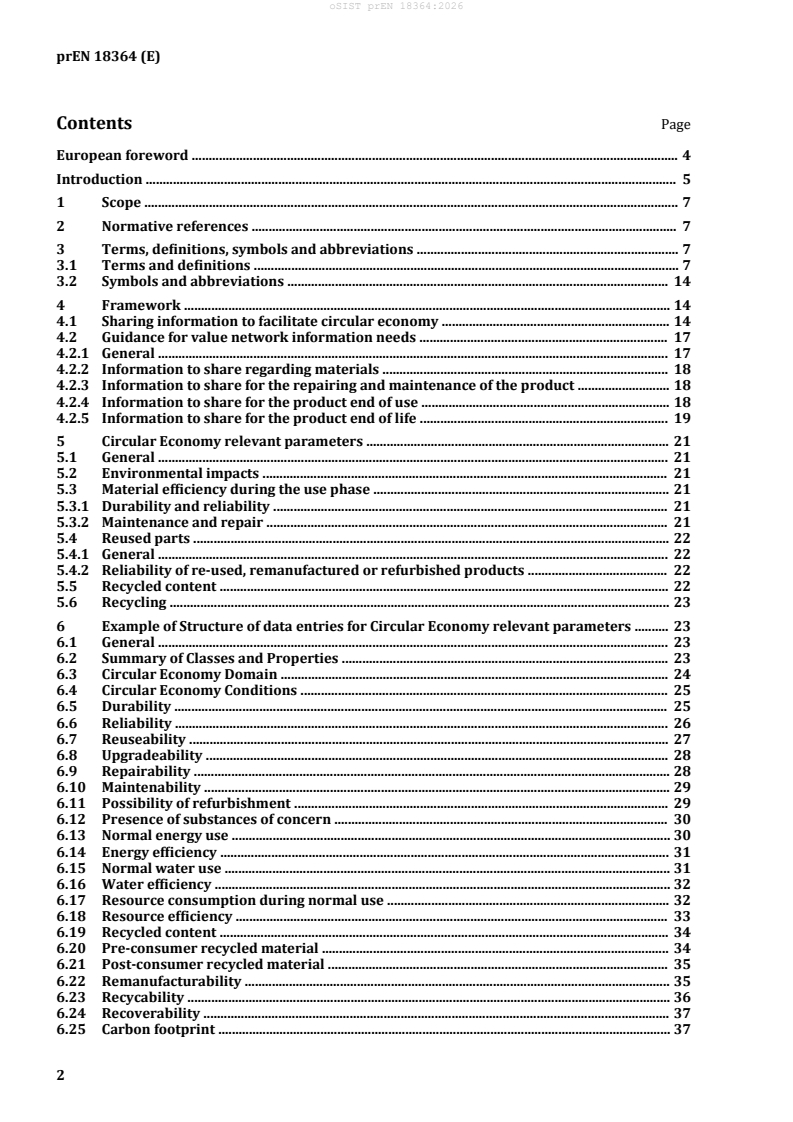
Contents Page
European foreword . 4
Introduction . 5
1 Scope . 7
2 Normative references . 7
3 Terms, definitions, symbols and abbreviations . 7
3.1 Terms and definitions . 7
3.2 Symbols and abbreviations . 14
4 Framework . 14
4.1 Sharing information to facilitate circular economy . 14
4.2 Guidance for value network information needs . 17
4.2.1 General . 17
4.2.2 Information to share regarding materials . 18
4.2.3 Information to share for the repairing and maintenance of the product . 18
4.2.4 Information to share for the product end of use . 18
4.2.5 Information to share for the product end of life . 19
5 Circular Economy relevant parameters . 21
5.1 General . 21
5.2 Environmental impacts . 21
5.3 Material efficiency during the use phase . 21
5.3.1 Durability and reliability . 21
5.3.2 Maintenance and repair . 21
5.4 Reused parts . 22
5.4.1 General . 22
5.4.2 Reliability of re-used, remanufactured or refurbished products . 22
5.5 Recycled content . 22
5.6 Recycling . 23
6 Example of Structure of data entries for Circular Economy relevant parameters . 23
6.1 General . 23
6.2 Summary of Classes and Properties . 23
6.3 Circular Economy Domain . 24
6.4 Circular Economy Conditions . 25
6.5 Durability . 25
6.6 Reliability . 26
6.7 Reuseability . 27
6.8 Upgradeability . 28
6.9 Repairability . 28
6.10 Maintenability . 29
6.11 Possibility of refurbishment . 29
6.12 Presence of substances of concern . 30
6.13 Normal energy use . 30
6.14 Energy efficiency . 31
6.15 Normal water use . 31
6.16 Water efficiency . 32
6.17 Resource consumption during normal use . 32
6.18 Resource efficiency . 33
6.19 Recycled content . 34
6.20 Pre-consumer recycled material . 34
6.21 Post-consumer recycled material . 35
6.22 Remanufacturability . 35
6.23 Recycability . 36
6.24 Recoverability . 37
6.25 Carbon footprint . 37
6.26 Environmental footprint . 38
Annex A (informative) Clarifications on Life cycle impacts . 39
Annex B (informative) Clarifications on Common Data Dictionary . 40
Bibliography . 41
European foreword
This document (prEN 18364) has been prepared by Technical Committee CEN/TC 473 “Circular
Economy”, the secretariat of which is held by SIS.
This document is currently submitted to the CEN Enquiry.
Introduction
0.1 Background
The transition towards a circular economy aims at the efficient use of resources, the minimization of
waste, and at the reuse and recycling of materials throughout value networks. One fundamental aspect
of a circular economy is the sharing of data about products, materials and resources. Providing decision-
makers with circularity related information is often a prerequisite to unlock the circularity potential
and minimize individual burdens for suppliers, buyers, and users. By promoting transparency and
collaboration, information sharing facilitates the effective management of resource stocks and flows,
ensuring materials are used and reused efficiently throughout their life cycles.
To conform to future product, material or resource information requirements contained in regulations
such as the Ecodesign for Sustainable Product Regulation (ESPR) [1], sharing data will be indispensable.
A harmonized understanding of how to mediate the intent of sustainability or circularity related choices
of the design, material or functionality of the product which might not be obviously apparent by data
and product appearance by actors in other industries/sectors is needed. This is to strengthen the
understanding of meaning, purpose and intent between actors with different roles, perspectives and
abilities to act along the value chain of the product.
Sharing information helps to trace – and thereby take responsibility for – resources, to provide
sufficiently detailed information enabling resource recovery, and to give guidance on how to retain or
add to the value of resources.
The information needed to support circular actions, includes guidance on how to establish and maintain
a circular flow of resources, closing, slowing, or narrowing resource flows, which are key strategies for
reducing waste and extending the life of resources. Furthermore, sharing information is needed to
ensure resources meet demand, to inform users on how to extend product lifespans, to add
considerations to the design phase regarding material selection and resource-efficient design, and to
facilitate resource recovery by manufacturers, recyclers, and other stakeholders.
A common framework enables organizations to effectively communicate, exchange, and utilize
information to support circular actions. Standardized information sharing promotes transparency and
trust among stakeholders, ensuring that shared information is accurate, reliable, and relevant. It fosters
confidence in decision-making and strengthens long-term partnerships. Operating in line with this
framework empowers organizations to identify gaps, track progress, and uncover opportunities for
innovation in circular actions, ultimately accelerating the transition toward a circular economy, by
optimizing circular practices, mitigating waste, and enhancing resource efficiency.
Within the European legislative framework, the ESPR [1] promotes sustainable product design, lifecycle
management, and a standardized framework for information exchange to facilitate compliance by
enabling organizations to share and access critical product information. One of the key features of the
ESPR [1] is the introduction of the requirement for the development and operation of an information
system for the concept Digital Product Passport (DPP) to various stakeholders throughout a product's
lifecycle on its various aspects, including its durability, reusability, upgradability, reparability, and the
presence of substances that inhibit circularity.
Other regulations such as the Toy Safety [2] and Detergents Regulations [3] demand precise
documentation of product safety, chemical composition, and compliance measures. The Critical Raw
Materials Act [4] emphasizes sustainable sourcing and recycling of critical raw materials. The Packaging
and Packaging Waste Regulation [5] mandates transparency in packaging design, recycling, and
disposal. Similarly, the Construction Products Regulation [6] requires consistent and transparent
information about the environmental and safety performance of construction materials. All these
regulations represent the need for standardized information sharing to facilitate compliance and
enhance trust among stakeholders.
To fulfil the upcoming legal requirements and avoid an increase in costs and efforts for value network
actors and to contribute to the alignment of different application fields in their transition to a circular
economy beyond pure data exchange, a harmonized view on information sharing is crucial. By aligning
with these EU regulations, this document not only supports compliance but also positions organizations
to proactively address emerging sustainability challenges as it supports stakeholders to efficiently share
and utilize information critical to achieving the regulatory goals of environmental protection, resource
efficiency, and circular economy advancement.
It covers both, data of products and information for stakeholders within the value networks and
structures those along the life cycle of a product.
0.2 Relationship between this document and other relevant standards
Harmonized data require a common understanding what the content is, e.g. how is a specific parameter
measured. Common understanding and harmonized data can be achieved by leveraging existing
standards as a reference for specific parameters, e.g. EN IEC 63000 [7] for hazardous substances and
EN IEC 82474-1 [8] . A harmonized structure also ensures machine readability and interoperability
between different information sharing systems. This will be ensured by following the common data
dictionary approach of EN 61360-1 [9].
NOTE The EN 61360 series of standards is being worked on in the ISO/TC 184/SC 4/JWG 24 Joint ISO/TC
184/SC 4 - IEC SC3D WG: Use of IEC CDD for ISO data dictionaries and ontologies.
The parameters provided in this document include all product parameters listed in Article 5 of the ESPR
[1] and are product agnostic. The parameters will be provided in the form of modules to be easily
included in EN IEC 82474-1 [8] , at a later stage. The product parameters will follow the structure
provided in EN IEC 63000 [7] to allow for interoperability with various systems.
Once introduced in the Common Data Dictionary (CDD), the parameters provided in this document
complement the implementation of ISO 59040 [10], by allowing information exchange required in ISO
59040 [10] in an interoperable and machine-readable form.
ISO 59014 [11] expects actors at the end of product life to correctly understand how the product should
be handled and further treated. To enable appropriate actions when entering the secondary part – the
“return section” – of the value network, guidance for different types of general dismantling and material
handling operators are formulated and mediated in a way that ensures correct interpretation. This
guidance should be free of technical jargon specific to the sector(s) that produced the product, its
components, and its material.
ISO 59010 [12] aims to ensure that all actors within the entire value network share a common
understanding of a product and its circular design idea throughout its lifetime. It also emphasizes the
need to mediate non-obvious risks, opportunities, and intentions behind circular product design
decisions to later actors in the value network to establish actionable circularity principles across the
entire value network.
ISO 59020 [13] gives guidance to organizations for measuring and assessing a defined economic system
to determine their circularity performance at a specific time. Measurement and assessment are
performed by the collection and calculation of data with the help of mandatory and optional circularity
indicators.
Although relevant circular economy terms are defined in ISO 59004:2024 [14] and ISO 59040 [10], this
document does not use them as a primary source for definitions, as, at the time of writing, revision of
those ISO documents is about to commence.
Besides the content, i.e. the specific parameter to be shared, there is also a need for a harmonized, aligned
system enabling data to be shared. This system is being developed by CEN/CLC/JTC 24 for the Digital
Product Passport at the same time this document is being developed. It covers, amongst others, the
topics of unique identifiers, data persistence, data security, data reliability and interoperability.
1 Scope
This document provides guidance to support information sharing on circular economy aspects
throughout value networks by providing product-group agnostic data entries in a common data
dictionary.
This document provides a framework to guide organizations of all types and sizes.
This document complements content-related aspects addressed in other standards or applications for
data or information sharing through a Digital Product Passport (DPP) and does not overlap with the
DPP framework and system developed by CEN/CLC/JTC 24.
This document is intended to help to set a framework for how to support information sharing on circular
economy aspects throughout value networks but is not foreseen to be used for conformity assessment
with regulations.
2 Normative references
There are no normative references in this document.
3 Terms, definitions, symbols and abbreviations
3.1 Terms and definitions
For the purposes of this document, the following terms and definitions and the following apply.
ISO and IEC maintain terminology databases for use in standardization at the following addresses:
— ISO Online browsing platform: available at http://www.iso.org/obp
— IEC Electropedia: available at http://www.electropedia.org/
3.1.1
circularity data
data relevant to describe a circularity aspect
3.1.2
circularity information
information relevant for circular economy related decision making
3.1.3
circularity aspect
element of an organization’s activities or solutions that interacts with the circular economy
[SOURCE: ISO 59004:2024 [14], 3.6.1]
3.1.4
circular economy
economic system that uses a systemic approach to circulate products and materials at their highest
value for as long as possible, aiming to eliminate waste and pollution, while contributing to sustainable
development and giving the opportunity for natural systems to regenerate themselves
Note 1 to entry: The inflow of primary materials is kept as low as possible.
[SOURCE: IEC 60050-193:2026 [15], IEV 193-01-01]
3.1.5
data traceability
ability of data to be tracked to original and verifiable sources
Note 1 to entry: Including calculations and operations performed on the data.
Note 2 to entry: ISO 14033:2019 [16] provides a framework both for how to achieve data traceability as well as
to audit and verify the level to which data traceability has been achieved.
Note 3 to entry: Data can be quantitative or qualitative.
[SOURCE: ISO 59004:2024 [14] , 3.3.16]
3.1.6
organization
person or group of people that has its own functions with responsibilities, authorities, and relationships
to achieve its objectives
Note 1 to entry: The concept of organization includes, but is not limited to sole-trader, company, corporation,firm,
enterprise, authority, partnership, charity or institution, or part or combination thereof, whether incorporated or
not, public or private (e.g. foundation, union, association, agency, municipality, region,country, intergovernmental
agencies).
Note 2 to entry: A group of organizations can also be considered as an organization that has, alone or collectively,
their own objectives.
[SOURCE: ISO 59004:2024 [14], 3.4.1]
3.1.7
interested party / stakeholder
person or organization that can affect, be affected by, or perceive itself to be affected by a decision or
activity
Note 1 to entry: To “perceive itself to be affected” means the perception has been made known to the organization.
[SOURCE: ISO 59004:2024 [14], 3.4.2]
3.1.8
customer
organization or individual member of the general public purchasing a solution for commercial,private
or public purposes
[SOURCE: ISO 59004:2024 [14] , 3.4.3]
3.1.9
user
organization or individual member of the general public using a solution for commercial, private or
public purposes
[SOURCE: ISO 26000:2010 [17], 2.3, modified — “user” replaced "customer" as the preferred term.
“using a solution” replaced “purchasing property, products or services”.]
3.1.10
holder
organization, customer or some other type of individual that possesses, carries or legally owns the object
of consideration
[SOURCE: ISO 59004:2024 [14] , 3.4.4]
3.1.11
value network
network of interlinked value chains and interested parties
[SOURCE: ISO 59004:2024 [14] , 3.5.3]
3.1.12
material recovery
controlled processing of end-of-life products or waste to produce material
Note 1 to entry: Processes for material recovery can include dismantling, depollution, grinding, shredding, milling,
concentration, homogenization, refining, etc.
Note 2 to entry: The result of the material recovery is either alternate material or material that will be further
processed in material recycling.
Note 3 to entry: Material recovery results in circular material, i.e. material that can be recovered again.
[SOURCE: IEC 60050-193:2026 [15], IEV 193-04-07, modified — Note 4 to entry and the Figure have
been removed.]
3.1.13
product category rules
PCR
set of specific rules, requirements and guidelines for sustainability assessments based on LCA (3.3.2)
for one or more product categories (3.2.5)
[SOURCE: prEN ISO 14025 [18] , 3.3.3 modified, reference to developing EPD (3.2.2) has been deleted]
3.1.14
durability
ability to function as required, under specified conditions of use, maintenance and repair, until the
technical end of life
Note 1 to entry: Technical end of life refers to when primary, secondary or tertiary functions cannot be delivered.
Note 2 to entry: The criteria for transition from non-functional state to end of life should be specified. The criteria
are based on predictable aspects (e.g. technical aspects) so that the durability can be estimated.
Note 3 to entry: Durability can be expressed in units appropriate to the part or product concerned, e.g. calendar
time, operating cycles, distance run, etc.
Note 4 to entry: Maintenance can include software updates.
Note 5 to entry: The term durability is also defined in the context ‘of an item’ in dependability (IEV 192-01-21).
[SOURCE: EN 45552:2020 [19] , 3.1.1.1, modified — In the definition the term ‘defined’ was replaced
by ‘specified’, the term ‘limiting state’ was replaced by ‘technical end of life’ and the term ‘is reached’
was deleted. Note 1 to entry was deleted and replaced by new note, note 2 to entry was modified and
the last sentence of note 3 to entry was deleted. Additionally, the figure and notes 4 and 5to entry were
added.]
3.1.15
reliability
probability that a product functions as required under given conditions, including maintenance, for a
given duration without limiting event
Note 1 to entry: The intended function(s) and given conditions are described in the information for use provided
with the product.
Note 2 to entry: Duration can be expressed in units appropriate to the part or product concerned, e.g. calendar
time, operating cycles, distance run, etc. The units should always be clearly stated.
[SOURCE: EN 45552:2020 [19] , 3.1.1.]
3.1.16
limiting event
occurrence which results in a primary or secondary function no longer being delivered
[SOURCE: EN 45552:2020 [19] , 3.1.1.3]
3.1.17
reuseability
ability of a product or part to be reused
[SOURCE: IEC 60050-193:2026 [15], IEV 193-06-02]
3.1.18
reuse
operation by which a product or part having reached the end of use is used again
Note 1 to entry: Reuse for another purpose is called repurpose.
Note 2 to entry: Normal, regular or sporadic use is not considered as reuse.
[SOURCE: IEC 60050-193:2026 [15], IEV 193-06-01, modified note 3 to entry deleted]
3.1.19
upgradeability
ability of a product or part to be upgraded
[SOURCE: IEC 60050-193:2026 [15], IEV 193-06-15]
3.1.20
upgrade
process to enhance the functionality, aesthetics or performance of a product or service
Note 1 to entry: An upgrade to a product can involve changes to its software, firmware or hardware (e.g. adding
memory or software functionality).
Note 2 to entry: Upgrade takes without significantly altering the original design of the product. Upgrade does not
lead to a repurpose of a product.
[SOURCE: IEC 60050-193:2026 [15], IEV 193-06-14]
3.1.21
repairability
ability of a product or part to be repaired
[SOURCE: IEC 60050-193 [20] FDIS:2026, IEV 193-06-13]
3.1.22
repair
direct action taken to effect restoration of a function of a product under specific use
Note 1 to entry: Repair includes fault localization, fault diagnosis, fault correction and function checkout.
[SOURCE: IEC 60050-193:2026 [15], IEV 193-06-12, modified, text revised and Note 2 to entry deleted.]
3.1.23
maintainability
ability to be retained in, or restored to, a state to perform as required, under given conditions
Note 1 to entry: Given conditions include location for maintenance, accessibility, maintenance procedures,
maintenance resources as well as those defined in the life profile.
Note 2 to entry: Maintainability can be quantified using appropriate measures. See (IEV) Section 192-07,
Maintainability and maintenance support: measures
[SOURCE: IEC 60050-193:2026 [15], IEV 193-06-07]
3.1.24
preventive maintenance
maintenance carried out to mitigate degradation and reduce the probability of failure
Note 1 to entry: See also condition-based maintenance (IEV 192-06-07), and scheduled maintenance (IEV
192-06-12).
[SOURCE: IEC 60050-193:2026 [15], IEV 193-06-09, Modified, Note 2 to entry deleted.]
3.1.25
possibility of refurbishment
ability of a product or part to be refurbished
3.1.26
refurbishment
process to restore a used product or part within the limits of its original or predetermined design
Note 1 to entry: Original or predetermined design includes form, functionality, performance, aesthetics and safety
aspects.
Note 2 to entry: Refurbishment can extend the remaining lifetime of the product.
Note 3 to entry: The identity of the product or part shall be maintained (e.g. serial or type number).
[SOURCE: IEC 60050-193:2026 [15], IEV 193-06-03 modified]
3.1.27
substance of concern
substance with hazardous properties of significant human health or environmental relevance that is
intentionally added to a product, remains present in the final article as placed on the market, and
adversely affects the reuse or recycling of materials within that product
3.1.28
normal energy use
typical or expected consumption of energy during a product’s intended operation and maintenance
3.1.29
energy efficiency
ratio of output of performance, service, goods or energy to input of energy
[SOURCE: 2017/1369/EU [21]]
3.1.30
normal water use
typical or expected consumption of water during a product’s intended operation and maintenance
3.1.31
water efficiency
ratio of output of performance, service, goods or energy to the consumptive use of water
[SOURCE: 2017/1369/EU [21] modified, i.e. term “energy” replaced by “resources”]
3.1.32
normal resource use
typical or expected consumption of energy, water, and material resources during a product’s intended
operation and maintenance
3.1.33
resource efficiency
ratio of output of performance, service, goods or energy to input of resources
3.1.34
recycled material
material reprocessed from end-of-life or waste that is of the same or similar type as the original material
and that is ready to be used in manufacturing products
Note 1 to entry: Recycled material can be pre- or post-consumer.
Note 2 to entry: Recycled material refers to the sum of the various fractions of materials recycled from end-of-life
products or waste like metals, plastics, etc. excluding alternate material used to produce energy
[SOURCE: IEC 60050-193:2026 [15], IEV 193-03-12, modified: Note 3 to entry deleted.]
3.1.35
pre-consumer recycled material
material (IEV 193-03-03) that has been recycled from material discarded during a manufacturing
process
Note 1 to entry: Excluded is reutilization of materials such as rework, regrind or scrap capable of being reclaimed
within the same process.
Note 2 to entry: Pre-consumer recycled material is sometimes referred to as post-industrial recycled material.
[SOURCE: IEC 60050-193:2026 [15], IEV 193-03-13]
3.1.36
post-consumer recycled material
material that has been reprocessed from end-of-life (IEV 193-05-07) products (IEV 193-02-01) or waste
(IEV 193-04-04) originated from end-users
Note 1 to entry: End-users can be individuals or entities such as households, or commercial, industrial or
institutional facilities in their role as end-users.
Note 2 to entry: This also includes returns of material from the distribution chain.
[SOURCE: IEC 60050-193:2026 [15] , IEV 193-03-14]
3.1.37
recycled content
recycled material content
proportion, by mass, of recycled material (IEV 193-03-12)
Note 1 to entry: Only pre-consumer and post-consumer recycled content are considered as recycled content
[SOURCE: IEC 60050-193:2026 [15], IEV 193-04-16, modified: Note 2 to entry deleted.]
3.1.38
pre-consumer recycled content
pre-consumer recycled material content proportion, by mass, ofpre-consumer recycled material (3.1.35)
3.1.39
post-consumer recycled content
post-consumer recycled material content
proportion, by mass, of post-consumer recycled material (3.1.36)
[SOURCE: IEC 60050-193:2026 [15], IEV 193-04-18]
3.1.40
possibility of remanufacturing
ability of a product or part to be remanufactured
3.1.41
remanufacture
industrial process to create a product by combining different parts from used products and including,
where necessary, new parts
Note 1 to entry: The product shall be given a new identity (for example serial or type number).
[SOURCE: IEC 60050-193:2026 [15], IEV 193-06-04, modified, Note 2 to entry deleted.]
3.1.42
recyclability
ability of a product or part to be recycled
3.1.43
material recycling
controlled processing of material that has been recovered from end-of-life products or waste to produce
material of the same or similar type as the original material
EXAMPLE An ABS compound that is shredded and then recovered in ABS compound; An Aluminium-alloy that
will be recycled as an Aluminium-alloy. A thermoset that is shredded and used as filler in a thermoset material.
Note 1 to entry: Polymer materials are of the same type if they have the same base polymer such as PE, PP, ABS.
Metal materials of the same type share the same base metal (Aluminium-alloy).
Note 2 to entry: There can be variation in the performance or characteristics of the recycled material compared
to the original one.
Note 3 to entry: In some cases, the process of recovery and recycling cannot be distinguished from each other.
Note 4 to entry: If the produced material is of a different type from the original material, then it is an alternate
material.
Note 5 to entry: Material recycling excludes products or parts recovery, alternate material recovery and energy
recovery.
[SOURCE: IEC 60050-193:2026 [15], IEV 193-04-13, modified — Note 6 to entry and the Figure have
been removed.]
3.1.44
recoverability
possibility of the recovery of materials
recovery operation of any kind, other than energy recovery and the reprocessing into materials that are
to be used as fuels or other means to generate energy
[SOURCE: 2008/98/EC [22]]
3.1.45
carbon footprint
sum of greenhouse gas emissions and greenhouse gas removals in a product system, expressed as CO2
equivalents and based on a life cycle assessment using the single impact category of climate change
[SOURCE: 2024/1781/EU [1]]
3.1.46
environmental footprint
quantification of the environmental impacts resulting from a product throughout its life cycle, whether
in relation to a single environmental impact category or an aggregated set of impact categories based
on the Product Environmental Footprint method established by Recommendation (EU) 2021/2279 or
other scientific methods developed by international organisations, widely tested in collaboration with
different industry sectors and adopted or implemented by the Commission in other Union law
[SOURCE: 2024/1781/EU [1]]
3.2 Symbols and abbreviations
Abbreviation Term
CDD Common Data Dictionary
ESPR Ecodesign for Sustainable Product Regulation
ID Identifier
IEC International Electrotechnical Commission
IEV International Electrotechnical Vocabulary
ISO International Organization for Standardization
LCA Life Cycle Assessment
PCR Product Category Rules
4 Framework
4.1 Sharing information to facilitate circular economy
This clause provides guidance on what to consider when sharing information with subsequent holders
of a product to unlock its circular potential. Figure 1 illustrates the path of a product’s resource flow,
from virgin extraction (V) to losses (L). Along this path, any actor can embed a potential circularity
aspect into the resource, material, component, or product during their period of ownership (holder).
Subsequent holders should be informed about how to act upon the embedded circularity aspect to
maximize its benefits and mitigate any potential disadvantages.
Key
C Used components
EOL Product end of life
EOU Product end of use
L Losses
M Raw material
P Product
R Recycled material
S Surplus from recovery
V Virgin material
W Waste
Figure 1 — Simplified representation of a product’s resource flow: from virgin extraction to losses
Figure 1 begins with virgin material (V) extraction, where material resources are sourced and then
transformed into usable raw materials (M) during material production. This stage may also use recycled
material (R) as input, reintegrating it into the material production process. The raw material (M) is
subsequently used in manufacturing and sales, where product (P) is created and distributed to the use
phase. During the use phase, the product (P) may undergo repairing or maintenance to extend its
product lifetime.
After the product end of use (EOU), the product proceeds to reuse to continue serving its purpose in yet
another use phase. When the product is no longer able to serve its purpose, it reaches the product end
of life (EOL), and remanufacturing or refurbishing processes may be undertaken to restore its usability.
A fully restored product (P) or component (C) may be reintegrated into use phase or manufacturing
and sales. At the product end of life (EOL), the product may instead continue to recycling to be sorted
into used components (C) to be reintegrated into remanufacturing or refurbishing, or recycled material
(R) to be reintegrated into material production, or waste (W) to be disposed of for biological or energy
recovery. After biological or energy recovery, there is material surplus from recovery (S) that may be
returned to recycling, e.g. for use in backfilling, as well as losses (L) that are no longer considered within
the product resource flow.
EXAMPLE 1 Repairing (see Figure 1): Repairing requires guidance for the user to make a correct
troubleshooting to conclude that the product needs to be repaired and which actions to take, the specification of
the right spare parts, where to acquire them, as well as addresses to a service workshop.
EXAMPLE 2 EOU (see Figure 1 ): A guidance on how to check the second-hand quality of the product, potentially
with support for a dedicated second-hand online platform that the registered user can utilize to hand over a
registered ownership to a new owner. In that way the new owner gets the same first-hand information.
EXAMPLE 3 EOL (see Figure 1 ): The last user can hand over the ownership to a recycler, so that the recycler
knows which materials are inside and on how to maximize the resource value from secondary material handling.
Such advice can be detailed, guiding a complete disassembly order, or can roughly suggest which major parts
should be handled in different ways.
EXAMPLE 4 Used components (see Figure 1 ): If provided with sufficient information from the manufacturer,
the sorting can preserve products or components for refurbishment or remanufacturing. Information needed for
such sorting can be expressed in terms of the quality of the end-of-life product, such as which components are
valuable, which visible damages are severe, as well as specifications for refurbishment or remanufacturing of the
product and its components.
EXAMPLE 5 Recycled material (see Figure 1 ): Part of a manufacturer’s circular design strategy can be that its
material either should be recycled or be based on sustainably grown renewable resources through biological
recovery. This is ensured by requiring all suppliers to provide certificates for verification. This certificate can then
be shared throughout the value network. Recycling can be both closed-loop, if the recycled material is used to
manufacture a new product similar to the one of the previous lifecycles, and open-loop, if the recycled material is
transferred into another material category.
4.2 Guidance for value network information needs
4.2.1 General
This clause provides guidance on identifying the types of information that the subsequent holders, users
and other actors may need, to act in line with the intended and designed circularity aspects of a product.
The guidance also includes how to identify the upstream and downstream providers, as well as the
future receivers of such information and which type of information they need. The information should
be based both on the product’s design and composition and on its subsequently intended or otherwise
foreseeable need for additional information for correct resource value preserving handling.
Organizations should begin by identifying the subsequent holders, users, and other actors who interact
with materials, products, or components throughout their life cycles. This process involves mapping
the value network both upstream and downstream to understand each actor’s role, responsibilities, and
decision-making needs. To ensure relevance, organizations should assess the future needs of these
information recipients, while taking into account their capacity to act on the provided data.
Upstream actors, such as suppliers, benefit from detailed insights into required specifications expressed
in material standards or requirements for circular processes, enabling them to tailor their inputs
accordingly. Downstream actors, including resellers, consumers, repairers, remanufacturers, and
recyclers, require guidance on product use, maintenance, repair instructions, and end-of-life options
for material recovery or recycling.
Ensuring that the right information reaches the right stakeholders at the right time enables all actors
in the value network to make informed decisions about how to fully take advantage of the circularity
potential embedded into a product’s design.
NOTE The data provided by product circularity data sheets based on ISO 59040 [10] can be used as relevant
information.
4.2.2 Information to share regarding materials
For efficient and safe retraction of material from a physical product, a practically designed list of included
materials should be supplied. A practical approach is to combine such a list with a disassembly manual
or an assembly structure. The list should minimally include the materials that are considered to protect
health or ecological risk, be of critical value for the circularity of the product or be considered from the
perspective of risk to contaminate mat
...