

EN 12572-1:2017
(Main)Artificial climbing structures - Part 1: Safety requirements and test methods for ACS with protection points
- Abstract
This European Standard specifies the safety requirements and test methods for artificial climbing structures with protection points (hereafter referred to as ACS).
This European Standard is applicable for ACS in normal use for sport climbing.
This European Standard is not applicable to ice climbing, dry tooling and playground equipment.
- Status
- Published
- Publication Date
- 03-Jan-2017
- Withdrawal Date
- 30-Jul-2017
- Technical Committee
- CEN/TC 136 - Sports, playground and other recreational equipment
- Drafting Committee
- CEN/TC 136/WG 9 - Artificial climbing structures
- Current Stage
- 9092 - Decision on results of review/2YR ENQ - revise - Review Enquiry
- Start Date
- 30-Jan-2024
- Completion Date
- 21-Oct-2026

Overview
EN 12572-1:2017 - Artificial climbing structures - Part 1: Safety requirements and test methods for ACS with protection points (CEN) sets safety, design and test requirements for artificial climbing structures (ACS) used for sport climbing. It applies to ACS with protection points and excludes ice climbing, dry tooling and playground equipment. The standard defines required documentation, marking, inspection and the test methods referenced in its annexes.
Key topics and technical requirements
- Scope & applicability: ACS for normal sport climbing; not for ice climbing, dry tooling or playground equipment.
- Protection points:
- First individual protection point height must not exceed 3.10 m.
- Spacing x between protection points varies with height h (examples): 1.00 m for h ≤ 4 m; increases up to 2.00 m for h > 10 m (10% tolerance allowed).
- Non‑permanent protection points require a breaking strength ≥ 20 kN in the main load direction.
- Individual top protection points must prevent rope escape, have at least two fixation points, and each link must meet required resistance (calculation or test - Annex C).
- Structural integrity:
- Entire ACS and permanent protection points must be justified by calculation using characteristic loads (Annexes A & B). Proof tests permitted at installation (Annex F).
- Surface and panel requirements:
- Impact resistance and deflection tested per Annex D; maximum deflection when fixed ≤ l/100 (l = span between fixings).
- Panel insert resistance (Annex E): deformation after specific steps ≤ 0.5 mm at 1.2 kN; no pull‑out after final procedure; five samples tested.
- Falling & free space:
- Falling space: 2 m behind, 1.5 m each side, and 8 m below protection points.
- Free space must permit safe landing and movement without obstructions.
- Marking, manual & documentation:
- ACS must be clearly marked with manufacturer, supplier/importer, reference EN 12572-1:2017, installation date and next main inspection date.
- Instruction manual required: protection point layout, max simultaneous lines, maintenance/inspection instructions (Annex G).
- Technical documentation must include structural calculations, test reports (impact, proof, panel insert, protection point tests), and installation proof tests.
Applications and who uses it
- Intended users:
- Climbing wall manufacturers, designers and structural engineers
- Indoor climbing facility operators and installers
- Inspectors, test laboratories and conformity assessors
- Facility owners commissioning safe sport climbing installations
- Practical uses:
- Design verification, installation acceptance and periodic inspection criteria
- Basis for safety testing of protection points, panels and connection assemblies
- Documentation and marking requirements to demonstrate compliance
Related standards
- EN 12572 series:
- Part 2 - Safety requirements and test methods for bouldering walls
- Part 3 - Safety requirements and test methods for climbing holds
- Normative references include Eurocodes for actions on structures (e.g., EN 1991 series) used for load calculations.
Keywords: EN 12572-1:2017, artificial climbing structures, ACS, protection points, safety requirements, test methods, climbing wall standards, CEN.
Relations
- Effective Date
- 11-Jan-2017
- Refers
EN 1998-1-2:2026 - Eurocode 8 - Design of structures for earthquake resistance - Part 1-2: Buildings - Effective Date
- 25-Mar-2026
- Effective Date
- 25-Mar-2026
- Effective Date
- 28-Jan-2026
- Effective Date
- 28-Jan-2026
- Effective Date
- 28-Jan-2026
- Refers
EN 1991-1-4:2005 - Eurocode 1: Actions on structures - Part 1-4: General actions - Wind actions - Effective Date
- 28-Jan-2026
- Effective Date
- 28-Jan-2026
- Effective Date
- 07-Feb-2024
Frequently Asked Questions
EN 12572-1:2017 is a standard published by the European Committee for Standardization (CEN). Its full title is "Artificial climbing structures - Part 1: Safety requirements and test methods for ACS with protection points". This standard covers: This European Standard specifies the safety requirements and test methods for artificial climbing structures with protection points (hereafter referred to as ACS). This European Standard is applicable for ACS in normal use for sport climbing. This European Standard is not applicable to ice climbing, dry tooling and playground equipment.
This European Standard specifies the safety requirements and test methods for artificial climbing structures with protection points (hereafter referred to as ACS). This European Standard is applicable for ACS in normal use for sport climbing. This European Standard is not applicable to ice climbing, dry tooling and playground equipment.
EN 12572-1:2017 is classified under the following ICS (International Classification for Standards) categories: 97.220.10 - Sports facilities. The ICS classification helps identify the subject area and facilitates finding related standards.
EN 12572-1:2017 has the following relationships with other standards: It is inter standard links to EN 12572-1:2007, EN 1998-1-2:2026, EN 1991-1-4:2026, EN 1991-1-5:2025, EN 1998-1-1:2024, EN 1991-1-3:2025, EN 1991-1-4:2005, EN 12572-3:2017, prEN 12572-1. Understanding these relationships helps ensure you are using the most current and applicable version of the standard.
EN 12572-1:2017 is available in PDF format for immediate download after purchase. The document can be added to your cart and obtained through the secure checkout process. Digital delivery ensures instant access to the complete standard document.
Standards Content (Sample)
2003-01.Slovenski inštitut za standardizacijo. Razmnoževanje celote ali delov tega standarda ni dovoljeno.Künstliche Kletteranlagen - Teil 1: Sicherheitstechnische Anforderungen und Prüfverfahren für KKA mit SicherungspunktenStructures artificielles d'escalade - Partie 1 : Exigences de sécurité et méthodes d'essai relatives aux SAE avec points d'assurageArtificial climbing structures - Part 1: Safety requirements and test methods for ACS with protection points97.220.10Športni objektiSports facilitiesICS:Ta slovenski standard je istoveten z:EN 12572-1:2017SIST EN 12572-1:2017en,fr,de01-marec-2017SIST EN 12572-1:2017SLOVENSKI
STANDARDSIST EN 12572-1:20071DGRPHãþD
EUROPEAN STANDARD NORME EUROPÉENNE EUROPÄISCHE NORM
EN 12572-1
January
t r s y ICS
{ yä t t rä s r Supersedes EN
s t w y tæ sã t r r yEnglish Version
Artificial climbing structures æ Part
sã Safety requirements and test methods for ACS with protection points Structures artificielles d 5escalade æ Partie
s ã Exigences de sécurité et méthodes d 5essai relatives aux SAE avec points d 5assurage
Künstliche Kletteranlagen æ Teil
sã Sicherheitstechnische Anforderungen und Prüfverfahren für KKA mit Sicherungspunkten This European Standard was approved by CEN on
t { October
t r s xä
egulations which stipulate the conditions for giving this European Standard the status of a national standard without any alterationä Upætoædate lists and bibliographical references concerning such national standards may be obtained on application to the CENæCENELEC Management Centre or to any CEN memberä
translation under the responsibility of a CEN member into its own language and notified to the CENæCENELEC Management Centre has the same status as the official versionsä
CEN members are the national standards bodies of Austriaá Belgiumá Bulgariaá Croatiaá Cyprusá Czech Republicá Denmarká Estoniaá Finlandá Former Yugoslav Republic of Macedoniaá Franceá Germanyá Greeceá Hungaryá Icelandá Irelandá Italyá Latviaá Lithuaniaá Luxembourgá Maltaá Netherlandsá Norwayá Polandá Portugalá Romaniaá Serbiaá Slovakiaá Sloveniaá Spainá Swedená Switzerlandá Turkey and United Kingdomä
EUROPEAN COMMITTEE FOR STANDARDIZATION COMITÉ EUROPÉEN DE NORMALISATION EUROPÄISCHES KOMITEE FÜR NORMUNG
CEN-CENELEC Management Centre:
Avenue Marnix 17,
B-1000 Brussels
t r s y CEN All rights of exploitation in any form and by any means reserved worldwide for CEN national Membersä Refä Noä EN
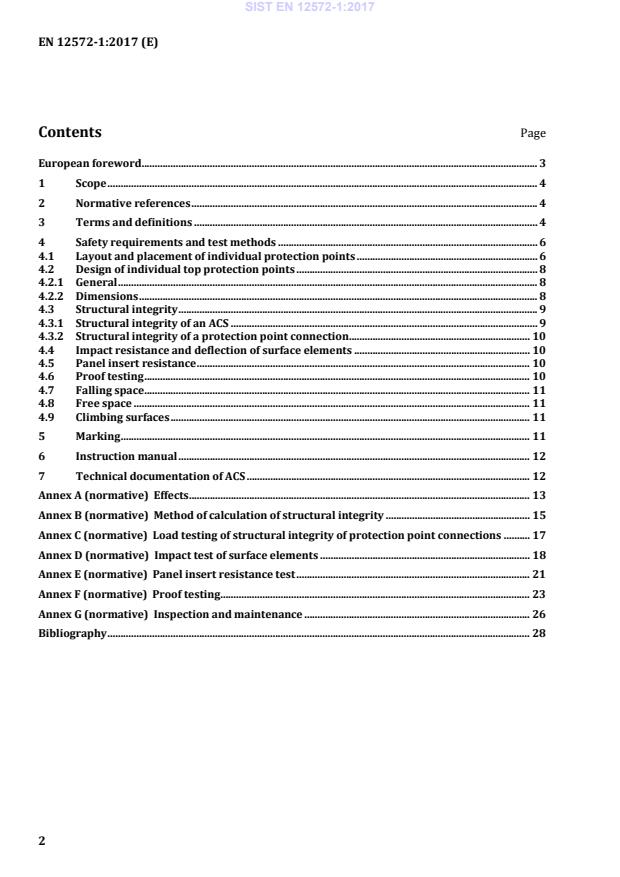
s t w y tæ sã t r s y ESIST EN 12572-1:2017
Effects . 13 Annex B (normative)
Method of calculation of structural integrity . 15 Annex C (normative)
Load testing of structural integrity of protection point connections . 17 Annex D (normative)
Impact test of surface elements . 18 Annex E (normative)
Panel insert resistance test . 21 Annex F (normative)
Proof testing . 23 Annex G (normative)
Inspection and maintenance . 26 Bibliography . 28
¶ 4 m; — 1,10 m for h > 4 m; — 1,20 m for h > 5 m; — 1,30 m for h > 6 m; — 1,40 m for h > 7 m; — 1,50 m for h > 8 m; — 2,00 m for h > 10 m. The distance x may have a tolerance of 10 %. h is the distance between the point and the ground measured vertically, in metres, beneath the point in all cases. For protection points, the maximum distance shall be measured from the lowest internal point of the attachment point. If permanent quick draws are installed, the maximum distance shall be measured from lower quick draw end to lower quick draw end. A permanent quick draw (e.g. chain secure element, Maillon Rapide) shall be disassembled from the climbing wall by means of tools (see Figure 2). Protection points attached with bolts shall be secured, so they cannot come undone, e.g. with lock nuts. SIST EN 12572-1:2017
a) b) Figure 1 — Layout of protection points
a) b) Figure 2 — Design and placement of permanent quick draws SIST EN 12572-1:2017
Figure 3 — Design of individual protection points SIST EN 12572-1:2017
Figure 4 — Rounding of parts 4.3 Structural integrity 4.3.1 Structural integrity of an ACS The structural integrity and stability of an ACS shall be justified by calculation using the characteristic loads given in Table A.1, in accordance with Annexes A, B and Figure 5. Ensure that the structure (e.g. building, concrete platform and ground) can safely accommodate the loads imposed by the ACS. Permanent protection points shall be calculated in accordance with Annexes A and B (e.g. glued protection points in concrete walls). Non-permanent protection points shall have a breaking strength in the main load direction of a minimum of 20 kN. SIST EN 12572-1:2017
NOTE The larger arrow indicates 6,6 kN. The smaller arrow indicates 1,6 kN. Figure 5 — Placement of the loads on collective protection systems 4.3.2 Structural integrity of a protection point connection All elements of an ACS shall be justified by calculation, however in exceptional cases for protection point connections only (the assembly that attaches the actual protection point to the sub frame), a load test as described in Annex C is acceptable as a method of evaluation. After applying the design load to the protection point connection there shall be no permanent deformation. After applying the breaking load to the protection point connection there shall be no breakage. 4.4 Impact resistance and deflection of surface elements When tested in accordance with Annex D, there shall be no breaking or splitting of any surface element. The deflection of the panels shall be calculated by using the load 0,8 kN (see Annex A) or be tested in accordance with Annex D, D.5. When fixed according to the manufacturer's specification, the maximum deflection of the surface element shall not exceed l/100:
where
l is the maximum length between the fixations of the surface. 4.5 Panel insert resistance To evaluate the panel insert concerning the resistance to breakage while mounting the climbing holds onto the wall or during climbing use, the panel inserts shall be tested in accordance with Annex E. After test step c) any resulting deformation shall not exceed 0,5 mm at 1,2 kN. After procedure e) there shall be no pull out of the panel insert. Five samples (panel-insert combination) shall be tested. 4.6 Proof testing When tested in accordance with Annex F, after settling under load there shall be no breaking, tearing or destruction of the elements after testing. SIST EN 12572-1
...