


EN 13232-6:2023
(Main)Railway applications - Track - Switches and crossings for Vignole rails - Part 6: Fixed common and obtuse crossings
Railway applications - Track - Switches and crossings for Vignole rails - Part 6: Fixed common and obtuse crossings
This document:
— Establish a working terminology for fixed crossings and their constituent parts, and identifies the main types;
— specifies the different and varying ways by which crossings can be described using the following parameters:
— geometry of the crossing;
— types of construction;
— design criteria;
— manufacturing processes;
— tolerances and inspection.
Bahnanwendungen - Oberbau - Weichen und Kreuzungen für Vignolschienen - Teil 6: Starre einfache und doppelte Herzstücke
Dieses Dokument:
legt Fachbegriffe für Herzstücke und ihre einzelnen Bauteile fest und benennt ihre Hauptteile;
führt die verschiedenen Möglichkeiten auf, nach denen Herzstücke unter Verwendung der folgenden Parameter beschrieben werden können:
Geometrie des Herzstücks;
Bauarten;
Konstruktionskriterien;
Herstellverfahren;
Grenzabweichungen und Abnahme.
Applications ferroviaires - Voie - Appareils de voie pour rails Vignole - Partie 6 : Cœurs de croisement et de traversée à pointes fixes
Le présent document :
— établit une terminologie pour les cœurs à pointes fixes et leurs constituants, et identifie les principaux types de cœurs ;
— spécifie les différents moyens de décrire les cœurs à l'aide des paramètres suivants :
— géométrie des cœurs ;
— types de construction ;
— critères de conception ;
— procédés de fabrication ;
— tolérances et inspection.
Železniške naprave - Zgornji ustroj proge - Kretnice in križišča za Vignolove tirnice - 6. del: Kretniška srca
Področje uporabe tega evropskega standarda vključuje:
– vzpostavitev delovne terminologije za kretniška srca in njihove sestavne dele ter opredelitev glavnih vrst;
– določitev različnih načinov, s katerimi je mogoče opisati kretniška srca z uporabo teh parametrov:
– geometrijo kretniškega srca;
– vrste konstrukcije;
– merila za projektiranje;
– proizvodne procese;
– tolerance in pregled.
General Information
- Status
- Published
- Publication Date
- 10-Oct-2023
- Technical Committee
- CEN/TC 256 - Railway applications
- Current Stage
- 6060 - Definitive text made available (DAV) - Publishing
- Start Date
- 11-Oct-2023
- Due Date
- 14-Apr-2021
- Completion Date
- 11-Oct-2023
Relations
- Effective Date
- 31-Oct-2018
- Effective Date
- 28-Jan-2026
- Effective Date
- 28-Jan-2026
- Effective Date
- 28-Jan-2026
- Effective Date
- 28-Jan-2026
- Effective Date
- 28-Jan-2026
- Effective Date
- 28-Jan-2026
- Effective Date
- 28-Jan-2026
- Effective Date
- 28-Jan-2026
- Refers
EN 13230-6:2020 - Railway applications - Track - Concrete sleepers and bearers - Part 6: Design - Effective Date
- 28-Jan-2026
- Effective Date
- 28-Jan-2026
- Effective Date
- 28-Jan-2026
- Effective Date
- 28-Jan-2026
- Effective Date
- 28-Jan-2026
- Effective Date
- 28-Jan-2026
Overview
EN 13232-6:2023 is the CEN European standard for railway switches and crossings for Vignole rails, specifically covering fixed common and obtuse crossings (fixed common and obtuse crossings). This Part 6 document establishes a working terminology, defines the main types of crossings, and specifies how crossings should be described and assessed using consistent parameters such as geometry, construction type, design criteria, manufacturing processes, tolerances and inspection. It supersedes EN 13232-6:2005+A1:2011 and forms part of the EN 13232 series for switches and crossings.
Key topics and technical requirements
- Terminology and parts: clear definitions for components (vee, wing/wing rail, splice rail, heel, apron, crossing nose, transfer area, wing wheel riser, etc.) and types (common crossing, straight/curved common, obtuse crossing, set of obtuse crossings).
- Geometry: standard ways to describe crossing geometry and crossing angle measurement (note: an obtuse crossing is defined where the angle at the theoretical intersection point is greater than 90°).
- Design requirements: geometric data, construction options (assembled, monobloc, welded legs), joints, supports and fastenings, rolling stock data (axle load, max speed), and drawing requirements.
- Materials and manufacturing: material specifications for assembled and monobloc crossings, manufacturing processes and quality measures.
- Tolerances and inspection: tools and instruments, critical dimensions, inspection methods, certification and procedures for detecting structural defects.
- Performance and safety: performance requirements to ensure reliable wheel/rail interaction and long-term serviceability of fixed crossings.
- Regulatory alignment: informative Annex ZA links the standard to EU Directive (EU) 2016/797 on railway interoperability.
Practical applications and users
Who uses EN 13232-6:2023:
- Track designers and railway engineers specifying fixed common and obtuse crossings in layouts.
- Manufacturers producing crossing components and monobloc panels to standardized tolerances and material rules.
- Maintenance and inspection teams applying the standard’s inspection criteria and defect-examination methods.
- Procurement and quality assurance professionals using consistent terminology and acceptance criteria.
- Rail infrastructure managers ensuring interoperability, safety and compliance with CEN/CENELEC rules and EU legislation.
Benefits:
- Harmonised terminology and geometry descriptions reduce design ambiguity.
- Clear tolerances and inspection procedures improve reliability, lifecycle planning and safety.
- Facilitates interoperability across national networks and suppliers.
Related standards
EN 13232-6 is part of the EN 13232 series (Parts 1–9). Normative references include:
- EN 13232-1/2/3/5 and other Parts in the switch and crossing series
- EN 13674 series (rail profiles)
- EN 13481 series (fastening systems)
- EN 13230 (concrete sleepers and bearers)
Keywords: EN 13232-6:2023, fixed crossings, obtuse crossings, Vignole rails, switches and crossings, railway track standard, geometry, tolerances, inspection, CEN.

Get Certified
Connect with accredited certification bodies for this standard

Zavod za gradbeništvo Slovenije (ZAG) - Inšpekcija
ZAG inspection body for construction products, structures, and materials.
Sponsored listings
Frequently Asked Questions
EN 13232-6:2023 is a standard published by the European Committee for Standardization (CEN). Its full title is "Railway applications - Track - Switches and crossings for Vignole rails - Part 6: Fixed common and obtuse crossings". This standard covers: This document: — Establish a working terminology for fixed crossings and their constituent parts, and identifies the main types; — specifies the different and varying ways by which crossings can be described using the following parameters: — geometry of the crossing; — types of construction; — design criteria; — manufacturing processes; — tolerances and inspection.
This document: — Establish a working terminology for fixed crossings and their constituent parts, and identifies the main types; — specifies the different and varying ways by which crossings can be described using the following parameters: — geometry of the crossing; — types of construction; — design criteria; — manufacturing processes; — tolerances and inspection.
EN 13232-6:2023 is classified under the following ICS (International Classification for Standards) categories: 93.100 - Construction of railways. The ICS classification helps identify the subject area and facilitates finding related standards.
EN 13232-6:2023 has the following relationships with other standards: It is inter standard links to EN 13232-6:2005+A1:2011, EN 13674-2:2019, EN 13481-3:2022, EN 13230-1:2016, EN 13674-1:2011+A1:2017, EN 13481-5:2022, EN 13481-2:2022, EN 13230-4:2016+A1:2020, EN 13481-1:2012, EN 13230-6:2020, EN 13481-4:2022, EN 13232-1:2023, EN 13232-2:2023, EN 15689:2009, EN 13481-7:2022. Understanding these relationships helps ensure you are using the most current and applicable version of the standard.
EN 13232-6:2023 is associated with the following European legislation: EU Directives/Regulations: 2008/57/EC, 2016/797/EU; Standardization Mandates: M/483, M/591. When a standard is cited in the Official Journal of the European Union, products manufactured in conformity with it benefit from a presumption of conformity with the essential requirements of the corresponding EU directive or regulation.
EN 13232-6:2023 is available in PDF format for immediate download after purchase. The document can be added to your cart and obtained through the secure checkout process. Digital delivery ensures instant access to the complete standard document.
Standards Content (Sample)
SLOVENSKI STANDARD
01-december-2023
Železniške naprave - Zgornji ustroj proge - Kretnice in križišča za Vignolove tirnice
- 6. del: Kretniška srca
Railway applications - Track - Switches and crossings for Vignole rails - Part 6: Fixed
common and obtuse crossings
Bahnanwendungen - Oberbau - Weichen und Kreuzungen für Vignolschienen - Teil 6:
Starre einfache und doppelte Herzstücke
Applications ferroviaires - Infrastructure - Appareils de voie - Partie 6: Curs de
croisement et de traversée à pointes fixes
Ta slovenski standard je istoveten z: EN 13232-6:2023
ICS:
45.080 Tračnice in železniški deli Rails and railway
components
2003-01.Slovenski inštitut za standardizacijo. Razmnoževanje celote ali delov tega standarda ni dovoljeno.
EN 13232-6
EUROPEAN STANDARD
NORME EUROPÉENNE
October 2023
EUROPÄISCHE NORM
ICS 93.100 Supersedes EN 13232-6:2005+A1:2011
English Version
Railway applications - Track - Switches and crossings for
Vignole rails - Part 6: Fixed common and obtuse crossings
Applications ferroviaires - Voie - Appareils de voie Bahnanwendungen - Oberbau - Weichen und
pour rails Vignole - Partie 6 : Cœurs de croisement et Kreuzungen für Vignolschienen - Teil 6: Starre einfache
de traversée à pointes fixes und doppelte Herzstücke
This European Standard was approved by CEN on 23 October 2022.
CEN members are bound to comply with the CEN/CENELEC Internal Regulations which stipulate the conditions for giving this
European Standard the status of a national standard without any alteration. Up-to-date lists and bibliographical references
concerning such national standards may be obtained on application to the CEN-CENELEC Management Centre or to any CEN
member.
This European Standard exists in three official versions (English, French, German). A version in any other language made by
translation under the responsibility of a CEN member into its own language and notified to the CEN-CENELEC Management
Centre has the same status as the official versions.
CEN members are the national standards bodies of Austria, Belgium, Bulgaria, Croatia, Cyprus, Czech Republic, Denmark, Estonia,
Finland, France, Germany, Greece, Hungary, Iceland, Ireland, Italy, Latvia, Lithuania, Luxembourg, Malta, Netherlands, Norway,
Poland, Portugal, Republic of North Macedonia, Romania, Serbia, Slovakia, Slovenia, Spain, Sweden, Switzerland, Türkiye and
United Kingdom.
EUROPEAN COMMITTEE FOR STANDARDIZATION
COMITÉ EUROPÉEN DE NORMALISATION
EUROPÄISCHES KOMITEE FÜR NORMUNG
CEN-CENELEC Management Centre: Rue de la Science 23, B-1040 Brussels
© 2023 CEN All rights of exploitation in any form and by any means reserved Ref. No. EN 13232-6:2023 E
worldwide for CEN national Members.
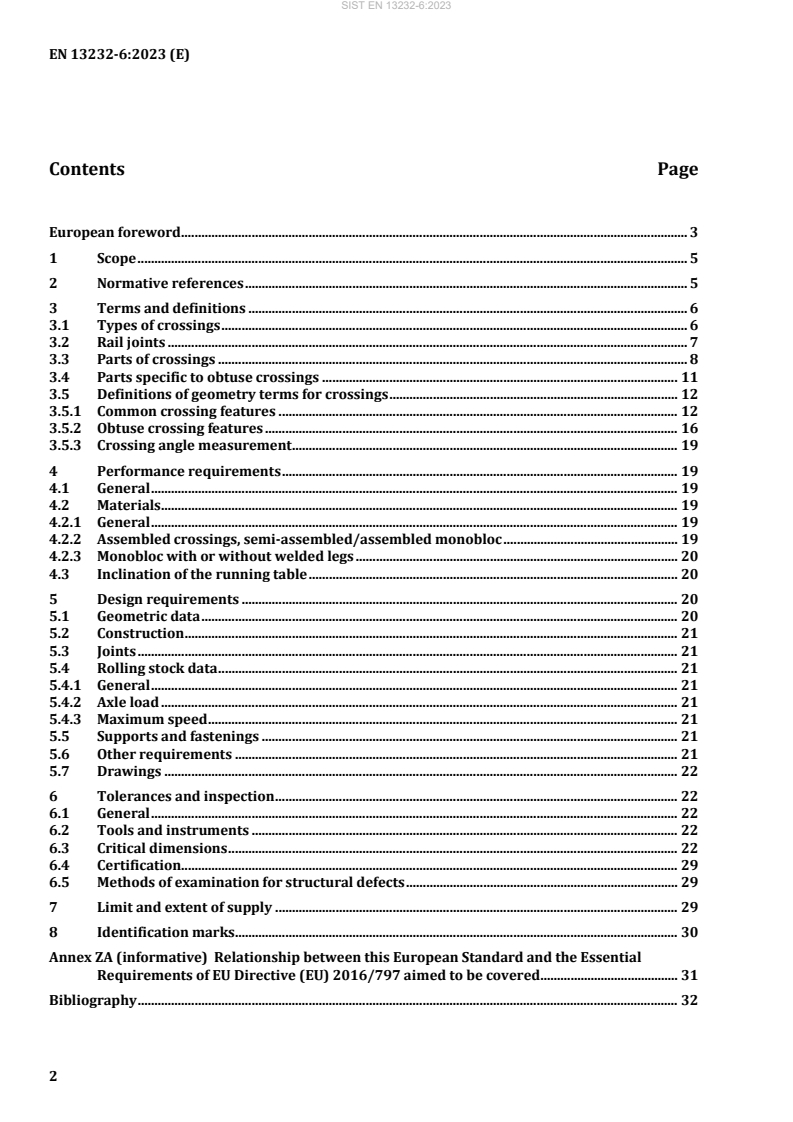
Contents Page
European foreword . 3
1 Scope . 5
2 Normative references . 5
3 Terms and definitions . 6
3.1 Types of crossings . 6
3.2 Rail joints . 7
3.3 Parts of crossings . 8
3.4 Parts specific to obtuse crossings . 11
3.5 Definitions of geometry terms for crossings . 12
3.5.1 Common crossing features . 12
3.5.2 Obtuse crossing features . 16
3.5.3 Crossing angle measurement . 19
4 Performance requirements . 19
4.1 General . 19
4.2 Materials . 19
4.2.1 General . 19
4.2.2 Assembled crossings, semi-assembled/assembled monobloc . 19
4.2.3 Monobloc with or without welded legs . 20
4.3 Inclination of the running table . 20
5 Design requirements . 20
5.1 Geometric data . 20
5.2 Construction . 21
5.3 Joints . 21
5.4 Rolling stock data . 21
5.4.1 General . 21
5.4.2 Axle load . 21
5.4.3 Maximum speed . 21
5.5 Supports and fastenings . 21
5.6 Other requirements . 21
5.7 Drawings . 22
6 Tolerances and inspection . 22
6.1 General . 22
6.2 Tools and instruments . 22
6.3 Critical dimensions . 22
6.4 Certification . 29
6.5 Methods of examination for structural defects . 29
7 Limit and extent of supply . 29
8 Identification marks. 30
Annex ZA (informative) Relationship between this European Standard and the Essential
Requirements of EU Directive (EU) 2016/797 aimed to be covered . 31
Bibliography . 32
European foreword
This document (EN 13232-6:2023) has been prepared by Technical Committee CEN/TC 256 “Railway
applications”, the secretariat of which is held by DIN.
This European Standard shall be given the status of a national standard, either by publication of an
identical text or by endorsement, at the latest by April 2024, and conflicting national standards shall be
withdrawn at the latest by April 2024.
Attention is drawn to the possibility that some of the elements of this document may be the subject of
patent rights. CEN shall not be held responsible for identifying any or all such patent rights.
This document supersedes EN 13232-6:2005+A1:2011.
This series of standards “Railway applications – Track – Switches and crossings for Vignole rails” covers
the design and quality of switches and crossings in flat bottomed rail. The list of Parts is as follows:
— Part 1: Definitions
— Part 2: Requirements for geometric design
— Part 3: Requirements for wheel/rail interaction
— Part 4: Actuation, locking and detection
— Part 5: Switches
— Part 6: Fixed common and obtuse crossings
— Part 7: Crossings with moveable parts
— Part 8: Expansion devices
— Part 9: Layouts
Part 1 contains terminology used throughout all parts of this series. Parts 2 to 4 contain basic design
guides and are applicable to all switch and crossing assemblies. Parts 5 to 8 deal with particular types of
equipment including their tolerances. These use Parts 1 to 4 as a basis. Part 9 defines the geometric and
non-geometric acceptance criteria for inspection of layouts.
The changes introduced in this document bring further detail and clarity to the requirements and a
number of the figures, the structure of the document is largely unchanged from the previous revision.
This document has been prepared under a standardisation request addressed to [the relevant ESO] by
the European Commission. The Standing Committee of the EFTA States subsequently approves these
requests for its Member States.
For the relationship with EU Legislation, see informative Annex ZA, which is an integral part of this
document.
Any feedback and questions on this document should be directed to the users’ national standards body.
A complete listing of these bodies can be found on the CEN website.
According to the CEN-CENELEC Internal Regulations, the national standards organisations of the
following countries are bound to implement this European Standard: Austria, Belgium, Bulgaria,
Croatia, Cyprus, Czech Republic, Denmark, Estonia, Finland, France, Germany, Greece, Hungary, Iceland,
Ireland, Italy, Latvia, Lithuania, Luxembourg, Malta, Netherlands, Norway, Poland, Portugal, Republic of
North Macedonia, Romania, Serbia, Slovakia, Slovenia, Spain, Sweden, Switzerland, Türkiye and the
United Kingdom.
1 Scope
This document:
— establishes a working terminology for fixed crossings and their constituent parts, and identifies the
main types;
— specifies the different and varying ways by which crossings can be described using the following
parameters:
— geometry of the crossing;
— types of construction;
— design criteria;
— manufacturing processes;
— tolerances and inspection.
2 Normative references
The following documents are referred to in the text in such a way that some or all of their content
constitutes requirements of this document. For dated references, only the edition cited applies. For
undated references, the latest edition of the referenced document (including any amendments) applies.
EN 13232-1:2023, Railway applications – Track – Switches and crossings for Vignole rails – Part 1:
Definitions
EN 13232-2:2023, Railway applications – Track – Switches and crossings for Vignole rails – Part 2:
Requirements for geometric design
EN 13232-3:2023, Railway applications – Track – Switches and crossings for Vignole rails – Part 3:
Requirements for wheel/rail interaction
EN 13674-1:2011+A1:2017, Railway applications - Track - Rail - Part 1: Vignole railway rails 46 kg/m
and above
EN 13674-2:2019, Railway applications - Track - Rail - Part 2: Switch and crossing rails used in
conjunction with Vignole railway rails 46 kg/m and above
EN 13674-3:2006+A1:2010, Railway applications - Track - Rail - Part 3: Check rails
EN 13674-4:2019, Railway applications - Track - Rail - Part 4: Vignole railway rails from 27 kg/m to, but
excluding 46 kg/m
EN 13803:2017, Railway applications - Track - Track alignment design parameters - Track gauges 1 435
mm and wider
EN 15689:2009, Railway applications - Track - Switches and crossings - Crossing components made of cast
austenitic manganese steel
EN 13481-1:2012, Railway applications - Track - Performance requirements for fastening systems - Part
1: Definitions
EN 13481-2:2022, Railway applications - Track - Performance requirements for fastening systems - Part
2: Fastening systems for concrete sleepers
EN 13481-3:2022, Railway applications - Track - Performance requirements for fastening systems - Part
3: Fastening systems for wood sleepers
EN 13481-4:2022, Railway applications - Track - Performance requirements for fastening systems - Part
4: Fastening systems for steel sleepers
EN 13481-5:2022, Railway applications - Track - Performance requirements for fastening systems - Part
5: Fastening systems for slab track with rail on the surface or rail embedded in a channel
EN 13481-7:2022, Railway applications - Track - Performance requirements for fastening systems - Part
7: Special fastening systems for switches and crossings and check rails
EN 13230-1:2016, Railway applications - Track - Concrete sleepers and bearers - Part 1: General
requirements
EN 13230-2:2016, Railway applications - Track - Concrete sleepers and bearers - Part 2: Prestressed
monoblock sleepers
EN 13230-3:2016, Railway applications - Track - Concrete sleepers and bearers - Part 3: Twin-block
reinforced sleepers
EN 13230-4:2016+A1:2020, Railway applications - Track - Concrete sleepers and bearers - Part 4:
Prestressed bearers for switches and crossings
EN 13230-5:2016, Railway applications - Track - Concrete sleepers and bearers - Part 5: Special elements
EN 13230-6:2020, Railway applications - Track - Concrete sleepers and bearers - Part 6: Design
3 Terms and definitions
For the purpose of this document the terms and definitions given in EN 13232-1:2023 apply.
ISO and IEC maintain terminological databases for use in standardization at the following addresses:
— ISO Online browsing platform: available at https://www.iso.org/obp
— IEC Electropedia: available at http://www.electropedia.org/
3.1 Types of crossings
3.1.1
common crossing
element in switch and crossing work where the intersecting running rails cross one another at an acute
angle
Note 1 to entry: see Figures 1 and 2, see also Figure 3 for the parts of a common crossing.
3.1.2
straight common crossing
common crossing where both the through route and turnout route is straight
Note 1 to entry: see Figure 1
3.1.3
curved common crossing
common crossing with a curved diverging route; designated as ordinary or double junction type
depending on the direction of curvature
3.1.3.1
ordinary
common crossing with diverging route curved to radius R as shown in Figure 1
Key
1 Radius R
2 Radius R or straight
Figure 1 — Common crossing
3.1.3.2
double junction type
common crossing with diverging route curved to radius R as shown in Figure 2
Figure 2 — Common crossing, double junction type
3.1.3.3
non-standard
common crossing with other forms of curvature
3.1.4
obtuse crossing
crossing in which the angle subtended at the theoretical intersection point (IP) is greater than 90°
3.1.4.1
set of obtuse crossings
pair of obtuse crossings placed such that the routes are a distance apart equal to track gauge
3.2 Rail joints
3.2.1
vee leg
extension of the vee of a crossing in standard rail profile
3.2.2
wing front
extension of the wing of a crossing in standard rail profile
3.3 Parts of crossings
3.3.1
vee
parts of the crossing forming the shape of a letter “V” which forms support to the wheels
3.3.2
transfer area
area over which the wheel transfers its load from one running surface to another
3.3.3
heel of crossing
physical end of the common crossing vee at its open end
3.3.4
apron
plate between two rail sections at wing front or vee end
3.3.5
wing wheel riser
raised part of the wing rail to lift the wheel over the crossing nose
3.3.6
back of wheel ramp
ramp provided to accommodate worn wheels from causing undue damage to the crossing
3.3.7
wing entry ramp
ramp provided to accommodate worn wheels from causing undue damage to the crossing when a
vehicle is travelling towards the nose from the heel, i.e. trailing
3.3.8
point rail
rail in a built-up crossing which when machined forms the crossing nose
Key
1 Common crossing 9 Crossing vee
2 Crossing nose 10 Crossing baseplate
3 Outside rail 11 Block
4 Check rail strut 12 Point rail
5 Check rail 13 Splice rail
6 Check rail support 14 Heel of crossing
7 Left hand wing (rail) 15 Bearers
8 Right hand wing (rail)
Figure 3 — Parts of common crossing panel
3.3.9
splice rail
rail in a built-up crossing which is spliced into the point rail, forming the crossing vee
Note 1 to entry: The crossing is described as “left hand splice” or “right hand splice” depending on the splice
position when the observer is facing the nose from the wing front.
3.3.10
wing or wing rail
outer part of the common crossing which supports and guides the wheels across the flangeway gap
3.3.10.1
left hand wing
wing to the left hand side of the crossing nose when facing the nose from the wing front
3.3.10.2
right hand wing
wing to the right hand side of the crossing nose when facing the nose from the wing front
3.3.11
outside rail
running rail opposite the crossing at a distance of track gauge away
3.3.12
check or check rail
special section bar ensuring (by guidance of the wheel) the safe passage of the axle opposite the neck
gap of the common crossing
3.3.13
check rail strut
part joining the common crossing to the check rail ensuring the maintenance of the correct position of
the check rail relative to the crossing nose
3.3.14
check rail support
part supporting the check rail
3.3.15
vee block
block between the vee rails or the point and splice rails in a built-up crossing towards the heel end of
the crossing
3.3.16
throat block
block between the wing rails at the throat position
3.3.17
wing front block
block between the two wing rails in front of the throat
3.3.18
flangeway block
block between the wing rails and vee forming the flangeway
3.3.19
block bolts or fasteners
mechanical device used to clamp blocks in position
3.3.20
web washer
washer used to give a flat suitable face for the bolt or fastener head and nut
3.3.21
fishing recess
recess in the rail or casting profile to permit the use of fishplates to form a joint
3.3.22
fishbolt hole
hole to permit the use of bolts when clamping rail joints using fishplates
3.3.23
bonding
provision for the use of an electrical connection to the crossing for track circuitry
3.4 Parts specific to obtuse crossings
3.4.1
obtuse crossing panel
arrangement in a layout that ensures the continuity of two routes, the corresponding running edges of
which intersect, and consisting of two obtuse crossings, complete with small fittings, and assembled
together usually with bearers. It is the central part of a diamond crossing
Key
1 Obtuse crossing 6 Check (rail)
2 Obtuse crossing baseplate 7 Knuckle
3 Left hand point (rail) 8 Block
4 Right hand point (rail) 9 Bearer
5 Wing (rail)
Figure 4 — Parts of obtuse crossing panel
Note 1 to entry: For an observer placed on the axis of symmetry of the obtuse crossing facing the wing rail from
outside the track (direction of the arrow) - all components to the left are “left hand”, all the components to the
right are “right hand”. See Figure 4.
3.4.2
knuckle
theoretical intersection of the running edges
3.4.3
nose of point rails
two parts of the crossing forming the running rail vees and supporting the wheels
3.4.4
obtuse wing rail
part of the crossing with horizontal set forming the running rail support between the point rail ends
3.4.5
check or check rail
part of the obtuse crossing ensuring (by guidance of the wheel) the safe passage of the axle between the
obtuse point rails
3.4.6
raised check
check rail is raised above the level of the running table to give increased guidance to the wheel when
passing through the knuckle area of an obtuse crossing
3.4.7
spliced check rail
extra check rail spliced into the back of the point rail to form a vee to provide additional guidance
particularly on sharp curve
3.4.8
neck block
block at the knuckle of the crossing
3.5 Definitions of geometry terms for crossings
3.5.1 Common crossing features
NOTE The following terms relate to common crossings and their check (rails). See Figure 5.
3.5.1.1
overall crossing length
length between the furthest wing front joint from the nose and the furthest vee joint from the nose
3.5.1.2
angle of crossing heel
acute angle formed by the tangents to the centre-lines of the two tracks measured at the heel of the
crossing
Note 1 to entry: See Figure 6
3.5.1.3
angle of crossing vee
acute angle formed by the intersection of the running edges of the two tracks measured at the
intersection point
Note 1 to entry: For curved crossings, the tangent to the curve at the Intersection Point is used. See Figure 7
Key
1 Overall length 9 Wing front opening 17 Running edges
2 Wing front 10 Vee opening 18 Crossing Angle
3 Vee 11 Fishing recess 19 Wing entry ramp
4 Throat opening 12 Left hand wing 20 Flangeway width
5 Elevation of nose 13 Right
...
Questions, Comments and Discussion
Ask us and Technical Secretary will try to provide an answer. You can facilitate discussion about the standard in here.
Loading comments...