

EN 12037:2022
(Main)Wood preservatives - Field test method for determining the relative protective effectiveness of a wood preservative exposed out of ground contact - Horizontal lap-joint method
- Abstract
This document specifies a test method for wood preservatives that are intended for use in wood to be exposed to the weather out of contact with the ground without the additional protection of a surface coating.
The method is applicable to the testing of commercial or experimental preservatives applied by techniques appropriate to commercial practice. The method is applicable to chemical products used individually or in combination to prevent the development of decay and/or - optional - the development of disfiguring organisms in wood and, where suitable, in wood-based materials.
NOTE 1 The method can also be used to test other treated wood species and naturally durable timbers. It can be adapted for testing the field performance of other wood-based systems and treatments designed to enhance durability, for example treated or untreated wood based composites, timber treated with non-biocidal systems, chemically modified or heat treated timber. Guidance on samples and sampling of naturally durable wood and modified wood is found in EN 350.
NOTE 2 Although the test is used to assess decay, it is possible to use the method to additionally assess stain or each separately when relevant.
- Status
- Published
- Publication Date
- 29-Nov-2022
- Technical Committee
- CEN/TC 38 - Durability of wood and derived materials
- Drafting Committee
- CEN/TC 38/WG 25 - External Factors and Preconditioning
- Current Stage
- 6060 - Definitive text made available (DAV) - Publishing
- Start Date
- 30-Nov-2022
- Due Date
- 10-Jun-2022
- Completion Date
- 30-Nov-2022



Overview
EN 12037:2022 - Wood preservatives: Field test method for determining the relative protective effectiveness of a wood preservative exposed out of ground contact - Horizontal lap-joint method (CEN, Nov 2022) defines a practical outdoor test to evaluate how well wood preservatives protect timber exposed to weather but not in contact with soil. The method uses jointed test specimens (horizontal lap-joints) exposed under natural conditions and rated over time for decay and, optionally, staining or other disfiguring organisms.
Key topics and technical requirements
- Test specimens (lap-joints): Jointed overlapping members assembled horizontally and mechanically fixed; prepared from recommended wood species (e.g., Scots pine sapwood) or other timbers as appropriate.
- Treatment and application: Applicable to commercial or experimental preservatives applied by realistic commercial techniques (brushing, spraying, dipping, vacuum processes, etc.). Annex A provides model treatment methods and guidance.
- Retention and application rate: Recording target retention or supplier-recommended application rate for superficial processes; retention measurement required.
- End-sealing, conditioning and labeling: Initial and final end sealing of specimens, post-treatment conditioning, and clear labeling prior to exposure are mandatory.
- Controls and comparators: Untreated control lap-joints are used to compare natural decay progression and establish relative protective effectiveness. Annex A also covers reference preservatives for benchmarking.
- Exposure site and installation: Selection and installation of outdoor test field to reflect intended service conditions; climatic variations are acknowledged and accounted for by using untreated controls. Annex D gives further test field guidance.
- Inspection and assessment: Periodic dismantling and standardized rating of decay extent on external surfaces and within joint areas using the specified grading system; optional assessment for staining fungi (Annex C).
- Duration, validity and reporting: Test duration, criteria for validity, and required test report contents are specified (see Clause 13–15 and Annex B for report examples).
Practical applications and who uses this standard
- Manufacturers and suppliers of wood preservatives for product development, performance claims, and quality control.
- Independent test laboratories conducting field exposure durability tests.
- Regulatory and certification bodies assessing preservative efficacy for market authorization and labeling.
- Timber treatment plants and R&D teams developing new treatment processes (penetrating or superficial).
- Specifiers, architects and engineers who need documented performance evidence for timber used out of ground contact.
Related standards
- EN 350 - Guidance on species selection, naturally durable wood and modified wood sampling (referenced in EN 12037 notes).
- EN 12037:2022 supersedes CEN/TS 12037:2003 and should be used for current field-performance evaluation of preservatives and treated wood exposed out of ground contact.
Keywords: EN 12037:2022, wood preservatives, horizontal lap-joint method, field test method, out of ground contact, wood durability, decay testing, staining fungi.
Relations
- Effective Date
- 07-Dec-2022
- Effective Date
- 28-Jan-2026
- Effective Date
- 28-Jan-2026
Get Certified
Connect with accredited certification bodies for this standard

ECOCERT
Organic and sustainability certification.

Eurofins Food Testing Global
Global leader in food, environment, and pharmaceutical product testing.

Intertek Bangladesh
Intertek certification and testing services in Bangladesh.
Sponsored listings
Frequently Asked Questions
EN 12037:2022 is a standard published by the European Committee for Standardization (CEN). Its full title is "Wood preservatives - Field test method for determining the relative protective effectiveness of a wood preservative exposed out of ground contact - Horizontal lap-joint method". This standard covers: This document specifies a test method for wood preservatives that are intended for use in wood to be exposed to the weather out of contact with the ground without the additional protection of a surface coating. The method is applicable to the testing of commercial or experimental preservatives applied by techniques appropriate to commercial practice. The method is applicable to chemical products used individually or in combination to prevent the development of decay and/or - optional - the development of disfiguring organisms in wood and, where suitable, in wood-based materials. NOTE 1 The method can also be used to test other treated wood species and naturally durable timbers. It can be adapted for testing the field performance of other wood-based systems and treatments designed to enhance durability, for example treated or untreated wood based composites, timber treated with non-biocidal systems, chemically modified or heat treated timber. Guidance on samples and sampling of naturally durable wood and modified wood is found in EN 350. NOTE 2 Although the test is used to assess decay, it is possible to use the method to additionally assess stain or each separately when relevant.
This document specifies a test method for wood preservatives that are intended for use in wood to be exposed to the weather out of contact with the ground without the additional protection of a surface coating. The method is applicable to the testing of commercial or experimental preservatives applied by techniques appropriate to commercial practice. The method is applicable to chemical products used individually or in combination to prevent the development of decay and/or - optional - the development of disfiguring organisms in wood and, where suitable, in wood-based materials. NOTE 1 The method can also be used to test other treated wood species and naturally durable timbers. It can be adapted for testing the field performance of other wood-based systems and treatments designed to enhance durability, for example treated or untreated wood based composites, timber treated with non-biocidal systems, chemically modified or heat treated timber. Guidance on samples and sampling of naturally durable wood and modified wood is found in EN 350. NOTE 2 Although the test is used to assess decay, it is possible to use the method to additionally assess stain or each separately when relevant.
EN 12037:2022 is classified under the following ICS (International Classification for Standards) categories: 71.100.50 - Wood-protecting chemicals. The ICS classification helps identify the subject area and facilitates finding related standards.
EN 12037:2022 has the following relationships with other standards: It is inter standard links to CEN/TS 12037:2003, EN ISO 15253:2021, CEN/TS 15679:2007. Understanding these relationships helps ensure you are using the most current and applicable version of the standard.
EN 12037:2022 is associated with the following European legislation: EU Directives/Regulations: 305/2011. When a standard is cited in the Official Journal of the European Union, products manufactured in conformity with it benefit from a presumption of conformity with the essential requirements of the corresponding EU directive or regulation.
EN 12037:2022 is available in PDF format for immediate download after purchase. The document can be added to your cart and obtained through the secure checkout process. Digital delivery ensures instant access to the complete standard document.
Standards Content (Sample)
SLOVENSKI STANDARD
01-marec-2023
Nadomešča:
SIST-TS CEN/TS 12037:2005
Zaščitna sredstva za les - Terenska preskusna metoda za ugotavljanje relativne
preventivne učinkovitosti biocidnega proizvoda za zaščito lesa nad zemljo -
Metoda z vodoravnim preklopnim spojem
Wood preservatives - Field test method for determining the relative protective
effectiveness of a wood preservative exposed out of ground contact - Horizontal lap-joint
method
Holzschutzmittel - Freilandprüfung zur Bestimmung der relativen Wirksamkeit eines
Holzschutzmittels ohne Erdkontakt - Verfahren mit horizontaler Überblattung (Lap-Joint)
Produits de préservation du bois - Méthode d'essai sur le terrain pour déterminer
l'efficacité protectrice relative d'un produit de préservation du bois sans contact avec le
sol - Méthode avec un assemblage à joint superposé
Ta slovenski standard je istoveten z: EN 12037:2022
ICS:
71.100.50 Kemikalije za zaščito lesa Wood-protecting chemicals
2003-01.Slovenski inštitut za standardizacijo. Razmnoževanje celote ali delov tega standarda ni dovoljeno.
EN 12037
EUROPEAN STANDARD
NORME EUROPÉENNE
November 2022
EUROPÄISCHE NORM
ICS 71.100.50 Supersedes CEN/TS 12037:2003
English Version
Wood preservatives - Field test method for determining
the relative protective effectiveness of a wood
preservative exposed out of ground contact - Horizontal
lap-joint method
Produits de préservation du bois - Méthode d'essai sur Holzschutzmittel - Freilandprüfung zur Bestimmung
le terrain pour déterminer l'efficacité protectrice der relativen Wirksamkeit eines Holzschutzmittels
relative d'un produit de préservation du bois sans ohne Erdkontakt - Verfahren mit horizontaler
contact avec le sol - Méthode avec un assemblage à Überblattung (Lap-Joint)
joint superposé
This European Standard was approved by CEN on 30 October 2022.
CEN members are bound to comply with the CEN/CENELEC Internal Regulations which stipulate the conditions for giving this
European Standard the status of a national standard without any alteration. Up-to-date lists and bibliographical references
concerning such national standards may be obtained on application to the CEN-CENELEC Management Centre or to any CEN
member.
This European Standard exists in three official versions (English, French, German). A version in any other language made by
translation under the responsibility of a CEN member into its own language and notified to the CEN-CENELEC Management
Centre has the same status as the official versions.
CEN members are the national standards bodies of Austria, Belgium, Bulgaria, Croatia, Cyprus, Czech Republic, Denmark, Estonia,
Finland, France, Germany, Greece, Hungary, Iceland, Ireland, Italy, Latvia, Lithuania, Luxembourg, Malta, Netherlands, Norway,
Poland, Portugal, Republic of North Macedonia, Romania, Serbia, Slovakia, Slovenia, Spain, Sweden, Switzerland, Türkiye and
United Kingdom.
EUROPEAN COMMITTEE FOR STANDARDIZATION
COMITÉ EUROPÉEN DE NORMALISATION
EUROPÄISCHES KOMITEE FÜR NORMUNG
CEN-CENELEC Management Centre: Rue de la Science 23, B-1040 Brussels
© 2022 CEN All rights of exploitation in any form and by any means reserved Ref. No. EN 12037:2022 E
worldwide for CEN national Members.
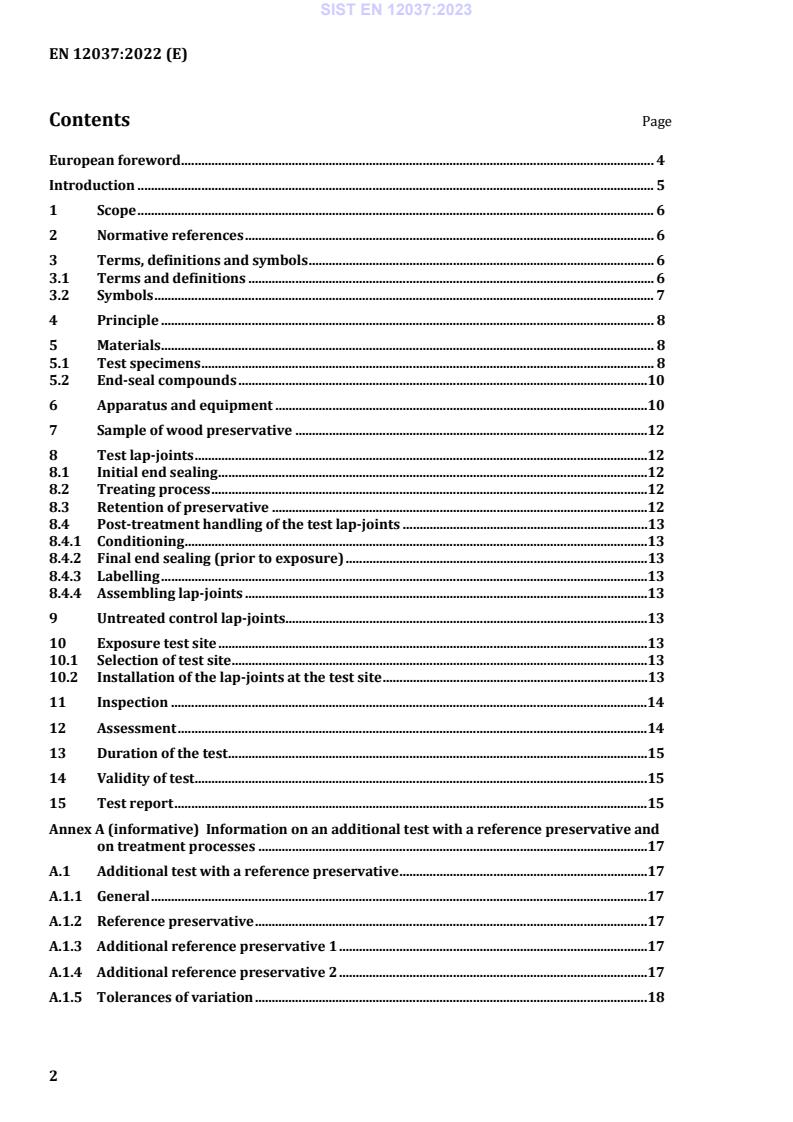
Contents Page
European foreword . 4
Introduction . 5
1 Scope . 6
2 Normative references . 6
3 Terms, definitions and symbols . 6
3.1 Terms and definitions . 6
3.2 Symbols . 7
4 Principle . 8
5 Materials . 8
5.1 Test specimens . 8
5.2 End-seal compounds .10
6 Apparatus and equipment .10
7 Sample of wood preservative .12
8 Test lap-joints .12
8.1 Initial end sealing .12
8.2 Treating process .12
8.3 Retention of preservative .12
8.4 Post-treatment handling of the test lap-joints .13
8.4.1 Conditioning .13
8.4.2 Final end sealing (prior to exposure) .13
8.4.3 Labelling .13
8.4.4 Assembling lap-joints .13
9 Untreated control lap-joints.13
10 Exposure test site .13
10.1 Selection of test site .13
10.2 Installation of the lap-joints at the test site .13
11 Inspection .14
12 Assessment .14
13 Duration of the test .15
14 Validity of test .15
15 Test report .15
Annex A (informative) Information on an additional test with a reference preservative and
on treatment processes .17
A.1 Additional test with a reference preservative .17
A.1.1 General .17
A.1.2 Reference preservative .17
A.1.3 Additional reference preservative 1 .17
A.1.4 Additional reference preservative 2 .17
A.1.5 Tolerances of variation .18
A.1.6 Reference lap-joint . 18
A.2 Model treatments methods . 19
A.2.1 General . 19
A.2.2 Brushing . 19
A.2.3 Spraying in a spray tunnel . 19
A.2.4 Dip process . 19
A.2.5 Steeping . 19
A.2.6 Double vacuum process . 20
A.2.7 Full-cell process . 20
Annex B (informative) Example of a test report . 21
Annex C (informative) Determination of the preventive efficacy of a test preservative or
components of a test preservative against staining fungi using horizontal lap-joint
method . 27
C.1 General . 27
C.2 Assessment . 27
Annex D (informative) Test field site . 28
Bibliography . 29
European foreword
This document (EN 12037:2022) has been prepared by Technical Committee CEN/TC 38 “Durability of
wood and wood-based products”, the secretariat of which is held by AFNOR.
This European Standard shall be given the status of a national standard, either by publication of an
identical text or by endorsement, at the latest by May 2023, and conflicting national standards shall be
withdrawn at the latest by May 2023.
Attention is drawn to the possibility that some of the elements of this document may be the subject of
patent rights. CEN shall not be held responsible for identifying any or all such patent rights.
This document supersedes CEN/TS 12037:2003.
Test results obtained with earlier versions of CEN/TS 12037 are still valid.
In relation to CEN/TS 12037:2003, the following main modifications have been made:
— change of variation in density of test specimens;
— change of grading system for evaluation.
Any feedback and questions on this document should be directed to the users’ national standards body.
A complete listing of these bodies can be found on the CEN website.
According to the CEN-CENELEC Internal Regulations, the national standards organisations of the
following countries are bound to implement this European Standard: Austria, Belgium, Bulgaria, Croatia,
Cyprus, Czech Republic, Denmark, Estonia, Finland, France, Germany, Greece, Hungary, Iceland, Ireland,
Italy, Latvia, Lithuania, Luxembourg, Malta, Netherlands, Norway, Poland, Portugal, Republic of North
Macedonia, Romania, Serbia, Slovakia, Slovenia, Spain, Sweden, Switzerland, Türkiye and the United
Kingdom.
Introduction
The main objective of the method is to evaluate the relative effectiveness of the preservative, applied to
jointed specimens of Scots pine sapwood by a treatment method relevant to its intended practical use
and as such does not necessarily accelerate decay but reflects probable performance in service.
The method is concerned with the protection against decay after exposure to a wide range of
microorganisms occurring out of ground contact under natural conditions. It takes into account also
physico-chemical effects of weathering on the performance of the preservative treated wood.
Since the lap-joints are exposed to natural outdoor conditions during the test period, variations in test
conditions from one exposure site to another should be expected. Differences in climate, especially
rainfall, will inevitably influence the general rate of development of decay fungi. However, by comparing
the results obtained for the test preservative with those obtained for untreated control lap-joints, the
relative protective effectiveness of the preservative under test can be evaluated.
The procedures described in this document are intended to be carried out by suitably trained and/or
supervised specialists. Appropriate safety precautions should be observed throughout the use of the
document.
1 Scope
This document specifies a test method for wood preservatives that are intended for use in wood to be
exposed to the weather out of contact with the ground without the additional protection of a surface
coating.
The method is applicable to the testing of commercial or experimental preservatives applied by
techniques appropriate to commercial practice. The method is applicable to chemical products used
individually or in combination to prevent the development of decay and/or – optional – the development
of disfiguring organisms in wood and, where suitable, in wood-based materials.
NOTE 1 The method can also be used to test other treated wood species and naturally durable timbers. It can be
adapted for testing the field performance of other wood-based systems and treatments designed to enhance
durability, for example treated or untreated wood based composites, timber treated with non-biocidal systems,
chemically modified or heat treated timber. Guidance on samples and sampling of naturally durable wood and
modified wood is found in EN 350.
NOTE 2 Although the test is used to assess decay, it is possible to use the method to additionally assess stain or
each separately when relevant.
2 Normative references
There are no normative references in this document.
3 Terms, definitions and symbols
For the purposes of this document, the following terms and definitions apply.
ISO and IEC maintain terminological databases for use in standardization at the following addresses:
— IEC Electropedia: available at https://www.electropedia.org/
— ISO Online browsing platform: available at https://www.iso.org/obp
3.1 Terms and definitions
3.1.1
active ingredient
chemical compound or compounds included in a wood preservative to give it specific activity against the
biological agents of deterioration
3.1.2
penetrating treatment process
process which includes features or procedures intended to overcome the natural resistance of wood to
penetration by a wood preservative in its ready for use form
Note 1 to entry: Such processes include for example currently practised technologies of diffusion treatments,
double-vacuum and vacuum-pressure methods.
3.1.3
superficial application process
process which does not include particular features or procedures intended to overcome the natural
resistance of wood to penetration by a wood preservative in its ready for use form
Note 1 to entry: Such processes include for example brush and spray techniques and short-term immersion
(dipping) processes in which wood normally has only a few minutes contact time with the preservative.
3.1.4
supplier
sponsor of the test
3.1.5
target retention
retention recommended by the supplier
3.1.6
application rate
amount of preservative product per square metre to be applied in superficial processes recommended
by the supplier
3.2 Symbols
3.2.1
nUD
V
nominal median rating for the upper side of the lap-joints for sets of replicates at the assessment of the
extent of decay
3.2.2
nLD
V
nominal median rating for the lower side of the lap-joints for sets of replicates at the assessment of the
extent of decay
3.2.3
nJD
V
nominal median rating for surfaces within the joint areas of the lap-joints for sets of replicates at the
assessment of the extent of decay
3.2.4
nUS
V
nominal median rating for the upper side of the lap-joints for sets of replicates at the assessment of the
extent of attack by staining fungi
3.2.5
nLS
V
nominal median rating for the lower side of the lap-joints for sets of replicates at the assessment of the
extent of attack by staining fungi
3.2.6
nJUS
V
nominal median rating for surfaces within the joint areas of the upper member of the lap-joints for sets
of replicates at the assessment of the extent of attack by staining fungi
3.2.7
nJLS
V
nominal median rating for surfaces within the joint areas of the lower member of the lap-joints for sets
of replicates at the assessment of the extent of attack by staining fungi
4 Principle
Jointed specimens (lap-joints) consisting of two overlapping parts (joint members) held together
mechanically are placed horizontally, out of contact with the ground and exposed to the weather. The lap-
joints are dismantled and examined at intervals. The extent of microbiological attack on the external
surfaces and within the joint areas is rated according to a specified rating system. Data for lap-joints
treated with the test product are compared with those generated from untreated specimens to assess
relative effectiveness.
5 Materials
5.1 Test specimens
5.1.1 Wood species
Susceptible wood species that can be completely penetrated with preservative shall be chosen as follows:
— for every test the sapwood of Scots pine (Pinus sylvestris L) shall be used;
— it is recommended that a hardwood species of local importance is included if the preservative is
expected to be used in this type of wood;
— if desired other wood species or wood-based materials may be incorporated in the test.
5.1.2 Wood quality
The wood shall be straight-grained and free from visible cracks, stain, decay, insect damage and other
defects. Some knots are permitted as specified in 5.1.3. The wood shall not have been water-stored,
floated, chemically treated, steamed or dried at temperatures above 60 °C. The wood shall originate from
trees preferably felled in winter.
The Scots pine shall be exclusively sapwood containing little resin and having between 2,5 and 10 annual
rings per 10 mm. The proportion of latewood in the annual rings shall not exceed 30 % of the whole. Use
wood without reaction wood or juvenile wood.
If other wood species are to be used the range in the number of annual rings per 10 mm for each wood
species shall be mentioned in the test report.
5.1.3 Provisions of test specimens
The longitudinal faces shall be parallel to the direction of the grain. The annual rings shall have a contact
angle of not greater than 10° to the broad faces of the test specimens. Make transverse cuts, neatly to give
sharp edges and a fine-sawn finish to the end-grain surfaces.
All the wood used in the test shall have been handled and dried in the same way.
Wood from at least three trees shall be used and evenly distributed among the different groups of lap-
joints.
Condition in a conditioning chamber (see 6.2) the timber stock to a moisture content of (12 ± 2) % mass
fraction (for Scots pine) %. Prepare lengths of timber with (38 ± 1) mm × (85 ± 1) mm cross section by
sawing (see 6.1) and planing (see Figure 1).
For other wood species condition to constant moisture content.
NOTE 1 A moisture meter of the two-pronged electrical conductivity type is suitable for assessing moisture
content.
Each lap-joint shall be prepared from a single piece of wood as two members (180 ± 1) mm long and
separated by no more than 100 mm, to allow for removal of knots and associated grain aberration, to
ensure a tight fit during the test (see Figure 1). Within the overlapping part and the adjacent 50 mm there
shall be no knots and in the rest of each member there are no more than 3 sound knots, the diameter of
which shall not exceed 10 mm.
Machine the joint in a way that after assembly of the two members the pith faces are on the same side of
the assembled joint (see Figure 1).
Store the joint members in the conditioning chamber (6.2) until required for treating.
Dimensions in millimetres
Key
1 cable strap
Figure 1 — Lap-joint
NOTE 2 The lap-joint members can be held together by two cable straps (6.7). The lap-joint is shown without the
weatherproof end seal.
5.1.4 Dimensions and density of test specimens
The dimensions of each lap-joint at (12 ± 2) % moisture content (mass fraction) shall be
(300 ± 2) mm × (85 ± 1) mm × (38 ± 1) mm with an overlapping close fitting part at mid-length of
(60 ± 1) mm (see Figure 1).
In a batch of specimens to be treated, the density of an individual is permitted to differ from the mean
value of the batch by ± 15 %. This tolerance is increased to ± 20 % for the untreated specimens. The mean
density of the treated specimens used for the test shall be recorded in the test report.
5.1.5 Number of lap-joints
Prepare at least 10 lap-joints for each combination of test parameters [wood species (see 5.1.1), test
preservative (see Clause 7), retention level or application rate (see 8.3), and untreated control (see
Clause 9)].
It is normally necessary to treat a higher number of lap-joints so that the required number can be selected
after treatment (see 8.2) and the inclusion of “abnormal” joints avoided. Optionally extra lap-joints may
be prepared for chemical analyses during exposure.
5.1.6 Labelling of lap-joints
Individual members of each lap-joint shall be assigned unique identification numbers in such a way that
these numbers are retained through all preparation operations. After preservative treatment an
identification label or tag of long-Iasting material shall be affixed e.g to the side of each lap-joint away
from the joint area. The labels shall be of a material which is inert to the wood and the chemicals it
contains after treatment and conditioning.
5.2 End-seal compounds
5.2.1 Preservative resistant end-seal: a material resistant to the penetration of the test preservative
solutions.
Polyvinyl acetate (PVAc) glues have been found to be suitable for many organic solvent formulations. For
water-borne formulations the weatherproof end-seal (5.2.2) may be used.
5.2.2 Weatherproof end-seal: a material which prevents water entry as well as microbial infection
and remains effective during long term exposure to the weather.
NOTE Two coats of an epoxy-resin/pitch compound have been found to be suitable.
6 Apparatus and equipment
6.1 Wood working equipment, including a saw capable of producing a fine sawn finish.
6.2 Conditioning chamber, well ventilated and controlled at (20 ± 2) °C and (65 ± 5) % relative
humidity.
6.3 Equipment, suitable for carrying out the treatment specified by the supplier.
6.4 Balance, capable of weighing to the nearest 0,1 g.
6.5 Safety equipment and protective clothing, appropriate for the test product, to ensure the safety
of the operator.
6.6 Labels and fixing pins, both long-lasting, inert and corrosion resistant with similar fixing pins.
6.7 Fixing material, cable straps, inert and weather resistant to be used for fixing the two members of
each joint together.
NOTE A suitable material of the straps is clear or white polyamide with a dimension of ca 360 mm × 5 mm.
These straps can easily be removed at the inspections and replaced by new straps when joints are returned to the
exposure racks.
Alternatively, custom designed stainless steel metal clips may be used. A suitable clip design is shown in
Figure 2.
Figure 2 — Suitable clip fabricated out of stainless steel to hold lap-joint in place
Two clips can be needed per test assembly.
6.8 Exposure rack, (see Figure 3) made of preservative treated wood, aluminium profiles or any other
similar durable material and located at least 1 m above ground level and at least 0,5 m above any low
vegetation (see Figure 3). The test specimens shall be separated from the rack by spacing pieces, cross-
section, minimum 5 mm × 5 mm, maximum 10 mm × 10 mm, made of a long-lasting weather resistant
material, that will not react with timber or treated lap-joints (see Figure 4).
Key
1 test samples
Figure 3 — Example of an exposure rack (measurements in meters stating minimum distances
(6.8))
Figure 4 — Example of a suitable arrangement of lap-joints on a rack (6.8)
7 Sample of wood preservative
The sample of preservative shall be representative of the product to be tested.
Samples shall be stored and handled in accordance with any written requirements from the supplier
including the product safety data sheet.
For the sampling of preservatives from bulk supplies, the procedures given in EN 212 should be used.
8 Test lap-joints
8.1 Initial end sealing
For each joint member, seal the end grain surface remote from the joint area twice with a preservative
resistant end seal (5.2); allow to dry.
8.2 Treating process
The preservative treatment is carried out after machining and initial end sealing but prior to assembling.
Apply the test preservative to the end-sealed test joint members using the process specified by the
supplier.
It is preferable to test at more than one retention of the active ingredients, ideally three, ranged about
that thought to be appropriate for out of ground contact use.
NOTE A range of model treatments is given in Annex A.
For all penetrating treatment processes, determine and record the volume of the lap-joint members and
its mass to the nearest 0,1 g immediately before treatment. After treatment allow to drain for several
minutes or wipe off excess solution from the surface with a cloth. Then reweigh each member and record
the mass after treatment.
For superficial treatments, calculate the amount of preservative in grams to be applied on each surface
of the lap-joint member to correspond to the uptake in grams or millilitres per square metre
recommended by the supplier. Apply double the calculated amount of preservative to the end grain
surfaces of the
...