

EN 4841-1:2022
(Main)Aerospace series - Shock mount with bushes - Part 1: Technical specification
- Abstract
This document specifies the required characteristics, inspection and test methods, qualification and acceptance conditions for shock mounts with bushes, designed to withstand static and dynamic loads possible for aerospace interior applications in the temperature range from -55 °C to 85 °C.
- Status
- Published
- Publication Date
- 24-May-2022
- Withdrawal Date
- 29-Nov-2022
- Technical Committee
- ASD-STAN - Aerospace
- Drafting Committee
- ASD-STAN/D 3/S 1 - Parts of Mechanical Systems
- Current Stage
- 6060 - Definitive text made available (DAV) - Publishing
- Start Date
- 25-May-2022
- Completion Date
- 25-May-2022

Overview
EN 4841-1:2022 - Aerospace series: Shock mount with bushes - Part 1: Technical specification defines the required characteristics, inspection and test methods, qualification and acceptance conditions for shock mounts with bushes used in aerospace interior applications. The standard covers assemblies consisting of inner and outer metal rings with vulcanized rubber and a spherical bearing, designed to withstand static and dynamic loads over a temperature range of −55 °C to 85 °C.
Key topics
- Scope & definition: Applies to shock mount assemblies for aerospace interiors; includes batch definitions (manufacturing and artificial batches) and terminology for qualification and acceptance tests.
- Mechanical requirements:
- Static and fatigue load testing (limit and ultimate loads measured at 85 °C; stiffness measured at 20 °C).
- Safety and tolerance factors: factor of safety (s) = 1.5 between ultimate and limit loads; manufacturing/material tolerance factor = 1.1.
- Inspection & test methods:
- Visual and roughness checks of external surfaces, dimensional checks, mass verification.
- Stiffness testing per EN 4662; load testing for limit and ultimate loads.
- Corrosion resistance: salt spray testing per EN ISO 9227 (spray time 192 h).
- Environmental conditioning per RTCA DO-160G Section 11, Category F.
- Fire worthiness assessed according to FAR/JAR/CS 25.853 and related burning behaviour standards.
- Qualification & acceptance:
- Manufacturer approval, classification of inspections, qualification test plans/reports, first article inspection, and batch acceptance testing with sample plans (Annex A).
- Materials & traceability:
- Material requirements and tests reference numerous EN/ISO standards for plastics, rubbers and metallic products (e.g., EN ISO 75‑2, EN ISO 527, ISO 37, EN 10204).
Applications
- Use EN 4841-1:2022 when specifying, designing, manufacturing, procuring or certifying aerospace shock mounts with bushes for cabin interiors, equipment mounts and other vibration isolation applications in aircraft.
- Typical users:
- Aerospace component designers and engineers
- Manufacturers of vibration control components and elastomeric parts
- Quality, test and certification teams performing qualification and acceptance testing
- Procurement specialists referencing compliance for contracts
Related standards
- EN 4841-2 (Part 2: Technical overview)
- EN 4662 (vibration control component test methods)
- EN 2424 (marking)
- EN ISO 9227 (salt spray corrosion)
- RTCA DO-160G (environmental test procedures)
- FAR/JAR/CS 25.853 (compartment interior flammability)
- EN 10204 (inspection documents)
Keywords: EN 4841-1:2022, shock mount with bushes, aerospace shock mount standard, vibration control, qualification and acceptance, static and dynamic loads, RTCA DO-160G, FAR 25.853, salt spray corrosion.
Relations
- Effective Date
- 25-Aug-2026
- Effective Date
- 25-Aug-2026
- Effective Date
- 09-Feb-2026
- Effective Date
- 09-Feb-2026
- Effective Date
- 09-Feb-2026
- Effective Date
- 28-Jan-2026
- Refers
EN ISO 9227:2022 - Corrosion tests in artificial atmospheres - Salt spray tests (ISO 9227:2022) - Effective Date
- 28-Jan-2026
- Effective Date
- 28-Jan-2026
- Effective Date
- 28-Jan-2026
- Effective Date
- 28-Jan-2026
- Effective Date
- 28-Jan-2026
- Effective Date
- 28-Jan-2026
- Effective Date
- 28-Jan-2026
- Effective Date
- 28-Jan-2026
- Effective Date
- 28-Jan-2026
Get Certified
Connect with accredited certification bodies for this standard

BUREAU VERITAS Certification Germany
Bureau Veritas certification in Germany.

Element Materials Technology
Materials testing and product certification.

AQMS Ltd.
AQMS provides ISO certification to SMEs across the UK.
Sponsored listings
Frequently Asked Questions
EN 4841-1:2022 is a standard published by the European Committee for Standardization (CEN). Its full title is "Aerospace series - Shock mount with bushes - Part 1: Technical specification". This standard covers: This document specifies the required characteristics, inspection and test methods, qualification and acceptance conditions for shock mounts with bushes, designed to withstand static and dynamic loads possible for aerospace interior applications in the temperature range from -55 °C to 85 °C.
This document specifies the required characteristics, inspection and test methods, qualification and acceptance conditions for shock mounts with bushes, designed to withstand static and dynamic loads possible for aerospace interior applications in the temperature range from -55 °C to 85 °C.
EN 4841-1:2022 is classified under the following ICS (International Classification for Standards) categories: 49.035 - Components for aerospace construction. The ICS classification helps identify the subject area and facilitates finding related standards.
EN 4841-1:2022 has the following relationships with other standards: It is inter standard links to ISO 1817:2015, ISO 34-1:2015, ISO 2781:2018, ISO 37:2017, ISO 48-4:2018, EN ISO 179-1:2010, EN ISO 9227:2022, EN 10204:2004, EN ISO 1183-1:2025, EN 3844-1:2019, EN 2424:2008, EN 3844-2:2019, EN 4662:2010, EN ISO 527-2:2012, EN 2826:2011. Understanding these relationships helps ensure you are using the most current and applicable version of the standard.
EN 4841-1:2022 is available in PDF format for immediate download after purchase. The document can be added to your cart and obtained through the secure checkout process. Digital delivery ensures instant access to the complete standard document.
Standards Content (Sample)
SLOVENSKI STANDARD
01-julij-2022
Aeronavtika - Dušilniki vibracij z oblogami - 1. del: Tehnična specifikacija
Aerospace series - Shock mount with bushes - Part 1: Technical specification
Luft- und Raumfahrt - Schwingungsdämpfer mit Buchse - Teil 1: Technische
Lieferbedingung
Série aérospatiale - Amortisseur de vibrations avec douille - Partie 1 : Spécification
technique
Ta slovenski standard je istoveten z: EN 4841-1:2022
ICS:
49.035 Sestavni deli za letalsko in Components for aerospace
vesoljsko gradnjo construction
2003-01.Slovenski inštitut za standardizacijo. Razmnoževanje celote ali delov tega standarda ni dovoljeno.
EN 4841-1
EUROPEAN STANDARD
NORME EUROPÉENNE
May 2022
EUROPÄISCHE NORM
ICS 49.035
English Version
Aerospace series - Shock mount with bushes - Part 1:
Technical specification
Série aérospatiale - Amortisseur de vibrations à bagues Luft- und Raumfahrt - Schwingungsdämpfer mit
- Partie 1 : Spécification technique Buchse - Teil 1: Technische Lieferbedingung
This European Standard was approved by CEN on 12 July 2020.
CEN members are bound to comply with the CEN/CENELEC Internal Regulations which stipulate the conditions for giving this
European Standard the status of a national standard without any alteration. Up-to-date lists and bibliographical references
concerning such national standards may be obtained on application to the CEN-CENELEC Management Centre or to any CEN
member.
This European Standard exists in three official versions (English, French, German). A version in any other language made by
translation under the responsibility of a CEN member into its own language and notified to the CEN-CENELEC Management
Centre has the same status as the official versions.
CEN members are the national standards bodies of Austria, Belgium, Bulgaria, Croatia, Cyprus, Czech Republic, Denmark, Estonia,
Finland, France, Germany, Greece, Hungary, Iceland, Ireland, Italy, Latvia, Lithuania, Luxembourg, Malta, Netherlands, Norway,
Poland, Portugal, Republic of North Macedonia, Romania, Serbia, Slovakia, Slovenia, Spain, Sweden, Switzerland, Turkey and
United Kingdom.
EUROPEAN COMMITTEE FOR STANDARDIZATION
COMITÉ EUROPÉEN DE NORMALISATION
EUROPÄISCHES KOMITEE FÜR NORMUNG
CEN-CENELEC Management Centre: Rue de la Science 23, B-1040 Brussels
© 2022 CEN All rights of exploitation in any form and by any means reserved Ref. No. EN 4841-1:2022 E
worldwide for CEN national Members.
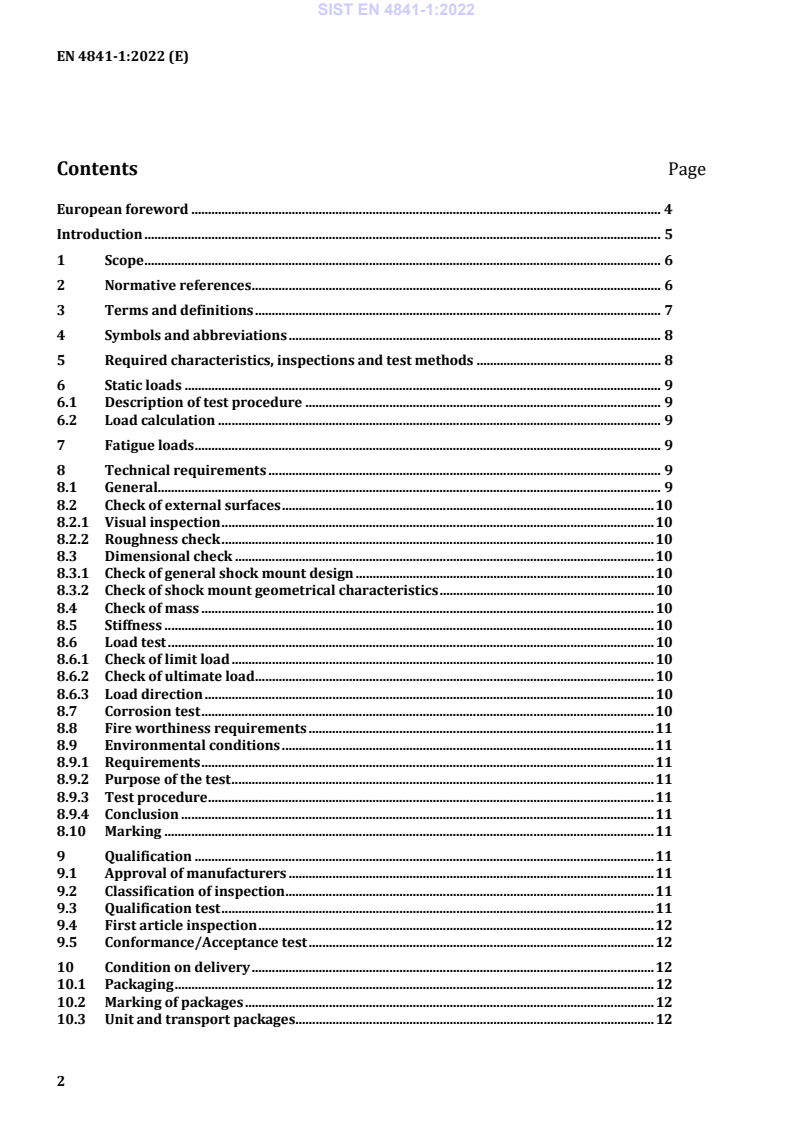
Contents Page
European foreword . 4
Introduction . 5
1 Scope . 6
2 Normative references . 6
3 Terms and definitions . 7
4 Symbols and abbreviations . 8
5 Required characteristics, inspections and test methods . 8
6 Static loads . 9
6.1 Description of test procedure . 9
6.2 Load calculation . 9
7 Fatigue loads . 9
8 Technical requirements . 9
8.1 General. 9
8.2 Check of external surfaces . 10
8.2.1 Visual inspection . 10
8.2.2 Roughness check . 10
8.3 Dimensional check . 10
8.3.1 Check of general shock mount design . 10
8.3.2 Check of shock mount geometrical characteristics . 10
8.4 Check of mass . 10
8.5 Stiffness . 10
8.6 Load test . 10
8.6.1 Check of limit load . 10
8.6.2 Check of ultimate load . 10
8.6.3 Load direction . 10
8.7 Corrosion test . 10
8.8 Fire worthiness requirements . 11
8.9 Environmental conditions . 11
8.9.1 Requirements . 11
8.9.2 Purpose of the test . 11
8.9.3 Test procedure . 11
8.9.4 Conclusion . 11
8.10 Marking . 11
9 Qualification . 11
9.1 Approval of manufacturers . 11
9.2 Classification of inspection . 11
9.3 Qualification test . 11
9.4 First article inspection . 12
9.5 Conformance/Acceptance test . 12
10 Condition on delivery . 12
10.1 Packaging . 12
10.2 Marking of packages . 12
10.3 Unit and transport packages . 12
11 Material . 12
11.1 Requirement . 12
11.2 Inspections and test method . 13
Annex A (normative) Sampling . 18
A.1 Acceptance test samples . 18
A.2 Qualification test samples . 18
Bibliography . 20
European foreword
This document (EN 4841-1:2022) has been prepared by the Aerospace and Defence Industries
Association of Europe - Standardization (ASD STAN).
After enquiries and votes carried out in accordance with the rules of this Association, this document has
received the approval of the National Associations and the Official Services of the member countries of
ASD-STAN, prior to its presentation to CEN.
This European Standard shall be given the status of a national standard, either by publication of an
identical text or by endorsement, at the latest by November 2022, and conflicting national standards shall
be withdrawn at the latest by November 2022.
Attention is drawn to the possibility that some of the elements of this document may be the subject of
patent rights. CEN shall not be held responsible for identifying any or all such patent rights.
According to the CEN-CENELEC Internal Regulations, the national standards organizations of the
following countries are bound to implement this European Standard: Austria, Belgium, Bulgaria, Croatia,
Cyprus, Czech Republic, Denmark, Estonia, Finland, Former Yugoslav Republic of Macedonia, France,
Germany, Greece, Hungary, Iceland, Ireland, Italy, Latvia, Lithuania, Luxembourg, Malta, Netherlands,
Norway, Poland, Portugal, Romania, Serbia, Slovakia, Slovenia, Spain, Sweden, Switzerland, Turkey and
the United Kingdom.
Any feedback and questions on this document should be directed to the users’ national standards body.
A complete listing of these bodies can be found on the CEN website.
Introduction
This document is part of the series of EN mechanical standards for aerospace applications.
1 Scope
This document specifies the required characteristics, inspection and test methods, qualification and
acceptance conditions for shock mounts with bushes, designed to withstand static and dynamic loads
possible for aerospace interior applications in the temperature range from −55 °C to 85 °C.
2 Normative references
The following documents are referred to in the text in such a way that some or all of their content
constitutes requirements of this document. For dated references, only the edition cited applies. For
undated references, the latest edition of the referenced document (including any amendments) applies.
EN 2424:2008, Aerospace series — Marking of aerospace products
EN 2825, Aerospace series — Burning behaviour of non metallic materials under the influence of radiating
heat and flames — Determination of smoke density
EN 2826, Aerospace series — Burning behaviour of non metallic materials under the influence of radiating
heat and flames — Determination of gas components in the smoke
EN 3844 (all parts), Aerospace series — Flammability of non-metallic materials
EN 4662, Aerospace series — Test specification for vibration control components
EN 4841-2, Aerospace series — Shock mounts with bushes — Part 2: Technical overview
EN 10204, Metallic products — Types of inspection documents
EN ISO 75-2, Plastics — Determination of temperature of deflection under load — Part 2: Plastics and
ebonite (ISO 75-2)
EN ISO 175, Plastics — Methods of test for the determination of the effects of immersion in liquid chemicals
(ISO 175)
EN ISO 178, Plastics — Determination of flexural properties (ISO 178)
EN ISO 179-1:2010, Plastics — Determination of Charpy impact properties — Part 1: Non-instrumented
impact test (ISO 179-1:2010)
EN ISO 291, Plastics — Standard atmospheres for conditioning and testing (ISO 291)
EN ISO 527-2:2012, Plastics — Determination of tensile properties — Part 2: Test conditions for moulding
and extrusion plastics (ISO 527-2:2012)
EN ISO 1172, Textile-glass-reinforced plastics — Prepregs, moulding compounds and laminates —
Determination of the textile-glass and mineral-filler content; calcination methods (ISO 1172)
EN ISO 1183-1, Plastics — Methods for determining the density of non-cellular plastics — Part 1:
Immersion method, liquid pycnometer method and titration method (ISO 1183-1)
EN ISO 9227, Corrosion tests in artificial atmospheres — Salt spray tests (ISO 9227)
DIN 53504:2017, Testing of rubber — Determination of tensile strength at break, tensile stress at yield,
elongation at break and stress values in a tensile test
DIN 65271, Aerospace series — Elastomeric semi-finished products and parts — Technical specification
ISO 34-1:2015, Rubber, vulcanized or thermoplastic — Determination of tear strength — Part 1: Trouser,
angle and crescent test pieces
ISO 37:2017, Rubber, vulcanized or thermoplastic — Determination of tensile stress-strain properties
ISO 48-4, Rubber, vulcanized or thermoplastic — Determination of hardness — Part 4: Indentation
hardness by durometer method (Shore hardness)
ISO 1817:2015, Rubber, vulcanized or thermoplastic — Determination of the effect of liquids
ISO 2781:2018, Rubber, vulcanized or thermoplastic — Determination of density
FAR/JAR/CS 25.853:1999, Compartment interiors
RTCA DO-160G:2010, Environmental Conditions and Test Procedures for Airborne Equipment
UL 746B, Standard for Safety for Polymeric Materials — Long Term Property Evaluations
3 Terms and definitions
For the purposes of this document, the following terms and definitions apply.
ISO and IEC maintain terminological databases for use in standardization at the following addresses:
• ISO Online browsing platform: available at https://www.iso.org/obp
• IEC Electropedia: available at https://www.electropedia.org/
3.1
standard part
complete shock mount assembly, which consists of inner and outer metal rings with vulcanized rubber
and spherical bearing
3.2
Batch definition
3.2.1
manufacturing batch
batch composed of inner and outer rings made of same material (same material batch), with same
dimensions and belonging to the same manufacturing campaign and vulcanized with the same rubber
compound
Published by: Beuth Verlag GmbH. www.beuth.de
Published by: European Aviation Safety Agency, Postfach 10 12 53, D-50452 Koeln, Germany.
Published by: Radio Technical Commission for Aeronautics (RTCA), 1140 Connecticut Ave., N.W. Suite 1020,
Washington, D.C. 20036, USA.
Published as UL Standard, https://ulstandards.ul.com/.
3.2.2
artificial batch
batch which consists of different manufacturing batches and is limited to a maximum of 100 shock
mounts
3.3
qualification test
test or series of tests to demonstrate that the products comply with the requirements stipulated in this
document and/or in a product standard and are accomplished according to documented parameters and
under reproducible conditions
3.4
acceptance test
test that demonstrates the characteristics of manufactured products comply with the requirements
4 Symbols and abbreviations
R roughness value
a
s ultimate/limit load factor
s fitting factor
QTP Qualification Test Plan
QTR Qualification Test Report
5 Required characteristics, inspections and test methods
Inspection and test methods shall be done according to Table 1.
Table 1 — Inspect
...