


FprEN 1918-2
(Main)Gas infrastructure - Underground gas storage - Part 2: Functional recommendations for storage in oil and gas fields
General Information
- Abstract
This document covers the functional recommendations for design, construction, testing, commissioning, operation, maintenance and abandonment of underground gas storage (UGS) facilities in oil and gas fields up to and including the wellhead.
It specifies practices which are safe and environmentally acceptable.
For necessary surface facilities for underground gas storage, EN 1918 5 applies.
In this context “gas” refers to flammable gas:
— which is in a gaseous state at a temperature of 15 °C and under a pressure of 0,1 MPa (the stored product is also named fluid);
— which meets specific quality requirements in order to maintain underground storage integrity, performance, environmental compatibility and fulfils contractual requirements.
This comprises:
— gas not in liquid phase under subsurface conditions;
— methane-rich gases;
— natural gas;
— biomethane;
— synthetic methane;
— hydrogen of various purities;
— any mixtures of the gases above;
— hydrocarbon gas in liquid phase under subsurface conditions such as;
— ethylene;
— liquified petroleum gas (LPG).
NOTE 1 Correspondingly the EN 1918 series can be considered where applicable for underground storage of any other fluid e.g. helium, carbon dioxide, compressed air, rDME (renewable dimethyl ether) and hydrogen transport fluids (such as ammonia and LOHC).
This document is not intended to be applied retrospectively to existing facilities.
NOTE 2 Correspondingly this document can be considered for major conversions in case of significant change of gas composition.
- Status
- Not Published
- Publication Date
- 04-Aug-2026
- Technical Committee
- CEN/TC 234 - Gas infrastructure
- Drafting Committee
- CEN/TC 234/WG 4 - Gas underground storage
- Current Stage
- 4599 - Dispatch of FV draft to CMC - Finalization for Vote
- Start Date
- 04-Feb-2026
- Due Date
- 25-Feb-2026
- Completion Date
- 04-Feb-2026

Overview
FprEN 1918-2: Gas Infrastructure - Underground Gas Storage - Part 2: Functional Recommendations for Storage in Oil and Gas Fields is a draft European Standard developed by the European Committee for Standardization (CEN). This standard provides comprehensive functional recommendations covering the design, construction, testing, commissioning, operation, maintenance, and abandonment of underground gas storage (UGS) facilities located within oil and gas fields, up to and including the wellhead. The standard aims to ensure practices that are safe and environmentally acceptable, contributing to the effective management and security of gas infrastructure across Europe.
Key Topics
Scope of Application
- Applicable to new UGS facilities in oil and gas fields; not for retrospective application.
- Covers various gases in a gaseous state (at 15 °C, 0.1 MPa), including natural gas, biomethane, synthetic methane, various purities of hydrogen, LPG, and their mixtures.
- Can be considered for major facility conversions after significant gas composition changes.
Safe and Environmentally Acceptable Practices
- Addresses safety management, health, and environmental protection at all stages.
- Integrates recommendations for minimizing emissions, particularly methane, in line with European and local requirements.
Design and Construction
- Provides criteria for evaluating field suitability: reservoir structure, adequate porosity/permeability, closure mechanisms, and integrity of caprock and existing/abandoned wells.
- Emphasizes knowledge transfer from exploration and production phases to ensure secure containment.
Testing and Commissioning
- Details procedures for verifying operational readiness and long-term containment integrity before entering active service.
Operation and Maintenance
- Recommends comprehensive monitoring systems for continuous assessment of well integrity, gas containment, and environmental impacts.
- Stresses regular maintenance and emergency preparedness to ensure operational continuity and safety.
Abandonment
- Sets requirements for safe and environmentally sound abandonment, including well plugging and decommissioning surface facilities.
Applications
Strategic Gas Storage
- Enables balancing of supply and demand by providing storage solutions for natural gas, biomethane, synthetic gases, and hydrogen.
- Supports both seasonal and peak-shaving requirements, ensuring energy security and grid reliability.
Commercial Services
- Facilitates trading, arbitrage, and provision of standby reserves through flexible storage solutions.
Energy Transition
- Provides essential infrastructure for integrating low-carbon and renewable gases, including biomethane and hydrogen, supporting the shift to a sustainable energy system.
Production Optimization
- Allows for storage and management of associated and produced gases, reducing venting and supporting environmental objectives.
Blending and Quality Management
- Offers capabilities for blending different gas qualities to meet contractual and regulatory standards.
Related Standards
- EN 1918-5: Functional recommendations for necessary surface facilities for underground gas storage.
- EN 1918-1: Recommendations for storage in aquifers.
- EN 1918-3: Storage in solution-mined salt caverns.
- EN 1918-4: Storage in rock caverns.
- CEN/TS 17874: Guidance for the quantification of methane emissions.
- ISO 1663: Methods for determining water vapour transmission.
- Other related ISO and IEC standards on terminology and technical requirements for gas handling and storage.
Practical Value
Adopting FprEN 1918-2 ensures that underground gas storage facilities in oil and gas fields are developed and managed to the highest standards of safety, environmental stewardship, and operational efficiency. The document empowers operators and regulators to make informed decisions, minimize risks, optimize resource use, and support Europe’s broader energy and climate goals. Compliance with these guidelines fosters public trust, aligns with EU directives, and enhances cross-border interoperability across the gas infrastructure sector.
By standardizing functional recommendations for UGS, this standard plays a crucial role in securing and decarbonizing Europe’s energy supply chain.
Relations
- Effective Date
- 18-Jan-2023
Get Certified
Connect with accredited certification bodies for this standard

Element Materials Technology
Materials testing and product certification.

ABS Group Brazil
ABS Group certification services in Brazil.

ABS Quality Evaluations Inc.
American Bureau of Shipping quality certification.
Sponsored listings
Frequently Asked Questions
FprEN 1918-2 is a draft published by the European Committee for Standardization (CEN). Its full title is "Gas infrastructure - Underground gas storage - Part 2: Functional recommendations for storage in oil and gas fields". This standard covers: This document covers the functional recommendations for design, construction, testing, commissioning, operation, maintenance and abandonment of underground gas storage (UGS) facilities in oil and gas fields up to and including the wellhead. It specifies practices which are safe and environmentally acceptable. For necessary surface facilities for underground gas storage, EN 1918 5 applies. In this context “gas” refers to flammable gas: — which is in a gaseous state at a temperature of 15 °C and under a pressure of 0,1 MPa (the stored product is also named fluid); — which meets specific quality requirements in order to maintain underground storage integrity, performance, environmental compatibility and fulfils contractual requirements. This comprises: — gas not in liquid phase under subsurface conditions; — methane-rich gases; — natural gas; — biomethane; — synthetic methane; — hydrogen of various purities; — any mixtures of the gases above; — hydrocarbon gas in liquid phase under subsurface conditions such as; — ethylene; — liquified petroleum gas (LPG). NOTE 1 Correspondingly the EN 1918 series can be considered where applicable for underground storage of any other fluid e.g. helium, carbon dioxide, compressed air, rDME (renewable dimethyl ether) and hydrogen transport fluids (such as ammonia and LOHC). This document is not intended to be applied retrospectively to existing facilities. NOTE 2 Correspondingly this document can be considered for major conversions in case of significant change of gas composition.
This document covers the functional recommendations for design, construction, testing, commissioning, operation, maintenance and abandonment of underground gas storage (UGS) facilities in oil and gas fields up to and including the wellhead. It specifies practices which are safe and environmentally acceptable. For necessary surface facilities for underground gas storage, EN 1918 5 applies. In this context “gas” refers to flammable gas: — which is in a gaseous state at a temperature of 15 °C and under a pressure of 0,1 MPa (the stored product is also named fluid); — which meets specific quality requirements in order to maintain underground storage integrity, performance, environmental compatibility and fulfils contractual requirements. This comprises: — gas not in liquid phase under subsurface conditions; — methane-rich gases; — natural gas; — biomethane; — synthetic methane; — hydrogen of various purities; — any mixtures of the gases above; — hydrocarbon gas in liquid phase under subsurface conditions such as; — ethylene; — liquified petroleum gas (LPG). NOTE 1 Correspondingly the EN 1918 series can be considered where applicable for underground storage of any other fluid e.g. helium, carbon dioxide, compressed air, rDME (renewable dimethyl ether) and hydrogen transport fluids (such as ammonia and LOHC). This document is not intended to be applied retrospectively to existing facilities. NOTE 2 Correspondingly this document can be considered for major conversions in case of significant change of gas composition.
FprEN 1918-2 is classified under the following ICS (International Classification for Standards) categories: 75.200 - Petroleum products and natural gas handling equipment. The ICS classification helps identify the subject area and facilitates finding related standards.
FprEN 1918-2 has the following relationships with other standards: It is inter standard links to EN 1918-2:2016. Understanding these relationships helps ensure you are using the most current and applicable version of the standard.
FprEN 1918-2 is associated with the following European legislation: Standardization Mandates: M/017. When a standard is cited in the Official Journal of the European Union, products manufactured in conformity with it benefit from a presumption of conformity with the essential requirements of the corresponding EU directive or regulation.
FprEN 1918-2 is available in PDF format for immediate download after purchase. The document can be added to your cart and obtained through the secure checkout process. Digital delivery ensures instant access to the complete standard document.
Standards Content (Sample)
SLOVENSKI STANDARD
01-junij-2025
Infrastruktura za plin - Podzemna plinska skladišča - 2. del: Funkcionalna
priporočila za skladiščenje na naftnih in plinskih poljih
Gas infrastructure - Underground gas storage - Part 2: Functional recommendations for
storage in oil and gas fields
Gasinfrastruktur - Untertagespeicherung von Gas - Teil 2: Funktionale Empfehlungen für
die Speicherung in Öl- und Gasfeldern
Infrastructures gazières - Stockage souterrain de gaz - Partie 2 : Recommandations
fonctionnelles pour le stockage en gisements de pétrole et de gaz
Ta slovenski standard je istoveten z: prEN 1918-2
ICS:
75.200 Oprema za skladiščenje Petroleum products and
nafte, naftnih proizvodov in natural gas handling
zemeljskega plina equipment
2003-01.Slovenski inštitut za standardizacijo. Razmnoževanje celote ali delov tega standarda ni dovoljeno.
DRAFT
EUROPEAN STANDARD
prEN 1918-2
NORME EUROPÉENNE
EUROPÄISCHE NORM
May 2025
ICS 75.200 Will supersede EN 1918-2:2016
English Version
Gas infrastructure - Underground gas storage - Part 2:
Functional recommendations for storage in oil and gas
fields
Infrastructures gazières - Stockage souterrain de gaz - Gasinfrastruktur - Untertagespeicherung von Gas - Teil
Partie 2 : Recommandations fonctionnelles pour le 2: Funktionale Empfehlungen für die Speicherung in
stockage en gisements de pétrole et de gaz Öl- und Gasfeldern
This draft European Standard is submitted to CEN members for enquiry. It has been drawn up by the Technical Committee
CEN/TC 234.
If this draft becomes a European Standard, CEN members are bound to comply with the CEN/CENELEC Internal Regulations
which stipulate the conditions for giving this European Standard the status of a national standard without any alteration.
This draft European Standard was established by CEN in three official versions (English, French, German). A version in any other
language made by translation under the responsibility of a CEN member into its own language and notified to the CEN-CENELEC
Management Centre has the same status as the official versions.
CEN members are the national standards bodies of Austria, Belgium, Bulgaria, Croatia, Cyprus, Czech Republic, Denmark, Estonia,
Finland, France, Germany, Greece, Hungary, Iceland, Ireland, Italy, Latvia, Lithuania, Luxembourg, Malta, Netherlands, Norway,
Poland, Portugal, Republic of North Macedonia, Romania, Serbia, Slovakia, Slovenia, Spain, Sweden, Switzerland, Türkiye and
United Kingdom.
Recipients of this draft are invited to submit, with their comments, notification of any relevant patent rights of which they are
aware and to provide supporting documentation.
Warning : This document is not a European Standard. It is distributed for review and comments. It is subject to change without
notice and shall not be referred to as a European Standard.
EUROPEAN COMMITTEE FOR STANDARDIZATION
COMITÉ EUROPÉEN DE NORMALISATION
EUROPÄISCHES KOMITEE FÜR NORMUNG
CEN-CENELEC Management Centre: Rue de la Science 23, B-1040 Brussels
© 2025 CEN All rights of exploitation in any form and by any means reserved Ref. No. prEN 1918-2:2025 E
worldwide for CEN national Members.
prEN 1918-2:2025 (E)
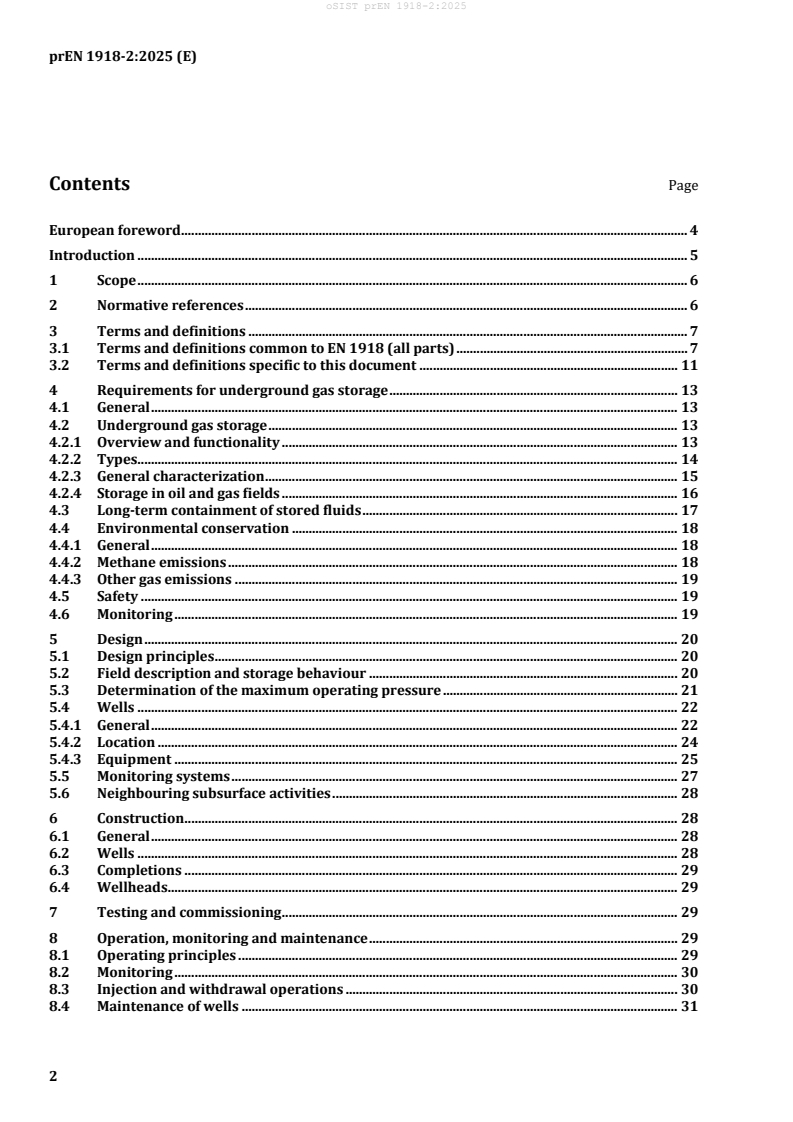
Contents Page
European foreword . 4
Introduction . 5
1 Scope . 6
2 Normative references . 6
3 Terms and definitions . 7
3.1 Terms and definitions common to EN 1918 (all parts) . 7
3.2 Terms and definitions specific to this document . 11
4 Requirements for underground gas storage . 13
4.1 General . 13
4.2 Underground gas storage . 13
4.2.1 Overview and functionality . 13
4.2.2 Types . 14
4.2.3 General characterization . 15
4.2.4 Storage in oil and gas fields . 16
4.3 Long-term containment of stored fluids . 17
4.4 Environmental conservation . 18
4.4.1 General . 18
4.4.2 Methane emissions . 18
4.4.3 Other gas emissions . 19
4.5 Safety . 19
4.6 Monitoring . 19
5 Design . 20
5.1 Design principles . 20
5.2 Field description and storage behaviour . 20
5.3 Determination of the maximum operating pressure . 21
5.4 Wells . 22
5.4.1 General . 22
5.4.2 Location . 24
5.4.3 Equipment . 25
5.5 Monitoring systems . 27
5.6 Neighbouring subsurface activities . 28
6 Construction . 28
6.1 General . 28
6.2 Wells . 28
6.3 Completions . 29
6.4 Wellheads . 29
7 Testing and commissioning . 29
8 Operation, monitoring and maintenance . 29
8.1 Operating principles . 29
8.2 Monitoring . 30
8.3 Injection and withdrawal operations . 30
8.4 Maintenance of wells . 31
prEN 1918-2:2025 (E)
8.5 Health, safety and environment . 31
8.5.1 Safety management and health and environment . 31
8.5.2 Emergency procedures . 31
8.6 Adaptation to climate change . 32
8.6.1 Climate change effects . 32
8.6.2 Climate change impacts . 32
9 Abandonment. 34
9.1 General . 34
9.2 Withdrawal of the gas . 34
9.3 Plugging and abandonment of wells . 34
9.4 Surface facilities . 35
Annex A (informative) Significant technical changes between this document and
EN 1918-2:2016 . 36
Bibliography . 37
prEN 1918-2:2025 (E)
European foreword
This document (prEN 1918-2:2025) has been prepared by Technical Committee CEN/TC 234 “Gas
infrastructure”, the secretariat of which is held by DIN.
This document is currently submitted to the CEN Enquiry.
This document will supersede EN 1918-2:2016.
For a list of significant technical changes with respect to EN 1918-2:2016, see Annex A.
This document has been prepared under a standardization request addressed to CEN by the European
Commission. The Standing Committee of the EFTA States subsequently approves these requests for its
Member States.
This document is Part 2 of a European Standard on “Gas infrastructure - Underground gas storage”
which includes the five following parts:
— Part 1: Functional recommendations for storage in aquifers;
— Part 2: Functional recommendations for storage in oil and gas fields;
— Part 3: Functional recommendations for storage in solution-mined salt caverns;
— Part 4: Functional recommendations for storage in rock caverns;
— Part 5: Functional recommendations for surface facilities.
prEN 1918-2:2025 (E)
Introduction
This document specifies common basic principles for underground gas storage facilities. Users of this
document should be aware that more detailed standards and/or codes of practice exist. This document
is intended to be applied in association with these national standards and/or codes of practice and does
not replace them. Furthermore, a non-exhaustive list of related European and international standards
can be found in the Bibliography.
NOTE Directive 2009/73/EC concerning common rules for the internal market in natural gas and the related
Regulation (EC) No 715/2009 on conditions for access to the natural gas transmission networks also aim at
technical safety including technical reliability of the European gas system. These aspects are also in the scope of
CEN/TC 234 standardization. In this respect CEN/TC 234 evaluated the indicated EU legislation and amended this
technical standard accordingly, where required and appropriate.
prEN 1918-2:2025 (E)
1 Scope
This document covers the functional recommendations for design, construction, testing, commissioning,
operation, maintenance and abandonment of underground gas storage (UGS) facilities in oil and gas
fields up to and including the wellhead.
It specifies practices which are safe and environmentally acceptable.
For necessary surface facilities for underground gas storage, EN 1918-5 applies.
In this context “gas” refers to flammable gas:
— which is in a gaseous state at a temperature of 15 °C and under a pressure of 0,1 MPa (the stored
product is also named fluid);
— which meets specific quality requirements in order to maintain underground storage integrity,
performance, environmental compatibility and fulfils contractual requirements.
This comprises:
— gas not in liquid phase under subsurface conditions;
— methane-rich gases;
— natural gas;
— biomethane;
— synthetic methane;
— hydrogen of various purities;
— any mixtures of the gases above;
— hydrocarbon gas in liquid phase under subsurface conditions such as;
— ethylene;
— liquified petroleum gas (LPG).
NOTE 1 Correspondingly the EN 1918 series can be considered where applicable for underground storage of
any other fluid e.g. helium, carbon dioxide, compressed air, rDME (renewable dimethyl ether) and hydrogen
transport fluids (such as ammonia and LOHC).
This document is not intended to be applied retrospectively to existing facilities.
NOTE 2 Correspondingly this document can be considered for major conversions in case of significant change
of gas composition.
2 Normative references
The following documents, in whole or in part, are normatively referenced in this document and are
indispensable for its application. For dated references, only the edition cited applies. For undated
references, the latest edition of the referenced document (including any amendments) applies.
prEN 1918-2:2025 (E)
EN 1918-5, Gas infrastructure - Underground gas storage - Part 5: Functional recommendations for
surface facilities
ISO 1663, Rigid cellular plastics - Determination of water vapour transmission properties
3 Terms and definitions
For the purposes of this document, the following terms and definitions apply. The definitions common
to EN 1918 (all parts) are listed in 3.1; those specific for this document are listed in 3.2.
ISO and IEC maintain terminology databases for use in standardization at the following addresses:
— ISO Online browsing platform: available at https://www.iso.org/obp
— IEC Electropedia: available at https://www.electropedia.org
3.1 Terms and definitions common to EN 1918 (all parts)
3.1.1
abandoned well
well permanently out of operation and permanently plugged including removed surface facilities
3.1.2
annulus
space between two strings of pipes or between the casing and the borehole
3.1.3
aquifer
reservoir, group of reservoirs or a part thereof that is fully water-bearing and displaying differing
permeability/porosity
3.1.4
auxiliary well
well completed for other purposes than gas injection/withdrawal, e.g. water disposal
3.1.5
casing
pipe or set of pipes that are screwed or welded together to form a string, which is placed in the
borehole for the purpose of supporting the borehole and to act as a barrier preventing subsurface
migration of fluids when the annulus between it and the borehole has been cemented and to connect
the storage reservoir respectively cavern to surface
3.1.6
casing shoe
bottom end of a casing
3.1.7
cementing
operation whereby usually a cement slurry is pumped and circulated down a cementation string within
the casing and then upwards into the annulus between the casing and the open or cased hole
3.1.8
completion
technical equipment inside the last cemented casing of a well
prEN 1918-2:2025 (E)
3.1.9
containment
capability of the storage reservoir or cavern and the storage wells to resist leakage or migration of the
fluids contained therein
Note 1 to entry: This is also known as the integrity of a storage facility.
3.1.10
core sample
sample of rock taken during coring operation in order e.g. to determine various parameters by
laboratory testing and/or for a geological description
3.1.11
cushion gas volume
gas volume required in a storage for reservoir management purpose and to maintain an adequate
minimum storage pressure for meeting working gas volume delivery with a required withdrawal profile
and in addition in caverns also for stability reasons
Note 1 to entry: The cushion gas volume of storages in oil and gas fields can consist of recoverable and non-
recoverable in situ gas volumes and/or injected gas volumes.
3.1.12
drilling
all technical activities connected with the construction of a well
3.1.13
exploration
all technical activities connected with the investigation of potential storage locations for the assessment
of storage feasibility and derivation of design parameters
3.1.14
formation (horizon)
body of rock mass characterized by a degree of homogeneous lithology which forms an identifiable
geologic unit
3.1.15
gas injection
gas delivery from gas transport system into the reservoir/cavern through surface facilities and wells
3.1.16
gas inventory
total of working and cushion gas volumes contained in UGS
3.1.17
gas withdrawal
gas delivery from the reservoir or cavern through wells and surface facilities to a gas transport system
3.1.18
geological modelling
generating the image of a structure from the information gathered
prEN 1918-2:2025 (E)
3.1.19
hydrogen
H
lightest and most represented chemical element, found in nature as a diatomic molecule (H , or
dihydrogen), gaseous under standard conditions, colorless, odorless and highly flammable
3.1.20
indicator horizon
horizon overlying the caprock in the storage area and used for monitoring
3.1.21
landing nipple
device in a tubing string with an internal profile to provide for latching and sealing various types of
plugs or valves
3.1.22
liner
casing installed within last cemented casing in the lowermost section of the well without extension to
surface
3.1.23
lithology
characteristics of rocks based on description of colour, rock fabrics, mineral composition, grain
characteristics, and crystallization
3.1.24
logging
measurement of physical parameters versus depth in a well
3.1.25
master valve
valve at the wellhead designed to close off the well for operational reasons and in case of emergency or
maintenance
3.1.26
maximum operating pressure
MOP
maximum pressure of the storage reservoir or cavern, normally at maximum inventory of gas in
storage, which has not to be exceeded in order to ensure the integrity of the UGS and is based on the
outcome of geological/technical engineering and is approved by authorities
Note 1 to entry: The maximum operating pressure is related to a datum depth and in caverns usually to the
casing shoe of the last cemented casing.
3.1.27
minimum operating pressure
minimum pressure of the storage reservoir or cavern, normally reached at the end of the decline phase
of the withdrawal profile and is for caverns based on geomechanical investigations to ensure stability
and to limit the effect of subsidence
Note 1 to entry: The minimum pressure is related to a datum depth and in caverns usually to the casing shoe of
the last cemented casing.
prEN 1918-2:2025 (E)
3.1.28
monitoring well
observation well
well for purposes of monitoring the storage horizon and/or overlying or underlying horizons for
subsurface phenomena such as pressure fluctuation, fluid flow and qualities, temperature, etc
3.1.29
operating well
well used for gas withdrawal and/or injection
3.1.30
overburden
all sediments or rock that overlie a geological formation
3.1.31
permeability
capacity of a rock to allow fluids to flow through its pores
Note 1 to entry: Permeability is usually expressed in Darcy. In the SI Unit system permeability is measured in
m .
3.1.32
plug
tool designed to isolate different zones within a well, usually set to prevent fluid migration, especially
for well abandonment operations
3.1.33
porosity
volume of the pore space (voids) within a rock formation expressed as a percentage of its total volume
3.1.34
reservoir
porous and permeable (in some cases naturally fractured) formation having area- and depth-related
boundaries based on physical and geological factors
Note 1 to entry: It contains fluids which are internally in pressure communication.
3.1.35
saturation
percentages of pore space occupied by fluids
3.1.36
seismic technology
technology to characterize the subsurface image with respect to extent, geometry, fault pattern and
fluid content applying acoustic waves, impressed by sources near to surface in the subsurface strata,
which pass through strata with different seismic responses and filtering effects back to surface, where
they are recorded and analysed
3.1.37
string
entity of casing or tubing plus additional equipment, screwed or welded together as parts of a well
respectively completion
prEN 1918-2:2025 (E)
3.1.38
subsurface safety valve
valve installed in casing and/or tubing beneath the wellhead or the lower end of the tubing for the
purpose of stopping the flow of gas in case of emergency
3.1.39
tubing
pipe or set of pipes that are screwed or welded together to form a string, through which fluids are
injected or withdrawn or which can be used for monitoring
3.1.40
well
borehole and its technical equipment including the wellhead
3.1.41
well integrity
well condition without uncontrolled release of fluids throughout the life cycle
3.1.42
well integrity management
complete system necessary to ensure well integrity at all times throughout the life cycle of the well,
which comprises dedicated personnel, assets including subsurface and surface installations, and
processes provided by the operator to monitor and assess well integrity
3.1.43
wellhead
equipment supported by the top of the casing including tubing hanger, shut off and flow valves, flanges
and auxiliary equipment, which provides the control and closing-off of the well at the upper end of the
well at the surface
3.1.44
working gas volume
volume of gas in the storage above the designed level of cushion gas volume, which can be
withdrawn/injected with installed subsurface and surface facilities (wells, flow lines, etc.) subject to
legal and technical limitations (pressures, gas velocities, flowrates, etc.)
Note 1 to entry: Depending on local site conditions (injection/withdrawal rates, utilization hours, etc.), the
working gas volume can be cycled more than once a year.
3.1.45
workover
well intervention to restore or increase production, repair or change the completion of a well or the
leaching equipment of a cavern
3.2 Terms and definitions specific to this document
3.2.1
boundary fault
fault, which forms the physical border in some storage reservoirs
3.2.2
capillary pressure
pressure difference between the non-wetting phase and the wetting phase in a porous rock
prEN 1918-2:2025 (E)
3.2.3
capillary threshold pressure
pressure needed to overcome the property of a porous rock saturated with a wetting phase (water) to
block the flow of a non-wetting phase (gas)
3.2.4
caprock
sealing barrier for fluids overlying the pore storage reservoir
3.2.5
closure
vertical distance between the top of the structure and the spill point
3.2.6
gas oil contact
interface between the gas and the oil phase in a reservoir
3.2.7
gas water contact
interface between the gas and water in a reservoir
3.2.8
hanger
device for supporting the weight of pipes and to assure the pressure tightness of the annulus
3.2.9
material balance
calculation method based on the fluids withdrawn from or injected into a reservoir and the fluids
remaining in the reservoir excluding the displacement process in the reservoir
3.2.10
initial reservoir pressure
pressure existing in a reservoir before any change due to operation of the reservoir or due to operation
in the surrounding area
Note 1 to entry: The initial reservoir pressure is related to a datum depth.
3.2.11
reservoir simulation
numerical modelling of a reservoir to predict or to monitor the behaviour and movement of the fluids in
the formation and in general the reservoir behaviour with respect to rates, pressures and saturation
distribution
Note 1 to entry: A reservoir model can be calibrated against historical data through the history match process.
3.2.12
sand screen
filters placed at the level of the storage formation in order to avoid the entrainment of sand particles
and fines during withdrawal
3.2.13
spill point
structural point within a reservoir, where hydrocarbons could leak and migrate out of the storage
structure
prEN 1918-2:2025 (E)
3.2.14
well testing
taking pressure and flow rate measurements during flowing and shut-in periods of operating wells to
provide information about the characteristics of the storage and the capacity of the wells
4 Requirements for underground gas storage
4.1 General
This clause gives general requirements for underground gas storage. More specific requirements for
underground gas storage in oil and gas fields are given in Clauses 5, 6, 7, 8 and 9.
4.2 Underground gas storage
4.2.1 Overview and functionality
EN 1918 series covers storage of gas as defined in the Scope. Because of the relevance of underground
gas storage of methane rich gases and hydrogen, the major part of this introduction is related to the
storage of these.
The underground gas storage (UGS) is an efficient proven common technology and is in use since 1915.
UGS are indispensable for balancing supply and demand.
Gas produced from natural resources or synthesized by various production methods is increasingly
being used to supply energy requirements. As the gas supply from various sources and market demand
are subject to fluctuations, gas is injected into underground gas storage reservoirs when market
demand falls below the level of gas delivery or vice versa. Gas is withdrawn from storage facilities to
supplement the supply if demand exceeds that supply or vice versa. Moreover, gas is injected into or
withdrawn from the underground gas storage reservoir if there is an economic incentive. Gas is
withdrawn from storage facilities to supplement the supply if demand exceeds that supply or
withdrawal is economically attractive.
The primary function of UGS is to ensure that supply is adjusted for peak and seasonal demand. Apart
from this, the storage facilities can provide stand-by reserves in case of interruption of the planned
supply or for regulatory and/or technical requirements. Typically, UGS is applied for commercial
storage services.
Thus, in summary underground gas storage facilities can be used for:
— security of supply;
— providing flexibilities;
— balancing of demand and supply;
— provision of balancing energy for the optimization of transport grids;
— trading and arbitrage purpose;
— stand-by provisions and strategic reserves;
— structuring renewable energy sources – power to gas;
— storage of associated gas as service for production optimization and resultant environmental
conservation;
prEN 1918-2:2025 (E)
— blending different types of gas quality.
4.2.2 Types
For storage of gas several types of underground gas storage facilities can be used, which differ by
storage formation and storage mechanism (see the following and Figure 1):
— pore storage;
— storage in aquifers;
— storage in former gas fields;
— storage in former oil fields;
— caverns;
— storage in salt caverns;
— storage in rock caverns (including lined rock caverns);
— storage in abandoned mines.
Key
1 operating wells
2 monitoring wells
3 indicator horizon
4 caprock
5 storage reservoir and stored gas
6 salt dome (valid also for salt layer)
7 cavern
Figure 1 — Storage in aquifers, oil and gas fields and solution mined salt caverns
For LPG storage only salt or rock caverns can be used.
prEN 1918-2:2025 (E)
The UGS type applied is dependent on the geological conditions and prerequisites as well on the
designed capacity layout.
4.2.3 General characterization
UGS are naturally or artificially developed reservoirs respectively artificially developed caverns in
subsurface geological formations used for the storage of gas (or in case of LPG in a liquid phase under
subsurface conditions). A UGS consists of all subsurface and surface facilities required for the storage
and for the withdrawal and injection of gas. Several subsurface storage reservoirs or caverns may be
connected to one or several common surface facilities.
The suitability of subsurface geological formations shall be investigated individually for each location,
in order to operate the storage facilities in an efficient, safe and environmentally compatible manner.
In order to construct a storage facility, wells are used to establish a controlled connection between the
reservoir or cavern and the surface facilities at the well head. The wells used for cycling the storage gas
are called operating wells. In addition to the operating wells specially assigned observation wells may
be used to monitor the storage performance with respect to pressures and saturations and the quality
of reservoir water as well as to monitor any interference in adjacent formations.
For the handling of gas withdrawal and gas injection the surface facilities are the link between the
subsurface facilities and the transport system, typically comprising facilities for gas
dehydration/treatment, hydrogen/natural gas separation, blending, compression, heating and cooling
and measurement, e.g. for process control and safety systems and inhibition.
Gas is injected via the operating wells into the pores of a reservoir or into a cavern, thus building up a
reservoir of compressed natural gas.
Gas is withdrawn using the operating wells. With progressing gas withdrawal, the reservoir or cavern
pressure declines according to the storage characteristic. For withdrawal, re-compression may be
needed.
The working gas volume can be withdrawn and injected within the pressure range between the
maximum and minimum operating pressure. In order to maintain the minimum operating pressure, it is
inevitable that a significant quantity of gas, known as cushion gas volume, remains in the reservoir or
cavern.
The storage facility comprises the following storage capacities:
— working gas volume;
— withdrawal rates;
— injection rates.
The technical storage performance is given by withdrawal and injection rate profiles versus working
gas volume.
Recommendations for the design, construction, testing and commissioning, operation and
abandonment of underground storage facilities are described in Clauses 5, 6, 7, 8 and 9.
Construction of a storage facility begins after the design and exploration phase and should be carried
out in accordance with the storage design, which applies proven experience from the oil and gas
industry.
For specific elements of an underground gas storage facility, e.g. wells and surface installations, existing
standards should be applied.
prEN 1918-2:2025 (E)
4.2.4 Storage in oil and gas fields
Storage of gas in oil and gas fields is a proven technology and is mainly used for the storage of large gas
volumes.
These UGS in pore storages (see Figure 2) are developed by building up a reservoir of compressed gas
in the pores of a subsurface structure, which was originally hydrocarbon bearing as in oil and gas fields.
For UGS in oil and gas fields (see Figure 2) the containment up to the initial pressure of these reservoirs
is proven by the existence of the hydrocarbon accumulation. The essential knowledge about the
reservoir behaviour and properties is available from the exploration phase and from the production
period of the oil and gas field. The storage integrity has to be analysed and demonstrated when
reservoir pressures above initial pressures are applied.
Special care has to be dedicated to the impact of the stored gas on adjacent strata and the interference
of injected fluids with reservoir water and/or oil in contact.
Feasibility of pore storage structures requires:
— dome-shaped structures, structural traps and/or lithological traps with an adequate closure to
ensure satisfactory containment of the gas-filled zone;
— reservoirs with adequate porosity and permeability to provide the desired capacity and
productivity;
— lithological, vertical and horizontal geological containment of the storage reservoir considering the
structural shape, sealing caprock layers and faults, if any, in order to prevent gas leakage at
anticipated operating pressures;
— especially proof of the caprock tightness at the anticipated operating pressures above initial
reservoir pressure based on the capillary threshold concept;
— technical integrity of existing and abandoned wells in order to prevent gas leakage at anticipated
operating pressures.
prEN 1918-2:2025 (E)
Key
1 storage wells
2 monitoring wells
3 indicator horizon
4 caprock
5 storage reservoir and stored gas
Figure 2 — Storage in oil and gas fields
4.3 Long-term containment of stored fluids
The storage facility shall be designed, constructed and operated to ensure the continuing long-term
containment of the stored or after abandonment remaining fluids.
This presupposes:
— adequate prior knowledge of the geological formation, in which the storage is to be developed and
of its geological environment;
— acquisition of all relevant information needed for specifying parameter limits for construction and
operation;
— demonstration that the storage is capable of ensuring long-term containment of the stored or after
abandonment remaining gas through its hydraulic and mechanical integrity.
The facility shall be constructed and operated so as to maintain the integrity of the containment.
All operations adjacent to a storage facility shall be compatible with the storage activity and shall not
endanger its integrity.
All new storage projects shall take into account existing adjacent activities and potential impact of
climate change.
prEN 1918-2:2025 (E)
4.4 Environmental conservation
4.4.1 General
The storage facility shall be designed, constructed, operated and abandoned in order to have the lowest
reasonably practicable impact on ground movement at the surface and on the environment.
Emissions of stored gas or other fluids used or created in operation shall be minimized according to
applicable emission targets. Appropriate measures to minimize leakages shall be implemented.
NOTE Regarding emissions of stored gas or other fluids, local regulations or requirements can apply.
This presupposes for the subsurface that the surrounding formations have been identified and their
relevant characteristics determined and that they are adequately protected.
4.4.2 Methane emissions
4.4.2.1 General
As methane is a powerful greenhouse gas, methane emission management should be integrated in the
design, construction, commissioning, operation, maintenance and abandonment phase to minimize
emissions.
The methane emissions can be divided into 3 main categories:
— fugitives;
— vented;
— incomplete combustion.
As part of the methane emission management operators shall have procedures for monitoring and
reporting of methane emissions on a regular basis. Active measures shall be taken to prevent leakage by
implementing leak detection and repair programs.
For quantification of methane emissions, CEN/TS 17874 can be used.
4.4.2.2 Design phase
During the technical design phase, the following technical examples to reduce emissions should be
taken into account:
— use electric, air pneumatic or mechanical (e.g. valve actuators, valve controllers) rather than gas
operated (gas pneumatic) components or equipment;
— consider how fugitive emissions can be quantified to assist in maintenance scheduling.
4.4.2.3 Construction and abandonment/decommissioning
For all phases including the conversion to another gas, means shall be applied to minimize emissions.
For example, the recompression or the flaring of that gas or other uses should be considered as an
alternative to venting. See Clause 6 for more information on construction.
During abandonment, means shall be applied to minimize emissions. For example, the recompression
or the flaring of that gas or other uses should be considered as an alternative to venting. See Clause 9 for
more information on abandonment.
prEN 1918-2:2025 (E)
4.4.2.4 Operation and maintenance
Leak detection and repair (LDAR) shall be applied regularly to the well heads.
During maintenance or well interventions, emissions shall be minimized.
Ideally, monitoring devices are installed at crucial modules within the facility, that constantly monitor
possible emissions. If leak detection and repair campaigns should be carried out on regular basis, this
campaign should consist of 4 phases:
— potential leak identification, based on site characteristics and/or previous experiences;
— detection and potential quantification of the leakages;
— repair or setting of a repair program and the associated reporting / tracing of the leakages and the
repairs;
— leakage and repair validation.
NOTE This can be applied to existing storages too.
Diverse emission quantification strategies can be applied depending on the type of asset (see CEN/TS
17874). Concerning fugitive emissions, the requirements of EN 15446 should be applied or any other
reference methodology, if available.
Adaption of common procedures should be considered to minimize methane emissions (e.g.
maintenance related vent reinjection).
Wells should be built with remote controlled pressure monitoring devices. Monitoring of wells shall be
done according to well integrity management systems based on ISO 1663.
See Clause 8 for more information on operation.
4.4.3 Other gas emissions
The requirements of 4.4.2 can be applied to hydrogen and GHG emissions.
4.5 Safety
The storage facility shall be designed, constructed, operated, maintained and abandoned to get the
lowest reasonably practicable risk to the safety of the staff, the public, the environment and the
facilities.
In addition to the usual safety rules and recommendations applicable to all comparable industrial
installations, measures shall be taken to reduce the risk and consequences of blow-out and leakages.
These measures shall at least include a surface safety valve and a subsurface safety valve for gas bearing
wells if technically applicable.
A safety management system should be applied.
4.6 Monitoring
In order to limit the environmental impact of storages adequate monitoring systems and procedures
shall be implemented and applied.
prEN 1918-2:2025 (E)
5 Design
5.1 Design principles
Surface and subsurface installations shall be designed in an integrated way in order to achieve an
environmentally, economically and technically optimized layout.
Surface and subsurface installations shall be designed to control the process and used fluids at any
combination of pressure and temperature to which they may be subjected to within a determined range
of operating conditions. They shall conform to existing standards for the individual part of a storage
system. The key parameters and procedures at the connection with the gas transport system and the
operative cooperation with the transport system operator shall be considered.
Proven technology shall be used for analysis and calculations. All relevant data should be documented.
Relevant proven technology should be used where possible. If facilities are exposed to methane rich gas
with limited hydrogen content, suitable technologies and procedures shall be applied. If facilities are
exposed to gas consisting predominantly of hydrogen, technologies and procedures suitable for
hydrogen service shall be applied. Verification of suitability is needed; this may require material testing.
In case hydrogen or hydrocarbon – hydrogen admixtures are to be stored, the likelihood of geochemical
reactions in the reservoir, possibly triggered by microbiological activity, should be taken into account in
order to anticipate risk of contamination and corrosion, e.g. hydrogen sulfide generation, and its impact
on corrosion/HIC.
The design shall be based on written procedures and shall be carried out by competent personnel and
companies.
All relevant data concerning the design (such as equipment specification, operating procedures, quality
assurance plan) shall be documented and made available to the owner and the operator of the storage
facility.
Emergency procedures should be developed
...