

EN 14972-13:2026
(Main)Fixed firefighting systems - Water mist systems - Part 13: Test protocol for wet benches and other similar processing equipment for open nozzle systems
- Abstract
This document specifies the evaluation of the fire performance of water mist systems for wet benches and other similar processing equipment.
- Status
- Published
- Publication Date
- 21-Jul-2026
- Technical Committee
- CEN/TC 191 - Fixed firefighting systems
- Drafting Committee
- CEN/TC 191/WG 10 - Water mist systems
- Current Stage
- 6060 - Definitive text made available (DAV) - Publishing
- Start Date
- 22-Jul-2026
- Due Date
- 29-May-2026
- Completion Date
- 22-Jul-2026

CEN publishes EN 14972-13:2026. It specifies a test protocol for evaluating the fire performance of water mist systems used for wet benches and other similar processing equipment with open nozzle systems. Manufacturers, test laboratories, and approval or specification teams use it to run the defined fire tests and document the results.
What does EN 14972-13:2026 specify?
EN 14972-13:2026 specifies how to evaluate water mist systems for wet benches and other similar processing equipment by fire testing their performance in a controlled test hall and simulated clean room enclosure.
The document is organized into clauses 1 to 9:
- Scope
- Normative references
- Terms and definitions
- General requirements
- Test hall requirements
- Test enclosure requirements
- Instrumentation requirements
- Fire test requirements
- Test report
Clause 8 contains the core fire test program, while Clause 6 defines the wet bench mock-up and clean room-style enclosure used to generate repeatable results.
What are the key requirements of EN 14972-13:2026?
Clause 4 sets the overall test discipline. EN 14972-13:2026 requires the system to complete the specified performance fire tests without manual intervention, while the test configuration, component locations, operating conditions, and enclosure details stay unchanged for a given application. In practice, that means the test result must reflect one fixed, repeatable installation rather than a changing setup.
Clause 4 also controls how the system is operated during tests. The manufacturer’s instructions govern nozzle placement, spray flux, operating pressure, and spray duration, and intermittent spraying is limited so the off period does not exceed 50 % of one complete cycle or 1 min. The standard also requires use of the minimum operating nozzle pressure, the maximum ceiling height and spacing, and uniform nozzle spacing. This matters because the tests must represent a demanding but realistic arrangement.
Clause 4.6 adds a special requirement for twin fluid water mist systems. EN 14972-13:2026 requires a straight discharge test with no fire to measure the discharge and oxygen concentration at maximum extinguishing agent flow and pressure, and the results are used to evaluate personnel safety and to inform the manufacturer’s DIOM manual. In practice, this is the part of the protocol that checks whether the discharge itself affects the safe use of the protected space.
Clause 5 defines the test hall conditions. The hall must be large enough, with natural or minimal ventilation, and the ceiling, floor, and walls must be as dry as possible. Room relative humidity must not exceed 70 % before the test, and the ambient temperature must be (20 ± 10) °C. These conditions matter because the test hall must not help or hinder extinguishment.
Clause 6 describes the simulated clean room facility and wet bench mock-up. EN 14972-13:2026 specifies a 3.7 m by 5.5 m by 3.7 m enclosure with porous ceiling and raised floor sections, airflow through a sub-floor, and blowers that create the primary and secondary airflows. The wet bench mock-up is centered on the back wall and includes a working surface, overhead compartment, plenum space, slots, and viewing windows. This setup is the basis for testing how the system behaves around both surface fires and subsurface plenum fires.
Clause 7 defines the measurement equipment. Exposed type K thermocouples are used, with shielding where water spray could affect the reading, and measurements are logged by computerized data acquisition at intervals not exceeding 1 s. The document also requires airflow verification, pressure measurement at the hydraulically most remote point, and video plus thermal imaging recording. In practice, the standard asks for enough instrumentation to show what the fire, the airflow, and the discharge actually did.
Clause 8 sets the fire test program and acceptance criteria. EN 14972-13:2026 begins with polypropylene pool-fire tests in several nominal pan sizes to find the worst-case fire location and pan size, and then applies those worst-case conditions to flammable liquid tests using acetone, isopropyl alcohol (IPA), and heptane. It includes ventilated subsurface plenum tests, wet bench working-surface tests, unventilated space tests, and a splash test. The acceptance criterion is direct: the fire must be extinguished within 60 s of system activation, and the splash test checks that the discharge does not throw heated liquid outside the defined area.
What terms does EN 14972-13:2026 define?
Water mist systems are the fire protection systems being evaluated by this standard, using water discharged as mist to control or extinguish fire.
Open nozzle systems are the water mist arrangements tested here, where the nozzles discharge openly into the protected space.
Wet bench mock-up is the test structure that simulates a wet bench so the system can be assessed under representative fire and airflow conditions.
Plenum is the subsurface space below the wet bench working surface, and it is one of the main fire locations tested in this document.
Pre-burn time is the 30 s period after steady-state burning is reached and before system activation in the fire tests.
Twin fluid water mist systems are systems for which EN 14972-13:2026 requires an additional straight discharge test to assess discharge behavior and oxygen concentration.
DIOM manual is the manufacturer’s manual that must account for the discharge and oxygen information gathered in the twin fluid test.
Who uses EN 14972-13:2026?
EN 14972-13:2026 is used by water mist system manufacturers, fire test laboratories, certification or approval bodies, and the engineers who specify protection for wet benches and similar processing equipment.
Manufacturers use it to design and type-test open nozzle systems against the defined fire scenarios. Test laboratories use it to build the enclosure, install the mock-up, and run the required sequences. Buyers, quality managers, and project engineers use the results to compare systems and to understand what was actually tested.
Which standards are used with EN 14972-13:2026?
EN 14972-1:2020+A1:2025 is the normative reference. It provides the shared design, installation, inspection, and maintenance framework, and Clause 9 refers to its test-report structure.
The foreword also places EN 14972-13:2026 within the EN 14972 series on fixed firefighting systems - water mist systems. Other parts of the series cover, among other applications, shopping areas, offices, car garages, machinery enclosures, atriums, cable tunnels, fryers, combustion turbines, industrial oil cookers, and residential occupancies.
What does the EN 14972-13:2026 document contain?
- Table 1 sets out the test program and shows how polypropylene tests are used first to identify the worst-case pan size and fire location.
- Table 2 gives the selected flammable liquids used in the later tests and their fire-related properties.
- Figures 1 to 3 show the simulated clean room facility, airflow path, and overall enclosure arrangement.
- Figures 4 to 9 show the wet bench mock-up for plenum tests, working-surface tests, and the single-nozzle configurations.
- Figure 10 shows the polypropylene fuel arrangement and ignition setup.
- Clause 7 defines the measurement and recording methods, and Clause 9 defines the test report by reference to EN 14972-1.
Relations
- Effective Date
- 29-Jul-2026
- Effective Date
- 29-Jul-2026
- Effective Date
- 29-Jul-2026
Get Certified
Connect with accredited certification bodies for this standard

CIS Institut d.o.o.
Personal Protective Equipment (PPE) certification body. Notified Body NB-2890 for EU Regulation 2016/425 PPE.

Kiwa BDA Testing
Building and construction product certification.
Kmetijski inštitut Slovenije
Agricultural Institute of Slovenia. Soil testing, plant health, agricultural product analysis.
Sponsored listings
Frequently Asked Questions
EN 14972-13:2026 is a standard published by the European Committee for Standardization (CEN). Its full title is "Fixed firefighting systems - Water mist systems - Part 13: Test protocol for wet benches and other similar processing equipment for open nozzle systems". This standard covers: This document specifies the evaluation of the fire performance of water mist systems for wet benches and other similar processing equipment.
This document specifies the evaluation of the fire performance of water mist systems for wet benches and other similar processing equipment.
EN 14972-13:2026 is classified under the following ICS (International Classification for Standards) categories: 13.220.20 - Fire protection. The ICS classification helps identify the subject area and facilitates finding related standards.
EN 14972-13:2026 has the following relationships with other standards: It is inter standard links to EN 14972-1:2020+A1:2025, EN 14972-1:2020, EN 17450-2:2024. Understanding these relationships helps ensure you are using the most current and applicable version of the standard.
EN 14972-13:2026 is available in PDF format for immediate download after purchase. The document can be added to your cart and obtained through the secure checkout process. Digital delivery ensures instant access to the complete standard document.
Standards Content (Sample)
SLOVENSKI STANDARD
01-september-2026
Vgrajeni gasilni sistemi - Sistemi s pršečo vodo - 13. del: Protokol preskušanja za
mokre mize in drugo podobno obdelovalno opremo za sistem z odprtimi šobami
Fixed firefighting systems - Water mist systems - Part 13: Test protocol for wet benches
and other similar processing equipment for open nozzle systems
Ortsfeste Brandbekämpfungsanlagen - Wassernebelsysteme - Teil 13: Prüfprotokoll für
Nassbänke und andere ähnliche Verarbeitungsanlagen für offene Düsensysteme
Installations fixes de lutte contre l’incendie - Systèmes à brouillard d’eau - Partie 13 :
Protocole d’essai des systèmes à buses ouvertes pour bancs humides et autres
équipements de traitement similaires
Ta slovenski standard je istoveten z: EN 14972-13:2026
ICS:
13.220.10 Gašenje požara Fire-fighting
2003-01.Slovenski inštitut za standardizacijo. Razmnoževanje celote ali delov tega standarda ni dovoljeno.
EN 14972-13
EUROPEAN STANDARD
NORME EUROPÉENNE
July 2026
EUROPÄISCHE NORM
ICS 13.220.20
English Version
Fixed firefighting systems - Water mist systems - Part 13:
Test protocol for wet benches and other similar processing
equipment for open nozzle systems
Installations fixes de lutte contre l'incendie - Systèmes Ortsfeste Brandbekämpfungsanlagen -
à brouillard d'eau - Partie 13 : Protocole d'essai des Wassernebelsysteme - Teil 13: Prüfprotokoll für Wet
systèmes à buses ouvertes pour bancs humides et Benches und andere ähnliche Verarbeitungsanlagen
autres équipements de traitement similaires für offene Düsensysteme
This European Standard was approved by CEN on 15 June 2026.
CEN members are bound to comply with the CEN/CENELEC Internal Regulations which stipulate the conditions for giving this
European Standard the status of a national standard without any alteration. Up-to-date lists and bibliographical references
concerning such national standards may be obtained on application to the CEN-CENELEC Management Centre or to any CEN
member.
This European Standard exists in three official versions (English, French, German). A version in any other language made by
translation under the responsibility of a CEN member into its own language and notified to the CEN-CENELEC Management
Centre has the same status as the official versions.
CEN members are the national standards bodies of Austria, Belgium, Bulgaria, Croatia, Cyprus, Czech Republic, Denmark, Estonia,
Finland, France, Germany, Greece, Hungary, Iceland, Ireland, Italy, Latvia, Lithuania, Luxembourg, Malta, Netherlands, Norway,
Poland, Portugal, Republic of North Macedonia, Romania, Serbia, Slovakia, Slovenia, Spain, Sweden, Switzerland, Türkiye and
United Kingdom.
EUROPEAN COMMITTEE FOR STANDARDIZATION
COMITÉ EUROPÉEN DE NORMALISATION
EUROPÄISCHES KOMITEE FÜR NORMUNG
CEN-CENELEC Management Centre: Rue de la Science 23, B-1040 Brussels
© 2026 CEN All rights of exploitation in any form and by any means reserved Ref. No. EN 14972-13:2026 E
worldwide for CEN national Members.
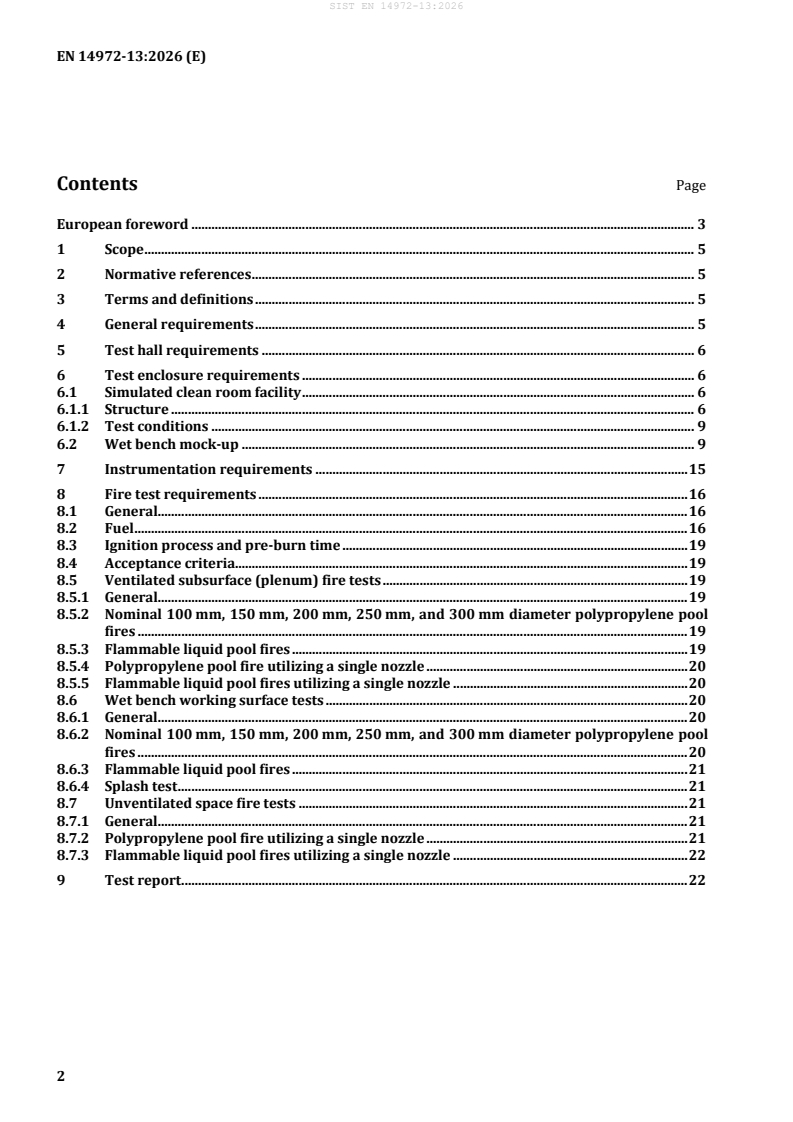
Contents Page
European foreword . 3
1 Scope . 5
2 Normative references . 5
3 Terms and definitions . 5
4 General requirements . 5
5 Test hall requirements . 6
6 Test enclosure requirements . 6
6.1 Simulated clean room facility . 6
6.1.1 Structure . 6
6.1.2 Test conditions . 9
6.2 Wet bench mock-up . 9
7 Instrumentation requirements . 15
8 Fire test requirements . 16
8.1 General. 16
8.2 Fuel . 16
8.3 Ignition process and pre-burn time . 19
8.4 Acceptance criteria. 19
8.5 Ventilated subsurface (plenum) fire tests . 19
8.5.1 General. 19
8.5.2 Nominal 100 mm, 150 mm, 200 mm, 250 mm, and 300 mm diameter polypropylene pool
fires . 19
8.5.3 Flammable liquid pool fires . 19
8.5.4 Polypropylene pool fire utilizing a single nozzle . 20
8.5.5 Flammable liquid pool fires utilizing a single nozzle . 20
8.6 Wet bench working surface tests . 20
8.6.1 General. 20
8.6.2 Nominal 100 mm, 150 mm, 200 mm, 250 mm, and 300 mm diameter polypropylene pool
fires . 20
8.6.3 Flammable liquid pool fires . 21
8.6.4 Splash test . 21
8.7 Unventilated space fire tests . 21
8.7.1 General. 21
8.7.2 Polypropylene pool fire utilizing a single nozzle . 21
8.7.3 Flammable liquid pool fires utilizing a single nozzle . 22
9 Test report . 22
European foreword
This document (EN 14972-13:2026) has been prepared by Technical Committee CEN/TC 191 “Fixed
firefighting systems”, the secretariat of which is held by BSI.
This European Standard shall be given the status of a national standard, either by publication of an
identical text or by endorsement, at the latest by January 2027, and conflicting national standards shall
be withdrawn at the latest by January 2027.
Attention is drawn to the possibility that some of the elements of this document may be the subject of
patent rights. CEN shall not be held responsible for identifying any or all such patent rights.
The EN 14972 series published under the general title Fixed firefighting systems — Water mist systems,
consists of the following parts:
— Part 1: Design, installation, inspection and maintenance;
— Part 2: Test protocol for shopping areas for automatic nozzle systems;
— Part 3: Test protocol for office, school class rooms and hotel for automatic nozzle systems;
— Part 4: Test protocol for non-storage occupancies for automatic nozzle systems;
— Part 5: Test protocol for car garages for automatic nozzle systems;
— Part 6: Test protocol for false floors and false ceilings for automatic nozzle systems;
— Part 7: Test protocol for commercial low hazard occupancies for automatic nozzle systems;
— Part 8: Test protocol for machinery in enclosures exceeding 260 m for open nozzle systems;
— Part 9: Test protocol for machinery in enclosures not exceeding 260 m for open nozzle systems;
— Part 10: Test protocol for atrium protection with sidewall nozzles for open nozzle systems;
— Part 11: Test protocol for cable tunnels for open nozzle systems;
— Part 12: Test protocol for commercial deep fat cooking fryers for manually activated open nozzle
systems;
— Part 13: Test protocol for wet benches and other similar processing equipment for open nozzle systems;
— Part 14: Test protocol for combustion turbines in enclosures exceeding 260 m for open nozzle systems;
— Part 15: Test protocol for combustion turbines in enclosures not exceeding 260 m for open nozzle
systems;
— Part 16: Test protocol for industrial oil cookers for open nozzle systems;
— Part 17: Test protocol for residential occupancies for automatic nozzle systems.
Any feedback and questions on this document should be directed to the users’ national standards body.
A complete listing of these bodies can be found on the CEN website.
According to the CEN-CENELEC Internal Regulations, the national standards organisations of the
following countries are bound to implement this European Standard: Austria, Belgium, Bulgaria, Croatia,
Cyprus, Czech Republic, Denmark, Estonia, Finland, France, Germany, Greece, Hungary, Iceland, Ireland,
Italy, Latvia, Lithuania, Luxembourg, Malta, Netherlands, Norway, Poland, Portugal, Republic of North
Macedonia, Romania, Serbia, Slovakia, Slovenia, Spain, Sweden, Switzerland, Türkiye and the United
Kingdom.
1 Scope
This document specifies the evaluation of the fire performance of water mist systems for wet benches
and other similar processing equipment.
2 Normative references
The following documents are referred to in the text in such a way that some or all of their content
constitutes requirements of this document. For dated references, only the edition cited applies. For
undated references, the latest edition of the referenced document (including any amendments) applies.
EN 14972-1:2020+A1:2025, Fixed firefighting systems — Water mist systems — Part 1: Design,
installation, inspection and maintenance
3 Terms and definitions
For the purposes of this document, the terms and definitions given in EN 14972-1 apply.
ISO and IEC maintain terminology databases for use in standardization at the following addresses:
— ISO Online browsing platform: available at https://www.iso.org/obp/
— IEC Electropedia: available at https://www.electropedia.org/
4 General requirements
4.1 Up to a maximum of 5 nozzles used in the fire tests shall be kept for later verification.
4.2 The water mist system, operating without manual intervention, shall successfully complete all
described performance fire tests for their specific applications.
4.3 The fire tests shall be conducted until the fire is extinguished, as required by the fire test.
4.4 System components, component locations, operating conditions and test enclosure details shall
remain unaltered throughout all the fire tests for a given application.
4.5 All fire tests shall be conducted using the manufacturer instructions in regard to nozzle placement,
spray flux, operating pressure, and spray duration. Sprays can be continuous or intermittent in time. In
case of intermittent, or cycled, sprays, the time period during which the system is not discharging shall
not be greater than 50 % of one complete on/off cycle. The system off period shall not exceed 1 min.
4.6 In conjunction with the performance fire tests, all twin fluid water mist systems shall be subjected
to a straight discharge test with no fire to evaluate the resulting discharge and oxygen concentration. This
evaluation shall be conducted using the maximum extinguishing agent flow and pressure. The discharge
duration for the test shall be the maximum required for the system and occupancy to be protected.
Oxygen measurements shall be recorded at a location(s) within the test enclosure. This information shall
be used to evaluate personnel safety and shall be accounted for in the manufacturer’s DIOM manual.
4.7 The minimum operating nozzle pressure (as specified by the manufacturer) shall be used for all
tests. System operating pressures shall be repeatable to within ± 5 %. If the system pressures cannot be
controlled within the specified tolerance, fire tests shall be conducted at the minimum and maximum
pressure by using external means to control the system pressure.
4.8 The maximum nozzle ceiling height and spacing (as specified by the manufacturer) shall be used
for all tests. This includes utilizing the maximum ceiling spacing of the nozzles from the walls.
4.9 The ceiling nozzle arrangement shall have uniform spacing. The ceiling nozzle spacing from the
wall shall be uniform, preferably one half of the main spacing.
5 Test hall requirements
5.1 The fire test hall shall be of adequate size with natural or minimal ventilation so as not to interfere
with the fire testing within the enclosure or about the wet bench mock-up in the hall.
5.2 The size of the test laboratory shall not impact extinguishment of any test fires (i.e. depletion of
oxygen due to an inadequately sized test laboratory).
5.3 For all fire tests, the ceiling, floor, and walls shall be as dry as possible, with only ambient moisture
content allowed. The relative humidity in the test enclosure shall not significantly differ from that of the
ambient relative humidity. Maximum room relative humidity shall not be more than 70 % prior to the
test.
5.4 The fire test hall shall be at an ambient temperature of (20 ± 10) °C prior to the start of the test.
6 Test enclosure requirements
6.1 Simulated clean room facility
6.1.1 Structure
The simulated clean room facility shall be constructed in a large open test hall. The enclosure shall be
3,7 m wide by 5,5 m long by 3,7 m in height. The enclosure shall be constructed of wood or metal frame
with an inner lining of minimum 13 mm gypsum or 0,7 mm galvanized steel. A 0,8 m by 2,0 m high
personnel door shall be installed with a locking mechanism in one of the walls. A 1,2 m by 2,4 m high
removable panel shall also be installed for test enclosure access (the personnel door may be constructed
within this panel).
The ceiling of the enclosure shall be constructed of a porous plate to allow inflow of air from the open
test hall at the ceiling level. The plate shall include 6,3 mm diameter perforations at 25 mm spacing. This
will result in an open area of approximately 6 %.
The floor of the enclosure shall be raised. The floor shall be constructed with closed mesh ca. 2,65 mm
steel grating (bearing bar size of 25 mm) tall by 3,2 mm thick. The mesh opening shall be 8 mm by
100 mm. A porous steel plate shall be placed below the steel grating. The plate shall include 6,5 mm
diameter perforations at 25 mm spacing. This will result in an open area of approximately 6 %.
A sub-floor shall be constructed underneath the primary enclosure, to allow airflow through the test
enclosure floor openings, creating a realistic flow environment surrounding the wet bench mock-up. The
sub-floor shall be 3,7 m wide by 5,5 m long by 1,2 m deep and shall be constructed of wood or metal frame
with an inner lining of minimum 13 mm gypsum or 0,7 mm galvanized steel.
The front and back 5,5 m walls of the sub-floor shall include 2,3 m wide by 0,7 m high openings. The
openings shall be horizontally and vertically centred in each wall of the sub-floor. Each opening shall be
ducted to the open test hall (see Figures 1 to 3) and shall include blowers to generate a downward flow
in the upper test enclosure. The ductwork and blowers serve as the primary wet bench air flow.
NOTE For tolerances not otherwise specified, see EN 14972-1:2020+A1:2025, Annex S.
Dimensions in metres
Key
1 porous Plate 5 metal plate with holes
2 uniform flow of at least 14 m /min per linear metre of wet bench 6 primary blower
3 raised floor 7 secondary blower
4 wet bench
Figure 1 — Clean room simulation facility – Side view
Dimensions in metres
Key
1 primary flow 4 window
2 door 5 camera
3 removable opening 6 secondary flow
Figure 2 — Clean room simulation facility – Top view
Dimensions in metres
Key
1 porous plate 5 surface area
2 uniform flow of at least 14 m /min per linear metre of wet bench 6 plenum
3 raised floor 7 secondary blower intake
4 wet bench 8 metal plate with holes
Figure 3 — Clean room simulation facility – Front view
6.1.2 Test conditions
The air flow in the test enclosure shall be the maximum air flow specified by the manufacturer. An average
downward velocity in a typical cleanroom facility is approximately (0,30 to 0,46) m/s. The minimum
3 3
/h per linear meter of wet ben
...