


EN 1918-1:2016
(Main)Gas infrastructure - Underground gas storage - Part 1: Functional recommendations for storage in aquifers
Gas infrastructure - Underground gas storage - Part 1: Functional recommendations for storage in aquifers
This European Standard covers the functional recommendations for design, construction, testing, commissioning, operation, maintenance and abandonment of underground gas storage (UGS) facilities in aquifers up to and including the wellhead.
It specifies practices, which are safe and environmentally acceptable.
For necessary surface facilities for underground gas storage, EN 1918-5 applies.
In this context "gas" is any hydrocarbon fuel:
- which is in a gaseous state at a temperature of 15 °C and under a pressure of 0,1 MPa (this includes natural gas, compressed natural gas (CNG) and liquefied petroleum gas (LPG). The stored product is also named fluid);
- which meets specific quality requirements in order to maintain underground storage integrity, performance, environmental compatibility and fulfils contractual requirements.
This European Standard specifies common basic principles for underground gas storage facilities. Users of this European Standard should be aware that more detailed standards and/or codes of practice exist. A non-exhaustive list of relevant standards can be found in Annex A.
This European Standard is intended to be applied in association with these national standards and/or codes of practice and does not replace them.
In the event of conflicts in terms of more restrictive requirements in the national legislation/regulation with the requirements of this European Standard, the national legislation/regulation takes precedence as illustrated in CEN/TR 13737 (all parts).
NOTE CEN/TR 13737 (all parts) contains:
- clarification of relevant legislation/regulations applicable in a country;
- if appropriate, more restrictive national requirements;
- national contact point for the latest information.
This European Standard is not intended to be applied retrospectively to existing facilities.
Gasinfrastruktur - Untertagespeicherung von Gas - Teil 1: Funktionale Empfehlungen für die Speicherung in Aquiferen
Diese Europäische Norm legt die funktionalen Empfehlungen für Planung, Errichtung, Prüfung, Inbetriebnahme, Betrieb, Instandhaltung und Stilllegung von Untertagegasspeicheranlagen in Aquiferen bis einschließlich des Bohrlochkopfes fest.
Sie legt sichere und umweltverträgliche Verfahrensweisen fest.
Für erforderliche Übertageanlagen für einen Untertagegasspeicher gilt EN 1918 5.
In diesem Zusammenhang ist „Gas“ jeder Brennstoff auf Kohlenwasserstoffbasis, der:
— sich bei einer Temperatur von 15 °C und unter einem Druck von 0,1 MPa in gasförmigem Zustand befindet (dazu gehören Erdgas, komprimiertes Erdgas (en: compressed natural gas, CNG) und Flüssig-gas (en: liquefied petroleum gas, LPG). Das gespeicherte Produkt wird auch als Medium bezeichnet);
— bestimmte Qualitätsanforderungen erfüllt, um die Integrität des Untertagespeichers, die Leistung und die Umweltverträglichkeit aufrechtzuerhalten, und vertragliche Anforderungen erfüllt.
Die vorliegende Europäische Norm legt allgemeine Grundsätze für Untertagegasspeicheranlagen fest. Die Anwender dieser Europäischen Norm sollten sich bewusst sein, dass detailliertere Normen und/oder Technische Regeln existieren. Eine Liste einschlägiger Normen, die allerdings nicht abschließend ist, findet sich in Anhang A.
Es ist vorgesehen, dass diese Europäische Norm in Verbindung mit nationalen Normen und/oder Technischen Regeln angewendet wird. Sie ersetzt diese nicht.
Beim Auftreten von Widersprüchen aufgrund restriktiverer Anforderungen in nationalen Gesetzen/Vor-schrif¬ten als in der vorliegenden Europäischen Norm gefordert haben nationale Gesetze/Vorschriften Vorrang, wie in CEN/TR 13737 (alle Teile) dargestellt.
ANMERKUNG CEN/TR 13737 (alle Teile) enthält:
— Darstellung der in den einzelnen Ländern zu beachtenden Gesetze/Vorschriften;
— wenn notwendig, darin enthaltene restriktivere nationale Anforderungen;
— eine nationale Kontaktstelle für die aktuellsten Informationen.
Es ist nicht vorgesehen, diese Europäische Norm rückwirkend auf bestehende Anlagen anzuwenden.
Infrastructures gazières - Stockage souterrain de gaz - Partie 1 : Recommandations fonctionnelles pour le stockage en nappe aquifère
La présente Norme européenne décrit les recommandations fonctionnelles pour la conception, la construction, les essais, la mise en service, l'exploitation, la maintenance et l'abandon des stockages souterrains de gaz en nappes aquifères jusqu'à la tête de puits incluse.
Elle spécifie les pratiques acceptables pour la sécurité et l'environnement.
Pour les installations de surface qui sont nécessaires pour un stockage souterrain de gaz, l'EN 1918-5 s’applique.
Dans ce contexte, le terme « gaz » désigne tout combustible hydrocarboné :
— qui est à l'état gazeux à une température de 15 °C et sous une pression de 0,1 MPa (sont inclus le gaz naturel, le gaz naturel comprimé (GNC) et le gaz de pétrole liquéfié (GPL)). Le produit stocké est également appelé « fluide » ;
— qui satisfait à des prescriptions spécifiques en matière de qualité afin de maintenir l'intégrité, les performances, la compatibilité environnementale du stockage souterrain et qui respecte les prescriptions contractuelles.
La présente Norme européenne spécifie les principes communs fondamentaux des stockages souterrains de gaz. Il convient que les utilisateurs de la présente Norme européenne gardent à l'esprit qu'il existe des normes et/ou des codes de bonne pratique plus détaillés. Une liste non exhaustive des normes pertinentes figure à l'Annexe A.
La présente Norme européenne est destinée à s'appliquer conjointement avec ces normes nationales et/ou codes de bonne pratique ; elle ne les remplace pas.
En cas de conflits en termes de prescriptions plus restrictives dans la réglementations/législation nationale vis-à-vis des prescriptions de la présente Norme européenne, la réglementation/législation nationale prévaut comme illustré dans le CEN/TR 13737 (toutes les parties).
NOTE Le CEN/TR 13737 (toutes les parties) donne :
— la clarification des législations/règlements applicables dans un pays ;
— si approprié, des prescriptions nationales plus restrictives ;
— un point de contact national pour une information ultérieure.
La présente Norme européenne n'est pas prévue pour être appliquée de façon rétroactive aux installations existantes.
Infrastruktura za plin - Podzemna plinska skladišča - 1. del: Funkcionalna priporočila za skladiščenje v vodonosnikih
Ta standard zajema funkcionalna priporočila za načrtovanje, izgradnjo, preskušanje, delovanje, vzdrževanje in opustitev podzemnih plinskih skladišč v vodonosnikih, vključno z ustjem vrtine. Določa prakse, ki so varne in okoljsko sprejemljive. Potrebni nadzemni objekti za podzemno skladiščenje plina so opisani v standardu prEN 1918-5. »Plin« v tem kontekstu pomeni vsako ogljikovodikovo gorivo, ki je v plinastem stanju pri temperaturi 15 °C in tlaku 1 bar. To vključuje zemeljski plin (imenovan tudi CNG) in LPG.
General Information
- Status
- Published
- Publication Date
- 22-Mar-2016
- Withdrawal Date
- 29-Sep-2016
- Technical Committee
- CEN/TC 234 - Gas infrastructure
- Drafting Committee
- CEN/TC 234/WG 4 - Gas underground storage
- Current Stage
- 9092 - Decision on results of review/2YR ENQ - revise - Review Enquiry
- Start Date
- 20-Dec-2022
- Completion Date
- 14-Apr-2025
Relations
- Effective Date
- 30-Mar-2016
- Effective Date
- 18-Jan-2023
Overview
EN 1918-1:2016 - published by CEN - provides functional recommendations for underground gas storage (UGS) in aquifers, covering all phases up to and including the wellhead. The standard applies to the design, construction, testing, commissioning, operation, maintenance and abandonment of aquifer storage facilities and specifies practices that are safe and environmentally acceptable. In this context gas includes hydrocarbon fuels gaseous at 15 °C and 0.1 MPa (e.g., natural gas, CNG, LPG). EN 1918-1 is part of the EN 1918 series; for surface facilities see EN 1918-5.
Key topics and requirements
- Scope and definitions: Common UGS terminology (e.g., aquifer, cushion gas, monitoring well, MOP) to ensure consistent application across projects.
- Design principles: Geological description, reservoir characterization, determination of maximum operating pressure (MOP) and minimum operating pressure, and interface with neighbouring subsurface activities.
- Wells and completions: Requirements for well construction, casing, cementing, liners, wellheads and completion equipment up to the wellhead.
- Monitoring systems: Recommendations for reservoir, indicator horizon and connected aquifer monitoring; use of observation wells, logging and seismic techniques.
- Operation & HSE: Operational principles for injection and withdrawal, maintenance of wells, health, safety and environmental (HSE) controls and emergency valves (e.g., master valve).
- Testing & commissioning: Procedures for pre-operational testing and commissioning of wells and monitoring equipment.
- Abandonment: Safe withdrawal of gas, plugging and permanent abandonment of wells, removal/management of surface facilities and post‑abandonment monitoring.
- Regulatory interaction: Guidance that national legislation/regulation takes precedence in case of more restrictive requirements; CEN/TR 13737 referenced for national specifics.
Applications and who uses it
EN 1918-1 is intended for professionals involved in the lifecycle of aquifer-based UGS:
- Reservoir and petroleum engineers evaluating storage feasibility and pressure limits
- Drilling and completion contractors implementing well construction and cementing
- Asset operators responsible for injection/withdrawal operations and maintenance
- HSE and environmental managers defining monitoring and mitigation programs
- Regulators and consultants aligning projects with European and national rules
Practical benefits include improved storage integrity, environmental compatibility, operational safety and consistent cross-border best practice.
Related standards
- EN 1918 series (Parts 2–5) for other storage media (oil/gas fields, salt caverns, rock caverns, surface facilities)
- EN 1918-5 - functional recommendations for surface facilities (applicable alongside Part 1)
- Annex A of EN 1918-1 lists additional relevant standards and codes of practice; consult CEN/TR 13737 for national legislative clarifications.
Keywords: EN 1918-1, underground gas storage, aquifer storage, UGS design, MOP, wellhead, monitoring, CEN, gas infrastructure.


Frequently Asked Questions
EN 1918-1:2016 is a standard published by the European Committee for Standardization (CEN). Its full title is "Gas infrastructure - Underground gas storage - Part 1: Functional recommendations for storage in aquifers". This standard covers: This European Standard covers the functional recommendations for design, construction, testing, commissioning, operation, maintenance and abandonment of underground gas storage (UGS) facilities in aquifers up to and including the wellhead. It specifies practices, which are safe and environmentally acceptable. For necessary surface facilities for underground gas storage, EN 1918-5 applies. In this context "gas" is any hydrocarbon fuel: - which is in a gaseous state at a temperature of 15 °C and under a pressure of 0,1 MPa (this includes natural gas, compressed natural gas (CNG) and liquefied petroleum gas (LPG). The stored product is also named fluid); - which meets specific quality requirements in order to maintain underground storage integrity, performance, environmental compatibility and fulfils contractual requirements. This European Standard specifies common basic principles for underground gas storage facilities. Users of this European Standard should be aware that more detailed standards and/or codes of practice exist. A non-exhaustive list of relevant standards can be found in Annex A. This European Standard is intended to be applied in association with these national standards and/or codes of practice and does not replace them. In the event of conflicts in terms of more restrictive requirements in the national legislation/regulation with the requirements of this European Standard, the national legislation/regulation takes precedence as illustrated in CEN/TR 13737 (all parts). NOTE CEN/TR 13737 (all parts) contains: - clarification of relevant legislation/regulations applicable in a country; - if appropriate, more restrictive national requirements; - national contact point for the latest information. This European Standard is not intended to be applied retrospectively to existing facilities.
This European Standard covers the functional recommendations for design, construction, testing, commissioning, operation, maintenance and abandonment of underground gas storage (UGS) facilities in aquifers up to and including the wellhead. It specifies practices, which are safe and environmentally acceptable. For necessary surface facilities for underground gas storage, EN 1918-5 applies. In this context "gas" is any hydrocarbon fuel: - which is in a gaseous state at a temperature of 15 °C and under a pressure of 0,1 MPa (this includes natural gas, compressed natural gas (CNG) and liquefied petroleum gas (LPG). The stored product is also named fluid); - which meets specific quality requirements in order to maintain underground storage integrity, performance, environmental compatibility and fulfils contractual requirements. This European Standard specifies common basic principles for underground gas storage facilities. Users of this European Standard should be aware that more detailed standards and/or codes of practice exist. A non-exhaustive list of relevant standards can be found in Annex A. This European Standard is intended to be applied in association with these national standards and/or codes of practice and does not replace them. In the event of conflicts in terms of more restrictive requirements in the national legislation/regulation with the requirements of this European Standard, the national legislation/regulation takes precedence as illustrated in CEN/TR 13737 (all parts). NOTE CEN/TR 13737 (all parts) contains: - clarification of relevant legislation/regulations applicable in a country; - if appropriate, more restrictive national requirements; - national contact point for the latest information. This European Standard is not intended to be applied retrospectively to existing facilities.
EN 1918-1:2016 is classified under the following ICS (International Classification for Standards) categories: 75.200 - Petroleum products and natural gas handling equipment. The ICS classification helps identify the subject area and facilitates finding related standards.
EN 1918-1:2016 has the following relationships with other standards: It is inter standard links to EN 1918-1:1998, prEN 1918-1. Understanding these relationships helps ensure you are using the most current and applicable version of the standard.
EN 1918-1:2016 is associated with the following European legislation: Standardization Mandates: M/017. When a standard is cited in the Official Journal of the European Union, products manufactured in conformity with it benefit from a presumption of conformity with the essential requirements of the corresponding EU directive or regulation.
You can purchase EN 1918-1:2016 directly from iTeh Standards. The document is available in PDF format and is delivered instantly after payment. Add the standard to your cart and complete the secure checkout process. iTeh Standards is an authorized distributor of CEN standards.
Standards Content (Sample)
2003-01.Slovenski inštitut za standardizacijo. Razmnoževanje celote ali delov tega standarda ni dovoljeno.NFLRQDOQDGasinfrastruktur - Untertagespeicherung von Gas - Teil 1: Funktionale Empfehlungen für die Speicherung in AquiferenInfrastructures gazières - Stockage souterrain de gaz - Partie 1 : Recommandations fonctionnelles pour le stockage en nappe aquifèreGas infrastructure - Underground gas storage - Part 1: Functional recommendations for storage in aquifers75.200Petroleum products and natural gas handling equipmentICS:Ta slovenski standard je istoveten z:EN 1918-1:2016SIST EN 1918-1:2016en,fr,de01-november-2016SIST EN 1918-1:2016SLOVENSKI
STANDARDSIST EN 1918-1:19991DGRPHãþD
EUROPEAN STANDARD NORME EUROPÉENNE EUROPÄISCHE NORM
EN 1918-1
March
t r s x ICS
y wä t r r Supersedes EN
s { s zæ sã s { { zEnglish Version
Gas infrastructure æ Underground gas storage æ Part
sã Functional recommendations for storage in aquifers Infrastructures gazières æ Stockage souterrain de gaz æ Partie
s ã Recommandations fonctionnelles pour le stockage en nappe aquifère
Gasinfrastruktur æ Untertagespeicherung von Gas æ Teil
sã Funktionale Empfehlungen für die Speicherung in Aquiferen This European Standard was approved by CEN on
s r January
t r s xä
egulations which stipulate the conditions for giving this European Standard the status of a national standard without any alterationä Upætoædate lists and bibliographical references concerning such national standards may be obtained on application to the CENæCENELEC Management Centre or to any CEN memberä
translation under the responsibility of a CEN member into its own language and notified to the CENæCENELEC Management Centre has the same status as the official versionsä
CEN members are the national standards bodies of Austriaá Belgiumá Bulgariaá Croatiaá Cyprusá Czech Republicá Denmarká Estoniaá Finlandá Former Yugoslav Republic of Macedoniaá Franceá Germanyá Greeceá Hungaryá Icelandá Irelandá Italyá Latviaá Lithuaniaá Luxembourgá Maltaá Netherlandsá Norwayá Polandá Portugalá Romaniaá Slovakiaá Sloveniaá Spainá Swedená Switzerlandá Turkey and United Kingdomä
EUROPEAN COMMITTEE FOR STANDARDIZATION COMITÉ EUROPÉEN DE NORMALISATION EUROPÄISCHES KOMITEE FÜR NORMUNG
CEN-CENELEC Management Centre:
Avenue Marnix 17,
B-1000 Brussels
t r s x CEN All rights of exploitation in any form and by any means reserved worldwide for CEN national Membersä Refä Noä EN
s { s zæ sã t r s x ESIST EN 1918-1:2016
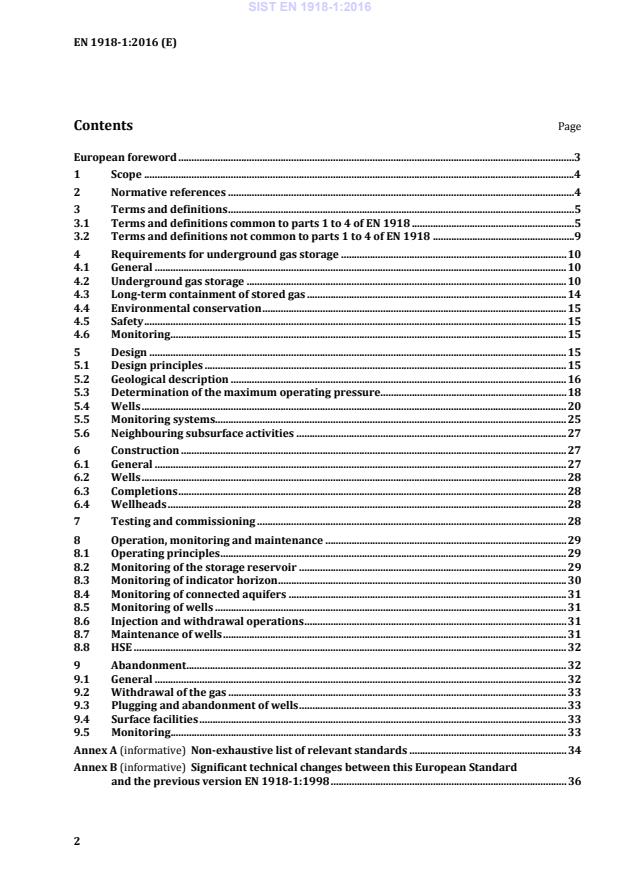
Non-exhaustive list of relevant standards . 34 Annex B (informative)
Significant technical changes between this European Standard and the previous version EN 1918-1:1998 . 36
MOP maximum pressure of the storage reservoir or cavern, normally at maximum inventory of gas in storage, which has not to be exceeded in order to ensure the integrity of the UGS and is based on the outcome of geological/technical engineering and is approved by authorities Note 1 to entry: The maximum operating pressure is related to a datum depth and in caverns usually to the casing shoe of the last cemented casing. 3.1.26 minimum operating pressure minimum pressure of the storage reservoir or cavern, normally reached at the end of the decline phase of the withdrawal profile and for caverns is based on geomechanical investigations to ensure stability and to limit the effect of subsidence and normally has to be approved by authorities and has not to be underrun Note 1 to entry: The minimum pressure is related to a datum depth. 3.1.27 monitoring well observation well well for purposes of monitoring the storage horizon and/or overlying or underlying horizons for subsurface phenomena such as pressure fluctuation, fluid flow and qualities, temperature, etc. 3.1.28 operating well well used for gas withdrawal and/or injection 3.1.29 overburden all sediments or rock that overlie a geological formation SIST EN 1918-1:2016
It contains fluids which are internally in pressure communication. 3.1.33 saturation percentages of pore space occupied by fluids 3.1.34 seismic technology technology to characterize the subsurface image with respect to extent, geometry, fault pattern and fluid content applying acoustic waves, impressed by sources near to surface in the subsurface strata, which pass through strata with different seismic responses and filtering effects back to surface, where they are recorded and analysed 3.1.35 string entity of casing or tubing plus additional equipment, screwed or welded together as parts of a well respectively completion 3.1.36 subsurface safety valve valve installed in casing and/or tubing beneath the wellhead or the lower end of the tubing for the purpose of stopping the flow of gas in case of emergency 3.1.37 tubing pipe or set of pipes that are screwed or welded together to form a string, through which fluids are injected or withdrawn or which can be used for monitoring 3.1.38 well borehole and its technical equipment including the wellhead 3.1.39 well integrity well condition without uncontrolled release of fluids throughout the life cycle SIST EN 1918-1:2016
Key 1 operating wells 2 monitoring wells 3 indicator horizon 4 caprock 5 storage reservoir and stored gas 6 salt dome 7 cavern Figure 1 — Storage in aquifers, oil and gas fields, solution mined salt caverns For LPG storage only salt or rock caverns can be applied. The UGS type applied, is dependent on the geological conditions and prerequisites as well as on the designed capacity layout. 4.2.3 General characterization of UGS UGS are naturally or artificially developed reservoirs respectively artificially developed caverns in subsurface geological formations used for the storage of natural gas (or LPG). An UGS consists of all subsurface and surface facilities required for the storage and for the withdrawal and injection of natural gas (or storage of LPG). Several subsurface storage reservoirs or caverns may be connected to one or several common surface facilities. The suitability of subsurface geological formations have to be investigated individually for each location, in order to operate the storage facilities in an efficient, safe and environmentally compatible manner. In order to construct a storage facility wells are used to establish a controlled connection between the reservoir or cavern and the surface facilities at the well head. The wells used for cycling the storage gas are called operating wells. In addition to the operating wells, specially assigned observation wells may be used to monitor the storage performance with respect to pressures and saturations and the quality of reservoir water as well as to monitor any interference in adjacent formations. SIST EN 1918-1:2016
Key 1 storage wells 2 monitoring wells 3 indicator horizon 4 caprock 5 storage reservoir and stored gas Figure 2 — Aquifer storage 4.3 Long-term containment of stored gas The storage facility shall be designed, constructed and operated to ensure the continuing long-term containment of the stored gas. This presupposes: — adequate prior knowledge of the geological formation, in which the storage is to be developed and of its geological environment; — acquisition of all relevant information needed for specifying parameter limits for construction and operation; — demonstration that the storage is capable of ensuring long-term containment of the stored gas through its hydraulic and mechanical integrity. SIST EN 1918-1:2016
...
이 기사는 EN 1918-1:2016 유럽 표준에 대해 논의한다. 이 표준은 지하 수력매장지역(Gas infrastructure - Underground gas storage)의 기능적인 권장사항을 다룬다. 이 표준은 수력매장지역의 설계, 건설, 시험, 취업, 운영, 유지보수 및 폐기에 대한 안전하고 환경적으로 받아들일 수 있는 방법을 명시한다. 이 표준은 15°C에서 0.1 MPa 의 압력 하에서 기체 상태로 있는 모든 탄화수소 연료(천연가스, 압축 천연가스(CNG), 액화 석유 가스(LPG) 포함)를 다룬다. 또한, 매장된 제품은 지하 저장의 무결성, 성능, 환경적 호환성, 계약상 요구사항을 충족시키기 위한 특정 품질 요건을 충족한다. 이 유럽 표준은 지하 수력매장지역에 대한 공통 기본 원칙을 기술한다. 이 표준을 사용하는 사용자들은 더 자세한 표준 및/또는 실천지침이 존재함을 인식해야 한다. 관련 기준들에 대한 비소진 목록은 부록 A에 있으며, 이 유럽 표준은 이러한 국가 표준 및/또는 실천지침과 함께 적용되어야 하며, 이를 대신하지 않는다. 이 유럽 표준의 요구사항과 국가 법규 사이에 더 제한적인 요구사항이 국가 법규에 있는 경우, 국가 법규가 우선시 되는 것을 CEN/TR 13737에 언급되어 있습니다. 이 유럽 표준은 기존 시설에 대해 후치적으로 적용되는 것을 의도하지 않는다.
This article discusses the EN 1918-1:2016 European Standard, which provides functional recommendations for the design, construction, operation, and maintenance of underground gas storage facilities in aquifers. The standard ensures that these facilities are safe and environmentally friendly. It applies to any hydrocarbon fuel in a gaseous state, including natural gas, compressed natural gas, and liquefied petroleum gas. The standard also outlines the use of other relevant national standards and codes of practice. It should be noted that this standard does not apply to existing facilities.
この記事では、EN 1918-1:2016という欧州規格について説明しています。この規格は、地下のガス貯蔵設備(Gas infrastructure - Underground gas storage)における機能的な推奨事項について取り上げています。この規格は、地下貯蔵設備の設計、建設、試験、運用、保守、廃棄における安全性と環境配慮性を確保するための方法を定めています。この規格は、15°Cで0.1 MPaの圧力下で気体状態にある、すべての炭化水素燃料(天然ガス、圧縮天然ガス(CNG)、液化石油ガス(LPG)を含む)を対象としています。また、貯蔵された製品は地下貯蔵の完全性、パフォーマンス、環境適合性を維持し、契約上の要件を満たすための特定の品質要件を満たすことが求められます。この欧州規格は、地下ガス貯蔵施設に対する共通の基本原則を規定しています。この欧州規格の使用者は、さらに詳細な規格や実践的なガイドラインが存在することを認識する必要があります。関連する規格の一部の一覧は付属書Aに記載されています。この欧州規格は、これらの国内規格や実践ガイドラインと併用されることを意図しており、これらの規格の置き換えではありません。国内の法律/規制においてより厳しい要件がある場合、この欧州規格の要件との間で矛盾が生じた場合は、国内の法律/規制が優先されます(CEN/TR 13737 の各部に詳述されています)。なお、この欧州規格は既存の施設には後ろ向きに適用されることは意図されていません。
Questions, Comments and Discussion
Ask us and Technical Secretary will try to provide an answer. You can facilitate discussion about the standard in here.
Loading comments...