

EN 14382:2019+A1:2024
(Main + Amendment)Gas safety shut-off devices for inlet pressure up to 10 MPa (100 bar)
- Abstract
This document specifies constructional, functional, testing marking and sizing requirements and documentation of gas safety shut-off devices:
- for inlet pressures up to 100 bar and nominal diameters up to DN 400;
- for an operating temperature range from -20 °C to +60 °C;
which operate with fuel gases of the 1st and 2nd family as defined in EN 437, used in the pressure regulating stations in accordance with EN 12186 or EN 12279, in transmission and distribution networks and also in commercial and industrial installations.
"Gas safety shut-off devices" will hereafter be called "SSDs" except in titles.
For standard safety shut-off devices when used in pressure regulating stations complying with EN 12186 or EN 12279, Annex ZA lists all applicable Essential Safety Requirements of Directive 2014/68/EU (PED).
This document considers the following temperature classes/types of SSDs:
- temperature class 1: operating temperature range from -10 °C to 60 °C;
- temperature class 2: operating temperature range from -20 °C to 60 °C;
- functional class A: SSDs that close when damage to the pressure detecting element occurs or when external power fails and whose re-opening, is possible only manually;
- functional class B: SSDs that do not close when damage to the pressure detecting element occurs but provide suitable and reliable protection and whose re-opening, is possible only manually;
- type IS: (integral strength type);
- type DS: (differential strength type).
SSDs complying with the requirements of this document may be declared as "in conformity with EN 14382" and bear the mark "EN 14382".
The material and functional requirements specified in this document may be applied to SSDs which use thermal energy or the effects of electrical energy to trip the operation of the closing member. For these SSDs the operational parameters are not specified in this document.
The SSD may incorporate a vent limiter, complying with the requirements in Annex J.
This standard for some paragraphs and sub clauses makes full reference to prEN 334:2016.
This document does not apply to:
- SSDs upstream from/on/in domestic gas-consuming appliances which are installed downstream of domestic gas meters;
- SSDs designed to be incorporated into pressure-regulating devices used in service lines with volumetric flow rate ≤ 200 m3/h at normal conditions and inlet pressure ≤ 5 bar.
Continued integrity of safety shut-off devices is ensured by periodic functional checks. For periodic functional checks it is common to refer to national regulations/standards where existing or users/manufacturers practices.
This document considers the reaction of the SSDs functional class A to the specified reasonable expected failures in terms of "fail close" behaviour, but it should be consider that there are other types of failures whose consequences cannot bring to the same reactions (these risks are covered via redundancy as per EN 12186) and that residual hazards should be reduced by a suitable surveillance in use / maintenance.
In this document, both safety shut-off devices that can be classified as "safety accessories" by themselves according the Pressure Equipment Directive (2014/68/EU) as well as safety shut-off devices that can be used to provide the necessary pressure protection through redundancy (e.g. shutoff device integrated in a pressure regulator, shut-off device with a second shut-off device) are considered. Addition of environmental considerations;
The provisions in this document are in line with the state of art at the moment of writing.
This document does not intend to limit the improvement of actual provisions (materials, requirements, test methods, acceptance criteria, etc.) or the developing of new provisions for SSDs where they are suitable to ensure an equivalent level of reliability.
- Status
- Published
- Publication Date
- 10-Sep-2024
- Current Stage
- 6060 - Definitive text made available (DAV) - Publishing
- Start Date
- 11-Sep-2024
- Due Date
- 21-Jul-2024
- Completion Date
- 11-Sep-2024

Overview
EN 14382:2019+A1:2024 (CEN) is the European standard for gas safety shut-off devices (SSDs) rated for inlet pressures up to 10 MPa (100 bar) and nominal diameters up to DN 400. It defines construction, functional, testing, marking, sizing and documentation requirements for SSDs used with fuel gases of the 1st and 2nd family (EN 437) in pressure regulating stations (EN 12186 / EN 12279), transmission and distribution networks, and commercial/industrial installations. SSDs that meet the requirements may be declared “in conformity with EN 14382” and bear the EN 14382 mark.
Key topics and technical requirements
- Scope and exclusions: Covers SSDs for inlet pressures ≤ 10 MPa and operating temperatures from −20 °C to +60 °C; excludes SSDs upstream of domestic appliances downstream of domestic meters and certain low‑flow service line devices (≤ 200 m3/h at ≤ 5 bar).
- Temperature and functional classes:
- Temperature class 1: −10 °C to +60 °C
- Temperature class 2: −20 °C to +60 °C
- Functional class A: fail‑close on pressure detector damage or power loss; re‑opening manual only
- Functional class B: do not close on detector damage but provide reliable protection; re‑opening manual only
- Types: IS (integral strength) and DS (differential strength)
- Construction & materials: Requirements for housings, diaphragms, elastomers and strength against internal pressure and dynamic gas impact
- Functional performance: Accuracy groups, response time, relatching/unlatching, closing force, flow coefficient (Cv/Kv), endurance and ageing
- Testing & verification: Type tests, routine tests, production surveillance, dimensional and materials checks, strength, tightness, antistatic tests and dynamic impact verification (see Annex D alternatives)
- Documentation & marking: Type test reports, routine/test records, operating instructions, sizing information, and mandatory markings; Annex ZA maps Essential Safety Requirements to Directive 2014/68/EU (PED)
- Special features: Vent limiter requirements (Annex J), environmental provisions (Annex L), and field surveillance/periodic functional checks per national rules
Applications and who uses this standard
EN 14382 is intended for:
- Manufacturers of SSDs for gas networks and pressure regulating equipment
- System designers and integrators specifying SSDs for transmission, distribution, and industrial gas installations
- Certification bodies and testing laboratories performing type and routine testing
- Operators, installers and maintenance teams responsible for selection, installation, periodic checks and documentation Use cases include pressure regulating stations, pipeline shut‑off protection, and redundant safety arrangements where SSDs provide fail‑safe isolation.
Related standards
- EN 12186, EN 12279 (pressure regulating stations)
- EN 437 (fuel gas families)
- prEN 334 referenced for specific clauses
- Directive 2014/68/EU (PED) - see Annex ZA
Keywords: EN 14382, gas safety shut-off devices, SSDs, 10 MPa, 100 bar, pressure regulating station, vent limiter, PED, functional class A, functional class B, IS, DS, flow coefficient, type testing.
Relations
- Merged From
EN 14382:2019/FprA1 - Gas safety shut-off devices for inlet pressure up to 10 MPa (100 bar) - Effective Date
- 03-Jul-2024
- Effective Date
- 03-Jul-2024
- Effective Date
- 25-Aug-2026
- Effective Date
- 09-Feb-2026
- Effective Date
- 28-Jan-2026
- Effective Date
- 28-Jan-2026
- Effective Date
- 28-Jan-2026
- Effective Date
- 28-Jan-2026
- Effective Date
- 28-Jan-2026
- Effective Date
- 28-Jan-2026
- Effective Date
- 28-Jan-2026
- Effective Date
- 28-Jan-2026
- Effective Date
- 28-Jan-2026
- Effective Date
- 28-Jan-2026
- Effective Date
- 28-Jan-2026
Get Certified
Connect with accredited certification bodies for this standard

Institut za varilstvo d.o.o. (Welding Institute)
Slovenia's leading welding institute since 1952. ISO 3834, EN 1090, pressure equipment certification, NDT personnel, welder qualification. Only IIW Au
Sponsored listings
Frequently Asked Questions
EN 14382:2019+A1:2024 is a standard published by the European Committee for Standardization (CEN). Its full title is "Gas safety shut-off devices for inlet pressure up to 10 MPa (100 bar)". This standard covers: This document specifies constructional, functional, testing marking and sizing requirements and documentation of gas safety shut-off devices: - for inlet pressures up to 100 bar and nominal diameters up to DN 400; - for an operating temperature range from -20 °C to +60 °C; which operate with fuel gases of the 1st and 2nd family as defined in EN 437, used in the pressure regulating stations in accordance with EN 12186 or EN 12279, in transmission and distribution networks and also in commercial and industrial installations. "Gas safety shut-off devices" will hereafter be called "SSDs" except in titles. For standard safety shut-off devices when used in pressure regulating stations complying with EN 12186 or EN 12279, Annex ZA lists all applicable Essential Safety Requirements of Directive 2014/68/EU (PED). This document considers the following temperature classes/types of SSDs: - temperature class 1: operating temperature range from -10 °C to 60 °C; - temperature class 2: operating temperature range from -20 °C to 60 °C; - functional class A: SSDs that close when damage to the pressure detecting element occurs or when external power fails and whose re-opening, is possible only manually; - functional class B: SSDs that do not close when damage to the pressure detecting element occurs but provide suitable and reliable protection and whose re-opening, is possible only manually; - type IS: (integral strength type); - type DS: (differential strength type). SSDs complying with the requirements of this document may be declared as "in conformity with EN 14382" and bear the mark "EN 14382". The material and functional requirements specified in this document may be applied to SSDs which use thermal energy or the effects of electrical energy to trip the operation of the closing member. For these SSDs the operational parameters are not specified in this document. The SSD may incorporate a vent limiter, complying with the requirements in Annex J. This standard for some paragraphs and sub clauses makes full reference to prEN 334:2016. This document does not apply to: - SSDs upstream from/on/in domestic gas-consuming appliances which are installed downstream of domestic gas meters; - SSDs designed to be incorporated into pressure-regulating devices used in service lines with volumetric flow rate ≤ 200 m3/h at normal conditions and inlet pressure ≤ 5 bar. Continued integrity of safety shut-off devices is ensured by periodic functional checks. For periodic functional checks it is common to refer to national regulations/standards where existing or users/manufacturers practices. This document considers the reaction of the SSDs functional class A to the specified reasonable expected failures in terms of "fail close" behaviour, but it should be consider that there are other types of failures whose consequences cannot bring to the same reactions (these risks are covered via redundancy as per EN 12186) and that residual hazards should be reduced by a suitable surveillance in use / maintenance. In this document, both safety shut-off devices that can be classified as "safety accessories" by themselves according the Pressure Equipment Directive (2014/68/EU) as well as safety shut-off devices that can be used to provide the necessary pressure protection through redundancy (e.g. shutoff device integrated in a pressure regulator, shut-off device with a second shut-off device) are considered. Addition of environmental considerations; The provisions in this document are in line with the state of art at the moment of writing. This document does not intend to limit the improvement of actual provisions (materials, requirements, test methods, acceptance criteria, etc.) or the developing of new provisions for SSDs where they are suitable to ensure an equivalent level of reliability.
This document specifies constructional, functional, testing marking and sizing requirements and documentation of gas safety shut-off devices: - for inlet pressures up to 100 bar and nominal diameters up to DN 400; - for an operating temperature range from -20 °C to +60 °C; which operate with fuel gases of the 1st and 2nd family as defined in EN 437, used in the pressure regulating stations in accordance with EN 12186 or EN 12279, in transmission and distribution networks and also in commercial and industrial installations. "Gas safety shut-off devices" will hereafter be called "SSDs" except in titles. For standard safety shut-off devices when used in pressure regulating stations complying with EN 12186 or EN 12279, Annex ZA lists all applicable Essential Safety Requirements of Directive 2014/68/EU (PED). This document considers the following temperature classes/types of SSDs: - temperature class 1: operating temperature range from -10 °C to 60 °C; - temperature class 2: operating temperature range from -20 °C to 60 °C; - functional class A: SSDs that close when damage to the pressure detecting element occurs or when external power fails and whose re-opening, is possible only manually; - functional class B: SSDs that do not close when damage to the pressure detecting element occurs but provide suitable and reliable protection and whose re-opening, is possible only manually; - type IS: (integral strength type); - type DS: (differential strength type). SSDs complying with the requirements of this document may be declared as "in conformity with EN 14382" and bear the mark "EN 14382". The material and functional requirements specified in this document may be applied to SSDs which use thermal energy or the effects of electrical energy to trip the operation of the closing member. For these SSDs the operational parameters are not specified in this document. The SSD may incorporate a vent limiter, complying with the requirements in Annex J. This standard for some paragraphs and sub clauses makes full reference to prEN 334:2016. This document does not apply to: - SSDs upstream from/on/in domestic gas-consuming appliances which are installed downstream of domestic gas meters; - SSDs designed to be incorporated into pressure-regulating devices used in service lines with volumetric flow rate ≤ 200 m3/h at normal conditions and inlet pressure ≤ 5 bar. Continued integrity of safety shut-off devices is ensured by periodic functional checks. For periodic functional checks it is common to refer to national regulations/standards where existing or users/manufacturers practices. This document considers the reaction of the SSDs functional class A to the specified reasonable expected failures in terms of "fail close" behaviour, but it should be consider that there are other types of failures whose consequences cannot bring to the same reactions (these risks are covered via redundancy as per EN 12186) and that residual hazards should be reduced by a suitable surveillance in use / maintenance. In this document, both safety shut-off devices that can be classified as "safety accessories" by themselves according the Pressure Equipment Directive (2014/68/EU) as well as safety shut-off devices that can be used to provide the necessary pressure protection through redundancy (e.g. shutoff device integrated in a pressure regulator, shut-off device with a second shut-off device) are considered. Addition of environmental considerations; The provisions in this document are in line with the state of art at the moment of writing. This document does not intend to limit the improvement of actual provisions (materials, requirements, test methods, acceptance criteria, etc.) or the developing of new provisions for SSDs where they are suitable to ensure an equivalent level of reliability.
EN 14382:2019+A1:2024 is classified under the following ICS (International Classification for Standards) categories: 23.060.40 - Pressure regulators. The ICS classification helps identify the subject area and facilitates finding related standards.
EN 14382:2019+A1:2024 has the following relationships with other standards: It is inter standard links to EN 14382:2019/FprA1, EN 14382:2019, ISO 7005-2:1988, EN 60534-1:2005, EN 10204:2004, EN 13906-1:2013, EN 1759-4:2003, EN 12279:2000, EN 1349:2009, EN 13906-2:2013, EN 334:2019, EN 1759-1:2004, EN 1092-1:2007+A1:2013, EN 13906-3:2014, EN 1759-3:2003. Understanding these relationships helps ensure you are using the most current and applicable version of the standard.
EN 14382:2019+A1:2024 is associated with the following European legislation: EU Directives/Regulations: 2014/68/EU; Standardization Mandates: M/601. When a standard is cited in the Official Journal of the European Union, products manufactured in conformity with it benefit from a presumption of conformity with the essential requirements of the corresponding EU directive or regulation.
EN 14382:2019+A1:2024 is available in PDF format for immediate download after purchase. The document can be added to your cart and obtained through the secure checkout process. Digital delivery ensures instant access to the complete standard document.
Standards Content (Sample)
SLOVENSKI STANDARD
01-februar-2025
Nadomešča:
SIST EN 14382:2019
Plinske varnostne zaporne naprave za vstopne tlake do 10 MPa (100 bar) (vključno
z dopolnilom A1)
Gas safety shut-off devices for inlet pressure up to 10 MPa (100 bar)
Gas-Sicherheitsabsperreinrichtungen für Eingangsdrücke bis 10 MPa (100 bar)
Dispositifs de sécurité pour postes et installations de détente-régulation de pression de
gaz - Clapets de sécurité pour pressions amont jusqu'à 10 MPa (100 bar)
Ta slovenski standard je istoveten z: EN 14382:2019+A1:2024
ICS:
23.060.40 Tlačni regulatorji Pressure regulators
2003-01.Slovenski inštitut za standardizacijo. Razmnoževanje celote ali delov tega standarda ni dovoljeno.
EN 14382:2019+A1
EUROPEAN STANDARD
NORME EUROPÉENNE
September 2024
EUROPÄISCHE NORM
ICS 23.060.40 Supersedes EN 14382:2019
English Version
Gas safety shut-off devices for inlet pressure up to 10 MPa
(100 bar)
Dispositifs de sécurité pour postes et installations de Gas-Sicherheitsabsperreinrichtungen für
détente-régulation de pression de gaz - Clapets de Eingangsdrücke bis 10 MPa (100 bar)
sécurité pour pressions amont jusqu'à 10 MPa (100
bar)
This European Standard was approved by CEN on 23 April 2019 and includes Amendment approved by CEN on 22 October
2023.
CEN members are bound to comply with the CEN/CENELEC Internal Regulations which stipulate the conditions for giving this
European Standard the status of a national standard without any alteration. Up-to-date lists and bibliographical references
concerning such national standards may be obtained on application to the CEN-CENELEC Management Centre or to any CEN
member.
This European Standard exists in three official versions (English, French, German). A version in any other language made by
translation under the responsibility of a CEN member into its own language and notified to the CEN-CENELEC Management
Centre has the same status as the official versions.
CEN members are the national standards bodies of Austria, Belgium, Bulgaria, Croatia, Cyprus, Czech Republic, Denmark, Estonia,
Finland, France, Germany, Greece, Hungary, Iceland, Ireland, Italy, Latvia, Lithuania, Luxembourg, Malta, Netherlands, Norway,
Poland, Portugal, Republic of North Macedonia, Romania, Serbia, Slovakia, Slovenia, Spain, Sweden, Switzerland, Türkiye and
United Kingdom.
EUROPEAN COMMITTEE FOR STANDARDIZATION
COMITÉ EUROPÉEN DE NORMALISATION
EUROPÄISCHES KOMITEE FÜR NORMUNG
CEN-CENELEC Management Centre: Rue de la Science 23, B-1040 Brussels
© 2024 CEN All rights of exploitation in any form and by any means reserved Ref. No. EN 14382:2019+A1:2024 E
worldwide for CEN national Members.
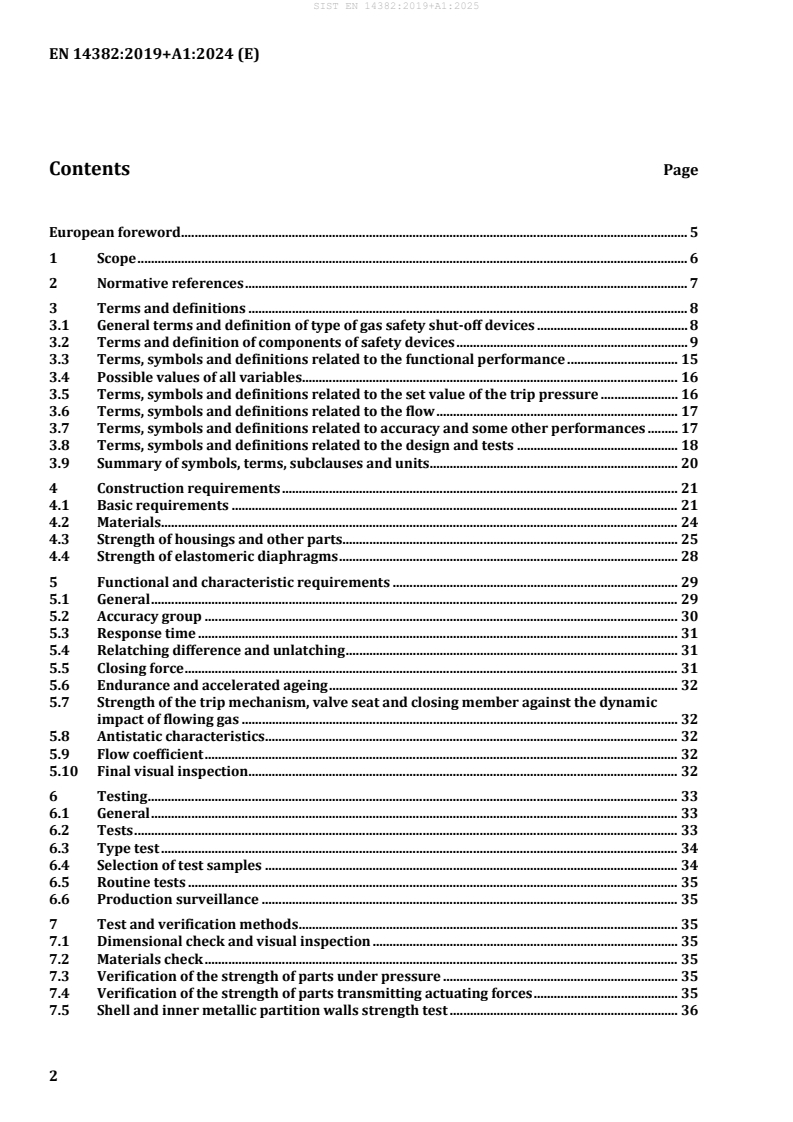
Contents Page
European foreword . 5
1 Scope . 6
2 Normative references . 7
3 Terms and definitions . 8
3.1 General terms and definition of type of gas safety shut-off devices . 8
3.2 Terms and definition of components of safety devices . 9
3.3 Terms, symbols and definitions related to the functional performance . 15
3.4 Possible values of all variables. 16
3.5 Terms, symbols and definitions related to the set value of the trip pressure . 16
3.6 Terms, symbols and definitions related to the flow . 17
3.7 Terms, symbols and definitions related to accuracy and some other performances . 17
3.8 Terms, symbols and definitions related to the design and tests . 18
3.9 Summary of symbols, terms, subclauses and units. 20
4 Construction requirements . 21
4.1 Basic requirements . 21
4.2 Materials . 24
4.3 Strength of housings and other parts. 25
4.4 Strength of elastomeric diaphragms . 28
5 Functional and characteristic requirements . 29
5.1 General . 29
5.2 Accuracy group . 30
5.3 Response time . 31
5.4 Relatching difference and unlatching . 31
5.5 Closing force . 31
5.6 Endurance and accelerated ageing . 32
5.7 Strength of the trip mechanism, valve seat and closing member against the dynamic
impact of flowing gas . 32
5.8 Antistatic characteristics . 32
5.9 Flow coefficient . 32
5.10 Final visual inspection . 32
6 Testing . 33
6.1 General . 33
6.2 Tests . 33
6.3 Type test . 34
6.4 Selection of test samples . 34
6.5 Routine tests . 35
6.6 Production surveillance . 35
7 Test and verification methods . 35
7.1 Dimensional check and visual inspection . 35
7.2 Materials check . 35
7.3 Verification of the strength of parts under pressure . 35
7.4 Verification of the strength of parts transmitting actuating forces . 35
7.5 Shell and inner metallic partition walls strength test . 36
7.6 Alternative shell and inner metallic partition walls strength test . 36
7.7 External tightness test . 36
7.8 Internal sealing test . 37
7.9 Test method and acceptance criteria to verify the antistatic characteristics . 37
7.10 Accuracy group . 37
7.11 Response time . 42
7.12 Relatching difference and unlatching . 43
7.13 Verification of closing force . 44
7.14 Endurance and accelerated ageing . 44
7.15 Resistance to gas of non-metallic parts . 44
7.16 Verification of the strength of the trip mechanism, valve seat and closing member
against dynamic impact of flowing gas . 44
7.17 Final visual inspection . 45
8 Field surveillance . 45
9 Documentation . 46
9.1 Documentation related to type test . 46
9.2 Documentation related to the routine tests . 46
9.3 Documentation related to production surveillance in accordance with 6.6 . 46
9.4 Operating instructions . 47
9.5 Information on sizing . 47
10 Marking . 48
10.1 General requirements . 48
10.2 Basic requirements . 48
10.3 Other additional requirements . 48
10.4 Markings for the various connections. 49
10.5 Identification of auxiliary devices . 49
11 Packaging and transportation of finished product . 49
Annex A (informative) Ice formation . 50
A.1 General . 50
A.2 Requirements . 50
A.3 Tests . 50
)
Annex B (informative) Compliance evaluation . 51
B.1 General . 51
B.2 Introduction. 51
B.3 Procedure . 51
B.4 Manufacturer’s compliance evaluation . 52
B.5 Issue of the certificate of compliance . 52
Annex C (informative) Pressure drop and flow coefficient . 53
C.1 Calculation method for pressure drop throughout the SSD . 53
C.2 Test method for the determination of the flow coefficients . 54
Annex D (normative) Alternative test method for verification of the strength of the trip
mechanism, valve seat and closing member . 55
D.1 Test method . 55
D.2 Test method for the determination of the dynamic factor C . 55
r
D.3 Test method for a series of SSDs . 56
Annex E (informative) Sizing equation . 58
Annex F (informative) Inspection certificate . 59
Annex G (informative) Order specification . 61
G.1 General . 61
G.2 Minimum specifications . 61
G.3 Optional specifications . 62
Annex H (informative) Acceptance test . 63
Annex I (informative) Suitability of safety shut-off device for damp operating conditions -
Test procedure, requirement and acceptance criteria. 64
Annex J (normative) Vent limiter . 65
J.1 General . 65
J.2 Scope . 65
J.3 Terms, symbols and definitions . 65
J.4 Requirements . 66
J.5 Testing and acceptance criteria . 66
J.6 Documentation . 68
J.7 Specific marking on vent limiter . 68
Annex K (informative) Glossary . 69
Annex L (informative) Environmental Provisions . 72
Annex ZA (informative) Relationship between this European Standard and the Essential
Requirements of Directive 2014/68/EU aimed to be covered . 75
Bibliography . 77
European foreword
This document (EN 14382:2019+A1:2024) has been prepared by Technical Committee CEN/TC 235
“Gas pressure regulators and associated safety devices for use in gas transmission and distribution”, the
secretariat of which is held by UNI.
This European Standard shall be given the status of a national standard, either by publication of an
identical text or by endorsement, at the latest by March 2025, and conflicting national standards shall
be withdrawn at the latest by March 2025.
Attention is drawn to the possibility that some of the elements of this document may be the subject of
patent rights. CEN shall not be held responsible for identifying any or all such patent rights.
This document includes Amendment 1 approved by CEN on 21 July 2024.
This document supersedes !EN 14382:2019."
The start and finish of text introduced or altered by amendment is indicated in the text by tags !".
!Deleted paragraphs"
This document can be used as a guideline for gas safety shut off devices outside the ranges specified in
this standard.
This edition has introduced the application of statistical strength testing for series produced pressure
and safety accessories on the basis of EU Directive 2014/68/EU Annex I article 3.2.2 and Guideline H-
14. Safety shut-off devices dealt with in this document are standard safety shut-off devices and, when
used in pressure regulating stations complying with EN 12186 or EN 12279, they are considered as
standard pressure equipment in accordance with Clause 2 a) of Art. 1 of Pressure Equipment Directive
2014/68/EU (PED).
For standard safety shut-off devices used in pressure regulating stations complying with EN 12186 or
EN 12279, Table ZA.1 given in Annex ZA includes all applicable Essential Requirements given in Annex I
of PED except external corrosion resistance for applications in corrosive environments.
This document has been prepared under a mandate given to CEN by the European Commission and the
European Free Trade Association, and supports essential requirements of EU Directive(s).
For relationship with EU Directive(s), see informative Annex ZA, which is an integral part of this
document.
Any feedback and questions on this document should be directed to the users’ national standards body.
A complete listing of these bodies can be found on the CEN website.
According to the CEN-CENELEC Internal Regulations, the national standards organisations of the
following countries are bound to implement this European Standard: Austria, Belgium, Bulgaria,
Croatia, Cyprus, Czech Republic, Denmark, Estonia, Finland, France, Germany, Greece, Hungary, Iceland,
Ireland, Italy, Latvia, Lithuania, Luxembourg, Malta, Netherlands, Republic of North Macedonia, Norway,
Poland, Portugal, Romania, Serbia, Slovakia, Slovenia, Spain, Sweden, Switzerland, Turkey and the
United Kingdom.
1 Scope
This document specifies constructional, functional, testing marking and sizing requirements and
documentation of gas safety shut-off devices:
— for inlet pressures up to 100 bar and nominal diameters up to DN 400;
— for an operating temperature range from –20 °C to +60 °C;
which operate with fuel gases of the 1st and 2nd family as defined in EN 437, used in the pressure
regulating stations in accordance with EN 12186 or EN 12279, in transmission and distribution
networks and also in commercial and industrial installations.
“Gas safety shut-off devices” will hereafter be called “SSDs” except in titles.
For standard safety shut-off devices when used in pressure regulating stations complying with
EN 12186 or EN 12279, Annex ZA lists all applicable Essential Safety Requirements of Directive
2014/68/EU (PED).
This document considers the following temperature classes/types of SSDs:
— temperature class 1: operating temperature range from –10 °C to 60 °C;
— temperature class 2: operating temperature range from –20 °C to 60 °C;
— functional class A: SSDs that close when damage to the pressure detecting element occurs or when
external power fails and whose re-opening, is possible only manually;
— functional class B: SSDs that do not close when damage to the pressure detecting element occurs
but provide suitable and reliable protection and whose re-opening, is possible only manually;
— type IS: (integral strength type);
— type DS: (differential strength type).
SSDs complying with the requirements of this document may be declared as “in conformity with
EN 14382“ and bear the mark “EN 14382”.
The material and functional requirements specified in this document may be applied to SSDs which use
thermal energy or the effects of electrical energy to trip the operation of the closing member. For these
SSDs the operational parameters are not specified in this document.
The SSD may incorporate a vent limiter, complying with the requirements in Annex J.
This standard for some paragraphs and sub clauses makes full reference to EN 334:2019.
This document does not apply to:
— SSDs upstream from/on/in domestic gas-consuming appliances which are installed downstream of
domestic gas meters;
— SSDs designed to be incorporated into pressure-regulating devices used in service lines with
volumetric flow rate ≤ 200 m /h at normal conditions and inlet pressure ≤ 5 bar.
The service lines are those defined in EN 12279
Continued integrity of safety shut-off devices is ensured by periodic functional checks. For periodic
functional checks it is common to refer to national regulations/standards where existing or
users/manufacturers practices.
This document considers the reaction of the SSDs functional class A to the specified reasonable
expected failures in terms of “fail close” behaviour, but it should be consider that there are other types
of failures whose consequences cannot bring to the same reactions (these risks are covered via
redundancy as per EN 12186) and that residual hazards should be reduced by a suitable surveillance in
use / maintenance.
In this document, both safety shut-off devices that can be classified as “safety accessories” by
themselves according the Pressure Equipment Directive (2014/68/EU) as well as safety shut-off
devices that can be used to provide the necessary pressure protection through redundancy (e.g. shutoff
device integrated in a pressure regulator, shut-off device with a second shut-off device) are considered.
Addition of environmental considerations;
The provisions in this document are in line with the state of art at the moment of writing.
This document does not intend to limit the improvement of actual provisions (materials, requirements,
test methods, acceptance criteria, etc.) or the developing of new provisions for SSDs where they are
suitable to ensure an equivalent level of reliability.
Some clauses of this standard should be re-considered at the time when characteristics for non-
conventional gases will be available.
Gas safety shut-off devices according to this European standard do not have their own source of ignition
and therefore are not within the scope of European Directive 2014/34/EU. Any additional component
(e.g. proximity switch, travel transducer etc.) should be independently considered in the framework of
assemblies per ATEX Guideline to the application of Directive 2014/34/EU of the European Parliament
and of the Council of 26nd February 2014, edition December 2017, §§42 and 43.
The document includes also environmental considerations.
2 Normative references
The following documents are referred to in the text in such a way that some or all of their content
constitutes requirements of this document. For dated references, only the edition cited applies. For
undated references, the latest edition of the referenced document (including any amendments) applies.
EN 334:2019, Gas pressure regulators for inlet pressures up to 100 bar
EN 1092-1:2007+A1:2013, Flanges and their joints - Circular flanges for pipes, valves, fittings and
accessories, PN designated - Part 1: Steel flanges
EN 1092-2:1997, Flanges and their joints - Circular flanges for pipes, valves, fittings and accessories, PN
designated - Part 2: Cast iron flanges
EN 1092-3:2003, Flanges and their joints - Circular flanges for pipes, valves, fittings and accessories, PN
designated - Part 3: Copper alloy flanges
EN 1092-4:2002, Flanges and their joints - Circular flanges for pipes, valves, fittings and accessories, PN
designated - Part 4: Aluminium alloy flanges
EN 1349:2009, Industrial process control valves
EN 1759-1:2004, Flanges and their joint - Circular flanges for pipes, valves, fittings and accessories, Class
designated - Part 1: Steel flanges, NPS 1/2 to 24
EN 1759-3:2003, Flanges and their joints - Circular flanges for pipes, valves, fittings and accessories, Class
designated - Part 3: Copper alloy flanges
EN 1759-4:2003, Flanges and their joint - Circular flanges for pipes, valves, fittings and accessories, class
designated - Part 4: Aluminium alloy flanges
EN 10204:2004, Metallic products - Types of inspection documents
EN 12186:2014, Gas infrastructure - Gas pressure regulating stations for transmission and distribution -
Functional requirements
EN 12279:2000, Gas supply systems - Gas pressure regulating installations on service lines - Functional
requirements
EN 13906-1:2013, Cylindrical helical springs made from round wire and bar - Calculation and design -
Part 1 : Compression springs
EN 13906-2:2013, Cylindrical helical springs made from round wire and bar - Calculation and design -
Part 2: Extension springs
EN 13906-3:2014, Cylindrical helical springs made from round wire and bar - Calculation and design -
Part 3: Torsion springs
EN 60534-1:2005, Industrial-process control valves - Part 1: Control valve terminology and general
considerations
ISO 7005-2:1998, Metallic flanges — Part 2: Cast iron flanges
3 Terms and definitions
For the purposes of this document, the following terms, definitions and symbols apply.
ISO and IEC maintain terminological databases for use in standardization at the following addresses:
• IEC Electropedia: available at http://www.electropedia.org/
• ISO Online browsing platform: available at http://www.iso.org/obp
NOTE Annex K lists all definitions and terms in alphabetic order for the English language, the relevant
translation in French and German language and the relevant sub clause of this clause.
3.1 General terms and definition of type of gas safety shut-off devices
3.1.1
gas safety shut-off device
device whose function is to stay in the open position under normal operating conditions and to shut-off
the gas flow automatically and completely when the monitored pressure exceeds the pre-set values
(over-pressure monitoring and/or under-pressure monitoring)
3.1.2
direct acting gas shut-off device
SSD in which the pressure detecting element is directly connected to the trip mechanism
Note 1 to entry: See Figure 1.
3.1.3
indirect acting gas shut-off device
SSD without mechanical connection between the pressure detector element and the trip mechanism
and where (pressure) energy from an internal or external source is used for activating the trip
mechanism and moving the closing element
Note 1 to entry: See Figures 2, 3 and 4.
3.1.4
gas cut-off device
SSD designed to shut-off the gas flow, which responds slower dynamically than a slam shut device when
the monitored pressure exceeds the pre-set values
EXAMPLE SSD using actuator driven by pipeline gas or external power.
3.1.5
gas slam shut device
SSD designed to quickly shut-off the gas flow when the monitored pressure exceeds the pre-set values
EXAMPLE Spring or weight loaded SSD.
3.1.6
sensing point
point from which the monitored variable is fed to the SSD
3.1.7
SSD size
nominal size DN of the inlet connection in accordance with EN ISO 6708 [5]
3.1.8
series of safety shut-off devices
SSDs with the same design concept but differing only in size
3.1.9
auxiliary energy
energy coming from pressure of the system (internal energy) or from any external source (compressed
air or gas)
3.2 Terms and definition of components of safety devices
3.2.1
main components
parts including normally: a controller, a trip mechanism, an actuator, a closing member and a relatching
device permitting the manual opening of the SSD. All these parts are functionally connected
Note 1 to entry: See Figures 1 to 5.
3.2.2
closing member
part which shuts off the gas flow completely
3.2.3
trip mechanism
mechanism which releases the closing member when activated by the controller
3.2.4
actuator
device activated by the trip mechanism which shuts the closing member
3.2.5
relatching device
device which enables the complete opening of the SSD
3.2.6
body
main pressure bearing envelope which provides the fluid flow passageway and the pipe end
connections
3.2.7
valve seat
corresponding sealing surfaces within an SSD which make full contact only when the closing member is
in the closed position
3.2.8
seat ring
part assembled in a component of the SSD to provide a removable seat
3.2.9
controller
device which includes:
— a setting element to adjust the set value of the trip pressure;
— a pressure detecting element which has the function to detect the feedback of the monitored
pressure (e.g. a diaphragm);
— a unit which compares the set value of the trip pressure with the monitored pressure;
— a system which gives the energy to operate the trip mechanism
3.2.10
bypass
device permitting manual equalization of pressure across a closed SSD
3.2.11
diaphragm
diaphragm used as pressure detecting element and diaphragm used to separate one chamber subjected
to pressure into two parts with different pressure (e.g.: balancing diaphragm)
Note 1 to entry: Diaphragms used as a closing member are not part of this group.
3.2.12
auxiliary devices
any device functionally connected to the main components of the SSD
Note 1 to entry: Examples are controller, vent limiter, etc.
Key
1 bypass 6 controller
2 relatching device 7 sensing line
3 trip mechanism 8 actuator
4 breather line 9 sensing point
5 setting element 10 closing member
11 SSD Body
Figure 1 — Example of direct acting gas safety shut-off devices
Key
1 bypass 8 loading pressure line (from internal power
source)
2 actuator 9 loading pressure line (from external power
source)
3 relatching device 10 breather/exhaust line
4 exhaust line 11 sensing point
5 trip mechanism 12 closing member
6 controller 13 SSD Body
7 sensing line
Figure 2 — Example N. 1 of an indirect acting gas shut-off device
Key
1 bypass 9 sensing point
2 actuator 10 closing member
3 relatching device 11 isolating valve
4 safety relief valve 12 pressure regulator
5 trip mechanism (directional control valve) 13 exhaust line
6 controller 14 breather line
7 sensing line 15 SSD Body
8 loading pressure line (from internal power source)
Figure 3 — Example N. 2 of an indirect acting gas shut-off device
Key
1 bypass 7 sensing line
2 actuator 8 loading pressure line (from external power source)
3 relatching device 9 loading pressure line (from internal power source)
4 exhaust line 10 breather/exhaust line
5 trip mechanism 11 sensing point
6 controller 12 closing member
13 pressure reducer (if applicable)
Figure 4 — Example N. 3 of an indirect acting gas shut-off device
3.2.13
loading pressure line
line connecting the controller and/or actuator to the internal or external power source
3.2.14
pressure bearing parts
parts whose failure to function would result in a release of the retained fuel gas to the atmosphere
Note 1 to entry: These include bodies, closing member, controllers, bonnets, blind flanges and pipes for process
and sensing lines but exclude compression fittings, diaphragms, bolts and other fasteners.
3.2.15
inner metallic partition wall
metallic wall that separates a chamber into two individual pressure-containing chambers at different
pressures under normal operating conditions
3.2.16
sensing line
line connecting the sensing point and the controller
3.2.17
exhaust line
line connecting the controller and/or actuator of the SSD to atmosphere for the safe exhausting of fuel
gas in the event of closing and/or failure of any part
3.2.18
breather line
line connecting the atmospheric side of the pressure detecting element to atmosphere
Note 1 to entry: In the event of a fault in the pressure detecting element this line can become an exhaust line.
3.3 Terms, symbols and definitions related to the functional performance
3.3.1 Terms related to types of pressure
3.3.1.1
inlet pressure
pu
gas pressure at the inlet of the SSD
3.3.1.2
pressure
all pressures specified in this standard are static gauge pressures except the ambient atmospheric
pressure
(2)
Note 1 to entry: Pressure is expressed in bar .
3.3.1.3
differential pressure
Δp
pressure drop across the SSD in mbar
3.3.1.4
loading pressure
pressure of the gas from the upstream or downstream pipeline or of the air from an external source
used as an energy source for the controller and/or actuator
3.3.1.5
trip pressure
p (for over-pressure monitoring)
do
p (for under-pressure monitoring)
du
pressure value at which the closing member moves to closed position
3.3.2 Other terms related to pressure
3.3.2.1
monitored pressure
pressure monitored and safeguarded by the SSD, normally the outlet pressure of the pressure
regulating station/installation
3.3.2.2
ambient atmospheric pressure
p
b
local static atmospheric pressure in bar (absolute pressure)
2 5
-1 5 2
1 bar = 10 Pascal = 1 000 mbar = 10 MPa = 10 N/m .
3.4 Possible values of all variables
3.4.1
actual value of the trip pressure
p (for over-pressure monitoring)
dio
p (for under-pressure monitoring)
diu
pressure value at which the closing member of an SSD starts to move
3.4.2
maximum value
highest value, which is specified by the index “max” added to the symbol of the variable:
— to which any variable can be adjusted or to which it is limited;
— any variable may reach during a series of measurements, or during a certain time period
3.4.3
minimum value
lowest value, which is specified by the index “min“ added to the symbol of the variable:
— to which any variable can be adjusted or to which it is limited;
— any variable may reach during a series of measurements or during a certain time period
3.4.4
disturbance variables
variables affecting the functioning of the SSD
EXAMPLES
— changes in flow rate;
— temperature changes;
— mechanical impacts;
— influence of moisture;
— influence of gas conditioning agents;
— dust, condensation or other foreign material;
— dynamic force on closing member created by gas flow
3.5 Terms, symbols and definitions related to the set value of the trip pressure
3.5.1
set point
p (for over-pressure monitoring)
dso
p (for under-pressure monitoring)
dsu
nominal trip pressure value under specified conditions
3.5.2
set range
W (for over-pressure monitoring)
do
W (for under-pressure monitoring)
du
whole range of set points which can be obtained with a SSD by adjustment and/or the replacement of
some components (e.g. replacement of the setting mean, or pressure detecting element)
3.5.3
specific set range
W (for over-pressure monitoring)
dso
W (for under-pressure monitoring)
dsu
whole range of set points which can be obtained with a SSD by adjustment and without replacement of
any component
3.6 Terms, symbols and definitions related to the flow
3.6.1
normal conditions
absolute pressure p of 1,01325 bar and temperature T of 273,15 K (0 °C)
n n
3.6.2
gas volume
volume of gas at normal conditions
Note 1 to entry: Gas volume is expressed in m .
3.6.3
volumetric flow rate
Q
n
volume of fluid at operating conditions which flows through the SSD per unit time, recalculated at
normal conditions
Note 1 to entry: Volumetric flow rate is expressed in m /h at normal conditions.
3.7 Terms, symbols and definitions related to accuracy and some other performances
3.7.1
trip pressure deviation
difference between the actual value of the trip pressure and the set point as a percentage of the set
value
Note 1 to entry: See Figure 5.
3.7.2
accuracy group
AG
maximum permissible absolute value of trip pressure deviation
Note 1 to entry: See Figure 5.
3.7.3
inlet operating pressure range
b
pu
range of inlet operating pressure for which the SSD ensures a given accuracy group
3.7.4
response time
t
a
time interval between attaining the permissible limit value of the trip pressure at the sensing point and
complete closure of the closing member
3.7.5
relatching pressure difference
Δp
w
minimum difference between the set value of the trip pressure and the monitored pressure which is
required for the correct resetting of the SSD
Key
1 Set value of trip pressure (pdso)
2 Actual value of trip pressure (pdio)
3 Trip pressure deviation
4 Accuracy group (AG)
5 Relatching difference (Δpw)
Figure 5 — Monitored pressure and trip pressure
3.7.6
pressure drop
drop in pressure, at specified operating conditions, of gas passing through the SSD
3.8 Terms, symbols and definitions related to the design and tests
3.8.1
component operating pressure
p
gas pressure occurring in any part of a SSD during operation
3.8.2
maximum component operating pressure
p
max
highest operating pressure at which a component of an SSD will continuously operate within specified
conditions
3.8.3
maximum inlet pressure
p
umax
highest inlet pressure at which the SSD can continuously operate within specified conditions
3.8.4
maximum allowable pressure
PS
maximum pressure for which the body, its inner metallic partition walls and some other pressure
bearing parts are designed in accordance with the strength requirements in this document
3.8.5
maximum/minimum allowable temperature
TS
maximum/minimum temperatures for which the body, its inner metallic partition walls and some other
pressure bearing parts are designed in accordance with the strength requirements in this document
3.8.6
specific maximum allowable pressure
PSD
pressure for which some pressure bearing parts of differential strength SSDs are designed where
PSD < PS
3.8.7
test pressure
pressure applied to a section of the SSD for a limited period of time in order to prove certain
characteristics
3.8.8
limit pressure
p
l
pressure at which yielding becomes apparent in any component of the SSD or its auxiliary devices
3.8.9
nominal pressure
PN
alphanumeric designation used for reference purposes related to a combination of mechanical and
dimensional characteristics of flanges in accordance with the relevant parts of EN 1092 series and
ISO 7005-2, which comprises the letters PN followed by a dimensionless whole number
3.8.10
safety factor
ratio of the limit pressure p to the maximum allowable pressure PS or to specific maximum allowable
l
pressure PSD applied to:
— SSD body: Sb (only PS);
— other pressure bearing part of the SSD: S (PS or PSD)
3.8.11
operating temperature range
temperature range at which the SSD components and auxiliary devices are capable of operating
continuously
3.8.12
closing force
F
S
force created by a
...