

EN 14071:2024
(Main)LPG equipment and accessories - Pressure relief valves for LPG pressure vessels - Ancillary equipment
General Information
- Abstract
This document specifies the design, testing and inspection requirements for pressure relief valve isolating devices, valve manifolds, vent pipes and system assemblies which are, where necessary, used with pressure relief valves for use in static pressure vessels for Liquefied Petroleum Gas (LPG) service.
This document addresses both prototype testing and production testing of isolating devices and PRV manifolds.
Pressure relief valves for LPG pressure vessels are specified in EN 14129:2014.
- Status
- Published
- Publication Date
- 26-Nov-2024
- Technical Committee
- CEN/TC 286 - Liquefied petroleum gas equipment and accessories
- Current Stage
- 6060 - Definitive text made available (DAV) - Publishing
- Start Date
- 27-Nov-2024
- Due Date
- 07-Jul-2022
- Completion Date
- 27-Nov-2024

Overview - EN 14071:2024 (LPG ancillary equipment)
EN 14071:2024, prepared by CEN/TC 286 and approved October 2024, defines design, testing and inspection requirements for ancillary equipment used with pressure relief valves (PRVs) on static LPG pressure vessels. The standard covers PRV isolating devices, valve manifolds, vent pipes and complete system assemblies, and it addresses both prototype testing and production testing for isolating devices and PRV manifolds. EN 14071:2024 supersedes the 2015/2019 edition and aligns with relevant EU requirements (see Annex ZA relating to the Pressure Equipment Directive).
Key topics and technical requirements
EN 14071:2024 sets out technical requirements across design, materials, testing and documentation, including:
- Materials and components: requirements for metallic and non‑metallic materials, lubricants, sealants and inspection documentation.
- Design requirements: detailed rules for isolating devices, manifolds, vent pipe design, connections and thread standards, plus minimum spring criteria.
- Testing of designs: prototype test methods such as hydraulic proof tests, isolator functional tests, operation/system tests, resistance of isolating mechanisms, over‑torque deformation, audible signal and residual flow tests, and stress‑cracking evaluations.
- Production testing: mandatory production checks for isolating devices and PRV manifolds to ensure consistency.
- Marking and user documentation: labelling, user instructions and traceability requirements for safe operation and regulatory compliance.
- Regulatory linkage: informative Annex ZA explains coverage against Directive 2014/68/EU (Pressure Equipment Directive).
Practical applications and users
EN 14071:2024 is essential for organizations involved in the design, manufacture, testing and installation of LPG vessel safety systems:
- Manufacturers of PRV isolating devices, valve manifolds and vent assemblies - for product design and production testing criteria.
- Design engineers and system integrators - to ensure component compatibility and safe venting arrangements for LPG storage.
- Test laboratories and inspection bodies - for prototype and routine testing methods and acceptance criteria.
- Plant operators, installers and service organizations - for correct selection, marking, installation and user instructions to maintain safety and regulatory compliance.
- Regulatory authorities verifying conformity with EU pressure equipment requirements.
Related standards
EN 14071 references and complements other standards, including:
- EN 14129:2024 (PRVs for LPG pressure vessels)
- EN ISO 11114-1 / 11114-2 (material compatibility)
- EN 1092-1 (flanges), EN 12516 (valve shell design), EN ISO 9227 (corrosion tests)
- EN 549, EN 751 series (sealing materials)
Using EN 14071:2024 helps ensure safe, compliant venting and isolation solutions for LPG pressure vessels, reducing risk and supporting conformity with European pressure equipment legislation.
Relations
- Effective Date
- 11-May-2020
- Effective Date
- 20-May-2026
- Effective Date
- 28-Jan-2026
- Refers
EN 549:2019+A2:2024 - Rubber materials for seals and diaphragms for gas appliances and gas equipment - Effective Date
- 28-Jan-2026
- Effective Date
- 28-Jan-2026
- Refers
EN ISO 9227:2022 - Corrosion tests in artificial atmospheres - Salt spray tests (ISO 9227:2022) - Effective Date
- 28-Jan-2026
- Effective Date
- 28-Jan-2026
- Effective Date
- 28-Jan-2026
- Effective Date
- 28-Jan-2026
- Effective Date
- 28-Jan-2026
- Effective Date
- 28-Jan-2026
- Effective Date
- 28-Jan-2026
- Effective Date
- 28-Jan-2026
- Effective Date
- 28-Jan-2026
- Refers
EN 14129:2024 - LPG Equipment and accessories - Pressure relief valves for LPG pressure vessels - Effective Date
- 28-Jan-2026
Get Certified
Connect with accredited certification bodies for this standard

Institut za varilstvo d.o.o. (Welding Institute)
Slovenia's leading welding institute since 1952. ISO 3834, EN 1090, pressure equipment certification, NDT personnel, welder qualification. Only IIW Au
Sponsored listings
Frequently Asked Questions
EN 14071:2024 is a standard published by the European Committee for Standardization (CEN). Its full title is "LPG equipment and accessories - Pressure relief valves for LPG pressure vessels - Ancillary equipment". This standard covers: This document specifies the design, testing and inspection requirements for pressure relief valve isolating devices, valve manifolds, vent pipes and system assemblies which are, where necessary, used with pressure relief valves for use in static pressure vessels for Liquefied Petroleum Gas (LPG) service. This document addresses both prototype testing and production testing of isolating devices and PRV manifolds. Pressure relief valves for LPG pressure vessels are specified in EN 14129:2014.
This document specifies the design, testing and inspection requirements for pressure relief valve isolating devices, valve manifolds, vent pipes and system assemblies which are, where necessary, used with pressure relief valves for use in static pressure vessels for Liquefied Petroleum Gas (LPG) service. This document addresses both prototype testing and production testing of isolating devices and PRV manifolds. Pressure relief valves for LPG pressure vessels are specified in EN 14129:2014.
EN 14071:2024 is classified under the following ICS (International Classification for Standards) categories: 23.060.40 - Pressure regulators. The ICS classification helps identify the subject area and facilitates finding related standards.
EN 14071:2024 has the following relationships with other standards: It is inter standard links to EN 14071:2015+A1:2019, ISO 6957:1988, EN 13480-3:2017, EN 549:2019+A2:2024, EN 13480-3:2017/A2:2020, EN ISO 9227:2022, EN 10204:2004, EN 1563:2018, EN 12420:2014, EN 13906-1:2013, EN 13445-2:2021+A1:2023, EN 751-1:1996, EN 12516-1:2014+A1:2018, EN 751-2:1996, EN 14129:2024. Understanding these relationships helps ensure you are using the most current and applicable version of the standard.
EN 14071:2024 is associated with the following European legislation: EU Directives/Regulations: 2008/68/EC, 2014/68/EU; Standardization Mandates: M/071, M/086, M/601, M/TDG, M/XXX. When a standard is cited in the Official Journal of the European Union, products manufactured in conformity with it benefit from a presumption of conformity with the essential requirements of the corresponding EU directive or regulation.
EN 14071:2024 is available in PDF format for immediate download after purchase. The document can be added to your cart and obtained through the secure checkout process. Digital delivery ensures instant access to the complete standard document.
Standards Content (Sample)
SLOVENSKI STANDARD
01-februar-2025
Nadomešča:
SIST EN 14071:2015+A1:2019
Oprema in pribor za utekočinjeni naftni plin (UNP) - Varnostni ventili za tlačne
posode za UNP - Pomožna oprema
LPG equipment and accessories - Pressure relief valves for LPG pressure vessels -
Ancillary equipment
Flüssiggas-Geräte und Ausrüstungsteile - Druckentlastungsventile für Druckbehälter für
Flüssiggas (LPG) - Zusatzausrüstung
Équipements pour GPL et leurs accessoires - Soupapes de sécurité des réservoirs de
gaz de pétrole liquéfié (GPL) - Équipement auxiliaire
Ta slovenski standard je istoveten z: EN 14071:2024
ICS:
23.020.32 Tlačne posode Pressure vessels
23.060.40 Tlačni regulatorji Pressure regulators
2003-01.Slovenski inštitut za standardizacijo. Razmnoževanje celote ali delov tega standarda ni dovoljeno.
EN 14071
EUROPEAN STANDARD
NORME EUROPÉENNE
November 2024
EUROPÄISCHE NORM
ICS 23.060.40 Supersedes EN 14071:2015+A1:2019
English Version
LPG equipment and accessories - Pressure relief valves for
LPG pressure vessels - Ancillary equipment
Équipements pour GPL et leurs accessoires - Soupapes Flüssiggas-Geräte und Ausrüstungsteile -
de sécurité des réservoirs de gaz de pétrole liquéfié Druckentlastungsventile für Druckbehälter für
(GPL) - Équipements auxiliaires Flüssiggas (LPG) - Zusatzausrüstung
This European Standard was approved by CEN on 27 October 2024.
CEN members are bound to comply with the CEN/CENELEC Internal Regulations which stipulate the conditions for giving this
European Standard the status of a national standard without any alteration. Up-to-date lists and bibliographical references
concerning such national standards may be obtained on application to the CEN-CENELEC Management Centre or to any CEN
member.
This European Standard exists in three official versions (English, French, German). A version in any other language made by
translation under the responsibility of a CEN member into its own language and notified to the CEN-CENELEC Management
Centre has the same status as the official versions.
CEN members are the national standards bodies of Austria, Belgium, Bulgaria, Croatia, Cyprus, Czech Republic, Denmark, Estonia,
Finland, France, Germany, Greece, Hungary, Iceland, Ireland, Italy, Latvia, Lithuania, Luxembourg, Malta, Netherlands, Norway,
Poland, Portugal, Republic of North Macedonia, Romania, Serbia, Slovakia, Slovenia, Spain, Sweden, Switzerland, Türkiye and
United Kingdom.
EUROPEAN COMMITTEE FOR STANDARDIZATION
COMITÉ EUROPÉEN DE NORMALISATION
EUROPÄISCHES KOMITEE FÜR NORMUNG
CEN-CENELEC Management Centre: Rue de la Science 23, B-1040 Brussels
© 2024 CEN All rights of exploitation in any form and by any means reserved Ref. No. EN 14071:2024 E
worldwide for CEN national Members.
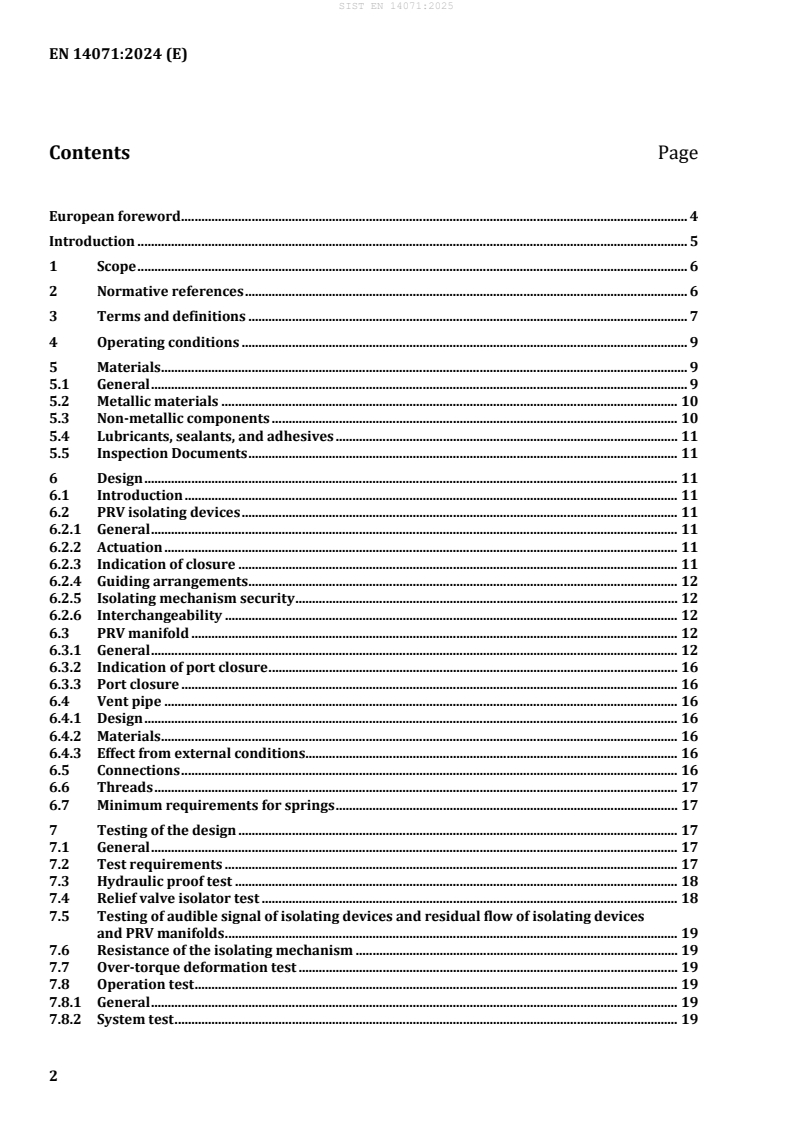
Contents Page
European foreword . 4
Introduction . 5
1 Scope . 6
2 Normative references . 6
3 Terms and definitions . 7
4 Operating conditions . 9
5 Materials . 9
5.1 General . 9
5.2 Metallic materials . 10
5.3 Non-metallic components . 10
5.4 Lubricants, sealants, and adhesives . 11
5.5 Inspection Documents . 11
6 Design . 11
6.1 Introduction . 11
6.2 PRV isolating devices . 11
6.2.1 General . 11
6.2.2 Actuation . 11
6.2.3 Indication of closure . 11
6.2.4 Guiding arrangements . 12
6.2.5 Isolating mechanism security . 12
6.2.6 Interchangeability . 12
6.3 PRV manifold . 12
6.3.1 General . 12
6.3.2 Indication of port closure . 16
6.3.3 Port closure . 16
6.4 Vent pipe . 16
6.4.1 Design . 16
6.4.2 Materials . 16
6.4.3 Effect from external conditions. 16
6.5 Connections . 16
6.6 Threads . 17
6.7 Minimum requirements for springs . 17
7 Testing of the design . 17
7.1 General . 17
7.2 Test requirements . 17
7.3 Hydraulic proof test . 18
7.4 Relief valve isolator test . 18
7.5 Testing of audible signal of isolating devices and residual flow of isolating devices
and PRV manifolds . 19
7.6 Resistance of the isolating mechanism . 19
7.7 Over-torque deformation test . 19
7.8 Operation test . 19
7.8.1 General . 19
7.8.2 System test . 19
7.9 Stress cracking test . 20
7.9.1 General . 20
7.9.2 Moist ammonia air stress cracking test . 20
7.9.3 Mercurous nitrate immersion test . 20
8 Production testing of isolating devices and PRV manifolds . 20
9 Marking and labelling . 21
9.1 PRV isolating device . 21
9.2 PRV manifolds . 21
10 User instructions. 21
10.1 PRV isolating devices . 21
10.2 PRV manifolds . 22
Annex A (normative) Dimensions of master test pieces for PRV and isolating devices . 23
Annex ZA (informative) Relationship between this European Standard and the essential
requirements of Directive 2014/68/EU (Pressure Equipment Directive) aimed to be
covered . 25
Bibliography . 27
European foreword
This document (EN 14071:2024) has been prepared by Technical Committee CEN/TC 286 “LPG
equipment and accessories”, the secretariat of which is held by NSAI.
This European Standard shall be given the status of a national standard, either by publication of an
identical text or by endorsement, at the latest by May 2025, and conflicting national standards shall be
withdrawn at the latest by May 2025.
Attention is drawn to the possibility that some of the elements of this document may be the subject of
patent rights. CEN shall not be held responsible for identifying any or all such patent rights.
This document has been prepared under a standardization request given to CEN by the European
Commission and the European Free Trade Association, and supports essential requirements of
EU Directive(s).
For relationship with EU Directive(s), see informative Annex ZA, which is an integral part of this
document.
This document supersedes EN 14071:2015+A1:2019.
The major changes in comparison to the previous edition include:
— Revision of 5.2 Metallic materials;
— Revision of 5.3 Non-metallic materials;
— Clarification to Table 1
— Revision of 6.3 Vent pipe
— Revision to the resistance of the isolating mechanism test, 7.6;
— Revision to the operation test, 7.8;
— Revision of the Kd value for M 36;
— Revision of Annex ZA.
Any feedback and questions on this document should be directed to the users’national standards body. A
complete listing of these bodies can be found on the CENwebsite.
According to the CEN-CENELEC Internal Regulations, the national standardsorganisations of the
following countries are bound to implement this EuropeanStandard: Austria, Belgium, Bulgaria, Croatia,
Cyprus, Czech Republic, Denmark,Estonia, Finland, France, Germany, Greece, Hungary, Iceland, Ireland,
Italy, Latvia,Lithuania, Luxembourg, Malta, Netherlands, Norway, Poland, Portugal, Republic ofNorth
Macedonia, Romania, Serbia, Slovakia, Slovenia, Spain, Sweden, Switzerland,Türkiye and the United
Kingdom.
Introduction
This document calls for the use of substances and procedures that may be injurious to health and/or the
environment if adequate precautions are not taken. It refers only to technical suitability: it does not
absolve the user from their legal obligations at any stage.
It is recommended that manufacturers develop an environmental management policy. For guidance, see
the EN ISO 14000 series [1], [2] and [3].
Protection of the environment is a key political issue in Europe and elsewhere. For TC 286 this is covered
in CEN/TS 16765 [4] LPG equipment and accessories - Environmental considerations for CEN/TC 286
standards, and this Technical Specification should be read in conjunction with this document. The
Technical Specification provides guidance on the environmental aspects to be considered regarding
equipment and accessories produced for the LPG industry and the following is addressed:
a) design;
b) manufacture;
c) packaging;
d) use and operation; and
e) disposal.
It has been assumed in the drafting of this document that the execution of its provisions is entrusted to
appropriately qualified and experienced people.
All pressures are gauge pressures unless otherwise stated.
NOTE This document requires measurement of material properties, dimensions and pressures. All such
measurements are subject to a degree of uncertainty due to tolerances in measuring equipment, etc. It may be
beneficial to refer to the leaflet “measurement uncertainty leaflet” SP INFO 2000 27 [5].
1 Scope
This document specifies the design, testing and inspection requirements for pressure relief valve (PRV),
isolating devices, valve manifolds, vent pipes and system assemblies which are, where necessary, used
with PRVs for use in static pressure vessels for Liquefied Petroleum Gas (LPG) service.
This document addresses both prototype testing and production testing of isolating devices and PRV
manifolds.
PRVs for LPG pressure vessels are specified in EN 14129:2024.
2 Normative references
The following documents are referred to in the text in such a way that some or all of their content
constitutes requirements of this document. For dated references, only the edition cited applies. For
undated references, the latest edition of the referenced document (including any amendments) applies.
EN 549:2019+A2:2024, Rubber materials for seals and diaphragms for gas appliances and gas equipment
EN 751-1:1996, Sealing materials for metallic threaded joints in contact with 1st, 2nd and 3rd family gases
and hot water - Part 1: Anaerobic jointing compounds
EN 751-2:1996, Sealing materials for metallic threaded joints in contact with 1st, 2nd and 3rd family gases
and hot water - Part 2: Non-hardening jointing compounds
EN 751-3:2022+A1:2023, Sealing materials for metallic threaded joints in contact with 1st, 2nd and 3rd
family gases and hot water - Part 3: Unsintered PTFE tapes and PTFE strings
EN 1092-1:2018, Flanges and their joints - Circular flanges for pipes, valves, fittings and accessories, PN
designated - Part 1: Steel flanges
EN 1563:2018, Founding - Spheroidal graphite cast irons
EN 10204:2004, Metallic products - Types of inspection documents
EN 12164:2016, Copper and copper alloys - Rod for free machining purposes
EN 12165:2016, Copper and copper alloys - Wrought and unwrought forging stock
EN 12420:2014, Copper and copper alloys - Forgings
EN 12516-1:2014+A1:2018, Industrial valves - Shell design strength - Part 1: Tabulation method for steel
valve shells
EN 12516-4:2014+A1:2018, Industrial valves - Shell design strength - Part 4: Calculation method for valve
shells manufactured in metallic materials other than steel
EN 13480-3:2017, Metallic industrial piping - Part 3: Design and calculation
EN 13445-2:2021+A1:2023, Unfired pressure vessels - Part 2: Materials
1) As impacted by EN 13480-3:2017/A2:2020 and EN 13480-3:2017/A3:2020.
EN 13906-1:2013, Cylindrical helical springs made from round wire and bar - Calculation and design - Part
1 : Compression springs
EN 14129:2024, LPG Equipment and accessories - Pressure relief valves for LPG pressure vessels
EN ISO 9227:2022, Corrosion tests in artificial atmospheres - Salt spray tests (ISO 9227:2022)
EN ISO 11114-1:2020, Gas cylinders - Compatibility of cylinder and valve materials with gas contents - Part
1: Metallic materials (ISO 11114-1:2020)
EN ISO 11114-2:2021, Gas cylinders - Compatibility of cylinder and valve materials with gas contents - Part
2: Non-metallic materials (ISO 11114-2:2021)
ISO 6957:1988, Copper alloys — Ammonia test for stress corrosion resistance
ASME B1.20.1:2013, Pipe threads, general purpose (inch)
3 Terms and definitions
For the purposes of this document, the following terms and definitions apply.
ISO and IEC maintain terminological databases for use in standardization at the following addresses:
— ISO Online browsing platform: available at https://www.iso.org/obp
— IEC Electropedia: available at http://www.electropedia.org/
3.1
liquefied petroleum gas
LPG
low pressure liquefied gas composed of one or more light hydrocarbons which are assigned to UN 1011,
UN 1075, UN 1965, UN 1969 or UN 1978 only and which consists mainly of propane, propene, butane,
butane isomers, butene with traces of other hydrocarbon gases
3.2
pressure vessel
assembly of the pressure envelope (including the openings and their closures) and non-pressure-
retaining parts attached directly to it
3.3
pressure relief valve
PRV
self-closing valve which automatically, without the assistance of any energy other than that of the vapour
concerned, discharges vapour at a predetermined pressure, and operates with a pop action
Note 1 to entry: This is known as a “safety valve” in ADR.
3.4
pressure relief valve system
PRV system
pressure relief valve(s) for use on the pressure vessel complete with isolating device or PRV manifold,
and vent pipe where appropriate
3.5
pressure relief valve isolating device
device fitted between the storage tank and the external pressure relief valve, which permits the
replacement of the pressure relief valve without de-pressuring the pressure vessel
3.6
coefficient of discharge
Kd
ratio of the actual measured flow capacity divided by the calculated theoretical flow capacity for the same
fluid at the same operating conditions
3.7
pressure relief valve manifold
PRV manifold
device fitted to a storage vessel permitting two or more pressure relief valves to be fitted only one of
which can be isolated at a time, which permits replacement of the isolated pressure relief valve without
depressurizing the vessel
3.8
discharge capacity
capacity at the flow rating pressure of a pressure relief valve expressed in cubic metres per minute of free
air at STP
3.9
vent pipe
open-ended pipe, fitted with a protection cap and attached to the pressure relief valve outlet, to direct
discharged fluid away from the protected pressure vessel surface
3.10
design signal flow
limited flow of LPG intended to equalise pressures so that a replacement PRV can be properly fitted to an
isolating device; indicate the effectiveness of the internal shut off in an isolating device before the PRV is
completely removed; and produce an acoustic signal
3.11
Standard Temperature and Pressure
STP
15,6 °C (288,7 K), 1,013 bar absolute (0,1013 MPa absolute)
3.12
flow rating pressure
inlet pressure at which the discharge capacity is measured
3.13
lift
actual travel of the sealing disc away from the closed position
3.14
sealing element
non-metallic resilient component which effects a seal by contact with the valve seat
3.15
valve seat
normally raised area of the pressure relief valve body on to which the sealing element effects a seal
3.16
maximum allowable pressure
PS
maximum pressure for which the equipment is designed
Note 1 to entry: All pressures are gauge pressures unless otherwise stated.
3.17
nominal diameter
DN
numerical designation of the size of a component, which is a convenient round number, approximately
equal to the manufacturing dimensions in millimetres (mm)
3.18
external leak tightness
resistance to leakage through the fitting to or from the atmosphere
4 Operating conditions
4.1 Equipment designed in accordance with this document shall be suitable for:
— minimum operating temperature of −20 °C;
— maximum operating temperature of 65 °C;
— maximum allowable pressure of 25 bar; and
— minimum pressure of 50 mbar absolute.
4.2 For some parts of Europe and certain applications, temperatures lower than – 20 °C can be
encountered. For these conditions, a temperature rating of – 40 °C shall apply.
NOTE 1 In service, temperatures below this can be encountered during short periods, for example, during
discharge.
NOTE 2 Vacuum conditions on the isolating device or PRV manifold, arising from butane at low temperature or
evacuation of the pressure vessel can expose the valve or fitting to a vacuum of 50 mbar absolute.
5 Materials
5.1 General
5.1.1 All materials in contact with LPG shall be physically and chemically compatible with LPG under
all normal operating conditions for which the device is intended to be used.
5.1.2 Material for components shall be selected for adequate strength in service. The material shall
resist atmospheric corrosion, brass dezincification, stress corrosion, impact and material failure. Where
stress corrosion could be present in a material, stress relieving heat treatment shall be carried out.
5.1.3 The components exposed to atmosphere shall be manufactured from corrosion resistant
materials or suitably protected against corrosion by painting or metal plating and shall be tested in
accordance with EN ISO 9227:2022 for 96 h.
5.2 Metallic materials
5.2.1 Equipment shall be made from steel, stainless steel or copper alloys in accordance with
EN ISO 11114-1:2020.
5.2.2 Shell materials shall be selected in accordance with EN 12516-1:2014+A1:2018,
EN 12516-4:2014+A1:2018 or EN 13445-2:2021+A1:2023.
5.2.3 Materials for steel flanges shall be in accordance with EN 1092-1:2018.
5.2.4 Components made from stainless steel shall contain not less than 16 % chromium, and not less
than 7 % nickel. Springs shall be manufactured from stainless steel wire and shall contain not less than
16 % chromium and not less than 6 % nickel.
5.2.5 Hot stamped brass shall be non-porous and shall be suitable for machining or other processes.
Leaded brass shall be CW614N or CW617N in accordance with EN 12420:2014, EN 12164:2016 or
EN 12165:2016. Sand-cast brass shall not be used. Cold drawn brass rods shall only be used for machining
after adequate testing for internal cracking, porosity or other inclusions and shall be heat treated where
present. Components produced from stamping brass shall not exhibit cold shuts, also known as folds, or
surface defects. Components manufactured from hot stamped brass, drawn brass or machined from brass
rod, shall be capable of withstanding, without cracking, the stress-cracking test.
5.2.6 Components manufactured from hot stamped brass or machined from brass rod shall be capable
of withstanding, without cracking, the stress-cracking test in accordance with 7.9.
5.2.7 Spheroidal graphite cast iron shall comply with EN 1563:2018, with an elongation at fracture of
more than 18 %. Other ductile irons or cast irons shall not be used. Castings shall be free from inclusions
and surface defects, which could adversely affect the strength, leak tightness or performance of the
device.
5.3 Non-metallic components
Non-metallic materials in contact with LPG shall be compatible with LPG and shall not fail during the
valve service life. They shall not distort, harden, swell or adhere to the body or seat face to such an extent
as to impair the function of the valve.
Non-metallic materials shall be in accordance with EN ISO 11114-2:2021.
Non-metallic materials which are exposed to UV shall be UV resistant as confirmed by the material
manufacturer.
Rubber materials in contact with LPG, for temperatures of –20 °C (−40 °C for low temperature
applications) to + 65 °C, shall meet the requirements of EN 549:2019+A2:2024 for resistance to:
a) a gas (n-pentane test);
b) lubricants;
c) ageing;
d) compression;
e) ozone (where the material is exposed to the atmosphere);
f) condensate/liquid phase of combustible gases (liquid B test).
--------
...