EN ISO 19152-2:2025
(Main)Geographic information - Land Administration Domain Model (LADM) - Part 2: Land registration (ISO 19152-2:2025)
Geographic information - Land Administration Domain Model (LADM) - Part 2: Land registration (ISO 19152-2:2025)
This document:
— defines a reference land administration domain model (LADM) covering basic information-related components of land registration (including elements above and below the surface of the Earth);
— provides an abstract, conceptual model with three packages and one sub-package related to:
— parties (people and organizations);
— basic administrative units, rights, responsibilities and restrictions (RRRs);
— spatial units (parcels, and the legal space of buildings and utility networks and other geometry) with a sub-package on surveying and spatial representation (geometry and topology);
— provides terminology for land administration (LA), based on various national and international systems, that is as simple as possible in order to be useful in practice. The terminology allows a shared description of different formal or informal practices and procedures in various jurisdictions;
— provides a platform for comparison and monitoring that is based on indicators;
— provides a basis for national and regional profiles; and
— enables the combination of land administration information from different sources in a coherent manner.
The following is outside the scope of this document:
— interference with (national) land administration laws with potentially legal implications; and
— construction of external databases with party data, address data, land cover data, physical utility network data, archive data and taxation data. However, the LADM provides stereotype classes for these data sets to indicate which data set elements the LADM expects from these external sources, if available.
This document provides the concepts and the detailed structure for standardization in the land administration domain.
Geoinformation - Land Administration Domain Model (LADM) - Teil 2: Erfassung von Grundeigentum (ISO 19152-2:2025)
Information géographique - Modèle du domaine de l’administration des terres (LADM) - Partie 2: Enregistrement foncier (ISO 19152-2:2025)
Le présent document:
— définit un modèle de référence du domaine de l'administration des terres (LADM) qui concerne les composants relatifs aux informations de base sur l'enregistrement foncier (y compris les éléments situés au-dessus et en dessous de la surface de la Terre);
— fournit un modèle abstrait et conceptuel composé de trois paquetages et un sous-paquetage liés:
— aux parties (individus et organisations);
— aux unités administratives de base, droits, responsabilités et restrictions (RRR);
— aux unités spatiales (parcelles, espace juridique des bâtiments, réseaux publics et autres géométries) avec un sous-paquetage sur le relevé et la représentation spatiale (géométrie et topologie);
— propose une terminologie pour l'administration des terres (LA), fondée sur divers systèmes nationaux et internationaux, aussi simple que possible afin d'être utile dans la pratique. La terminologie permet d'obtenir une description commune de différentes pratiques et procédures, officielles ou non, dans diverses juridictions;
— fournit une plateforme de comparaison et de surveillance fondée sur des indicateurs;
— propose une base pour les profils nationaux et régionaux; et
— permet la combinaison cohérente des informations relatives à l'administration des terres issues de différentes sources.
Les éléments suivants ne relèvent pas du domaine d'application du présent document:
— les interférences avec les lois (nationales) d'administration des terres susceptibles d'engendrer des implications juridiques; et
— l'élaboration de bases de données externes avec les données relatives aux parties, aux adresses, à l'occupation des terres, au réseau public physique, aux archives et à la fiscalité. Cependant, le modèle du domaine de l'administration des terres (LADM) propose des classes type pour ces jeux de données, afin d'indiquer quels éléments des jeux de données le LADM attend de ces sources externes, lorsqu'elles sont disponibles.
Le présent document fournit les concepts et la structure détaillée de la normalisation dans le domaine de l'administration des terres.
Geografske informacije - Model domene za zemljiško administracijo (LADM) - 2. del: Vpis v zemljiško knjigo (ISO 19152-2:2025)
Ta dokument: – določa referenčni model domene za zemljiško administracijo (LADM), ki zajema osnovne informacijske komponente vpisa v zemljiško knjigo (vključno z elementi nad zemeljskim površjem in pod njim); – vključuje abstrakten konceptualni model s tremi svežnji in enim podsvežnjem, ki se navezujejo na: – stranke (osebe in organizacije); – osnovne administrativne enote, pravice, obveznosti in omejitve (RRR); – prostorske enote (parcele, pravni prostor zgradb, infrastrukturna omrežja in druge geometrije) s podsvežnjem o meritvah in prostorskem prikazu (geometrija in topologija); – podaja terminologijo za zemljiško administracijo (LA), ki temelji na številnih nacionalnih in mednarodnih sistemih ter je dovolj enostavna, da je uporabna v praksi. Terminologija omogoča skupen opis številnih uradnih in neuradnih praks ter postopkov v okviru različnih pravnih pristojnosti; – določa platformo za primerjavo in nadzor, ki temelji na kazalnikih; – zagotavlja podlago za profile na nacionalni in regionalni ravni; ter – omogoča skladno združevanje informacij s področja zemljiške administracije iz različnih virov. Naslednje ne spada na področje uporabe tega dokumenta: – poseganje v (nacionalno) zakonodajo na področju zemljiške administracije, ki bi lahko imelo pravne posledice; ter – vzpostavitev zunanjih podatkovnih zbirk s podatki o strankah, naslovih, podatki o rabi tal, podatki o fizičnih omrežjih komunalnih služb, arhivu in obdavčitvi. V modelu domene za zemljiško administracijo so stereotipni razredi za te podatkovne nize, ki prikazujejo, kateri elementi podatkovnih nizov se v okviru modela domene za zemljiško administracijo pričakujejo od teh zunanjih virov, če so na voljo. Ta dokument zagotavlja koncepte in podrobno strukturo za standardizacijo v domeni za zemljiško administracijo.
General Information
- Status
- Published
- Publication Date
- 03-Jun-2025
- Technical Committee
- CEN/TC 287 - Geographic Information
- Drafting Committee
- CEN/TC 287 - Geographic Information
- Current Stage
- 6060 - Definitive text made available (DAV) - Publishing
- Start Date
- 04-Jun-2025
- Completion Date
- 04-Jun-2025
Relations
- Effective Date
- 19-Jan-2023
Overview
EN ISO 19152-2:2025 - Geographic information - Land Administration Domain Model (LADM) - Part 2: Land registration (ISO 19152-2:2025) defines a reference conceptual model for land registration. It updates and supersedes the earlier EN ISO 19152:2012 and provides standardized concepts, terminology and structure to represent party information, rights-responsibilities-restrictions (RRRs) and spatial units (including parcels, building legal space and utility networks). The standard is prepared under ISO/TC 211 in collaboration with CEN/TC 287 and is intended to support consistent land administration, data integration and interoperability across jurisdictions.
Key Topics and Technical Requirements
- Abstract conceptual model: A reference LADM model organized into three main packages and one sub‑package covering the essential information components for land registration.
- Parties: Representation of people and organizations involved in land administration (owners, holders, administrators).
- RRRs (Rights, Responsibilities and Restrictions): Modelled basic administrative units that define legal interests in land.
- Spatial units: Parcels and legal spaces for buildings, utility networks and other geometry types - with emphasis on coherent spatial representation.
- Surveying and spatial representation: Sub‑package addressing geometry and topology to support accurate cadastral and legal-space modelling.
- Terminology: Harmonized land administration vocabulary designed to be simple, practical and useful across different national and international systems.
- Interoperability & integration: Mechanisms to combine land administration information from diverse sources coherently; includes stereotype classes to indicate expected elements from external data sets (e.g., parties, addresses, land cover, utilities) without prescribing construction of those external databases.
- Profiles and indicators: Basis for national and regional profiles and a platform for comparison and monitoring using indicators.
- Out of scope: The standard does not interfere with national land laws nor mandate building external databases (it only provides stereotypes to reference external datasets).
Practical Applications and Who Uses It
- Land registries and cadastral agencies: Standardize data models for registration, surveying and legal ownership records.
- Surveyors and GIS professionals: Implement geometry, topology and surveying workflows consistent with a harmonized LADM model.
- Software vendors and system integrators: Design interoperable land administration solutions, data exchange schemas and national profiles.
- Policy makers and planners: Compare and monitor land administration performance using common indicators.
- Utilities and infrastructure managers: Model legal spaces and networks where integration with land rights is required.
- Researchers and standards bodies: Develop extensions, national profiles and best practices based on the LADM conceptual framework.
Related Standards
- Part of the ISO 19152 (LADM) family; this document is the Part 2 land registration specification and supersedes EN ISO 19152:2012. It aligns with ISO/TC 211 geographic information standards and CEN/CENELEC implementation guidance for national adoption.
Keywords: LADM, land administration, land registration, ISO 19152-2, spatial units, RRR, surveying, geometry, topology, interoperability, cadastral data, national profile.
EN ISO 19152-2:2025 - POZOR: Potrebno posredovati še manjkajoči del SIST standarda (ISO). Ob nakupu se obrnite na prodaja@sist.si. ATTENTION: The missing part of the SIST (ISO) standard must be provided. When purchasing, please contact prodaja@sist.si.
Frequently Asked Questions
EN ISO 19152-2:2025 is a standard published by the European Committee for Standardization (CEN). Its full title is "Geographic information - Land Administration Domain Model (LADM) - Part 2: Land registration (ISO 19152-2:2025)". This standard covers: This document: — defines a reference land administration domain model (LADM) covering basic information-related components of land registration (including elements above and below the surface of the Earth); — provides an abstract, conceptual model with three packages and one sub-package related to: — parties (people and organizations); — basic administrative units, rights, responsibilities and restrictions (RRRs); — spatial units (parcels, and the legal space of buildings and utility networks and other geometry) with a sub-package on surveying and spatial representation (geometry and topology); — provides terminology for land administration (LA), based on various national and international systems, that is as simple as possible in order to be useful in practice. The terminology allows a shared description of different formal or informal practices and procedures in various jurisdictions; — provides a platform for comparison and monitoring that is based on indicators; — provides a basis for national and regional profiles; and — enables the combination of land administration information from different sources in a coherent manner. The following is outside the scope of this document: — interference with (national) land administration laws with potentially legal implications; and — construction of external databases with party data, address data, land cover data, physical utility network data, archive data and taxation data. However, the LADM provides stereotype classes for these data sets to indicate which data set elements the LADM expects from these external sources, if available. This document provides the concepts and the detailed structure for standardization in the land administration domain.
This document: — defines a reference land administration domain model (LADM) covering basic information-related components of land registration (including elements above and below the surface of the Earth); — provides an abstract, conceptual model with three packages and one sub-package related to: — parties (people and organizations); — basic administrative units, rights, responsibilities and restrictions (RRRs); — spatial units (parcels, and the legal space of buildings and utility networks and other geometry) with a sub-package on surveying and spatial representation (geometry and topology); — provides terminology for land administration (LA), based on various national and international systems, that is as simple as possible in order to be useful in practice. The terminology allows a shared description of different formal or informal practices and procedures in various jurisdictions; — provides a platform for comparison and monitoring that is based on indicators; — provides a basis for national and regional profiles; and — enables the combination of land administration information from different sources in a coherent manner. The following is outside the scope of this document: — interference with (national) land administration laws with potentially legal implications; and — construction of external databases with party data, address data, land cover data, physical utility network data, archive data and taxation data. However, the LADM provides stereotype classes for these data sets to indicate which data set elements the LADM expects from these external sources, if available. This document provides the concepts and the detailed structure for standardization in the land administration domain.
EN ISO 19152-2:2025 is classified under the following ICS (International Classification for Standards) categories: 35.240.70 - IT applications in science. The ICS classification helps identify the subject area and facilitates finding related standards.
EN ISO 19152-2:2025 has the following relationships with other standards: It is inter standard links to EN ISO 19152:2012. Understanding these relationships helps ensure you are using the most current and applicable version of the standard.
You can purchase EN ISO 19152-2:2025 directly from iTeh Standards. The document is available in PDF format and is delivered instantly after payment. Add the standard to your cart and complete the secure checkout process. iTeh Standards is an authorized distributor of CEN standards.
Standards Content (Sample)
SLOVENSKI STANDARD
01-november-2025
Nadomešča:
SIST EN ISO 19152:2013
Geografske informacije - Model domene za zemljiško administracijo (LADM) - 2.
del: Vpis v zemljiško knjigo (ISO 19152-2:2025)
Geographic information - Land Administration Domain Model (LADM) - Part 2: Land
registration (ISO 19152-2:2025)
Geoinformationen - Land Administration Domain Model (LADM) - Teil 2: Erfassung von
Grundeigentum (ISO 19152-2:2025)
Information géographique - Modèle du domaine de l’administration des terres (LADM) -
Partie 2: Enregistrement foncier (ISO 19152-2:2025)
Ta slovenski standard je istoveten z: EN ISO 19152-2:2025
ICS:
07.040 Astronomija. Geodezija. Astronomy. Geodesy.
Geografija Geography
35.240.70 Uporabniške rešitve IT v IT applications in science
znanosti
2003-01.Slovenski inštitut za standardizacijo. Razmnoževanje celote ali delov tega standarda ni dovoljeno.
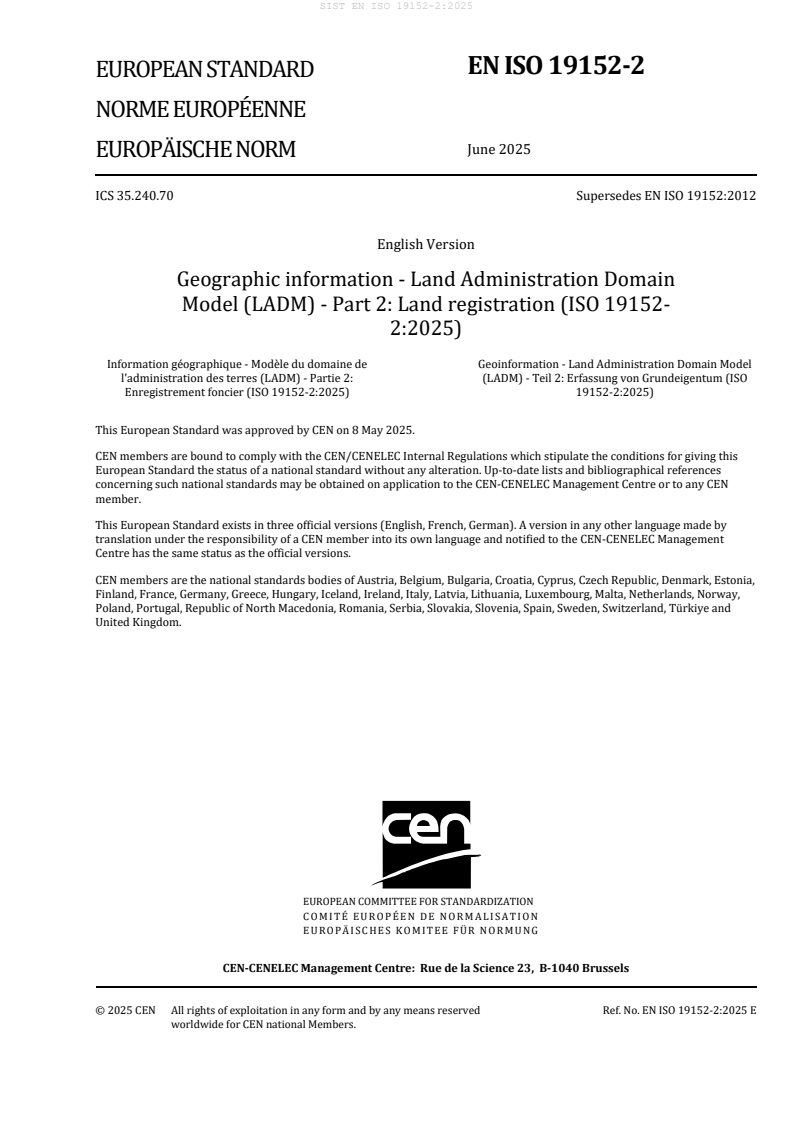
EN ISO 19152-2
EUROPEAN STANDARD
NORME EUROPÉENNE
June 2025
EUROPÄISCHE NORM
ICS 35.240.70 Supersedes EN ISO 19152:2012
English Version
Geographic information - Land Administration Domain
Model (LADM) - Part 2: Land registration (ISO 19152-
2:2025)
Information géographique - Modèle du domaine de Geoinformation - Land Administration Domain Model
l'administration des terres (LADM) - Partie 2: (LADM) - Teil 2: Erfassung von Grundeigentum (ISO
Enregistrement foncier (ISO 19152-2:2025) 19152-2:2025)
This European Standard was approved by CEN on 8 May 2025.
CEN members are bound to comply with the CEN/CENELEC Internal Regulations which stipulate the conditions for giving this
European Standard the status of a national standard without any alteration. Up-to-date lists and bibliographical references
concerning such national standards may be obtained on application to the CEN-CENELEC Management Centre or to any CEN
member.
This European Standard exists in three official versions (English, French, German). A version in any other language made by
translation under the responsibility of a CEN member into its own language and notified to the CEN-CENELEC Management
Centre has the same status as the official versions.
CEN members are the national standards bodies of Austria, Belgium, Bulgaria, Croatia, Cyprus, Czech Republic, Denmark, Estonia,
Finland, France, Germany, Greece, Hungary, Iceland, Ireland, Italy, Latvia, Lithuania, Lux
...
Le document SIST EN ISO 19152-2:2025, intitulé "Information géographique - Modèle de domaine de l'administration foncière (LADM) - Partie 2 : Enregistrement foncier", établit un modèle de référence complet pour l'administration foncière. Ce modèle couvre les composants fondamentaux liés aux informations d'enregistrement foncier, en intégrant les éléments situés au-dessus et en dessous de la surface de la Terre. L'une des forces majeures de cette norme réside dans sa capacité à offrir un modèle conceptuel abstrait qui se divise en trois packages principaux et un sous-package. Ces packages traitent des parties prenantes (individus et organisations), des unités administratives de base, ainsi que des droits, responsabilités et restrictions (RRRs). De plus, les unités spatiales, y compris les parcelles et l'espace juridique des bâtiments ainsi que des réseaux de services publics, sont également abordées, avec une attention particulière portée à la représentation spatiale et à la topologie. La norme propose également une terminologie simplifiée pour l'administration foncière, prenant en compte une variété de systèmes nationaux et internationaux. Cela facilite la communication et l'harmonisation des pratiques formelles et informelles à travers différentes juridictions. En permettant une description partagée, la norme contribue à une meilleure compréhension et mise en œuvre des procédures administratives liées à la propriété foncière. Un autre atout important de ce document est qu'il établit une plateforme de comparaison et de suivi basée sur des indicateurs, ce qui est essentiel pour l'évaluation continue des pratiques d'administration foncière. En outre, il fournit une base pour l'élaboration de profils nationaux et régionaux, renforçant ainsi la pertinence de la norme dans divers contextes géographiques. Bien que certaines éléments soient explicitement exclus du champ d'application de cette norme, telle que l'interférence avec les lois nationales d'administration foncière, le modèle permet néanmoins d'indiquer les ensembles de données externes que le LADM attend, garantissant ainsi une intégration cohérente des informations provenant de diverses sources. En résumé, le SIST EN ISO 19152-2:2025 constitue un outil essentiel pour la normalisation dans le domaine de l'administration foncière, offrant une structure détaillée et des concepts clairs pour l'enregistrement foncier et l'administration des terres.
The EN ISO 19152-2:2025 standard presents a comprehensive framework for the Land Administration Domain Model (LADM), specifically focusing on land registration. Its primary strength lies in its holistic approach, addressing both above and below surface elements, which ensures that the land administration domain is not only well-defined but also adaptable to various administrative contexts. The standard delineates a clear conceptual model that comprises three main packages and one sub-package dedicated to crucial components of land administration. This structured approach facilitates the identification and categorization of parties involved in land administration, as well as administrative units and the associated rights, responsibilities, and restrictions (RRRs). By doing so, it lays the groundwork for a cohesive understanding of land registration across different jurisdictions. One of the notable aspects of ISO 19152-2:2025 is its emphasis on providing a user-friendly terminology for land administration. This is particularly beneficial as it draws from a diverse range of national and international frameworks, allowing practitioners and stakeholders to engage with the standard seamlessly. The simplicity of the terminology enhances its practicality, promoting effective communication across various land administration practices, both formal and informal. Furthermore, the standard establishes a platform for comparison and monitoring through the use of indicators, which is essential for assessing the performance and effectiveness of land registration systems. It also serves as a basis for the development of national and regional profiles, enabling governments and organizations to tailor their land administration systems to local needs while maintaining alignment with global standards. By enabling the integration of land administration information from diverse sources, this document fosters coherence in data management, thereby enhancing the efficiency of land registration processes. It's important to note that while the standard provides a comprehensive framework, it clearly delineates its limitations concerning interference with national land administration laws and the construction of external databases. This clarity ensures that users understand the scope and applicability of the standard without overstepping legal boundaries. Overall, the EN ISO 19152-2:2025 standard is a crucial instrument for standardizing land administration practices, offering significant strengths in its structured framework, user-centric terminology, and focus on comparability, making it highly relevant for stakeholders in the land registration domain.
Die Norm EN ISO 19152-2:2025 mit dem Titel "Geographic information - Land Administration Domain Model (LADM) - Part 2: Land registration" bietet einen umfassenden Rahmen für die Standardisierung im Bereich der Bodenverwaltung. Erstens definiert das Dokument ein Referenzmodell für die Bodenadministration, das grundlegende informationsbezogene Komponenten der Landregistrierung abdeckt, einschließlich der ober- und unterirdischen Elemente der Erde. Dies stellt sicher, dass sämtliche relevanten Aspekte der Landregistrierung in einem konsistenten und strukturierten Format erfasst werden. Die Stärke der Norm liegt in ihrem abstrakten, konzeptionellen Modell, das in drei Hauptpakete und ein Unterpaket unterteilt ist. Diese Pakete adressieren die relevanten Akteure (Personen und Organisationen), grundlegende Verwaltungseinheiten sowie Rechte, Verantwortlichkeiten und Beschränkungen (RRRs). Darüber hinaus behandelt das Modell räumliche Einheiten wie Parzellen und den rechtlichen Raum von Gebäuden und Versorgungsnetzen, während ein Unterpaket die Themen Vermessung und räumliche Darstellung (Geometrie und Topologie) abdeckt. Ein weiterer wichtiger Aspekt der Norm ist die bereitgestellte Terminologie für die Bodenverwaltung, die auf verschiedenen nationalen und internationalen Systemen basiert. Diese Terminologie ist so einfach wie möglich gehalten, um praktische Anwendung zu gewährleisten und eine gemeinsame Beschreibung unterschiedlicher formeller oder informeller Praktiken sowie Verfahren in verschiedenen Jurisdiktionen zu ermöglichen. Dies erhöht die Relevanz der Norm für eine Vielzahl von Anwendern und Stakeholdern. Zudem stellt die Norm eine Plattform für Vergleich und Monitoring zur Verfügung, die auf spezifischen Indikatoren basiert. Dies ist besonders nützlich für die Erstellung nationaler und regionaler Profile. Durch die Möglichkeit, Informationen zur Bodenverwaltung aus unterschiedlichen Quellen in kohärenter Weise zu kombinieren, wird die Nutzerfreundlichkeit und Effizienz verbessert. Wichtig zu beachten ist, dass die Norm nicht mit (nationalen) Gesetzen der Bodenadministration interferiert, die potenziell rechtliche Konsequenzen haben könnten. Der Hinweis auf stereotype Klassen für bestimmte Datensätze, wie Party-Daten oder Adressdaten, ermöglicht es jedoch, die Interoperabilität zwischen externen Datenquellen und dem LADM zu gewährleisten. Insgesamt bietet die EN ISO 19152-2:2025 eine wertvolle Grundlage für die Standardisierung in der Bodenverwaltung und ist damit sowohl für Fachleute als auch für Entscheidungsträger von erheblichem Nutzen.
표준화 문서 EN ISO 19152-2:2025는 토지 등록에 관한 지리 정보 및 토지 관리 도메인 모델(LADM)의 중요한 구성 요소를 정의하고 있습니다. 이 문서는 토지 등록과 관련된 기본 정보 요소를 포괄적으로 다루며, 지구 표면 위와 아래의 다양한 요소를 포함하는 참조 모델을 제공합니다. 이는 토지 관리 도메인에 대한 명확한 기준을 설정하는데 기여하며, 국제적으로 통용될 수 있는 표준을 형성하는 데 중요한 역할을 합니다. 이 표준의 강점은 세 가지 패키지와 하나의 하위 패키지로 구성된 추상적 개념 모델을 제공함으로써, 다양한 이해관계자(사람과 조직)에 대한 명확한 정의를 할 수 있다는 점입니다. 기본 관리 단위, 권리, 책임 및 제약(RRRs)을 포함한 모델은 토지 등록 프로세스에서의 투명성을 높이고, 의사결정을 지원하는 데 필수적입니다. 특히, 공간 단위(토지 필지, 건물 및 유틸리티 네트워크의 법적 공간 포함)에 대한 명확한 정의는 토지 관리의 실무에 큰 도움이 됩니다. 또한, 이 문서는 가능한 한 단순한 용어를 제공하여 다양한 국가 및 국제 시스템에 기반한 토지 관리(LA) 용어의 공유된 설명을 가능하게 합니다. 이는 각기 다른 법률 관행과 절차를 포괄적으로 이해할 수 있도록 지원하며, 다수의 관할권에서의 일관성을 보장합니다. 표준은 또한 비교 및 모니터링을 위한 플랫폼을 제공하며, 국가 및 지역 프로필 작성을 위한 기반을 마련합니다. 각기 다른 출처의 토지 관리 정보를 일관되게 결합할 수 있게 하여 데이터의 통합성을 높이는 것도 큰 장점입니다. 그러나 이 문서의 범위에는 (국가) 토지 관리 법률과의 간섭 또는 외부 데이터베이스의 구축이 포함되지 않습니다. 이러한 요소들은 잠재적인 법적 결과를 초래할 수 있기 때문에 명확히 제외되었습니다. 그럼에도 불구하고 LADM은 이러한 데이터 세트가 있을 경우 어떤 데이터 세트 요소를 기대하는지를 나타내기 위한 스테레오타입 클래스를 제공합니다. 결론적으로, EN ISO 19152-2:2025는 토지 관리 도메인 내에서 표준화를 위한 중요한 개념과 구조를 제공하며, 이를 통해 글로벌 수준에서의 토지 행정과 관리의 효율성을 높이는 데 기여할 것입니다.
EN ISO 19152-2:2025は、地理情報および土地管理分野における標準化の重要な枠組みを提供しています。この文書は、土地登録に関する基本情報関連コンポーネントを網羅する参照土地管理ドメインモデル(LADM)を定義しています。特に、地球表面の上および下に関連する要素を含む土地登録について、効果的な基盤を提供しています。 この標準の強みは、その抽象的かつ概念的モデルが、関係者(人々および組織)、基本行政単位、権利、責任、制約(RRR)、および空間単位(パセルや建物の法的空間、ユーティリティネットワークなど)と関連している点です。そのうえ、調査および空間表現に関するサブパッケージも含まれており、幾何学とトポロジーの観点から詳細な理解を促進します。 さらに、この文書は土地管理(LA)のための用語集を提供しており、さまざまな国際的および国内のシステムに基づいて、実際に役立つ可能な限りシンプルな用語を展開しています。この用語集は、異なる法的または非公式の慣行と手続きについての共通の記述を可能にし、さまざまな法域での使用において実用性を向上させます。 また、主要な指標に基づいた比較およびモニタリングのプラットフォームを提供し、国家および地域のプロファイルの基盤を作ります。これにより、異なる情報源から得られる土地管理情報を一貫性のある形で結合することが可能になります。これらの機能は、土地管理における標準化をさらに進めるための重要な要素です。 ただし、この文書の範囲外として、国家の土地管理法との干渉や、パーティデータ、住所データ、土地被覆データ、物理的ユーティリティネットワークデータ、アーカイブデータ、税務データを含む外部データベースの構築は含まれていません。とはいえ、LADMはこれらのデータセットから期待される要素を示すステレオタイプクラスを提供しています。 総じて、SIST EN ISO 19152-2:2025は土地管理ドメインにおける標準化の概念と詳細な構造を提供し、国際的および地域的な枠組みでの土地登録に不可欠なリソースとなっており、実務において非常に関連性の高い標準です。
EN ISO 19152-2:2025 표준은 토지 등록에 대한 참조 토지 관리 도메인 모델(LADM)을 정의하고 있으며, 지구 표면의 위아래 요소를 포함한 기본 정보 관련 구성 요소를 포괄합니다. 이 표준은 세 가지 패키지와 하나의 하위 패키지로 구성된 추상적 개념 모델을 제공하며, 여기에는 사람과 조직으로 구성된 당사자, 기본 행정 단위, 권리, 책임 및 제한(RRR), 그리고 구획, 건물의 법적 공간 및 유틸리티 네트워크 등의 공간 단위가 포함됩니다. 특히, 측량 및 공간 표현에 관한 하위 패키지가 포함되어 있어 정확한 기하학 및 위상 정보를 다룹니다. 이 표준의 강점 중 하나는 다양한 국가 및 국제 시스템을 기반으로 한 토지 관리(LA)를 위한 용어 정의입니다. 이는 실용적 유용성을 위해 가능한 한 간단하게 작성되어 있어, 다양한 관할권 내의 공식 및 비공식 관행과 절차의 공유된 설명을 가능하게 합니다. 또한, EN ISO 19152-2:2025는 지표를 바탕으로 한 비교 및 모니터링 플랫폼을 제공하여 지속적인 개선을 도모할 수 있는 기반을 마련합니다. 이렇게 구축된 기초는 국가 및 지역 프로필 수립에 기여하며, 서로 다른 출처의 토지 관리 정보를 일관성 있게 결합할 수 있는 능력을 제공합니다. 하지만 이 문서의 범위 밖에는 (국가) 토지 관리 법률과의 간섭이나 외부 데이터베이스에서 당사자 데이터, 주소 데이터, 토지 피복 데이터, 물리적 유틸리티 네트워크 데이터, 아카이브 데이터 및 과세 데이터의 구성이 포함되지 않음을 명시하고 있습니다. 그럼에도 불구하고 LADM은 이러한 데이터 세트에서 기대되는 요소를 나타내기 위한 모델 클래스를 제공하여, 필요 시 외부 출처로부터의 데이터 통합을 지원합니다. 결론적으로, EN ISO 19152-2:2025 표준은 토지 관리 도메인 내에서 표준화의 개념과 자세한 구조를 제공하며, 이로 인해 국제적인 표준에 맞춘 효율적인 토지 관리 시스템 구축이 더욱 용이해질 것입니다.
EN ISO 19152-2:2025は、地理情報と土地管理ドメインモデル(LADM)に関する指針を提供する重要な標準です。この標準の範囲は、土地登録に関連する基本情報コンポーネントを定義しており、地表面上および下の要素を含んでいます。標準は、土地管理のすべての関連要素を包括的に捉えており、その結果、さまざまな法域における正式または非正式な実践や手続きを共有するための用語集も提供しています。 強みとしては、抽象的かつ概念的なモデルを提供し、三つのパッケージおよび一つのサブパッケージを通じて、関係者(人々や組織)、基本的な行政単位、権利、責任および制限(RRRs)、および空間単位(地目、建物および公共インフラネットワークの法的空間、幾何学)を扱っている点が挙げられます。また、測量や空間表現に関するサブパッケージも含まれており、幾何学およびトポロジーに関する重要な情報が提供されています。 この標準は、データの比較や監視を行うための基盤を提供し、国および地域のプロファイルを形成するためにも利用できるため、実践的なアプリケーションにおいて特に重要です。土地行政情報を異なるソースから一貫した形で統合できる能力は、信頼性の高いデータ分析を促進します。 ただし、この標準の範囲には、(国家)土地行政法との干渉や、外部データベースの構築(当事者データ、住所データ、土地利用データ、物理的公共インフラネットワークデータ、アーカイブデータおよび課税データを含む)に関する内容は含まれません。これにもかかわらず、LADMは、これらの外部ソースから期待されるデータセット要素を示すためのステレオタイプクラスを提供しており、標準化プロセスをより円滑に進めることができます。 EN ISO 19152-2:2025は、土地管理のドメインにおける標準化のための概念と詳細な構造を提供し、今後の地理情報システムや土地登録システムの発展に寄与することが期待されています。
Le document EN ISO 19152-2:2025 intitulé "Geographic information - Land Administration Domain Model (LADM) - Part 2: Land registration" est une norme essentielle dans le domaine de l'administration foncière. Son objectif principal est de définir un modèle de domaine de référence pour l'administration foncière, qui englobe les composants d'information de base liés à l'enregistrement foncier, y compris les éléments au-dessus et en dessous de la surface terrestre. L'un des points forts de cette norme réside dans sa capacité à fournir un modèle conceptuel abstrait structuré en trois paquets et un sous-paquet. Ces paquets traitent des parties prenantes (individus et organisations), des unités administratives de base, ainsi que des droits, responsabilités et restrictions (RRRs). De plus, le modèle inclut des unités spatiales (parcelles, espaces juridiques de bâtiments et réseaux d'utilité ainsi que d'autres géométries), avec un sous-paquet consacré à l'arpentage et à la représentation spatiale, qui est crucial pour une compréhension complète de la géométrie et de la topologie. Un autre aspect significatif de la norme EN ISO 19152-2:2025 est la fourniture d'une terminologie simplifiée, adaptée à l'administration foncière (LA). Cette terminologie facilite la description partagée des différentes pratiques et procédures, qu'elles soient formelles ou informelles, dans diverses juridictions, ce qui souligne la pertinence de la norme dans un contexte international. La norme offre également une plateforme pour la comparaison et le suivi basés sur des indicateurs, et établit un socle pour les profils nationaux et régionaux. Cela favorise une meilleure cohérence dans la combinaison des informations d'administration foncière provenant de différentes sources, renforçant ainsi l'interopérabilité des systèmes d'enregistrement foncier. En revanche, il est important de noter que la norme ne couvre pas l'interférence avec les lois nationales d'administration foncière ni la construction de bases de données externes contenant des données sur les parties, les adresses, la couverture terrestre, ou d'autres données. Cependant, elle propose des classes stéréotypées pour ces ensembles de données, afin d'indiquer les éléments que le LADM s'attend à recevoir de ces sources externes. En résumé, le document EN ISO 19152-2:2025 représente un avancement important dans la standardisation du domaine de l'administration foncière, en fournissant des concepts et une structure détaillée qui répondent aux besoins actuels et futurs de la gestion foncière à l'échelle mondiale.
The EN ISO 19152-2:2025 standard is a pivotal document that defines a comprehensive reference land administration domain model (LADM) specifically focused on land registration. Its well-articulated scope delineates fundamental components related to land registration, encompassing both above and below the Earth's surface. This extensive framework is exceptionally beneficial for professionals in the geographic information and land administration fields, offering an abstract conceptual model that is organized into three distinct packages and one sub-package. One of the notable strengths of this standard is its inclusive approach to terminology in land administration (LA). By drawing from various national and international systems, the document ensures that the terminology is simplified, thereby enhancing its practicality across diverse jurisdictions. This facilitates a shared understanding of both formal and informal practices, which is crucial for stakeholders involved in land administration. Moreover, the standard emphasizes the importance of spatial units, including parcels and the legal spaces for buildings and utility networks. The inclusion of a sub-package dedicated to surveying and spatial representation strengthens the model's capacity for precise geometric and topological configurations, aiding in robust spatial analysis. Another beneficial aspect of the EN ISO 19152-2:2025 is its ability to provide a platform for comparison and monitoring through the use of indicators. This feature supports stakeholders in evaluating their land administration practices against established benchmarks, fostering continuous improvement within the sector. Additionally, the standard lays a solid foundation for developing national and regional profiles, ensuring the adaptability of the land administration domain model to local contexts. The standard further enhances its relevance by allowing for the coherent integration of land administration information from various sources. While it deliberately avoids overstepping into areas such as national land administration laws or external database construction, it still appreciates the need for synchronization by providing stereotype classes to indicate expected data elements from external sources. In summary, the EN ISO 19152-2:2025 standard serves as an essential guide for professionals in geographic information and land administration. Its comprehensive and structured approach to defining the land administration domain model, coupled with its emphasis on practical terminology and integration capabilities, makes it a vital tool for navigating the complexities of land registration.
Die Norm EN ISO 19152-2:2025, die den Land Administration Domain Model (LADM) behandelt, bietet eine umfassende Grundlage für die Standardisierung im Bereich der geografischen Informationen, insbesondere in der Landregistrierung. Der Geltungsbereich dieser Norm ist klar definiert, indem sie ein Referenzmodell für die Landverwaltung bereitstellt, das essentielle informationsbezogene Komponenten der Landregistrierung umfasst. Dies schließt sowohl Elemente über als auch unter der Erdoberfläche ein. Eine der stärksten Eigenschaften dieser Norm ist das abstrakte Konzeptmodell, das in drei Pakete und ein Unterpaket unterteilt ist. Diese strukturierte Herangehensweise ermöglicht es, die Rollen und Beziehungen von Parteien, den grundlegenden Verwaltungseinheiten sowie den Rechten, Verantwortlichkeiten und Beschränkungen (RRRs) systematisch zu erfassen. Besonders hervorzuheben ist das Unterpaket, das sich mit der räumlichen Darstellung befasst, da es eine wichtige Grundlage für die Vermessung und die Topologie der räumlichen Einheiten, wie Flächen und rechtliche Raume von Gebäuden, bietet. Ein weiterer bedeutender Aspekt dieser Norm ist die bereitgestellte Terminologie für die Landverwaltung. Diese Terminologie wurde entwickelt, um möglichst einfach und praxisnah zu sein, was ihre Anwendbarkeit in verschiedenen nationalen und internationalen Systemen erleichtert. Dadurch wird eine einheitliche Beschreibung unterschiedlicher formeller und informeller Praktiken und Verfahren in verschiedenen Jurisdiktionen ermöglicht, was die Vergleichbarkeit und das Monitoring von Landverwaltungsinformationen fördert. Die Norm bietet auch eine wertvolle Plattform zur Kombination von Landverwaltungsinformationen aus unterschiedlichen Quellen, was ihre Relevanz und Anwendung in der Praxis weiter steigert. Dies ist besonders wichtig für die Entwicklung von nationalen und regionalen Profilen sowie für den interdisziplinären Austausch von Daten. Zusammenfassend lässt sich sagen, dass die EN ISO 19152-2:2025 eine integrative und strukturierte Herangehensweise zur Standardisierung im Bereich der Landverwaltung bietet, die durch ihre klare Struktur, praxisnahe Terminologie und die Möglichkeit zur Interoperabilität von Daten besticht.


Questions, Comments and Discussion
Ask us and Technical Secretary will try to provide an answer. You can facilitate discussion about the standard in here.
Loading comments...